
LEAD ANALYST
Utkarsh Khirodkar is a Lead Market Research Analyst at MetaStat Insight, specializing in market intelligence, technology sector assessments, and competitive strategy.

Global 3D Model Marketplace Market Size, Share, By Type (Generic 3D Models, Rigged 3D Models, Animated 3D Models, Game-Ready 3D Models, CAD, Engineering 3D Models, 3D Scanned Models, AR Optimized 3D Models, VR Optimized 3D Models, Customizable 3D Models, and Parametric 3D Models), By License Type (Royalty-Free License, Editorial License, Commercial License, Exclusive License, Extended License, and Subscription-Based Access), By Platform Type (Open Marketplace Platforms, Curated Marketplace Platforms, Enterprise Asset Platforms, Niche Platforms, and Vertical-Specific Platforms), By End-Users (Game Developers, Film and Animation Studios, Architects and Interior Designers, Manufacturing and Product Design Companies, E-commerce Companies, Retail Companies, Advertising Agencies, Marketing Agencies, AR Developers, VR Developers, Educational Institutions, and Healthcare Organizations), Industry Analysis, Growth, Trends, and Forecast, 2026-2033
Report ID
MSI-4725
Published
May, 2026
Pages
316 Pages
Format
Report Details
Choose Your License
3D Model Marketplace Market
Global 3D Model Marketplace market size is valued at USD 1,888.2 million in 2025 and projected to grow at a CAGR of 15.2% during the forecast period, reaching USD 5,853.8 million by 2033.
North America holds 32.2% in 2025 with US leading the market share in 2025.
Generic 3D Models segment accounts for a market share of 18.3% in 2025.
Key trends driving growth: Increased adoption of real-time 3D content in gaming, AR/VR, and metaverse platforms accelerating asset demand, along with expansion of e-commerce and digital visualization driving need for high-quality 3D product models.
Opportunities include growing enterprise adoption of digital twins and immersive simulations creating demand for specialized, high-value 3D assets.
Key insight: The Global 3D Model Marketplace market is gaining momentum owing to creator economy expansion, real-time rendering demand, cross-industry visualization needs, and scalable digital asset monetization.
The Global 3D Model Marketplace Market within the digital content economy is shifting beyond basic file-exchange platforms. It is becoming a structured ecosystem where creators, studios, brands, and enterprises access reusable digital assets with speed and flexibility. Marketplace platforms are enabling faster production cycles by offering categorized, licensed, and instantly downloadable assets compatible with multiple software environments.
Over the coming years, asset commerce models will evolve toward subscription libraries, bundled licensing, collaborative editing workflows, and AI-enhanced search discovery. The Global 3D Model Marketplace Market will increasingly support immersive commerce, digital twins, and interactive media production where high-quality digital assets are required at scale.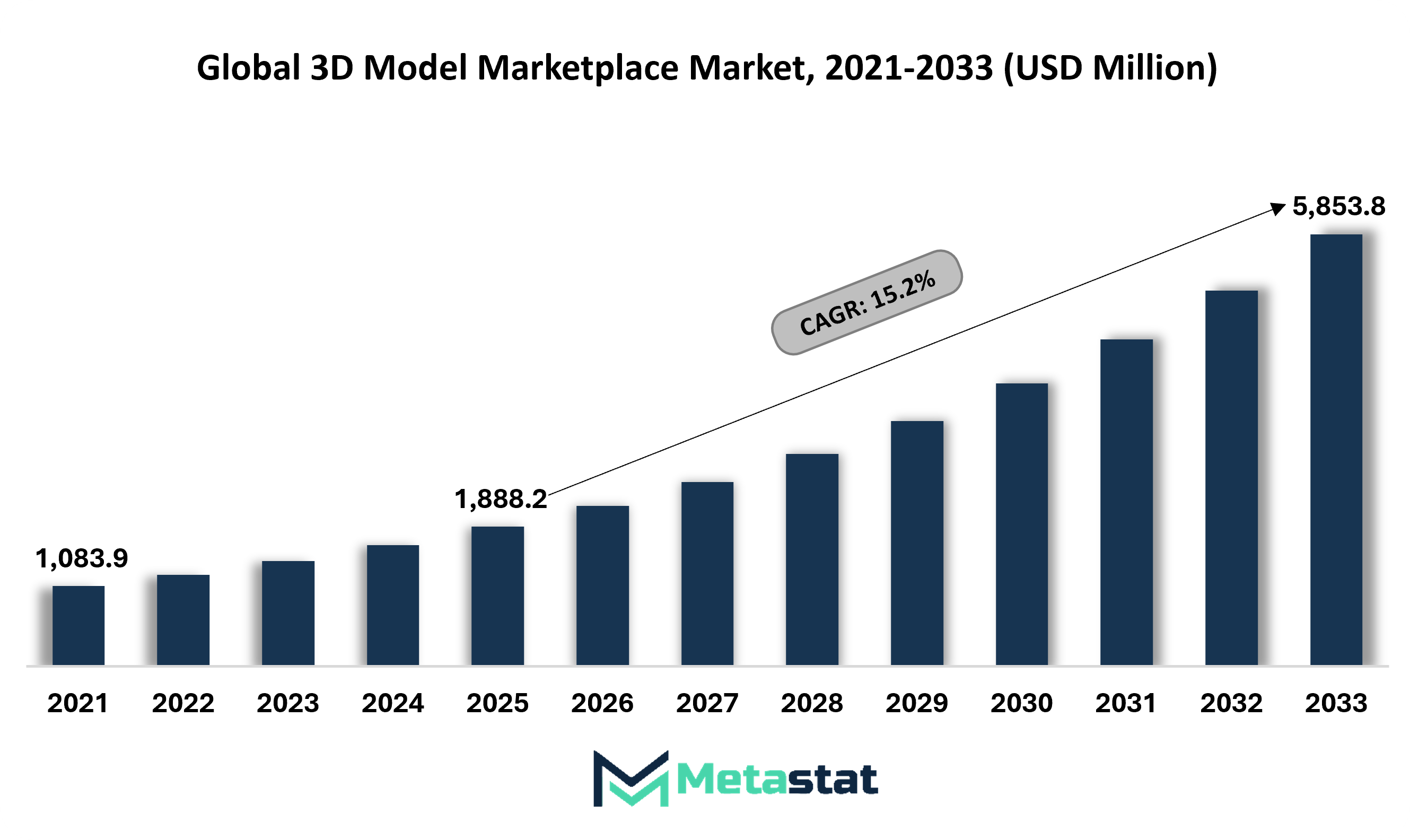
Increased adoption of real-time 3D content in gaming, AR/VR, and metaverse platforms accelerating asset demand.
Rapid growth across gaming studios, augmented reality applications, virtual reality training, and metaverse environments is creating strong demand for ready-made assets. Faster production cycles, lower development costs, and frequent content updates are encouraging marketplace expansion. Future commercial ecosystems will rely increasingly on scalable 3D model libraries.
Expansion of e-commerce and digital visualization driving need for high-quality 3D product models
Online retail platforms are using interactive product views to improve purchase confidence and reduce return rates. Furniture, fashion, electronics, and home décor brands are investing in accurate digital models for immersive catalog experiences. Future shopping channels will treat 3D visualization as a standard selling requirement.
Intellectual property and licensing complexities limiting seamless asset usage across platforms
Ownership disputes, uncertain usage rights, and varied licensing terms are slowing transactions across many marketplaces. Commercial buyers frequently require legal certainty before deploying assets in games, marketing campaigns, or simulations. Future growth will rely on standardized contracts, stronger verification systems, and transparent royalty management frameworks.
High dependency on skilled creators leading to inconsistent quality and pricing variability
Market supply depends heavily on skilled designers, animators, and technical artists. Skill gaps often create inconsistent quality standards, delayed deliveries, and pricing variability across categories. Future platform leaders will build creator training systems, quality benchmarks, and automated review tools to stabilize supply conditions.
Growing enterprise adoption of digital twins and immersive simulations creating demand for specialized, high-value 3D assets
Manufacturing, healthcare, automotive, construction, and logistics sectors are adopting digital twins for planning and performance analysis. Demand is rising for accurate industrial models, environment scans, and simulation-ready assets. Future revenue pools will shift toward premium enterprise libraries with sector-specific customization and support services.
The Global 3D Model Marketplace market is classified based on Type, License Type, Platform Type, and End-Users.
Generic 3D Models segment is valued at USD 397.9 million in 2026 and is projected to reach USD 787.9 million by 2033, at a CAGR of 10.3% during the forecast period.
Generic 3D Models support rapid concept development across marketing, education, retail presentations, training visuals, and simulation libraries. Expanding demand for ready-to-use assets will encourage broader catalog growth, faster project delivery, and shorter production timelines. Metadata tagging, search precision, and preview quality will shape future purchasing behavior.
Rigged 3D Models segment is valued at USD 311.4 million in 2026 and is projected to reach USD 745.2 million by 2033, at a CAGR of 13.3% during the forecast period.
Rigged 3D Models create value for character animation pipelines used in video games, films, learning modules, and branded campaigns. Future demand will rise with automation tools supporting facial controls, body mechanics, and motion compatibility. Higher interoperability across engines and software suites will enhance commercial adoption.
Animated 3D Models segment is valued at USD 294.5 million in 2026 and is projected to reach USD 753.4 million by 2033, at a CAGR of 14.4% during the forecast period.
Animated 3D Models strengthen storytelling across product launches, educational media, immersive training, and digital entertainment. Growing preference for ready-to-use motion assets will improve creator productivity. Future platforms will offer loop packs, emotion libraries, and scene-ready motion sets for faster campaign deployment.
Game-Ready 3D Models segment is valued at USD 422.5 million in 2026 and is projected to reach USD 1,314.8 million by 2033, at a CAGR of 17.6% during the forecast period.
Game-Ready 3D Models remain essential for projects requiring optimized geometry, textures, collision setup, and engine compatibility. Rising indie game development activity will increase purchasing volumes. Future marketplaces will prioritize performance scores, polygon transparency, and plug-and-play bundles that support shorter production cycles.
CAD/Engineering 3D Models segment is valued at USD 277.2 million in 2026 and is projected to reach USD 810.7 million by 2033, at a CAGR of 16.6% during the forecast period.
CAD/Engineering 3D Models serve industrial planning, prototyping, mechanical training, and technical presentations. Demand will develop with digital manufacturing and smart factory expansion. Future listings will include simulation readiness, tolerance data, editable assemblies, and material behavior inputs for stronger engineering workflows.
3D Scanned Models segment is valued at USD 162.5 million in 2026 and is projected to reach USD 490.5 million by 2033, at a CAGR of 17.1% during the forecast period.
3D Scanned Models provide realistic surfaces for heritage archives, retail visualization, medical learning, and virtual environments. Better scanning hardware will increase asset supply worldwide. Future growth will rely on texture fidelity, cleanup automation, licensing clarity, and rapid cloud delivery systems.
AR/VR Optimized 3D Models segment is valued at USD 204.0 million in 2026 and is projected to reach USD 673.2 million by 2033, at a CAGR of 18.6% during the forecast period.
AR/VR Optimized 3D Models support immersive commerce, guided maintenance, digital tourism, and interactive training. Lightweight files and responsive rendering will remain important. Future marketplaces will reward headset compatibility, spatial interaction support, and latency-efficient packaging suitable for expanding immersive ecosystems.
Customizable/Parametric 3D Models segment is valued at USD 103.2 million in 2026 and is projected to reach USD 278.1 million by 2033, at a CAGR of 15.2% during the forecast period.
Customizable/Parametric 3D Models enable adjustable dimensions, materials, colors, and functional features for rapid personalization. Adoption will rise across furniture, engineering, retail, and architecture sectors. Future growth will center on browser configurators, instant pricing engines, and automated production handoff tools.
Royalty-Free License segment is projected to reach USD 2,595.2 million by 2033, at a CAGR of 18.8% during the forecast period.
Royalty-Free License options attract creators and buyers seeking predictable costs and repeated usage rights across multiple projects. Wider startup participation will support continued adoption. Future contracts will include clearer territory terms, AI training clauses, and simplified compliance dashboards for efficient asset management.
Editorial License segment is projected to reach USD 490.5 million by 2033, at a CAGR of 12.5% during the forecast period.
Editorial License formats serve news media, documentaries, historical content, and commentary projects requiring restricted commercial usage. Rising digital publishing volumes will sustain demand. Future progress will involve stronger rights verification, archive sourcing tools, and automated usage alerts that reduce legal uncertainty.
Commercial License segment is projected to reach USD 798.5 million by 2033, at a CAGR of 6% during the forecast period.
Commercial License models remain critical for campaigns, product sales visuals, brand media, and monetized experiences. Rising enterprise digitization will expand transaction volumes. Future licensing models will bundle indemnity coverage, team seats, and location-based flexibility to support enterprise procurement standards.
Exclusive License segment is projected to reach USD 314.2 million by 2033, at a CAGR of 13% during the forecast period.
Exclusive License offerings appeal to premium buyers seeking differentiation, scarcity, and ownership confidence for signature campaigns or flagship products. Limited supply supports stronger pricing. Future demand will develop through verified removal systems, resale prevention controls, and authenticity certificates that strengthen buyer trust.
Extended License segment is projected to reach USD 662.6 million by 2033, at a CAGR of 17.4% during the forecast period.
Extended License plans address requirements related to mass distribution, merchandise, templates, and wider audience reach. Expanding creator economies will support adoption. Future contracts will use usage tiers, automated upgrades, and spend tracking tools that improve purchasing convenience for scaling enterprises.
Subscription-Based Access segment is projected to reach USD 992.8 million by 2033, at a CAGR of 18.3% during the forecast period.
Subscription-Based Access models encourage recurring revenue for platforms while offering predictable budgets for buyers. Growing freelancer communities will prefer unlimited or credit-based plans. Future success will depend on catalog freshness, usage analytics, and flexible seat management across distributed teams.
Open Marketplace Platforms segment is projected to reach USD 2,780.5 million by 2033.
Open Marketplace Platforms encourage wide seller participation, broad price ranges, and diverse asset categories. Rapid catalog expansion will attract budget-conscious buyers. Future leadership will depend on trust systems, review integrity, fraud control, and smarter recommendation engines that improve discovery quality.
Curated Marketplace Platforms segment is projected to reach USD 1,389.1 million by 2033.
Curated Marketplace Platforms focus on quality screening, style consistency, and reliable technical standards. Premium studios often prefer managed sourcing environments. Future growth will rise from expert vetting, managed collections, and concierge support that delivers stronger confidence for complex production needs.
Enterprise Asset Platforms segment is projected to reach USD 722.4 million by 2033.
Enterprise Asset Platforms address governance, security, version control, and team collaboration needs across large enterprises. Expanding digital transformation programs will increase adoption. Future services will integrate procurement systems, approval workflows, analytics dashboards, and private asset libraries supporting global operations.
Niche/Vertical-Specific Platforms segment is projected to reach USD 961.8 million by 2033.
Niche/Vertical-Specific Platforms target sectors such as healthcare, automotive, architecture, education, and fashion. Specialized demand supports premium pricing and stronger relevance. Future expansion will stem from expert metadata, industry templates, compliance-ready assets, and domain-focused customer support services.
Game Developers segment is projected to grow at a CAGR of 14.7% during the forecast period.
Game Developers buy characters, props, vehicles, environments, and effects to accelerate launches. Rising mobile, console, and cloud gaming activity will sustain demand. Future buying behavior will favor engine-ready assets, modular packs, and performance-tested files that reduce development bottlenecks.
Film and Animation Studios segment is projected to grow at a CAGR of 13.4% during the forecast period.
Film and Animation Studios use digital assets for scenes, characters, motion sequences, and visual effects. Higher streaming content output will increase sourcing needs. Future platforms will provide cinematic-grade textures, render compatibility, and collaborative licensing for distributed production teams.
Architects and Interior Designers segment is projected to grow at a CAGR of 14.5% during the forecast period.
Architects and Interior Designers rely on furniture, décor, structural elements, and environment assets for presentations. Growing demand for digital walkthroughs will support market expansion. Future value will emerge from material realism, measurement accuracy, and instant rendering compatibility across design software.
Manufacturing and Product Design Companies segment is projected to grow at a CAGR of 15.9% during the forecast period.
Manufacturing and Product Design Companies use model libraries for prototyping, packaging previews, training, and concept validation. Smart manufacturing trends will increase demand. Future platforms will prioritize editable geometry, tolerance-ready components, and seamless integration with engineering software ecosystems.
E-commerce and Retail Companies segment is projected to grow at a CAGR of 18.3% during the forecast period.
E-commerce and Retail Companies adopt 3D assets for product visualization, virtual try-on, and interactive catalogs. Higher digital shopping expectations will support growth. Future demand will center on scalable conversion pipelines, photorealistic textures, and rapid omnichannel deployment tools.
Advertising and Marketing Agencies segment is projected to grow at a CAGR of 12.6% during the forecast period.
Advertising and Marketing Agencies use digital models for campaigns, motion graphics, product launches, and immersive promotions. Rising demand for rapid creative turnaround will increase purchases. Future platforms will favor trend-responsive collections, brand-safe licensing, and rapid customization features.
AR/VR Developers segment is projected to grow at a CAGR of 19.8% during the forecast period.
AR/VR Developers require optimized assets for simulations, training modules, commerce experiences, and entertainment worlds. Expanding hardware adoption will strengthen spending. Future priorities will include low-latency files, interaction-ready objects, and spatial audio compatibility across devices.
Educational Institutions segment is projected to grow at a CAGR of 13.2% during the forecast period.
Educational Institutions use 3D assets for science labs, engineering training, history exhibitions, and remote learning engagement. Digital classrooms will support ongoing demand. Future platforms will provide curriculum bundles, multilingual metadata, and affordable institutional licensing models.
Healthcare Organizations segment is projected to grow at a CAGR of 14.7% during the forecast period.
Healthcare Organizations use digital models for anatomy teaching, surgical planning, patient communication, and treatment simulations. Growing health technology funding will support adoption. Future marketplaces will focus on accuracy validation, privacy-safe workflows, and medically reviewed content libraries.
Based on geography, the 3D Model Marketplace market is divided into North America, Europe, Asia-Pacific, South America, Middle East, and Africa.
North America is witnessing strong market adoption owing to advanced gaming ecosystems, creator platforms, and enterprise visualization demand.
In North America, 3D Model Marketplace Market growth is gaining momentum from software innovation, strong payment infrastructure, and a large independent creator base.
Europe holds a significant position in the 3D Model Marketplace Market, supported by strong adoption across gaming, animation, architecture, product design, digital media, and industrial visualization.
Asia-Pacific offers significant opportunities for the 3D Model Marketplace Market through expanding game development hubs, animation outsourcing, and digital commerce growth.
Within Asia-Pacific, the 3D Model Marketplace Market benefits from rising mobile gaming demand and growing investments in immersive technology ecosystems.
Across the Middle East, Africa, and South America, the 3D Model Marketplace Market is progressing through startup growth, digital media expansion, and increasing adoption of 3D design tools in education and commerce.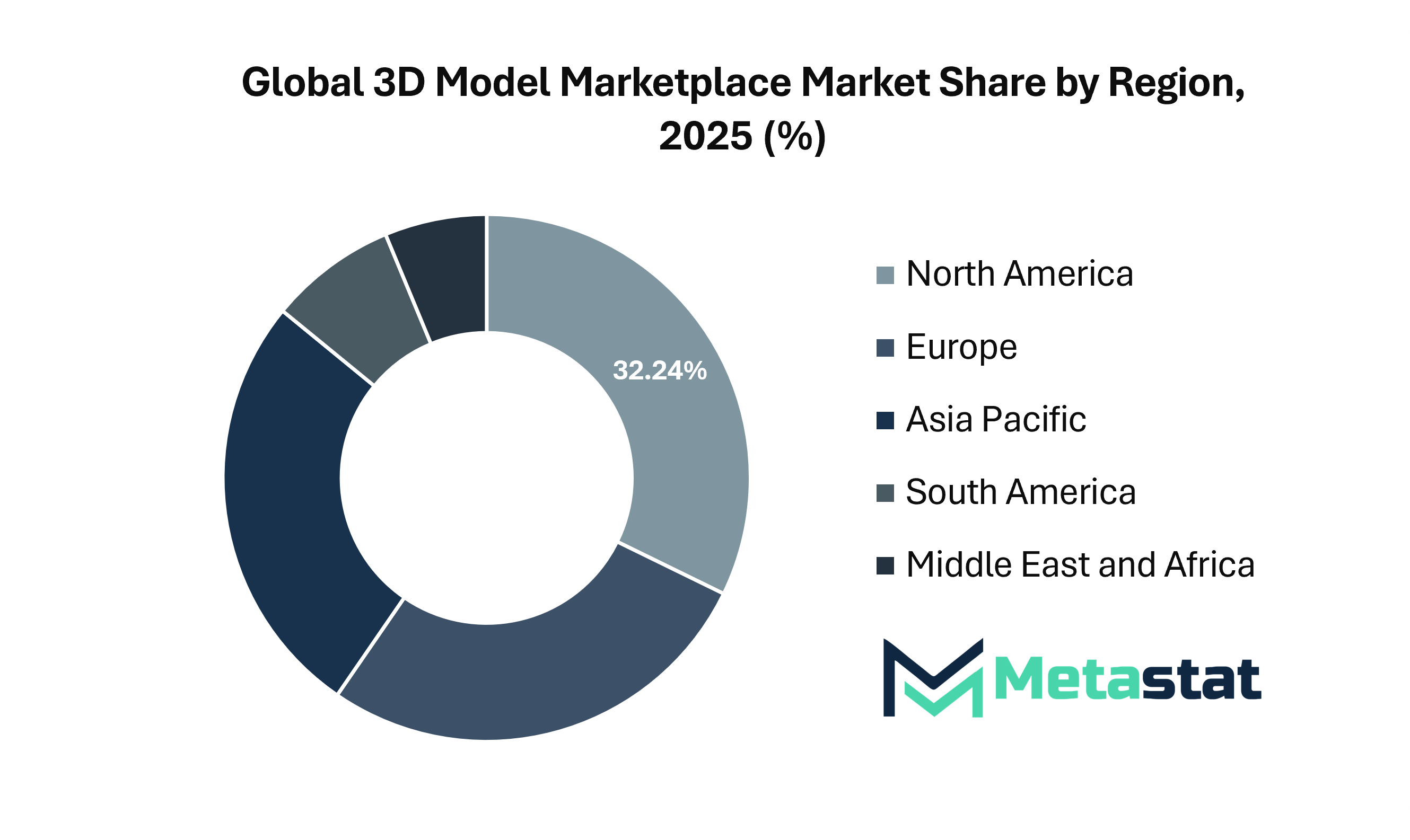
The Global 3D Model Marketplace Market has evolved into an active digital asset ecosystem where creators, designers, engineers, studios, and enterprises buy, sell, and license 3D models. Market adoption has increased as industries rely on visual content for faster planning, marketing, training, product design, and immersive media development. Gaming studios require characters and environments, architects need building visuals, and online sellers use realistic product views to improve digital product presentation. Buyers increasingly prefer ready-made 3D assets as they reduce production timelines and development costs. Sellers benefit by reaching customers across countries through digital storefronts. The market also supports freelancers who generate revenue by developing models for niche requirements. Growth in virtual reality, augmented reality, online simulations, and digital commerce has created fresh demand. Better internet access and easier payment systems have further increased participation from small creators, independent studios, and large enterprises.
Competition remains strong as users look for high-quality assets, fair pricing, flexible licensing, and files compatible with different software tools. Companies such as Unity Software Inc. and Epic Games, Inc. support large creator communities through development platforms linked to asset stores. Sketchfab, Inc. has become prominent for browser-based 3D viewing, allowing users to inspect assets before purchase. CGTrader, UAB and TurboSquid, Inc. have built strong reputations through wide catalogs serving multiple industries. Buyers frequently compare realism, file formats, licensing rules, technical compatibility, and customer support before placing orders. Reviews and ratings also shape buyer trust, making platform reputation a major factor in repeat sales.
The market is not limited to entertainment. Manufacturing, education, engineering, architecture, and product design have created new use cases for downloadable models and printable files. Prusa Research a.s., UltiMaker B.V., and Formlabs, Inc. connect digital designs with physical manufacturing. Engineering-focused companies including Trimble Inc., Dassault Systemes SolidWorks Corporation, CADENAS GmbH, and TraceParts SAS support industrial workflows where accuracy, interoperability, and technical specifications matter. Educational customers also purchase 3D models for training, classroom demonstrations, science projects, and remote learning applications. A wider user base helps keep market demand stable even when adoption slows in one sector.
Independent artist platforms continue to shape the market by offering style-focused libraries, niche collections, and direct selling options. Firms such as My Mini Factory Ltd, Cults SAS, RenderHub Inc., Gumroad, Inc., KitBash3D, LLC, DAZ 3D, Inc., and Reallusion Inc. help artists reach global buyers. Going forward, success in the Global 3D Model Marketplace Market will depend on search quality, transparent licensing, faster downloads, creator monetization, and regularly updated content libraries. Platforms that build trust between buyers and creators will maintain stronger positions over the forecast period.
Market size is forecast to rise from USD 1,888.2 million in 2025 to over USD 5,853.8 million by 2033.
The Global 3D Model Marketplace market is expected to increasingly integrate AI tagging, procedural asset generation, blockchain-backed licensing records, and real-time collaboration workflows. Platforms that combine trust, quality control, and creator monetization are expected to outperform.
This research report categorizes the 3D Model Marketplace market based on key segments and regions, forecasts revenue growth, and analyses trends in each submarket. The report analyses the key growth drivers, opportunities, and challenges influencing the 3D Model Marketplace market. Recent market developments and competitive strategies such as expansion, product launch, partnership, merger, and acquisition have been included to draw the competitive landscape in the market.
The report strategically identifies and profiles the key market players and analyses their core competencies in each sub-segment of the 3D Model Marketplace market.
|
Report Attributes |
Details |
|
Study Period |
2021-2033 |
|
Base Year |
2025 |
|
Estimated Year |
2026 |
|
Forecast Period |
2026-2033 |
|
Historical Period |
2021-2025 |
|
Growth Rate |
CAGR 15.2% from 2026 to 2033 |
|
Revenue Unit |
USD million |
|
Segmentation |
By Type, License Type, Platform Type, End-Users, and Region |
|
By Region |
North America (By Type, License Type, Platform Type, End-Users, and Country)
|
|
Europe (By Type, License Type, Platform Type, End-Users, and Country)
|
|
|
Asia Pacific (By Type, License Type, Platform Type, End-Users, and Country)
|
|
|
South America (By Type, License Type, Platform Type, End-Users, and Country)
|
|
|
Middle East and Africa (By Type, License Type, Platform Type, End-Users, and Country)
|
Find answers to common questions about this report
Top players operating in the 3D Model Marketplace industry include Unity Software Inc., Epic Games, Inc., Sketchfab, Inc., CGTrader, UAB, TurboSquid, Inc., and Prusa Research a.s., UltiMaker B.V.
Global 3D Model Marketplace market is estimated to reach USD 5,853.8 million by 2033.
Intellectual property and licensing complexities limiting seamless asset usage across platforms will hamper the market growth within the forecast period.
North America region dominates the market.
Increased adoption of real-time 3D content in gaming, AR/VR, and metaverse platforms accelerating asset demand and Expansion of e-commerce and digital visualization driving need for high-quality 3D product models are key driving factors, boosting the market.
The Generic 3D Models is the leading type segment in the Global market.
The Global 3D Model Marketplace market is expected to grow at a CAGR of 15.2% over the forecast period (2026-2033).
The Metastat Insights analysis shows that the North America 3D Model Marketplace market size is estimated to be USD 1,633.8 million by 2033.
The Metastat Insights study shows that the Global 3D Model Marketplace market size was USD 1,888.2 million in 2025.
The analysts below cover Information & Technology research at Metastat Insights.
LEAD ANALYST
Utkarsh Khirodkar is a Lead Market Research Analyst at MetaStat Insight, specializing in market intelligence, technology sector assessments, and competitive strategy.

PRINCIPAL CONSULTANT - ENTERPRISE AI & EMERGING TECHNOLOGIES
Banking & Finance · Electronics and Semiconductor · Energy and Power · Healthcare IT · Information & Technology · Professional Services
Vijay Gunti is a Principal Consultant at MetaStat Insight, bringing over two decades of experience across enterprise digital transformation, technology strategy, and intelligent systems.

LEAD CONSULTANT - COMMUNICATION, TELECOM, AND IT
Electronics and Semiconductor · Information & Technology · Machinery & Equipment · Professional Services
Ravindra Sathe Consultants for Communication, Telecom, and IT at MetaStat Insight. He leads the firm's industry research initiatives across telecommunications infrastructure, digital connectivity, enterprise networking, and emerging information technology domains.
Enterprise zero-trust network rollouts are often slowed down by multi-cloud transit latency and proprietary hardware retirement schedules. This study provided realistic total cost of ownership models comparing cloud-delivered security edge solutions against traditional hardware refreshes. The analysis of contract renewal lengths and software maintenance fees gave us clear visibility into enterprise replacement cycles over the next three to five years.
Scaling antibody-drug conjugate manufacturing hinges on contract manufacturing availability for high-potency active ingredients. The MetaStat Insight analysis looked closely at global cleanroom slot constraints, bioconjugation batch failure rates, and supply chain redundancies between the US, Europe, and India. The supplier capability matrix proved genuinely useful for our team when mapping secondary source options across our clinical pipeline.
Floating offshore wind feasibility relies heavily on specialized installation vessel availability and port crane limits, which most broad renewable energy forecasts ignore. The report delivered a thorough analysis of dry dock capacity, mooring chain supply constraints, and raw material pricing trends for deepwater anchor installations. It served as a solid independent sanity check for our offshore project capital expenditure assumptions.
Explore related market intelligence reports worth reading alongside this one.