
LEAD ANALYST
Utkarsh Khirodkar is a Lead Market Research Analyst at MetaStat Insight, specializing in market intelligence, technology sector assessments, and competitive strategy.

Global Digital Twin Market Size, Share, By Solution (Component, Process and System), By Application (Product Design & Development, Predictive Maintenance, Business Optimization and Others), By Enterprise Size (Large Enterprises, Medium Enterprises and Small Enterprises), By End Use (Agriculture, Manufacturing, Telecommunication, Aerospace & Defense, Retail & Consumer Goods, Residential & Commercial, Healthcare & Lifesciences, Energy & Utilities, Automotive & Transport and Other Industries), Industry Analysis, Growth, Trends, and Forecast, 2026-2033
Report ID
MSI-5234
Published
September, 2026
Pages
262 Pages
Format
Historical
Base year
Forecast
Forecast period
Report Details
Market Valuation: Valued at $36.1 Billion in 2025, projected to reach $301.8 Billion by 2033 at a 30.4% CAGR.
Dominant Segment: The Component segment leads the market, projected to grow from USD 14.7 billion in 2026 to USD 84.5 billion by 2033, driven by the increasing demand for advanced technologies and integration into existing systems.
Geographic Lead: Asia-Pacific is expected to experience the fastest growth, fueled by significant investments in smart city initiatives and advanced manufacturing practices, enhancing the adoption of digital twin applications.
What's Inside: This report provides a comprehensive analysis of the competitive landscape, market segmentation by solution, application, enterprise size, and end use, along with detailed forecasts from 2026 to 2033.
Emerging Opportunities: The urgency for digital transformation across sectors creates substantial opportunities for digital twin solutions, particularly in enhancing operational efficiency and real-time monitoring capabilities.
Choose Your License
Global Digital Twin Market
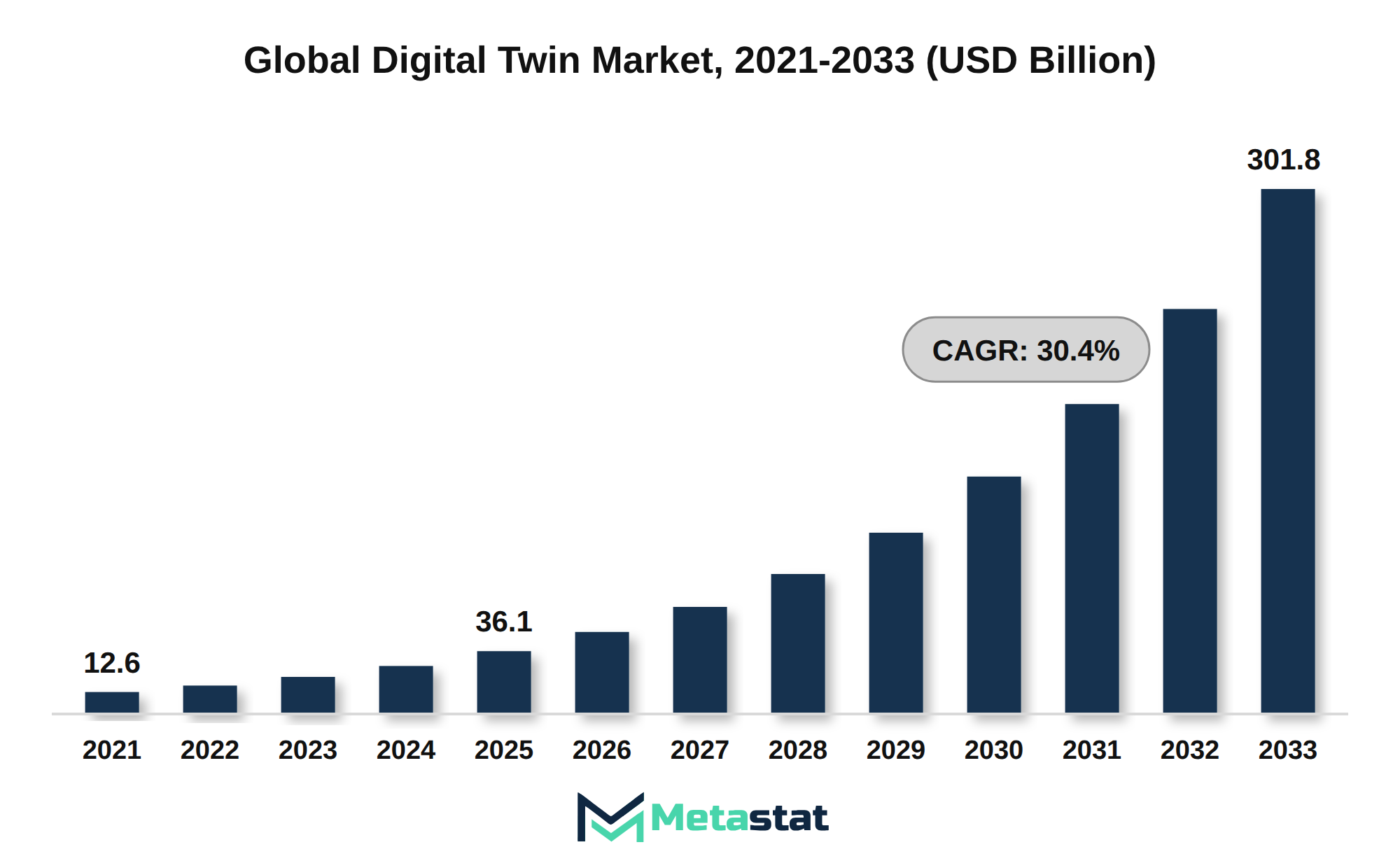
The global Digital Twin market was valued at USD 36.1 billion in 2025 and is projected to reach USD 301.8 billion by 2033, growing at a CAGR of 30.4% over the forecast period.
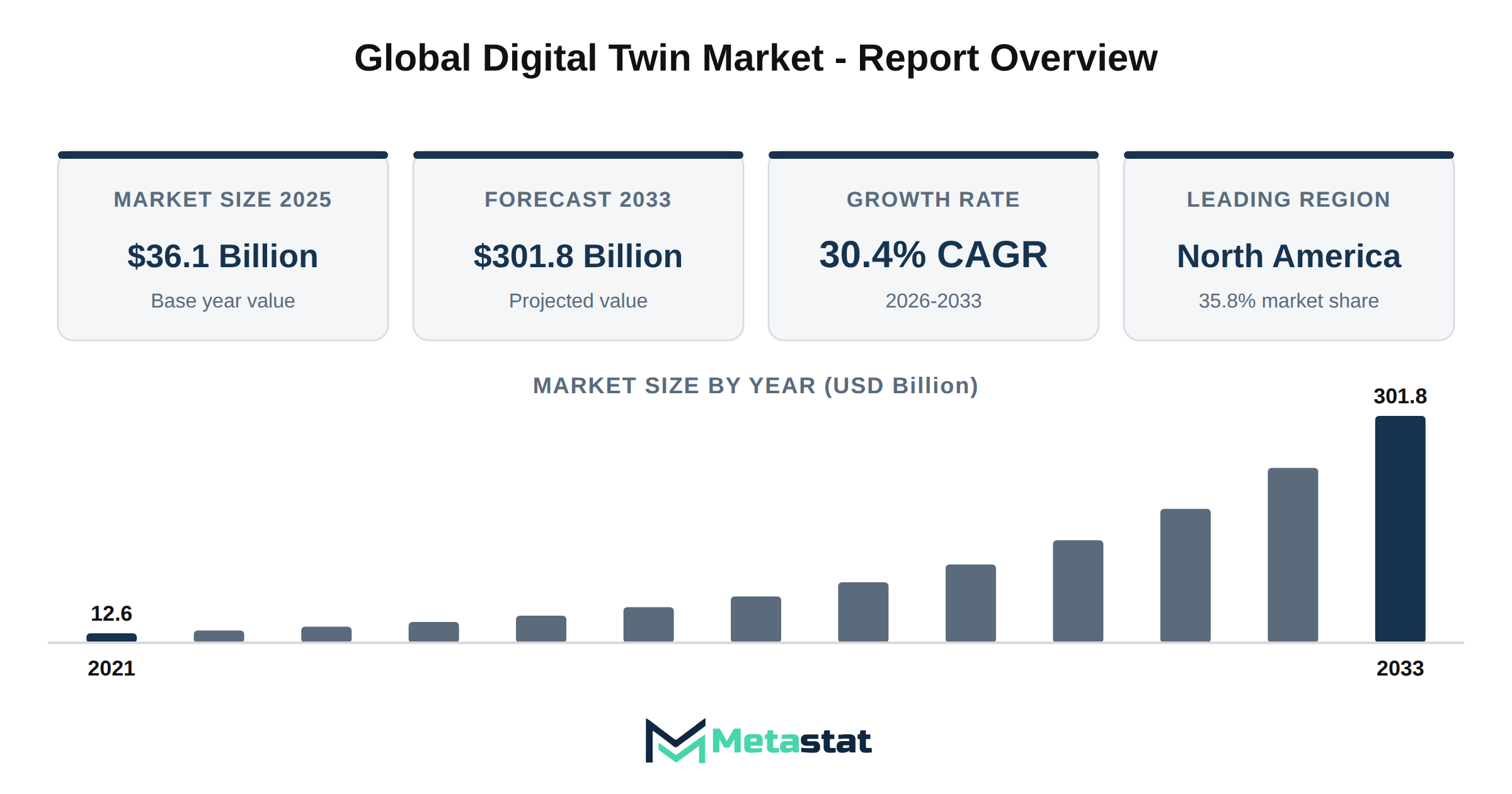
The Digital Twin market reached a valuation of USD 36.1 billion in 2025, demonstrating significant growth from USD 12.6 billion in 2021. Projections indicate robust expansion, with an anticipated market value of USD 301.8 billion by 2033, reflecting a compound annual growth rate (CAGR) of 30.4% during the forecast period from 2026 to 2033. This growth trajectory highlights the increasing adoption of digital twin technologies across various sectors.
Enterprise adoption trends show a marked transition toward cognitive digital twins, driven by advancements in artificial intelligence and data analytics. This shift enhances operational efficiencies and informs strategic decision-making, particularly in manufacturing and industrial settings. Consequently, organizations embracing this technology position themselves to capitalize on the benefits of real-time data utilization and predictive insights.
Key drivers accelerating digital twin deployment include the push for smart manufacturing and the broader Industry 4.0 movement. Industries increasingly recognize the value of integrating digital twin solutions to optimize processes, improve product quality, and reduce operational costs. Such implementations lead to enhanced productivity and competitiveness in the market.
Cross-sector demand dynamics reveal strong interest in digital twin applications from healthcare, automotive, and aerospace engineering industries. Each sector seeks to leverage digital twin technology to enhance product development, streamline operations, and improve maintenance strategies. This growing demand illustrates the versatility and applicability of digital twins across various fields.
Technological convergence enhances the market, with the integration of generative AI, IoT sensor fabrics, and edge computing improving the capabilities of digital twins. These advancements facilitate more accurate simulations and real-time monitoring, enabling organizations to derive insights and enhance their operational strategies.
Cloud architecture versus on-premises simulation platforms in digital twin infrastructure remains a critical consideration for enterprises. Organizations evaluate the benefits of cloud-based solutions, including scalability and ease of access, against the control and security offered by on-premises systems. This decision impacts deployment strategies and operational efficiencies.
The digital twin market is projected to exhibit substantial growth, driven by various factors influencing enterprise adoption and technological advancements. The transition toward cognitive digital twins enhances operational efficiencies and decision-making capabilities across multiple industries. This advancement reflects a broader trend in smart manufacturing and Industry 4.0, where organizations increasingly integrate digital twin technologies to optimize processes and improve system performance.
Demand dynamics across sectors including healthcare, automotive, and aerospace engineering show a significant appetite for digital twin solutions. In healthcare, digital twins facilitate personalized medicine and predictive analytics, while in automotive and aerospace, they support design validation and real-time performance monitoring. These applications highlight the versatility and value of digital twin technologies in enhancing product lifecycles and operational resilience.
Technological convergence remains a significant force in the digital twin landscape. The integration of generative AI, IoT sensor fabrics, and edge computing enhances data capture and analysis capabilities, enabling real-time insights and greater automation. This convergence encourages innovative applications and expands the market's potential, positioning digital twins because essential tools for organizations seeking to gain competitive advantages.
Infrastructure considerations, including cloud architecture versus on-premises simulation platforms, impact deployment strategies for digital twin technologies. Organizations increasingly favor cloud-based solutions for their scalability and accessibility, aligning with the trend towards remote operations and collaborative environments. This shift reflects a broader movement towards digital transformation across industries.
Investment activity within the market shows a surge in venture capital funding, driven by interest from big tech companies and strategic M&A transactions. These investments facilitate the development of advanced solutions and enhance the competitive landscape. The influx of capital accelerates innovation and supports the entrance of niche simulation providers and platform integrators, enriching the ecosystem.
Interoperability standards, cybersecurity frameworks, and data governance mandates play crucial roles in shaping the market's trajectory. Organizations increasingly prioritize security and compliance, ensuring the integrity of data within digital twin applications. This focus strengthens stakeholder trust and encourages broader adoption across various sectors.
Competitive dynamics involve established enterprise software giants and emerging players focusing on niche simulation solutions. This competition drives innovation and prompts market participants to enhance their offerings continuously. Supply chain optimization and predictive maintenance through virtual asset modeling deliver significant ROI, reinforcing the value proposition of digital twins in operational settings.
Regional market opportunities highlight North America's industrial dominance in the digital twin space, while Asia-Pacific emerges because a significant player, particularly in smart city initiatives. The contrasting scales of development in these regions create diverse growth prospects, allowing organizations to tailor their strategies according to local market conditions.
Future outlooks indicate a trend towards autonomous digital twins and integration within the metaverse, facilitating system-of-systems evolution. Organizations are set to leverage these advancements to enhance efficiency and collaboration across operations. This evolution signifies a notable phase for the digital twin market, driven by innovation and the pursuit of sustainability.
Adoption of digital twins accelerates due to ongoing digital transformation across multiple industries. Enterprises pursue innovative solutions to enhance operational efficiency and improve decision-making. The transition towards automation and artificial intelligence enhances the functionality of digital twin technologies, leading to increased investment in these solutions.
Industries including manufacturing, healthcare, and telecommunications are driving demand for the digital twin market. This demand stems from the need for real-time insights and predictive analytics, which digital twins provide by integrating data from various sources and systems. The ability of these technologies to simulate real-world scenarios allows organizations to optimize resources and reduce operational costs.
Investment in digital infrastructure further supports the growth trajectory of the market, because companies allocate capital towards modernizing their operations. The focus on enhancing productivity and achieving cost-efficiency initiatives enables businesses to extract maximum value from their investments in digital twin solutions. Consequently, the market is set to experience significant expansion because more organizations recognize the potential of these technologies.
Growing capital investment environments significantly influence the Digital Twin market. Investment in digital technologies enhances operational efficiency and promotes innovation across industries. Higher venture funding enables organizations to explore advanced applications of digital twins, facilitating their integration into existing processes.
Economic expansion and rising GDP encourage businesses to allocate resources towards technological advancements. Companies investing in automation and artificial intelligence leverage digital twins to optimize operations and reduce costs. This trend influences various sectors, including manufacturing and telecommunication, where increased productivity demands innovative solutions.
Emerging demographic patterns and evolving consumer behaviors create further impetus for digital twin technology. Organizations adapt to shifting market preferences by integrating digital solutions that enhance customer engagement and service delivery. The Digital Twin market benefits from this alignment, driven by companies striving to meet the expectations of a changing consumer landscape.
The relationship between capital investment and technological integration positions the Digital Twin market for sustained growth. This dynamic drives demand for innovative solutions, ultimately leading to improved operational productivity and efficiency.
Challenges in regulatory compliance and market fragmentation restrict growth within the Digital Twin market. Regulatory requirements surrounding data handling and security create significant hurdles for organizations attempting to implement these technologies effectively. The complexity of navigating diverse regulations across various regions leads to increased costs and delays in deployment, deterring potential adopters.
Market fragmentation introduces competition among numerous suppliers, complicating purchasing decisions for enterprises. Organizations face difficulties in selecting the right solutions from a crowded marketplace, which slows the adoption of digital twin technologies. The presence of alternative offerings and substitutes creates further challenges, because businesses weigh their options, often resulting in hesitation to commit to new technologies.
Macroeconomic headwinds, including inflationary pressures and supply chain disruptions, exacerbate these issues, increasing operational costs for businesses. Resource scarcity further limits available options for companies looking to integrate digital twins into their operations, leading to delays in project timelines. Consequently, these factors contribute to slower growth within the Digital Twin market.
Geopolitical fragmentation poses significant challenges to the Digital Twin market, impacting the ability to source critical components and materials. Trade deficits and tariff friction create additional costs that undermine profitability for firms operating within the market. Rising input cost structures strain margins and hinder investments in advanced technologies. Logistics disruptions contribute to uncertainty in project timelines and affect overall market growth.
Technological disruptions, including the rapid pace of innovation, require continuous adaptation and integration of new systems. This necessity leads to complex research and development integrations that delay product rollouts. Interoperability friction among different platforms complicates the adoption of digital twins and limits their effectiveness across various industries. The increasing demand for sustainability drives organizations to address environmental lifecycle footprints, adding another layer of complexity to implementation.
Workforce skill gaps present a barrier to successful adoption. Organizations struggle to find talent equipped to operate and manage digital twin technologies. Talent retention pressures exacerbate this issue, leading to increased costs associated with hiring and training. Evolving legal liabilities and tightening global regulatory standards require firms to navigate compliance overhead, diverting resources from innovation and market expansion.
In this competitive landscape, pricing compression and market saturation challenge existing players while creating opportunities for new entrants. Substitution pressures from alternative technologies divert attention and investment away from digital twins and further complicate market dynamics. Addressing these multifaceted challenges is crucial for stakeholders aiming to leverage the full potential of the Digital Twin market, ensuring long-term growth and resilience.
The Digital Twin market experiences substantial opportunities driven by technological disruptions and the urgency for digital transformation across various sectors. Industries increasingly seek to optimize their operations, which drives demand for sophisticated digital twin solutions that enable real-time monitoring and predictive analytics. The rapid adoption of advanced technologies significantly enhances productivity and operational efficiency, ultimately influencing overall market growth.
Geographical expansion emerges because a critical factor, particularly in regions including Asia Pacific, where infrastructure modernization accelerates adoption rates. Nations invest heavily in smart city initiatives and advanced manufacturing practices, creating a robust environment for digital twin applications. This regional demand reflects a broader trend towards sustainable development and innovation, aligning with global efforts to address environmental challenges.
Sustainability imperatives shape the market landscape. Organizations increasingly focus on green transformations and ESG-driven alignments, compelling them to integrate digital twin technologies into their operational frameworks. This integration supports asset life-cycle extensions and maintenance upgradations, which enhance resource efficiency and minimize waste. Consequently, the market sees heightened activity in product integration and niche application growth, expanding the potential customer base.
Strategic consolidation through cross-industry mergers and acquisitions further influences market dynamics. Companies recognize the diversify their portfolios and enhance their offerings in response to evolving buying behaviors and digital procurement shifts. This consolidation streamlines operations and creates significant competitive advantages, positioning firms to capitalize on emerging trends within the Digital Twin market.
Value-chain optimization, process automation, and operational yield maximization are critical focal points for market participants. By leveraging digital twin technologies, organizations achieve greater efficiency and reduce operational costs. These advancements not only contribute to improved profitability but strengthen the market's competitive landscape because firms innovate and adapt to changing consumer demands.
The Global Digital Twin market is segmented based on Solution, Application, Enterprise Size, and End Use.
Valued at USD 14.7 billion in 2026, the Component segment is projected to reach USD 84.5 billion by 2033, reflecting a CAGR of 28.4% during the forecast period. The increasing demand for advanced technologies drives the adoption of digital twin solutions across various industries. Integration of digital twins into existing systems enhances operational efficiency and enables real-time monitoring, which significantly improves decision-making processes. Technological maturation is important, with advancements in IoT, AI, and machine learning contributing to the evolution of this segment.
Next-gen upgrades facilitate the integration of digital twin technologies, allowing businesses to optimize their product design and development processes. This trend aligns with ongoing shifts in consumption patterns toward more data-driven decision-making frameworks. End-use dynamics demonstrate significant adoption in manufacturing, where the need for predictive maintenance and process optimization is critical. Regulatory compliance standards further support investment in digital twin technologies, ensuring enhanced safety and efficiency across different sectors.
Supply chain resilience is a critical factor for the growth of the Component segment, driven by companies seeking to mitigate risks associated with disruptions. Raw material sourcing challenges and logistics vulnerabilities prompt organizations to incorporate digital twins into their supply chains, enhancing visibility and responsiveness. The strategic opportunity windows presented by technological obsolescence necessitate ongoing investment, driving innovation and competitive advantage within the digital twin market.
Significant growth in the Process segment of the Digital Twin market is driven by advancements in automation and data analytics. Companies increasingly adopt digital twin technology to enhance operational efficiency, reduce downtime, and streamline production processes. The ability to simulate real-time processes allows organizations to make informed decisions, ultimately leading to cost savings and improved productivity across various sectors.
Investment in next-generation technologies, including artificial intelligence and machine learning, fuels the expansion of the Process segment. These technologies facilitate predictive analytics, enabling organizations to identify potential issues before they escalate, thus enhancing reliability and operational resilience. Industries including manufacturing and telecommunications actively leverage digital twin solutions to optimize resource allocation and enhance quality control measures.
The Process segment is estimated to reach USD 93.6 billion by 2033, at a CAGR of 30.8% during the forecast period. This growth reflects increasing demand for real-time monitoring and predictive maintenance capabilities within manufacturing processes. The integration of digital twin solutions with existing enterprise systems supports efficient data flow, enhancing operational visibility and decision-making across production lines.
Regulatory compliance standards and the push for sustainable practices significantly influence the adoption of digital twin technologies. Organizations pursue compliance with environmental regulations by applying digital twins to simulate and analyze the impact of various operational changes on emissions and sustainability goals. Consequently, this trend drives market growth because firms seek solutions that align with regulatory requirements.
Strategic investments in the Process segment highlight the importance of digital twin technologies for maintaining competitive advantages. While industries continue to experience disruptions, organizations increasingly recognize the value of these technologies for improving supply chain resilience and managing operational uncertainties. The ongoing evolution of product development processes, coupled with a focus on minimizing costs, positions the Process segment for strong growth in the Digital Twin market.
The growth trajectory of the System segment in the Digital Twin market emphasizes its increasing relevance in various industries. Anticipated to reach USD 123.7 billion by 2033, this segment experiences significant demand driven by advancements in automation and operational efficiency. Industries including manufacturing, aerospace, and telecommunication are prominent adopters, leveraging digital twins to optimize processes and enhance product lifecycle management.
Technological maturation plays a critical role, driven by next-generation upgrades in AI and IoT that create integration opportunities for existing systems. Enhanced predictive maintenance capabilities improve operational resilience, particularly in manufacturing, where unplanned downtime incurs substantial costs. By implementing digital twins, businesses streamline operations, significantly reducing maintenance expenses and improving overall asset performance.
End-use dynamics reflect a shift toward more sophisticated applications, with companies increasingly focusing on product design and development. This trend highlights the necessity for advanced simulation and modeling, allowing firms to innovate rapidly while minimizing costs. Regulatory compliance standards further drive the adoption of digital twins, ensuring that organizations maintain safety and performance benchmarks across sectors.
Strategic opportunity windows arise from the increasing interest in sustainability and energy efficiency. Firms that apply digital twin technology achieve substantial benefits in resource optimization, aligning with global sustainability goals. The integration of regulations and standards into operational frameworks enhances competitive positioning, enabling firms to respond effectively to market demands.
Valued at USD 14.8 billion in 2026, the Product Design & Development segment is projected to reach USD 87.5 billion by 2033, at a CAGR of 28.9% during the forecast period. Primary demand drivers include the increasing focus on innovation and efficiency in product development processes. Companies across various industries seek competitive advantages through rapid prototyping and design iteration, employing digital twins to enhance collaboration and reduce time-to-market.
Technological maturation significantly influences adoption rates within this segment. Advancements in artificial intelligence, machine learning, and simulation technologies facilitate the integration of digital twin solutions into existing workflows. These upgrades enable organizations to visualize complex product designs and optimize performance prior to physical production, thereby enhancing overall product quality and alignment with customer needs. This integration supports increased efficiency and effectiveness in product development.
End-use dynamics demonstrate a shift towards more data-driven approaches in product design and development. Organizations leverage data analytics to inform design choices, leading to greater customization and personalization of products. This trend aligns with consumer demand for tailored solutions, prompting businesses to adopt digital twins for enhanced customer engagement.
Regulatory compliance standards and certifications related to product safety and performance shape segment growth. Companies operating in highly regulated industries, including aerospace and automotive, employ digital twins to ensure adherence to stringent guidelines while optimizing design processes. This compliance-driven approach supports the market's expansion by mitigating risks associated with product failures and recalls.
Capital investment outlook remains robust, with enterprises allocating substantial resources to digital transformation initiatives. Organizations recognize the strategic opportunity created by implementing digital twins, enhancing their operational efficiency and innovation capabilities. The continuous evolution of digital twin technology positions businesses to capitalize on emerging market trends and maintain competitive advantages within the Digital Twin market, driving further growth and adoption.
Significant growth in the Predictive Maintenance segment highlights a shift towards proactive maintenance strategies across various industries. This segment is estimated to reach USD 101.1 billion by 2033, at a CAGR of 32% during the forecast period. Several factors drive this expansion, including the increasing need for operational efficiency and the desire to minimize downtime. Industries including manufacturing and telecommunications increasingly adopt predictive maintenance solutions to enhance equipment reliability and reduce repair costs.
Technological maturation supports segment growth, with advancements in IoT and data analytics enabling more accurate predictions of equipment failures. The evolution of these technologies enhances robust data collection and processing capabilities, which support real-time monitoring and maintenance scheduling. Regulatory compliance standards in various sectors further encourage investments in predictive maintenance, driven by companies seeking to adhere to safety and operational regulations.
End-use dynamics significantly influence demand, with sectors including manufacturing and aerospace prioritizing predictive maintenance to enhance asset performance. Consumption shifts toward more data-driven decision-making processes further encourage the adoption of these solutions. The strategic opportunity window for predictive maintenance remains broad, supported by ongoing investments in digital transformation initiatives across industries. Overall, the combination of these factors positions the segment for substantial growth within the broader Digital Twin market.
Rapid advancements in technology drive significant demand for the Business Optimization segment within the Digital Twin market. Organizations increasingly adopt digital twin solutions to enhance operational efficiency, minimize costs, and improve decision-making processes. The ongoing emphasis on data-driven strategies and real-time analytics supports this growth, enabling enterprises to optimize resources effectively.
Market expectations indicate that this segment is projected to reach USD 77 billion by 2033. Companies across various industries recognize the value of integrating digital twin technology into their operations. This integration leads to streamlined processes and enhanced performance metrics, which appeal to stakeholders focused on productivity gains.
Growing competition among enterprises accelerates the need for effective business optimization strategies. Organizations actively seek innovative solutions to differentiate themselves in crowded markets. The utilization of digital twins facilitates predictive analytics, allowing companies to anticipate trends and respond proactively to market changes.
Increased investment in digital transformation initiatives strengthens the market's growth potential. Organizations prioritize the implementation of advanced technologies, with digital twins playing a critical role in reshaping business models. This trend reflects a broader shift toward embracing Industry 4.0 principles, where interconnected systems enable agile decision-making.
While the market evolves, challenges related to cost structures and pricing volatility emerge. Companies navigate these complexities while striving for sustainable growth. Strategic investment in research and development ensures that organizations remain competitive in technological advancements, ultimately ensuring long-term success in the Business Optimization segment.
Growth in the Others segment stems from increasing interest in innovative applications of digital twins across diverse sectors. The expansion of industries adopting digital twins drives demand, with areas including smart cities, energy management, and healthcare leveraging this technology for enhanced operational efficiency and strategic decision-making. Demand drivers include the need for real-time data integration and predictive analytics, which support businesses in optimizing their processes and reducing costs.
Others segment is projected to grow at a CAGR of 29.2% during the forecast period. The evolution of product offerings further accelerates this growth, driven by vendors developing tailored solutions that cater to specific industry needs. By investing in next-gen upgrades, companies enhance their digital twin capabilities, leading to improved service delivery and customer satisfaction.
Increased collaboration among stakeholders within the digital twin ecosystem drives innovation and accelerates adoption. This collaboration, coupled with advancements in technology, facilitates the integration of digital twin solutions into existing workflows, driving further demand. The digital twin market benefits from these dynamics, with the Others segment presenting significant opportunities for growth and investment.
Valued at USD 25.4 billion in 2026, the Large Enterprises segment is projected to reach USD 150.9 billion by 2033, at a CAGR of 29% during the forecast period. The growing emphasis on operational efficiency and data-driven decision-making drives demand among large enterprises for digital twin solutions. These enterprises leverage advanced technologies to optimize their processes, enhance product development, and improve maintenance strategies, driving substantial market growth.
Technological maturation plays a significant role in expanding the market. Continuous innovations in simulation, data analytics, and machine learning enable large enterprises to create accurate digital representations of physical assets, thereby supporting predictive maintenance and operational optimization. Increased investments in next-generation upgrades enhance the competitive edge of these enterprises, promoting a trend toward integrated solutions that streamline workflows and reduce costs.
End-use dynamics indicate that sectors including manufacturing and aerospace significantly contribute to the market's expansion. These industries experience heightened efficiencies and reduced downtime through the implementation of digital twin technologies, which facilitate real-time monitoring and enhanced resource allocation. The shift towards smart manufacturing techniques directly influences demand within the Large Enterprises segment.
Pricing volatility and margin pressures impact adoption, with large enterprises focusing on cost-effective solutions that deliver measurable ROI. Strategic opportunity windows arise because companies identify areas for improvement, particularly in maintenance and operational processes. With an increasing focus on sustainability, regulatory compliance, and technological advancements, large enterprises prioritize investments in digital twin solutions, positioning themselves favorably within the competitive environment of the digital twin market.
Valued at USD 96.6 billion by 2033, the Medium Enterprises segment demonstrates a robust CAGR of 31.3% during the forecast period. Increased adoption of digital twins within medium-sized businesses stems from the necessity for enhanced operational efficiency and data-driven decision-making. Factors including limited resources and the desire to compete with larger players drive these enterprises toward innovative solutions that digital twins provide.
Technological maturation influences the expansion of the market within this segment. While digital twin technologies advance, they deliver more affordable, scalable, and user-friendly solutions. This evolution creates a conducive environment for medium enterprises to integrate digital twins into their workflows, resulting in improved product development, predictive maintenance, and overall business optimization.
Next-gen upgrades create strategic opportunity windows for medium enterprises, enabling them to leverage real-time data for better forecasting and resource allocation. This capability enhances operational visibility and drives competitive differentiation in an increasingly crowded market. Consumption shifts toward technology-driven solutions further encourage medium enterprises to adopt digital twins, aligning with broader industry trends that value agility and responsiveness.
Regulatory compliance standards influence the digital twin market, compelling medium enterprises to adopt technologies that ensure adherence to evolving regulations. By implementing digital twin solutions, these enterprises streamline processes, monitor compliance in real-time, and reduce the risk of penalties associated with non-compliance.
Cost structures and pricing volatility present challenges within the medium enterprises segment, emphasizing the need for efficient resource management. However, the long-term benefits of digital twin adoption, including reduced operational costs and enhanced productivity, outweigh initial investments, making these technologies increasingly attractive.
Overall, the Medium Enterprises segment of the Digital Twin market represents a vital area of growth, supported by demand drivers, technological advancements, and the strategic imperative to enhance operational efficiency in a competitive landscape.
Valued at USD 54.3 billion by 2033, the Small Enterprises segment experiences strong growth driven by increasing adoption of Digital Twin technologies across various sectors. Key demand drivers include the growing need for efficient operations and cost reduction, which smaller firms prioritize to maintain competitiveness in the market. These enterprises benefit significantly from scalable and flexible solutions that leverage Digital Twin capabilities, leading to enhanced product development and predictive maintenance outcomes.
Investment in next-generation upgrades remains crucial for small enterprises, owing to technological maturation that allows for the integration of advanced analytics and simulation tools. The transition towards digital transformation facilitates a deeper understanding of system performance, enabling strategic decision-making based on real-time data. This capability enhances operational resilience and promotes a proactive approach to addressing market demands.
End-use dynamics reflect an increasing shift towards sectors including manufacturing and agriculture, where Digital Twin applications drive efficiency and innovation. Regulatory compliance standards further encourage small enterprises to invest in digital solutions that support sustainable practices. The combination of favorable consumption shifts and strategic opportunity windows within this segment contributes to its anticipated growth trajectory in the Digital Twin market.
Valued at USD 2.1 billion in 2026, the Agriculture segment is projected to reach USD 16.4 billion by 2033, at a CAGR of 34.6% during the forecast period. Growing concerns regarding food security and demand for sustainable farming practices drive substantial growth in this segment. Technological advancements enable precision agriculture, enhancing crop yields and resource management. The integration of digital twin technology facilitates real-time monitoring of environmental conditions, equipment performance, and crop health, allowing farmers to optimize operations effectively.
Investment in agricultural innovation and increasing adoption of IoT devices further support market expansion. Operational efficiencies resulting from data-driven decisions lead to lower costs and improved yield forecasts. In the context of the digital twin market, regulatory support for modern agricultural practices enhances adoption rates among producers. While the market matures, heightened competition among technology providers drives innovation, offering farmers advanced tools for managing complex agricultural systems.
Manufacturing holds a critical position in the Digital Twin market, reflecting the growing integration of digital technologies within production environments. The segment is estimated to reach USD 63.4 billion by 2033, at a CAGR of 29.7% during the forecast period. Demand for digital twins is driven by the need for improved operational efficiency and the optimization of production processes, enabling manufacturers to simulate, predict, and enhance operations.
Technological maturation in automation and data analytics enhances the adoption of digital twin solutions in manufacturing. Investments in predictive maintenance and real-time monitoring facilitate lower downtime and reduced operational risks. Companies increasingly leverage digital twins to streamline processes, leading to significant cost savings and performance enhancements.
Shifts in consumption patterns within the manufacturing sector highlight the growing emphasis on sustainability and resource optimization. Regulatory compliance plays an important role, attributed to manufacturers aligning operations with environmental standards and safety regulations. The integration of digital twins supports these compliance efforts by providing comprehensive data tracking and reporting capabilities.
Strategic opportunities arise from the ability of digital twin technologies to transform traditional manufacturing models. Companies investing in next-gen upgrades position themselves favorably in the market, gaining a competitive edge through enhanced product development cycles and reduced time-to-market. The focus on resilience within supply chains and the exploration of disruptive alternatives further drive the adoption of digital twin technologies.
Demand for digital twin solutions within the telecommunication sector experiences significant growth due to the increasing need for network optimization and management. Operators actively seek advanced technologies to enhance service quality and reduce operational costs. The adoption of digital twins facilitates real-time monitoring and predictive analytics, enabling telecom companies to optimize infrastructure and improve customer satisfaction.
The telecommunication segment is projected to reach USD 23.1 billion by 2033. Factors driving this growth include rising investments in 5G networks and the necessity for improved data analytics capabilities. Telecom providers prioritize enhanced operational efficiencies and service reliability, driving demand for digital twin applications that support these objectives.
Technological maturation significantly contributes to expanding this segment, with advancements in artificial intelligence, machine learning, and Internet of Things integrating seamlessly with digital twin frameworks. These innovations enable telecom companies to simulate network performance under various conditions, optimizing resource allocation and planning for future growth.
Next-gen upgrades in network infrastructure advance the digital twin market, allowing telecom operators to adapt swiftly to changing demands and competitive pressures. The ability to visualize complex system interactions and analyze vast datasets enhances decision-making capabilities, leading to more strategic investments and improved service offerings.
Growth in the Aerospace & Defense segment of the Digital Twin market is projected to accelerate, driven by the demand for improved simulation and modeling capabilities. Defense contractors and aerospace manufacturers increasingly adopt digital twin technology to optimize operations, enhance product design, and streamline maintenance processes. The segment's expansion stems from significant investments in advanced technologies, including artificial intelligence and machine learning, which facilitate real-time monitoring and predictive analytics.
The Aerospace & Defense sector anticipates enhanced operational efficiency through the use of digital twin solutions. These technologies enable organizations to create virtual replicas of physical assets, allowing for better data analysis and decision-making. Companies focusing on next-generation upgrades drive this segment's growth by leveraging enhanced capabilities in simulation and virtual testing. Regulatory compliance standards encourage investment in digital twin technologies, ensuring that products meet stringent safety and performance criteria.
This segment is projected to grow at a CAGR of 29.6% during the forecast period. While organizations seek to gain a competitive edge through innovation, capital investment outlooks continue to strengthen. The integration of digital twins into operational frameworks supports long-term resilience in the Aerospace & Defense market, leading to improved performance and cost savings. The sector’s focus on enhancing supply chain resilience and minimizing risks associated with disruptive alternatives contributes to its growth trajectory.
Growth in the Retail & Consumer Goods segment results from increasing demand for personalized shopping experiences and efficient inventory management. Retailers apply digital twin technology to create virtual replicas of physical stores, enhancing customer engagement and improving operational efficiency. This technology supports real-time data analysis, allowing businesses to respond promptly to market trends and consumer preferences.
Technological maturation within the industry drives the adoption of digital twins, with retailers investing in advanced analytics and machine learning capabilities. These advancements facilitate improved decision-making processes and optimize supply chain management, leading to enhanced margins. The increasing complexity of consumer demands necessitates innovative solutions, positioning digital twins because a strategic asset in the Digital Twin market.
Consumption shifts towards online shopping increase the need for retailers to integrate digital solutions. By applying digital twins, companies better manage their online platforms and physical assets in tandem, ensuring consistency in branding and customer experience. Regulatory compliance standards surrounding data security and privacy further motivate retailers to adopt secure digital twin technologies.
Strategic opportunity windows arise from shifting consumer behaviors, necessitating continuous investment in next-generation upgrades. Brands focus on evolving their products and services to meet changing preferences, driving market relevance. The Retail & Consumer Goods segment's growth trajectory highlights the importance of adaptable business models in a fast-evolving environment, leading to sustained interest in digital twin applications within the market.
Adoption of digital twin solutions in the residential and commercial end-use sector reflects an increasing focus on enhancing operational efficiency and sustainability. Demand stems from rising consumer expectations for smart buildings and energy-efficient systems. Integration of IoT technologies and advanced data analytics facilitates real-time monitoring and management of facilities, driving interest in digital twins among property developers and facility managers.
Technological maturation in building automation and energy management systems supports segment expansion. Innovations in augmented reality (AR) and virtual reality (VR) enhance user experiences, leading to broader acceptance of digital twin applications in smart homes and commercial properties. These advancements enable innovative designs, optimizing space usage and resource allocation in various building types.
Regulatory compliance and environmental standards encourage the adoption of digital twin technologies, particularly regarding energy efficiency and operational transparency. The sector aligns with sustainable development goals, prompting strategic investments in smart infrastructure. Stakeholders recognize these technologies because essential for meeting evolving regulatory requirements and enhancing environmental performance.
The market for residential and commercial applications presents strategic opportunity windows for technology providers. Growing demand for smart solutions drives competition among suppliers, stimulating innovation and collaboration. Capital investment outlook remains positive, driven by expanding infrastructure projects and the increasing prevalence of connected devices in urban settings.
Increasing adoption of digital twin technologies within the Healthcare & Lifesciences sector reflects a growing focus on patient-centric solutions and operational efficiency. The rising complexity of healthcare systems drives demand for advanced simulation tools that enhance decision-making and improve patient outcomes. Stakeholders pursue these technologies to optimize resource allocation, streamline patient monitoring, and encourage innovation in treatment methodologies.
Regulatory compliance and the need for adherence to industry standards shape the landscape of the Digital Twin market in this segment. Organizations invest in digital twin solutions to manage regulatory requirements effectively, ensuring that processes align with evolving health regulations. This alignment promotes trust and enhances the credibility of healthcare providers in the eyes of patients and regulatory bodies.
Technological maturation facilitates the integration of digital twin solutions in various healthcare applications, including surgical planning and personalized medicine. Enhanced data analytics capabilities enable healthcare professionals to access real-time insights, leading to better clinical decisions. While the technology evolves, the potential for next-generation upgrades emerges, providing further opportunities for innovation in treatment options and patient care.
End-use dynamics reflect a shift toward more personalized healthcare experiences, with digital twins enabling tailored treatment plans based on individual patient data. This trend enhances patient engagement and satisfaction, encouraging loyalty to healthcare providers that prioritize innovative solutions. Ongoing investments in healthcare infrastructure and technology will further stimulate growth in the digital twin segment, positioning it because a critical component of future healthcare advancements.
While the market evolves, consumption shifts toward more integrated digital strategies, prompting healthcare organizations to adopt comprehensive digital twin frameworks. These frameworks provide an overall view of patient interactions, allowing for improved health outcomes while reducing costs. The strategic opportunity windows for investment in this segment continue to expand, driven by increasing demand for innovative healthcare solutions that leverage digital twin capabilities.
In the Energy & Utilities sector, demand for digital twin solutions stems from the need for enhanced operational efficiency and real-time monitoring capabilities. Adoption of these technologies enables companies to optimize asset performance and reduce downtime, driven by increasing pressure to meet regulatory compliance and sustainability goals. Customers within this segment focus on leveraging data analytics and predictive maintenance to improve service reliability and reduce operational risks.
Technological maturation influences the expansion of this segment, with advancements in IoT, AI, and machine learning enhancing the capabilities of digital twin solutions. The integration of these technologies enables better data integration and visualization, allowing utilities to monitor systems more effectively. This evolution results in increased investment in next-gen upgrades, driven by organizations seeking to stay competitive and compliant in a rapidly changing regulatory landscape.
End-use dynamics indicate a shift towards more sustainable practices, influencing consumption patterns within the market. Companies prioritize innovative digital twin applications to monitor energy consumption and emissions, aiding in the transition to renewable energy sources. Regulatory compliance standards compel organizations to adopt advanced technologies that facilitate real-time reporting and adherence to environmental mandates.
Investment outlook appears robust, with capital flowing into the development of digital twin technologies tailored for the Energy & Utilities sector. Strategic opportunity windows arise from the increasing demand for renewable energy solutions and smart grid technologies, creating potential for significant growth within the market. The ability to visualize complex systems and predict potential failures enhances overall resilience in supply chains and operational frameworks.
Advancements in the automotive and transport industries drive significant interest in digital twin technology. Primary demand stems from the need for enhanced vehicle performance, improved safety, and streamlined manufacturing processes. Automotive manufacturers increasingly leverage digital twin solutions to optimize design and development phases, enabling faster time-to-market while ensuring vehicle reliability.
Technological maturation supports the expansion of this segment. Continuous upgrades to software and hardware facilitate more sophisticated simulations, allowing companies to model real-world conditions more accurately. This evolving environment supports the development of next-generation vehicles equipped with advanced connectivity and autonomous capabilities.
Demand for predictive maintenance solutions within this segment illustrates a clear trend towards minimizing downtime and maximizing operational efficiency. Companies adopt digital twin technology to monitor vehicle health in real-time, addressing issues before they escalate into costly failures. This shift towards preventative maintenance aligns with broader industry goals of reducing lifecycle costs and enhancing customer satisfaction.
Regulatory compliance standards continue to shape the adoption of digital twin technologies in automotive and transport. Manufacturers adhere to increasingly stringent emissions and safety regulations, prompting investments in innovative solutions that ensure compliance while maintaining competitiveness. The market's growth reflects the urgency to integrate these technologies within compliance frameworks.
Strategic opportunity windows emerge owing to automotive companies recognizing the potential of digital twin technology to transform traditional practices. Investments in research and development support innovative applications, from virtual testing environments to advanced manufacturing processes. The digital twin market positions itself because a critical element in the future of automotive and transport, driving both efficiency and sustainability.
Growth in the Other Industries segment is driven by diverse applications of digital twin technologies across various sectors, including construction, logistics, and energy management. The increasing emphasis on efficiency, cost reduction, and sustainable practices encourages organizations to adopt these advanced solutions, facilitating improved operational performance and resource optimization. Adoption of digital twin technologies supports enterprises in monitoring assets and processes, enhancing decision-making, and forecasting outcomes more accurately.
Technological maturation is important in expanding the Digital Twin market within Other Industries. Innovations in IoT, artificial intelligence, and machine learning enable organizations to deploy sophisticated digital twin solutions, optimizing operations and increasing competitiveness. Companies recognize that these technologies provide valuable insights, driving investments into next-generation upgrades and product evolution to meet the demands of an evolving economic landscape.
Downstream applications in Other Industries reflect a shift towards integrating digital twin solutions into core business processes. Organizations leverage these tools to model scenarios, analyze data, and simulate performance, allowing for proactive adjustments and strategic planning. Regulatory compliance standards influence the market, compelling companies to adopt digital twin technologies to ensure adherence to industry regulations and enhance their operational frameworks.
Consumption shifts in this segment highlight the increasing reliance on data-driven decision-making. Businesses depend on real-time data analytics facilitated by digital twin technologies to optimize processes and reduce operational risks. Capital investment outlooks remain strong, with organizations anticipating substantial returns from investments in digital twin solutions, driving overall market growth.
Based on geography, the Global Digital Twin market is divided into North America, Europe, Asia-Pacific, South America, Middle East, and Africa.
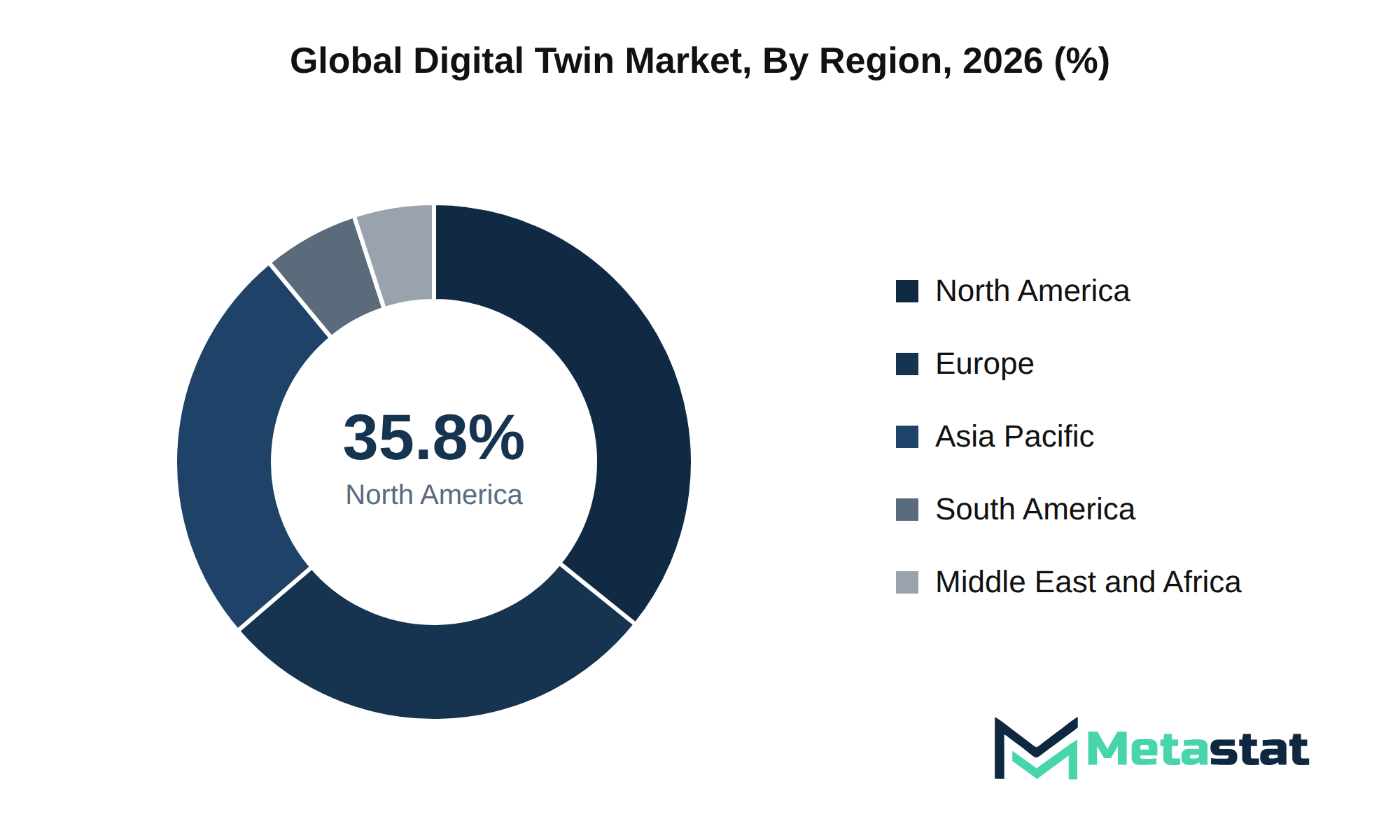
North America represents a significant portion of the Digital Twin market, with a projected market size of USD 102.6 billion by the end of 2033. The region accounts for 35.8% of the global market share in 2025, highlighting the importance of North American enterprises in driving digital twin adoption. The considerable growth rate of 30.4% CAGR during the forecast period will be fueled by various factors, including infrastructure modernization and local compliance mandates.
The United States, Canada, and Mexico serve because key countries contributing to the expansion of the market. The adoption of digital twin technologies in these nations is influenced by high-value replacement cycles and increasing investments in localized manufacturing densities. Regional demand for innovative solutions enhances competitive landscapes because domestic market leaders strive to maintain their positions.
Emerging trends in nearshoring initiatives and localized procurement dynamics further support market growth. These initiatives promote regional supply chain regionalization, enabling businesses to respond swiftly to changing market conditions and consumer demands. Consequently, the Digital Twin market in North America is expected to experience expansion fueled by these underlying factors.
Europe represents a significant portion of the global Digital Twin market, holding a 27.9% share in 2025. Countries including Germany, France, the UK, Italy, Spain, and Russia contribute to this strong position, driven by advanced manufacturing sectors and a growing emphasis on digital transformation. The robust demand for digital twin technologies stems from the region's focus on improving operational efficiencies and reducing costs across industries.
Infrastructure modernization plays a crucial role in the region's growth, with investments in smart factories and digitalization initiatives. High-value replacement cycles in machinery and equipment further stimulate demand for digital twin solutions, enabling organizations to optimize their operations. Segment expansion is particularly notable in areas like predictive maintenance and business optimization, with industries striving for enhanced productivity and reduced downtime.
In Europe, localized procurement dynamics and the presence of domestic market leaders create a competitive landscape that drives innovation. Companies including Siemens AG, Dassault Systems SE, and Hexagon AB lead the market, implementing advanced technologies that drive adoption. Regional B2B buying behaviors reflect a preference for established vendors with proven track records in delivering digital solutions.
Increasing foreign direct investment flows contribute to geographic expansion opportunities in underpenetrated territories. Geopolitical fragmentation influences trade dynamics, prompting companies to regionalize supply chains and explore nearshoring initiatives. This trend supports the Digital Twin market's growth, driven by organizations seeking solutions that align with local compliance mandates and regulatory requirements.
The Asia-Pacific region holds a significant position in the Digital Twin market, contributing 25.3% of the global market share in 2025. This region benefits from rapid industrialization and increasing adoption of advanced technologies across sectors including manufacturing, healthcare, and telecommunications. Countries including China, Japan, and India lead in digital transformation, with substantial investments in infrastructure modernization and technology upgrades.
While industries pursue operational efficiencies, the demand for digital twin solutions rises, driven by the need for predictive maintenance and enhanced product design and development capabilities. The presence of a diverse range of enterprises, from large corporations to medium-sized firms, fuels market expansion, with significant growth anticipated in the medium and small enterprise segments.
The competitive landscape within the region features established players alongside emerging firms, driving innovation and enhancing service offerings. Local procurement dynamics and cultural nuances influence purchasing decisions, necessitating tailored approaches for successful market penetration. Efforts in localized manufacturing and supply chain regionalization further strengthen the market's resilience and adaptability.
Regional resource availability, including skilled labor and technological infrastructure, supports the growth of the Digital Twin market. Continuous foreign direct investment (FDI) flows signal confidence in the region's market potential, creating favorable conditions for sustained advancements and increasing market share through strategic partnerships and collaborations.
The Digital Twin market in South America shows notable potential, with Brazil and Argentina leading the way in adoption and implementation. The region's current share of the global market stands at 6.00% in 2025, reflecting a growing interest in digital transformation across various sectors. Brazil, with a robust industrial base, focuses on leveraging digital twin technologies in manufacturing and agriculture, driving operational efficiencies and improving product lifecycle management.
Argentina follows closely, adopting digital twin solutions in its agricultural sector to enhance precision farming and optimize resource management. The market benefits from increasing investments in infrastructure modernization, creating opportunities for local enterprises to integrate advanced technologies. Emerging market front-runners, including Brazil, are expected to drive incremental growth vectors, strengthening the overall market landscape.
Localized procurement dynamics and cultural nuances significantly influence buyer behavior in the region. Companies adapt their offerings to align with regional preferences and regulatory frameworks. This strategic approach enhances market penetration and facilitates the growth of domestic market participants within the Digital Twin market, ensuring competitive advantage.
In the Middle East and Africa, the Digital Twin market reflects significant expansion potential, driven by increasing investments in infrastructure modernization and digital transformation initiatives across various sectors. Countries including Saudi Arabia and the UAE actively pursue technological advancements, enhancing their competitive positions in the global landscape. South Africa emerges because a key player, with its focus on industrial growth and innovation contributing to market development.
Regional supply chain dynamics influence the market, with localized manufacturing densities enhancing resource efficiency. Cross-border trade corridors improve connectivity within the region, facilitating access to advanced digital solutions. Geopolitical factors impact the adoption landscape, where varying regulatory frameworks shape compliance mandates and trade policy shifts.
Domestic market leaders establish strong footholds, contributing to a competitive landscape characterized by vendor consolidation trends. Local procurement dynamics differ, influenced by cultural nuances and regional B2B buying behaviors. Energy grid resiliency and local infrastructure readiness significantly enhance the region's ability to integrate digital twin technologies into existing systems.
With a projected market share of 5.0% by 2025, the region is positioned for substantial growth through 2033, aligning with global trends in the Digital Twin market. Efforts to increase foreign direct investment (FDI) encourage the geographic expansion windows, motivating international players to explore opportunities within this emerging market.
Competitive Landscape and Strategic Insights
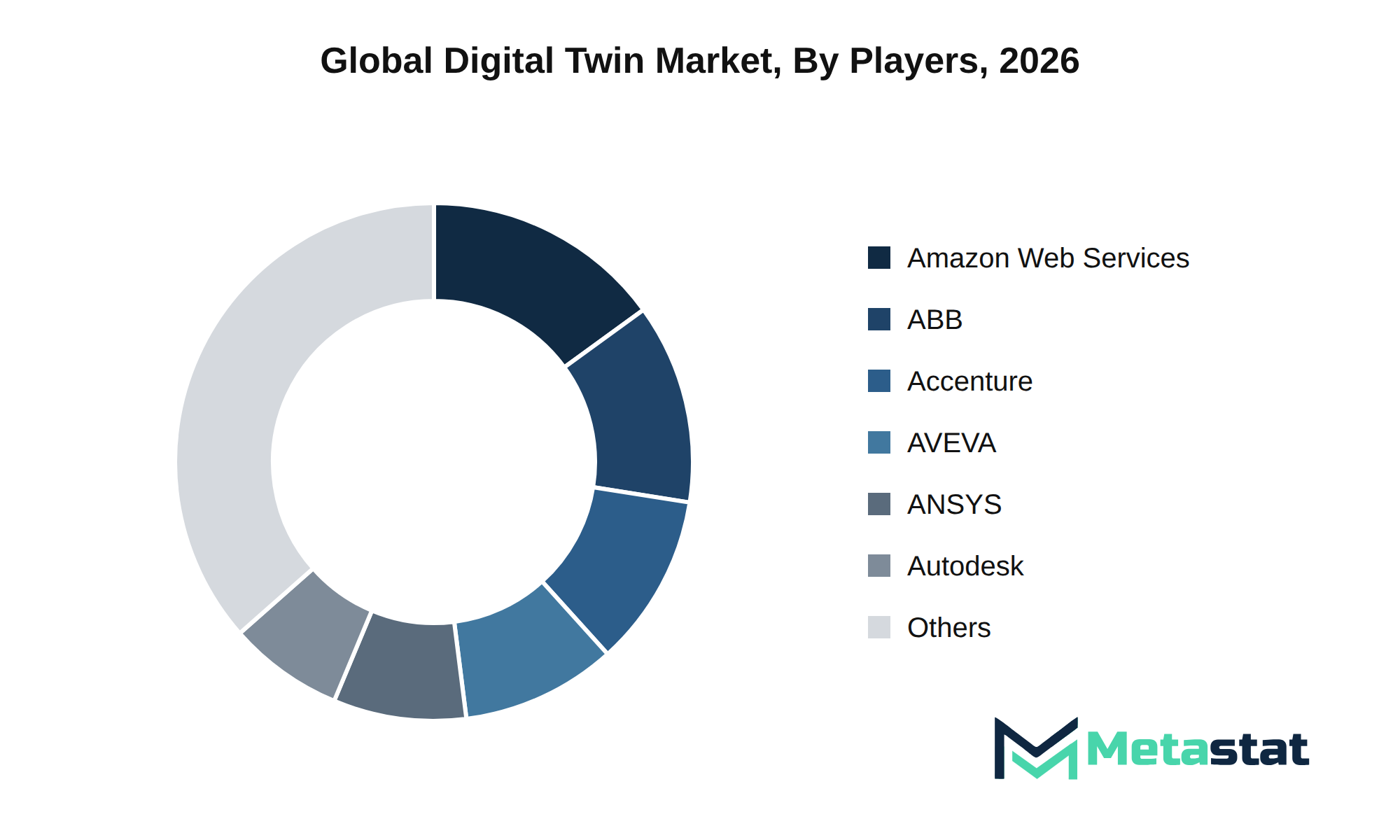
The Digital Twin market features numerous players strategically positioned across various segments, including solutions, applications, and enterprise size. Companies like ABB, Microsoft Corporation, and Siemens AG focus on product differentiation through advanced technological capabilities, while firms including Amazon Web Services and IBM Corporation emphasize their go-to-market strategies to enhance customer engagement and retention. This positioning enables companies to capture a larger share of the market and respond effectively to evolving customer needs.
Research and development pipelines drive innovation within the market. Companies including Altair and ANSYS, Inc. invest heavily in proprietary technology moats, enabling them to maintain competitive advantages. Strategic alliances, joint ventures, and cross-industry partnerships enhance collaboration and facilitate access to new markets. The competitive outlook reflects ongoing industry restructuring, with significant attention directed toward barriers to entry for new entrants, thereby shaping the growth trajectory of the digital twin ecosystem. These innovations and partnerships are critical for sustaining long-term market growth and enhancing operational efficiencies.
Market size is forecast to rise from USD 36.1 billion in 2025 to over USD 301.8 billion by 2033. The base case projects a compound annual growth rate (CAGR) of 30.4%, driven by various factors impacting the Digital Twin market.
Macroeconomic scenario planning indicates a strong alignment between economic growth and the adoption of digital twin technologies. Economic cycles influence downstream demand, with recovery phases supporting significant investment in technology integration. Core industries are maturing, prompting a shift toward advanced technologies where digital twins offer distinct operational advantages.
Next-generation technology integration plays a crucial role in shaping growth trajectories. Timelines for research and development commercialization are tightening, enabling faster deployment of digital twin solutions. Regulatory evolution and compliance milestones affect market dynamics, with policymakers emphasizing the importance of digital transformation across sectors.
Geopolitical realignments and evolving trade corridors impact global supply chains, necessitating strategic capital allocation for infrastructure commitments. Companies prioritize capital expenditure (CapEx) investments in digital solutions to enhance operational efficiency and competitiveness.
Emerging white-space opportunities arise from unmet enterprise needs, highlighting high-growth pockets within the market. Executive-level strategic imperatives focus on defensibility roadmaps that leverage digital twins to optimize performance and achieve sustainability goals. This focus on innovation and efficiency drives the Digital Twin market forward, supporting strong growth in the coming years.
The report strategically identifies and profiles the key market players and analyses their core competencies in each sub-segment of the Digital Twin market.
|
Report Attributes |
Details |
|
Study Period |
2021-2033 |
|
Base Year |
2025 |
|
Estimated Year |
2026 |
|
Forecast Period |
2026-2033 |
|
Historical Period |
2021-2025 |
|
Growth Rate |
CAGR 30.4% from 2026 to 2033 |
|
Revenue Unit |
USD billion |
|
Segmentation |
By Solution, Application, Enterprise Size, End Use, and Region |
|
By Region |
North America (By Solution, Application, Enterprise Size, End Use, and Country)
|
|
Europe (By Solution, Application, Enterprise Size, End Use, and Country)
|
|
|
Asia Pacific (By Solution, Application, Enterprise Size, End Use, and Country)
|
|
|
South America (By Solution, Application, Enterprise Size, End Use, and Country)
|
|
|
Middle East and Africa (By Solution, Application, Enterprise Size, End Use, and Country)
|
Find answers to common questions about this report
The Digital Twin market size was valued at USD 36.1 billion in 2025.
The Digital Twin market is projected to grow at a CAGR of 30.4% during the forecast period from 2026 to 2033.
The North America Digital Twin market size is estimated to reach USD 102.6 billion by 2033.
The Application segment leads the Digital Twin market, with a projected value of USD 101.1 billion in 2033 for Predictive Maintenance. This segment demonstrates the highest growth potential compared to others.
Key drivers for the Digital Twin market include ongoing digital transformation across multiple industries and the demand for real-time insights and predictive analytics. Investment in digital technologies enhances operational efficiency and encourages innovation in sectors including manufacturing, healthcare, and telecommunications, positioning the market for significant expansion.
North America holds the dominant share of the Digital Twin market, with a projected value of USD 102.6 billion in 2033, representing 35.8 percent of the total market.
Challenges in regulatory compliance and market fragmentation restrict growth within the Digital Twin market. Regulatory requirements surrounding data handling create hurdles for effective implementation, while market fragmentation complicates purchasing decisions. macroeconomic headwinds, including inflation and supply chain disruptions, increase operational costs and hinder adoption.
Ongoing digital transformation across multiple industries drives product adoption in the Digital Twin market. Enterprises seek innovative solutions to enhance operational efficiency and improve decision-making, while investment in digital infrastructure supports growth. The ability of digital twins to provide real-time insights and predictive analytics further accelerates their integration into various sectors.
The Digital Twin market is estimated to reach a valuation of USD 301.8 billion by 2033.
Key players in the Digital Twin market include ABB, Accenture plc, Amazon Web Services, ANSYS, Inc., Autodesk Inc., Microsoft Corporation, and Oracle Corporation.
The analysts below cover Machinery & Equipment research at Metastat Insights.
LEAD ANALYST
Utkarsh Khirodkar is a Lead Market Research Analyst at MetaStat Insight, specializing in market intelligence, technology sector assessments, and competitive strategy.

INDUSTRY CONSULTANT - CHEMICALS & ADVANCED MATERIALS
Chemicals and Materials · Machinery & Equipment · Packaging
Amit Gadhekar Consultant for Chemicals and Materials at MetaStat Insight, directing sector-specific intelligence, research, and strategic consulting across global chemical and processing markets.

PRINCIPAL CONSULTANT - QUALITY SYSTEMS & COMPLIANCE
Electronics and Semiconductor · Machinery & Equipment · Professional Services
Omkar Phadtare is an Industry Consultant at MetaStat Insight, specializing in quality systems, regulatory compliance, and standards benchmarking to drive data-driven market intelligence and strategic industry research.

ENERGY & INFRASTRUCTURE INDUSTRY CONSULTANT
Automotive and Transportation · Electronics and Semiconductor · Energy and Power · Machinery & Equipment
Saurabh Vasant Ganvir consults for Energy & Infrastructure Industry at MetaStat Insight, specializing in renewable energy, solar EPC, and electric vehicle (EV) infrastructure markets.

LEAD CONSULTANT - COMMUNICATION, TELECOM, AND IT
Electronics and Semiconductor · Information & Technology · Machinery & Equipment · Professional Services
Ravindra Sathe Consultants for Communication, Telecom, and IT at MetaStat Insight. He leads the firm's industry research initiatives across telecommunications infrastructure, digital connectivity, enterprise networking, and emerging information technology domains.
Transitioning ultra-class mining haul trucks to alternative power requires concrete data on remote hydrogen refueling infrastructure economics. The report evaluated megawatt-scale electrolyzer installation expenses, onsite storage safety mandates, and heavy-duty fuel cell stack degradation under continuous duty cycles. That technical rigor helped our engineers benchmark realistic total operating cost horizons for off-highway fleet decarbonization.
Enterprise zero-trust network rollouts are often slowed down by multi-cloud transit latency and proprietary hardware retirement schedules. This study provided realistic total cost of ownership models comparing cloud-delivered security edge solutions against traditional hardware refreshes. The analysis of contract renewal lengths and software maintenance fees gave us clear visibility into enterprise replacement cycles over the next three to five years.
Scaling antibody-drug conjugate manufacturing hinges on contract manufacturing availability for high-potency active ingredients. The MetaStat Insight analysis looked closely at global cleanroom slot constraints, bioconjugation batch failure rates, and supply chain redundancies between the US, Europe, and India. The supplier capability matrix proved genuinely useful for our team when mapping secondary source options across our clinical pipeline.
Explore related market intelligence reports worth reading alongside this one.