
LEAD ANALYST
Utkarsh Khirodkar is a Lead Market Research Analyst at MetaStat Insight, specializing in market intelligence, technology sector assessments, and competitive strategy.

Global Water and Wastewater Infrastructure Solutions Market Size, Share, By Solution Type (Drinking Water Treatment Plants, Wastewater Treatment Plants, Desalination Plants, Water Reuse & Recycling Facilities, Water Transmission & Distribution Networks, Wastewater Collection & Sewerage Networks, Stormwater & Urban Drainage Systems, Flood & Coastal Protection Infrastructure, Dams, Reservoirs & Water Resource Infrastructure, Others (Bioresources, Groundwater & Nature-Based Water Infrastructure)), By Project Lifecycle Service (Strategic Planning, Feasibility & Advisory, Engineering & Detailed Design, Program & Project Management, EPC & Design-Build Delivery, Construction Management & Supervision, Commissioning & Start-Up, Operations & Maintenance, Asset Management & Performance Optimization, Digital Water, Modelling & Analytics, Others (Technical Assurance, Regulatory & Permitting Support)), By End-Use Sector (Municipal & Public Water Utilities, Industrial Manufacturing, Oil, Gas & Petrochemicals, Power Generation & Energy, Mining & Metals, Semiconductors & Electronics, Data Centers, Commercial & Institutional, Agriculture & Irrigation, Others (Transport Infrastructure, Tourism & Mixed-Use Developments)), Industry Analysis, Growth, Trends, and Forecast, 2026-2033
Report ID
MSI-4981
Published
August, 2026
Pages
283 Pages
Format
Historical
Base year
Forecast
Forecast period
Report Details
Choose Your License
Global Water and Wastewater Infrastructure Solutions Market
The global Water and Wastewater Infrastructure Solutions market was valued at USD 372.8 billion in 2025 and is projected to reach USD 670 billion by 2033, growing at a CAGR of 7.6% over the forecast period.
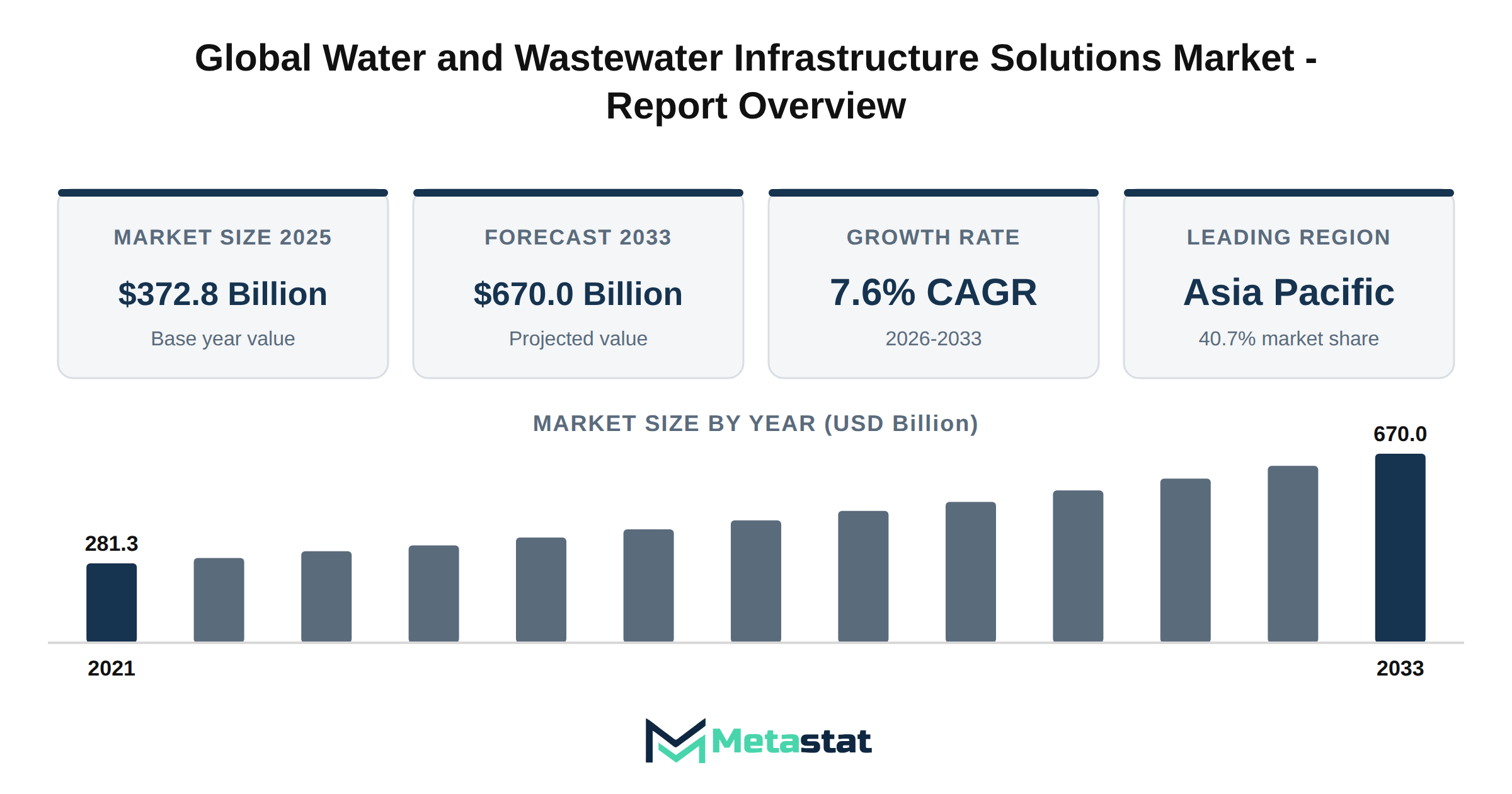
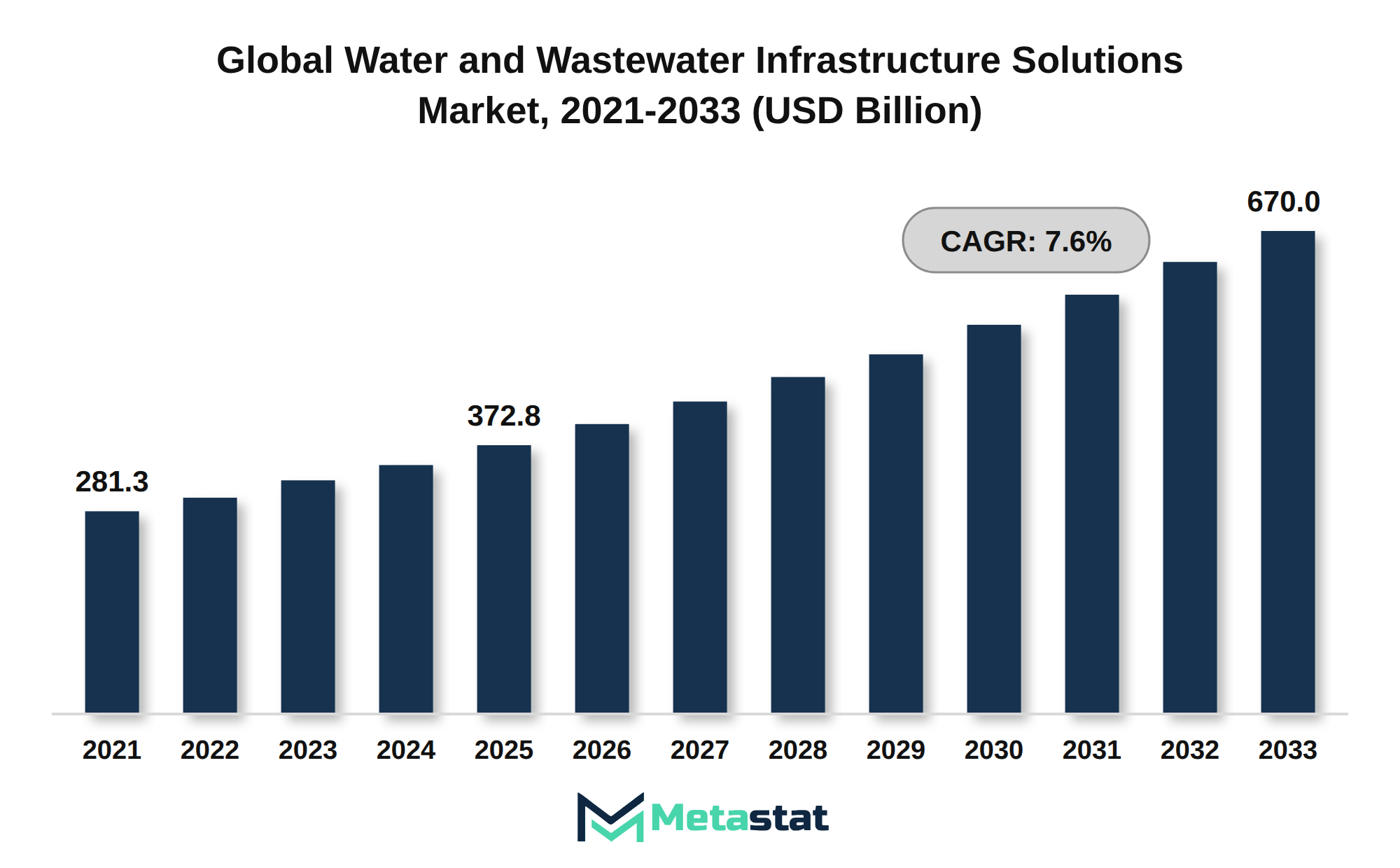
The Water and Wastewater Infrastructure Solutions market is poised for significant growth, with a base value of USD 372.8 billion in 2025, projected to reach USD 670 billion by 2033. This represents a compound annual growth rate (CAGR) of 7.6%. The market has demonstrated a robust expansion trajectory, starting from a historical value of USD 281.3 billion in 2021 and increasing progressively each year.
In 2024, the market value reached USD 345.3 billion, followed by USD 372.8 billion in 2025. The forecast for subsequent years indicates continued upward momentum, with values expected to reach USD 402.2 billion in 2026, USD 433.5 billion in 2027, and USD 467.4 billion in 2028. By 2029, the market is projected at USD 499 billion, and further growth is anticipated, culminating in a projected value of USD 670 billion by 2033.
Market growth is driven by increased demand for efficient water management solutions, compliance with evolving environmental regulations, and the necessity for infrastructure upgrades in aging systems. Investment in sustainable technologies and infrastructure projects influences market dynamics, with public and private sectors allocating significant resources to meet these challenges.
Regional distribution indicates a strong market presence in Asia Pacific, accounting for 40.7% of the total share, followed by North America at 25.1% and Europe at 20.4%. Emerging economies in Asia Pacific particularly enhance demand due to rapid urbanization and industrialization, leading to heightened investments in water and wastewater infrastructure.
In terms of solution types, the market encompasses a range of areas, including drinking water treatment plants, wastewater treatment plants, desalination plants, and water reuse and recycling facilities. Each segment reflects unique growth trajectories, with wastewater treatment plants projected to reach USD 142 billion by 2033, indicating a CAGR of 7.4%.
Strategic planning, feasibility, and advisory services within the project lifecycle are critical components, with values expected to increase from USD 23.7 billion in 2026 to USD 37.5 billion in 2033, representing a CAGR of 6.8%. The overall expansion in the Water and Wastewater Infrastructure Solutions market relies on continuous innovation and investment in advanced technologies to enhance operational efficiency and sustainability.
The Water and Wastewater Infrastructure Solutions market faces various regulatory compliance challenges that influence operational frameworks. Stricter environmental regulations drive investments in advanced treatment technologies, compelling companies to adapt to changing compliance requirements. These adaptations impact capital allocation strategies, prompting increased funding for innovation and infrastructure upgrades.
Market fragmentation presents both challenges and opportunities for participants. Numerous small and medium enterprises operate alongside larger corporations, creating a competitive environment that encourages innovation. This competitive environment fosters collaboration and partnerships, enabling firms to leverage specialized expertise while enhancing service offerings.
Inflationary pressures and currency volatility significantly affect cost structures within the market. Fluctuations in material costs and labor expenses impact operational budgets, influencing pricing strategies and profitability. Companies increasingly focus on cost-efficient solutions to maintain competitive pricing while ensuring quality service delivery.
The ongoing shift towards sustainable transformation and decarbonization influences investment strategies within the Water and Wastewater Infrastructure Solutions market. Companies prioritize projects that align with sustainability goals, leading to increased funding for green technologies and infrastructure projects. This trend enhances long-term viability and aligns with global sustainability initiatives.
Next-generation innovations significantly shape the market, with advancements in digital water management, smart technologies, and data analytics. These innovations streamline operations and enhance efficiency, resulting in improved service delivery. Companies adopting these technologies position themselves competitively in a changing marketplace.
Future strategic outlooks emphasize the importance of robust infrastructure investments. Capital expenditure on water and wastewater systems underpins growth, enabling companies to meet increasing demands for reliable water services. Strategic investments in infrastructure lead to enhanced resilience against climate change impacts, ensuring sustainable water resource management.
Investment in infrastructure development significantly influences the Water and Wastewater Infrastructure Solutions market. Increased capital allocation from both public and private sectors creates a supportive environment for upgrading and expanding existing water and wastewater systems. Economic growth, characterized by rising GDP and favorable interest rates, enhances the capacity for public-private partnerships, enabling substantial funding for projects aimed at improving water treatment, distribution, and wastewater management.
This influx of capital directly correlates with technological integration within the market. Investment in advanced technologies, including automation and AI, streamlines operations and enhances service delivery. By adopting innovative solutions, municipal and public water utilities optimize their resource management while effectively addressing aging infrastructure challenges. The result is a more resilient system capable of meeting increasing demand in urban areas.
Shifting demographic patterns, including urbanization and growing populations, necessitate increased investment in water and wastewater solutions. Municipalities face pressure to provide sustainable and efficient services to expanding urban centers. This aligns with broader trends of sustainability and resource stewardship, reflecting communities' prioritization of environmentally responsible practices in water management. Such trends further encourage investment in the Water and Wastewater Infrastructure Solutions market, reflecting a commitment to long-term sustainability and operational efficiency.
Capital investment emerges because a key driver of growth in the Water and Wastewater Infrastructure Solutions market. Economic factors, technological advancements, and demographic shifts collectively shape the investment landscape, resulting in a dynamic environment ripe for innovative solutions and sustainable practices.
Investment in digital transformation directly impacts the Water and Wastewater Infrastructure Solutions market by enhancing operational efficiency and enabling cost-saving measures. Increasing adoption of automation, artificial intelligence, and software solutions optimizes existing processes, thereby reducing overhead expenses and improving service delivery. This trend arises from companies seeking to streamline operations and enhance productivity, driven by rising labor costs and pressing sustainability goals that create challenges.
The emphasis on technology integration drives the development of smart infrastructure, which enhances the management of water resources and wastewater treatment. Smart sensors and data analytics improve decision-making and real-time monitoring, leading to improved resource stewardship. Increased operational efficiency allows companies to allocate capital toward innovation and expansive growth, ultimately positioning the market for robust developments through 2033.
Shifting consumer behaviors and demographic patterns further reinforce the drive toward digital transformation. Growing urbanization and aging populations increase demand for efficient water management systems, necessitating innovative solutions that meet evolving customer expectations. The Water and Wastewater Infrastructure Solutions market aligns itself with these demands through investments in technology, ensuring sustainable growth and resilience in a competitive environment.
The Water and Wastewater Infrastructure Solutions market encounters significant challenges related to regulatory compliance, which increases project costs and extends timelines. Stringent regulations surrounding water quality and environmental protection necessitate advanced technologies and processes, increasing capital expenditure for projects. Compliance hurdles delay project approvals, resulting in extended periods before infrastructure becomes operational.
Legal mandates requiring sustainable practices place additional financial burdens on water utilities and service providers. The need for ongoing investments in infrastructure upgrades to meet these mandates leads to capital stagnation, particularly for smaller entities lacking the necessary resources. High operational costs associated with maintaining compliance contribute further to financial strain, limiting the ability of service providers to invest in new technologies.
Macroeconomic headwinds, including inflationary pressures and supply chain disruptions, affect project execution and overall market growth. Rising costs of materials and labor reduce margins, compelling stakeholders to reassess investment strategies. Geopolitical instability exacerbates these issues, leading to uncertainty in project funding and execution.
Market fragmentation complicates the competitive landscape, making it challenging for companies to navigate compliance and regulatory requirements effectively. This fragmentation results in varied adoption rates across regions, with certain markets facing cultural barriers that hinder the implementation of advanced water and wastewater solutions. The cumulative effects of these factors impose constraints on the market, impacting growth potential and future investment. Addressing these challenges is essential for achieving sustained success within the Water and Wastewater Infrastructure Solutions market.
The Water and Wastewater Infrastructure Solutions market faces challenges due to geopolitical fragmentation, which leads to disruptions in supply chains. This fragmentation results from various factors including rising nationalism, trade deficits, and tariff friction between countries. Such conditions complicate the procurement of critical materials and components necessary for infrastructure projects, hindering timely project delivery and increasing costs for suppliers and end-users.
Trade tensions and tariffs inflate prices for imported materials, causing budget overruns for projects financed by municipal and public water utilities. Rising input costs impact overall project feasibility and profitability, forcing stakeholders to reevaluate planned investments in infrastructure development. These dynamics create an environment where procurement strategies require reevaluation, adding complexity to project lifecycle services within the market.
Technological disruptions contribute to challenges, including the need for interoperability among different systems and components. This requirement complicates integration efforts, particularly for existing infrastructure that lacks compatibility with new technologies. Interoperability friction inhibits the efficiency of water treatment plants, desalination facilities, and wastewater systems, ultimately affecting operational effectiveness and compliance with evolving legal liabilities.
The Water and Wastewater Infrastructure Solutions market navigates these geopolitical and technological challenges to maintain a steady growth trajectory. Strategic planning and robust risk management are essential in addressing these issues, ensuring that projects proceed within budget and timeline constraints while meeting the increasing demand for sustainable and resilient infrastructure solutions.
The Water and Wastewater Infrastructure Solutions market experiences significant opportunities driven by emerging regional demands. Increasing urbanization and population growth compel governments and municipalities to enhance their water and wastewater infrastructure. This expansion results in a pressing need for modernization initiatives, focusing on efficiency and sustainability. Investments directed toward upgrading aging infrastructure present substantial growth potential for various stakeholders, including public utilities and private sector participants.
Geographical expansion influences market dynamics. Developing regions prioritize investments in water and wastewater treatment facilities to address clean water access and pollution control challenges. This trend creates opportunities for technology providers to deliver innovative solutions, including advanced treatment technologies and digital management systems. The market aligns with these needs through strategic partnerships and collaborations, enhancing operational capabilities and streamlining project execution.
Technological disruptions significantly influence the adoption of next-generation innovations. The integration of digital technologies facilitates improved operational efficiency, enabling real-time monitoring and data analytics. This transition toward digital procurement models aligns with evolving buying behaviors, where consumers and businesses prioritize digital platforms for sourcing infrastructure solutions. Consequently, suppliers that embrace these shifts strengthen their competitive position within the market.
Sustainability imperatives and ESG-driven alignments drive the market toward eco-friendly practices. Companies recognize the importance of adapting to environmental standards, leading to increased demand for sustainable solutions in water and wastewater management. This focus on green transformations encourages the development of integrated systems that optimize resource use and minimize environmental impact. Initiatives promoting asset life-cycle extensions and maintenance upgrades further enhance the longevity and efficiency of infrastructure.
Strategic consolidation and cross-industry mergers shape the market. Companies seek to broaden their service offerings and enhance competitive advantages through collaborative efforts. This trend drives market growth, enabling firms to diversify their portfolios and address niche applications within the Water and Wastewater Infrastructure Solutions market. Overall, these dynamics create a favorable environment for investment, innovation, and growth in water and wastewater infrastructure solutions.
The Global Water and Wastewater Infrastructure Solutions market is segmented based on Solution Type, Project Lifecycle Service, and End-Use Sector.
Valued at USD 69.6 billion in 2026, the Drinking Water Treatment Plants segment is projected to reach USD 109.9 billion by 2033, at a CAGR of 6.7% during the forecast period. Growing urbanization and rising population numbers contribute to increased demand for clean drinking water, driving investment in treatment infrastructure. Enhanced regulatory standards concerning water quality and safety are influencing municipalities and utilities to upgrade existing systems and implement advanced technologies. These standards ensure compliance with stringent guidelines, leading to a shift towards modern treatment solutions.
Technological advancements in water treatment processes, including membrane filtration, reverse osmosis, and UV disinfection, enhance efficiency and effectiveness in removing contaminants. These innovations lead to reduced operational costs and improved water quality, further stimulating the market. Rising consumer awareness about water quality and the health implications of contaminants prompts investments in advanced treatment facilities. The trend towards sustainability and resource conservation, including water reuse and recycling, drives the development of new treatment technologies.
End-use sectors including municipal and public water utilities play a significant role in this segment. These organizations prioritize upgrading infrastructure to meet growing demands and ensure long-term sustainability. Increasing investment from public and private entities toward modernizing water treatment facilities reflects the strategic focus on enhancing performance and reliability. The Water and Wastewater Infrastructure Solutions market is set to benefit significantly from these trends, with the Drinking Water Treatment Plants segment positioned for sustained growth throughout the forecast period.
Current trends in the Water and Wastewater Infrastructure Solutions market indicate a growing emphasis on Wastewater Treatment Plants, driven by increasing environmental regulations and the need for sustainable waste management practices. Urbanization and population growth raise demands for efficient wastewater treatment systems, prompting investments in infrastructure upgrades and new facilities. These facilities ensure compliance with stringent regulatory frameworks designed to protect water quality and public health.
Wastewater Treatment Plants segment is estimated to reach USD 142 billion by 2033, at a CAGR of 7.4% during the forecast period. The segment experiences expansion due to technological advancements that enhance treatment efficiency and reduce operational costs. Innovations in membrane technologies, biological treatment processes, and automation contribute to improved performance and lower energy consumption, appealing to both municipal and industrial buyers seeking cost-effective solutions.
Shifts in consumption patterns highlight a growing awareness of water conservation and recycling, influencing the demand for advanced wastewater treatment options. Industries increasingly recognize the value of treated wastewater for applications including irrigation and industrial processes, further driving the segment's growth. Regulatory compliance standards continue to push operators toward adopting next-generation wastewater treatment technologies, ensuring compliance with increasingly stringent environmental standards.
Market players strategically pursue investments in R&D to enhance their capabilities in delivering efficient wastewater solutions. Partnerships between technology providers and end-users facilitate the adoption of innovative solutions, positioning companies favorably to capture market share, driven by rising competition. Overall, the market remains poised for sustained growth, driven by a combination of regulatory pressures, technological advancements, and shifting consumer preferences.
Desalination Plants play a crucial role in addressing global water scarcity challenges, particularly in arid regions and areas with limited freshwater resources. Rising demand for potable water, driven by population growth and urbanization, significantly influences the expansion of this segment. Innovations in desalination technologies, including energy-efficient reverse osmosis and advanced membrane solutions, enhance operational efficiency and reduce costs over time. These technological advancements facilitate the adoption of desalination plants across various geographic regions.
Regulatory support for sustainable water management practices contributes to the segment's growth. Policies promoting the use of alternative water sources, including seawater desalination, set the framework for investment and infrastructure development in the Water and Wastewater Infrastructure Solutions market. Environmental concerns push stakeholders to explore cleaner technologies, driving the shift towards next-generation desalination facilities.
By 2033, the Desalination Plants segment is projected to reach USD 56.3 billion. This figure highlights the segment's significance within the Water and Wastewater Infrastructure Solutions market. Key end-use sectors, including municipal water utilities and industrial applications, increasingly invest in desalination to meet their water supply needs, reflecting a strategic opportunity window for stakeholders in this space.
Investment in Water Reuse & Recycling Facilities aligns with global sustainability goals, encouraging resource conservation and reducing the environmental impact of wastewater. Regulatory pressures and increased awareness of water scarcity drive the demand for efficient water management solutions. Industries including municipal water utilities, industrial manufacturing, and agriculture increasingly adopt these technologies to enhance operational efficiency and meet compliance standards.
Water Reuse & Recycling Facilities segment is projected to grow at a CAGR of 9.3% during the forecast period. Continuous advancements in treatment technologies and innovations in water recycling processes enable more effective solutions, encouraging stakeholders to invest in infrastructure upgrades. The market benefits from increased capital investments, particularly in areas facing water shortages and stringent regulations.
Increased focus on sustainability and economic benefits associated with water reuse significantly influence consumption patterns. The integration of recycled water into various applications, including irrigation and industrial processes, demonstrates the versatility of these facilities. This adaptability positions the Water Reuse & Recycling Facilities segment because a key player in the broader Water and Wastewater Infrastructure Solutions market.
Investment in Water Transmission & Distribution Networks represents a vital area within the Water and Wastewater Infrastructure Solutions market. Growing urbanization and the increasing need for efficient water distribution systems drive demand for these networks. An enhanced focus on sustainable water management practices accelerates the adoption of innovative technologies in this segment.
Technological advancements significantly shape the efficiency and effectiveness of water transmission and distribution systems. Integration of smart technologies, including IoT and automation, facilitates real-time monitoring and management of water resources, minimizing losses during distribution. These advancements support operational efficiency and the provision of reliable water supply, reinforcing the segment's importance.
Regulatory compliance surrounding water quality and distribution standards influences investment strategies within the market. Stricter regulations necessitate upgrades to aging infrastructure, promoting the integration of modern solutions that meet contemporary safety and sustainability standards. Consequently, these factors drive capital investment and enhance the reliability of water supply systems.
Growing awareness regarding environmental sustainability contributes to shifts in consumption patterns, with an increasing emphasis on water conservation and recycling initiatives. This trend encourages the development of advanced water transmission and distribution networks that support efficient usage and minimize waste. Such initiatives align with global goals for sustainable resource management.
Strategic partnerships among stakeholders within the Water Transmission & Distribution Networks segment improve innovation and enhance supply chain resilience. Collaborations among manufacturers, technology providers, and utilities enhance knowledge sharing and facilitate the development of next-generation solutions, ensuring that the market remains adaptive to evolving demands.
Increasing urbanization drives demand for enhanced wastewater collection and sewerage networks. These systems play a vital role in ensuring public health and environmental protection, particularly in densely populated areas. Technological advancements contribute to the modernization of existing infrastructures, improving efficiency and reducing operational costs. The implementation of smart technologies facilitates real-time monitoring and management of sewer systems, helping to identify issues proactively, which strengthens long-term demand for these solutions.
Regulatory compliance shapes the development of wastewater collection and sewerage networks, with governments enforcing stringent standards for wastewater treatment and discharge. This regulatory landscape encourages investment in advanced treatment technologies, ensuring that facilities operate within the required guidelines. Shifting consumption patterns and environmental concerns prompt municipalities to seek sustainable solutions, leading to increased adoption of innovative technologies that promote water conservation and reuse, which is projected to enhance market growth.
Collaboration among stakeholders, including public utilities and private sector players, enhances project outcomes in the market. This collaboration creates an environment conducive to knowledge sharing and resource optimization, laying the groundwork for future expansions. Strategic investments in capital projects focus on upgrading aged infrastructures and expanding service areas. These investments present significant opportunities for growth within the wastewater collection and sewerage networks segment, reinforcing its position in the overall market.
The integration of next-generation upgrades, including decentralized wastewater treatment solutions, influences the operational landscape. These systems offer flexibility and resilience, addressing specific local needs while maintaining compliance with regulatory standards. Overall, the ongoing evolution of wastewater collection and sewerage networks represents a critical component of the wider Water and Wastewater Infrastructure Solutions market, reflecting the urgent need for sustainable and efficient water management practices.
Urbanization drives the need for effective stormwater management solutions. Increased precipitation and changing weather patterns contribute to flooding challenges in urban areas, leading to heightened demand for stormwater and urban drainage systems. These systems play a significant role in mitigating flooding risks, protecting infrastructure, and ensuring public safety, reinforcing long-term demand for these solutions.
Technological advancements enhance the functionality of stormwater management systems. Innovations in materials, design, and digital monitoring tools improve efficiency, allowing for better water quality management and resource recovery. Integration of smart technologies facilitates real-time monitoring and responsive management strategies, optimizing performance while reducing operational costs, which supports broader adoption across urban environments.
Regulatory compliance influences investment in stormwater and urban drainage systems. Authorities impose stringent requirements on urban infrastructure to manage runoff effectively, leading to increased capital expenditures. Compliance with environmental standards drives the adoption of advanced treatment technologies and promotes sustainable practices, resulting in significant growth potential for the market.
Investment in resilient infrastructure represents a strategic opportunity within the market. Stakeholders recognize the importance of long-term solutions to address urban water challenges. The focus on environmentally sustainable practices encourages collaboration among public and private entities, enhancing capital investment and supporting innovation in the sector, which is expected to strengthen market positioning.
Climate change and increasing extreme weather events escalate the demand for effective flood and coastal protection infrastructure. Rising sea levels and intensified storm surges necessitate robust protective measures to safeguard communities, industries, and ecosystems. Urban development in vulnerable coastal regions emphasizes the urgency for innovative solutions that mitigate flood risks and enhance resilience against natural disasters.
Technological advancements drive the evolution of flood and coastal protection strategies. Smart infrastructure, integrating digital technologies, supports real-time monitoring and data analysis, enhancing decision-making processes. This technological maturation influences the design and implementation of adaptive solutions, catering to the specific needs of various regions facing unique environmental challenges.
Regulatory compliance plays a critical role in shaping investment and development priorities within the Water and Wastewater Infrastructure Solutions market. Governments and local authorities enforce stringent regulations to promote sustainable practices and ensure safety in flood-prone areas. Compliance with these standards creates opportunities for stakeholders to innovate and develop effective infrastructure solutions.
Investment in flood protection initiatives yields significant long-term benefits. Enhanced infrastructure reduces the economic impact of flooding, preserving property, infrastructure, and public health. The value generated from effective flood management encourages public and private sector collaboration, driving capital investment toward resilient solutions that adapt to changing environmental conditions.
Investment in dams, reservoirs, and water resource infrastructure supports sustainable water management practices, particularly in regions experiencing water scarcity. This segment addresses critical needs for storage and distribution, which are essential for both urban and agricultural applications. Rapid urbanization drives demand for reliable water supply systems. Investments in expanding and upgrading existing infrastructure are necessary.
Regulatory compliance standards push stakeholders to adopt advanced technologies and implement best practices in water resource management. Adoption of smart water technologies enhances efficiency in monitoring and controlling water distribution. This trend aligns with global sustainability goals and drives the development of innovative solutions and improvements in existing facilities.
Technological maturation influences investment decisions, with smart technologies and digital monitoring systems providing opportunities for enhanced performance and resource optimization. Downstream applications across municipal utilities and industrial sectors create a need for reliable water storage and management systems. The market experiences increased interest from various stakeholders, including government entities and private investors.
Cost structures and pricing volatility present challenges for the development of water resource infrastructure. Fluctuations in raw material costs impact project budgets, requiring careful financial planning and strategic sourcing. Supply chain resilience becomes significant in mitigating risks associated with material shortages and logistical vulnerabilities. These challenges drive the necessity for innovative project delivery methods and effective risk management strategies.
Strategic opportunity windows exist for stakeholders looking to capture market share in developing regions. Investments in public-private partnerships facilitate the development of large-scale infrastructure projects. Competition intensifies; companies focusing on technological advancements and sustainable practices position themselves favorably within the Water and Wastewater Infrastructure Solutions market.
Incorporating bioresources, groundwater, and nature-based solutions in water management presents various opportunities for the market. Increasing awareness of environmental sustainability drives demand for innovative solutions that employ natural processes for water treatment and resource management. This shift towards eco-friendly practices aligns with global initiatives focused on reducing carbon footprints and enhancing biodiversity.
Regulatory compliance standards increasingly emphasize the importance of sustainability in water and wastewater infrastructure. Policymakers encourage the adoption of nature-based solutions, which lead to lower operational costs and improved system resilience against climate change impacts. This regulatory push creates a favorable environment for investment in innovative technologies within this sub-segment.
Consumer preferences shift toward sustainable practices, influencing industries to adopt greener water infrastructure solutions. This trend aligns with broader consumption patterns favoring environmentally responsible products and services. Addressing these shifts enhances suppliers' competitive positions in the market.
Technological advancements in bioresource management and groundwater management contribute to the evolution of water treatment processes. Next-generation upgrades focus on integrating smart technologies that optimize resource use and improve efficiency. These technological maturation processes enable stakeholders to develop more effective and sustainable solutions, enhancing the overall performance of the water infrastructure sector.
Investment opportunities arise from the strategic need for enhancing water quality and availability. Capital investment outlooks indicate strong support for initiatives that integrate nature-based solutions, creating strategic opportunity windows for companies willing to innovate. Leveraging these opportunities significantly enhances growth prospects for organizations operating in the Water and Wastewater Infrastructure Solutions market.
Valued at USD 23.7 billion in 2026, the Strategic Planning, Feasibility & Advisory segment is projected to reach USD 37.5 billion by 2033, at a CAGR of 6.8% during the forecast period. Primary demand drivers for this segment include increasing complexity in water and wastewater projects, which necessitates comprehensive planning and advisory services. Stakeholders including municipal governments and private sector entities seek to optimize resource allocation and enhance project success rates through effective strategic planning.
Adoption of innovative technologies and methodologies in project lifecycle services enhances the segment's growth prospects. The incorporation of digital tools in strategic planning enables improved decision-making processes, providing stakeholders with data-driven insights. This trend aligns with a broader movement towards digital transformation within the Water and Wastewater Infrastructure Solutions market, creating new avenues for capital investment and strategic opportunity windows.
Growing regulatory compliance standards and stringent environmental policies compel organizations to engage in thorough feasibility studies before project initiation. These compliance requirements necessitate a shift towards more sustainable practices in water management, ultimately driving demand for advisory services in this sector. The increasing emphasis on sustainability aligns with global efforts to combat climate change and preserve water resources, leading to heightened scrutiny of project proposals.
Cost structures within the segment remain under pressure due to fluctuating raw material prices and inflationary trends affecting overall project budgets. In this environment, companies specializing in strategic planning and advisory services are positioned to offer value by identifying cost-saving opportunities and optimizing project delivery. Pricing volatility and margin pressures highlight the essential role of strategic planning in mitigating financial risks and ensuring project viability.
The focus on developing resilient supply chains through enhanced logistical frameworks strengthens the segment's outlook. Companies prioritize collaboration with suppliers to establish robust networks that withstand disruptions. This strategic approach enhances efficiency in project execution, allowing organizations to meet the evolving demands of the Water and Wastewater Infrastructure Solutions market effectively.
Investment in the Engineering & Detailed Design segment supports strategic planning and the development of effective water and wastewater infrastructure. This segment is projected to reach USD 78.4 billion by 2033, at a CAGR of 6.5% during the forecast period. Growing demand for innovative design solutions is driven by the increasing complexity of infrastructure projects, necessitating sophisticated engineering approaches. Various end-use sectors, including municipal and industrial entities, influence the requirement for advanced design methodologies that comply with regulatory standards. Adoption of digital tools and modeling techniques enhances project delivery efficiency, reduces costs, and improves overall project outcomes.
The emphasis on sustainability shapes the Engineering & Detailed Design segment within the Water and Wastewater Infrastructure Solutions market. Firms increasingly focus on developing resilient and adaptable designs to accommodate future environmental and regulatory challenges. This includes integrating renewable energy sources and implementing environmentally friendly materials into project plans. Such advancements create competitive advantages for companies that invest in advanced technologies and sustainable practices, leading to stronger market positions. The segment's growth illustrates the importance of innovative design solutions in meeting the evolving demands of the water and wastewater infrastructure landscape.
Investment in the Program & Project Management segment reflects the necessity for effective execution of large-scale water and wastewater initiatives. This segment addresses rising complexities associated with managing diverse projects across various lifecycle stages, driving demand for skilled project management professionals. Coupled with increasing regulatory pressures and the need for compliance with environmental standards, the market for Program & Project Management experiences significant growth. Project owners, including municipal entities and private sector clients, prioritize effective management to enhance project outcomes while controlling costs.
While sustainability initiatives gain traction, organizations focus on optimizing resource allocation and mitigating environmental impact. The increasing emphasis on sustainability drives demand for sophisticated project management solutions capable of integrating sustainability metrics into project frameworks. The anticipated growth in the segment aligns with broader objectives within the Water and Wastewater Infrastructure Solutions market. Stakeholders recognize the value of comprehensive program management strategies that enhance operational efficiencies and ensure successful project delivery.
Growth in the EPC & Design-Build Delivery segment aligns with the increasing complexity and scale of water and wastewater projects. Factors driving this trend include the rising demand for integrated solutions that streamline project execution, from initial design to final delivery. Clients seek partners who demonstrate expertise in managing large-scale water infrastructure projects, ensuring compliance with stringent regulatory standards and enhancing overall efficiency. The segment is projected to grow at a CAGR of 6.5% during the forecast period.
Technological maturation reshapes project execution methodologies. Advanced digital tools, including modeling and analytics, improve project outcomes, leading to better resource allocation and cost management. Clients in the market look for suppliers who leverage these technologies, providing innovative solutions that address unique project challenges. Enhanced collaboration among stakeholders promotes timely project delivery while minimizing disruptions and cost overruns.
Investment in sustainable practices drives demand for EPC and design-build solutions. End-use sectors increasingly prioritize eco-friendly approaches, promoting the adoption of next-generation upgrades in infrastructure design. Regulatory compliance standards require firms to implement sustainable solutions, further influencing project requirements. Players in this segment remain agile and responsive to shifts in client expectations, ensuring alignment with evolving industry trends.
Competition intensifies owing to new entrants emerging, prompting established players to innovate continuously. Strategic opportunity windows arise for firms that offer differentiated services, particularly in areas like asset management and performance optimization. The capital investment outlook for the EPC and Design-Build Delivery segment remains robust, with significant funding directed towards projects that enhance infrastructure resilience and adaptability in a changing climate. This ongoing investment supports the overall growth trajectory of the water and wastewater infrastructure solutions market.
Growing complexity in water and wastewater projects creates significant demand for Construction Management & Supervision services. These services ensure that projects adhere to timelines and budgets, facilitating the execution of infrastructure solutions effectively. Increasing regulatory compliance standards and the need for quality assurance in the Water and Wastewater Infrastructure Solutions market further drive the necessity for experienced management teams during construction phases.
Technological advancements enhance capabilities in project management, enabling real-time monitoring and analytics during construction. The adoption of next-generation tools leads to improved efficiency and cost-effectiveness. End-use dynamics, including rising demand from municipal and industrial sectors, necessitate robust construction management practices that ensure project completion aligns with anticipated operational requirements.
Challenges related to pricing volatility and margin pressures impact the broader construction sector. Strategic opportunity windows exist for companies that leverage innovative management practices and technologies to improve project outcomes. A focus on supply chain resilience and raw material sourcing is essential in mitigating risks that could disrupt construction timelines. Effective construction management and supervision are essential for navigating these market dynamics successfully and achieving desired project goals.
Increasing focus on system efficiency and reliability drives demand for commissioning and start-up services within the Water and Wastewater Infrastructure Solutions market. This segment ensures that newly constructed systems operate smoothly, adhering to established performance standards. Stakeholders prioritize these services to minimize downtime during the transition from construction to operational phases, ultimately impacting project timelines and budgets.
Technological advancements in automation and monitoring solutions influence the commissioning and start-up processes. Enhanced system diagnostics and performance assessments enable quicker identification of potential issues, leading to faster resolution and operational readiness. The integration of smart technologies into water and wastewater management further supports successful implementation, enhancing the overall effectiveness of these solutions.
Regulatory compliance and environmental standards necessitate thorough commissioning protocols. These protocols ensure that systems meet safety, quality, and environmental benchmarks before operations begin. In this context, adherence to compliance standards becomes critical, shaping the expectations for service providers and increasing the complexity of commissioning tasks.
While municipalities and industries face growing pressure to optimize water usage and management, the commissioning and start-up segment emerges owing to a strategic opportunity. Successful execution of these services improves system performance and reduces operational costs, ultimately benefiting end users across various sectors. Capital investment in this area reflects a commitment to sustainable practices within the broader Water and Wastewater Infrastructure Solutions market.
Increasing focus on operational efficiency enhances the need for robust Operations & Maintenance services within the Water and Wastewater Infrastructure Solutions market. Growth in urban populations and the complexity of managing diverse water resources drive demand for these services. Utilities and private sector players seek reliable solutions to ensure the continuous performance of treatment plants and distribution networks, supporting long-term operational effectiveness.
Regulatory compliance standards play a significant role in shaping the demands for effective operational practices. Stringent guidelines surrounding water quality and environmental impact necessitate that service providers enhance their maintenance protocols. This alignment with regulatory frameworks mitigates risks and enhances consumer trust in public water systems, reinforcing the market's stability.
Technological advancements contribute to the evolution of Operations & Maintenance practices. The integration of digital tools and predictive analytics enables stakeholders to optimize maintenance schedules and reduce downtime. These innovations lead to enhanced asset management, driving lifecycle cost savings while improving service reliability, which is expected to strengthen market competitiveness.
Environmental sustainability initiatives influence consumption shifts within the market. Organizations prioritize eco-friendly practices, and demand for maintenance solutions that address energy efficiency and resource conservation rises. This focus on sustainability complements regulatory efforts and enhances the competitive edge of service providers, fostering increased market participation.
Strategic opportunity windows exist for companies to expand their service offerings in response to market dynamics. Players in the Water and Wastewater Infrastructure Solutions market that prioritize Operations & Maintenance differentiate themselves by providing comprehensive support that extends beyond traditional service models. This approach positions them favorably in a landscape characterized by increasing complexity and higher consumer expectations, driving future growth.
Investment in Operations & Maintenance services represents a crucial aspect of capital planning for utilities and private operators. By prioritizing these services, stakeholders ensure compliance with government regulations and address the operational challenges posed by aging infrastructure. This proactive stance on maintenance enhances resilience within the supply chain, underpinning the overall efficiency of the water and wastewater sector, which is anticipated to support long-term market expansion.
Technological advancements in Asset Management and Performance Optimization enhance system efficiency and longevity within the Water and Wastewater Infrastructure Solutions market. Increased focus on sustainability drives utilities and organizations to optimize resource usage while minimizing operational costs. Implementing advanced analytics and real-time monitoring systems significantly improves asset performance and decision-making processes, supporting long-term operational efficiency.
The push towards regulatory compliance and environmental standards necessitates investments in innovative technologies. Enhanced data management and predictive maintenance strategies contribute to reduced downtime and operational disruptions, reflecting the broader market trend of integrating digital solutions in water and wastewater management. Such investments are expected to strengthen compliance and operational reliability.
Adoption of next-generation technologies facilitates significant improvements in operational performance. Utilities seek to transition from traditional practices to data-driven approaches, leading to widespread implementation of smart technologies. This evolution increases resilience against challenges including aging infrastructure, climate variability, and resource scarcity, positioning utilities to better manage risks and enhance service delivery.
Investment in performance optimization strategies reflects a strategic response to the growing demand for improved wastewater management and water quality. Enhanced asset management practices support utilities in addressing service reliability, regulatory compliance, and consumer expectations. This dynamic positions the market for growth, driven by the need for technological innovation and sustainable practices, ultimately expanding the addressable market.
Technological advancements in digital water solutions improve the capabilities of modeling and analytics, allowing for optimized water management strategies. Enhanced data analytics tools facilitate real-time monitoring and decision-making, improving operational efficiency and resource allocation. Stakeholders across the water and wastewater ecosystem increasingly prioritize data-driven insights, driving the adoption of advanced digital platforms. This trend aligns with broader objectives related to sustainability, regulatory compliance, and cost management in the Water and Wastewater Infrastructure Solutions market.
Incorporating innovative technologies leads to significant improvements in system performance and customer service. The demand for predictive analytics tools and digital twins supports proactive maintenance strategies, reducing downtime and optimizing asset life cycles. Industries recognize the value of advanced analytics in mitigating risks and enhancing service delivery, driving growth in this sub-segment. Addressing regulatory compliance standards through digital solutions remains a crucial aspect of operational frameworks, with organizations seeking to meet stringent environmental and health regulations.
Strategic investments in research and development enhance product evolution and technological maturation in digital solutions. The push for next-generation upgrades aligns with evolving consumer expectations and operational requirements. By leveraging digital water, modeling, and analytics, firms in the market achieve a competitive advantage, ultimately driving expansion across various sectors, including municipal utilities and industrial applications.
Compliance with regulatory standards and permitting processes significantly influences project timelines and costs within the water and wastewater infrastructure sectors. Technical assurance ensures adherence to these standards, thereby ensuring that projects meet safety and environmental regulations. Demand for these services often correlates with increasing public and governmental scrutiny regarding water quality and environmental impact, creating a pressing requirement for robust compliance mechanisms.
The evolving framework of environmental policies and sustainability initiatives encourages investment in technical assurance, regulatory, and permitting support. This segment faces challenges related to pricing volatility and margin pressures, driven by fluctuating regulatory requirements and the need for specialized expertise. Successful navigation of these complexities enhances project delivery and operational efficiency, presenting strategic opportunity windows for firms specializing in this area.
Technological advancements in digital water management systems further drive the need for technical assurance services. These technologies support data-driven decision-making, enhancing project outcomes and compliance management. While the Water and Wastewater Infrastructure Solutions market continues to evolve, increased capital investment in this sub-segment is expected to reflect the growing importance of regulatory compliance and environmental sustainability across the industry.
Investment in the Municipal & Public Water Utilities sector reflects increasing urbanization and population growth, necessitating the development of resilient water infrastructure. Valued at USD 194.1 billion in 2026, this segment is projected to reach USD 301.5 billion by 2033, at a CAGR of 6.5% during the forecast period. Rising demand for efficient and reliable water supply systems drives significant advancements in technology and infrastructure development. Regulatory compliance standards and environmental sustainability initiatives further fuel these developments, compelling municipalities to upgrade aging systems and adopt modern water management practices.
Strategic investments in this segment enhance overall operational efficiency and ensure compliance with stringent regulations. Innovations in water reuse and recycling facilities play a critical role in addressing water scarcity challenges faced by municipalities. The transition toward smart water management solutions, integrating digital technologies, is increasingly evident, promoting better monitoring and control of water resources. These trends align with the broader dynamics of the Water and Wastewater Infrastructure Solutions market, reflecting a commitment to sustainability and public health.
Technological maturation drives greater integration of next-generation upgrades within existing systems, influencing the evolution of service delivery models. The sector's growth correlates with increased funding for infrastructure upgrades, emphasizing the importance of strategic planning and advisory services. While the market continues to evolve, stakeholders remain vigilant regarding cost structures and pricing volatility to ensure financial sustainability and service reliability.
Significant growth in the Industrial Manufacturing segment arises from increasing demand for efficient water and wastewater management solutions. This demand results from the need for sustainable practices in industrial processes, driven by stricter environmental regulations and the push for resource efficiency. Investment in advanced treatment technologies enhances product quality and operational reliability, which is essential for maintaining competitive advantage in the market.
Technological maturation contributes to expanding this segment. Innovations in water reuse and recycling technologies enable manufacturers to minimize water consumption while maximizing output. The continuous evolution of treatment processes reduces operational costs and improves environmental compliance, which attracts further investment in the Water and Wastewater Infrastructure Solutions market.
Market dynamics shift towards integrated solutions that encompass strategic planning, engineering, and project management services. The adoption of comprehensive approaches assists manufacturers in navigating regulatory requirements and optimizing water use throughout their operations. This strategy encourages collaboration among various stakeholders, ensuring efficient water resource management.
While industries increasingly emphasize sustainability, the market for water solutions tailored to industrial manufacturing expands, projected to reach USD 68.3 billion by 2033, at a CAGR of 7.2% during the forecast period. The potential for strategic opportunity windows lies in the alignment of water infrastructure investments with evolving industrial needs, enhancing market resilience and driving innovation.
Investment in the Oil, Gas & Petrochemicals segment reflects rising demand for water and wastewater solutions, driven by stringent environmental regulations and the need for sustainable practices. Companies focus on enhancing operational efficiency while reducing environmental impact, leading to increased adoption of advanced technologies in water treatment and management. This segment is projected to reach USD 55.6 billion by 2033, aligning with overall growth trends in the Water and Wastewater Infrastructure Solutions market.
Technological maturation in water treatment processes facilitates effective management of wastewater and recycling of water, which is essential in the oil and gas industry. Next-generation upgrades, including digital water solutions and automation, support operational efficiency and compliance with regulatory standards. These advancements position companies to capitalize on strategic opportunity windows, allowing for greater flexibility in addressing water management challenges.
Demand shifts toward integrated solutions that encompass upstream, midstream, and downstream applications. Companies prioritize investments in infrastructure that enhance water reuse and resource recovery, ultimately promoting sustainability within the sector. Environmental considerations are increasingly important, with the Oil, Gas & Petrochemicals segment adopting innovative approaches to water management, significantly impacting market dynamics.
Investment in the Power Generation & Energy segment reflects the increasing demand for reliable and sustainable water management solutions. This segment is projected to grow at a CAGR of 7% during the forecast period. Factors driving adoption include the necessity for enhanced efficiency in energy production processes and the integration of advanced water treatment technologies. Regulatory compliance standards surrounding environmental impact and water usage efficiency further increase investment in infrastructure upgrades.
Technological maturation encourages innovation in water treatment systems, enabling operators to utilize next-generation upgrades. Increased emphasis on digital water solutions streamlines operations and enhances monitoring capabilities. Consumption shifts towards sustainable energy practices boost the demand for efficient wastewater management systems, positioning the Power Generation & Energy segment because a critical player in the Water and Wastewater Infrastructure Solutions market.
Investments in this sector facilitate the development of advanced treatment plants and recycling facilities, adhering to evolving regulatory frameworks. The growing focus on renewable energy sources necessitates robust water solutions, aiming for both economic and environmental sustainability. The potential for strategic opportunity windows expands, leading to further capital investment and driving market dynamics within the Water and Wastewater Infrastructure Solutions market.
In the Mining & Metals sector, water and wastewater management faces unique challenges and opportunities. Increasing global demand for minerals and metals drives the need for efficient water treatment solutions in mining operations. Stricter environmental regulations compel companies to invest in advanced wastewater treatment technologies, ensuring compliance with legal standards. Enhanced focus on sustainable practices leads to significant shifts in operational strategies, emphasizing water reuse and recycling. Industry participants recognize the importance of technological maturation in the development of next-generation solutions, which offer improved efficiency and reduced environmental impact.
Investment in digital water solutions gains traction, enabling better monitoring and optimization of water usage in mining processes. These innovations contribute to enhanced efficiency and lower operational costs while promoting sustainable practices. Regulatory compliance remains a critical driver, influencing decision-making and capital investment in the sector. While the market evolves, the need for resilience in supply chains becomes increasingly prominent, necessitating strategic sourcing and effective risk management. Overall, the Mining & Metals segment within the Water and Wastewater Infrastructure Solutions market presents a sector marked by ongoing technological advancements and a commitment to sustainability.
Growth in the Semiconductors & Electronics sector reflects the increasing demand for high-purity water and effective wastewater treatment processes essential for manufacturing operations. This sector requires advanced water treatment technologies to meet stringent quality standards, particularly for semiconductor fabrication, where even minimal contamination disrupts production. Investment in innovative solutions enhances operational efficiency and product quality while addressing environmental concerns associated with wastewater discharge.
Regulatory compliance and sustainability initiatives drive the adoption of advanced water treatment solutions within the market. The integration of next-generation water treatment technologies, including membrane filtration and advanced oxidation processes, supports the evolving needs of the electronics industry. While manufacturers pursue eco-friendly practices, investment in water reuse and recycling facilities becomes critical for reducing overall water consumption and mitigating waste impact.
The demand for skilled professionals in project management and engineering services continues to rise due to companies navigating complex water treatment projects. Strategic partnerships among key players in the Water and Wastewater Infrastructure Solutions market enhance service delivery and drive innovation. This collaboration addresses the unique challenges faced by the Semiconductors & Electronics sector.
Considering the ongoing advancements in technology, investment in research and development remains vital for staying competitive in the market. Suppliers that focus on creating disruptive alternatives and leveraging automation enhance their potential for capturing market share. Overall, the growth trajectory of the Semiconductors & Electronics sector influences market dynamics, shaping investment strategies and operational approaches across the industry.
Investment in Data Centers reflects a rising demand for efficient water and wastewater management systems driven by an increasing focus on environmental sustainability and regulatory compliance. The growth of cloud computing and digital services increases the need for reliable water infrastructure to sustain operations and cooling systems within data center facilities. Enhanced technological capabilities in monitoring and management systems facilitate optimal water usage, contributing directly to operational efficiency and sustainability goals.
Strategic upgrades in water management technologies, including advanced water recycling and treatment solutions, provide competitive advantages for data center operators. These innovations align with global trends toward reducing water consumption and enhancing water quality. The emphasis on energy efficiency in data centers directly correlates with water usage efficiency, influencing capital investment strategies within the Water and Wastewater Infrastructure Solutions market.
Regulatory compliance standards play a critical role in shaping the water management strategies of data centers. Adhering to strict environmental regulations necessitates investment in advanced water treatment technologies to minimize discharge and enhance water reuse capabilities. Such conditions create a robust marketplace for innovative solutions tailored to the specific demands of this segment, ensuring that operators meet compliance requirements and achieve sustainability objectives.
Demand for water and wastewater solutions in the Commercial & Institutional sector stems from increasing regulatory compliance standards and heightened emphasis on sustainable practices. Organizations in this sector prioritize efficient water usage to minimize operational costs and reduce environmental impact. The pursuit of innovative water management technologies drives adoption, reflecting a significant shift toward next-generation upgrades that enhance operational efficiency and reliability.
Investment in water reuse and recycling systems is gaining traction, aligning with evolving consumption patterns and the need for responsible resource management. The sector experiences pressure from pricing volatility and margin constraints, which compel stakeholders to seek cost-effective solutions. Strategic opportunities emerge for providers that offer flexible, scalable solutions tailored to unique end-use dynamics, ensuring alignment with institutional goals and compliance requirements.
Technological maturation in the water and wastewater infrastructure solutions market facilitates enhanced operational resilience, strengthening supply chain robustness and addressing logistical vulnerabilities. Organizations actively explore disruptive alternatives that promote efficiency while mitigating risks associated with traditional water sourcing methods. The focus on capital investment in this segment signifies a commitment to long-term sustainability and resource optimization.
Growing challenges related to water scarcity and agricultural sustainability drive the demand for effective irrigation solutions. Farmers recognize the importance of reliable water management to ensure crop productivity and resource conservation. Enhancing irrigation systems through modern technology optimizes water usage and contributes to improved agricultural yields.
Regulatory compliance and environmental standards shape the operational strategies of agricultural enterprises. Stakeholders seek solutions that meet compliance requirements and promote sustainable practices. Investments in advanced water reuse and recycling technologies are increasing, enabling more efficient water management in farming.
Shifts in consumer preferences towards organic and sustainably sourced products impact water management strategies in agriculture. Demand for these products rises, increasing the pressure for efficient water usage in cultivation processes. Consequently, investments in the Water and Wastewater Infrastructure Solutions market are expected to expand, focusing on innovative irrigation technologies.
The integration of smart technologies into irrigation systems helps farmers monitor water usage effectively. Such advancements improve operational efficiencies while reducing costs associated with water management. Interest in investments that enhance irrigation capabilities and streamline resource allocation is increasing.
Investment in transport infrastructure, tourism, and mixed-use developments directly impacts the demand for water and wastewater infrastructure solutions. Urbanization drives the need for effective water management systems to support growing populations and commercial activities. Enhanced water management practices become critical in rapidly developing areas, where infrastructure keeps pace with demographic changes.
Regulatory compliance significantly influences project design and implementation within this sub-segment. Authorities enforce standards to ensure environmental sustainability and public health, creating opportunities for innovative water and wastewater solutions. Adoption of advanced technologies, including smart water management systems, supports compliance with evolving regulations while improving operational efficiencies.
Market players face challenges related to pricing volatility and margin pressures resulting from fluctuating raw material costs. Strategic investments in supply chain resilience become essential to mitigate risks associated with sourcing and logistics. The focus on sustainable practices creates opportunities for product evolution, enabling firms to meet regulatory requirements while addressing consumer demand for environmentally friendly solutions.
The growth of mixed-use developments creates heightened competition among suppliers to deliver integrated water management solutions. Collaboration between stakeholders, including developers and municipal authorities, drives the adoption of effective approaches to water resource management. Emphasizing next-generation upgrades enhances system reliability, aligning with the growing emphasis on resilience in urban infrastructure.
Overall, the transport infrastructure, tourism, and mixed-use developments segment of the water and wastewater infrastructure solutions market presents compelling opportunities for innovation and growth. The integration of advanced technologies and sustainable practices will shape the future direction of this sub-segment, contributing to the broader expansion of the market.
Based on geography, the Global Water and Wastewater Infrastructure Solutions market is divided into North America, Europe, Asia-Pacific, South America, Middle East, and Africa.
North America presents a robust environment for the Water and Wastewater Infrastructure Solutions market, projected to expand at a CAGR of 7.6% within the forecast period, reaching a market size (TAM) of USD 158.8 billion by the end of 2033. The region's share of the global market in 2025 stands at 25.1%, reflecting strong demand driven by infrastructure modernization and increasing investments in water treatment facilities.
Growth in the municipal sector stems from aging infrastructure and heightened focus on compliance with local and federal regulations. Municipal and public water utilities represent a significant end-use sector, with investments projected to grow from USD 194.1 billion in 2026 to USD 301.5 billion by 2033. This focus on upgrading and expanding existing facilities drives demand for advanced treatment technologies, including drinking water treatment plants and wastewater treatment plants.
Industrial manufacturing in North America demonstrates significant growth potential, driven by rising demand for water-efficient processes. This sector is expected to achieve a market valuation of USD 68.3 billion by 2033. The increasing complexity of water management in industries including oil, gas, and petrochemicals necessitates innovative solutions to enhance efficiency and sustainability.
Regional competitive dynamics highlight a market populated by notable players including Veolia Water Technologies, SUEZ, and Xylem Inc., all actively pursuing market share through strategic partnerships and technological advancements. The ongoing trend towards localized manufacturing and nearshoring initiatives enables these companies to enhance service delivery and respond efficiently to regional demands.
North America's strong regulatory frameworks and compliance mandates create an environment conducive to investment in water and wastewater infrastructure. These dynamics facilitate cross-border trade corridors and support foreign direct investment (FDI) flows, reinforcing the region's position because a leader in the Water and Wastewater Infrastructure Solutions market.
Europe's share of the global Water and Wastewater Infrastructure Solutions market stands at 20.4% in 2025. The region benefits from strong regulatory frameworks that prioritize environmental sustainability, driving demand for advanced water treatment and management technologies. Countries including Germany, France, the UK, Italy, and Spain represent significant markets, each pursuing infrastructure modernization initiatives to enhance operational efficiency and water quality.
Investment in wastewater treatment plants serves because a key growth driver, focusing on enhancing capacity and compliance with stringent environmental standards. The emergence of localized manufacturing densities enables domestic suppliers to meet the increasing demand for specialized solutions effectively. Geopolitical factors, including regional stability, influence cross-border trade corridors and the flow of foreign direct investment (FDI), further shaping the competitive landscape within the market.
Various end-use sectors, particularly municipal and public water utilities, drive continuous investment in infrastructure, ensuring the delivery of reliable services. The ongoing need for high-value replacement cycles in aging infrastructure creates opportunities for innovation and new project development. With a commitment to sustainable practices, the market is expected to experience incremental growth through modernization efforts across the region.
The Asia-Pacific region represents a share of the Water and Wastewater Infrastructure Solutions market, accounting for 40.7% of the global market in 2025. Rapid urbanization and population growth in key countries including China, India, and Southeast Asia drive the demand for advanced water treatment and wastewater management systems. The region experiences a strong emphasis on infrastructure modernization, necessitating increased investment in drinking water treatment and wastewater treatment plants.
Emerging market front-runners benefit from government initiatives aimed at enhancing water quality and availability. Countries like Japan and South Korea exhibit strong regulatory frameworks that encourage innovation in water and wastewater solutions. Local compliance mandates further compel stakeholders to adopt sustainable practices, creating a favorable environment for the growth of this market.
High-value replacement cycles emerge owing to aging infrastructure necessitating upgrades and replacements across the region. This trend influences continuous investment in the market, particularly in urban areas with established but deteriorating water systems. Incremental growth vectors, including localized manufacturing densities and supply chain regionalization, influence the competitive dynamics, allowing domestic players to strengthen their market position.
Geopolitical factors and trade policies shape the landscape for cross-border trade corridors, impacting the procurement dynamics within the Asia-Pacific. Strategic entry barriers persist, with foreign direct investment (FDI) flows indicating a robust interest in the region. Market participants and vendors consolidate their presence, enhancing their capabilities to meet the increasing demand for efficient water and wastewater solutions.
Localized procurement dynamics reflect cultural nuances and regional B2B buying behaviors, influencing how companies engage with suppliers and customers. The availability of resources and energy grid resiliency in countries like Australia provide a competitive edge in infrastructure projects. Overall, the Asia-Pacific region stands poised for substantial growth, driven by its commitment to advancing water and wastewater infrastructure solutions.
Investment trends in Brazil and Argentina drive the growth of the Water and Wastewater Infrastructure Solutions market in South America. The region's focus on infrastructure modernization, coupled with increasing urbanization, increases demand for effective water management systems. Local governments prioritize projects that enhance water quality and availability, highlighting the importance of investment in drinking water treatment plants and wastewater treatment facilities.
The share of the global market for South America is projected at 4.7% in 2025, reflecting the potential for growth in this underpenetrated territory. Key players within this market, including domestic leaders and international firms, engage in localized procurement strategies to cater to unique regional demands. Cultural nuances influence regional B2B buying behaviors, shaping the competitive landscape within Brazil and Argentina.
Investment in cross-border trade corridors supports market expansion by facilitating access to advanced technologies and solutions. Enhanced resource availability, combined with strategic foreign direct investment (FDI) flows, positions South America because an emerging front-runner in the Water and Wastewater Infrastructure Solutions market. Local compliance mandates and regulatory frameworks guide the development of projects, further enhancing the region's growth trajectory.
The Middle East and Africa represent a promising region for the Water and Wastewater Infrastructure Solutions market, with a global market share of 9.00% in 2025. Factors driving market growth include the region's commitment to infrastructure modernization and the increasing demand for sustainable water management solutions during rapid urbanization.
Countries including Saudi Arabia and the UAE show strong governmental support for projects aimed at enhancing water supply and treatment capabilities. This support enables investment in advanced technologies, promoting more efficient water usage and reducing wastage. South Africa, facing significant challenges related to water scarcity, prioritizes upgrading its existing infrastructure, which drives investment in wastewater treatment facilities and water reuse systems.
The market benefits from localized procurement dynamics, which support regional supply chains and enhance the availability of raw materials. Emerging market front-runners in the region focus on innovative solutions to meet local demands while ensuring compliance with environmental regulations. Increased foreign direct investment flows into the region signal a growing confidence in long-term infrastructure projects.
Vendor consolidation trends are evident, driven by companies striving to enhance their competitive edge, resulting in partnerships that leverage local expertise. This consolidation promotes knowledge sharing and increases the efficacy of project delivery, impacting the overall growth of the market.
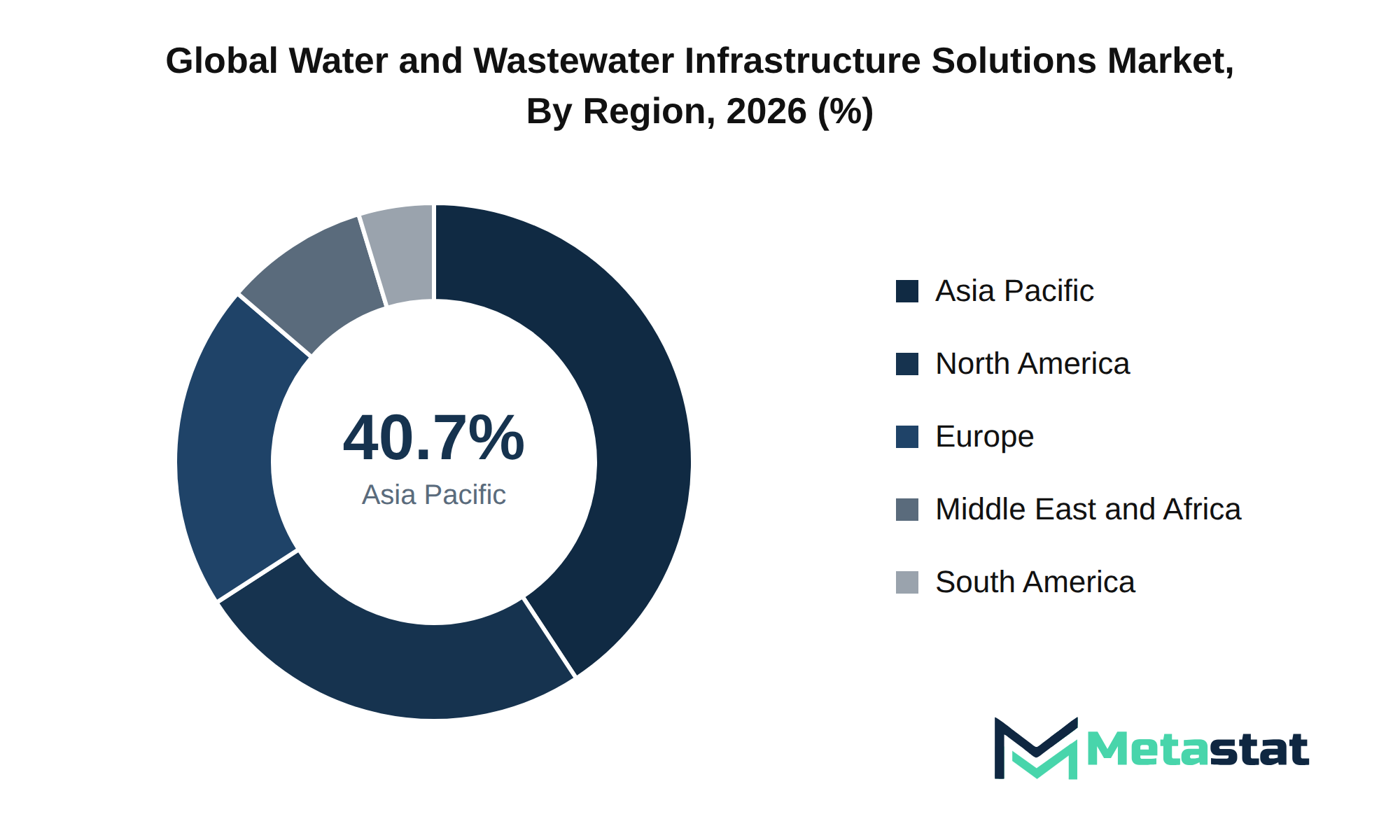
The Water and Wastewater Infrastructure Solutions market consists of several prominent players focusing on various strategic approaches to establish and maintain competitive advantages. Companies engage in mergers and acquisitions to enhance technological capabilities and expand market presence. Strategic alliances and joint ventures facilitate access to specialized resources and expertise, driving innovation and improving service offerings.
Product differentiation is significant in the market, with firms investing in research and development to introduce advanced technologies and sustainable solutions. Proprietary technologies and robust intellectual property portfolios provide a competitive edge, enabling companies to protect innovations and position themselves effectively against new entrants.
Customer retention strategies remain vital, with businesses emphasizing brand equity dynamics and enhancing customer relationships through tailored solutions. The market experiences varying barriers to entry, including significant capital requirements and regulatory compliance, which influence the competitive landscape and deter potential disruptors.
The outlook for competition in the Water and Wastewater Infrastructure Solutions market suggests ongoing consolidation. Firms seek to optimize value chains and strengthen procurement leverage. Companies including Veolia Water Technologies, SUEZ, and Xylem Inc. exemplify strategic growth vectors, enhancing capabilities to address evolving market demands and environmental challenges.
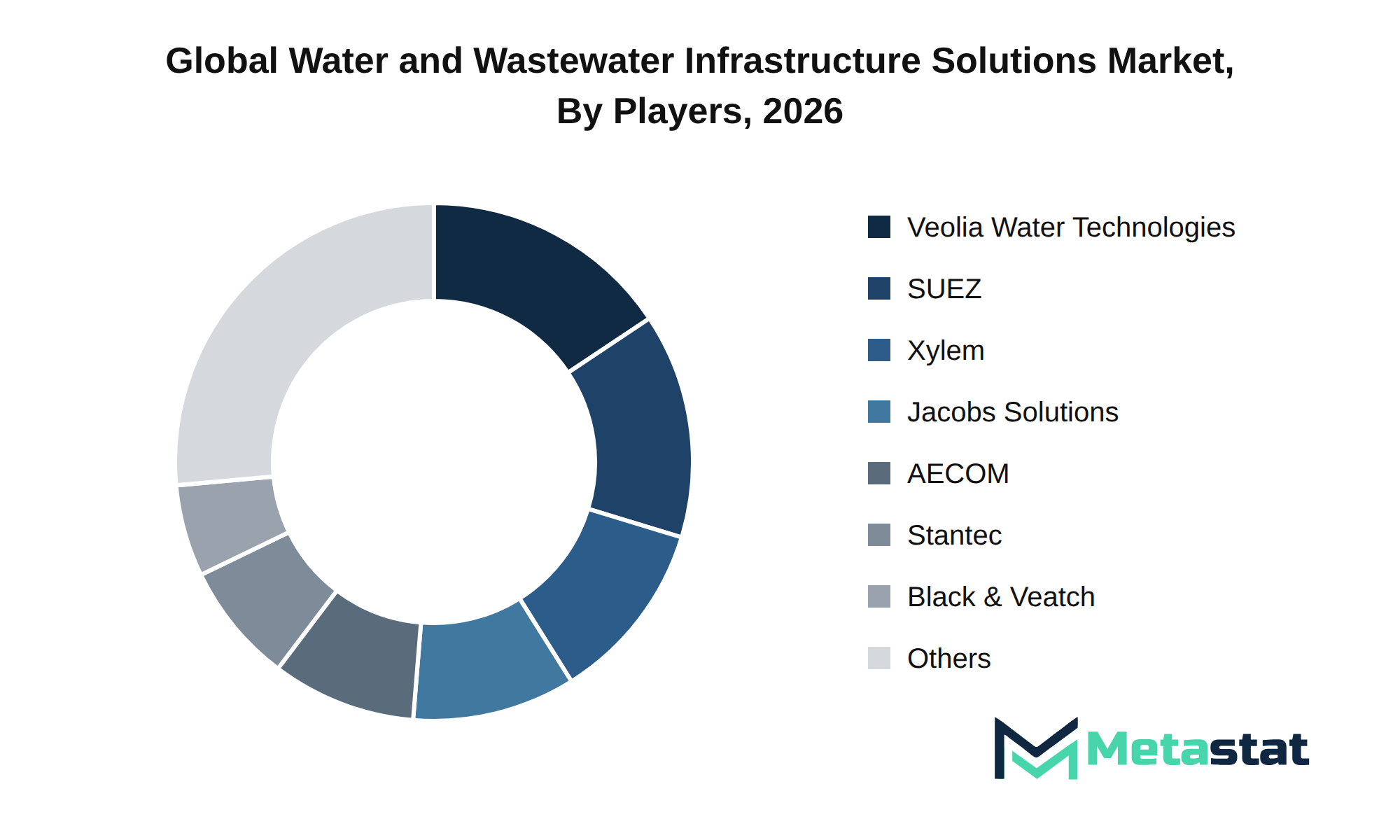
Market size is forecast to rise from USD 372.8 billion in 2025 to over USD 670 billion by 2033. This growth reflects a compound annual growth rate (CAGR) of 7.6%. The base case illustrates steady demand driven by urbanization, population growth, and regulatory pressures for improved water quality and resource management.
The bull case envisions accelerated investment in next-generation technologies, including smart water management systems and advanced treatment solutions, enhancing operational efficiency and addressing pressing environmental challenges. In contrast, the bear case anticipates potential obstacles, including geopolitical tensions, supply chain disruptions, and fluctuating commodity prices, which could hinder growth trajectories in the Water and Wastewater Infrastructure Solutions market.
Market participants navigate evolving regulatory requirements, compliance milestones, and strategic capital allocation while focusing on innovation and sustainability. Emerging white-space opportunities present avenues for addressing unmet enterprise needs, particularly in underserved regions. These dynamics contribute to the maturation of core industries and shape infrastructure commitments and capital expenditure investment vectors within the market.
The report strategically identifies and profiles the key market players and analyses their core competencies in each sub-segment of the Water and Wastewater Infrastructure Solutions market.
Report Attributes | Details |
Study Period | 2021-2033 |
Base Year | 2025 |
Estimated Year | 2026 |
Forecast Period | 2026-2033 |
Historical Period | 2021-2025 |
Growth Rate | CAGR 7.6% from 2026 to 2033 |
Revenue Unit | USD billion |
Segmentation | By Solution Type, Project Lifecycle Service, End-Use Sector, and Region |
By Region | North America (By Solution Type, Project Lifecycle Service, End-Use Sector, and Country)
|
Europe (By Solution Type, Project Lifecycle Service, End-Use Sector, and Country)
| |
Asia Pacific (By Solution Type, Project Lifecycle Service, End-Use Sector, and Country)
| |
South America (By Solution Type, Project Lifecycle Service, End-Use Sector, and Country)
| |
Middle East and Africa (By Solution Type, Project Lifecycle Service, End-Use Sector, and Country)
|
Find answers to common questions about this report
The Water and Wastewater Infrastructure Solutions market size was valued at USD 372.8 billion in 2025, according to the Metastat Insights study.
The Water and Wastewater Infrastructure Solutions market is projected to grow at a CAGR of 7.6% during the forecast period from 2026 to 2033.
The North America Water and Wastewater Infrastructure Solutions market size is estimated to reach USD 158.8 billion by 2033.
The segment leading the Water and Wastewater Infrastructure Solutions market is Municipal & Public Water Utilities, with a projected value of USD 301.5 billion by 2033. This segment demonstrates significant growth potential, driven by increasing demand for water services.
Investment in infrastructure development, technological integration, and shifting demographic patterns are key drivers for the Water and Wastewater Infrastructure Solutions market. Increased capital allocation from public and private sectors supports system upgrades, while the adoption of advanced technologies enhances operational efficiency and addresses challenges related to aging infrastructure and urbanization.
The Water and Wastewater Infrastructure Solutions market experiences growth constraints due to stringent regulatory compliance, which raises project costs and extends timelines. geopolitical fragmentation disrupts supply chains, complicating the procurement of essential materials and components, ultimately hindering project delivery and increasing costs for stakeholders.
Investment in infrastructure development significantly influences product adoption in the Water and Wastewater Infrastructure Solutions market. Increased capital allocation from public and private sectors, along with the integration of advanced technologies, creates a supportive environment for upgrading systems and addressing aging infrastructure challenges. Shifting demographic patterns and urbanization drive demand for efficient solutions, reinforcing market growth.
The Water and Wastewater Infrastructure Solutions market is estimated to reach a valuation of USD 670 billion by 2033.
Key players in the Water and Wastewater Infrastructure Solutions market include Veolia Water Technologies, SUEZ, Xylem Inc., Jacobs Solutions Inc., AECOM, and Black & Veatch.
The Drinking Water Treatment Plants segment is projected to reach USD 109.9 billion by 2033, growing from USD 69.6 billion in 2026, reflecting a compound annual growth rate of 6.7%.
The analysts below cover Packaging research at Metastat Insights.
LEAD ANALYST
Utkarsh Khirodkar is a Lead Market Research Analyst at MetaStat Insight, specializing in market intelligence, technology sector assessments, and competitive strategy.

SENIOR RESEARCH ANALYST
Biotechnology · Food and Beverages · Medical Devices · Packaging
Snehal Pasalkar is a Research Analyst at MetaStat Insight, operating at the intersection of life sciences research, competitive strategy, and market intelligence.

INDUSTRY CONSULTANT - CHEMICALS & ADVANCED MATERIALS
Chemicals and Materials · Machinery & Equipment · Packaging
Amit Gadhekar Consultant for Chemicals and Materials at MetaStat Insight, directing sector-specific intelligence, research, and strategic consulting across global chemical and processing markets.
Tracking ceramic matrix composite adoption in high-bypass aero engines requires strict attention to material qualification cycles and FAA airworthiness testing milestones. The MetaStat Insight team provided a detailed timeline of silicon carbide fiber manufacturing capacity and commercial foundry lead times. Having clear visibility into upstream thermal barrier coating supply helped us stress-test our long-term component procurement strategy.
Transitioning ultra-class mining haul trucks to alternative power requires concrete data on remote hydrogen refueling infrastructure economics. The report evaluated megawatt-scale electrolyzer installation expenses, onsite storage safety mandates, and heavy-duty fuel cell stack degradation under continuous duty cycles. That technical rigor helped our engineers benchmark realistic total operating cost horizons for off-highway fleet decarbonization.
Enterprise zero-trust network rollouts are often slowed down by multi-cloud transit latency and proprietary hardware retirement schedules. This study provided realistic total cost of ownership models comparing cloud-delivered security edge solutions against traditional hardware refreshes. The analysis of contract renewal lengths and software maintenance fees gave us clear visibility into enterprise replacement cycles over the next three to five years.
Explore related market intelligence reports worth reading alongside this one.
Starting from
$2950