
LEAD ANALYST
Utkarsh Khirodkar is a Lead Market Research Analyst at MetaStat Insight, specializing in market intelligence, technology sector assessments, and competitive strategy.

Pressure Pipe Market Size, Share, By Type (Plastic Pipe, Iron Pipe, Steel Pipe, Concrete Pipe, and Others), By Material (Poly Vinyl Chloride (PVC), High-Density Polyethylene (HDPE), Polypropylene (PP), Steel, Concrete, Cast Iron, and Others), By Application (Water, Wastewater, Oil, Gas, Chemical, Power Generation, and Others), By End-user (Residential, Commercial, Industrial, and Municipal), Industry Analysis, Growth, Trends, and Forecast, 2026-2033
Report ID
MSI-4576
Published
April, 2026
Pages
320 Pages
Format
Report Details
Choose Your License
Pressure Pipe Market
Global Pressure Pipe market valued at USD 37.7 billion in 2025, growing at a CAGR of 5.3% during 2026-2033, reaching USD 56.8 billion by 2033.
North America held 23.7% share in 2025, with the U.S. leading regional adoption.
Plastic Pipe segment accounted for a 47.0% market share in 2025.
Key trends driving growth: Expansion of water supply, irrigation, and wastewater infrastructure projects; Industrialization and energy investments requiring high-pressure fluid transport
Opportunities include Rising adoption of advanced materials such as HDPE and composite pressure pipes for durability and corrosion resistance.
Key insight: Urban infrastructure expansion and material innovation strengthen growth prospects for the Global Pressure Pipe market amid cost and regulatory constraints.
The Global Pressure Pipe market across commercial piping and fluid transportation will extend beyond basic water delivery and conventional infrastructure use cases. Over the approaching years, industry members will form strain pipe solutions to guide complex operational environments where reliability, durability, and system monitoring capabilities will carry more weight than volume-driven demand alone. Product development will increasingly align with specialised business applications which include strength transmission, chemical management, desalination systems, and advanced irrigation networks working under variable load situations.
Material science will shape future positioning, with producers shifting attention towards composite blends, bolstered polymers, and hybrid metal–plastic structures designed to address severe pressure cycles without compromising flexibility. The market will rely less on scale expansion and more on performance differentiation, where pressure tolerance, corrosion resistance, and installation adaptability define competitive standing. Custom engineering services will gain prominence, permitting suppliers to tailor pipe structures for assignment-specific strain profiles and regulatory frameworks.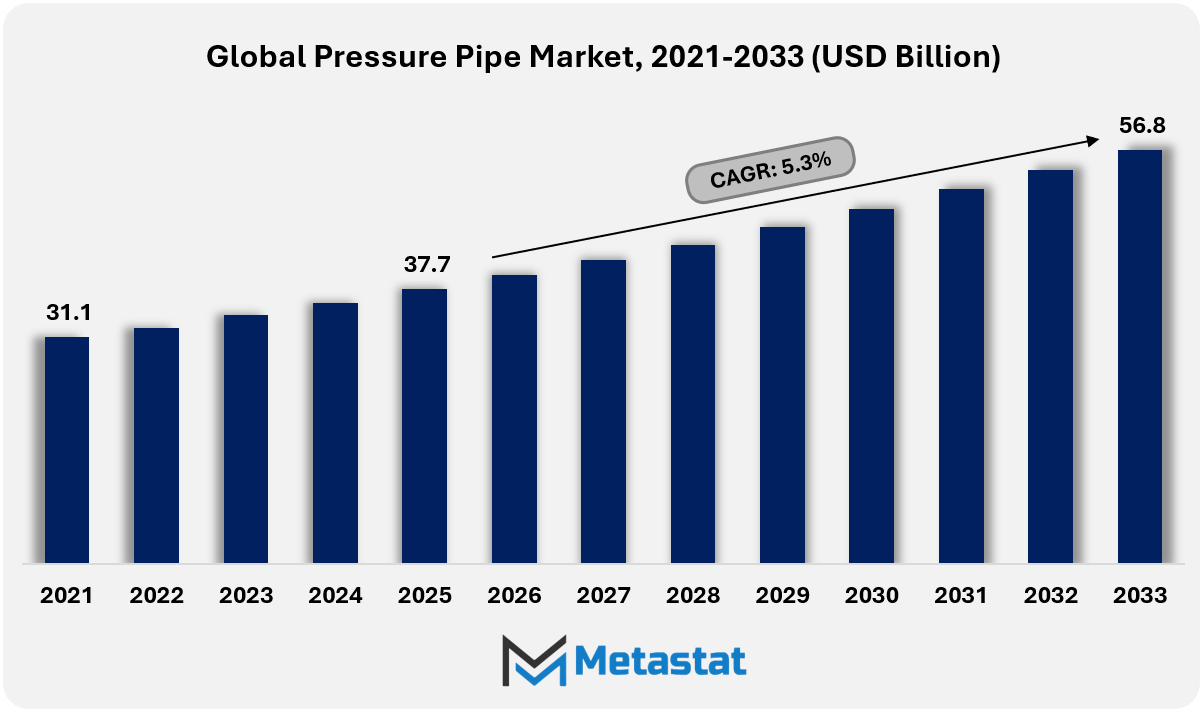
Expansion of water supply, irrigation, and wastewater infrastructure projects.
The Global Pressure Pipe market will benefit from sustained investments across municipal water networks, agricultural irrigation systems, and wastewater management projects. Rapid urban growth, population growth, and food safety priorities will push governments toward durable pressure piping solutions that support long-term flow stability and operational reliability.
Industrialization and energy investments requiring high-pressure fluid transport
Industrial zones and energy projects will increasingly rely on reliable fluid conveyance under elevated pressure conditions. Oil refining, chemical processing, electricity technology, and renewable installations will inspire wider use of bolstered piping structures. Such tendencies will position the Global Pressure Pipe marketplace for sustained call for pushed through performance-targeted infrastructure planning.
Fluctuating raw material prices impacting manufacturing costs.
Volatility across metals, polymers, and specialty resins will affect manufacturing economics for pressure pipe manufacturers. Unpredictable pricing trends will compress margins and complicate long-term procurement techniques. Cost uncertainty will slow capability expansion choices, creating pricing sensitivity throughout procurement cycles in the Global Pressure Pipe marketplace.
High installation and maintenance costs compared to non-pressure piping systems.
Pressure-rated pipelines require skilled labor, specialized jointing techniques, and stricter safety protocols. Installation complexity and periodic inspection needs will raise lifecycle expenditure. Budget-conscious projects will delay adoption despite performance benefits, growing adoption resistance across price-sensitive regions within the Global Pressure Pipe marketplace.
Rising adoption of advanced materials such as HDPE and composite pressure pipes for durability and corrosion resistance.
Material innovation will reshape future deployment patterns through lightweight structures, prolonged provider life, and resistance to chemical degradation. HDPE and composite answers will lessen downtime and replacement frequency. Such benefits will open new software zones and support long-term enlargement prospects for the Global Pressure Pipe market.
The Global Pressure Pipe market is segmented by Type, Material, Application, and End-User.
Plastic Pipe segment is estimated at USD 18.6 billion in 2026 and is projected to reach USD 28.3 billion by 2033, registering a CAGR of 6.1% during 2026-2033.
Plastic pipe adoption will accelerate through infrastructure upgrades and improved network monitoring for utility pipelines. Lightweight handling, corrosion resistance, and decreased lifecycle maintenance will assist wider setup throughout city initiatives. Future production awareness will improve strain tolerance and thermal stability, allowing long-term performance under demanding flow conditions without growing setup complexity or operational burden.
Iron Pipe segment is estimated at USD 4.5 billion in 2026 and is projected to reach USD 5.2 billion by 2033, at a CAGR of 2.1% during the forecast period.
Iron pipe utilization will remain relevant in applications requiring structural power and prolonged provider lifestyles. Advancements in inner linings and outside coatings will enhance resistance towards chemical exposure and moisture-driven degradation. Municipal utilities will rely on iron pipe networks for strong pressure control where mechanical durability and predictable overall performance remain important for many years.
Steel Pipe segment is estimated at USD 7.0 billion in 2026 and is projected to reach USD 9.7 billion by 2033, at a CAGR of 4.7% during the forecast period.
Steel pipe demand will develop across high-stress transmission corridors driven by power distribution enlargement. Improved alloy composition and precision welding will raise protection standards while reducing leakage risk. Automation in fabrication will deliver uniform quality, helping reliable shipping across various terrains whilst assembly stricter regulatory stress thresholds.
Concrete Pipe segment is estimated at USD 5.8 billion in 2026 and is projected to reach USD 7.7 billion by 2033, at a CAGR of 4.1% during the forecast period.
Concrete pipe installation will remain relevant for large-diameter networks in municipal water and wastewater systems, including pressurized transmission lines. Material engineering upgrades will give a boost to load-bearing potential and joint reliability. Infrastructure planners will prioritize concrete pipe solutions for lengthy-time period resilience within increasing city drainage and water supply frameworks.
Others segment is estimated at USD 3.7 billion in 2026 and is projected to reach USD 6 billion by 2033, at a CAGR of 6.9% during the forecast period.
Alternative pipe sorts will address specialised operational necessities together with temperature extremes and niche industrial flows. Material innovation will allow tailored answers without sacrificing pressure integrity. Such alternatives will complement mainstream categories through targeted deployment aligned with unique engineering needs.
Poly Vinyl Chloride (PVC) segment is projected to reach USD 15.7 billion by 2033, at a CAGR of 5.4% during the forecast period.
PVC utilization will increase through cost-effective water distribution projects and fast city housing growth. Enhanced formulations will enhance stress staying power and UV resistance. Utility operators will prefer PVC because of simplified setup methods and decreased maintenance expenditure, supporting sustainable community expansion.
High-Density Polyethylene (HDPE) segment is projected to reach USD 15 billion by 2033, at a CAGR of 6.7% during the forecast period.
HDPE adoption will increase owing to flexibility advantages and joint integrity under fluctuating pressure. Advanced extrusion strategies will supply uniform wall thickness and prolonged lifespan. Infrastructure modernization programs will combine HDPE for trenchless installation projects requiring minimal surface disruption.
Polypropylene (PP) segment is projected to reach USD 4.7 billion by 2033, at a CAGR of 7% during the forecast period.
Polypropylene usage will grow within chemical environments requiring thermal balance and chemical compatibility. Material refinement will support higher stress ratings without sacrificing flexibility. Industrial centers will install PP pipelines to preserve operational efficiency across controlled fluid shipping systems.
Steel segment is projected to reach USD 7.4 billion by 2033, at a CAGR of 4.4% during the forecast period.
Steel material selection will strengthen throughout lengthy-distance pressurized delivery networks. Surface treatment innovations will enhance corrosion protection and fatigue resistance. Strategic investments will focus on steel structures assisting power transition infrastructure, together with hydrogen and opportunity gas distribution.
Concrete segment is projected to reach USD 5.4 billion by 2033, at a CAGR of 3.7% during the forecast period.
Concrete fabric deployment will sustain growth within massive-scale municipal supply systems. Reinforcement generation enhancements will decorate crack resistance below internal stress hundreds. Urban planners will integrate strengthened concrete pipelines for a durable carrier throughout increasing metropolitan zones.
Cast Iron segment is projected to reach USD 4.1 billion by 2033, at a CAGR of 1.8% during the forecast period.
Cast iron usage will keep within legacy network upgrades, requiring compatibility with existing networks. Modern casting techniques will lessen brittleness and enhance sealing reliability. Public infrastructure initiatives will rely upon solid iron stability for long-duration service life expectations.
Others segment is projected to reach USD 4.6 billion by 2033, at a CAGR of 5.3% during the forecast period.
Emerging substances will benefit relevance via specialised engineering applications stressful precise performance tendencies. Research investment will free up hybrid compositions, assisting in better efficiency. Select deployment will complement traditional materials throughout evolving infrastructure desires.
Water and Wastewater segment is projected to reach USD 32.4 billion by 2033.
Water and wastewater infrastructure within the Global Pressure Pipe market will see sustained modernization driven by population growth and resource management priorities. Advanced monitoring integration will help with leakage reduction and pressure optimization. Governments will prioritize resilient piping networks, ensuring uninterrupted public supply services.
Oil and Gas segment is projected to reach USD 8.5 billion by 2033.
Oil and gas applications will demand bolstered pressure pipe structures, assisting in prolonged operational safety. Exploration interest and transmission improvements will encourage material innovation. Compliance-driven design requirements will elevate system reliability across upstream and downstream operations.
Chemical segment is projected to reach USD 5.9 billion by 2033.
Chemical industry usage will emphasize fabric compatibility and strain consistency. The manufacturing boom will stimulate demand for pipes able to manage reactive substances. Future systems will integrate stronger safety controls, assisting in non-stop industrial processing environments.
Power Generation segment is projected to reach USD 4 billion by 2033.
Power generation facilities would require strain pipe networks supporting cooling systems and fluid flow. Capacity growth and renewable integration will support demand. Engineering precision will ensure solid overall performance below continuous thermal and strain stress conditions.
Others segment is projected to reach USD 5.9 billion by 2033.
Additional applications will emerge across agriculture, mining, and specialized commercial operations. Tailored pipe solutions will deal with operationally demanding situations linked to pressure version. Market contributors will reply through adaptive design techniques.
Residential segment is projected to grow at a CAGR of 4.6% during the forecast period.
Residential infrastructure development will support sustained consumption through urban housing growth. Builders will prioritize pressure pipe systems, assisting dependable water distribution. Efficiency-targeted construction practices will inspire the adoption of long-lasting and occasional-renovation piping solutions.
Commercial segment is projected to grow at a CAGR of 4.4% during the forecast period.
Commercial centers will require strain pipe installations to help high-usage environments. Retail complexes and office developments will combine superior piping structures, ensuring constant delivery. Long-term operational reliability will have an impact on fabric selection decisions.
Industrial segment is projected to grow at a CAGR of 4.7% during the forecast period.
Industrial users will depend upon stress pipe networks for uninterrupted manufacturing process. Facility automation will grow the call for precision-engineered pipelines. Safety compliance and operational continuity will guide procurement techniques across production sectors.
Municipal segment is projected to grow at a CAGR of 6.2% during the forecast period.
Municipal authorities in the Global Pressure Pipe marketplace will invest in large-scale network upgrades addressing aging infrastructure. Strategic planning will focus on longevity and stress performance. Public provider reliability will stay primary to municipal pipeline deployment initiatives.
Based on geography, the Global Pressure Pipe market is divided into North America, Europe, Asia-Pacific, South America, Middle East, and Africa.
North America Pressure Pipe Market is set to expand at a CAGR of 5.3% within the forecast period, reaching a market size (TAM) of USD 12.8 billion by the end of 2033.
North America supports the Global Pressure Pipe Market through sustained funding for water infrastructure renewal across aging municipal networks. Regional growth is further supported by expansion in oil and gas transmission and industrial fluid transport systems.
Asia Pacific offers strong opportunity for the Global Pressure Pipe Market through rapid urban expansion, large-scale water supply projects, irrigation development, and industrialization across emerging economies.
The Middle East and Africa and South America support steady market progress through water scarcity management programs, infrastructure expansion, and public utility upgrades.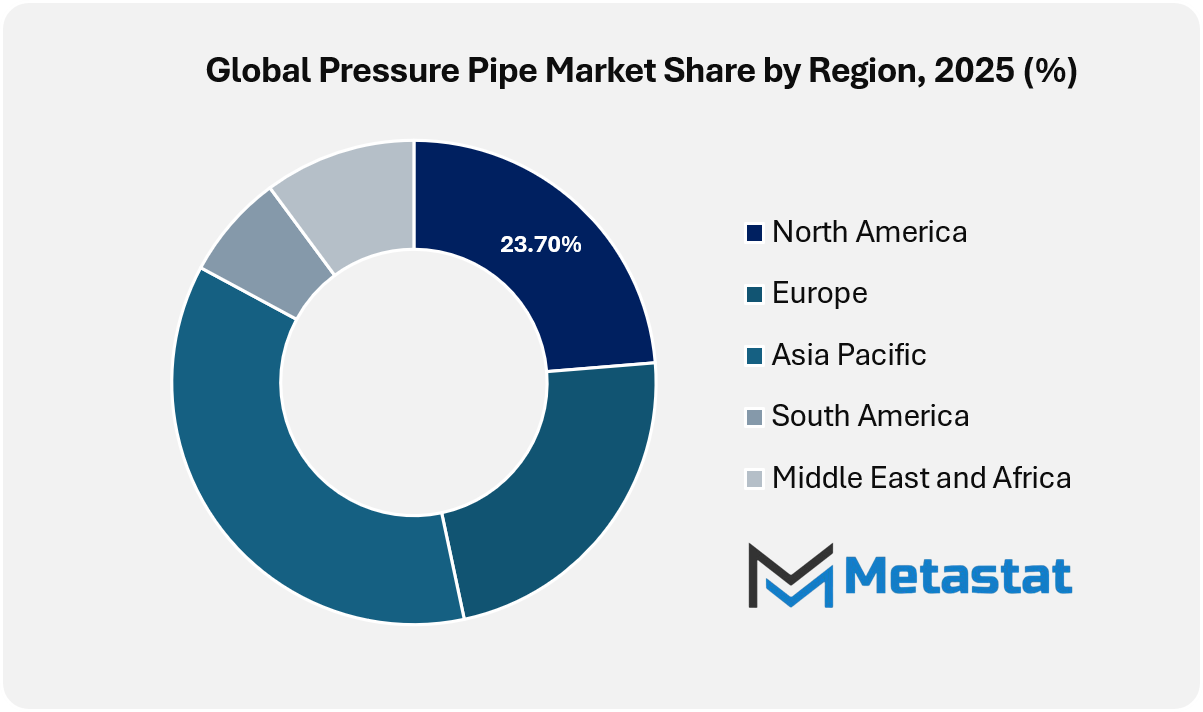
The Global Pressure Pipe market performs a crucial function in supporting present-day infrastructure, specifically in water delivery, irrigation, sewage, oil and gas, and business fluid transport. Growing urban populations, rising investments in public utilities, and stronger attention on durable piping solutions will continue to shape the market. Pressure pipes are valued for their ability to handle high internal pressure while maintaining lengthy service life, making them important for both new initiatives and gadget upgrades. Material innovation, price efficiency, and regional manufacturing strength will have an impact on how agencies compete and increase their presence.
Several competitors dominate the marketplace via scale, product reliability, and broad distribution networks. Companies including JM Eagle, IPEX Inc., WL Plastics, Westlake Pipe & Fittings, Northern Pipe Products, and Charlotte Pipe and Foundry have built strong recognition in plastic and composite stress pipe solutions. Their focus on consistent quality, regulatory compliance, and mission-specific customization will support long-term contracts with municipalities and private developers. At the same time, players like Astral Pipes, Finolex Industries Ltd., Tigre S/A, and Vinidex Pty Ltd. continue to strengthen their local leadership via capacity enlargement and local market understanding.
Metal and advanced composite strain pipe manufacturers also play a vital role in high-stress and huge-diameter applications. Companies such as Tata Ductura (Tata Steel), McWane Ductile, Northwest Pipe Company, Thompson Pipe Group, Tenaris S.A., and Future Pipe Industries address demanding use instances in which electricity and durability continue to be crucial. Amiblu Holding GmbH, NOV Fiber Glass Systems, and Molecor Tecnologia SL make contributions through specialized answers that stabilize corrosion resistance with lengthy operational lifestyles. These companies will gain from big infrastructure investments and long-term software initiatives throughout advanced and developing economies.
Innovation-driven and area-of-interest-targeted groups add depth to the competitive landscape. Firms consisting of Kubota-Chemix Co., Ltd, SIMONA AG, Wavin B.V. (Orbia), Pipelife International GmbH, Atkore International Inc., and Puhui Industry Co., Ltd aid the marketplace through superior materials, gadget integration, and performance-focused designs. Regional specialists like Cresline Plastic Pipe Co, Shand Group (Raksha), Sizabantu Piping Systems (Pty) Ltd, Zenith Irrigation, and Pexmart play an essential role in meeting localized infrastructure needs. With sustainability, lifecycle value reduction, and overall performance reliability advantage, these corporations will refine their services to live aggressively in a step-by-step developing market.
Market size is projected to increase from USD 37.7 billion in 2025 to USD 56.8 billion by 2033.
The global pressure pipe market will stand out as a technologically sophisticated segment driven by application-specific engineering rather than large-scale deployment. Its future position will depend on how effectively suppliers combine innovation with operational precision, lifecycle responsiveness and infrastructure flexibility in different industrial scenarios.
This research report categorizes the Pressure Pipe market based on key segments and regions, forecasts revenue growth, and analyses trends in each submarket. The report analyses the key growth drivers, opportunities, and challenges influencing the Pressure Pipe market. Recent market developments and competitive strategies such as expansion, product launch, partnership, merger, and acquisition have been included to draw the competitive landscape in the market.
|
Report Attributes |
Details |
|
Study Period |
2021-2033 |
|
Base Year |
2025 |
|
Estimated Year |
2026 |
|
Forecast Period |
2026-2033 |
|
Historical Period |
2021-2025 |
|
Growth Rate |
CAGR 5.3% from 2026 to 2033 |
|
Revenue Unit |
USD billion |
|
Sales Volume Unit |
Thousand Units |
|
Segmentation |
By Type, Material, Application, End-user, and Region |
|
By Region |
North America (By Type, Material, Application, End-user, and Country)
|
|
Europe (By Type, Material, Application, End-user, and Country)
|
|
|
Asia Pacific (By Type, Material, Application, End-user, and Country)
|
|
|
South America (By Type, Material, Application, End-user, and Country)
|
|
|
Middle East and Africa (By Type, Material, Application, End-user, and Country)
|
The report strategically identifies and profiles the key market players and analyses their core competencies in each sub-segment of the Pressure Pipe market.
Find answers to common questions about this report
Top players operating in the Pressure Pipe industry include Cresline Plastic Pipe Co, Kubota-Chemix Co., Ltd, Northern Pipe Products, Charlotte Pipe and Foundry, and Pexmart.
The Plastic Pipe is the leading type segment in the Global market.
Global Pressure Pipe market is estimated to reach USD 56.8 billion by 2033.
The Metastat Insights analysis shows that the North America Pressure Pipe market size is estimated to be USD 12.8 billion by 2033.
Fluctuating raw material prices impacting manufacturing costs will hamper market growth within the forecast period.
Asia Pacific is expected to lead market expansion during 2026-2033.
Expansion of water supply, irrigation, and wastewater infrastructure projects and industrialization and energy investments requiring high-pressure fluid transport are key factors boosting the market.
The Metastat Insights study shows that the Global Pressure Pipe market size was USD 37.7 billion in 2025.
The Global Pressure Pipe market is likely to grow at a CAGR of 5.3% over the forecast period (2026-2033).
The analysts below cover Machinery & Equipment research at Metastat Insights.
LEAD ANALYST
Utkarsh Khirodkar is a Lead Market Research Analyst at MetaStat Insight, specializing in market intelligence, technology sector assessments, and competitive strategy.

INDUSTRY CONSULTANT - CHEMICALS & ADVANCED MATERIALS
Chemicals and Materials · Machinery & Equipment · Packaging
Amit Gadhekar Consultant for Chemicals and Materials at MetaStat Insight, directing sector-specific intelligence, research, and strategic consulting across global chemical and processing markets.

PRINCIPAL CONSULTANT - QUALITY SYSTEMS & COMPLIANCE
Electronics and Semiconductor · Machinery & Equipment · Professional Services
Omkar Phadtare is an Industry Consultant at MetaStat Insight, specializing in quality systems, regulatory compliance, and standards benchmarking to drive data-driven market intelligence and strategic industry research.

ENERGY & INFRASTRUCTURE INDUSTRY CONSULTANT
Automotive and Transportation · Electronics and Semiconductor · Energy and Power · Machinery & Equipment
Saurabh Vasant Ganvir consults for Energy & Infrastructure Industry at MetaStat Insight, specializing in renewable energy, solar EPC, and electric vehicle (EV) infrastructure markets.

LEAD CONSULTANT - COMMUNICATION, TELECOM, AND IT
Electronics and Semiconductor · Information & Technology · Machinery & Equipment · Professional Services
Ravindra Sathe Consultants for Communication, Telecom, and IT at MetaStat Insight. He leads the firm's industry research initiatives across telecommunications infrastructure, digital connectivity, enterprise networking, and emerging information technology domains.
When planning edge sensor rollouts across refinery environments, generic IoT reports typically miss the harsh-environment certification bottlenecks. MetaStat Insight gave an objective evaluation of ATEX and Class 1 Division 2 hardware availability, along with realistic five-year maintenance cycle cost projections. The comparison of wireless mesh versus private cellular backhaul helped our team pressure-test network reliability models for remote processing facilities.
In the biological seed treatment space, registration timelines vary drastically between the European Union, Brazil, and North America. The MetaStat Insight research handled these cross-border regulatory barriers with genuine nuance, mapping commercialization pathways alongside historical field adoption rates. The segmentation between microbial strains and biochemical active ingredients was particularly well structured.
Our team was tracking whether regional recycling infrastructure could realistically absorb the growing volume of lithium iron phosphate batteries over the next decade. The report did a solid job separating announced hydrometallurgical plant capacity from active, permitted operational throughput. That distinction made the feedstock availability projections and regional recovery rate models far more credible than standard commercial overviews.
Explore related market intelligence reports worth reading alongside this one.
Starting from
$2950