
LEAD ANALYST
Utkarsh Khirodkar is a Lead Market Research Analyst at MetaStat Insight, specializing in market intelligence, technology sector assessments, and competitive strategy.

3D Models Market Size, Share, By Type (3Ds Max Models, Maya Models, Cinema 4D Models, Blender Models, Obj Models, FBX Models, and Others), By Application (Film, Television, Game, News Media, Advertising, Architecture, and Others), By Deployment Mode (On-Premises and Cloud), By End-User (Entertainment, Media, Architecture, Construction, Healthcare, Automotive, Defense, Retail, and Others), Industry Analysis, Growth, Trends, and Forecast, 2026-2033
Report ID
MSI-4624
Published
April, 2026
Pages
320 Pages
Format
Report Details
Choose Your License
3D Models Market
Global 3D Models market size is valued at USD 1,913.2 million in 2025 and projected to grow at a CAGR of 15.2% during the forecast period, reaching USD 5,931.3 million by 2033.
North America holds 35.0% in 2025 with US leading the market share in 2026.
3Ds Max Models segment account for a market share of 17.6% in 2025.
Key trends driving growth: Rapid growth of gaming, animation, and film production is significantly increasing demand for high-quality 3D assets and environments, along with expanding adoption of AR/VR, metaverse platforms, and immersive digital experiences is accelerating the use of 3D models across industries.
Opportunities include rising demand for real-time 3D content in e-commerce, digital twins, and virtual product visualization creates strong growth potential for scalable 3D asset libraries.
Key insight:The Global 3D Models market is transitioning toward scalable, cloud-integrated ecosystems where high-quality digital assets drive efficiency, realism, and immersive user experiences across industries.
The Global 3D Models market is also benefiting from rising demand for real-time rendering capabilities, as industries increasingly require instant visualization and interactive simulations for decision-making, design validation, and customer engagement.
Future market expansion is being supported by AI-based modeling tools, the growth of metaverse ecosystems, and rising integration of 3D assets into enterprise workflows. The shift toward cloud-based platforms and collaborative environments is further accelerating adoption across professional and commercial use cases.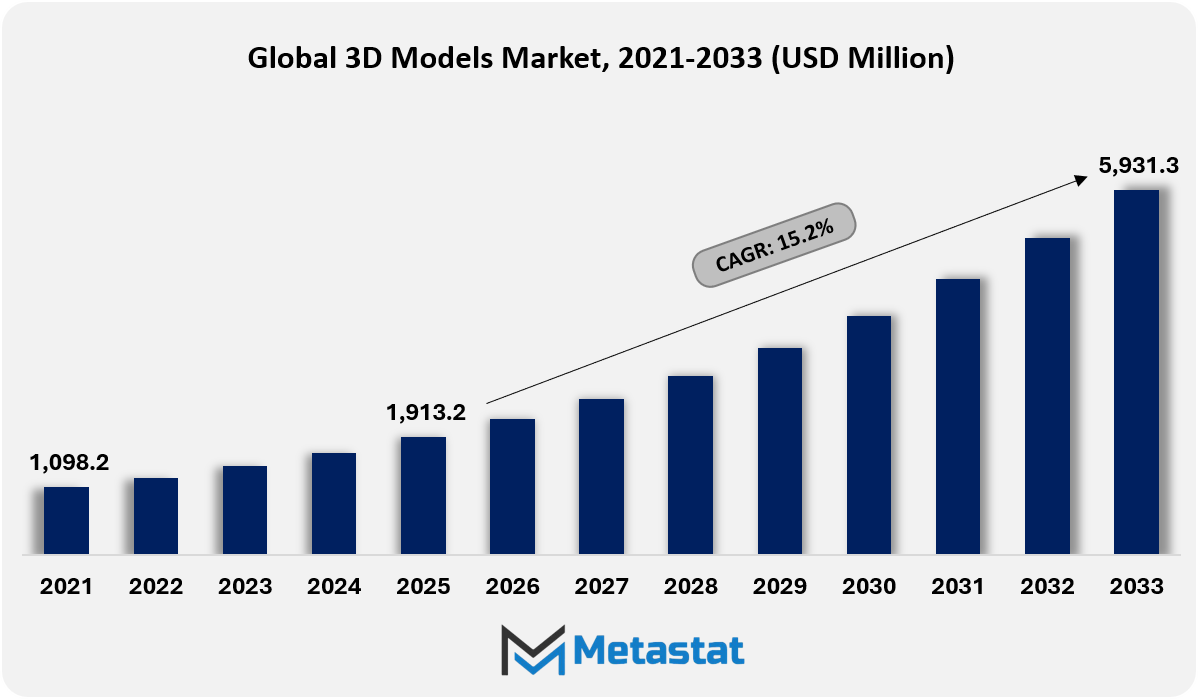
Rapid growth of gaming, animation, and film production is significantly increasing demand for high-quality 3D assets and environments.
The Global 3D Models market is witnessing strong momentum with the continuous expansion of gaming studios, animation production, and film development pipelines. Rising demand for realistic characters, environments, and visual effects is increasing the need for high-quality asset libraries, faster rendering performance, and scalable production workflows across global creative industries.
Expanding adoption of AR/VR, metaverse platforms, and immersive digital experiences is accelerating the use of 3D models across industries.
The Global 3D Models market is gaining further traction with the wider adoption of augmented reality, virtual reality, and metaverse platforms. Enterprises are increasingly using immersive visualization for training, marketing, simulation, and product presentation, which is driving demand for adaptable 3D assets suitable for cross-platform deployment and real-time interaction.
High skill requirements and complex software tools increase production costs and limit entry for smaller creators or studios.
The Global 3D Models market faces challenges related to advanced technical expertise, complex production workflows, and expensive design software. Limited availability of skilled professionals continues to increase operating costs for studios and independent creators, which restricts accessibility and slows participation from smaller entities in high-quality 3D asset development.
Intellectual property concerns and unauthorized redistribution of digital assets can reduce revenue for creators and markets.
The Global 3D Models market continues to face risks associated with asset piracy, intellectual property misuse, and unauthorized redistribution across digital platforms. Weak enforcement mechanisms reduce creator confidence and limit monetization opportunities, making secure licensing systems, digital rights controls, and asset tracking solutions increasingly important.
Rising demand for real-time 3D content in e-commerce, digital twins, and virtual product visualization creates strong growth potential for scalable 3D asset libraries.
The Global 3D Models market is benefiting from rising adoption of real-time visualization across e-commerce platforms and industrial applications. Digital twins and virtual product displays are creating strong demand for accurate and scalable 3D assets, supporting the development of standardized libraries that enable faster deployment, customization, and stronger user engagement in digital environments.
The Global 3D Models market is classified based on Type, Application, Deployment Mode, and End-User.
3Ds Max Models segment is valued at USD 387.0 million in 2026 and is projected to reach USD 970.2 million by 2033, at a CAGR of 14% during the forecast period.
The Global 3D Models market shows strong alignment with 3ds Max Models owing to their established use in high-precision rendering, architectural visualization, and advanced environment design. Continued compatibility with professional rendering systems and real-time engines is supporting adoption across content production pipelines and scalable asset creation workflows.
Maya Models segment is valued at USD 390 million in 2026 and is projected to reach USD 938.5 million by 2033, at a CAGR of 13.4% during the forecast period.
The Global 3D Models market is projected to record steady growth in Maya Models, supported by strong animation capabilities and industry-standard rigging tools. Studios continue to rely on Maya for character development, complex simulations, and cinematic production, while ongoing software enhancements are improving realism and supporting broader adoption across visual storytelling workflows.
Cinema 4D Models segment is valued at USD 250.7 million in 2026 and is projected to reach USD 625.2 million by 2033, at a CAGR of 13.9% during the forecast period.
The Global 3D Models market is gaining traction in Cinema 4D Models with rising demand for motion graphics, advertising content, and visual effects. Creative professionals prefer Cinema 4D for its intuitive workflow and efficient rendering output, which is supporting wider adoption across digital content production and faster project execution.
Blender Models segment is valued at USD 392.9 million in 2026 and is projected to reach USD 1,403.9 million by 2033, at a CAGR of 20% during the forecast period.
The Global 3D Models market is witnessing rapid expansion in Blender Models owing to open-source accessibility, strong community-driven innovation, and growing acceptance across professional environments. Designers, developers, and independent creators are increasingly adopting Blender for cost efficiency and flexibility, while continuous updates are strengthening functionality across commercial and creative workflows.
Obj Models segment is valued at USD 274.3 million in 2026 and is projected to reach USD 674.4 million by 2033, at a CAGR of 13.7% during the forecast period.
The Global 3D Models market continues to maintain steady demand for OBJ Models owing to broad compatibility across multiple platforms and design tools. The format supports seamless data exchange and workflow interoperability, which preserves its relevance in applications requiring standardized file structures and dependable geometry representation.
FBX Models segment is valued at USD 331.9 million in 2026 and is projected to reach USD 939.5 million by 2033, at a CAGR of 16% during the forecast period.
The Global 3D Models market is seeing rising adoption of FBX Models owing to strong support for animation data, rigging, and cross-platform integration. Game developers and digital content creators rely on FBX for efficient asset transfer, while workflow improvements are enhancing collaboration across production environments.
Others segment is valued at USD 175.3 million in 2026 and is projected to reach USD 379.6 million by 2033, at a CAGR of 11.7% during the forecast period.
The Global 3D Models market continues to evolve through alternative model formats that address niche requirements and specialized applications. Emerging formats are supporting advanced rendering methods, simulation capabilities, and workflow customization, ensuring adaptability across new technologies and expanding digital ecosystems.
Film & Television segment is projected to reach USD 1,164.4 million by 2033, at a CAGR of 14.8% during the forecast period.
The Global 3D Models market is expanding strongly in Film & Television with rising demand for cinematic visual effects, immersive storytelling, and virtual production. Production studios are investing in advanced modeling techniques to improve scene realism, creative flexibility, and production efficiency.
Game segment is projected to reach USD 1,997.1 million by 2033, at a CAGR of 16.8% during the forecast period.
The Global 3D Models market is witnessing robust growth in gaming applications, supported by rising demand for interactive experiences, realistic environments, and character-driven content. Game developers are increasingly using advanced 3D assets to improve visual quality, real-time rendering, and player engagement across multiple platforms.
News Media segment is projected to reach USD 376.3 million by 2033, at a CAGR of 10.9% during the forecast period.
The Global 3D Models market is gaining relevance in News Media through broader use of visual storytelling tools and data-led presentation formats. Broadcasters and digital publishers are integrating 3D models into content delivery to improve audience understanding, with future demand supported by augmented reality features and interactive news experiences.
Advertising segment is projected to reach USD 798.4 million by 2033, at a CAGR of 14.1% during the forecast period.
The Global 3D Models market is transforming advertising through stronger use of product visualization, immersive campaigns, and interactive brand communication. Companies are adopting 3D assets to improve customer engagement, support personalized digital experiences, and strengthen visual impact across marketing channels.
Architecture segment is projected to reach USD 1,088 million by 2033, at a CAGR of 16.3% during the forecast period.
The Global 3D Models market plays a significant role in Architecture by improving visualization of building designs, urban planning concepts, and project communication. Real-time simulation, detailed rendering, and precise model-based presentation are supporting faster decision-making and stronger project efficiency across construction workflows.
Others segment is projected to reach USD 507.1 million by 2033, at a CAGR of 13.8% during the forecast period.
The Global 3D Models market is extending across additional applications such as education, training, simulation, and engineering visualization. Organizations are using 3D assets to improve learning outcomes, operational efficiency, and digital engagement, which is supporting wider market expansion across emerging sectors.
On-Premises segment is projected to reach USD 1,747.2 million by 2033.
Global 3D Models market will maintain relevance in On-Premises deployment through demand for data security and control. Enterprises will prefer localized systems for sensitive projects. Future adoption will continue in sectors requiring strict compliance standards, ensuring reliable performance and secure asset management.
Cloud segment is projected to reach USD 4,184.1 million by 2033.
Global 3D Models market will accelerate in Cloud deployment through scalability and remote accessibility. Businesses will adopt cloud-based platforms to streamline collaboration and storage. Future advancements will improve processing capabilities, enabling efficient handling of complex models and supporting distributed creative teams.
Entertainment & Media segment is projected to grow at a CAGR of 17.3% during the forecast period.
The Global 3D Models market will remain strongest in Entertainment & Media, supported by continued growth in digital content creation, streaming, gaming, and immersive experiences. Studios are increasing investment in advanced modeling technologies, while virtual production and interactive storytelling continue to strengthen audience engagement across platforms.
Architecture & Construction segment is projected to grow at a CAGR of 15.9% during the forecast period.
The Global 3D Models market is expanding steadily in Architecture & Construction through rising need for accurate visualization, design communication, and project planning. Industry professionals are increasingly relying on 3D models to improve design precision, stakeholder collaboration, and smart infrastructure development.
Healthcare segment is projected to grow at a CAGR of 16.5% during the forecast period.
The Global 3D Models market is expanding in Healthcare through wider use in medical imaging, training, surgical planning, and anatomical visualization. Healthcare professionals are using 3D models to improve understanding of complex structures, with growing adoption supporting stronger precision and simulation-based outcomes.
Automotive segment is projected to grow at a CAGR of 14.2% during the forecast period.
The Global 3D Models market is gaining traction in Automotive through increased use in design prototyping, digital simulation, and product development workflows. Manufacturers are using 3D models to improve testing efficiency, shorten development timelines, and strengthen design accuracy across vehicle programs.
Defense segment is projected to grow at a CAGR of 13.8% during the forecast period.
The Global 3D Models market is expanding in Defense through broader use in simulation, training, mission planning, and operational visualization. Defense organizations are adopting 3D models to improve scenario analysis and readiness, with increasing reliance on digital training systems supporting long-term demand.
Retail segment is projected to grow at a CAGR of 14% during the forecast period.
The Global 3D Models market is reshaping Retail through virtual product displays, immersive commerce, and stronger digital shopping experiences. Retailers are adopting 3D visualization to improve product presentation and online engagement, while continued digital transformation is supporting wider use across commerce platforms.
Others segment is projected to grow at a CAGR of 9.9% during the forecast period.
The Global 3D Models market is also expanding across sectors such as education, engineering, and research. Organizations are leveraging 3D models to improve visualization, efficiency, and innovation, with broader cross-industry adoption supporting sustained market development.
Based on geography, the Global 3D Models market is divided into North America, Europe, Asia-Pacific, South America, Middle East, and Africa.
Strong presence of gaming studios, animation companies, and enterprise visualization users supports steady demand for high-quality 3D assets in North America.
Established automotive, architecture, design, and media industries continue to support adoption of 3D models across Europe.
Rapid expansion of gaming, mobile content creation, e-commerce visualization, and digital infrastructure investment is accelerating market growth in Asia Pacific.
Rising use of digital media, branded content, and architectural visualization is supporting gradual adoption of 3D modeling solutions across South America.
Smart city projects, real estate visualization, digital education tools, and media development are supporting emerging demand for 3D modeling solutions across Middle East & Africa.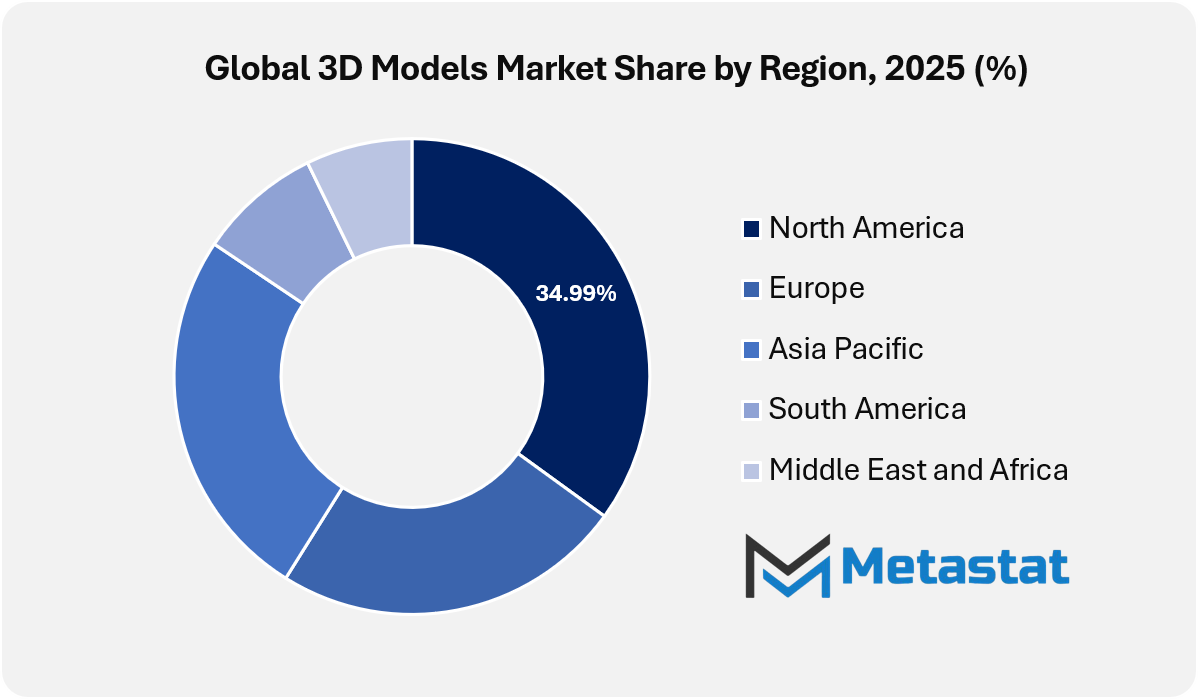
The Global 3D Models market will expand steadily as digital content becomes increasingly important across design, entertainment, e-commerce, architecture, and product development. Businesses are relying on high-quality visual assets to improve presentation, accelerate design workflows, and deliver more immersive user experiences. Rising use of ready-made and custom 3D assets across industries is strengthening the commercial value of digital model libraries and market platforms.
Ease of access is becoming a major growth enabler for the market. Earlier, 3D model creation required advanced technical expertise and expensive software, which limited wider participation. At present, many platforms offer user-friendly tools, cloud-based workflows, and extensive pre-built asset libraries, making 3D content creation and deployment more efficient for both professionals and new users. This shift is helping designers reduce production time and project costs, while also creating stronger monetization opportunities for independent creators.
Competitive intensity in the market continues to rise with the presence of large and specialized digital asset platforms. Companies such as TurboSquid, Inc., Sketchfab, CGTrader, Fab, Envato, Unity Asset Store, Thingiverse, MyMiniFactory, Cults, Creative Market, 3DExport, Free3D, 3dsky, MakerWorld, Printables, Cubebrush, FlippedNormals, Superhive Market, Daz 3D, RenderHub, Renderosity, 3DModels.org, Highend3D, CGAxis, KitBash3D, Design Connected, Evermotion, Renderpeople, DOSCH 3D, Maxtree, Poly Haven, and Blend Swap continue to strengthen the ecosystem by serving both asset creators and end users. Platform usability, asset quality, licensing flexibility, pricing, and catalog breadth remain key factors influencing buyer preference and competitive positioning.
Technology advancement is also expected to play a central role in future market development. Increasing adoption of virtual reality, augmented reality, real-time rendering, and AI-assisted modeling tools is driving stronger demand for realistic and production-ready 3D assets. At the same time, wider availability of online learning resources and design communities is supporting skill development, expanding the creator base, and improving long-term market scalability.
Market size is forecast to rise from USD 1,913.2 million in 2025 to over USD 5,931.3 million by 2033.
The Global 3D Models market is projected to grow rapidly, supported by rising demand for immersive digital experiences, real-time visualization, and advanced simulation technologies. Market expansion is being strengthened by AI-assisted modeling tools, growth of metaverse ecosystems, and deeper integration of 3D assets into enterprise workflows. Cloud-based platforms and collaborative environments are further accelerating adoption across industries.
By Type:
By Application:
By Deployment Mode:
By End-User:
This research report categorizes the 3D Models market based on key segments and regions, forecasts revenue growth, and analyses trends in each submarket. The report analyses the key growth drivers, opportunities, and challenges influencing the 3D Models market. Recent market developments and competitive strategies such as expansion, product launch, partnership, merger, and acquisition have been included to draw the competitive landscape in the market.
The report strategically identifies and profiles the key market players and analyses their core competencies in each sub-segment of the 3D Models market.
|
Report Attributes |
Details |
|
Study Period |
2021-2033 |
|
Base Year |
2025 |
|
Estimated Year |
2026 |
|
Forecast Period |
2026-2033 |
|
Historical Period |
2021-2025 |
|
Growth Rate |
CAGR 15.2% from 2026 to 2033 |
|
Revenue Unit |
USD Million |
|
Segmentation |
By Type, Application, Deployment Mode, End-User, and Region |
|
By Region |
North America (By Type, Application, Deployment Mode, End-User, and Country)
|
|
Europe (By Type, Application, Deployment Mode, End-User, and Country)
|
|
|
Asia Pacific (By Type, Application, Deployment Mode, End-User, and Country)
|
|
|
South America (By Type, Application, Deployment Mode, End-User, and Country)
|
|
|
Middle East and Africa (By Type, Application, Deployment Mode, End-User, and Country)
|
Find answers to common questions about this report
Rapid growth of gaming, animation, and film production is significantly increasing demand for high-quality 3D assets and environments and expanding adoption of AR/VR, metaverse platforms, and immersive digital experiences is accelerating the use of 3D models across industries. are key driving factors, boosting the market.
The Maya Models is the leading type of segment in the Global market.
Top players operating in the 3D Models industry include TurboSquid, Inc., Sketchfab, CGTrader, Fab, Envato, Unity Asset Store, and Thingiverse.
Global 3D Models market is estimated to reach USD 5,931.3 million by 2033.
North America region dominates the market.
High skill requirements and complex software tools increase production costs and limit entry for smaller creators or studios will hamper the market growth within the forecast period.
The Global 3D Models market is expected to grow at a CAGR of 15.2% over the forecast period (2026-2033).
The Metastat Insights analysis shows that the North America 3D Models market size is estimated to be USD 1,778.8 million by 2033.
The Metastat Insights study shows that the Global 3D Models market size was USD 1,913.2 million in 2025.
The analysts below cover Information & Technology research at Metastat Insights.
LEAD ANALYST
Utkarsh Khirodkar is a Lead Market Research Analyst at MetaStat Insight, specializing in market intelligence, technology sector assessments, and competitive strategy.

PRINCIPAL CONSULTANT - ENTERPRISE AI & EMERGING TECHNOLOGIES
Banking & Finance · Electronics and Semiconductor · Energy and Power · Healthcare IT · Information & Technology · Professional Services
Vijay Gunti is a Principal Consultant at MetaStat Insight, bringing over two decades of experience across enterprise digital transformation, technology strategy, and intelligent systems.

LEAD CONSULTANT - COMMUNICATION, TELECOM, AND IT
Electronics and Semiconductor · Information & Technology · Machinery & Equipment · Professional Services
Ravindra Sathe Consultants for Communication, Telecom, and IT at MetaStat Insight. He leads the firm's industry research initiatives across telecommunications infrastructure, digital connectivity, enterprise networking, and emerging information technology domains.
When evaluating distributed energy resource management systems, standard research summaries tend to gloss over the operational differences between front-of-the-meter utility deployments and behind-the-meter industrial sites. The MetaStat Insight report addressed those distinctions directly, especially regarding software interoperability standards and grid interconnection backlogs. The five-year market sizing across regional transmission organizations provided actionable context for our grid modernization strategy.
Most industry reports on warehouse automation bundle autonomous mobile robots and fixed conveyor installations into the same top-level numbers, which complicates advisory work. This study split the market cleanly by payload tiers, navigation technology, and fleet management software layers. The regional forecast for Western Europe gave our team defensible adoption benchmarks when evaluating capital allocation for logistics clients, saving us days of secondary data scrubbing.
Analyzing the transition from natural gas to green hydrogen in iron ore reduction requires realistic infrastructure timelines. Meta stat insight supplied a detailed regional assessment of DRI plant conversion costs and scrap metal availability in North America and Western Europe. Their report carefully examined pellet quality specs and electrical grid access constraints without making oversimplified market assumptions. The research material served as a practical reference during internal technology roadmap discussions.
Explore related market intelligence reports worth reading alongside this one.
Starting from
$2950