
LEAD ANALYST
Utkarsh Khirodkar is a Lead Market Research Analyst at MetaStat Insight, specializing in market intelligence, technology sector assessments, and competitive strategy.

Abrasives Market Size, Share, By Product Type (Bonded Abrasives, Coated Abrasives, Super Abrasives, and Others), By Material (Natural and Synthetic), By Application (Grinding, Cutting, Polishing, Drilling, Finishing, Dressing, and Others), By End User (Automotive, Transportation, Manufacturing, Construction, Heavy Machinery, Metal Fabrication, Electrical, Electronics Equipment, and Others), Industry Analysis, Growth, Trends, and Forecast, 2026-2033
Report ID
MSI-4671
Published
April, 2026
Pages
312 Pages
Format
Report Details
Choose Your License
Abrasives Market
The Global Abrasives market size was valued at USD 51.6 billion in 2025 and projected to grow at a CAGR of 6.0% during the forecast period, reaching USD 82.2 billion by 2033.
North America accounted for 23.6% of the Global Abrasives market in 2025, with the United States leading the regional market.
Coated Abrasives is the leading product type segment in the Global Abrasives market.
Key trends driving growth: Rising industrial manufacturing and metal fabrication activities propel consistent demand for grinding, cutting, and surface finishing solutions, along with increased adoption of advanced machining and precision engineering techniques supports sustained abrasives consumption
Opportunities include rising demand for high-performance and eco-friendly abrasives across aerospace, electronics, and renewable energy manufacturing.
Key insight: Rising industrial manufacturing and precision engineering requirements continue to strengthen the growth trajectory of the Global Abrasives market.
The Global Abrasives market is expanding beyond traditional industrial applications into advanced manufacturing, precision engineering, and sustainable materials processing. Abrasives are no longer limited to grinding wheels and polishing discs, but are increasingly used in aerospace surface finishing, semiconductor wafer processing, electric vehicle battery component manufacturing, and additive manufacturing post-processing. Performance expectations for abrasive materials continue to rise, with end users seeking tighter tolerances, cleaner finishes, and compatibility with automated production environments.
In high-precision sectors such as medical device manufacturing and microelectronics, abrasive solutions support ultra-fine surface finishing where even minor deviations affect product performance and reliability. The shift toward lightweight alloys and composite materials in automotive and aerospace manufacturing is increasing the need for abrasive systems that can handle varying hardness levels and thermal sensitivities. Advanced formulations using engineered ceramics and synthetic diamonds will gain wider adoption in robotics-enabled machining environments, supporting the evolution of smart manufacturing systems.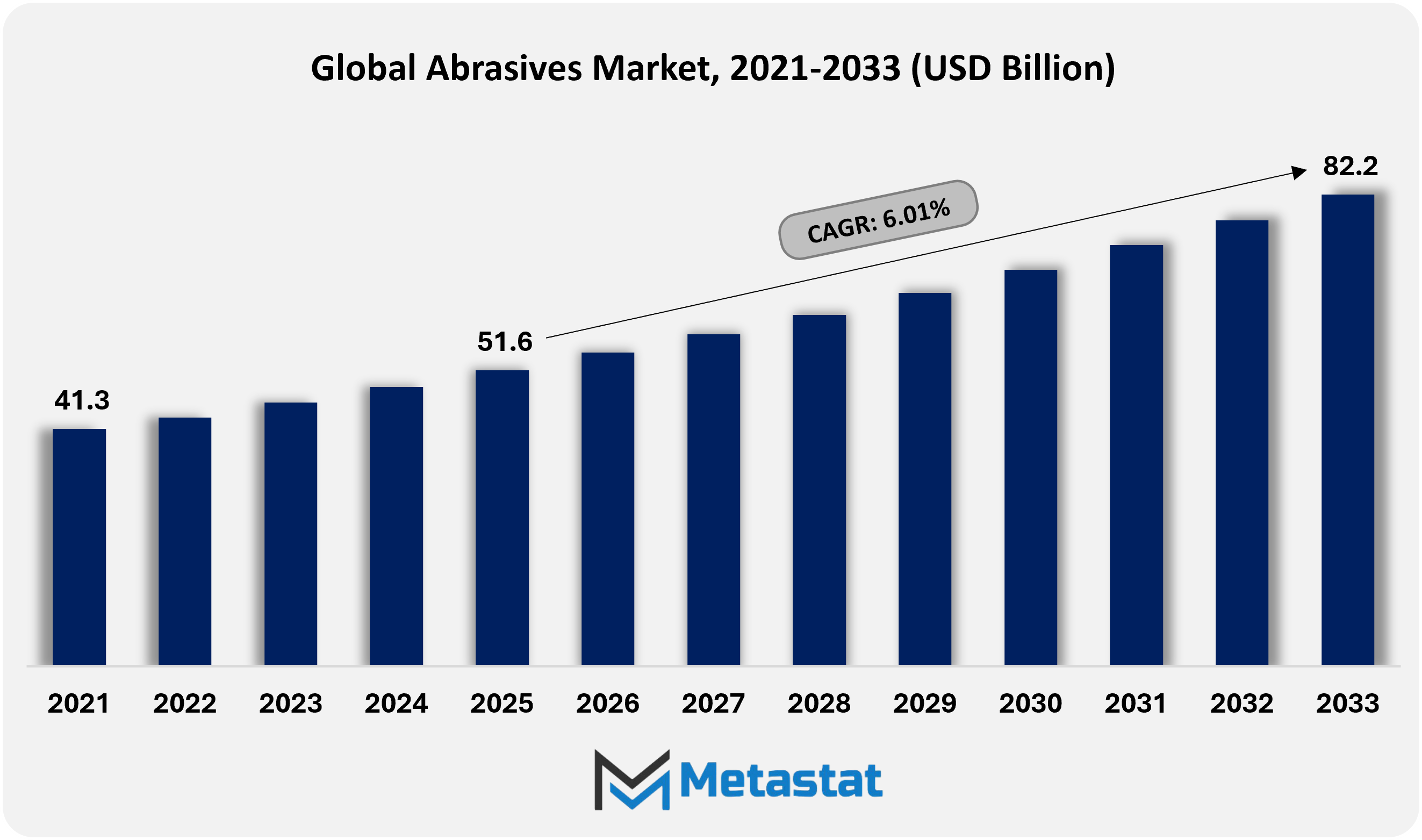
Rising industrial manufacturing and metal fabrication activities propel consistent demand for grinding, cutting, and surface finishing solutions.
Rising industrial output across automotive, construction, heavy equipment, and infrastructure sectors is strengthening demand for grinding, cutting, and surface finishing solutions. Expansion of fabrication facilities and modernization of production lines are increasing reliance on efficient abrasive tools. The Global Abrasives market will maintain steady momentum through continuous surface preparation requirements across multiple manufacturing industries.
Increased adoption of advanced machining and precision engineering techniques supports sustained abrasives consumption
Integration of computer-controlled machining, micro-finishing systems, and automated production technologies is raising quality and performance standards in component manufacturing. Precision engineering requires higher finishing accuracy and tighter tolerances, supporting increased use of advanced abrasives. The Global Abrasives market will benefit from continued alignment with high-speed machining and precision calibration requirements across advanced industrial environments.
Volatility in raw material prices, including aluminum oxide and silicon carbide, impacts cost structures and margins
Fluctuations in mining output, energy costs, and global trade conditions continue to affect input price stability. Unpredictable pricing for aluminum oxide and silicon carbide can pressure manufacturing planning and profit margins. Market participants will need stronger sourcing strategies and supply chain optimization to maintain cost competitiveness.
Occupational health and environmental regulations related to dust emissions and waste disposal restrict unrestricted usage
Regulatory authorities across major economies are tightening standards related to dust emissions, worker safety, and industrial waste disposal. Compliance with these requirements is increasing the need for filtration systems, cleaner production methods, and safer application practices. Growth in the Global Abrasives market will increasingly depend on adaptation to environmental and occupational safety standards.
Growing demand for high-performance and eco-friendly abrasives in aerospace, electronics, and renewable energy manufacturing presents expansion potential
Expanding aerospace applications, semiconductor fabrication capacity, and renewable energy infrastructure are creating new opportunities for advanced abrasive formulations. Development of recyclable materials and low-emission products is gaining importance in industrial procurement and sustainability programs. The Global Abrasives market will expand through product innovation focused on durability, precision, and environmental compatibility.
The Global Abrasives market is classified based on Product Type, Material, Application, and End User.
Bonded Abrasives segment is estimated at USD 18.4 billion in 2026 and is projected to reach USD 25.6 billion by 2033, at a CAGR of 4.8% during the forecast period.
Bonded abrasives will retain strong relevance across precision engineering and automated manufacturing environments. Integration with advanced grinding systems will support consistent material removal, dimensional stability, and controlled surface finish. Increased use of high-strength alloys and composite materials will encourage development of durable bonded solutions designed for high-speed and high-load industrial operations across global production facilities.
Coated Abrasives segment is estimated at USD 21.7 billion in 2026 and is projected to reach USD 31.4 billion by 2033, at a CAGR of 5.4% during the forecast period.
Coated abrasives will continue to gain wider usage across surface preparation, finishing, and refurbishment applications driven by industrial modernization. Growth in furniture production, automotive refinishing, metalworking, and maintenance operations will support adoption across multiple end-use industries. Improvements in backing materials, grain technology, and adhesion performance will enhance productivity and broaden application scope within the Global Abrasives market.
Super Abrasives segment is estimated at USD 10.5 billion in 2026 and is projected to reach USD 19.2 billion by 2033, at a CAGR of 9% during the forecast period.
Super abrasives will witness strong adoption across high-precision applications requiring exceptional hardness, thermal resistance, and dimensional consistency. Semiconductor processing, aerospace component manufacturing, and medical device production will increasingly rely on diamond and cubic boron nitride solutions for critical finishing operations. Ongoing focus on micron-level accuracy, extended tool life, and process efficiency will strengthen the premium position of super abrasives in the market.
Others segment is estimated at USD 4 billion in 2026 and is projected to reach USD 6 billion by 2033, at a CAGR of 6% during the forecast period.
Other abrasive categories, including non-woven abrasives and specialty blends, will address niche industrial requirements across polishing, deburring, and fine finishing applications. Engineered textures and customized surface solutions will support controlled finishing in selected manufacturing operations. Product diversification and application-specific development will help suppliers capture incremental opportunities across emerging industrial markets.
Natural segment is projected to reach USD 19.5 billion by 2033, at a CAGR of 3.4% during the forecast period.
Natural abrasive materials will continue to hold relevance across cost-sensitive applications and conventional surface treatment processes. Availability, sourcing efficiency, and application suitability will remain key factors influencing their usage across selected industries. Preference for lower-impact material options in specific operations will support continued demand for natural abrasives within parts of the Global Abrasives market.
Synthetic segment is projected to reach USD 62.7 billion by 2033, at a CAGR of 7% during the forecast period.
Synthetic abrasive materials will dominate performance-driven applications requiring uniform grain structure, higher durability, and predictable processing outcomes. Advances in material engineering and controlled production methods will support large-scale supply of high-consistency abrasive products. Expansion of automated manufacturing, high-speed machining, and precision finishing environments will continue to strengthen demand for synthetic formats across the Global Abrasives market.
Grinding segment is projected to reach USD 22.8 billion by 2033.
Grinding will remain a core application area within the Global Abrasives market, supported by widespread use across metalworking, machinery, automotive, and industrial maintenance activities. Automated production systems and tighter dimensional requirements will increase the need for abrasives that offer stable performance under continuous operation. Advanced grinding solutions will remain essential for achieving accuracy, productivity, and surface integrity across industrial processes.
Cutting segment is projected to reach USD 17.5 billion by 2033.
Cutting applications will continue to benefit from demand for abrasive discs and wheels designed for higher efficiency, material control, and operational safety. Growth in infrastructure, fabrication, shipbuilding, and equipment manufacturing will support steady use of cutting abrasives across industrial settings. Product innovation aimed at durability, faster cutting rates, and reduced material loss will strengthen market potential in this segment.
Polishing segment is projected to reach USD 13.4 billion by 2033.
Polishing applications will expand alongside rising demand for improved surface appearance, smoothness, and finishing precision across industrial and consumer-oriented manufacturing sectors. Automotive finishing, electronics production, and metal component treatment will remain key demand areas for polishing abrasives. Development of fine-grit and micro-abrasive technologies will support broader penetration across premium finishing applications.
Drilling segment is projected to reach USD 7.6 billion by 2033.
Drilling applications using abrasive-based solutions will remain important in operations involving hard materials, engineered surfaces, and specialized industrial components. Construction activity, energy infrastructure, and heavy equipment manufacturing will continue to support demand in this area. Product development focused on heat resistance, structural stability, and drilling efficiency will strengthen application relevance across industrial markets.
Finishing segment is projected to reach USD 11.4 billion by 2033.
Finishing applications will gain importance owing to increasing industrial emphasis on quality assurance, dimensional control, and surface compliance standards. Aerospace, tooling, electronics, and precision component manufacturing will require refined finishing solutions capable of delivering repeatable results. Improved abrasive formulations and better process control will support growth across high-value finishing operations in the Global Abrasives market.
Dressing segment is projected to reach USD 4.3 billion by 2033.
Dressing applications will remain necessary for maintaining grinding wheel performance, process efficiency, and tool life across industrial manufacturing environments. Automated conditioning systems and precision machining setups will continue to use dressing solutions for wheel correction and performance restoration. Steady relevance of grinding-intensive operations will sustain demand for dressing products across the market.
Others segment is projected to reach USD 5.1 billion by 2033.
Other applications, including deburring, cleaning, and surface conditioning, will contribute additional demand across diverse industrial activities. Small and medium-scale manufacturers will continue to adopt flexible abrasive tools suited to cost-efficient operations and varied finishing requirements. Broader industrialization across developing markets will support gradual expansion of these application areas.
Automotive & Transportation segment is projected to grow at a CAGR of 5.3% during the forecast period.
Automotive and transportation industries will continue to use abrasives extensively across component shaping, surface preparation, grinding, and finishing operations. Electric vehicle production, lightweight material processing, and higher quality standards will strengthen requirement for advanced abrasive solutions. Stable vehicle manufacturing activity and ongoing process modernization will support sustained consumption within this end-user segment.
Manufacturing & Construction segment is projected to grow at a CAGR of 6.8% during the forecast period.
Manufacturing and construction will remain major end-use sectors for abrasives, supported by infrastructure development, equipment production, and industrial modernization activity. Steel processing, concrete treatment, fabrication, and assembly operations require reliable abrasive solutions for surface preparation and material finishing. Continued expansion of industrial capacity and urban development projects will reinforce long-term demand across this segment.
Heavy Machinery segment is projected to grow at a CAGR of 5.1% during the forecast period.
Heavy machinery manufacturing will rely on durable abrasives for processing large metal components, maintaining dimensional accuracy, and supporting equipment performance. Production growth across mining, agriculture, material handling, and infrastructure machinery will increase the need for robust grinding and cutting solutions. Abrasives with higher durability and consistent operating performance will remain important across this segment.
Metal Fabrication segment is projected to grow at a CAGR of 7.3% during the forecast period.
Metal fabrication will continue to represent a strong demand center for abrasives owing to widespread use in cutting, grinding, deburring, and finishing structural and custom metal components. Growth in fabricated steel products, industrial assemblies, and precision metal parts will support consumption across workshops and production facilities. Higher automation and quality requirements will further strengthen demand for performance-oriented abrasive systems.
Electrical & Electronics Equipment segment is projected to grow at a CAGR of 6.7% during the forecast period.
Electrical and electronics equipment manufacturing will increasingly adopt high-precision abrasives for component shaping, surface treatment, and finishing of sensitive materials. Miniaturization trends, semiconductor expansion, and higher accuracy requirements will support usage of fine-performance abrasive products across the segment. Technological advancement in electronics production will continue to create attractive opportunities for specialized abrasives.
Others segment is projected to grow at a CAGR of 0.6% during the forecast period.
Other end users, including marine equipment, energy systems, and general industrial maintenance operations, will contribute stable demand across selected abrasive applications. Diverse industrial activity in emerging economies will support adoption of tailored abrasive products across specialized use cases. Broader participation from smaller industrial sectors will help maintain balanced market expansion.
Based on geography, the Global Abrasives market is divided into North America, Europe, Asia-Pacific, South America, Middle East, and Africa.
North America Abrasives Market is set to expand at a CAGR of 6.0% within the forecast period, reaching a market size (TAM) of USD 17.6 billion by the end of 2033.
North America’s advanced industrial infrastructure and excessive adoption of precision machining technology boost up abrasives utilization across metallic fabrication devices.
Europe will remain an important regional market for abrasives, supported by advanced automotive production, industrial machinery manufacturing, aerospace engineering, and precision metalworking activity.
Asia Pacific’s rapid urbanization and huge-scale infrastructure initiatives create sizable increase possibilities for producers inside the Abrasives Market.
Asia Pacific expanding electronics and automotive manufacturing hubs open new revenue avenues for covered and bonded abrasives providers.
Across the Middle East, Africa, and South America, the Abrasives Market reflects gradual growth supported by means of infrastructure development, mining activity, and growing industrial processing capability.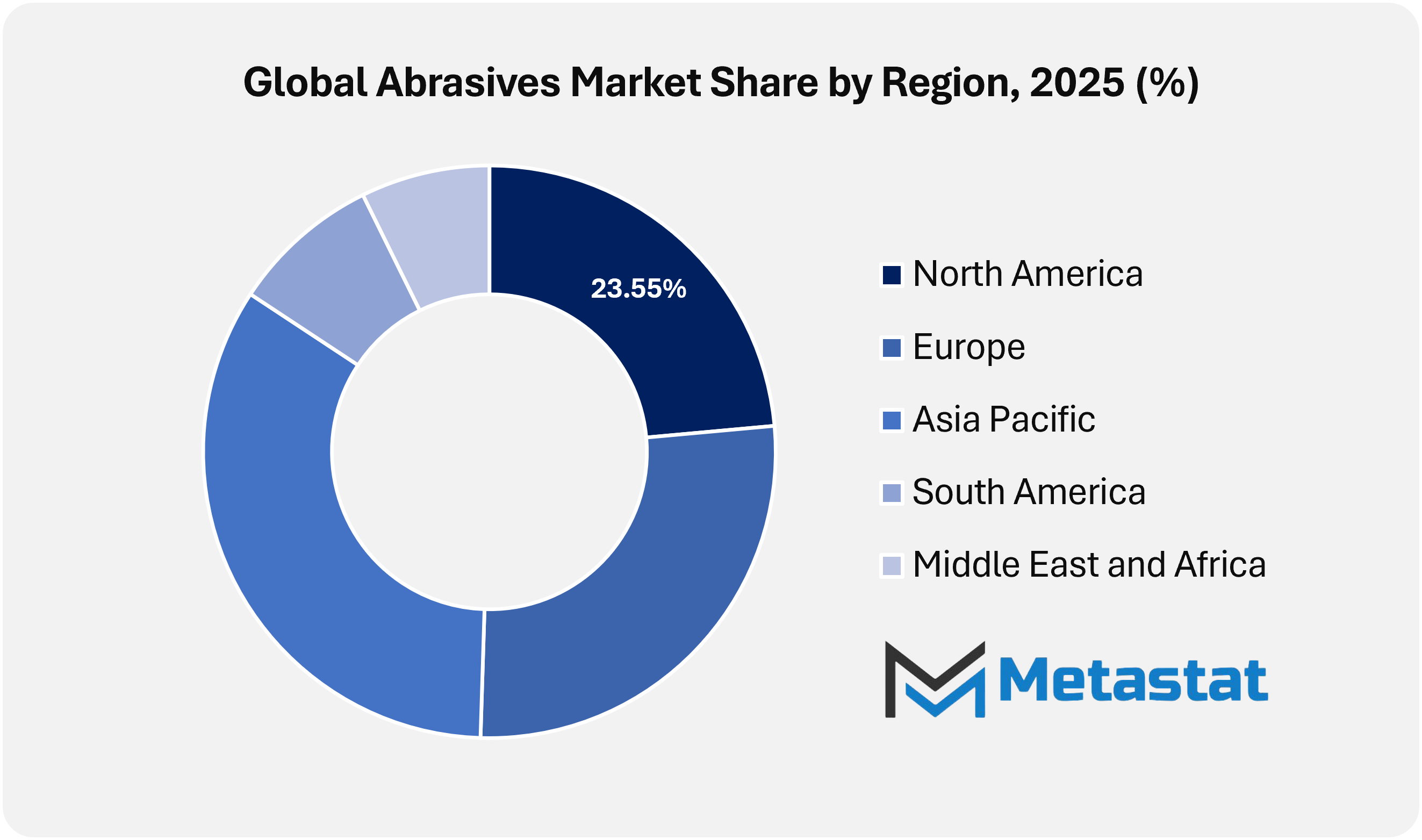
The Global Abrasives market maintains a strong position across industrial manufacturing and construction-related activities worldwide. Abrasives are widely used for cutting, grinding, polishing, and surface finishing in industries such as automotive, metal fabrication, aerospace, electronics, and building materials. Demand will remain steady as manufacturers continue to prioritize precision finishing, productivity, and quality control. Growth in infrastructure projects, vehicle production, and industrial maintenance activities will further support market expansion.
Leading companies in the market are investing in product development, technical performance, and geographic expansion to strengthen their competitive positions. 3M Company and Compagnie de Saint-Gobain S.A. remain prominent participants through broad portfolios across coated, bonded, and specialty abrasives. Tyrolit, KLINGSPOR, Mirka, and sia Abrasives maintain strong positions in metalworking and woodworking applications, while Carborundum Universal Limited, NIPPON RESIBON CORPORATION, Noritake Co., Limited, Kure Grinding Wheel Co., Ltd., and FUJI GRINDING WHEEL MFG. CO., LTD. continue to serve precision grinding and industrial finishing requirements across Asia.
A broad group of regional and specialized manufacturers also contributes to the competitive structure of the market. Companies such as Deerfos Co., Ltd., PFERD, VSM, Hermes Schleifmittel GmbH, Weiler Abrasives d.o.o., and Osborn International GmbH focus on specialized surface treatment and industrial finishing solutions. SAIT ABRASIVI S.p.A., molemab S.p.A., LUKAS-ERZETT GmbH & Co. KG, RHODIUS Abrasives GmbH, Starcke GmbH & Co. KG, Schleifscheibenfabrik GmbH & Co. KG, THELEICO Schleiftechnik GmbH & Co. KG, and Elbe Schleiftechnik GmbH continue to strengthen their positions in European industrial markets through technical expertise and established distribution networks. The organizations serve neighbourhood industries even as progressively expanding exports. Competition inside the worldwide abrasives marketplace will remain firm, with corporations focusing on product consistency, pricing strategies, and long-time period partnerships with industrial shoppers to stable regular revenue increase.
Market size is forecast to rise from USD 51.6 billion in 2025 to over USD 82.2 billion by 2033.
Beyond heavy industry, applications such as architectural restoration, renewable energy infrastructure, and advanced surface treatment will continue to depend on precision abrasive technologies. Wind turbine blade maintenance and solar panel component finishing are expected to require specialized abrasive grades designed for durability and minimal substrate damage. As manufacturing disciplines continue to converge, abrasives will evolve from a support function into a strategic enabler of precision, efficiency, and responsible production practices worldwide.
This research report categorizes the Abrasives market based on key segments and regions, forecasts revenue growth, and analyses trends in each submarket. The report analyses the key growth drivers, opportunities, and challenges influencing the Abrasives market. Recent market developments and competitive strategies such as expansion, product launch, partnership, merger, and acquisition have been included to draw the competitive landscape in the market.
The report strategically identifies and profiles the key market players and analyses their core competencies in each sub-segment of the Abrasives market.
|
Report Attributes |
Details |
|
Study Period |
2021-2033 |
|
Base Year |
2025 |
|
Estimated Year |
2026 |
|
Forecast Period |
2026-2033 |
|
Historical Period |
2021-2025 |
|
Growth Rate |
CAGR 6.0% from 2026 to 2033 |
|
Revenue Unit |
USD billion |
|
Sales Volume Unit |
Kilotons |
|
Segmentation |
By Product Type, Material, Application, End User, and Region |
|
By Region |
North America (By Product Type, Material, Application, End User, and Country)
|
|
|
Europe (By Product Type, Material, Application, End User, and Country)
|
|
|
Asia Pacific (By Product Type, Material, Application, End User, and Country)
|
|
|
South America (By Product Type, Material, Application, End User, and Country)
|
|
|
Middle East and Africa (By Product Type, Material, Application, End User, and Country)
|
Find answers to common questions about this report
Top players operating in the Abrasives industry include 3M Company, Compagnie de Saint-Gobain S.A., Tyrolit Schleifmittelwerke Swarovski K.G., KLINGSPOR AG, Mirka Ltd, sia Abrasives Industries AG, and Carborundum Universal Limited.
Asia Pacific region dominates the market.
Rising industrial manufacturing and metal fabrication activities propel consistent demand for grinding, cutting, and surface finishing solutions and Increased adoption of advanced machining and precision engineering techniques supports sustained abrasives consumption are key driving factors, boosting the market.
The Metastat Insights analysis shows that the North America Abrasives market size is estimated to be USD 17.6 billion by 2033.
The Coated Abrasives is the leading type segment in the Global market.
The Metastat Insights study shows that the Global Abrasives market size was USD 51.6 billion in 2025.
The Global Abrasives market is expected to row at a CAGR of 6.0% over the forecast period (2026-2033).
The analysts below cover Chemicals and Materials research at Metastat Insights.
LEAD ANALYST
Utkarsh Khirodkar is a Lead Market Research Analyst at MetaStat Insight, specializing in market intelligence, technology sector assessments, and competitive strategy.

INDUSTRY CONSULTANT - CHEMICALS & ADVANCED MATERIALS
Chemicals and Materials · Machinery & Equipment · Packaging
Amit Gadhekar Consultant for Chemicals and Materials at MetaStat Insight, directing sector-specific intelligence, research, and strategic consulting across global chemical and processing markets.
Integrating zero-trust access controls across legacy electronic health record systems involves complex compliance overhead. Team produced an analysis that clearly separated identity governance and administration tools from privileged access management platforms. Their evaluation of HIPAA and GDPR compliance features across cloud native solutions gave our architecture group clear baseline criteria. The custom data request regarding biometric authentication adoption in hospital networks was returned promptly with clear documentation.
Evaluating calorific value requirements and air permit compliance across municipal waste facilities requires localized data. Metastat Insight structured their analysis around operational throughput capacity and feedstock composition variations in Latin America and Eastern Europe. Their competitive mapping of sorting equipment vendors helped clarify technology differences between optical separators and heavy media systems. The study provided an objective baseline during our capital expenditure reviews.
Decarbonizing industrial thermal processes hinges on refrigerant regulations and compressor efficiency limits. Metastat Insights delivered a thorough market analysis that evaluated natural refrigerants like CO2 and hydrocarbons against synthetic low-GWP alternatives. The breakdown of utility incentives and grid capacity constraints across key European manufacturing hubs offered valuable perspective. The follow-up conversation with their sector analysts addressed our specific questions on mechanical vapor recompression systems efficiently.
Explore related market intelligence reports worth reading alongside this one.
Starting from
$2950
Starting from
$2950