
LEAD ANALYST
Utkarsh Khirodkar is a Lead Market Research Analyst at MetaStat Insight, specializing in market intelligence, technology sector assessments, and competitive strategy.

Malaysia Tyre Pyrolysis Products Market Size, Share, By Output Type (Pyrolytic Oil, Syngas, Recovered Carbon Black, and Steel Wires), By End User (Cement Plants, Power Plants, Rubber Manufacturers, Tire Manufacturers, Chemical Manufacturing Companies, Oil Refineries, Blending Units, Asphalt Manufacturers, Metal Recycling Companies, Plastic Industries, Pigment Industries, and Other Industrial Users), Industry Analysis, Growth, Trends, and Forecast, 2026-2033
Report ID
MSI-4789
Published
June, 2026
Updated
Pages
314 Pages
Format
Report Details
Choose Your License
Malaysia Tyre Pyrolysis Products Market
Malaysia Tyre Pyrolysis Products market size is valued at USD 205.9 million in 2025 and projected to grow at a CAGR of 9.3% during the forecast period, reaching USD 421.8 million by 2033.
Pyrolytic Oil segment account for a market share of 48.03% in 2025.
Key trends driving growth: Increasing generation of end-of-life tyres is driving demand for advanced tyre recycling technologies and rising industrial adoption of pyrolysis oil as an alternative fuel is supporting market growth.
Opportunities include growing demand for recovered carbon black in rubber and plastics manufacturing offers strong revenue potential and expansion of waste-to-energy and circular economy initiatives is creating new investment opportunities in Malaysia.
Key insight: Recovered carbon black is emerging as the most valuable product segment owing to rising industrial demand for sustainable raw materials.
The Malaysia Tyre Pyrolysis Products Market is gaining momentum owing to the country’s increasing focus on sustainable waste management and circular economy practices. Rising volumes of end-of-life tyres from the automotive sector have created strong demand for advanced recycling technologies capable of converting tyre waste into value-added products, including pyrolysis oil, recovered carbon black, steel wire, and syngas. Industrial sectors across Malaysia are increasingly adopting pyrolysis oil as an alternative fuel source owing to its cost efficiency and high calorific value, while recovered carbon black is gaining wider usage in rubber processing, plastics, coatings, and industrial manufacturing. Tighter environmental regulations related to landfill disposal and waste treatment are encouraging industries to shift toward resource recovery solutions.
Technological advancements in continuous pyrolysis systems and refining processes are further strengthening the market landscape in Malaysia. Companies are investing in advanced pyrolysis units capable of delivering higher product yields, lower emissions, and improved product quality. Recovered carbon black has emerged as one of the most commercially attractive outputs owing to increasing demand for sustainable raw materials in tyre production and industrial applications. Malaysia’s established rubber and manufacturing industries offer a strong downstream ecosystem for pyrolysis-derived products, creating opportunities for domestic supply chain integration. In addition, rising energy costs and volatility in fossil fuel prices are pushing industries to explore tyre pyrolysis oil as an alternative industrial fuel, supporting long-term market expansion.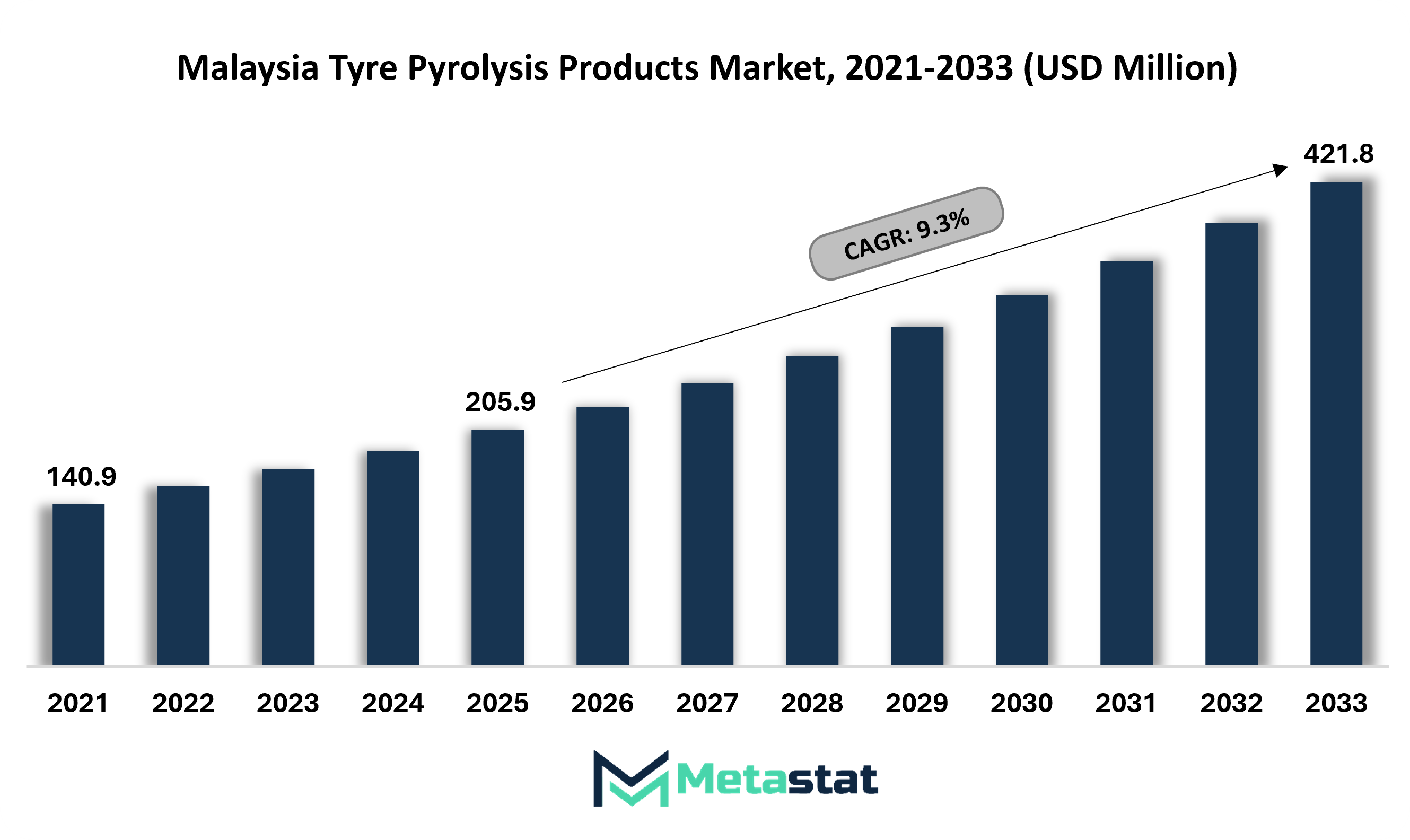
The Malaysian tyre pyrolysis industry operates under stringent environmental surveillance designed to curb industrial pollution and encourage resource circularity. The primary regulatory authority is the Department of Environment Malaysia (DOE), operating under the Environmental Quality Act 1974. Facilities must secure written approvals, site suitability clearances, and air emission licenses before commissioning. Because end-of-life tyres present distinct fire hazards and environmental risks, the regulatory treatment of feedstock, storage, and derived fractions intersects closely with the Scheduled Waste Regulations 2005. When process residues or unrefined pyrolysis condensates exhibit hazardous characteristics, operators must comply with strict storage, labeling, and consignment tracking requirements.
Recent policy shifts prioritize emissions mitigation and the phaseout of poorly controlled thermal units. The Environmental Quality (Clean Air) Regulations 2014 mandate continuous emission monitoring systems (CEMS) for specific pollutants, including particulate matter, sulfur dioxide, and nitrogen oxides. The DOE strictly regulates volatile organic compound (VOC) emissions, acidic gas scrubbers, and wastewater discharge from quenching systems. In addition, the National Solid Waste Management Policy reinforces municipal tire diversion, discouraging illegal dumping and unlicensed burning. This evolving framework creates clear commercial implications: compliance overhead increases operating costs, forcing subscale operators out while benefiting capital-equipped recyclers capable of meeting federal standards.
Revenue and margin dynamics in the Malaysia tyre pyrolysis products market depend directly on global commodity benchmarks and local feedstock economics. The commercial value of tire pyrolysis oil (TPO) closely tracks regional light fuel oil and industrial diesel benchmarks, often trading at a discount of 15% to 25% due to its elevated sulfur content and variable flash point. Recovered carbon black (rCB) pricing is benchmarked against virgin carbon black grades such as N660 and N772. Unmilled, raw pyrolysis char sells at low salvage rates to solid fuel markets, whereas micronized, pelletized rCB commands higher pricing in rubber compounding and masterbatch sectors.
The cost structure of an operational pyrolysis plant in Malaysia comprises three primary components: raw material logistics, thermal energy consumption, and regulatory compliance. Feedstock collection costs vary depending on haulage distance from automotive hubs. Operating expenses are heavily influenced by the internal energy balance of the facility. Advanced installations capture non-condensable syngas to fuel the pyrolysis reactors, substantially lowering external burner fuel expenses. Labor, maintenance of mechanical seals, catalyst replacement (where applicable), and de-ashing downstream processes form the remainder of the cost baseline. Margins expand significantly when operators invest in post-processing equipment that upgrades base char and crude oil into commercial-grade commodities.
Malaysia generates a consistent volume of scrap tires annually, driven by high vehicle ownership rates and dense logistics traffic. The waste tire supply chain remains largely decentralized, relying on local scrap collectors, automotive service workshops, tire retreaders, and municipal collection contractors. Sourcing predictability depends heavily on established regional networks and collection hubs.
The Klang Valley (major waste tyre source) generates the highest concentration of post-consumer tires in the country. The high density of passenger cars, commercial delivery fleets, and public transport infrastructure across Selangor and Kuala Lumpur ensures a continuous aggregate supply. Scrap tires in this area are concentrated in commercial collection yards, reducing aggregate gathering time but incurring urban transport surcharges. Similarly, the Penang manufacturing hub and the southern industrial belts supply substantial volumes of medium and heavy commercial vehicle tires, which offer higher rubber content and thicker steel wire yields than passenger car radials.
Despite steady domestic generation, formal collection infrastructure faces logistical bottlenecks. A significant portion of scrap rubber historically entered informal scrap yards or illegal discard channels. Under the National Solid Waste Management Policy, the government has encouraged formalized recovery pathways to channel scrap tires directly to licensed processing centers. Sourcing competition is intensifying as cement kilns co-process shredded tires as tire-derived fuel (TDF), creating direct raw material competition for pyrolysis operators. Processors must establish long-term off-take contracts with major fleet operators and retreaders to hedge against feedstock price volatility.
The technological landscape of tyre pyrolysis in Malaysia is undergoing a shift from basic thermal decomposition units to advanced continuous pyrolysis technology. Early market entrants relied extensively on batch pyrolysis systems imported due to lower initial capital requirements. These batch reactors, however, present operational inefficiencies: long heating and cooling cycles, high labor intensity during char discharge, and intermittent syngas generation that hinders energy integration.
Adopting continuous pyrolysis technology demands substantial capital expenditure. Continuous systems require automated de-beading, precision tire shredding, airlocks, and continuous solid-discharge cooling systems to run non-stop for weeks. Operators face major technological hurdles, including thermal cracking consistency, reactor coking, and volatile sulfur management in the condensable oil vapor. The high initial capital requirement, often several times that of a basic batch plant, creates a financing barrier for domestic small and medium enterprises. Commercial success hinges on achieving technical reliability, continuous feedstock throughput, and stable product quality to satisfy industrial off-takers.
Market dynamics, infrastructural maturity, and supply-demand balances differ markedly between Peninsular Malaysia and the East Malaysian states of Sabah and Sarawak on Borneo.
Peninsular Malaysia represents the overwhelming share of pyrolysis activities and end-product consumption. Key industrial activity is anchored along the west coast corridor. The Johor industrial corridor provides access to maritime bunkering, regional fuel oil buyers, and heavy manufacturing clusters. The Klang Valley serves as the predominant feedstock generation node, while the northern manufacturing zones in Perak and Penang support metal recycling, industrial foundries, and rubber fabrication. The presence of integrated transport infrastructure, specialized engineering service providers, and chemical storage depots lowers operating overhead and facilitates regular product off-take across the peninsula.
East Malaysia presents a distinctly isolated operating environment. While Sabah and Sarawak possess heavy commercial vehicle tires from timber, agricultural, and mining fleets, the dispersed geography inflates transportation expenses. Feedstock aggregation across remote interior roads is economically challenging. Local industrial off-take for pyrolysis fuel and recovered char is narrow compared to the peninsula, necessitating inter-island maritime shipping to reach Peninsular or overseas consumers. As a result, commercial pyrolysis operations in East Malaysia remain localized, operating primarily as waste-mitigation solutions rather than high-volume chemical recovery facilities.
Malaysia occupies a central position within the Southeast Asian trade in circular materials and recovered commodities. Regional trade flows for pyrolysis products are shaped by transboundary waste restrictions, global fuel pricing, and international demand for recovered carbon black (rCB). Under international conventions and national laws enforced by the Department of Environment Malaysia (DOE), the cross-border import of whole scrap tires is restricted to protect domestic ecosystems from hazardous dumping. However, the trade of processed, non-hazardous outputs follows standard commercial channels.
Tire-derived fuel oil is predominantly consumed domestically by local industrial burners or blended in regional bunkering networks across the Malacca Strait. In contrast, recovered carbon black and high-tensile steel scrap participate actively in export markets. Upgraded rCB that meets export specifications finds buyers in regional polymer and mechanical rubber compounding hubs across East and Southeast Asia. The scrap steel wire recovered from the primary de-beading and thermal decomposition processes enters domestic and regional metallurgical supply chains. High scrap steel prices enhance the revenue baseline of Malaysian processors, offsetting shifts in localized fuel oil demand.
Increasing generation of end-of-life tyres is driving demand for advanced tyre recycling technologies.
Rising vehicle ownership across Malaysia is increasing the accumulation of discarded tyres, creating strong demand for efficient recycling solutions. Expansion of waste management regulations is encouraging industrial investment in sustainable tyre disposal methods. Future market development indicates wider adoption of automated pyrolysis systems capable of improving material recovery, supporting long-term expansion in the Malaysia tyre pyrolysis products market.
Rising industrial adoption of pyrolysis oil as an alternative fuel is supporting market growth.
Industrial facilities across manufacturing, cement production, and power generation sectors are increasing pyrolysis oil usage owing to rising fuel costs. Demand for lower-emission fuel alternatives is strengthening industrial interest in tyre-derived energy products. Future industrial transformation across Malaysia will improve acceptance of pyrolysis oil, creating stronger business opportunities in the Malaysia tyre pyrolysis products market.
High capital investment requirements limit the entry of small-scale operators.
High financial requirements associated with pyrolysis plant setup, emission control systems, and advanced processing equipment are limiting participation from smaller businesses. Financial pressure linked with technology upgrades is further slowing operational expansion. Future market competition will remain concentrated among financially strong companies capable of supporting infrastructure development in the Malaysia tyre pyrolysis products market.
Inconsistent product quality from low-grade pyrolysis systems creates operational challenges.
Variation in output quality from outdated pyrolysis equipment is creating challenges for industrial consumers seeking stable fuel and material performance. Concerns related to impurities in recovered products are reducing confidence among end-use industries. Future market improvement will rely heavily on technological modernization and quality standardization across manufacturing facilities operating in the Malaysia tyre pyrolysis products market.
Growing demand for recovered carbon black in rubber and plastics manufacturing offers strong revenue potential.
Rising consumption of sustainable raw materials across rubber processing and plastics manufacturing industries is creating strong industrial opportunities for recovered carbon black suppliers. Manufacturers are increasing focus on cost-efficient materials with lower environmental impact. Future commercial partnerships and product innovation are anticipated to strengthen revenue generation prospects across the Malaysia tyre pyrolysis products market.
The Malaysia Tyre Pyrolysis Products market is classified based on Output Type and End User.
Pyrolytic Oil segment is valued at USD 108.4 million in 2026 and is projected to reach USD 201.6 million by 2033, at a CAGR of 9.3% during the forecast period.
Growing fuel demand across industrial operations in Malaysia will support stronger adoption of pyrolytic oil during the coming years. Energy-intensive industries will increase procurement owing to rising pressure from conventional fuel prices. Malaysia tyre pyrolysis products market will witness wider industrial integration through blending applications, transportation fuel processing, industrial heating operations, and alternative energy development projects.
Syngas segment is valued at USD 20.0 million in 2026 and is projected to reach USD 35.9 million by 2033, at a CAGR of 8.7% during the forecast period.
Industrial facilities across Malaysia are projected to increase syngas utilization for captive power generation and thermal applications. Cleaner fuel preferences among manufacturing units will create stronger operational demand. Malaysia tyre pyrolysis products market will benefit from technological improvements linked with efficient fuel recovery systems, helping industrial manufacturers reduce dependency on imported energy sources across long-term production activities.
Recovered Carbon Black (rCB) segment is valued at USD 57.7 million in 2026 and is projected to reach USD 113.0 million by 2033, at a CAGR of 10.1% during the forecast period.
Recovered carbon black will gain stronger commercial acceptance owing to sustainability targets adopted by rubber processing companies. Demand will rise from manufacturers seeking cost-efficient raw material alternatives with lower environmental impact. Malaysia tyre pyrolysis products market will benefit from research activities focused on improving quality standards, particle consistency, and commercial-grade performance capabilities.
Steel Wires segment is valued at USD 39.7 million in 2026 and is projected to reach USD 71.3 million by 2033, at a CAGR of 8.7% during the forecast period.
Steel wire recovery from waste tyres will support metal recycling activities across Malaysia. Construction material suppliers and scrap processing companies will increase procurement owing to rising infrastructure investments. Malaysia tyre pyrolysis products market could generate additional revenue opportunities through improved metal separation technologies, higher recovery efficiency, and stronger participation from domestic recycling enterprises during future years.
Cement & Power Plants segment is projected to reach USD 130.6 million by 2033, at a CAGR of 9.2% during the forecast period.
Cement and power plant facilities will emerge among major customers in the Malaysia tyre pyrolysis products market. Industrial operators will increase utilization of pyrolysis-derived fuel products to reduce operational expenditure and improve waste management practices. Rising focus on alternative energy consumption could enhance long-term procurement activities across large-scale industrial manufacturing environments.
Rubber & Tire Manufacturers segment is projected to reach USD 108.4 million by 2033, at a CAGR of 10% during the forecast period.
Rubber and tyre manufacturers will increase usage of recovered carbon black for sustainable manufacturing operations. Environmental commitments across industrial supply chains will encourage greater reliance on recycled raw materials. Malaysia tyre pyrolysis products market will experience stronger collaboration between tyre recycling facilities and rubber producers aiming for circular production systems and reduced material wastage.
Chemical Manufacturing Companies segment is projected to reach USD 62.8 million by 2033, at a CAGR of 9.2% during the forecast period.
Chemical manufacturing companies are projected to explore pyrolysis-derived products for industrial processing and feedstock development. Demand will increase owing to growing focus on resource optimization and cost control. Malaysia tyre pyrolysis products market could attract investment toward advanced refining technologies capable of enhancing product purity, industrial compatibility, and large-scale usage across chemical processing activities.
Oil Refineries & Blending Units segment is projected to reach USD 47.8 million by 2033, at a CAGR of 9.4% during the forecast period.
Oil refineries and blending units will evaluate pyrolytic oil integration for fuel enhancement applications. Rising interest in alternative hydrocarbon sources will support market expansion across industrial fuel sectors. Malaysia tyre pyrolysis products market will gain momentum through refinery modernization initiatives, improved blending efficiency, and growing commercial acceptance of recycled fuel products within industrial operations.
Asphalt Manufacturers segment is projected to reach USD 33.5 million by 2033, at a CAGR of 8.9% during the forecast period.
Asphalt manufacturers will increase adoption of tyre pyrolysis-derived materials for road construction and infrastructure development initiatives. Sustainable construction projects across Malaysia will create favourable growth conditions. Malaysia Tyre Pyrolysis Products Market will witness stronger participation from public infrastructure contractors seeking durable, recycled, and cost-effective material solutions for highway expansion and urban development programs.
Metal Recycling Companies segment is projected to reach USD 21.5 million by 2033, at a CAGR of 8% during the forecast period.
Metal recycling companies will strengthen procurement of recovered steel wire generated through tyre pyrolysis processing. Infrastructure growth and industrial manufacturing activities will support continuous demand for recycled steel products. Malaysia Tyre Pyrolysis Products Market is anticipated to benefit from advanced recovery systems capable of enhancing recycling efficiency and improving material recovery profitability across industrial operations.
Plastic & Pigment Industries segment is projected to reach USD 13.9 million by 2033, at a CAGR of 9.9% during the forecast period.
Plastic and pigment industries will create additional growth opportunities for recovered carbon black applications. Industrial buyers will prefer recycled additives owing to growing sustainability requirements and production cost management strategies. Malaysia Tyre Pyrolysis Products Market could experience broader industrial penetration through product innovation, enhanced material consistency, and improved compatibility across manufacturing applications.
Other Industrial Users segment is projected to reach USD 3.3 million by 2033, at a CAGR of 6.6% during the forecast period.
Several industrial sectors, including manufacturing, logistics, engineering, and industrial heating operations, will participate in the Malaysia tyre pyrolysis products market during future years. Rising awareness regarding waste utilization and alternative fuel development will support broader industrial adoption. Industrial diversification could encourage continuous investment in processing infrastructure, operational efficiency, and sustainable resource management practices.
Raw char extracted from tyre pyrolysis contains residual ash, uncracked heavy hydrocarbons, and inorganic zinc and silica complexes added during tire vulcanization. To compete effectively with virgin carbon black, recovered carbon black (rCB) must undergo extensive post-treatment, including multi-stage magnetic separation, acid demineralization or thermal de-ashing, fine micronization, and wet or dry pelletization. The downstream value of rCB depends on its structural properties, aggregate size distribution, and surface activity.
Industrial applications in Malaysia vary by processing grade. Semi-refined rCB serves as an economical filler in conveyor belts, agricultural rubber parts, automotive floor mats, footwear outsoles, and bituminous asphalt additives. Premium, ultra-micronized rCB is increasingly accepted as a partial replacement (typically 10% to 30%) for virgin grades like N660 in technical rubber goods and masterbatches. The Malaysian Rubber Board conducts ongoing research into elastomeric compound reinforcement, validating that appropriately processed rCB preserves tensile strength and elongation metrics. The commercial challenge lies in ensuring batch-to-batch consistency, as variations in tire feedstocks alter ash content and surface area characteristics.
Tire pyrolysis oil (TPO) is a dark, medium-viscosity hydrocarbon mixture with a high gross calorific value, making it an effective liquid fuel substitute. Its primary commercial outlet in Malaysia is direct combustion in high-capacity industrial heat generation equipment. As shown below, industrial facilities select specific utilization routes based on their operational profiles and thermal tolerances:
To optimize performance across these applications, fuel distributors and large industrial consumers measure pyrolysis distillates against established fuel standards. Operators frequently reference standards like ASTM D6751 (pyrolysis oil quality standard adaptations and biodiesel-related fuel specifications) and ASTM D396 when establishing distillation, flash point, kinematic viscosity, and water-sediment benchmarks. Meeting these fuel quality parameters is critical to prevent fuel injector clogging, excessive soot deposition, and burner corrosion in commercial operations.
The Malaysian government has introduced various strategic frameworks to accelerate the transition from linear resource consumption to a closed-loop economy. Central to this transformation is the Circular Economy Roadmap Malaysia, which establishes actionable targets for industrial solid waste diversion, plastic recycling, and rubber resource recovery. These policy directives recognize the tyre pyrolysis sector as an essential bridge between hazardous waste disposal and secondary raw material generation.
To stimulate private capital allocation, the Malaysian Investment Development Authority (MIDA) provides targeted fiscal incentives for green technology ventures. Through the Green Investment Tax Allowance (GITA) and Green Income Tax Exemption (GITE), eligible pyrolysis operators investing in qualifying continuous technology, automated shredding lines, and advanced emission controls can offset substantial capital expenditure against statutory income. Furthermore, subsidized financing programs administered via commercial banks and sustainable infrastructure funds lower the cost of borrowing for capital-intensive thermal treatment installations. These incentives encourage operators to transition away from polluting batch operations toward technologically advanced, environmentally verified production ecosystems.
The Malaysia Tyre Pyrolysis Products Market has started gaining attention owing to the growing focus on waste management, industrial recycling, and sustainable fuel alternatives. End-of-life tyres have become a major environmental concern in many countries, including Malaysia, where increasing vehicle ownership has added pressure on disposal systems. Pyrolysis technology offers a practical solution by converting waste tyres into useful outputs such as fuel oil, recovered carbon black, steel wire, and syngas. Many industries are now evaluating these recovered materials to reduce dependence on traditional raw materials and lower manufacturing costs. The market is also benefiting from growing awareness regarding circular economy practices, where waste materials are reused instead of being discarded. Government support for cleaner industrial practices and stricter regulations on landfill dumping is encouraging organizations to invest in advanced recycling operations. Manufacturers are also improving processing methods to enhance product quality, helping recycled outputs gain wider industrial acceptance.
Several organizations are actively shaping market growth through technology development, recycling operations, and partnerships with industrial buyers. Green Rubber & Petroleum Sdn Bhd and Eco Power Synergy Sdn Bhd are among the companies contributing to local processing activities and waste tyre management solutions in Malaysia. Mass Grow Synergy Sdn Bhd has also gained attention for its efforts in converting scrap tyres into reusable industrial products. International players such as Klean Industries Inc., Bolder Industries, and Contec S.A. are influencing the industry through technological advancements and cleaner recovery systems. European firms such as Pyrum Innovations AG and Scandinavian Enviro Systems AB are also attracting global attention for improving recovered carbon black quality and reducing industrial emissions linked to tyre disposal.
Asian companies are playing a crucial role in strengthening supply chains and increasing industrial adoption of recycled materials. LD Carbon Co., Ltd. and Enrestec Inc. are known for developing advanced processing systems that improve operational performance. Firms such as Ecolomondo Corporation and Black Bear Carbon continue expanding their presence in the sustainable materials sector through innovation and research. The market is also seeing support from recovered carbon black manufacturers such as RCB Nanotechnologies GmbH and Finster Black Pvt. Ltd., which are focusing on enhancing material performance for industrial applications. Rising interest from tyre manufacturers, rubber product companies, and fuel consumers is creating stronger demand for recycled outputs, encouraging both regional and global companies to increase investments in processing facilities.
Future growth in Malaysia will remain positive owing to industrial expansion, environmental pressure, and stronger interest in sustainable production. Businesses are becoming increasingly open to using recycled fuel and recovered carbon black in manufacturing processes owing to cost advantages and environmental benefits. Indian companies, including Epsilon Carbon Pvt. Ltd. and Gravita India Ltd., are also gaining recognition for their recycling expertise and material recovery capabilities. Large carbon black producers such as Birla Carbon, Orion S.A., and Cabot Corporation will influence future demand for recovered materials through sustainability initiatives and industrial partnerships. With growing environmental awareness, advanced recycling technology, and stronger industrial acceptance, the market will witness steady business opportunities during the coming years.
Market size is forecast to rise from USD 205.9 million in 2025 to over USD 421.8 million by 2033.
The outlook for the Malaysia Tyre Pyrolysis Products Market remains positive, supported by stronger sustainability targets, industrial decarbonization efforts, and rising investment in recycling infrastructure. Recovered carbon black is expected to witness substantial growth owing to increasing incorporation of recycled materials into automotive and rubber products.
This research report categorizes the Malaysia Tyre Pyrolysis Products market based on key segments and regions, forecasts revenue growth, and analyses trends in each submarket. The report analyses the key growth drivers, opportunities, and challenges influencing the Malaysia Tyre Pyrolysis Products market. Recent market developments and competitive strategies such as expansion, product launch, partnership, merger, and acquisition have been included to draw the competitive landscape in the market.
The report strategically identifies and profiles the key market players and analyses their core competencies in each sub-segment of the Malaysia Tyre Pyrolysis Products market.
|
Report Attributes |
Details |
|
Study Period |
2021-2033 |
|
Base Year |
2025 |
|
Estimated Year |
2026 |
|
Forecast Period |
2026-2033 |
|
Historical Period |
2021-2025 |
|
Growth Rate |
CAGR 9.3% from 2026 to 2033 |
|
Revenue Unit |
USD million |
|
Sales Volume Unit |
Kilotons |
|
Segmentation |
By Output Type and End User |
Find answers to common questions about this report
High capital investment requirements limit the entry of small-scale operators will hamper the market growth within the forecast period.
Malaysia Tyre Pyrolysis Products market is estimated to reach USD 421.8 million by 2033.
Increasing generation of end-of-life tyres is driving demand for advanced tyre recycling technologies and rising industrial adoption of pyrolysis oil as an alternative fuel is supporting market growth are key driving factors, boosting the market.
Top players operating in the Malaysia Tyre Pyrolysis Products industry includes Green Rubber & Petroleum Sdn Bhd, Eco Power Synergy Sdn Bhd, Mass Grow Synergy Sdn Bhd, Klean Industries Inc., Bolder Industries, and Contec S.A
The Pyrolytic Oil is the leading type of segment in the Malaysia market.
The Malaysia Tyre Pyrolysis Products market is expected to grow at a CAGR of 9.3% over the forecast period (2026-2033).
The Metastat Insights study shows that the Malaysia Tyre Pyrolysis Products market size was USD 205.9 million in 2025.
The primary technical challenges include high ambient humidity and elevated cooling water temperatures, which reduce vapor condensation efficiency in heat exchangers. Furthermore, incoming scrap tyres frequently retain rainwater, requiring energy-intensive pre-drying steps or causing reactor temperature instability, increased steam generation, and accelerated system corrosion.
A mid-scale tyre pyrolysis plant in Malaysia typically achieves a return on investment within 3 to 5 years. Payback velocity depends heavily on continuous plant uptime, feedstock procurement costs, syngas recycling efficiency, and the commercial ability to sell pelletized recovered carbon black rather than untreated char.
Selangor, Johor, and Penang generate the highest volumes of waste tyres in Malaysia. These states feature the nation's highest vehicle registrations, extensive port-related logistics fleets, and dense industrial corridors. The Klang Valley within Selangor represents the largest single municipal and commercial scrap tyre sourcing region.
Import duties and freight tariffs on virgin petrochemicals and imported furnace carbon black enhance the cost competitiveness of domestic pyrolysis products. Local industrial off-takers purchase domestic tyre-derived fuel and rCB to avoid currency volatility, reduce shipping exposure, and hedge against higher-priced imported primary raw materials.
Operators must obtain written Site Suitability Clearance, an Environmental Impact Assessment (EIA) approval, and written Permission to Construct from the Department of Environment Malaysia (DOE). Plants require air emission licenses under the Clean Air Regulations 2014, wastewater discharge clearance, and local municipal council operating licenses.
Malaysia produces competitive, standardized pyrolysis products, particularly where operators deploy continuous systems and post-treatment refining. While Thailand and Indonesia have larger aggregate production volumes, Malaysia benefits from advanced port logistics, stricter regulatory oversight by the DOE, and sophisticated testing infrastructure supported by rubber research institutes.
Asphalt mixing plants, cement kilns, and metal smelting foundries actively substitute conventional heavy fuel oil with tyre pyrolysis oil. In addition, manufacturers of technical rubber goods, solid tyres, conveyor belts, footwear outsoles, and masterbatch colorants are increasingly replacing portions of virgin carbon black with recovered carbon black.
Recovered carbon black in Malaysia typically trades at a 30% to 50% discount compared to virgin carbon black grades like N660. The price spread reflects higher ash content and surface chemistry variations. As milling and de-ashing technologies improve, high-purity pelletized rCB narrows this gap by capturing higher-value compounding applications.
The analysts below cover Chemicals and Materials research at Metastat Insights.
LEAD ANALYST
Utkarsh Khirodkar is a Lead Market Research Analyst at MetaStat Insight, specializing in market intelligence, technology sector assessments, and competitive strategy.

INDUSTRY CONSULTANT - CHEMICALS & ADVANCED MATERIALS
Chemicals and Materials · Machinery & Equipment · Packaging
Amit Gadhekar Consultant for Chemicals and Materials at MetaStat Insight, directing sector-specific intelligence, research, and strategic consulting across global chemical and processing markets.
Last Updated: September, 2026
Tracking ceramic matrix composite adoption in high-bypass aero engines requires strict attention to material qualification cycles and FAA airworthiness testing milestones. The MetaStat Insight team provided a detailed timeline of silicon carbide fiber manufacturing capacity and commercial foundry lead times. Having clear visibility into upstream thermal barrier coating supply helped us stress-test our long-term component procurement strategy.
Transitioning ultra-class mining haul trucks to alternative power requires concrete data on remote hydrogen refueling infrastructure economics. The report evaluated megawatt-scale electrolyzer installation expenses, onsite storage safety mandates, and heavy-duty fuel cell stack degradation under continuous duty cycles. That technical rigor helped our engineers benchmark realistic total operating cost horizons for off-highway fleet decarbonization.
Enterprise zero-trust network rollouts are often slowed down by multi-cloud transit latency and proprietary hardware retirement schedules. This study provided realistic total cost of ownership models comparing cloud-delivered security edge solutions against traditional hardware refreshes. The analysis of contract renewal lengths and software maintenance fees gave us clear visibility into enterprise replacement cycles over the next three to five years.
Explore related market intelligence reports worth reading alongside this one.