
LEAD ANALYST
Utkarsh Khirodkar is a Lead Market Research Analyst at MetaStat Insight, specializing in market intelligence, technology sector assessments, and competitive strategy.

AI Speech Recognition Market By Deployment Mode (Cloud-Based and On-Premises), By Technology (Automatic Speech Recognition, Text-to-Speech, and Natural Language Processing), By End-User Industry (Healthcare, BFSI, Automotive, IT, Telecommunications, Retail, Education, Government, and Others), Industry Analysis, Size, Share, Growth, Trends, and Forecast, 2033
Report ID
MSI-4260
Published
October, 2025
Pages
256 Pages
Format
Report Details
Choose Your License
AI Speech Recognition Market
The global AI speech recognition market developed from a pioneering research concept to one of the most dynamic sectors of the technology industry. Its roots go back to the middle of the 20th century when early attempts at teaching computers to understand human language were limited to single words. Those early systems, although early, laid the groundwork for what would become insightful voice-enabled technology. With the years, steady improvement of computing power and algorithmic precision propelled the industry from academic interest to commercialization.
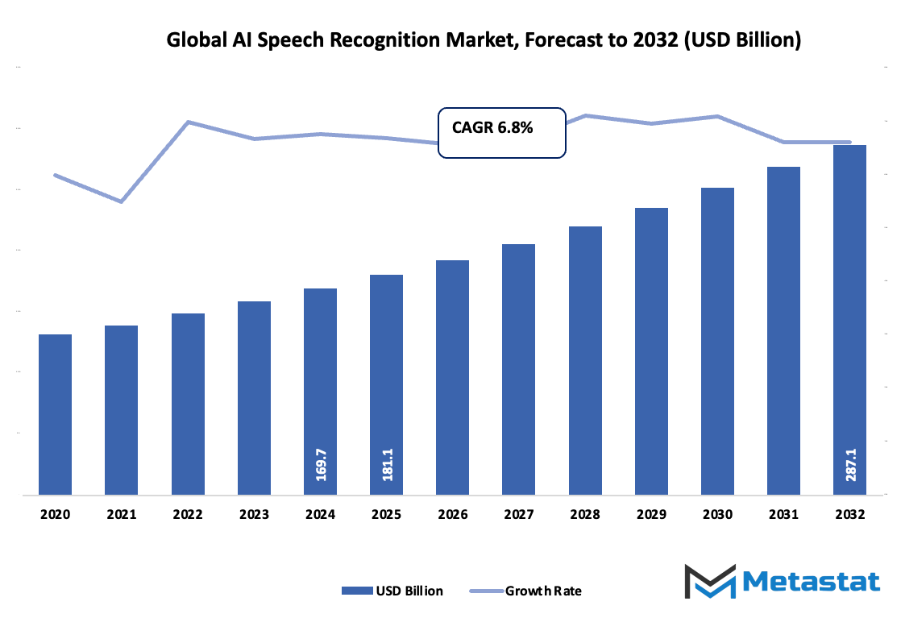
Global AI speech recognition market valued approximately USD 181.1 million in 2025, registering growth at a CAGR of approximately 6.8% over 2032, with potential to cross over USD 287.1 million.
Cloud-Based maintain nearly 72.9% market share, leading innovation and expanding applications through aggressive R&D.
Key growth-inducing trends: Growth in voice devices and virtual assistants demand., Increased usage in healthcare, automotive, and customer service industries for productivity.
Opportunities are: Growth of multilingual and real-time speech recognition products into global markets.
Key insight: Market doubles in value over the next decade, which is a healthy sign of expansion opportunities.
By the latter half of the 1990s, as the use of online communication proliferated and cell phones became ubiquitous, speech recognition started to pick up. The evolution of cloud computing in the early 2000s flipped its course on its head. Processing rich voice data no longer required clunky local computation, but instead, servers could compute enormous linguistic datasets in real-time. It enabled developers and enterprises to build speech interfaces that could understand several languages and accents with much more accuracy.
The game-changer arrived when consumer electronics infused voice assistants into everyday life. Smartphones, smart speakers, and cars began responding to natural human speech, and the world AI Speech Recognition market became an innovation-led competitive space. The demand crept beyond convenience eventually. Fields such as healthcare, banking, and customer support opened their doors for voice systems for documentation, security, and accessibility. This was driven by a deep cultural transformation — individuals began expecting technology to adapt to their voice, not the other way around. In the past few years, advances in deep learning and neural networks have focused speech models to detect tone, emotion, and intent. Regulations around privacy and ethical practices also shaped how businesses handle user data, outlining how technology companies will build voice systems in the future.
The global AI speech recognition market will continue to evolve as hardware speeds up, edge computing grows, and support for multiple languages becomes seamless. From its humble beginnings in research labs to its current pervasiveness in nearly all digital devices, this sector's development shows how human language became a new form of interface between people and machines — one that will define the future of communication technology in the next few years.
The global AI speech recognition market is mainly classified based on Deployment Mode, Technology, End-User Industry.
Cloud-Based: Cloud-based systems will dominate the global AI speech recognition market as companies and organizations seek flexible and scalable solutions. These solutions will provide real-time accessibility, faster upgrades, and distant integration. Organizations will increasingly adopt cloud deployment due to cost-effectiveness, easy maintenance, and ability to process extensive voice data without restrictions of local infrastructure.
On-Premises: On-premises solutions will continue to enjoy popularity among organizations that want complete control over sensitive information. The market will see consistent demand for on-premises installation for sectors where data privacy is a major concern. The solutions will offer stability, customization, and direct control over speech recognition processes, ensuring adherence to stringent regulatory guidelines.
Automatic Speech Recognition: Automatic Speech Recognition will be the central theme of the market, converting speech to text efficiently. Automatic Speech Recognition will make industries communicate faster and be more productive. Developments in the future will render it more accurate, accent-sensitive, and context-aware, making it an important application for businesses and individuals alike.
Text-to-Speech: Text-to-Speech will transform the user experience by rendering text as natural speech. The market will benefit from its applications in accessibility, voice assistants, and customer interactions. Future development will focus on voice personalization, emotional tone embedding, and multilingual support to ensure interactions become human-like and engaging.
Natural Language Processing: Natural Language Processing will drive intelligent understanding of human speech in the global AI speech recognition market. The tech will be employed for context, sentiment, and intent understanding to allow systems to respond appropriately. Its focus in the future will be on conversational AI, improved language models, and semantic comprehension, developing more responsive and adaptive speech recognition.
Healthcare: In the healthcare sector, the global AI speech recognition market will improve patient engagement, clinical documentation, and diagnostic processes. Voice-supported solutions will allow doctors to input data without the use of hands, automate clinical records, and end errors. Future adoption will focus on incorporation into electronic health platforms, facilitating telemedicine and real-time monitoring of patients.
BFSI: The bank, financial, and insurance industries will utilize the market for detecting fraud, automating customer service, and safe transaction. Voice recognition will increase client authentication and operation efficiency. Trends in the future will shift towards AI-driven analytics, customized client interaction, and faster processing of finance-related information via voice systems.
Automotive: Voice controls and in-car assistants will revolutionize the automotive industˀy with better driver comfort and security. The market will establish perfect communication between drivers and cars. Next-generation releases will highlight real-time voice navigation, multi-language support, and compatibility with autonomous vehicle technology for smarter mobility solutions.
IT and Telecommunications: IT and telecommunications will harness the global AI speech recognition market to automate services, offer customer support, and streamline workflows. Voice commands will curtail the necessity for human intervention and offer enhanced operational efficiency. Future applications will include AI-aided troubleshooting, virtual agents, and increased interactivity between platforms, enhancing overall user satisfaction.
Retail: Retailers will tap the market to provide personalized shopping experiences, voice search, and improved customer care. Voice-enabled systems will automate order processing and inventory management. Future trends will surround interactive shopping assistants, multi-lingual support, and real-time consumer analytics driving engagement and sales.
Education: The education sector will benefit from voice-based learning, lecture recording, and accessibility tools. The market will make learning more interactive and inclusive. Future trends will move towards real-time translation, adaptive learning platforms, and AI-based tutoring and, in the process, make learning a more engaging and productive experience for students and teachers.
Government: Governments will utilize the market for safe communication, document processing, and citizens' services. Voice recognition will increase the efficiency of public administration and data management. The future application will focus on multilingual support, smart analysis of citizens' applications, and automation of routine tasks to enable faster, more transparent governance.
Others: Media, logistics, and legal industries will adopt the global AI speech recognition market for easy communication, transcription, and business process. Next-generation innovations will focus on domain customization, multilinguality, and embedment with emerging cutting-edge technologies, which will provide improved productivity, faster decision-making, and voice-enabled solutions availability.
|
Forecast Period |
2025-2032 |
|
Market Size in 2025 |
$181.1 Million |
|
Market Size by 2032 |
$287.1 Million |
|
Growth Rate from 2025 to 2032 |
6.8% |
|
Base Year |
2025 |
|
Regions Covered |
North America, Europe, Asia-Pacific, South America, Middle East & Africa |
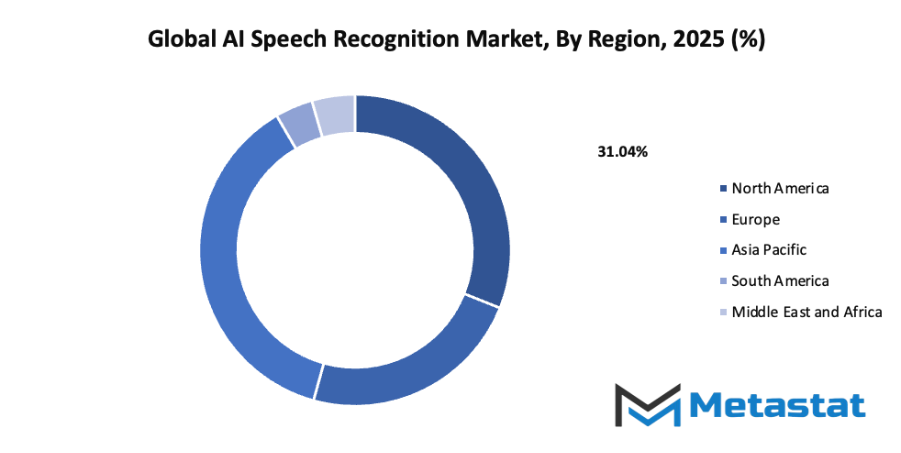
Based on geography, the global AI speech recognition market is divided into North America, Europe, Asia-Pacific, South America, and the Middle East & Africa.
North America is further divided into the U.S., Canada, and Mexico, whereas Europe consists of the UK, Germany, France, Italy, and the Rest of Europe.
Asia-Pacific is segmented into India, China, Japan, South Korea, and the Rest of Asia-Pacific.
The South America region includes Brazil, Argentina, and the Rest of South America, while the Middle East & Africa is categorized into GCC Countries, Egypt, South Africa, and the Rest of the Middle East & Africa.
Rising demand for voice-enabled devices and virtual assistants: The global AI speech recognition market will continue to grow as more devices rely on voice commands. Users will prefer hands-free interactions, making voice-enabled features a standard expectation in everyday technology, boosting market adoption significantly.
Increasing adoption in healthcare, automotive, and customer service industries for efficiency: The global AI speech recognition market will expand as industries adopt voice recognition for faster, more accurate operations. Healthcare will use it for patient records, automotive for in-car controls, and customer service for automated support, driving efficiency and reducing human errors.
Accuracy challenges due to accents, dialects, and background noise: The global AI speech recognition market faces issues in understanding diverse speech patterns. Systems will need continuous improvements to handle different accents, dialects, and noisy environments, ensuring consistent performance across global users and enhancing user trust.
Privacy and data security concerns in handling voice data: The global AI speech recognition market will need to address rising concerns about voice data privacy. Companies must implement strong security measures and transparent policies to protect sensitive information, balancing technological advancements with user trust and regulatory compliance.
Expansion of multilingual and real-time speech recognition solutions for global markets: The global AI speech recognition market will see opportunities through real-time and multilingual solutions. Expanding capabilities to understand multiple languages simultaneously will allow global accessibility, enhancing communication and bridging gaps between users from diverse linguistic backgrounds.
The global AI speech recognition market is shaped by a combination of well-established international leaders and rapidly growing regional competitors. Companies such as OpenText Corporation, Apple Inc., Microsoft Corporation, Amazon Web Services, Inc., IBM Corporation, Nuance Communications, Inc., Baidu, Inc., iFLYTEK Co., Ltd., Sensory, Inc., Speechmatics Ltd., Verint Systems Inc., Voci Technologies Inc., and Brainasoft play key roles in defining industry standards, driving innovation, and influencing market trends. These companies have built strong technological foundations and extensive customer networks, which allow them to maintain a competitive edge in a fast-moving environment.
Emerging regional players are creating new challenges for these leaders by introducing specialized solutions tailored to local markets, offering flexible pricing models, and rapidly adopting new technologies. This growing competition encourages innovation and drives companies to improve the accuracy, speed, and usability of speech recognition solutions. The interplay between established global players and agile regional companies creates a dynamic market where constant adaptation will determine long-term success.
Looking ahead, the competitive landscape will likely become more intense as advancements in machine learning and natural language processing continue to expand the capabilities of speech recognition systems. Companies will focus on delivering highly personalized, context-aware solutions that can operate across multiple languages and dialects. Strategic insights will be critical for staying ahead, including understanding customer needs, predicting technology shifts, and forming strategic partnerships to accelerate development and deployment.
Market size is forecast to rise from USD 181.1 million in 2025 to over USD 287.1 million by 2032. AI Speech Recognition will maintain dominance but face growing competition from emerging formats.
In this future, market leaders will need to balance investment in research and development with practical applications that provide immediate value to businesses and consumers. Regional players will continue to gain traction by identifying niche opportunities and offering innovative features that larger competitors may initially overlook. Ultimately, the success of companies in the AI Speech Recognition industry will depend on their ability to anticipate change, embrace new technologies, and strategically position themselves to capture emerging opportunities.
This research report categorizes the global AI speech recognition market based on various segments and regions, forecasts revenue growth, and analyzes trends in each submarket. The report analyses the key growth drivers, opportunities, and challenges influencing the global AI speech recognition market. Recent market developments and competitive strategies such as expansion, type launch, development, partnership, merger, and acquisition have been included to draw the competitive landscape in the market. The report strategically identifies and profiles the key market players and analyses their core competencies in each sub-segment of the global AI speech recognition market.
Find answers to common questions about this report
Global AI Speech Recognition market is valued at $181.1 million in 2025.
Global AI Speech Recognition market is estimated to grow with a CAGR of 6.8% from 2025 to 2032.
Global AI Speech Recognition market is estimated to reach $287.1 million by 2032.
Top players operating in the AI Speech Recognition industry includes OpenText Corporation, Apple Inc., Microsoft Corporation, Amazon Web Services, and Others.
The analysts below cover Information & Technology research at Metastat Insights.
LEAD ANALYST
Utkarsh Khirodkar is a Lead Market Research Analyst at MetaStat Insight, specializing in market intelligence, technology sector assessments, and competitive strategy.

PRINCIPAL CONSULTANT - ENTERPRISE AI & EMERGING TECHNOLOGIES
Banking & Finance · Electronics and Semiconductor · Energy and Power · Healthcare IT · Information & Technology · Professional Services
Vijay Gunti is a Principal Consultant at MetaStat Insight, bringing over two decades of experience across enterprise digital transformation, technology strategy, and intelligent systems.

LEAD CONSULTANT - COMMUNICATION, TELECOM, AND IT
Electronics and Semiconductor · Information & Technology · Machinery & Equipment · Professional Services
Ravindra Sathe Consultants for Communication, Telecom, and IT at MetaStat Insight. He leads the firm's industry research initiatives across telecommunications infrastructure, digital connectivity, enterprise networking, and emerging information technology domains.
Assessing 200mm wafer transition schedules and substrate supply bottlenecks requires precise technical intelligence. MetaStat Insight supplied an actionable breakdown comparing planar and trench MOSFET architectures across automotive and industrial drive markets. The regional capacity estimates for Asia-Pacific foundries helped clarify lead-time uncertainties during our strategic planning session. When we needed additional clarification on high-purity raw material sourcing, their analyst team responded with helpful context within twenty-four hours.
Tracking maintenance cycle demand for secondary flight display units and terrain collision avoidance systems across regional jet fleets involves complex aftermarket dynamics. MetaStat Insight provided practical analysis separating airline retrofit programs from OEM forward-fit production schedules in North America and Southeast Asia. The supplier matrix highlighted component obsolescence timelines without resorting to vague generalizations. The dataset served as a dependable reference during our annual program review meetings.
Evaluating secondary resin quality across post-consumer packaging streams requires reliable technical segmentation. MetaStat Insight delivered an objective assessment that distinguished between extrusion-grade flake pricing and optical sorting throughput limitations across Western Europe. The competitive positioning breakdown for licensed depolymerization technology providers answered several questions during our feedstock feasibility audit. Their team clarified regional trade restrictions on mixed plastic scrap quickly when our team submitted follow-up requests.
Explore related market intelligence reports worth reading alongside this one.