
LEAD ANALYST
Utkarsh Khirodkar is a Lead Market Research Analyst at MetaStat Insight, specializing in market intelligence, technology sector assessments, and competitive strategy.

AI‑Powered Industrial Drone Market Size, Share, By Drone Type (Fixed-Wing Drones, Rotary-Wing (Multi-Rotor) Drones, Hybrid Drones and VTOL (Vertical Take-Off & Landing) Drones), By AI Capability (Computer Vision, Image Recognition, Autonomous Navigation, Obstacle Avoidance, Predictive Maintenance, Analytics, Swarm Intelligence, Collaborative Drones, Natural Language, and Voice Command AI), By Distribution Model (Direct Sales, Drone-as-a-Service (DaaS) Providers, System Integrators, AI Platform Vendors, Online, and E-commerce Channels), By End-Users (Energy, Utilities, Agriculture, Construction, Infrastructure, Mining, Metals, Logistics, Retail, E-commerce, Defense, Public Safety, Environmental, and Government Agencies), Industry Analysis, Growth, Trends, and Forecast, 2026-2033
Report ID
MSI-4580
Published
April, 2026
Pages
320 Pages
Format
Report Details
Choose Your License
AI‑Powered Industrial Drone
The Global AI‑Powered Industrial Drone market size was valued at USD 14.6 billion in 2025 and projected to grow at a CAGR of 17.6% during the forecast period, reaching USD 53.2 billion by 2033.
Global AI‑Powered Industrial Drone market valued at USD 14.6 billion in 2025, growing at a CAGR of 17.6% through 2033, with potential to exceed USD 53.2 billion.
North America accounts for 30.7% share in 2025, with the United States leading within the region.
Fixed-Wing Drones segment accounted for 24.4% share in 2025.
Key trends driving growth include increased reliance on AI-enabled automation to improve accuracy, safety, and operational uptime in industrial inspection, along with increased adoption of predictive analytics and autonomous workflows to reduce labor intensity and enhance productivity across industrial sites.
Opportunities include Expansion of end-to-end autonomous drone-in-a-box ecosystems enabling continuous, remote, and unmanned industrial operations at scale.
Key insight: The Global AI-Powered Industrial Drone market advances through automation-led efficiency gains, balanced by regulatory complexity and cost barriers, while industrial digitization supports long-term expansion.
The global AI-powered industrial drone landscape is set to move beyond traditional aerial tasks toward operational intelligence within industrial automation and unmanned systems. Future deployments prioritize autonomous decision-making at the edge, where drones interpret complex environments with limited human intervention. Industrial operators will rely on onboard inference engines that identify structural fatigue, process deviations, and safety anomalies ahead of failure events, strengthening industrial risk control.
Beyond visual inspection, drone intelligence will merge spatial data with operational datasets from enterprise systems, digital twins, and industrial sensors. This convergence positions drones as mobile decision nodes that support production planning, maintenance scheduling, and asset lifecycle modeling. Data captured during flight will influence downstream industrial workflows in near real time, extending relevance beyond the flight window.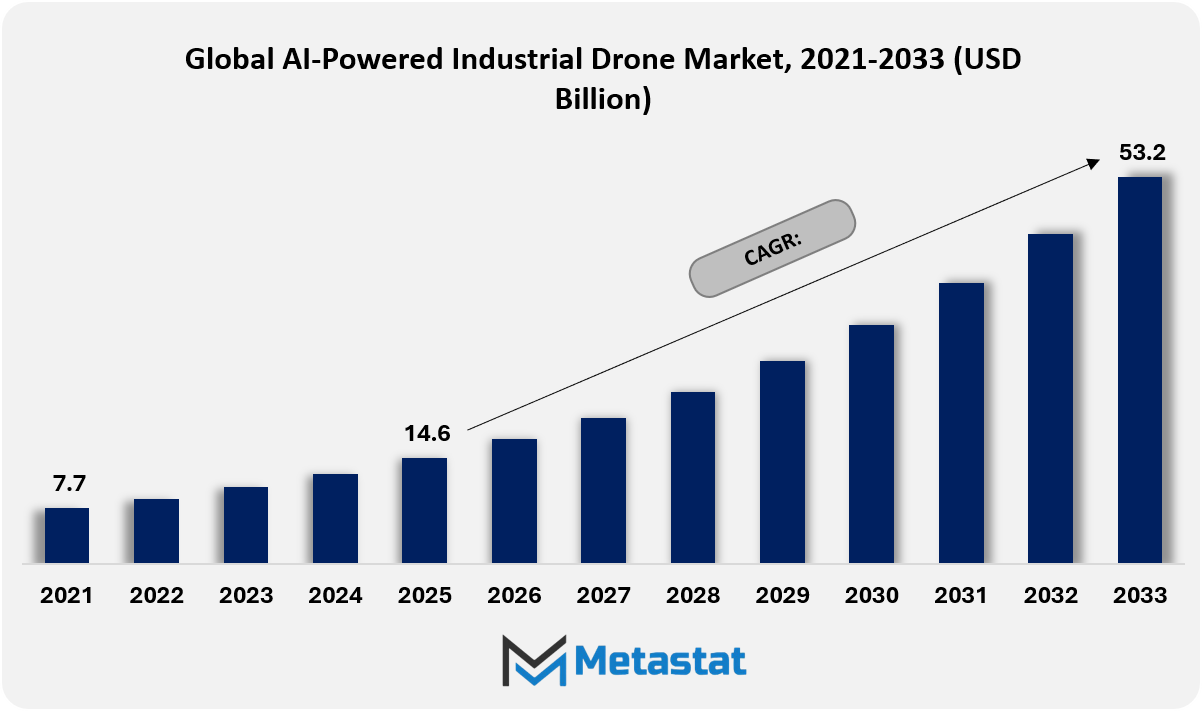
Increased reliance on AI-enabled automation to improve accuracy, safety, and operational uptime in industrial inspection.
Industrial inspection activities show increased reliance on AI-enabled automation, supporting higher measurement precision, risk avoidance, and continuous asset monitoring. Machine vision, edge analytics, and intelligent navigation support safer inspections across energy, mining, and infrastructure environments. Within the Global AI-Powered Industrial Drone market, automated inspection supports long-term operational resilience.
Increased adoption of predictive analytics and autonomous workflows to reduce labor intensity and enhance productivity across industrial sites.
Predictive analytics integrated with autonomous flight planning supports early fault detection and optimized maintenance cycles. Automated data interpretation reduces manual intervention, supporting productivity gains across large industrial facilities. Industrial sites increasingly value analytics-driven insights, enabling proactive decision-making and consistent operational output across geographically dispersed assets.
Strict regulatory limitations on BVLOS flights and autonomous mission approvals, impacting deployment scalability.
Regulatory frameworks governing beyond-visual-line-of-sight operations impose approval delays and operational constraints. Autonomous mission authorization remains limited across several regions, slowing large-scale deployment. Compliance complexity increases project timelines and operating costs, limiting adoption across sectors requiring continuous aerial monitoring and long-range inspection capabilities.
High cost of AI-integrated hardware, payloads, and data-processing systems reducing adoption among small and mid-scale enterprises.
Advanced sensors, onboard processors, and secure data infrastructure require significant capital investment. Smaller firms face budget constraints during technology evaluation and deployment stages. High ownership and integration costs create adoption barriers, especially across price-sensitive industrial operators seeking short-term return visibility.
Expansion of end-to-end autonomous drone-in-a-box ecosystems enabling continuous, remote, and unmanned industrial operations at scale.
Drone-in-a-box ecosystems support automated charging, mission scheduling, data transfer, and analytics without on-site human presence. Remote operations improve scalability across industrial networks and hazardous locations. Continuous monitoring capability supports future-ready industrial models, positioning autonomous aerial systems as core components within digital industrial infrastructure.
The Global AI-Powered Industrial Drone market is segmented by Drone Type, AI Capability, Distribution Model, and End-Users.
Fixed-Wing Drones segment is estimated at USD 4.2 billion in 2026 and is projected to reach USD 12.3 billion by 2033, at a CAGR of 16.7% during the forecast period.
Fixed-wing drones will support long-duration industrial missions through extended flight range and energy efficiency. Industrial monitoring, corridor inspection and wide area mapping will benefit from continued aerial performance. Future deployments will emphasize autonomous route planning and advanced sensor fusion to support large-scale asset monitoring and regional infrastructure assessment.
Rotary-Wing (Multi-Rotor) Drones segment is estimated at USD 9.2 billion in 2026 and is projected to reach USD 25.4 billion by 2033, at a CAGR of 15.7% during the forecast period.
Rotary-wing drones will enable precision-driven industrial operations through vertical lift capability and controlled hovering. Site inspection, close-range analysis and confined area navigation will expand into industrial facilities. AI-powered stability systems and real-time analytics will strengthen operational accuracy, supporting detailed data capture within complex operational environments.
Hybrid / VTOL (Vertical Take-Off & Landing) Drones segment is estimated at USD 3.8 billion in 2026 and is projected to reach USD 15.4 billion by 2033, at a CAGR of 22.3% during the forecast period.
Hybrid VTOL drones will bridge endurance and flexibility through combined lift mechanisms. Industrial users will adopt such platforms for operations requiring runway freedom and extended coverage. The integrated AI system will manage transition control, route optimization and adaptive flight behavior, enabling efficient deployment in various industrial areas.
Computer Vision & Image Recognition segment is projected to reach USD 14.3 billion by 2033, at a CAGR of 17.1% during the forecast period.
Computer vision capabilities will transform industrial drone outputs into actionable intelligence. Automated fault detection, pattern recognition, and environmental assessment will support predictive decision-making. Industrial workflows will rely on real-time visual analytics to improve safety compliance, reduce inspection time, and increase operational accuracy in asset-heavy industries.
Autonomous Navigation & Obstacle Avoidance segment is projected to reach USD 17.9 billion by 2033, at a CAGR of 16.9% during the forecast period.
Autonomous navigation systems will increase operational reliability through continuous environmental sensing and adaptive path control. Industrial drones will perform complex missions without human intervention, thereby reducing operational risks. AI-led obstacle avoidance will strengthen mission continuity within dynamic industrial areas, supporting uninterrupted inspection and surveillance activities.
Predictive Maintenance & Analytics segment is projected to reach USD 11.4 billion by 2033, at a CAGR of 18.1% during the forecast period.
Predictive maintenance analytics will transform drone-generated data into forward-looking operational insights. Device health monitoring will rely on trend analysis and anomaly detection. Industrial operators will reduce downtime through early fault detection, enable proactive maintenance planning and improve asset lifecycle management supported by AI intelligence.
Swarm Intelligence & Collaborative Drones segment is projected to reach USD 6.7 billion by 2033, at a CAGR of 19.8% during the forecast period.
Swarm intelligence will enable coordinated drone operations through shared data processing and distributed task execution. Industrial projects will deploy supporting fleets to expedite survey, inspection and monitoring activities. AI-powered coordination will optimize coverage efficiency, operational time and data consistency at large industrial sites.
Natural Language / Voice Command AI segment is projected to reach USD 2.9 billion by 2033, at a CAGR of 17.8% during the forecast period.
Natural language interfaces will simplify industrial drone control through voice-based operational commands. Field operators will manage mission parameters with minimal technical intervention. AI interpretation engines will improve command accuracy and response time, support safe operations and streamline human-machine interactions within industrial workflows.
Direct Sales segment is projected to reach USD 22.5 billion by 2033.
Direct income channels will help customized drone procurement for commercial customers with described operational necessities. Manufacturers will deliver tailor-made hardware and included AI answers. Long-term service agreements and upgrade pathways will enhance customer confidence, helping sustained adoption throughout regulated industrial environments.
Drone-as-a-Service (DaaS) Providers segment is projected to reach USD 13.2 billion by 2033.
Drone-as-a-Service providers will extend market accessibility through subscription-based deployment models. Industrial organizations will leverage managed services without capital-intensive investment. Providers will deliver analytics, compliance management, and operational expertise, enabling rapid integration of AI-powered drone capabilities into existing workflows.
System Integrators & AI Platform Vendors segment is projected to reach USD 14.2 billion by 2033.
System integrators will align drone hardware with enterprise software ecosystems through unified AI platforms. Industrial adoption relies on seamless data flow and interoperability. Vendors will focus on scalable architectures, cybersecurity assurance, and workflow integration to support enterprise-wide intelligence generation.
Online / E-commerce Channels segment is projected to reach USD 3.3 billion by 2033.
Online distribution channels will support standardized drone procurement and spare parts sourcing. Industrial buyers will access specifications, software updates, and support resources via digital platforms. Expansion of online channels will complement enterprise procurement strategies through transparency and operational convenience.
Energy & Utilities segment is projected to grow at a CAGR of 17.1% during the forecast period.
Energy and utility sectors will deploy intelligent drones for asset inspection, fault detection, and grid monitoring. AI-driven analytics will strengthen infrastructure resilience and safety compliance. Operational efficiency will improve through reduced manual inspection cycles and improved situational awareness across distributed energy assets.
Agriculture segment is projected to grow at a CAGR of 17.2% during the forecast period.
Agricultural operations will undertake AI-powered drones for crop fitness assessment, yield forecasting, and aid optimization. Precision analytics will manual irrigation, fertilization, and pest manage strategies. Drone intelligence will help sustainable farming practices and advanced productiveness across large agricultural holdings.
Construction & Infrastructure segment is projected to grow at a CAGR of 17% during the forecast period.
Construction and infrastructure projects will integrate smart drones for progress tracking, safety audits, and site planning. AI-enabled mapping and modeling will improve decision accuracy. Project timelines will improve through real-time visibility and data-driven coordination across multi-phase development activities.
Mining & Metals segment is projected to grow at a CAGR of 17.5% during the forecast period.
Mining and metals industries will rely on AI-powered drones for terrain analysis, volume measurement, and safety monitoring. Autonomous inspection will reduce human exposure to hazardous environments. Predictive insights will support operational continuity and regulatory compliance within resource extraction activities.
Logistics, Retail & E-commerce segment is projected to grow at a CAGR of 18% during the forecast period.
Logistics and retail sectors will discover drone intelligence for inventory tracking, facility inspection, and delivery optimization. AI-pushed analytics will beautify supply chain visibility. Operational responsiveness will improve via computerized tracking and information-supported path efficiency planning.
Defense & Public Safety segment is projected to grow at a CAGR of 17.9% during the forecast period.
Defense and public safety agencies will deploy intelligent drones for surveillance, reconnaissance, and emergency response. AI-enabled situational awareness will support rapid decision-making. Operational readiness will improve through autonomous monitoring, risk assessment, and coordinated mission execution.
Environmental & Government Agencies segment is projected to grow at a CAGR of 20.2% during the forecast period.
Environmental and authorities' corporations will undertake AI-powered drones for tracking ecosystems, city planning, and catastrophe assessment. Data-driven insights will help coverage components and regulatory oversight. Long-time period sustainability desires will align with shrewd aerial monitoring and analytical precision.
Based on geography, the Global AI-Powered Industrial Drone market is divided into North America, Europe, Asia Pacific, South America, and Middle East and Africa.
North America AI‑Powered Industrial Drone Market is set to expand at a CAGR of 17.6% within the forecast period, reaching a market size (TAM) of USD 15.6 billion by the end of 2033.
In North America, manufacturing digitalization and Industry 4.0 adoption has increased demand for AI-powered industrial drones to improve inspection accuracy and operational uptime.
In North America, heavy investment from the energy, utilities and logistics sectors accelerates the use of AI-enabled drones for predictive maintenance and asset monitoring.
In Asia Pacific, rapid industrial expansion in China, India, and Southeast Asia supports opportunities for AI-powered industrial drones in large-scale infrastructure inspection.
In Asia Pacific, supportive government initiatives for smart factories and automation create high growth potential for AI-powered industrial drone deployment.
In Middle East and Africa and South America, adoption of AI-powered industrial drones is gaining momentum through infrastructure expansion, mining activity, and oil operations, supported by gradual improvement in the industrial automation ecosystem.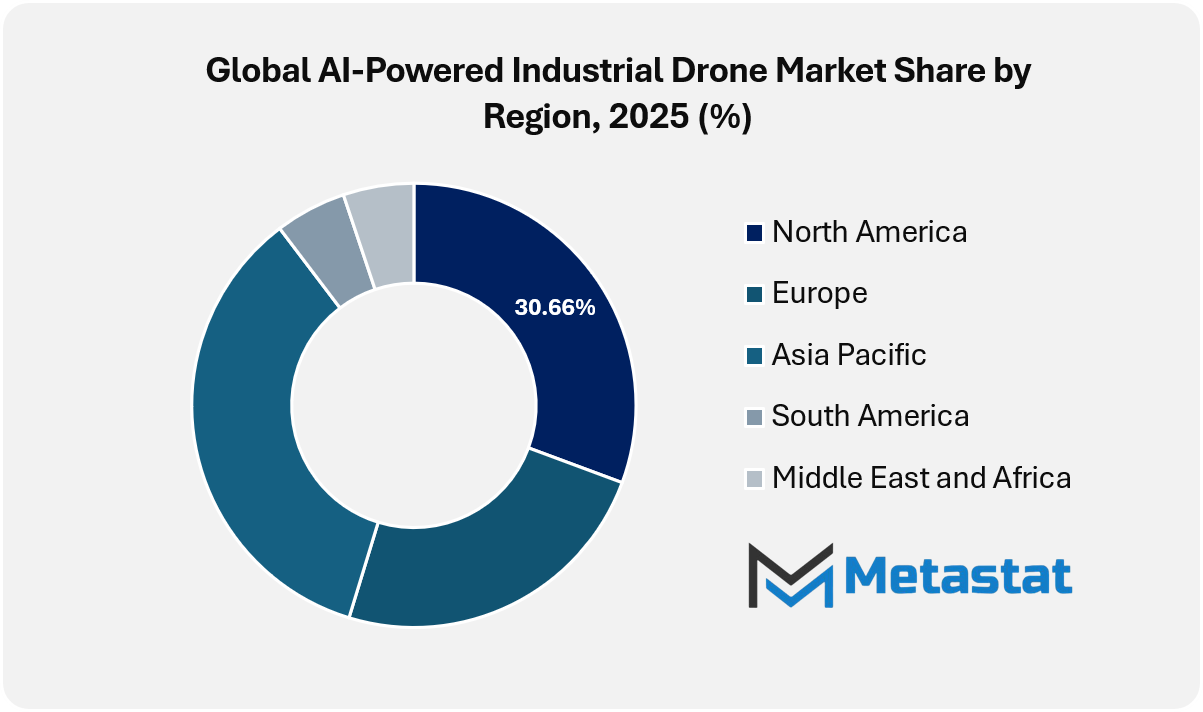
The global AI-powered industrial drone market continues to gain steady interest driven by increased demand for safer, faster, and data-driven operations across industries. These drones support inspection, mapping, surveillance, and monitoring tasks where manual work brings higher risk and slower output. Artificial intelligence enables drones to process visual data, detect faults, track patterns, and support decision-making with limited human input. Industries including energy, construction, mining, agriculture, and public safety increasingly rely on these systems to improve performance while controlling operating costs. The shift toward automation in industrial workflows continues to strengthen market momentum.
Technology development plays a critical role in shaping competition within the market. AI-powered industrial drones feature advanced computer vision, obstacle avoidance, real-time analytics, and autonomous navigation. These capabilities reduce dependency on specialized pilots and support continuous operations in complex environments. Many industrial users prefer solutions that integrate with existing software platforms and data systems. Hardware reliability, flight endurance, and sensor accuracy remain key buying criteria, particularly for inspection and surveillance tasks where precision drives value.
Key international AI-powered industrial drone market competitors include DJI, Skydio, Autel Robotics, Parrot, Teledyne FLIR, Flyability, Exyn Technologies, Percepto, American Robotics, Airobotics (Ondas), Azur Drones, Sunflower Labs, PrecisionHawk, Raptor Maps, SkySpecs, Terra Drone Corporation, ACSL, PRODRONE, Yamaha Motor, XAG, JOUAV, MMC UAV, Microdrones, Wingtra, Quantum-Systems, Delair, DeltaQuad Group, Schiebel, SwissDrones, Voliro, Draganfly, Inspired Flight, Aerodyne Group, and Drone Volt. The companies focus on expanding autonomous flight capabilities, improving AI accuracy, and building industry-specific solutions. Some players specialize in inspection or mapping, while others target security, logistics, or large-scale industrial monitoring.
Regional growth patterns display sturdy adoption in North America and Europe because of early era popularity and supportive industrial use instances. Asia Pacific shows rising interest pushed with the aid of infrastructure improvement, clever production, and huge-scale land management wishes. Regulatory clarity, protection approvals, and airspace control remain crucial elements influencing deployment speed throughout areas. Partnerships between drone manufacturers, software program companies, and business service vendors retain to shape aggressive techniques.
Market size is forecast to rise from USD 14.6 billion in 2025 to over USD 53.2 billion by 2033.
Business value is likely to shift from hardware performance to adaptive intelligence layers that evolve through continuous learning. Vendors compete on domain-trained models for mining, energy, logistics and heavy manufacturing contexts. Custom intelligence stacks designed for specific industrial environments are projected to replace generic automation frameworks. In the long term, industrial drones are expected to act as autonomous partners embedded in the operational ecosystem. Their role is set to expand from observation to participation in industrial execution, establishing intelligent aerial systems as permanent components of industrial strategy than complementary tools.
This research report categorizes the AI‑Powered Industrial Drone market based on key segments and regions, forecasts revenue growth, and analyses trends in each submarket. The report analyses the key growth drivers, opportunities, and challenges influencing the AI‑Powered Industrial Drone market. Recent market developments and competitive strategies such as expansion, new site development, partnership, merger, and acquisition are included to present the competitive landscape.
The report strategically identifies and profiles the key market players and analyses their core competencies in each sub-segment of the AI‑Powered Industrial Drone market.
|
Report Attributes |
Details |
|
Study Period |
2021-2033 |
|
Base Year |
2025 |
|
Estimated Year |
2026 |
|
Forecast Period |
2026-2033 |
|
Historical Period |
2021-2025 |
|
Growth Rate |
CAGR 17.6% from 2026 to 2033 |
|
Revenue Unit |
USD billion |
|
Sales Volume Unit |
Units |
|
Segmentation |
By Drone Type, AI Capability, Distribution Model, End-Users, and Region |
|
By Region |
North America (By Drone Type, AI Capability, Distribution Model, End-Users, and Country)
|
|
Europe (By Drone Type, AI Capability, Distribution Model, End-Users, and Country)
|
|
|
Asia Pacific (By Drone Type, AI Capability, Distribution Model, End-Users, and Country)
|
|
|
South America (By Drone Type, AI Capability, Distribution Model, End-Users, and Country)
|
|
|
Middle East and Africa (By Drone Type, AI Capability, Distribution Model, End-Users, and Country)
|
Find answers to common questions about this report
Increased reliance on AI-enabled automation to improve accuracy, safety, and operational uptime in industrial inspection. and Rising adoption of predictive analytics and autonomous workflows to reduce labor intensity and enhance productivity across industrial sites are key driving factors, boosting the market.
Global AI‑Powered Industrial Drone market is estimated to reach USD 53.2 billion by 2033.
Asia Pacific region dominates the market.
The Metastat Insights analysis shows that the North America AI‑Powered Industrial Drone market size is estimated to be USD 15.6 billion by 2033.
Top players operating in the AI‑Powered Industrial Drone industry include DJI, Skydio, Autel Robotics, Parrot, Teledyne FLIR, and Flyability.
The Metastat Insights study shows that the Global AI‑Powered Industrial Drone market size was USD 14.6 billion in 2025.
The Global AI‑Powered Industrial Drone market is likely to grow at a CAGR of 17.6% over the forecast period (2026-2033).
The Rotary-Wing (Multi-Rotor) Drones is the leading type segment in the Global market.
Strict regulatory limitations on BVLOS flights and autonomous mission approvals impacting deployment scalability will hamper market growth within the forecast period.
The analysts below cover Machinery & Equipment research at Metastat Insights.
LEAD ANALYST
Utkarsh Khirodkar is a Lead Market Research Analyst at MetaStat Insight, specializing in market intelligence, technology sector assessments, and competitive strategy.

INDUSTRY CONSULTANT - CHEMICALS & ADVANCED MATERIALS
Chemicals and Materials · Machinery & Equipment · Packaging
Amit Gadhekar Consultant for Chemicals and Materials at MetaStat Insight, directing sector-specific intelligence, research, and strategic consulting across global chemical and processing markets.

PRINCIPAL CONSULTANT - QUALITY SYSTEMS & COMPLIANCE
Electronics and Semiconductor · Machinery & Equipment · Professional Services
Omkar Phadtare is an Industry Consultant at MetaStat Insight, specializing in quality systems, regulatory compliance, and standards benchmarking to drive data-driven market intelligence and strategic industry research.

ENERGY & INFRASTRUCTURE INDUSTRY CONSULTANT
Automotive and Transportation · Electronics and Semiconductor · Energy and Power · Machinery & Equipment
Saurabh Vasant Ganvir consults for Energy & Infrastructure Industry at MetaStat Insight, specializing in renewable energy, solar EPC, and electric vehicle (EV) infrastructure markets.

LEAD CONSULTANT - COMMUNICATION, TELECOM, AND IT
Electronics and Semiconductor · Information & Technology · Machinery & Equipment · Professional Services
Ravindra Sathe Consultants for Communication, Telecom, and IT at MetaStat Insight. He leads the firm's industry research initiatives across telecommunications infrastructure, digital connectivity, enterprise networking, and emerging information technology domains.
Our team was tracking whether regional recycling infrastructure could realistically absorb the growing volume of lithium iron phosphate batteries over the next decade. The report did a solid job separating announced hydrometallurgical plant capacity from active, permitted operational throughput. That distinction made the feedstock availability projections and regional recovery rate models far more credible than standard commercial overviews.
Tracking capacity expansion in single-use bioprocessing requires dependable data on raw material availability and cleanroom-grade polymer supply chains. The competitive landscape chapter gave a grounded evaluation of secondary component suppliers across North America and Asia-Pacific rather than simply reprinting press releases. Having that level of supplier benchmarking helped clarify dual-sourcing considerations for our clinical pipeline planning.
When evaluating distributed energy resource management systems, standard research summaries tend to gloss over the operational differences between front-of-the-meter utility deployments and behind-the-meter industrial sites. The MetaStat Insight report addressed those distinctions directly, especially regarding software interoperability standards and grid interconnection backlogs. The five-year market sizing across regional transmission organizations provided actionable context for our grid modernization strategy.
Explore related market intelligence reports worth reading alongside this one.
Starting from
$2950