
LEAD ANALYST
Utkarsh Khirodkar is a Lead Market Research Analyst at MetaStat Insight, specializing in market intelligence, technology sector assessments, and competitive strategy.

Gas Compressors Market Size, Share, By Compressor Type (Centrifugal Gas Compressors, Reciprocating Gas Compressors, Screw Gas Compressors, and Others), By Lubrication Type (Oil-free Compressors and Oil-lubricated Compressors), By Pressure Rating (Low Pressure, Medium Pressure, and High Pressure), By End‑Use Industry (Oil, Gas, Petrochemicals, Chemical Processing, Power Generation, Industrial Manufacturing, and Others), Industry Analysis, Growth, Trends, and Forecast, 2026-2033
Report ID
MSI-4745
Published
May, 2026
Pages
316 Pages
Format
Report Details
Choose Your License
Gas Compressors Market
Global Gas Compressors market size is valued at USD 5,338.2 million in 2025 and projected to grow at a CAGR of 3.2% during the forecast period, reaching USD 6,863.9 million by 2033.
Global Gas Compressors market valued at USD 5,338.2 million in 2025, growing at a CAGR of 3.2% through 2033, with potential to exceed USD 6,863.9 million.
North America held a 28.6% market share in 2025, with the U.S. leading the regional market.
Centrifugal Gas Compressors segment accounted for a market share of 38.6% in 2025.
Key trends driving market growth include natural gas pipeline and LNG infrastructure expansion, along with rising industrial process throughput requirements across refining, petrochemicals, chemicals, and power generation.
Opportunities include electrified and low-emission compression packages with digital condition monitoring for hydrogen, CCUS, and renewable gas value chains.
Key insight: Rising energy demand and industrial expansion are strengthening the growth trajectory of the Global Gas Compressors market despite efficiency and emissions-related challenges.
The Global Gas Compressors market within the industrial equipment and energy systems industry is expanding beyond conventional oil and gas applications and moving toward a broader role across diversified gas handling environments. While upstream exploration, gas transmission, and pipeline operations continue to shape a major share of installed demand, the market is increasingly gaining relevance across hydrogen infrastructure, biogas upgrading facilities, carbon capture networks, and distributed industrial systems. Manufacturers are focusing on compressor platforms capable of handling variable gas compositions, fluctuating pressure conditions, and stricter emissions requirements, supporting wider deployment across evolving energy and industrial value chains.
Urban gas distribution networks are increasingly adopting compact and low-noise compression systems integrated with digital monitoring capabilities. New installations are being designed with embedded sensors, remote diagnostics, and predictive maintenance functions to improve uptime and operational visibility. Procurement priorities are gradually shifting from initial equipment cost toward lifecycle efficiency, service reliability, and performance transparency. Industrial decarbonization initiatives are also encouraging the adoption of electrically driven and oil-free compressor systems aligned with tightening environmental and operating standards.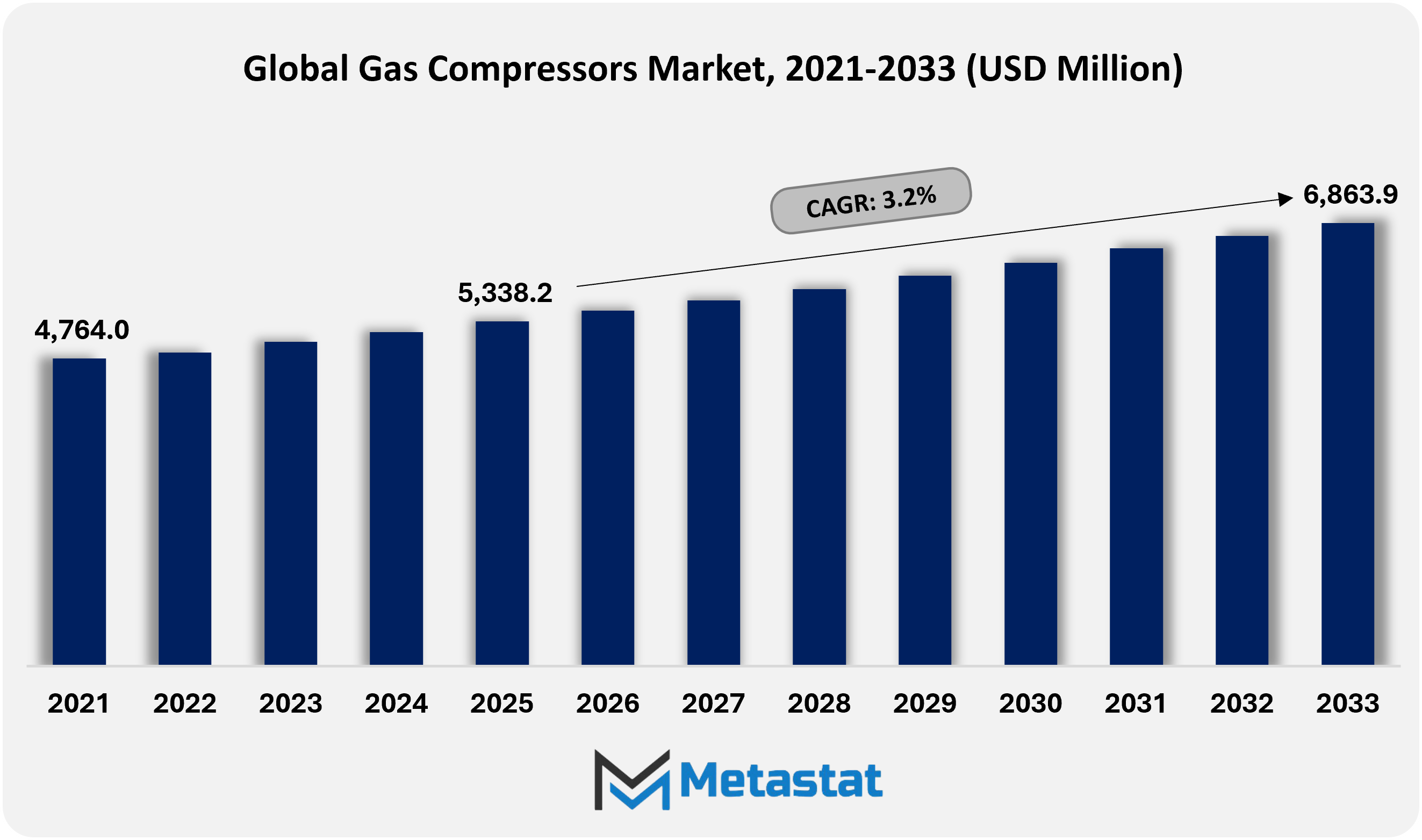
Natural gas pipeline and LNG build-out, including compressor stations and midstream expansions.
Expansion of natural gas pipelines, LNG terminals, and related midstream infrastructure continues to support demand across the Global Gas Compressors market. New compressor stations across transmission and gathering systems are required to maintain gas flow, pressure stability, and long-distance transport efficiency. Ongoing investment in gas export facilities, storage systems, and cross-border energy corridors is supporting demand for advanced compressor technologies designed for continuous and high-pressure operation.
Industrial process throughput needs across refining, petrochemicals, chemicals, and power generation
Rising throughput requirements across refining, petrochemicals, chemicals, and power generation are supporting compressor demand across industrial processing environments. Gas compressors play an important role in pressure control, gas transfer, and continuous process operation across production facilities handling large-scale volumes. Industrial operators are increasingly investing in reliable and energy-efficient systems that support process optimization, equipment stability, and long-duration performance across heavy-duty operating conditions.
High capital cost, complex installation, and maintenance intensity across lifecycle operations
High capital cost, installation complexity, and maintenance intensity remain key challenges across the Global Gas Compressors market. Large compressor systems often require detailed engineering, foundation preparation, precision alignment, and integration with supporting equipment, which increases project timelines and upfront investment requirements. In addition, ongoing servicing needs, spare parts availability, and dependence on skilled technical personnel raise total lifecycle cost and influence purchasing decisions across end-use industries.
Energy-efficiency and emissions compliance requirements, including noise, vibration, and methane management
Energy-efficiency standards and emissions compliance requirements are placing increasing pressure on compressor manufacturers and end users. Regulations linked to methane leakage, vibration control, acoustic performance, and emissions reduction are encouraging the use of advanced sealing systems, low-loss components, and monitoring technologies. Compliance with these requirements is increasing development costs and accelerating the shift toward compressor systems designed for higher efficiency, lower emissions, and improved operational control.
Electrified and low-emission compression packages with digital condition monitoring for hydrogen, CCUS, and renewable gas value chains
Electrified and low-emission compression packages integrated with digital condition monitoring present a strong opportunity across hydrogen, CCUS, and renewable gas applications. Operators are showing rising interest in compressor systems that support cleaner operation, remote diagnostics, predictive maintenance, and improved asset reliability. These capabilities are becoming increasingly important across emerging energy networks where uptime, emissions performance, and data-based asset management are critical to project viability and long-term system efficiency.
The Global Gas Compressors market is classified based on Compressor Type, Lubrication Type, Pressure Rating, and End‑Use Industry.
Centrifugal Gas Compressors segment is valued at USD 2,124.6 million in 2026 and is projected to reach USD 2,705.1 million by 2033, at a CAGR of 3.5% during the forecast period.
Centrifugal gas compressors will maintain strong adoption across large-scale processing facilities, transmission systems, and energy infrastructure projects owing to their suitability for continuous operation and high-flow applications. Their role is particularly important across gas pipelines, LNG facilities, and major industrial processing sites where stable performance and operational efficiency remain essential. Continued improvements in aerodynamic design, digital monitoring, and predictive maintenance are supporting their long-term relevance across the Global Gas Compressors market.
Reciprocating Gas Compressors segment is valued at USD 1,758.2 million in 2026 and is projected to reach USD 2,080.4 million by 2033, at a CAGR of 2.4% during the forecast period.
Reciprocating gas compressors will remain important across applications requiring high pressure, precise gas handling, and controlled flow conditions. These systems are widely used across gas storage, refining, chemical processing, and upstream operations where pressure intensity and process control are critical. Ongoing improvements in component durability, sealing performance, and emissions management are supporting their continued use across demanding industrial environments.
Screw Gas Compressors segment is valued at USD 1,233.7 million in 2026 and is projected to reach USD 1,606.8 million by 2033, at a CAGR of 3.8% during the forecast period.
Screw gas compressors are gaining wider acceptance across mid-scale industrial applications owing to their compact structure, stable performance, and suitability for continuous-duty operation. Their use is expanding across manufacturing plants, distributed processing facilities, and industrial systems where space efficiency and ease of operation are important. Advancements in rotor design, energy optimization, and package integration are improving their competitiveness across the Global Gas Compressors market.
Others segment is valued at USD 387 million in 2026 and is projected to reach USD 471.5 million by 2033, at a CAGR of 2.9% during the forecast period.
Other compressor technologies, including diaphragm and scroll systems, are serving specialized applications that require contamination control, precision gas handling, or compact installation formats. These systems are increasingly used across laboratories, medical gas environments, research facilities, and niche industrial processes. Their role remains smaller in value terms, though their importance is increasing across highly specialized operating settings.
Oil-free Compressors segment is projected to reach USD 2,228 million by 2033, at a CAGR of 4.8% during the forecast period.
Oil-free compressors will witness stronger growth across industries where gas purity, contamination control, and regulatory compliance are critical. Food processing, pharmaceuticals, electronics, and selected medical applications continue to support demand for oil-free systems that deliver clean and controlled compression. Advances in coatings, sealing technology, and efficiency enhancement are improving the performance profile of this segment across the Global Gas Compressors market.
Oil-lubricated Compressors segment is projected to reach USD 4,635.9 million by 2033, at a CAGR of 2.5% during the forecast period.
Oil-lubricated compressors continue to hold a strong position across heavy industrial applications owing to durability, cost efficiency, and suitability for demanding operating conditions. These systems remain widely used across petrochemicals, fabrication, manufacturing, and energy processing environments where long operating hours and mechanical reliability are priorities. Improvements in lubricant management, filtration systems, and maintenance performance continue to strengthen the segment’s installed base.
Low Pressure segment is projected to reach USD 1,615.8 million by 2033.
Low-pressure compressors are widely used across ventilation systems, packaging operations, light industrial processes, and selected utility applications where moderate compression is sufficient for stable performance. Their adoption is supported by the expansion of small and medium-scale production environments requiring reliable and energy-efficient gas handling solutions. Motor efficiency, package simplicity, and operating cost remain important purchasing considerations across this segment.
Medium Pressure segment is projected to reach USD 2,965.9 million by 2033.
Medium-pressure compressors play a central role across industrial gas distribution, processing facilities, and transmission-related applications where balanced pressure capability and consistent performance are required. They are increasingly deployed across infrastructure modernization projects, industrial plants, and utility-linked installations. The segment benefits from growing interest in remote monitoring, operational reliability, and efficient package design across mixed industrial environments.
High Pressure segment is projected to reach USD 2,282.2 million by 2033.
High-pressure compressors are essential across exploration, gas reinjection, hydrogen systems, chemical synthesis, and specialized industrial applications that require intense compression capability. Their importance is rising across advanced energy and process industries where safety, pressure integrity, and thermal stability are critical. Engineering improvements linked to materials, sealing performance, and system control are supporting the premium positioning of this segment.
Oil and Gas segment is projected to grow at a CAGR of 2.5% during the forecast period.
Oil and gas remain a major end-use segment for gas compressors owing to continued requirements across upstream extraction, midstream transport, storage, LNG infrastructure, and downstream processing. Compressor systems remain essential for maintaining flow, pressure control, and gas movement across multiple stages of the value chain. Ongoing pipeline development, LNG investment, and digital asset management adoption continue to support long-term segment demand.
Petrochemicals & Chemical Processing segment is projected to grow at a CAGR of 4.4% during the forecast period.
Petrochemical and chemical processing facilities continue to rely on gas compressors for feedstock handling, process pressure management, and continuous production operations. Capacity additions across bulk chemicals, specialty chemicals, and polymer production are supporting equipment demand across this segment. Procurement trends are increasingly shaped by efficiency improvement, process optimization, and emissions-control priorities.
Power Generation segment is projected to grow at a CAGR of 2.3% during the forecast period.
Power generation applications require gas compressors across turbine support systems, fuel handling processes, and selected plant operations where stable gas movement is necessary for efficient output. Rising deployment across gas-fired and hybrid power systems is supporting demand for reliable compression equipment. Segment growth is also linked to efficiency improvement initiatives and efforts to align plant operations with lower-emission generation frameworks.
Industrial Manufacturing segment is projected to grow at a CAGR of 3.8% during the forecast period.
Industrial manufacturing facilities use gas compressors across material handling, pneumatic systems, automation platforms, and process support operations. Growth across automotive, metals, electronics, and general manufacturing is sustaining equipment replacement and capacity expansion activity. Smart factory integration, energy management focus, and equipment reliability remain central factors influencing purchasing decisions across this segment.
Others segment is projected to grow at a CAGR of 4.4% during the forecast period.
Other end-use industries, including healthcare, mining, environmental services, and research applications, are contributing to incremental demand for gas compressors across specialized operating environments. These applications often require customized solutions suited to specific gas compositions, pressure requirements, and safety standards. The widening use of compressors across niche sectors is gradually expanding the market’s application base.
Based on geography, the Global Gas Compressors market is divided into North America, Europe, Asia-Pacific, South America, Middle East, and Africa.
North America Gas Compressors Market is set to expand at a CAGR of 3.2% within the forecast period, reaching a market size (TAM) of USD 1,805.9 million by the end of 2033.
North America drives the Gas Compressors market through increasing shale fuel exploration and growing LNG export infrastructure investments.
Strong modernization of pipeline networks throughout North America supports regular demand inside the Gas Compressors market.
Asia Pacific gives fundamental opportunities for the Gas Compressors market owing to rapid industrialization and developing natural gasoline consumption throughout electricity and manufacturing sectors.
Expanding city gas distribution initiatives across Asia Pacific create new opportunities inside the Gas Compressors market.
Across the Middle East, Africa, and South America, the Gas Compressors market profits momentum from upstream oil and gas growth, gasoline monetization projects, and increasing go-border pipeline trends.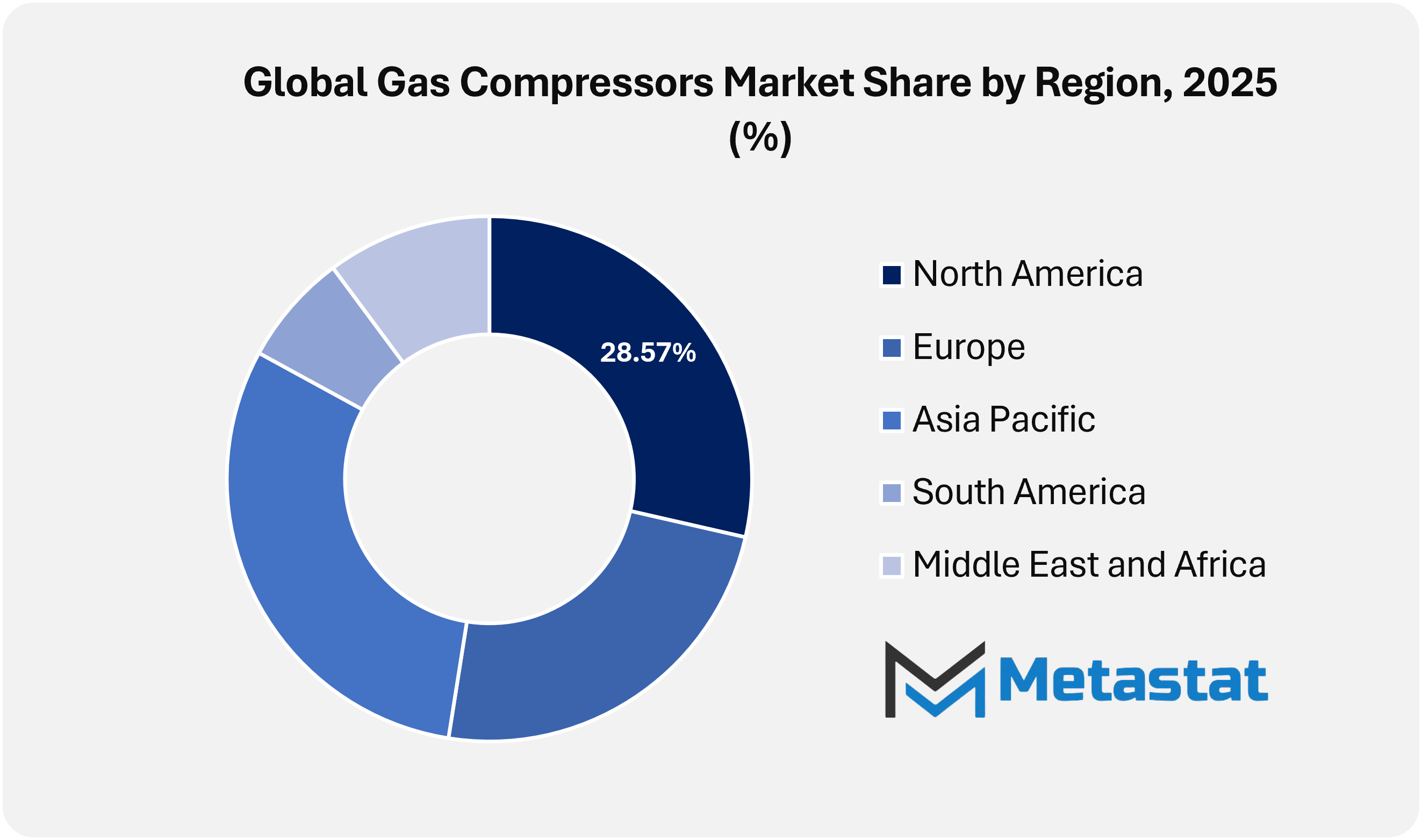
The Global Gas Compressors market remains highly important across industries that depend on gas movement, storage, and pressure management. Compressors are widely used across oil and gas, power generation, chemicals, manufacturing, LNG infrastructure, and specialized industrial applications. Market growth is supported by energy demand, industrial expansion, infrastructure investment, and the need for higher operating efficiency across gas handling systems. At the same time, emissions standards and digitalization trends are reshaping product development priorities across the competitive landscape.
Large multinational manufacturers continue to account for a significant share of the market through broad product portfolios, strong engineering capabilities, and global service networks. Companies such as Atlas Copco AB, Siemens Energy AG, Burckhardt Compression Holding AG, Ingersoll Rand Inc., Hitachi Ltd., and Kawasaki Heavy Industries, Ltd. maintain established positions across industrial, energy, and process applications. Their competitive strength is supported by technology depth, aftermarket capabilities, and long-standing relationships across major end-use sectors.
Specialized manufacturers also hold strong positions across high-pressure, oil-free, and precision gas handling applications. Ariel Corporation, Bauer Compressors Inc., HAUG Sauer Kompressoren AG, PDC Machines, Inc., Haskel International, Inc., Maximator GmbH, and RIX Industries are notable participants across niche segments requiring advanced compression performance and application-specific engineering. These players compete through product specialization, operational reliability, and alignment with demanding gas handling requirements across hydrogen, specialty gases, and industrial processing environments.
Regional and diversified players continue to strengthen competition across the broader market. Chart Industries, Inc., GEA Group AG, Kirloskar Pneumatic Company Limited, Shanghai Electric Blower Works Co., Ltd., Enerflex Ltd., Solar Turbines Incorporated, Kaishan Group Co., Ltd., Mattei Group, Gardner Denver (LeROI), GasPro Compression Corp., Euro Gas Systems, and Comptech Equipments Limited contribute to market development through localized supply capabilities, service reach, and targeted industrial offerings. Competitive intensity will remain shaped by efficiency improvement, digital monitoring integration, product reliability, and long-term aftermarket support.
Market size is forecast to rise from USD 5,338.2 million in 2025 to over USD 6,863.9 million by 2033.
Over the forecast period, the Global Gas Compressors market is expected to evolve from a conventional equipment category into a critical enabling component across broader energy, industrial, and low-emission gas infrastructure systems. Future market development will be shaped by application diversification, digital monitoring integration, energy-efficiency priorities, and the ability of manufacturers to address changing gas compositions and operating requirements. Compressor systems aligned with reliability, emissions performance, and intelligent asset management are likely to gain stronger traction across both traditional and emerging end-use environments.
This research report categorizes the Gas Compressors market based on key segments and regions, forecasts revenue growth, and analyses trends in each submarket. The report analyses the key growth drivers, opportunities, and challenges influencing the Gas Compressors market. Recent market developments and competitive strategies such as expansion, product launch, partnership, merger, and acquisition have been included to draw the competitive landscape in the market.
The report strategically identifies and profiles the key market players and analyses their core competencies in each sub-segment of the Gas Compressors market.
|
Report Attributes |
Details |
|
Study Period |
2021-2033 |
|
Base Year |
2025 |
|
Estimated Year |
2026 |
|
Forecast Period |
2026-2033 |
|
Historical Period |
2021-2025 |
|
Growth Rate |
CAGR 3.2% from 2026 to 2033 |
|
Revenue Unit |
USD million |
|
Sales Volume Unit |
Thousand Units |
|
Segmentation |
By Compressor Type, Lubrication Type, Pressure Rating, End‑Use Industry, and Region |
|
By Region |
North America (By Compressor Type, Lubrication Type, Pressure Rating, End‑Use Industry, and Country)
|
|
Europe (By Compressor Type, Lubrication Type, Pressure Rating, End‑Use Industry, and Country)
|
|
|
Asia Pacific (By Compressor Type, Lubrication Type, Pressure Rating, End‑Use Industry, and Country)
|
|
|
South America (By Compressor Type, Lubrication Type, Pressure Rating, End‑Use Industry, and Country)
|
|
|
Middle East and Africa (By Compressor Type, Lubrication Type, Pressure Rating, End‑Use Industry, and Country)
|
Find answers to common questions about this report
Top players operating in the Gas Compressors industry include Atlas Copco AB, Bauer Compressors Inc., Siemens Energy AG, Burckhardt Compression Holding AG, Hitachi Ltd, Chart Industries, Inc., and Kobe Steel, Ltd.
North America region dominates the market.
The Centrifugal Gas Compressors is the leading type segment in the Global market.
Natural gas pipeline and LNG build-out, including compressor stations and midstream expansions and Industrial process throughput needs across refining, petrochemicals, chemicals, and power generation are key driving factors, boosting the market.
Global Gas Compressors market is estimated to reach USD 6,863.9 million by 2033.
High capital cost, complex installation, and maintenance intensity across lifecycle operations will hamper the market growth within the forecast period.
The Metastat Insights analysis shows that the North America Gas Compressors market size is estimated to be USD 1,805.9 million by 2033.
The Global Gas Compressors market is expected to grow at a CAGR of 3.2% over the forecast period (2026-2033).
The Metastat Insights study shows that the Global Gas Compressors market size was USD 5,338.2 million in 2025.
The analysts below cover Machinery & Equipment research at Metastat Insights.
LEAD ANALYST
Utkarsh Khirodkar is a Lead Market Research Analyst at MetaStat Insight, specializing in market intelligence, technology sector assessments, and competitive strategy.

INDUSTRY CONSULTANT - CHEMICALS & ADVANCED MATERIALS
Chemicals and Materials · Machinery & Equipment · Packaging
Amit Gadhekar Consultant for Chemicals and Materials at MetaStat Insight, directing sector-specific intelligence, research, and strategic consulting across global chemical and processing markets.

PRINCIPAL CONSULTANT - QUALITY SYSTEMS & COMPLIANCE
Electronics and Semiconductor · Machinery & Equipment · Professional Services
Omkar Phadtare is an Industry Consultant at MetaStat Insight, specializing in quality systems, regulatory compliance, and standards benchmarking to drive data-driven market intelligence and strategic industry research.

ENERGY & INFRASTRUCTURE INDUSTRY CONSULTANT
Automotive and Transportation · Electronics and Semiconductor · Energy and Power · Machinery & Equipment
Saurabh Vasant Ganvir consults for Energy & Infrastructure Industry at MetaStat Insight, specializing in renewable energy, solar EPC, and electric vehicle (EV) infrastructure markets.

LEAD CONSULTANT - COMMUNICATION, TELECOM, AND IT
Electronics and Semiconductor · Information & Technology · Machinery & Equipment · Professional Services
Ravindra Sathe Consultants for Communication, Telecom, and IT at MetaStat Insight. He leads the firm's industry research initiatives across telecommunications infrastructure, digital connectivity, enterprise networking, and emerging information technology domains.
Tracking ceramic matrix composite adoption in high-bypass aero engines requires strict attention to material qualification cycles and FAA airworthiness testing milestones. The MetaStat Insight team provided a detailed timeline of silicon carbide fiber manufacturing capacity and commercial foundry lead times. Having clear visibility into upstream thermal barrier coating supply helped us stress-test our long-term component procurement strategy.
Transitioning ultra-class mining haul trucks to alternative power requires concrete data on remote hydrogen refueling infrastructure economics. The report evaluated megawatt-scale electrolyzer installation expenses, onsite storage safety mandates, and heavy-duty fuel cell stack degradation under continuous duty cycles. That technical rigor helped our engineers benchmark realistic total operating cost horizons for off-highway fleet decarbonization.
Enterprise zero-trust network rollouts are often slowed down by multi-cloud transit latency and proprietary hardware retirement schedules. This study provided realistic total cost of ownership models comparing cloud-delivered security edge solutions against traditional hardware refreshes. The analysis of contract renewal lengths and software maintenance fees gave us clear visibility into enterprise replacement cycles over the next three to five years.
Explore related market intelligence reports worth reading alongside this one.