
LEAD ANALYST
Utkarsh Khirodkar is a Lead Market Research Analyst at MetaStat Insight, specializing in market intelligence, technology sector assessments, and competitive strategy.

Europe Mini Excavators Market Size, Share, By Type (Wheeled and Track), By Operating Weight (Less Than 4 Tons, and 4 Tons to 10 Tons), By Power Source (Diesel-powered, Electric-powered, and Hybrid), By End User (Landscaping, Construction, and Agriculture), Industry Analysis, Growth, Trends, and Forecast, 2026-2033
Report ID
MSI-4779
Published
May, 2026
Pages
315 Pages
Format
Report Details
Choose Your License
Europe Mini Excavators Market
Europe Mini Excavators market size is valued at USD 2,162.9 million in 2025 and projected to grow at a CAGR of 4.2% during the forecast period, reaching USD 3,004.1 million by 2033.
Wheeled segment account for a market share of 8.3% in 2025
Key trends driving growth: Rising urban infrastructure and renovation activities, Increasing demand for compact equipment in confined spaces.
Opportunities include growing adoption of electric and eco-friendly mini excavators.
Key insight: The Europe Mini Excavators market is shifting toward technology-enabled machines with telematics, operator comfort improvements, and maintenance diagnostics.
The Europe Mini Excavators market is expanding steadily, supported by rising demand for compact construction equipment suited for urban worksites, infrastructure renewal projects, and precision excavation tasks. Contractors across Europe are adopting mini excavators for jobs requiring maneuverability, lower ground impact, and efficient fuel consumption. The market is supported by rising investments in road repair, utility line upgrades, landscaping, and residential development. Mini excavators are becoming preferred machines for projects where larger equipment cannot operate efficiently. Their versatility with multiple attachments is strengthening adoption across construction, landscaping, agriculture, and utility maintenance applications.
Stringent emission standards and sustainability goals are encouraging manufacturers to develop low-emission and electric models. The Europe Mini Excavators market is also benefiting from rental fleet expansion, enabling smaller contractors to access advanced equipment without major capital expenditure. The market is moving toward technology-enabled machines equipped with telematics, improved operator comfort, and predictive maintenance diagnostics. Fleet owners are prioritizing uptime, fuel efficiency, and lifecycle cost optimization, shaping future purchasing decisions across the region.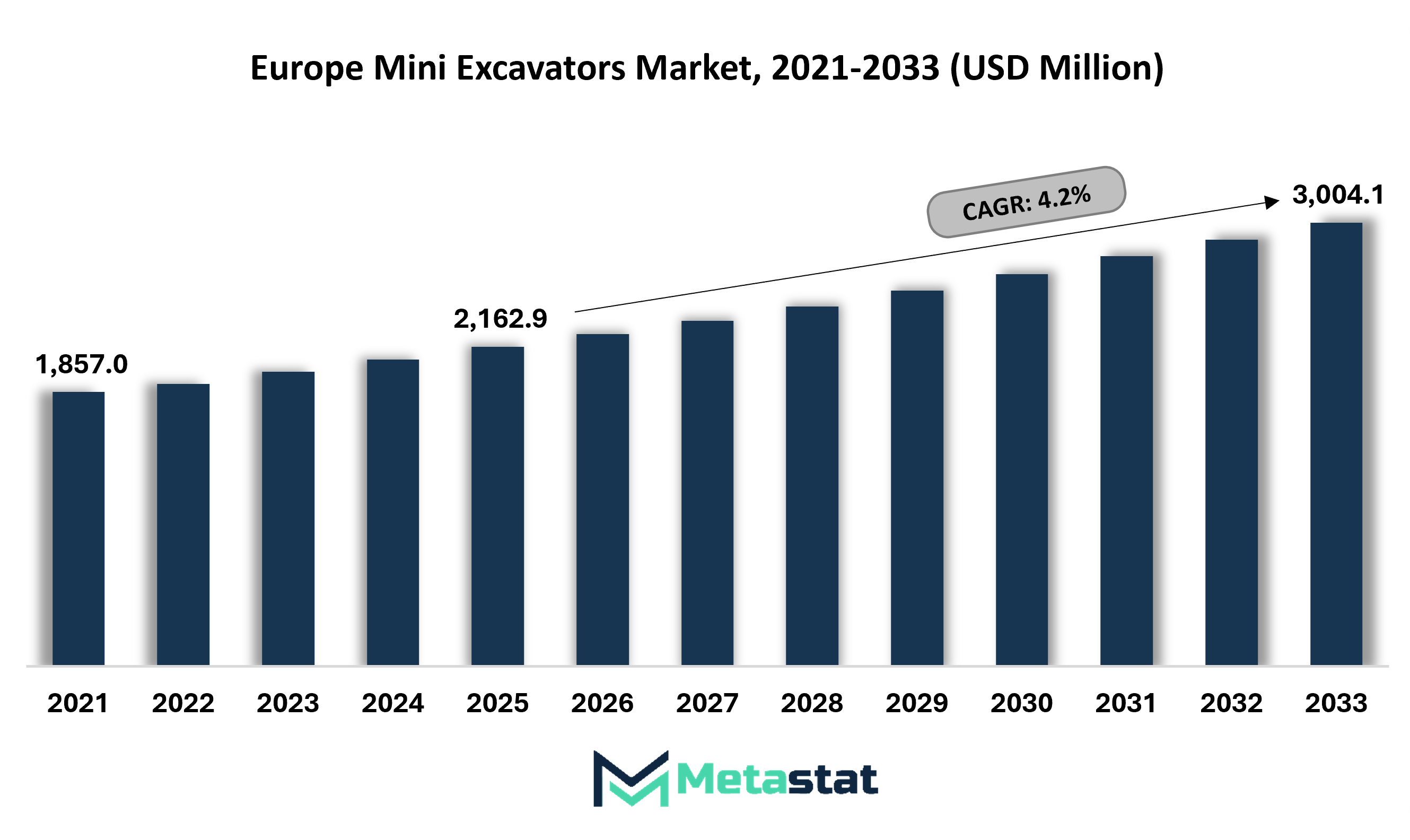
Rising urban infrastructure and renovation activities.
Expansion of transport corridors, housing upgrades, utility replacement programs, and commercial property renewal across European cities is creating steady equipment demand. Mini excavators support pavement repair, basement work, drainage trenching, and landscape preparation. Future municipal budgets will increase fleet purchases linked to modernization goals and faster project completion schedules.
Increasing demand for compact equipment in confined spaces
Dense streets, narrow access lanes, indoor demolition zones, and confined construction plots are increasing preference for compact equipment. Mini excavators allow movement in areas where larger machines face operating limits. Future building designs with tighter work zones will strengthen demand from contractors seeking precision, lower disruption, and efficient material handling capability.
High initial purchase and maintenance cost
High purchase prices, attachment costs, financing charges, servicing needs, and replacement parts create budget pressure for small contractors. Ownership decisions often slow during uncertain economic periods. Future market growth will rely on leasing models, extended warranties, and predictive maintenance packages that reduce total operating expenditure over time.
Limited power compared to large excavators
Mini excavators deliver flexibility, although heavy rock excavation, deep digging, and bulk material movement generally require larger machines. Capacity limitations can reduce their suitability for major infrastructure contracts. Future manufacturers will address performance gaps through stronger hydraulics, smarter controls, and upgraded attachment compatibility for broader project coverage.
Growing adoption of electric and eco-friendly mini excavators
Emission regulations, noise limits, and sustainability goals are encouraging the transition toward battery-powered and low-emission models. Electric mini excavators are suitable for indoor projects, residential zones, and night-time operations where lower noise and reduced emissions are required. Future charging networks, battery upgrades, and incentive programs will create strong commercial opportunities across European construction fleets.
The Europe Mini Excavators market is classified based on Type, Operating Weight, Power Source, and End User.
Wheeled segment is valued at USD 186.0 million in 2026 and is projected to reach USD 260.8 million by 2033, at a CAGR of 4.9% during the forecast period.
Urban project activity will support wheeled mini excavator adoption across Europe. Faster road mobility, reduced surface damage, and efficient transfer between nearby job sites will improve contractor productivity. Municipal maintenance programs, utility trenching, and rental fleet expansion will create stable purchasing interest during the forecast period.
Track segment is valued at USD 2,065.5 million in 2026 and is projected to reach USD 2,743.4 million by 2033, at a CAGR of 4.1% during the forecast period.
Tracked mini excavators will remain strongly preferred for uneven ground, wet soil, and demolition zones. Strong grip, balance, and digging stability will attract infrastructure contractors. Renewable energy site preparation, drainage works, and rural construction activity will encourage continued investment across several European countries.
Less Than 4 Tons segment is projected to reach USD 2,050.9 million by 2033, at a CAGR of 4% during the forecast period.
The less than 4 tons category will gain momentum through compact size, easy transport, and strong suitability for restricted job sites. Residential renovation, garden shaping, indoor foundation work, and narrow lane access will increase equipment use. Rental channels will support small builders seeking affordable machines with dependable daily output.
4 Tons to 10 Tons segment is projected to reach USD 953.2 million by 2033, at a CAGR of 4.8% during the forecast period.
The 4 tons to 10 tons segment will serve buyers requiring stronger lifting force and deeper excavation capacity. Medium commercial projects, pipeline work, road repair, and warehouse development will support segment expansion. Fleet owners will value balanced fuel use, operating reach, and versatile attachment compatibility.
Diesel-powered segment is projected to reach USD 2,565.5 million by 2033.
Diesel-powered units will retain a meaningful share where long operating hours and remote worksites limit charging access. High torque, established service networks, and familiar maintenance practices will support purchases. Quarry support tasks, farm projects, and continuous digging schedules will sustain near-term market relevance.
Electric-powered segment is projected to reach USD 286.3 million by 2033.
Electric-powered machines will expand rapidly under emission rules, low-noise requirements, and smart city investments. Indoor construction, hospital expansion sites, and night operations will favor battery models. Charging networks, battery improvements, and lower operating expenses will strengthen acceptance across advanced European markets.
Hybrid segment is projected to reach USD 152.3 million by 2033.
Hybrid equipment will attract buyers seeking fuel savings with dependable runtime. Combined power systems will support variable workloads across mixed job locations. Large rental groups and sustainability-focused contractors will test hybrid fleets first, creating wider commercial confidence during future replacement cycles.
Landscaping and Construction segment is projected to grow at a CAGR of 4.4% during the forecast period.
The landscaping and construction segment will remain a primary revenue source. Housing upgrades, park development, drainage correction, paving preparation, and compact urban projects will increase machine usage. Contractors will prefer versatile equipment supporting augers, breakers, buckets, and grading tools for multi-task job execution.
Agriculture segment is projected to grow at a CAGR of 3.6% during the forecast period.
Agricultural demand will rise through land leveling, trench creation, irrigation line placement, and barn foundation work. Compact dimensions will suit orchards, vineyards, and greenhouse zones. Farm mechanization programs and labor cost pressure will encourage steady mini excavator adoption across Europe.
Germany leads the Europe Mini Excavators market, supported by strong construction equipment adoption, urban infrastructure renewal, and steady municipal investment.
The United Kingdom market is gaining traction through residential renovation, urban redevelopment, utility maintenance, and infrastructure modernization projects.
France represents a steady market for mini excavators, supported by public infrastructure upgrades, housing refurbishment, landscaping projects, and municipal maintenance programs.
Italy’s mini excavators market is supported by residential construction, heritage-area renovation, road maintenance, agriculture-related excavation, and small commercial projects.
Spain is witnessing steady adoption of mini excavators across urban development, landscaping, tourism infrastructure, road repair, and utility projects.
Rest of Europe includes markets such as the Nordics, Benelux, Central Europe, and Eastern Europe, where mini excavator adoption is supported by urban renewal, municipal maintenance, utility upgrades, and landscaping activity.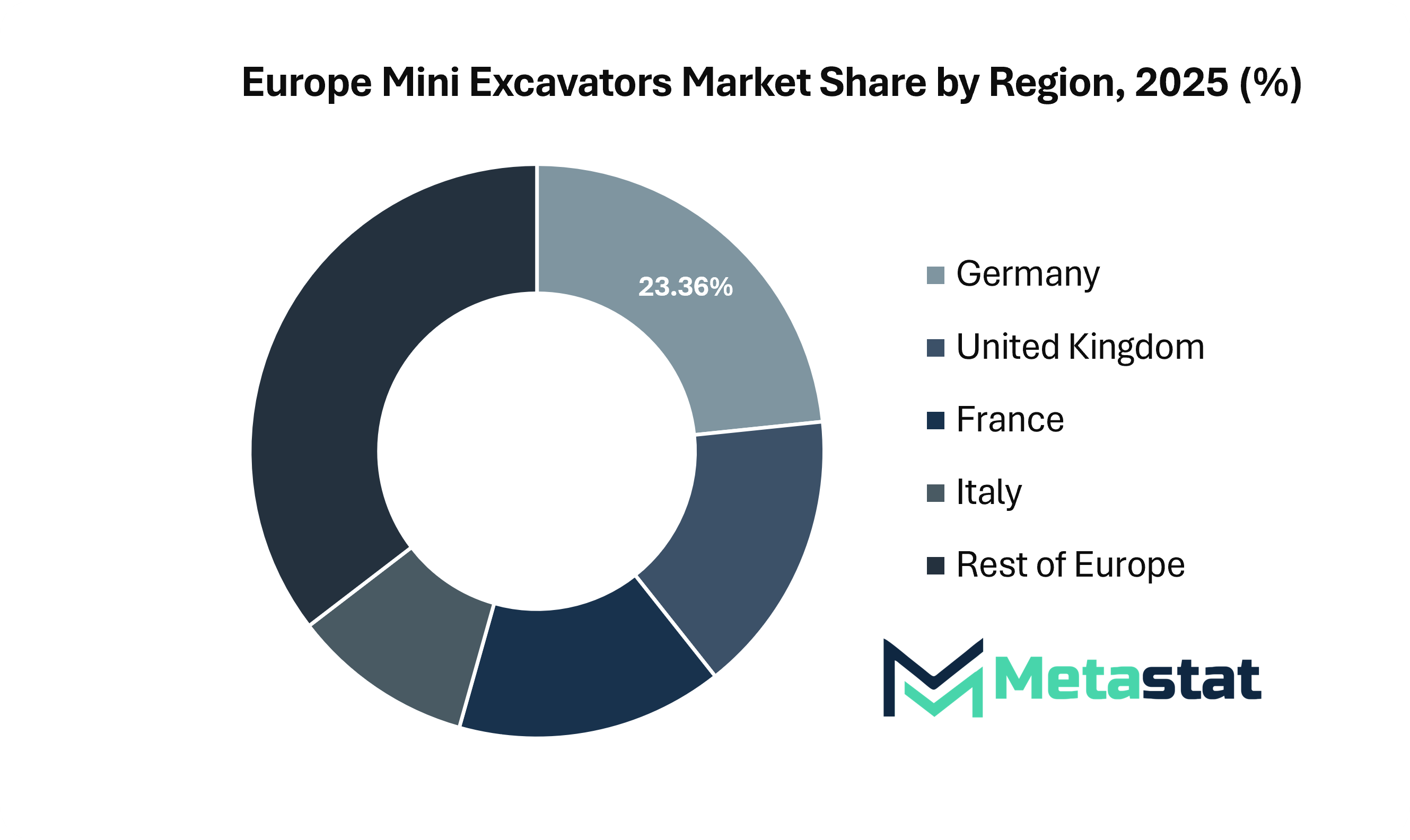
Europe’s compact construction equipment market continues to gain momentum as contractors seek machines suited for narrow streets, indoor worksites, and small urban projects. The Europe Mini Excavators market will benefit from demand for faster digging, lower fuel consumption, and easier movement between job sites. Buyers regularly evaluate dealer support, spare parts availability, and resale value before placing orders. Rental companies are also adding compact machines as many contractors prefer short-term access over direct ownership. Better battery options and quieter engines will support work near homes, schools, and hospitals where noise limits remain strict and project schedules require careful planning.
Leading providers shape buying decisions through pricing, dealer reach, equipment reliability, and aftersales support. Caterpillar Inc., Komatsu Ltd., Hitachi Construction Machinery Co., Ltd., and Volvo Construction Equipment AB remain trusted names across many European fleets. J C Bamford Excavators Ltd., Wacker Neuson SE, CASE Construction Equipment, and New Holland Construction compete strongly in utility, construction, landscaping, and rental channels. Yanmar Compact Equipment, Kubota Baumaschinen GmbH, Hyundai Construction, and Develon Europe continue expanding product options for buyers seeking multiple machine sizes. Strong warranty terms, financing plans, and operator comfort will often influence contracts beyond headline power figures alone.
Other manufacturers are also adding competitive pressure and widening product availability. Doosan Bobcat EMEA s.r.o., Kobelco Construction Machinery Europe B.V., LiuGong Europe, SANY Group, and Sunward Europe Heavy Industry NV are active across several European countries. Wilhelm Schäfer GmbH, Hidroman, HZC Power GmbH, Lumag GmbH, GÜNTER GROSSMANN, RENTAMAT, XCMG, Mini Pelle IMX, and Jiangsu Hengli Hydraulic Co., Ltd. further expand supply alternatives. Their presence will support price competition and give contractors wider choice across attachments, track width, cab style, and delivery timelines based on project needs and budget priorities.
Looking ahead, steady housing repair work, public utility upgrades, and landscaping jobs will support sales. Adoption will rise faster where labor shortages push companies toward machines that save time and reduce manual digging. Dealers that train operators and maintain fast spare parts availability will gain repeat business. Used equipment values will remain important as smaller buyers monitor costs closely. The Europe Mini Excavators market will see wider adoption of electric-powered models in cities where regulations favour low noise and cleaner operation. Firms that combine competitive pricing with reliable service support will maintain stronger positions during the forecast period.
The Europe Mini Excavators market size is forecast to rise from USD 2,162.9 million in 2025 to USD 3,004.1 million by 2033.
The market is positioned for sustained growth through infrastructure spending, rental channel expansion, and rising adoption of compact, versatile machinery. Electrification trends are expected to accelerate product development and fleet renewal across construction, landscaping, utility, and municipal applications.
This research report categorizes the Europe Mini Excavators market based on key segments and regions, forecasts revenue growth, and analyzes trends in each submarket. The report analyzes the key growth drivers, opportunities, and challenges influencing the Europe Mini Excavators market. Recent market developments and competitive strategies such as expansions, product launches, partnerships, mergers, and acquisitions have been included to present the competitive landscape of the market.
The report strategically identifies and profiles key market players and analyzes their core competencies across each sub-segment of the Europe Mini Excavators market.
|
Report Attributes |
Details |
|
Study Period |
2021-2033 |
|
Base Year |
2025 |
|
Estimated Year |
2026 |
|
Forecast Period |
2026-2033 |
|
Historical Period |
2021-2025 |
|
Growth Rate |
CAGR 4.2% from 2026 to 2033 |
|
Revenue Unit |
USD million |
|
Sales Volume Unit |
Thousand Units |
|
Segmentation |
By Type, Operating Weight, Power Source, End User, and Region |
|
By Region |
|
Find answers to common questions about this report
Europe Mini Excavators market is estimated to reach USD 3,004.1 million by 2033.
High initial purchase and maintenance cost will hamper the market growth within the forecast period.
The Track is the leading type segment in the Europe market.
Rising urban infrastructure and renovation activities and Increasing demand for compact equipment in confined spaces are key driving factors, boosting the market.
Top players operating in the Europe Mini Excavators industry includes Caterpillar Inc., Komatsu Ltd., Hitachi Construction Machinery Co., Ltd., Volvo Construction Equipment AB, and J C Bamford Excavators Ltd.
The Metastat Insights study shows that the Europe Mini Excavators market size was USD 2,162.9 million in 2025.
The Europe Mini Excavators market is expected to grow at a CAGR of 4.2% over the forecast period (2026-2033).
The analysts below cover Machinery & Equipment research at Metastat Insights.
LEAD ANALYST
Utkarsh Khirodkar is a Lead Market Research Analyst at MetaStat Insight, specializing in market intelligence, technology sector assessments, and competitive strategy.

INDUSTRY CONSULTANT - CHEMICALS & ADVANCED MATERIALS
Chemicals and Materials · Machinery & Equipment · Packaging
Amit Gadhekar Consultant for Chemicals and Materials at MetaStat Insight, directing sector-specific intelligence, research, and strategic consulting across global chemical and processing markets.

PRINCIPAL CONSULTANT - QUALITY SYSTEMS & COMPLIANCE
Electronics and Semiconductor · Machinery & Equipment · Professional Services
Omkar Phadtare is an Industry Consultant at MetaStat Insight, specializing in quality systems, regulatory compliance, and standards benchmarking to drive data-driven market intelligence and strategic industry research.

ENERGY & INFRASTRUCTURE INDUSTRY CONSULTANT
Automotive and Transportation · Electronics and Semiconductor · Energy and Power · Machinery & Equipment
Saurabh Vasant Ganvir consults for Energy & Infrastructure Industry at MetaStat Insight, specializing in renewable energy, solar EPC, and electric vehicle (EV) infrastructure markets.

LEAD CONSULTANT - COMMUNICATION, TELECOM, AND IT
Electronics and Semiconductor · Information & Technology · Machinery & Equipment · Professional Services
Ravindra Sathe Consultants for Communication, Telecom, and IT at MetaStat Insight. He leads the firm's industry research initiatives across telecommunications infrastructure, digital connectivity, enterprise networking, and emerging information technology domains.
Most industry reports on warehouse automation bundle autonomous mobile robots and fixed conveyor installations into the same top-level numbers, which complicates advisory work. This study split the market cleanly by payload tiers, navigation technology, and fleet management software layers. The regional forecast for Western Europe gave our team defensible adoption benchmarks when evaluating capital allocation for logistics clients, saving us days of secondary data scrubbing.
Analyzing the transition from natural gas to green hydrogen in iron ore reduction requires realistic infrastructure timelines. Meta stat insight supplied a detailed regional assessment of DRI plant conversion costs and scrap metal availability in North America and Western Europe. Their report carefully examined pellet quality specs and electrical grid access constraints without making oversimplified market assumptions. The research material served as a practical reference during internal technology roadmap discussions.
Integrating zero-trust access controls across legacy electronic health record systems involves complex compliance overhead. Team produced an analysis that clearly separated identity governance and administration tools from privileged access management platforms. Their evaluation of HIPAA and GDPR compliance features across cloud native solutions gave our architecture group clear baseline criteria. The custom data request regarding biometric authentication adoption in hospital networks was returned promptly with clear documentation.
Explore related market intelligence reports worth reading alongside this one.
Starting from
$2950