
LEAD ANALYST
Utkarsh Khirodkar is a Lead Market Research Analyst at MetaStat Insight, specializing in market intelligence, technology sector assessments, and competitive strategy.

Global Taper Lock Bushing Market Size, Share, By Product Type (Standard Taper Lock Bushings, QD Bushings, Split Taper Bushings, and Others), By Material (Steel, Cast Iron, Stainless Steel, and Others), By Application (Pulleys, Sprockets, Couplings, Conveyors, and Others), By End-Users (Automotive, Mining, Manufacturing, Power Transmission, Agriculture, and Others), Industry Analysis, Growth, Trends, and Forecast, 2026-2033
Report ID
MSI-4786
Published
May, 2026
Pages
314 Pages
Format
Report Details
Choose Your License
Taper Lock Bushing Market
Global Taper Lock Bushing market size is valued at USD 1,187.8 million in 2025 and projected to grow at a CAGR of 5.4% during the forecast period, reaching USD 1,808.0 million by 2033.
North America holds 20.4% in 2025 with US leading the market share in 2025.
Standard Taper Lock Bushings segment account for a market share of 44.1% in 2025.
Key trends driving growth: Rising use of belt-driven and chain-driven power transmission systems in manufacturing, mining, agriculture, and material handling equipment propels demand for taper lock bushings, along with increased replacement of conventional keyed hubs with easy-to-install, maintenance-friendly shaft locking components supports adoption across industrial machinery.
Opportunities include expansion of automation, conveyor systems, and aftermarket industrial maintenance creates opportunities for standardized and customized taper lock bushing solutions.
Key insight: Rising industrial automation and machinery modernization are steadily increasing demand for high-efficiency shaft-locking solutions like taper lock bushings.
The Global Taper Lock Bushing Market plays a critical role in the broader mechanical power transmission industry, where these components are widely used to mount pulleys, gears, sprockets, and couplings onto shafts with precision and stability. Their design enables easy installation, accurate alignment, and quick removal, helping reduce downtime in industrial operations. With growing reliance on efficient machinery across mining, agriculture, oil & gas, construction, and manufacturing, demand for taper lock bushings continues to rise. Market growth is further supported by improvements in material engineering, including the use of high-grade steel and alloy materials that improve durability, corrosion resistance, and load-bearing capacity.
The market is witnessing steady expansion driven by global industrialization and automation trends, with projections indicating a stable CAGR during the forecast period. Asia Pacific leads in demand owing to rapid industrial expansion, while North America and Europe maintain strong positions supported by technological advancements and established manufacturing ecosystems. The competitive landscape includes a mix of global and regional players focusing on product innovation, precision engineering, pricing competitiveness, and supply reliability. Additionally, the growing emphasis on energy-efficient systems and reduced maintenance costs is encouraging industries to adopt high-performance taper lock bushings, strengthening long-term market opportunities.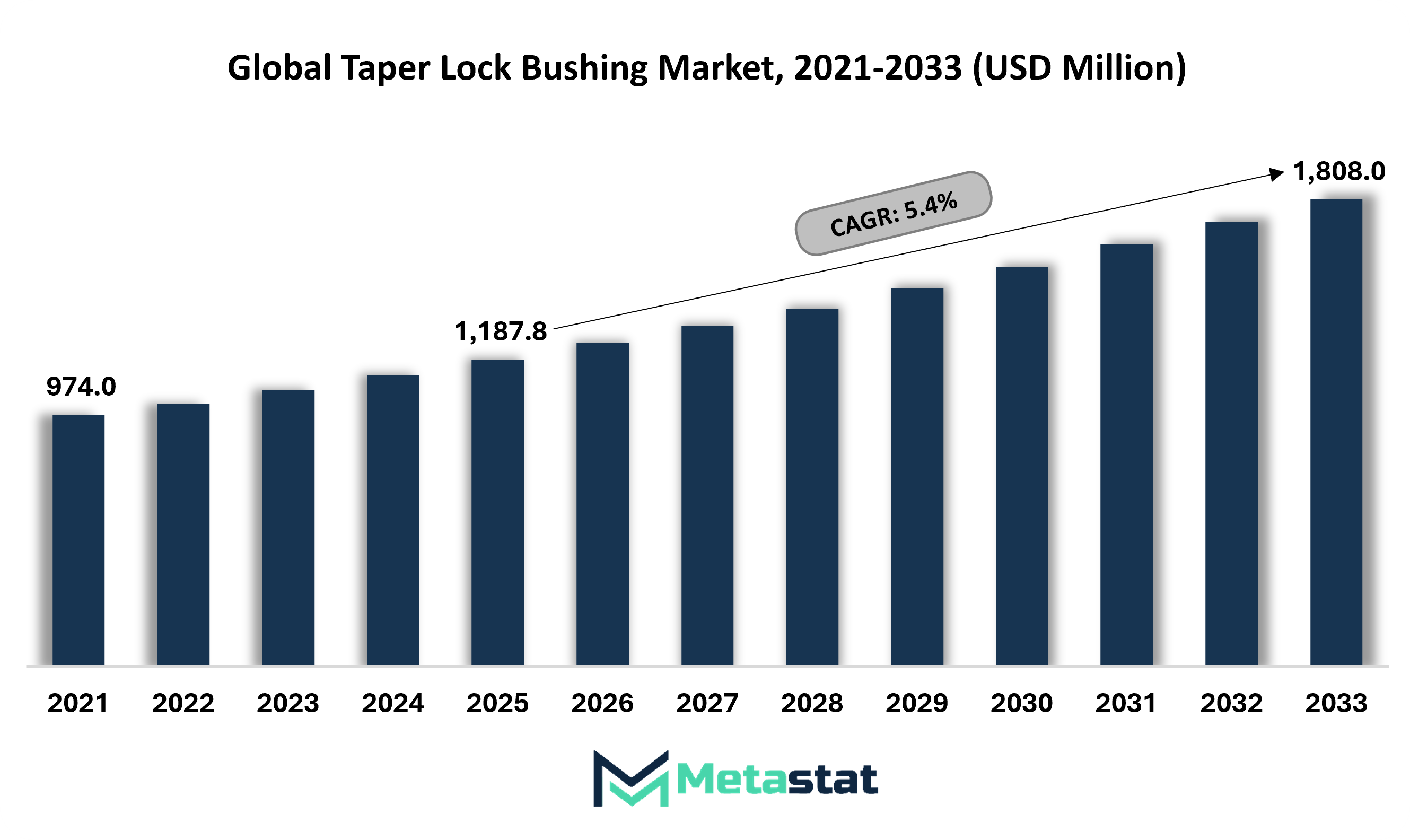
Rising use of belt-driven and chain-driven power transmission systems in manufacturing, mining, agriculture, and material handling equipment propels demand for taper lock bushings.
Rising use of belt-driven and chain-driven power transmission systems in manufacturing, mining, agriculture, and material handling equipment strengthens demand for taper lock bushings. Industrial growth across emerging economies will increase reliance on efficient shaft-mounting solutions, supporting consistent growth in the taper lock bushing market through equipment deployment and modernization efforts.
Increased replacement of conventional keyed hubs with easy-to-install, maintenance-friendly shaft locking components supports adoption across industrial machinery.
Increased replacement of conventional keyed hubs with easy-to-install, maintenance-friendly shaft-locking components encourages wider adoption across industrial machinery. Simplified installation processes reduce downtime and labor costs, creating long-term value for manufacturers. Future industrial design trends will favor modular components, further supporting the integration of taper lock bushings in advanced mechanical systems.
Availability of alternative locking systems such as keyless locking assemblies, split taper bushings, and shrink discs limits adoption in precision and heavy-duty applications.
Availability of alternative locking systems, including keyless locking assemblies, split taper bushings, and shrink discs, creates competitive pressure, limiting adoption in precision and heavy-duty applications. Technological upgrades in competing solutions will attract industries requiring higher torque capacity and accuracy, influencing purchasing decisions across sectors relying on high-performance transmission systems.
Improper installation, shaft wear, and misalignment risks restrict product performance in high-speed or high-load operating environments.
Improper installation, shaft wear, and misalignment risks reduce product performance in high-speed or high-load operating environments. Performance limitations under extreme conditions create operational concerns, leading industries to explore alternative shaft-locking solutions. Future improvements in installation techniques and material strength will play a key role in addressing reliability issues in demanding applications.
Expansion of automation, conveyor systems, and aftermarket industrial maintenance creates opportunities for standardized and customized taper lock bushing solutions.
Expansion of automation, conveyor systems, and aftermarket industrial maintenance generates strong opportunities for standardized and customized taper lock bushing solutions. Growing emphasis on predictive maintenance and equipment lifecycle management will increase demand for easily replaceable components, supporting innovation and product diversification across the taper lock bushing market in the coming years.
The Global Taper Lock Bushing market is classified based on Product Type, Material, Application, and End-Users.
Standard Taper Lock Bushings segment is valued at USD 551.8 million in 2026 and is projected to reach USD 772.0 million by 2033, at a CAGR of 4.9% during the forecast period.
Standard taper lock bushings will maintain strong demand owing to reliable performance in mechanical assemblies. Industrial growth across manufacturing hubs will support steady adoption. Compatibility with multiple shaft sizes will encourage long-term usage across machinery applications. Future growth will rely on cost efficiency, durability, and ease of installation across diverse industrial environments.
QD Bushings segment is valued at USD 343.4 million in 2026 and is projected to reach USD 537.5 million by 2033, at a CAGR of 6.6% during the forecast period.
QD bushings will gain traction owing to quick-detachment functionality and reduced downtime during maintenance cycles. Industrial automation trends will support higher demand for such flexible components. Precision alignment and ease of replacement will improve operational performance. Future adoption will rise across sectors focusing on productivity improvement and reduced maintenance complexity.
Split Taper Bushings segment is valued at USD 257.0 million in 2026 and is projected to reach USD 386.0 million by 2033, at a CAGR of 6% during the forecast period.
Split taper bushings will witness increased utilization in applications requiring strong grip and high torque transmission. Industrial operations seeking secure shaft-mounting solutions will prefer such designs. Growth will align with heavy machinery utilization across mining and construction. Future demand will rely on energy efficiency and wear resistance under demanding operating conditions.
Others segment is valued at USD 98.5 million in 2026 and is projected to reach USD 112.5 million by 2033, at a CAGR of 1.9% during the forecast period.
Other product variations will include specialized designs catering to niche industrial requirements. Customization will play a key role in attracting industry-specific applications. Demand will emerge from sectors requiring unique dimensions, materials, or performance specifications. Future growth will depend on innovation, tailored engineering solutions, and adaptability across evolving industrial requirements.
Steel segment is projected to reach USD 972.5 million by 2033, at a CAGR of 6.2% during the forecast period.
Steel-based bushings will dominate owing to high strength and durability in harsh operating conditions. Industrial sectors requiring robust performance will prefer steel variants. Resistance to mechanical stress will enhance reliability in long-term usage. Future growth will rely on advancements in alloy composition and improved resistance against fatigue and corrosion.
Cast Iron segment is projected to reach USD 458.0 million by 2033, at a CAGR of 4.1% during the forecast period.
Cast iron bushings will remain relevant owing to cost-effectiveness and adequate strength for moderate applications. Industrial buyers seeking economical solutions will continue adoption. Stability under standard load conditions will support regular utilization. Future growth will depend on improved casting techniques and enhanced surface treatments for longer operational life.
Stainless Steel segment is projected to reach USD 286.8 million by 2033, at a CAGR of 6.1% during the forecast period.
Stainless steel bushings will witness growing demand driven by corrosion resistance and hygiene requirements. Food processing and chemical industries will increase usage. Long service life in harsh environments will enhance market presence. Future adoption will expand with increased focus on clean operations and resistance to extreme environmental exposure.
Others segment is projected to reach USD 90.8 million by 2033, at a CAGR of 2.6% during the forecast period.
Other materials will include composites and advanced alloys designed for specific industrial requirements. Demand will develop in sectors requiring lightweight or high-performance characteristics. Innovation in material technology will drive the development of efficient alternatives. Future trends will focus on sustainability, reduced weight, and improved mechanical efficiency.
Pulleys segment is projected to reach USD 578.9 million by 2033.
Pulley systems will represent a major application area owing to widespread use in power transmission. Efficient torque transfer will drive demand for reliable bushings. Industrial machinery relying on smooth rotational movement will support growth. Future expansion will align with automation and enhanced equipment performance across manufacturing facilities.
Sprockets segment is projected to reach USD 486.9 million by 2033.
Sprocket applications will drive demand through utilization in chain-driven systems across industries. Consistent alignment and secure fitting will enhance operational efficiency. Heavy-duty operations will depend on durable bushing solutions. Future growth will be supported by improvements in conveyor and drive system technologies.
Couplings segment is projected to reach USD 369.9 million by 2033.
Coupling systems will utilize taper lock bushings for secure shaft connections and vibration control. Industrial setups requiring precision alignment will increase adoption. Efficient power transmission between rotating components will remain critical. Future demand will rise with growing emphasis on equipment stability and reduced mechanical failure.
Conveyors segment is projected to reach USD 283.3 million by 2033.
Conveyor systems will contribute significantly owing to widespread use in logistics and manufacturing sectors. Continuous movement operations will require durable and easy-to-maintain components. Reliable shaft-locking solutions will enhance equipment performance. Future growth will be linked to expansion in warehousing, e-commerce, and automated material handling.
Others segment is projected to reach USD 89.0 million by 2033.
Other applications will include specialized equipment across emerging industrial sectors. Demand will arise from specific operational requirements and customized equipment designs. Adaptability across varied mechanical systems will support growth. Future trends will focus on integration with advanced technologies and improved efficiency in niche applications.
Automotive segment is projected to grow at a CAGR of 5.3% during the forecast period.
The automotive industry will drive demand through growing production and advanced manufacturing processes. Precision components will require reliable bushing solutions for efficient assembly. Growth in electric vehicles will further influence adoption. Future demand will rely on innovation in vehicle design and higher mechanical performance standards.
Mining segment is projected to grow at a CAGR of 4.7% during the forecast period.
The mining sector will rely on durable bushings owing to harsh operating conditions and heavy machinery utilization. High load capacity and wear resistance will remain essential. Continuous operations will require reliable components. Future growth will align with the expansion of mining activities and technological improvements in extraction equipment.
Manufacturing segment is projected to grow at a CAGR of 6.2% during the forecast period.
The manufacturing sector will dominate usage owing to extensive equipment deployment across production lines. Efficiency and reduced downtime will drive demand for high-performance bushings. Automation trends will further increase reliance on precision components. Future expansion will depend on smart manufacturing and advanced production technologies.
Power Transmission segment is projected to grow at a CAGR of 6.6% during the forecast period.
The power transmission industry will require efficient shaft-locking solutions for optimum power transfer. Reliable performance under continuous operation will remain critical. Growth will be supported by infrastructure development and energy projects. Future demand will increase with modernization of transmission systems and improved mechanical performance.
Power Transmission segment is projected to grow at a CAGR of 6.6% during the forecast period.
The agriculture sector will adopt taper lock bushings to improve farm machinery reliability and equipment uptime. Durable components will support operations across varied environmental conditions. Mechanization trends will increase utilization across regions. Future growth will depend on technological advancements in agricultural equipment and improved productivity requirements.
Others segment is projected to grow at a CAGR of 0.6% during the forecast period.
Other end-user segments will include construction, marine, and industrial services. Diverse operational benefits will drive demand for adaptable solutions. Customized applications will support consistent growth. Future trends will focus on increasing industrial activities and adoption of advanced equipment across multiple sectors within the taper lock bushing market.
Based on geography, the Global Taper Lock Bushing market is divided into North America, Europe, Asia-Pacific, South America, Middle East, and Africa.
North America is witnessing steady adoption of taper lock bushings owing to the strong presence of advanced manufacturing, automation technologies, and heavy equipment industries.
Europe continues to record stable demand supported by automotive production, industrial machinery, and established power transmission component manufacturers.
Asia Pacific leads the market owing to rapid industrial expansion in China, India, Japan, and Southeast Asia, along with large-scale demand for power transmission systems.
South America is supported by infrastructure development, mining activity, and manufacturing modernization.
The Middle East & Africa is generating moderate but consistent demand, driven by mining, oil & gas, construction, and gradual industrial technology adoption despite price sensitivity and supply-chain challenges.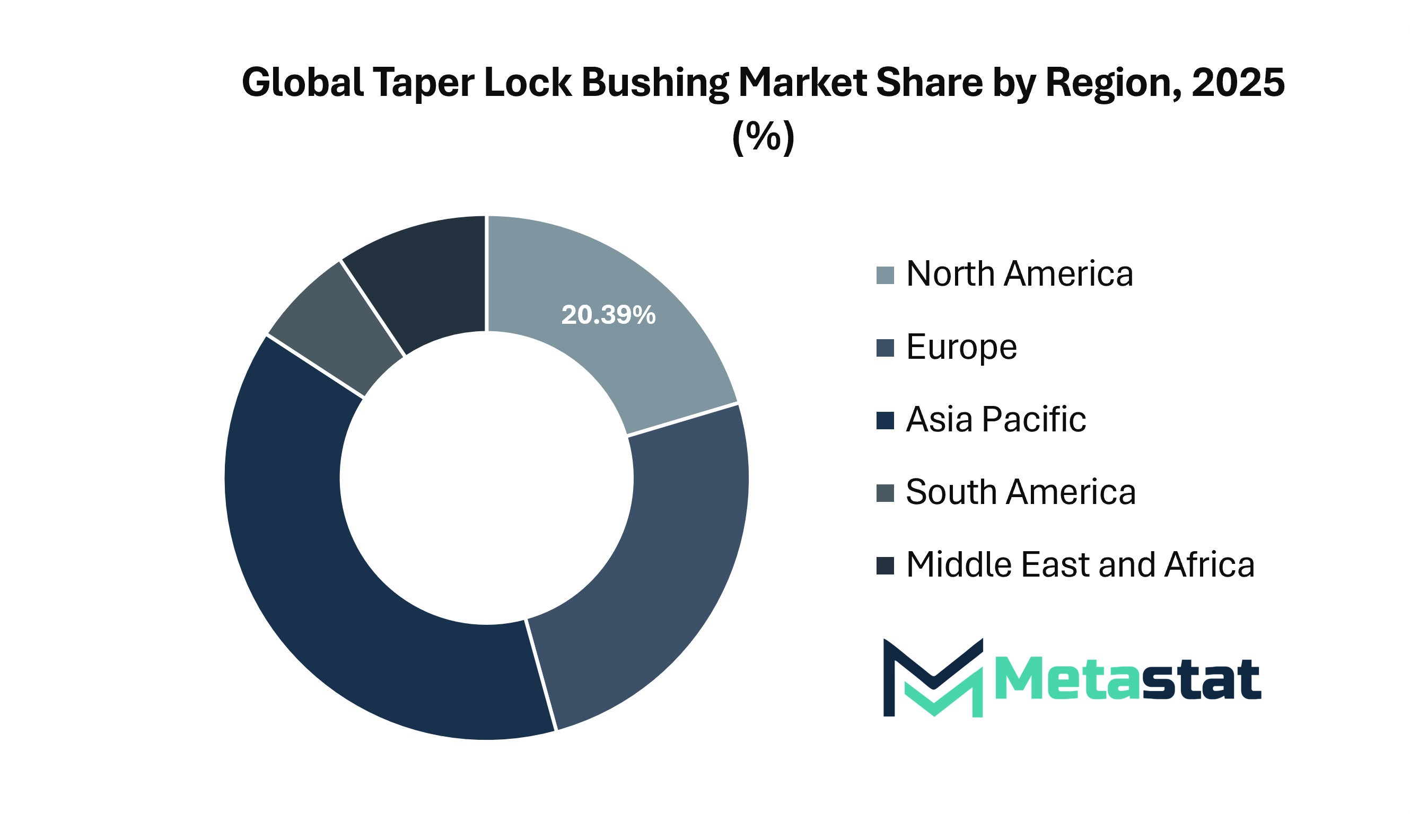
The Global Taper Lock Bushing Market indicates steady development, supported by consistent demand from manufacturing and mechanical power transmission sectors. These components play a practical role in connecting shafts with pulleys, sprockets, gears, and couplings, helping machinery operate with improved stability and alignment. Growth in industrial automation and equipment upgrades will further support adoption, especially in regions focused on improving production efficiency. Small and mid-sized industries are also increasing utilization owing to ease of installation and reduced maintenance needs. The market reflects a balanced mix of replacement demand and new installations, keeping overall momentum stable without sharp demand fluctuations.
Competition across the industry remains active, with several companies focusing on product durability, pricing, and supply reliability. Key Global Taper Lock Bushing Industry players such as Gates Corporation, Martin Sprocket & Gear, Inc., and Dodge Industrial, Inc. continue to invest in improved materials and precision engineering. Firms such as Fenner Precision Polymers and Optibelt GmbH are strengthening their presence through expanded product lines. At the same time, PIX Transmissions Limited and Chiaravalli Group S.p.A. are building reach in emerging markets. This competitive spread ensures buyers have multiple options, keeping pricing pressure moderate while encouraging consistent quality improvements.
Regional demand patterns show a clear link with industrial growth and infrastructure development. Asia Pacific stands out owing to strong manufacturing activity, where companies such as Rathi Transpower Pvt. Ltd. and Aashapuri Engineering Pvt. Ltd. benefit from local demand. Europe maintains steady consumption, with players such as Cross & Morse Limited and TYMA CZ, s.r.o. supporting established industries. North America continues to rely on advanced manufacturing systems, with companies such as U.S. Tsubaki Power Transmission, LLC maintaining a strong foothold. Markets across the Middle East, Africa, and South America show gradual growth, driven by ongoing industrial projects and increased focus on equipment performance.
Looking ahead, the market will continue to move forward with a focus on reliability, cost control, and easy installation features. Companies such as AB SKF, Bando Chemical Industries, Ltd., and Lenze SE will support innovation through improved engineering and product consistency. Smaller manufacturers such as Dews Aircon Pvt. Ltd. and A.G. Engineers will find opportunities in niche and regional demand. The Global Taper Lock Bushing Market will maintain steady growth, supported by practical applications and long-term industrial requirements, without major disruption in demand patterns.
Market size is forecast to rise from USD 1,187.8 million in 2025 to over USD 1,808.0 million by 2033.
The Global Taper Lock Bushing Market is expected to witness steady growth supported by industrial automation, machinery modernization, expanding conveyor applications, and replacement demand across power transmission systems. Future growth is likely to be driven by standardized shaft-locking solutions, precision-engineered components, aftermarket maintenance demand, and wider adoption across manufacturing, mining, agriculture, and material handling equipment.
This research report categorizes the Taper Lock Bushing market based on key segments and regions, forecasts revenue growth, and analyses trends in each submarket. The report analyses the key growth drivers, opportunities, and challenges influencing the Taper Lock Bushing market. Recent market developments and competitive strategies such as expansion, product launch, partnership, merger, and acquisition have been included to draw the competitive landscape in the market.
The report strategically identifies and profiles the key market players and analyses their core competencies in each sub-segment of the Taper Lock Bushing market.
|
Report Attributes |
Details |
|
Study Period |
2021-2033 |
|
Base Year |
2025 |
|
Estimated Year |
2026 |
|
Forecast Period |
2026-2033 |
|
Historical Period |
2021-2025 |
|
Growth Rate |
CAGR 5.4% from 2026 to 2033 |
|
Revenue Unit |
USD million |
|
Sales Volume Unit |
Thousand Units |
|
Segmentation |
By Product Type, Material, Application, End-Users, and Region |
|
By Region |
North America (By Product Type, Material, Application, End-Users, and Country)
|
|
Europe (By Product Type, Material, Application, End-Users, and Country)
|
|
|
Asia Pacific (By Product Type, Material, Application, End-Users, and Country)
|
|
|
South America (By Product Type, Material, Application, End-Users, and Country)
|
|
|
Middle East and Africa (By Product Type, Material, Application, End-Users, and Country)
|
Find answers to common questions about this report
Top players operating in the Taper Lock Bushing industry includes Gates Corporation, Martin Sprocket & Gear, Inc., Dodge Industrial, Inc., Fenner Precision Polymers, Optibelt GmbH, PIX Transmissions Limited, Chiaravalli Group S.p.A., Cross & Morse Limited, Naismith Engineering Pty Ltd, TransDrive Pty Ltd, AB SKF, Dunlop BTL Ltd., B&B Manufacturing, Inc., Transmission Developments Co (GB) Ltd, Poggi Trasmissioni Meccaniche S.p.A., SIT S.p.A., Lemvigh-Müller, Bando Chemical Industries, Ltd., Masterdrive, Inc. and Linn Gear Manufacturing Corporation.
Global Taper Lock Bushing market is estimated to reach USD 1,808.0 million by 2033.
Expansion of automation, conveyor systems, aftermarket industrial maintenance, and demand for easy-to-install shaft-locking components are expected to favour product adoption.
Availability of alternative locking systems such as keyless locking assemblies, split taper bushings, and shrink discs limits adoption in precision and heavy-duty applications. will hamper the market growth within the forecast period.
Asia Pacific dominates the taper lock bushing market.
Rising use of belt-driven and chain-driven power transmission systems in manufacturing, mining, agriculture, and material handling equipment propels demand for taper lock bushings and increased replacement of conventional keyed hubs with easy-to-install, maintenance-friendly shaft locking components supports adoption across industrial machinery. are key driving factors, boosting the market.
The Metastat Insights analysis shows that the North America Taper Lock Bushing market size is estimated to be USD 422.5 million by 2033.
The Standard Taper Lock Bushings segment leads the Taper Lock Bushing Market.
The Metastat Insights study shows that the Global Taper Lock Bushing market size was USD 1,187.8 million in 2025.
The Global Taper Lock Bushing market is expected to grow at a CAGR of 5.4% over the forecast period (2026-2033).
The analysts below cover Machinery & Equipment research at Metastat Insights.
LEAD ANALYST
Utkarsh Khirodkar is a Lead Market Research Analyst at MetaStat Insight, specializing in market intelligence, technology sector assessments, and competitive strategy.

INDUSTRY CONSULTANT - CHEMICALS & ADVANCED MATERIALS
Chemicals and Materials · Machinery & Equipment · Packaging
Amit Gadhekar Consultant for Chemicals and Materials at MetaStat Insight, directing sector-specific intelligence, research, and strategic consulting across global chemical and processing markets.

PRINCIPAL CONSULTANT - QUALITY SYSTEMS & COMPLIANCE
Electronics and Semiconductor · Machinery & Equipment · Professional Services
Omkar Phadtare is an Industry Consultant at MetaStat Insight, specializing in quality systems, regulatory compliance, and standards benchmarking to drive data-driven market intelligence and strategic industry research.

ENERGY & INFRASTRUCTURE INDUSTRY CONSULTANT
Automotive and Transportation · Electronics and Semiconductor · Energy and Power · Machinery & Equipment
Saurabh Vasant Ganvir consults for Energy & Infrastructure Industry at MetaStat Insight, specializing in renewable energy, solar EPC, and electric vehicle (EV) infrastructure markets.

LEAD CONSULTANT - COMMUNICATION, TELECOM, AND IT
Electronics and Semiconductor · Information & Technology · Machinery & Equipment · Professional Services
Ravindra Sathe Consultants for Communication, Telecom, and IT at MetaStat Insight. He leads the firm's industry research initiatives across telecommunications infrastructure, digital connectivity, enterprise networking, and emerging information technology domains.
Evaluating secondary resin quality across post-consumer packaging streams requires reliable technical segmentation. MetaStat Insight delivered an objective assessment that distinguished between extrusion-grade flake pricing and optical sorting throughput limitations across Western Europe. The competitive positioning breakdown for licensed depolymerization technology providers answered several questions during our feedstock feasibility audit. Their team clarified regional trade restrictions on mixed plastic scrap quickly when our team submitted follow-up requests.
Evaluating sovereign cloud deployments for core banking platforms demands a clear view of data residency regulations and migration exit strategies. MetaStat Insight delivered an exhaustive review of regional latency tolerances, mainframe decommission milestones, and third-party vendor concentration risk. The regulatory compliance mapping across European and Asian financial jurisdictions gave our team a dependable baseline for multi-cloud infrastructure discussions.
Replacing petrochemical surfactants with bio-based alternatives requires realistic timelines on industrial precision fermentation scaling. The market research broke down commercialization timelines, feedstock sugar price sensitivities, and regional cosmetic ingredient regulatory approvals in Europe and East Asia. That supplier readiness mapping gave our formulations team reliable context when comparing renewable chemical sourcing roadmaps.
Explore related market intelligence reports worth reading alongside this one.
Starting from
$2950