Australia Mobile Virtual Network Operator (MVNO) Market
Australia Mobile Virtual Network Operator (MVNO) Market Size, Share, By Operational Model (Full MVNO, Reseller MVNO, Service Operator MVNO), By Service (4G MVNO, 5G MVNO, and Others), By Service Type (Postpaid and Prepaid), By Subscriber (Business and Individual/Residential), Industry Analysis, Growth, Trends, and Forecast, 2026-2033
Report ID
MSI-4648
Published
April 20, 2026
Pages
313 Pages
Format
Report Details
Comprehensive Market Analysis And Insights
Market Overview
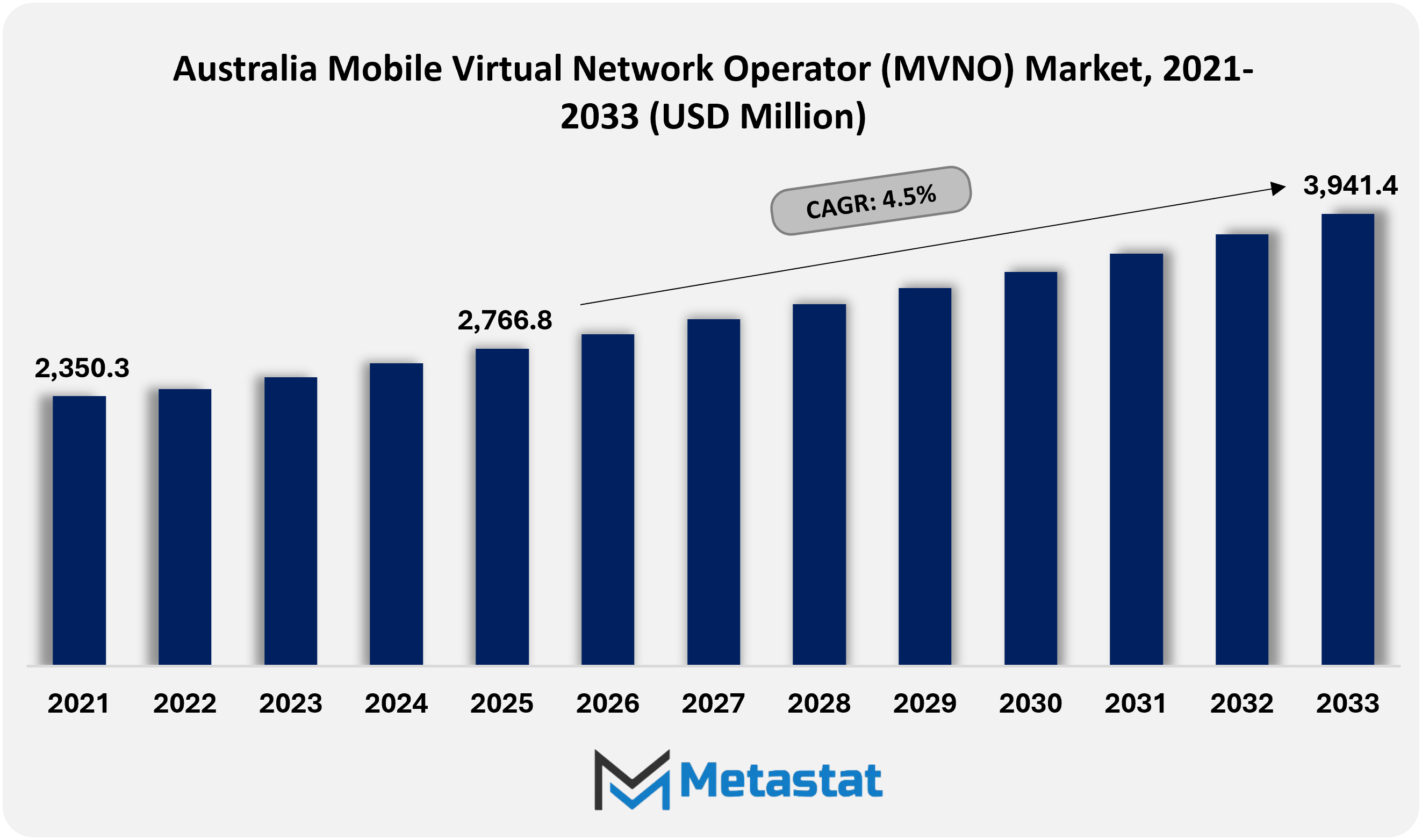
Australia Mobile Virtual Network Operator (MVNO) market size is valued at USD 2,766.8 million in 2025 and projected to grow at a CAGR of 4.5% during the forecast period, reaching USD 3,941.4 million by 2033.
Australia Mobile Virtual Network Operator (MVNO) Market: Comprehensive Data-Driven Market Analysis and Strategic Outlook
Full MVNO segment accounts for a market share of 49.6% in 2025.
Key trends driving growth: Increasing consumer preference for cost-effective mobile plans encourages adoption of MVNO services across Australia and expanding smartphone penetration and strong mobile data consumption strengthen demand for alternative telecom service providers.
Opportunities include growth in eSIM technology enables easier onboarding and digital activation for MVNO customers and rising demand for niche mobile plans designed for travelers, students, and digital-first users opens new market segments.
Key insight: Growing demand for flexible mobile plans and rising digital connectivity support expansion in the Australia Mobile Virtual Network Operator (MVNO) Market.
Australia Mobile Virtual Network Operator (MVNO) Market belongs to the telecommunications services industry, yet its future trajectory will extend beyond the conventional resale-based mobile connectivity model. Over the coming years, digital operators in Australia will increasingly intersect with digital services, data-driven platforms, and niche customer ecosystems that move beyond traditional voice and data offerings.
Future trends will position MVNOs as service orchestrators rather than simple network resellers. Many providers will introduce integrated digital bundles that combine connectivity with financial tools, entertainment subscriptions, travel utilities, and security features. Such integration will strengthen daily customer engagement rather than limiting operators to basic billing relationships. Strategic partnerships with technology firms, media platforms, and fintech companies will create space for specialised services targeted at student groups, remote workers, migrant communities, and small businesses.
Market Dynamics
Growth Drivers:
Increasing client choice for price-powerful cell plans encourages adoption of MVNO offerings throughout Australia.
Rising demand for affordable communication solutions is supporting growth across the Australia Mobile Virtual Network Operator (MVNO) Market. Consumers are increasingly comparing pricing transparency, flexible billing, and low-commitment mobile plans. Service providers will introduce personalised data bundles, digital plan management, and competitive tariffs, encouraging wider participation among price-sensitive mobile subscribers across urban and regional Australia.
Expanding telephone penetration and strong cellular statistics consumption improve demand for opportunity telecom carrier providers.
Rapid smartphone adoption across Australia is creating sustained traffic growth across mobile networks. Strong reliance on streaming, cloud services, remote work platforms, and mobile applications is expanding the service base supporting the Australia Mobile Virtual Network Operator (MVNO) Market. Evolving connectivity requirements will support higher-data plans, encouraging alternative telecom providers to address changing digital consumption patterns.
Restraints and Challenges:
Dependence on community infrastructure owned by major telecom operators limits operational flexibility for MVNO providers.
Operational reliance on infrastructure managed by major telecom network owners affects long-term strategy in the Australia Mobile Virtual Network Operator (MVNO) Market. Access agreements, wholesale pricing structures, and technical network control shape service delivery capabilities. Future negotiations with host networks will determine scalability potential, influencing service innovation and operational autonomy among emerging MVNO brands.
Intense rate competition in the telecom zone places pressure on earnings margins for smaller MVNO brands.
Competitive pricing structures create financial pressure across participants operating within the Australia Mobile Virtual Network Operator (MVNO) Market. Major telecom operators maintain strong brand visibility and pricing influence, forcing smaller MVNO companies to sustain competitive promotional strategies. Future profitability will depend on niche targeting, differentiated customer experience, and digital service innovation supporting sustainable revenue generation.
Opportunities:
Growth in eSIM era enables less complicated onboarding and digital activation for MVNO clients.
Advancing eSIM adoption is creating new operational opportunities across the Australia Mobile Virtual Network Operator (MVNO) Market. Digital activation reduces physical SIM distribution challenges and improves remote onboarding efficiency. Future telecom environments will support instant connectivity, app-based plan activation, and seamless device switching, encouraging broader participation among digitally oriented mobile subscribers across Australia.
Market Segmentation Analysis
The Australia Mobile Virtual Network Operator (MVNO) market is classified based on Operational Model, Service, Service Type, and Subscriber.
By Operational Model, the market is further segmented into:
Full MVNO
Full MVNO segment is valued at USD 1,435.7 million in 2026 and is projected to reach USD 1,938 million by 2033, at a CAGR of 4.4% during the forecast period.
Full MVNO participation will gain strong traction owing to greater control over network elements, billing platforms, customer data systems, and service design. Greater operational control supports tailored telecom services, innovative pricing models, and digital service expansion across enterprise and residential communication environments.
Reseller MVNO
Reseller MVNO segment is valued at USD 843.7 million in 2026 and is projected to reach USD 1,191.5 million by 2033, at a CAGR of 5.1% during the forecast period.
Reseller MVNO participation will expand through simplified market entry requirements and lower infrastructure investment. Partnerships with established network providers support faster brand launches, retail-focused offerings, and niche communication services targeted at budget-sensitive consumer groups across urban and regional telecom distribution channels.
Service Operator MVNO
Service Operator MVNO segment is valued at USD 613.9 million in 2026 and is projected to reach USD 811.9 million by 2033, at a CAGR of 4.1% during the forecast period.
Service Operator MVNO participation will increase through partial infrastructure management combined with host network collaboration. Operational flexibility supports differentiated offerings, digital connectivity solutions, and value-added communication tools designed for evolving consumer usage patterns and enterprise mobility requirements.
By Service, the market is divided into:
4G MVNO
4G MVNO segment is projected to reach USD 1,611.2 million by 2033, at a CAGR of 0.9% during the forecast period.
4G MVNO presence will maintain stable demand owing to broad network coverage, reliable connectivity performance, and compatibility with existing mobile devices. Telecom providers will continue offering affordable voice and data services across metropolitan areas and regional communities where dependable mobile communication remains essential.
5G MVNO
5G MVNO segment is projected to reach USD 2,278.1 million by 2033, at a CAGR of 10.8% during the forecast period.
5G MVNO growth will support high-speed data services, advanced mobile applications, and smart connectivity solutions. Improved network capabilities will strengthen enterprise mobility, immersive communication platforms, and next-generation customer experiences across technology-driven urban environments in Australia.
Others
Others segment is projected to reach USD 52.0 million by 2033, at a CAGR of 4% during the forecast period.
Other service categories will include emerging connectivity solutions supporting specialised communication requirements. Internet of Things connectivity, machine-to-machine communication services, and private mobile network applications will encourage telecom innovation across sectors such as transportation, logistics, healthcare, and industrial operations.
By Service Type, the market is further divided into:
Postpaid
Postpaid segment is projected to reach USD 1,055.1 million by 2033.
Postpaid service adoption will increase owing to structured billing cycles, premium mobile plans, and bundled digital services. Telecom providers will introduce customised enterprise mobility plans, international roaming options, and larger data allowances supporting professionals, corporate teams, and high-usage communication needs.
Prepaid
Prepaid segment is projected to reach USD 2,886.3 million by 2033.
Prepaid participation will remain significant owing to flexible payment structures and simplified subscription management. Consumers will continue choosing prepaid plans for cost control, short-term connectivity needs, and convenient recharge options available through digital payment systems and retail telecom distribution networks.
By Subscriber, the Australia Mobile Virtual Network Operator (MVNO) market is divided as:
Business
Business segment is projected to grow at a CAGR of 3.3% during the forecast period.
Business subscriber demand will strengthen through corporate mobility programs, remote workforce connectivity, and integrated communication platforms. Telecom operators will provide scalable data plans, secure connectivity infrastructure, and enterprise account management systems supporting organisational communication, digital collaboration, and operational mobility.
Individual/Residential
Individual/Residential segment is projected to grow at a CAGR of 7% during the forecast period.
Individual/Residential growth will increase through affordable telecom services, digital lifestyle connectivity, and competitive mobile data plans. Consumer communication requirements will expand across streaming, social media platforms, online education services, and smart home connectivity supported by flexible MVNO offerings.
Competitive Landscape and Strategic Insights
The Australia Mobile Virtual Network Operator (MVNO) market has grown steadily as more consumers seek flexible and affordable mobile services. MVNO providers do not build their own mobile networks; instead, they use the infrastructure of major telecom operators and offer services under their own brands. This model allows MVNO providers to focus on pricing, customer service, and tailored plans that appeal to specific user groups. Over time, the model will continue attracting consumers seeking reliable connectivity without long-term contracts or expensive bundled offerings.
Many Australian consumers prefer MVNO services owing to simple plans and strong value. These operators often target budget-conscious users, students, families, and customers seeking voice and data services without additional complexity. Competition among providers will keep pricing competitive while encouraging better service quality. MVNO brands also work closely with retail chains and digital platforms, helping them reach customers through familiar stores and online channels.
Several companies play a significant role in shaping the Australia Mobile Virtual Network Operator (MVNO) market. Key industry participants include MEDION Australia Pty Limited (ALDI Mobile), amaysim Mobile Pty Ltd, Woolworths Group Limited (Everyday Mobile), Belong Mobile, and Kogan Mobile Operations Pty Ltd. Other notable companies include Lebara Mobile, Moose Mobile, Dodo Mobile, iiNet Limited, and Felix Mobile. These players focus on offering competitive data plans, prepaid options, and convenient account management through mobile apps and online service platforms.
Additional participants such as Coles Mobile, Tangerine Telecom Pty Ltd, and Aussie Broadband Limited also support the growth of the market. Their presence is strengthening competition and giving customers wider choice in terms of pricing and service features. As mobile data usage continues to rise across Australia, MVNO providers will introduce stronger digital support, flexible subscriptions, and tailored packages that match changing customer requirements. Such developments will keep the market dynamic and support further innovation in mobile communication services.
Forecast and Future Outlook
Market size is forecast to rise from USD 2,766.8 million in 2025 to over USD 3,941.4 million by 2033.
The Australia Mobile Virtual Network Operator (MVNO) Market is expected to increasingly act as a bridge between connectivity and digital lifestyle services. Future market progress will depend not only on mobile plan pricing but also on the ability of providers to create interconnected user experiences that improve how Australians engage with mobile technology in daily life.
Mobile Virtual Network Operator (MVNO) Market Key Segments:
By Operational Model:
Full MVNO
Reseller MVNO
Service Operator MVNO
By Service:
4G MVNO
5G MVNO
Others
By Service Type:
Postpaid
Prepaid
By Subscriber:
Business
Individual/Residential
Key Australia Mobile Virtual Network Operator (MVNO) Industry Players
This research report categorizes the Australia Mobile Virtual Network Operator (MVNO) market based on key segments and regions, forecasts revenue growth, and analyses trends in each submarket. The report analyses the key growth drivers, opportunities, and challenges influencing the Australia Mobile Virtual Network Operator (MVNO) market. Recent market developments and competitive strategies such as expansion, product launch, partnership, merger, and acquisition have been included to draw the competitive landscape in the market.
The report strategically identifies and profiles the key market players and analyses their core competencies in each sub-segment of the Australia Mobile Virtual Network Operator (MVNO) market.
Report Attributes
Details
Study Period
2021-2033
Base Year
2025
Estimated Year
2026
Forecast Period
2026-2033
Historical Period
2021-2025
Growth Rate
CAGR 4.5% from 2026 to 2033
Revenue Unit
USD million
Segmentation
By Operational Model, Service, Service Type, Subscriber, and Region
By Operational Model
Full MVNO
Reseller MVNO
Service Operator MVNO
By Service
4G MVNO
5G MVNO
Others
By Service Type
Postpaid
Prepaid
By Subscriber
Business
Individual/Residential
WHAT REPORT PROVIDES
Key Company Market Share, Revenue, and Position/Ranking
Key Market Leaders
Full In-Depth Analysis of the Parent Industry
Industry Statistics
Important Changes in Market and Its Dynamics
Segmentation Details of the Market
Historical, On-Going, and Projected Market Analysis
Assessment of Niche Industry Developments
Market Share Analysis
Key Strategies of Major Players
Company Profiles of Key Players
Unique Selling Propositions of Leading Market Players
Emerging Segments and Regional Growth Potential
Key Strategic Recommendations
Competitive Benchmarking
End of Report Overview
Frequently Asked Questions
Find answers to common questions about this report
Top players operating in the Mobile Virtual Network Operator (MVNO) industry include MEDION Australia Pty Limited (ALDI Mobile), amaysim Mobile Pty Ltd, Woolworths Group Limited (Everyday Mobile), Belong Mobile, Kogan Mobile Operations Pty Ltd., Lebara Mobile, Moose Mobile, Dodo Mobile, iiNet Limited, Felix Mobile, and Coles Mobile.
Australia Mobile Virtual Network Operator (MVNO) market is estimated to reach USD 3,941.4 million by 2033.
Dependence on network infrastructure owned by major telecom operators limits operational flexibility for MVNO providers will hamper the market growth within the forecast period.
Increasing consumer preference for cost-effective mobile plans encourages adoption of MVNO services across Australia and expanding smartphone penetration and strong mobile data consumption strengthen demand for alternative telecom service providers are key driving factors, boosting the market.
The Prepaid is the leading type of segment in the Australia market.
The Australia Mobile Virtual Network Operator (MVNO) market is expected to grow at a CAGR of 4.5% over the forecast period (2026-2033).
The Metastat Insights study shows that the Australia Mobile Virtual Network Operator (MVNO) market size was USD 2,766.8 million in 2025.
Choose Your License
Australia Mobile Virtual Network Operator (MVNO) Market
Industrial RFID Reader Market Size, Share, Trends, 2033
Global Industrial RFID Reader market size: USD 3,640.6 million in 2025, forecast USD 8,153.6 million by 2033 at a 10.6% CAGR. Segment and regional data.
Industrial RFID Reader market, Industrial RFID Reader Market Size, Industrial RFID Reader Market Share, Industrial RFID Reader Market Analysis, Industrial RFID Reader Market Growth, Industrial RFID Reader Market Trends, Industrial RFID Reader Market Research Report, Industrial RFID Reader Market Forecast, Industrial RFID Reader, Industrial RFID Reader Market Research, Industrial RFID Reader Industry, Industrial RFID Reader Industry Report, Industrial RFID Reader Market Data, Industrial RFID Reader Statistics, Industrial RFID Reader Market Statistics, Industrial RFID Reader Industry Trends, Industrial RFID Reader Market Report, Industrial RFID Reader Market Trends, Industrial RFID Reader Market News, Industrial RFID Reader Forecasts, Industrial RFID Reader Market Intelligence Report, Industrial RFID Reader market 2033, Industrial RFID Reader market outlook, Industrial RFID Reader market segmentation, Industrial RFID Reader market drivers, Industrial RFID Reader market restraints, Industrial RFID Reader market opportunities, Industrial RFID Reader market CAGR, Industrial RFID Reader suppliers, Industrial RFID Reader manufacturers, Industrial RFID Reader market by region, North America Industrial RFID Reader market, Asia Pacific Industrial RFID Reader market, Europe Industrial RFID Reader market, Industrial RFID Reader market competitive landscape, Industrial RFID Reader market key players, Fixed RFID Readers market, UHF RFID Readers market, Warehouse and Conveyor Automation market, Logistics and Warehousing market.
Global Online Dating market size reached USD 3.7 billion in 2025 and is forecast to hit USD 7.8 billion by 2033 at a 9.6% CAGR. Segment and regional data.
Online Dating market, Online Dating Market Size, Online Dating Market Share, Online Dating Market Analysis, Online Dating Market Growth, Online Dating Market Trends, Online Dating Market Research Report, Online Dating Market Forecast, Online Dating, Online Dating Market Research, Online Dating Industry, Online Dating Industry Report, Online Dating Market Data, Online Dating Statistics, Online Dating Market Statistics, Online Dating Industry Trends, Online Dating Market Report, Online Dating Market Trends, Online Dating Market News, Online Dating Forecasts, Online Dating Market Intelligence Report, Online Dating market 2033, Online Dating market outlook, Online Dating market segmentation, Online Dating market drivers, Online Dating market restraints, Online Dating market opportunities, Online Dating market CAGR, Online Dating suppliers, Online Dating manufacturers, Online Dating market by region, North America Online Dating market, Asia Pacific Online Dating market, Europe Online Dating market, Online Dating market competitive landscape, Online Dating market key players, Online Dating Apps market, Online Matchmaking Services market, Subscription-Based Online Dating market, Mobile Applications Online Dating market.
Global Containers-As-A-Service (CAAS) market size: USD 7.8 billion in 2025, forecast USD 83.9 billion by 2033 at a 34.4% CAGR. Segment and regional data.