
LEAD ANALYST
Utkarsh Khirodkar is a Lead Market Research Analyst at MetaStat Insight, specializing in market intelligence, technology sector assessments, and competitive strategy.

Business Process Outsourcing (BPO) Market Size, Share, By Service Type (Finance, Accounting, Human Resource, KPO, Procurement, Customer Services, and Others), By End Use (BFSI, Healthcare, Manufacturing, IT, Telecommunications, Retail and Others), By Outsourcing Type (Onshore, Nearshore, and Offshore), By Organization Size (Large Enterprises, Small Enterprises, and Medium Enterprises), Industry Analysis, Growth, Trends, and Forecast, 2026-2033
Report ID
MSI-4566
Published
February, 2026
Updated
Pages
298 Pages
Format
Report Details
Choose Your License
Business Process Outsourcing (BPO) Market
The Global Business Process Outsourcing (BPO) market size is valued at USD 323.7 billion in 2025. The market is projected to grow from USD 350.9 billion in 2026 to USD 635.6 billion by 2033, exhibiting a CAGR of 8.9% during the forecast period.
Global Business Process Outsourcing (BPO) market was valued at USD 323.7 billion in 2025 and is projected to reach USD 635.6 billion by 2033, registering a CAGR of 8.9% during 2026-2033.
North America held a 37.5% share in 2025, supported by strong enterprise outsourcing adoption across the United States.
Finance and Accounting segment accounted for a 21.4% share in 2025.
Key trends driving growth: Rising enterprise focus on cost optimization through outsourced customer support, finance, HR, and IT-enabled services, along with expanding digital adoption across industries that encourages third-party vendors to manage scalable back-office operations.
Key opportunities include growing demand for analytics-driven, AI-integrated outsourcing services across BFSI, healthcare, and e-commerce.
Key insight: The global BPO market advances through cost efficiency demand and digital transformation momentum while shifting toward technology-led, value-added service models.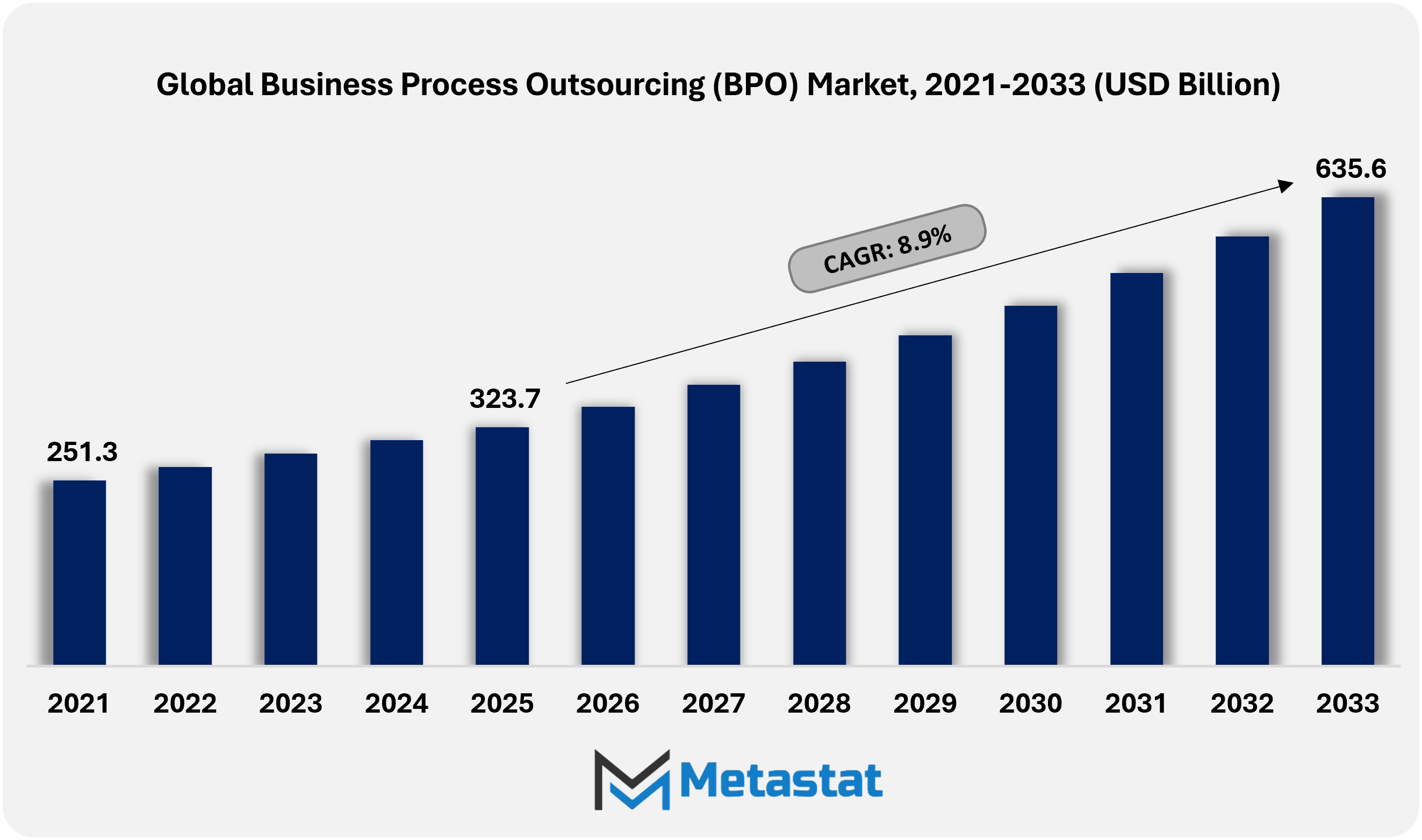
The global Business Process Outsourcing (BPO) market and its industry will progress towards a phase where service value will be defined less by scale and more by embedded intelligence, operational foresight, and sector-specific customization. Future outsourcing engagements will shift beyond transaction execution and bring providers closer to the strategic decision-making layers within client organizations. Vendor-customer relationships will evolve into long-term partnerships built around outcome ownership, accountability, and shared risk structures, rather than volume-based delivery commitments.
Automation outsourcing will not replace demand but will reshape the service structure. Providers will redesign their delivery models to focus on human-machine collaboration, where cognitive tools handle repetitive workflows while domain experts manage decision-driven processes. Over time, industry-focused BPO offerings will gain priority, particularly in healthcare administration, financial operations, insurance processing, and digital commerce support. Such specialization would encourage the development of proprietary frameworks and vertically aligned operating playbooks rather than standardized service menus.
Modern customer engagement demands seamless continuity across voice, email, web chat, mobile messaging, and social platforms. Omnichannel support operations eliminate fragmented interactions by centralizing interaction histories into unified Customer Relationship Management (CRM) platforms. When customers move between touchpoints, their context moves with them. This continuity prevents repetitive interactions, reduces customer frustration, and improves first-contact resolution rates.
Leading service providers such as Teleperformance and Concentrix have rebuilt their delivery models around this integrated approach. Instead of managing separate teams for phone calls and digital tickets, providers now deploy blended agents supported by real-time agent-assist tools. These systems suggest relevant solutions and next best actions based on live conversational context.
Operational success in omnichannel environments relies on dynamic workforce management and cross-channel routing. Cloud platforms distribute volumes based on agent skill sets, language requirements, and real-time channel surges. When voice queues experience sudden spikes, trained digital agents shift channels to absorb the surplus volume. This operational flexibility protects Service Level Agreements (SLAs) while maintaining consistent service quality.
The integration of Generative AI has further refined these operations. Automated conversational agents handle high-frequency, repetitive inquiries across messaging channels without human intervention. When complex issues arise, the interaction transfers smoothly to an experienced specialist along with a full transcript and an AI-generated summary. This hybrid human-machine workflow optimizes operational costs and delivers rapid, personalized support.
The development of the global business process outsourcing market will be in accordance with enterprise strategies that are centred on protecting margins and ensuring predictable spending. Customer service, finance, human resources, and IT-enabled business process outsourcing will help minimize fixed operational expenses while ensuring enhanced business continuity. This will also enable enterprises to allocate funds for innovation and market development.
Digital adoption in manufacturing, retail, BFSI, and healthcare sectors will lead to greater dependence on external service providers for back-office scalability. Cloud computing, automation tools, and workflow management will promote vendor-driven process management. Future processes will enable capacity management for fluctuating transaction volumes without scaling internal infrastructure.
Rising standards of data security and industry-specific regulations will slow down the outsourcing process of sensitive tasks. Compliance mandates in banking, healthcare, and public services will require strict governance frameworks. Vendor accountability, audit preparedness, and jurisdictional data controls will influence outsourcing decisions and will lead to slower adoption within high-risk process categories.
Operational balance will continue to be linked to skilled workforce availability throughout process outsourcing regions. High prices, wage inflation, and expertise migration will raise shipping threat. Service consistency will rely on continuous education investment, automation aid, and geographic diversification to offset team of workers volatility.
Advanced analytics and AI-enabled solutions will strengthen outsourcing value propositions across BFSI, healthcare, and e-commerce. Predictive insights, automated decision support, and real-time reporting will elevate service models beyond task execution. Vendors offering data-driven optimization will secure long-term partnerships focused on measurable business outcomes.
The Global Business Process Outsourcing (BPO) market is classified based on Service Type, End Use, Outsourcing Type, and Organization Size.
Finance and Accounting segment is valued at USD 75.1 billion in 2026 and is projected to reach USD 132.8 billion by 2033, at a CAGR of 8.5% during the forecast period.
Finance and accounting services will advance through automation, predictive reporting, and compliance-based workflows. Digital ledgers, real-time solutions and regulatory oversight will reshape delivery models. Cost discipline and accuracy will guide adoption within the global Business Process Outsourcing (BPO) market while supporting scalable financial operations aligned with long-term enterprise planning.
Human Resources segment is valued at USD 39.1 billion in 2026 and is projected to reach USD 74.4 billion by 2033, at a CAGR of 9.6% during the forecast period.
Human resources services will focus on talent analytics, remote workforce administration, and policy administration. Cloud platforms, skills forecasting and continuous learning frameworks will aid in hiring quality and retention outcomes. Strategic workforce planning will receive priority, enabling organizations to prepare for future skill demands and evolving employment structures.
KPO segment is valued at USD 40.0 billion in 2026 and is projected to reach USD 72.5 billion by 2033, at a CAGR of 8.9% during the forecast period.
KPO services will expand through advanced research, data interpretation and domain-centric insights. Analytics, market intelligence and decision support will strengthen the executive plan. High-value knowledge delivery will support innovation cycles and risk assessment, positioning the KPO function as a contributor to strategic development rather than operational support.
Procurement segment is valued at USD 27.4 billion in 2026 and is projected to reach USD 47.7 billion by 2033, at a CAGR of 8.2% during the forecast period.
Procurement services will make progress towards intelligent sourcing, supplier risk mapping and spend transparency. Digital negotiations, contract lifecycle tools and sustainability scoring will influence vendor selection. Efficient procurement operations will support flexibility in supply chains while maintaining cost controls and ethical sourcing standards.
Customer Service segment is valued at USD 76.0 billion in 2026 and is projected to reach USD 150.6 billion by 2033, at a CAGR of 10.3% during the forecast period.
Customer services will evolve through omnichannel engagement, sentiment analysis and AI-assisted resolution systems. Continuity and personalization of the experience will guide the service framework. Scalable support structures will address rising service expectations, enable brand loyalty and improve lifecycle value across different customer segments.
Others segment is valued at USD 93.2 billion in 2026 and is projected to reach USD 157.6 billion by 2033, at a CAGR of 7.8% during the forecast period.
Other service categories will include compliance processing, analytical support and specialized administrative functions. Modular service delivery will allow tailored engagement based on industry needs. Flexibility and speed will define value creation, supporting emerging business models and operational experimentation.
BFSI segment is projected to reach USD 94.7 billion by 2033, at a CAGR of 7.4% during the forecast period.
BFSI adoption will accelerate through demand for secure processing, regulatory compliance and transaction accuracy. Risk management, customer onboarding and claims processing will benefit from standardized delivery. Outsourced operations will support sustainability and scalability while meeting increased governance expectations.
Healthcare segment is projected to reach USD 93.4 billion by 2033, at a CAGR of 10.5% during the forecast period.
Healthcare utilization will increase through administrative simplification, patient data management and revenue cycle optimization. Digital record management and compliance monitoring will provide support to care providers. Operational efficiencies will free up internal resources, allowing greater focus on clinical outcomes and service access.
Manufacturing segment is projected to reach USD 132.8 billion by 2033, at a CAGR of 6.9% during the forecast period.
Manufacturing engagement will increase through supply chain coordination, procurement analysis, and financial control services. Outsourcing engagements will support production planning and vendor management accountability. Outsourced functions will strengthen operational continuity amid demand fluctuations and global sourcing pressures.
IT and Telecommunications segment is projected to reach USD 59.1 billion by 2033, at a CAGR of 13.0% during the forecast period.
There will be increased demand for IT and telecommunications through network support, billing operations and customer lifecycle management. High data volumes and rapid service launches will require specialized operational expertise. Outsourcing partnerships will support scalability and service reliability in competitive markets.
Retail segment is projected to reach USD 73.1 billion by 2033, at a CAGR of 8.4% during the forecast period.
Retail adoption will increase through order management, customer service, and inventory management. Data insights will help with demand forecasting and targeted engagement. Outsourced operations will allow for agility in the physical and digital worlds while managing operating costs.
Others segment is projected to reach USD 182.4 billion by 2033, at a CAGR of 9.4% during the forecast period.
Other end-use industries will adopt outsourced services for back-office optimization and compliance administration. Sector-specific customization will guide service design. The operational focus will support growth initiatives in emerging industries with limited internal infrastructure.
Onshore segment is projected to reach USD 296.8 billion by 2033, with a 45.4% share in 2025.
Onshore outsourcing will maintain relevance through regulatory alignment, cultural proximity and data sensitivity management. High-complexity processes will benefit from local expertise. Service delivery will prioritize compliance assurance and collaborative integration with internal teams.
Nearshore segment is projected to reach USD 109.3 billion by 2033, with an 18.8% share in 2025.
Nearshore models will gain traction through geographic proximity, cost balancing, and time-zone alignment. Regional talent pools will support multilingual services and rapid coordination. Closer delivery will enhance efficiency and collaboration for regional trade expansion.
Offshore segment is projected to reach USD 229.4 billion by 2033, with a 35.8% share in 2025.
Offshore outsourcing will continue to thrive through mass benefits, talent availability and process standardization. Improved governance and security frameworks will strengthen confidence. The offshore centres will support high-volume operations and continuous service delivery across global time zones.
Large Enterprises segment is projected to grow at a CAGR of 8.6% during the forecast period.
Large enterprises will take advantage of outsourcing for scale optimization, cost administration, and global process alignment. Multi-location delivery and advanced analytics will support complex operations. The strategic partnership will focus on transformation initiatives and long-term efficiency gains.
Small & Medium Enterprises segment is projected to grow at a CAGR of 9.3% during the forecast period.
Small and medium enterprises will adopt outsourcing to prepare for operational stability and growth. Access to skilled resources and structured processes will reduce entry barriers. Flexible engagement models will support expansion without heavy capital investment.
Based on geography, the Global Business Process Outsourcing (BPO) market is divided into North America, Europe, Asia-Pacific, South America, Middle East, and Africa.
North America Business Process Outsourcing (BPO) Market is set to expand at a CAGR of 8.9% within the forecast period, reaching a market size (TAM) of USD 227.5 billion by the end of 2033.
The increasing enterprise focus on cost optimization and margin protection will accelerate the adoption of outsourcing in customer management, finance, and IT-enabled services in North America sector.
In North America, higher enterprise digital maturity will drive demand for analytics-driven, automation-integrated, and compliance-oriented BPO offerings.
Expanding the availability of a skilled workforce will position the Asia Pacific as a preferred destination for complex, knowledge-intensive outsourcing tasks.
Regional adoption in Asia Pacific of cloud platforms and AI-enabled workflows will open long-term opportunities for next-generation BPO service models.
The Middle East, Africa and South America will exhibit uneven but strategic BPO adoption due to digital infrastructure upgrades, multilingual talent pools and increasing participation of regional enterprises seeking operational efficiency.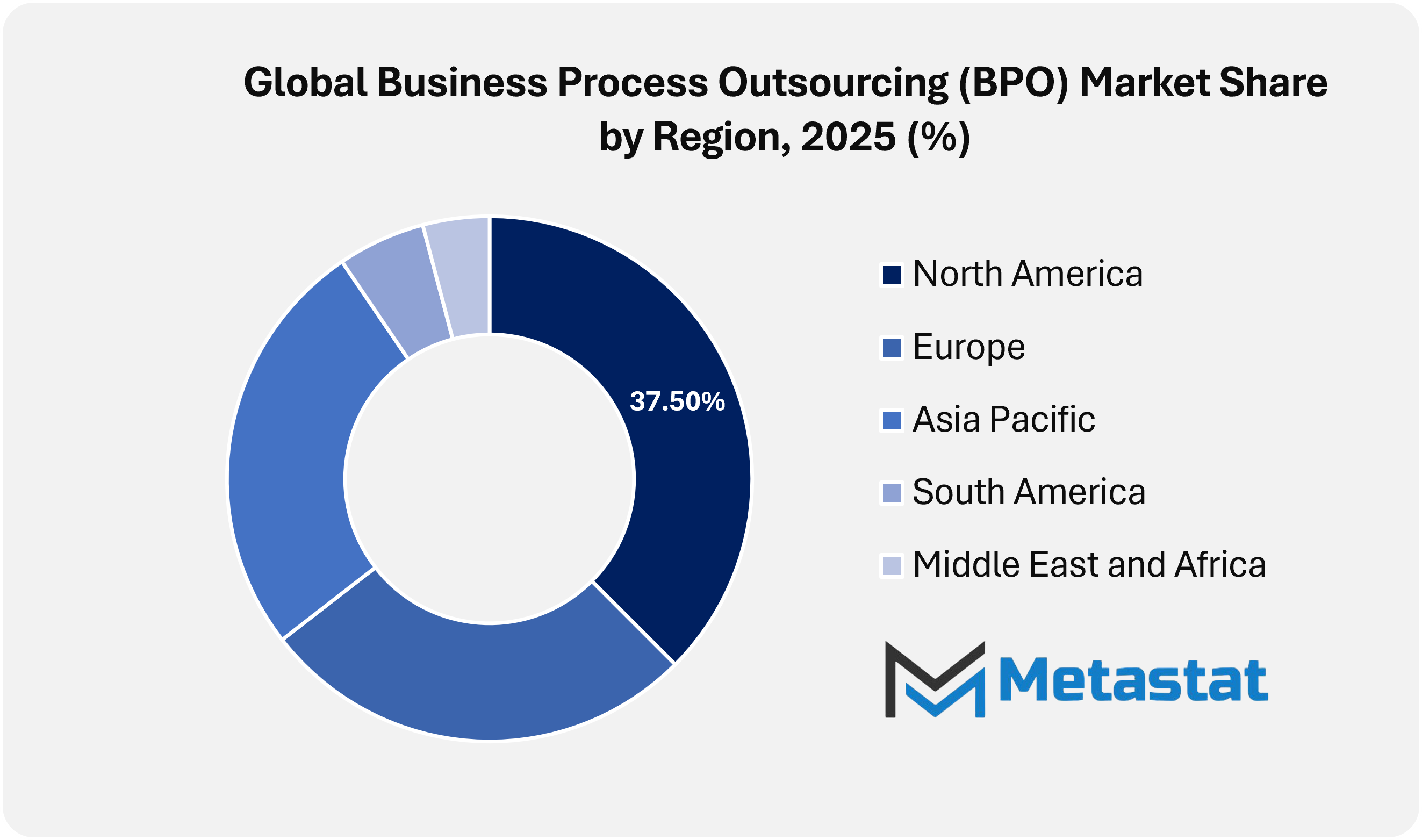
The Global Business Process Outsourcing (BPO) Market will progress through a steady shift toward operational performance and digital support across industries. Enterprises will rely on outsourcing partners to manage customer engagement, back-office functions, analytics, and technical support while maintaining cost control. Client requirements will emphasize faster response times, improved service quality, and scalable delivery models. BPO providers will focus on blending automation with human expertise to meet rising expectations while preserving the personalized experience required in service-led operations.
Artificial intelligence, data analytics, and cloud-based platforms will allow service providers to deliver deeper insights and faster execution. Automation will reduce manual workloads, and domain specialists will manage complex interactions requiring judgment and empathy. Businesses will select companions capable of adapting workflows to enterprise-specific desires, which include banking, healthcare, telecom, retail, and technology offerings. Such adaptability will assist long-term partnerships instead of brief-term contracts.
Competition within the global business process outsourcing (BPO) market will remain intense, with established players strengthening portfolios through innovation and global delivery networks. Major industry participants include [24]7.ai, Inc., Accenture, Alorica, Amdocs, Arabian Internet & Communications, Arvato CRM Solutions, Atento, Atos SE, Capgemini, Capita PLC, CBRE, CGI, Cognizant, Concentrix Corporation, Conduent, DXC Technology, EXL, Firstsource Solutions, Foundever, Genpact, HCL Technologies Limited, HGS (Hinduja Global Solutions), Hitachi, IBM Corporation, Infosys Limited, and InTouchCX. Each organization will focus on specific strengths ranging from customer experience management to finance, human resources, and digital transformation services.
Geographic engagement will aid market momentum, increasing carrier providers' presence in Asia, Latin America, the Middle East, and Eastern Europe. Cost advantages, a multilingual talent pool, and advanced digital infrastructure will attract international clients searching out various shipping locations. Regional vendors will gain visibility through nearby expertise, even as global agencies will enlarge via partnerships and acquisitions.
Looking ahead, the global business process outsourcing (BPO) market is expected to become more closely aligned with enterprise strategy rather than being limited to operational functions alone. Customers will anticipate measurable consequences related to sales growth, customer retention, and operational flexibility. Market progress will depend upon balancing automation with human-centric provider transport at the same time as preserving operations conscious of converting commercial enterprise needs.
Market size is projected to rise from USD 323.7 billion in 2025 to USD 635.6 billion by 2033.
Service pricing structures will transition toward outcome-based models supported by transparent service-level analytics. In parallel, sustainability, ethical labour practices, and governance alignment will influence dealer choice selections, particularly amongst multinational clients with public duty duties. In the long run, the worldwide business process outsourcing (BPO) market will establish itself not only as a performance engine additionally an operational extension of organizational strategy, shaping how organizations design workflows, control risk, and preserve competitiveness in an increasingly regulated and data-intensive environment.
This research report categorizes the Business Process Outsourcing (BPO) market based on key segments and regions, forecasts revenue growth, and analyses trends in each submarket. The report analyses the key growth drivers, opportunities, and challenges influencing the Business Process Outsourcing (BPO) market. Recent market developments and competitive strategies such as expansion, type launch, development, partnership, merger, and acquisition have been included to draw the competitive landscape in the market.
The report strategically identifies and profiles the key market players and analyses their core competencies in each sub-segment of the Business Process Outsourcing (BPO) market.
|
Report Attributes |
Details |
|
Study Period |
2021-2033 |
|
Base Year |
2025 |
|
Estimated Year |
2026 |
|
Forecast Period |
2026-2033 |
|
Historical Period |
2021-2025 |
|
Growth Rate |
CAGR 8.9% from 2026 to 2033 |
|
Revenue Unit |
USD billion |
|
Segmentation |
By Service Type, End Use, Outsourcing Type, Organization Size, and Region |
|
By Service Type |
|
|
By End Use |
|
|
By Outsourcing Type |
|
|
By Organization Size |
|
|
By Region |
North America (By Service Type, End Use, Outsourcing Type, Organization Size, and Country)
|
|
Europe (By Service Type, End Use, Outsourcing Type, Organization Size, and Country)
|
|
|
Asia Pacific (By Service Type, End Use, Outsourcing Type, Organization Size, and Country)
|
|
|
South America (By Service Type, End Use, Outsourcing Type, Organization Size, and Country)
|
|
|
Middle East and Africa (By Service Type, End Use, Outsourcing Type, Organization Size, and Country)
|
Find answers to common questions about this report
The Metastat Insights study shows that the Global Business Process Outsourcing (BPO) market size was USD 323.7 billion in 2025.
The Global Business Process Outsourcing (BPO) market is likely to grow at a CAGR of 8.9% over the forecast period (2026-2033).
The Metastat Insights analysis shows that the North America Business Process Outsourcing (BPO) market size is estimated to be USD 227.5 billion by 2033.
Finance & Accounting is the leading type segment in the Global market.
Rising enterprises focus on cost optimization through outsourced customer support, finance, HR, and IT-enabled services, expanding digital adoption across industries encouraging third-party vendors to manage scalable back-office operations are key driving factors, boosting the market.
North America region dominates the market.
Global Business Process Outsourcing (BPO) market is estimated to reach USD 635.6 billion by 2033.
Top players operating in the Business Process Outsourcing (BPO) industry includes [24]7.ai, Inc., Accenture, Alorica, Amdocs, and Arabian Internet & Communications.
Customer support and technical services show rapid growth due to increasing consumer demand for 24/7 omnichannel responsiveness and digital self-service. Concurrently, Finance and Accounting Outsourcing (FAO) experiences strong enterprise adoption as organizations automate core financial processes, utilizing Knowledge Process Outsourcing (KPO) partnerships to unlock deeper strategic business intelligence.
The three primary cross-border compliance risks are international data privacy violations under regulations like GDPR compliance, unauthorized data leaks exposing proprietary intellectual property, and non-compliance with regional labor or financial reporting mandates. Organizations address these vulnerabilities by requiring rigorous third-party audits and formal ISO 27001 certification across all partner delivery facilities.
Remote work decentralized the BPO labor pool, enabling providers to hire skilled talent outside traditional metropolitan delivery hubs. This shift broadened access to multilingual agents and specialized Knowledge Process Outsourcing (KPO) experts. However, supporting remote workforces requires service providers to deploy zero-trust cloud architectures, enhanced endpoint security, and continuous compliance monitoring.
While specific contract terms vary across industry verticals, modern enterprise agreements routinely include automation and continuous improvement mandates. These provisions require service providers to implement technologies like Robotic Process Automation (RPA) and AI solutions over the contract lifecycle, tying vendor financial margins directly to operational efficiency gains and SLA performance.
Small and medium enterprises prioritize operational flexibility, low minimum seat requirements, and rapid onboarding over massive global footprints. While large corporations look to providers like Accenture for complex multi-tower engagements, SMEs seek cost-effective, plug-and-play managed services with straightforward Service Level Agreements (SLAs) and transparent, usage-based pricing models.
Nearshore outsourcing regions across Latin America and Eastern Europe are steadily gaining market share. Countries like Colombia, Mexico, Costa Rica, and Poland offer real-time time-zone alignment, cultural affinity, and bilingual capabilities for Western clients. Additionally, emerging African delivery hubs, such as South Africa and Egypt, are expanding rapidly by providing high-quality, cost-competitive customer service.
Generative AI shifts BPO pricing away from traditional full-time equivalent labor models toward transaction-based and outcome-oriented commercial terms. In service delivery, AI co-pilots assist agents with real-time knowledge retrieval and automated summarization, while autonomous agents resolve routine tickets directly. This dynamic increases operational efficiency, tightens Service Level Agreements (SLAs), and lowers per-contact costs.
Metastat Insight applies a hybrid research methodology combining top-down macroeconomic evaluation with bottom-up vendor revenue aggregation. Analysts conduct structured executive interviews with enterprise buyers and outsourcing practice heads to validate demand-side budgets. Data triangulation across financial filings, contract registries, and industry databases confirms market sizing without relying on unverified projections.
The analysts below cover Professional Services research at Metastat Insights.
LEAD ANALYST
Utkarsh Khirodkar is a Lead Market Research Analyst at MetaStat Insight, specializing in market intelligence, technology sector assessments, and competitive strategy.

PRINCIPAL CONSULTANT - ENTERPRISE AI & EMERGING TECHNOLOGIES
Banking & Finance · Electronics and Semiconductor · Energy and Power · Healthcare IT · Information & Technology · Professional Services
Vijay Gunti is a Principal Consultant at MetaStat Insight, bringing over two decades of experience across enterprise digital transformation, technology strategy, and intelligent systems.

PRINCIPAL CONSULTANT - QUALITY SYSTEMS & COMPLIANCE
Electronics and Semiconductor · Machinery & Equipment · Professional Services
Omkar Phadtare is an Industry Consultant at MetaStat Insight, specializing in quality systems, regulatory compliance, and standards benchmarking to drive data-driven market intelligence and strategic industry research.

LEAD CONSULTANT - COMMUNICATION, TELECOM, AND IT
Electronics and Semiconductor · Information & Technology · Machinery & Equipment · Professional Services
Ravindra Sathe Consultants for Communication, Telecom, and IT at MetaStat Insight. He leads the firm's industry research initiatives across telecommunications infrastructure, digital connectivity, enterprise networking, and emerging information technology domains.
Last Updated: September, 2026
Evaluating calorific value requirements and air permit compliance across municipal waste facilities requires localized data. Metastat Insight structured their analysis around operational throughput capacity and feedstock composition variations in Latin America and Eastern Europe. Their competitive mapping of sorting equipment vendors helped clarify technology differences between optical separators and heavy media systems. The study provided an objective baseline during our capital expenditure reviews.
Decarbonizing industrial thermal processes hinges on refrigerant regulations and compressor efficiency limits. Metastat Insights delivered a thorough market analysis that evaluated natural refrigerants like CO2 and hydrocarbons against synthetic low-GWP alternatives. The breakdown of utility incentives and grid capacity constraints across key European manufacturing hubs offered valuable perspective. The follow-up conversation with their sector analysts addressed our specific questions on mechanical vapor recompression systems efficiently.
Assessing 200mm wafer transition schedules and substrate supply bottlenecks requires precise technical intelligence. MetaStat Insight supplied an actionable breakdown comparing planar and trench MOSFET architectures across automotive and industrial drive markets. The regional capacity estimates for Asia-Pacific foundries helped clarify lead-time uncertainties during our strategic planning session. When we needed additional clarification on high-purity raw material sourcing, their analyst team responded with helpful context within twenty-four hours.
Explore related market intelligence reports worth reading alongside this one.