
LEAD ANALYST
Utkarsh Khirodkar is a Lead Market Research Analyst at MetaStat Insight, specializing in market intelligence, technology sector assessments, and competitive strategy.

Complete Blood Count Device Market By Device Type (Automated Blood Count Analyzers, Manual Blood Count Analyzers, PoC Testing Devices, and Hematology Analyzers), By Technology (Impedance Technology, Laser-Based Technology, and Flow Cytometry, Microscopy), By End User (Hospitals, Clinics, Diagnostic Laboratories, Blood Banks, Transfusion Centers, and Others), By Distribution Channel (Online and Offline), Industry Analysis, Size, Share, Growth, Trends, and Forecast, 2025-2032
Report ID
MSI-4467
Published
February, 2026
Pages
256 Pages
Format
Report Details
Choose Your License
Complete Blood Count Device Market
The global complete blood count device market has been a long journey of innovations in clinical laboratory which finally ended up with the mid-20th century when hospitals still used manual cell counting methods that were very slow and inconsistent relying only on trained technicians. The introduction of hematology analyzers in research laboratories using electrical impedance to measure cell populations marked the beginning of automation in the field. Those very first devices changed the world’s expectations for speed and accuracy and their impact would last for decades. During the 70s late and 80s optical measurement, automated dilution systems, and integrated quality-control functions became core milestones driving manufacturers to develop instruments that would ultimately be used for high-volume diagnostic workflows in national health systems.
The global demand for precise and automatic instruments in laboratories, as a result of the expansion of healthcare services and an increase in patient load, presented a challenge to the engineers. This situation, as i.e. the company's big point-of-care compact analyzers and the centralized lab's high-throughput systems, made their way through the bar. The transformation of the clinical practice led to regular blood tests being widely accepted as a key part of preventive medicine. Moreover, the companies were pushed to invest more in reliability, stability, and traceability of results as a result of Government regulations that imposed strict standards on the Performance of Medical Equipment, especially of devices in emergency and oncology.
The Current scenario of the market will be the outcome of a continuous quality improvement in microfluidics, reagent stability, and automated data validation. It is estimated from the publicly available health statistics of the government that more than 4 billion diagnostic blood tests are done every year in the national healthcare networks, and the blood count panels are among the most common procedures performed on the global scale. Professional societies of health care report that the lack of laboratory technicians has been a concern for over ten years, and thus the requirement for devices, that can execute uninterrupted cycles with very little manual involvement, has been heightened. On the other hand, the procurement data from the public hospitals reveal an unbroken uptrend in the demand for analyzers that work well with electronic medical record systems, indicating that the coming years will see clinical settings giving more importance to smooth data flow.
The global complete blood count device market has been expanding ever since it first came into existence with manual cell counting and now with connected and increasingly automated systems. The market will keep on changing according to the demands of the clinical world, regulations, and technological breakthroughs.
The global complete blood count device market is mainly classified based on Device Type, Technology, End-User, Distribution Channel.
By Device Type is further segmented into:
By Technology the market is divided into:
By End-User the market is further divided into:
By Distribution Channel the global complete blood count device market is divided as:
|
Forecast Period |
2025-2032 |
|
Market Size in 2025 |
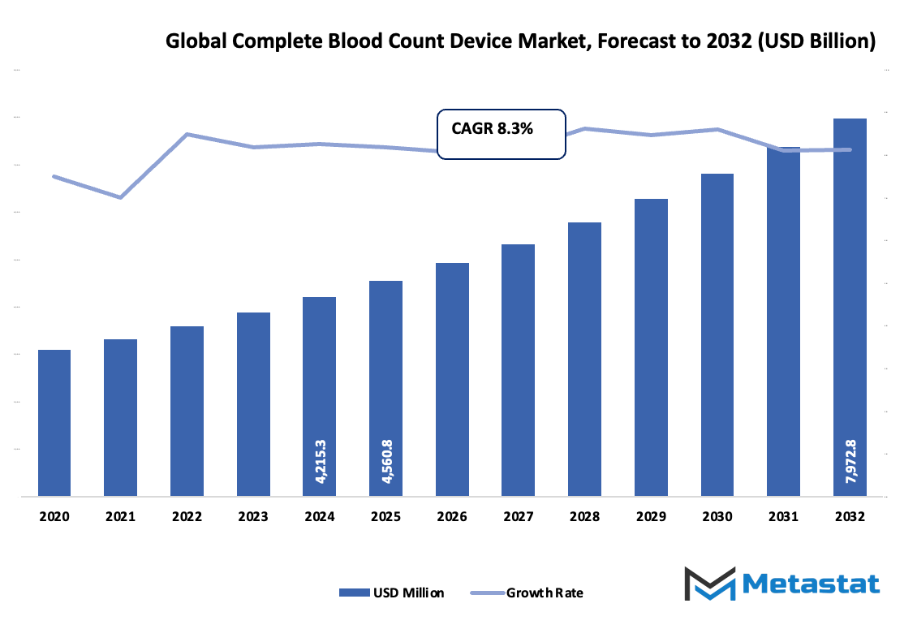
$4560.8 Million |
|
Market Size by 2032 |
$7972.8 Million |
|
Growth Rate from 2025 to 2032 |
8.3% |
|
Base Year |
2024 |
|
Regions Covered |
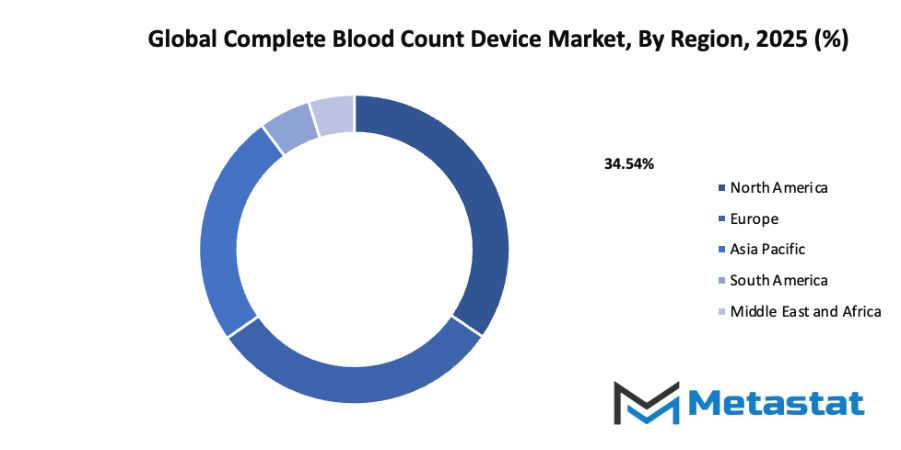
North America, Europe, Asia-Pacific, South America, Middle East & Africa |
Growth Drivers
Challenges and Opportunities
Opportunities
A broad mix of global leaders and rising regional players shapes the current global complete blood count device market. Constant product development, steady regulatory attention, and growing clinical demand have encouraged strong competition among established corporations and smaller innovators. Abbott Laboratories, Agilent Technologies, BD, Bio-Rad Laboratories, BioMérieux, Danaher Corporation, Horiba, PerkinElmer, PixCell Medical Technologies, Roche Diagnostics, Siemens Healthineers, and Thermo Fisher stand out as key forces in this space. Each organization contributes a distinct approach to diagnostic technology, fostering steady advancement across laboratories, clinics, and testing facilities.
A wide range of product strategies supports market growth, including enhancements in automation, point-of-care performance, digital integration, and reliability. Stronger analytical features and faster testing capacity have boosted adoption across both large medical centers and smaller healthcare settings. Broader access to high-quality testing has encouraged greater attention to preventive care, encouraging further investment from major companies. Regional manufacturers continue to gain attention as well, offering cost-focused solutions designed for growing healthcare networks across developing areas.
Ongoing demand for accurate blood analysis drives continuous improvement in device durability, data handling, and maintenance efficiency. Strong competition encourages consistent upgrades in hardware design and software support, allowing healthcare professionals to rely on more stable and user-friendly tools. Advances in automated sampling and simplified workflows have reduced operating time for many facilities, leading to smoother daily routines and improved resource management.
Market size is forecast to rise from USD 4560.8 million in 2025 to over USD 7972.8 million by 2032. Complete Blood Count Device will maintain dominance but face growing competition from emerging formats.
Large corporations within the market often concentrate on advanced platforms with expanded diagnostic menus, while emerging competitors highlight compact designs and affordability. This balance strengthens global availability and helps healthcare providers choose devices that match local needs, budget limits, and patient volumes. Steady attention to quality, speed, and accessibility supports a healthier competitive landscape and promotes more dependable testing for medical communities around the world.
This research report categorizes the global complete blood count device market based on various segments and regions, forecasts revenue growth, and analyzes trends in each submarket. The report analyses the key growth drivers, opportunities, and challenges influencing the global complete blood count device market. Recent market developments and competitive strategies such as expansion, type launch, development, partnership, merger, and acquisition have been included to draw the competitive landscape in the market. The report strategically identifies and profiles the key market players and analyses their core competencies in each sub-segment of the global complete blood count device market.
Find answers to common questions about this report
Global Complete Blood Count Device market is valued at $4560.8 million in 2025.
Global Complete Blood Count Device market is estimated to grow with a CAGR of 8.3% from 2025 to 2032.
Global Complete Blood Count Device market is estimated to reach $7972.8 million by 2032.
Top players operating in the Complete Blood Count Device industry includes Abbott Laboratories, Agilent Technologies, BD, Bio-Rad Laboratories, and Others.
The analysts below cover Medical Devices research at Metastat Insights.
LEAD ANALYST
Utkarsh Khirodkar is a Lead Market Research Analyst at MetaStat Insight, specializing in market intelligence, technology sector assessments, and competitive strategy.

LEAD PRINCIPAL ANALYST, PHARMA AND HEALTHCARE
Food and Beverages · Healthcare · Healthcare IT · Medical Devices
Ajay Devgire is the Lead Healthcare Analyst at MetaStat Insight, leading strategic research and market intelligence initiatives across the global healthcare domain.

SENIOR RESEARCH ANALYST
Biotechnology · Food and Beverages · Medical Devices · Packaging
Snehal Pasalkar is a Research Analyst at MetaStat Insight, operating at the intersection of life sciences research, competitive strategy, and market intelligence.
Floating offshore wind feasibility relies heavily on specialized installation vessel availability and port crane limits, which most broad renewable energy forecasts ignore. The report delivered a thorough analysis of dry dock capacity, mooring chain supply constraints, and raw material pricing trends for deepwater anchor installations. It served as a solid independent sanity check for our offshore project capital expenditure assumptions.
Assessing commercial microgrid software adoption requires looking past top-level installation numbers and examining utility interconnection queues. The research provided verifiable data on average permitting timelines, tariff structures, and battery storage integration costs across regional utility territories. That grounded perspective was valuable for our team when building five-year demand projections for industrial microgrid controllers.
Ambulatory surgical centers have very different purchasing cycles for robotic-assisted surgery platforms than major hospital networks. The MetaStat Insight study focused squarely on capital expenditure depreciation, procedural reimbursement pathways, and surgeon training overhead. That operational clarity made it much simpler to validate multi-year procedure growth forecasts against actual ambulatory center adoption patterns.
Explore related market intelligence reports worth reading alongside this one.