
LEAD ANALYST
Utkarsh Khirodkar is a Lead Market Research Analyst at MetaStat Insight, specializing in market intelligence, technology sector assessments, and competitive strategy.

Healthcare Manikins Market By Type (Patient Simulator Manikins, Task Trainers, Anatomical Models, and Others), By Fidelity (Low-Fidelity, Medium-Fidelity, and High-Fidelity), By Age Group (Adult Manikins, Pediatric Manikins, and Neonatal Manikins), By Application (Nursing Education, Medical Education, Emergency Medical Services (EMS) Training, Military Medical Training, and Others), Industry Analysis, Size, Share, Growth, Trends, and Forecast, 2025-2032
Report ID
MSI-4205
Published
October, 2025
Pages
255 Pages
Format
Report Details
Choose Your License
Healthcare Manikins Market
The global healthcare manikins market and industry evolved from modest beginnings to a major medical education and training niche. The history of this market originated in the early twentieth century, when medical schools utilized primarily primitive wooden or fabric dummies to learn anatomy and emergency techniques. These primitive devices were narrow in focus but represented the initial step towards developing realistic models capable of replicating human reaction under a controlled setting.
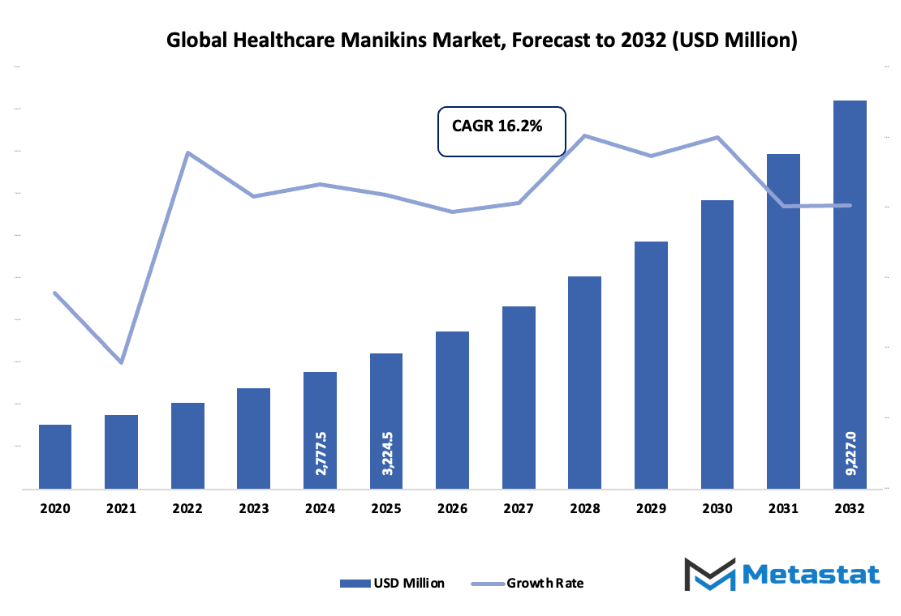
Global healthcare manikins market size of around USD 3224.5 million in 2025, expanding at a CAGR of about 16.2% from 2032, with prospects exceeding USD 9227 million.
Patient Simulator Manikins contribute a market share of nearly 46.8%, driving innovation and expanding applications with stringent research.
Key drivers of growth: Increased demand for advanced medical training and simulation education, Increasing focus on patient safety and reducing medical errors
Opportunities are: Integration of AI and virtual reality with healthcare manikins for completely interactive training solutions
Key take-out: The market is due to increase exponentially in value over the next ten years, with tremendous growth opportunities.
By the mid-1900s, advances in synthetic materials enabled more realistic and more durable manikins.
Plastic bodies that could be reused repeatedly in classrooms and laboratories provided medical instructors with an even more practical solution. A breakthrough was achieved in the 1960s, when cardiopulmonary resuscitation manikins that could mimic breathing and chest compressions were made available for production. This technology generated a revolution, as training not only became visible but practical too, helping practitioners to acquire critical lifesaving skills. When the needs of healthcare changed, the market adapted. In the 1980s and 1990s, nursing education programs expanded, creating a heightened need for manikins to allow the simulation of patient care.
Electronics continued to transform the business. With sensors and programmable functions, manikins now simulated pulse, heartbeat, and even voice, representing a shift towards interactive learning. These developments mirrored the growing emphasis on patient safety and the realization that clinical errors could be reduced through realistic training. Additionally in recent times, the global healthcare manikins market has been driven by regulation criteria that favor simulation-based training. School centers, hospitals, and emergency squads began to use high-fidelity manikins in structured learning sessions. Consumer preferences have also shifted, with a shift towards models providing realistic, technology-driven experiences. Artificial intelligence, wireless connectivity, and data monitoring will usher in the next generation of training systems. From crude wood models to sophisticated simulators, the trajectory of this market proves how education, technology, and regulation will drive it to become even more advanced in the years to come. Over the next few years, the global healthcare manikins market will neither remain static but will move toward increasingly higher realism and accessibility so that healthcare professionals everywhere learn the skills they need in safe and effective ways.
The global healthcare manikins market is mainly classified based on Type, Fidelity, Age Group, Application.
Patient Simulator Manikins: The global healthcare manikins market will see Patient Simulator Manikins growing more advanced, possessing realistic features that respond to medical procedures in real time. Future development will focus on how to incorporate artificial intelligence in order to mimic complex human conditions and move training closer to real-world situations and prepare medical professionals for high-stakes decision-making.
Task Trainers: Task Trainers will evolve increasingly in the global healthcare manikins market as a necessary element of learning complex procedures such as injections, suturing, and airway management. Evolutions will enhance stamina and touch accuracy, with various repetitions without compromising quality. This will increase learners' confidence while reducing risks involving first-time clinical exposure.
Anatomical Models: Anatomical Models in global healthcare manikins market will become increasingly detailed with the use of 3D printing and intelligent materials. These models will aid medical students with accurate modeling of organs, tissues, and systems of the human body. This will allow customized learning experience as well as increase diagnostic and surgical preparation in training environments.
Other: The global healthcare manikins market will also expand with innovative products beyond conventional categories, including hybrid models combining physical and digital elements. These technologies will provide interactive learning platforms, allowing healthcare institutions to combine traditional training with augmented and virtual reality, making accessibility and adaptability even greater in medical education worldwide.
Low-Fidelity: Low-Fidelity products in the global healthcare manikins market will remain applicable for basic instruction, giving cost-effective options for initial skill acquisition. They will provide lower-level functions that allow students to focus on basic techniques. Future advancements will give even low-cost products durability and serve as a reliable training tool.
Medium-Fidelity: Medium-Fidelity simulators in the global healthcare manikins market will continue to bridge the gap between low-end and highly advanced simulators. Such simulators will come with incomplete physiological responses, which will offer learners first-hand experience in patient care. Next-generation feedback mechanisms will make them a perfect balance between accessibility and technological advancement.
High-Fidelity: High-Fidelity products in the global healthcare manikins market will be the center of simulation-based instruction. The advanced manikins will mimic human physiology, including breathing, circulation, and neurological functions. Emerging models will feature data-driven analytics, which will allow educators to track learner performance with precision so that medical professionals are prepared to counter real emergencies effectively.
Adult Manikins: Adult Manikins in the global healthcare manikins market will remain dominant due to their wide application in diverse medical training. They will evolve to simulate age-related conditions and chronic diseases, enabling realistic practice for medical learners. These improvements will expand preparedness for addressing complex healthcare needs of adult populations in the future.
Pediatric Manikins: Pediatric Manikins will become increasingly vital in the global healthcare manikins market as training shifts to address child-specific healthcare challenges. They will incorporate features that reflect pediatric physiology and conditions. With advanced sensors, these manikins will improve emergency preparedness, ensuring medical professionals can deliver specialized care for younger patients with confidence.
Neonatal Manikins: Neonatal Manikins will gain importance in the global healthcare manikins market due to the need for specialized newborn care. Future models will include detailed functions for critical conditions such as respiratory distress and cardiac arrest. These advancements will enable healthcare teams to practice delicate neonatal interventions, enhancing survival outcomes in real-life clinical scenarios.
Nursing Education: Nursing Education within the global healthcare manikins market will increasingly rely on simulation-based training to prepare learners for patient interaction. These manikins will offer opportunities to practice vital signs monitoring, wound care, and communication skills. Future models will focus on integrating emotional response simulations, ensuring well-rounded training for nursing professionals.
Medical Education: Medical Education will remain a significant segment of the global healthcare manikins market, providing hands-on training for aspiring doctors. Manikins will simulate complex medical cases, allowing repeated practice in a safe environment. Advancements will support personalized learning paths, ensuring that each medical student receives training tailored to skill level and specialization.
Emergency Medical Services (EMS) Training: In the global healthcare manikins market, EMS Training will be strengthened by advanced manikins capable of replicating critical emergencies. These manikins will simulate trauma, cardiac arrest, and accident-related injuries. Future models will offer real-time feedback, enabling paramedics and first responders to refine techniques that are crucial during life-threatening situations outside hospital settings.
Military Medical Training: Military Medical Training within the global healthcare manikins market will continue to prioritize combat-related scenarios. Manikins will replicate injuries such as burns, blast trauma, and severe bleeding, providing realistic battlefield training. Future models will incorporate advanced durability and feedback systems, preparing military medics to deliver effective treatment under high-stress conditions.
Others: The Others category in the global healthcare manikins market will cover specialized applications in dentistry, obstetrics, and mental health training. Future innovations will enable more diverse training simulations, ensuring broader coverage of healthcare fields. These developments will support comprehensive learning, addressing both mainstream and specialized areas of healthcare education.
|
Forecast Period |
2025-2032 |
|
Market Size in 2025 |
$3224.5 Million |
|
Market Size by 2032 |
$9227 Million |
|
Growth Rate from 2025 to 2032 |
16.2% |
|
Base Year |
2024 |
|
Regions Covered |
North America, Europe, Asia-Pacific, South America, Middle East & Africa |
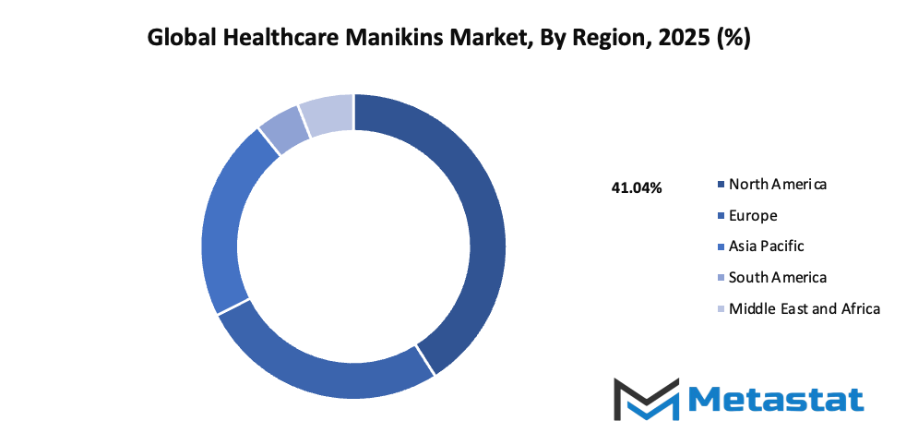
Based on geography, the global healthcare manikins market is divided into North America, Europe, Asia-Pacific, South America, and the Middle East & Africa.
North America is further divided into the U.S., Canada, and Mexico, whereas Europe consists of the UK, Germany, France, Italy, and the Rest of Europe.
Asia-Pacific is segmented into India, China, Japan, South Korea, and the Rest of Asia-Pacific.
The South America region includes Brazil, Argentina, and the Rest of South America, while the Middle East & Africa is categorized into GCC Countries, Egypt, South Africa, and the Rest of the Middle East & Africa.
Increasing demand for advanced medical training and simulation-based learning: Growing reliance on simulation-based education is driving expansion within the global healthcare manikins market. Learners can practice repeatedly without real-world risks, which builds confidence and skill. As medical procedures become more complex, demand for high-quality training methods rises, making manikins essential for preparing future healthcare professionals effectively.
Rising focus on patient safety and reduction of medical errors: The global healthcare manikins market will benefit from rising awareness of patient safety and the urgent need to reduce medical errors. Simulation with manikins allows learners to refine critical skills before applying them in real settings. This reduces risks, builds efficiency, and fosters trust in healthcare services through better preparedness.
High cost of advanced healthcare manikins and simulation systems: The cost of simulation systems remains a significant challenge for the global healthcare manikins market. Advanced manikins with lifelike features and integrated technology often require substantial investment. Many institutions with limited budgets struggle to acquire these tools, restricting broader use despite the proven benefits in training and patient safety.
Limited access and adoption in resource-constrained settings: A major challenge for the global healthcare manikins market is limited adoption in areas with fewer resources. Many institutions in developing regions lack financial support and infrastructure to implement simulation-based training. This gap in accessibility hinders equal learning opportunities, creating a divide in the quality of medical training worldwide.
Integration of AI and virtual reality with healthcare manikins for immersive training solutions: Future expansion of the global healthcare manikins market will be shaped by AI and virtual reality. These technologies create highly interactive and realistic training scenarios, enhancing engagement and skill development. By combining physical manikins with immersive simulations, learners can practice in dynamic environments, preparing more effectively for real-life medical challenges.
The global healthcare manikins market is expected to play an even greater role in the future of medical training and education. This industry continues to grow as demand for advanced simulation-based learning rises, with technology driving new opportunities and standards for training environments. The industry is a mix of both international industry leaders and emerging regional competitors, creating a dynamic and competitive setting that encourages constant development. Important competitors include Laerdal Medical, Simulaids Ltd, 3B Scientific, Elevate Healthcare Inc, Tianjin Tellyes Medical Teaching Technology Development Co., Ltd., Ambu, Nasco Healthcare, Shanghai Honglian Medical, Mentone Educational, Adam Rouilly, TruCorp, Prestan Products, and Tellyes Scientific.
Healthcare manikins are no longer seen only as basic teaching aids. In the future, these tools will evolve into highly advanced systems that replicate human responses with greater accuracy. Realistic feedback on breathing, circulation, and neurological responses will make training more practical and reliable, allowing medical professionals to prepare for complex scenarios in a safe environment. With increased adoption of artificial intelligence and data-driven technologies, healthcare manikins will become more interactive, adjusting in real time to simulate patient reactions. This development will give educators more flexibility and improve overall learning outcomes.
The presence of both global giants and emerging local firms will push innovation forward. Established companies will continue to refine high-end models with integrated digital platforms, while regional players will focus on affordability and accessibility. This balance between premium solutions and cost-effective alternatives will expand access to simulation training across developed and developing regions. It will also encourage collaboration between manufacturers, research institutions, and healthcare organizations to build smarter and more adaptable manikins.
Future demand will also be shaped by the growing importance of remote and hybrid training models. Manikins connected to virtual platforms will allow learners to engage in guided training sessions from different locations, a development that will reduce geographical barriers to education. The combination of hardware, software, and online connectivity will make training more personalized and widely available, strengthening the ability of healthcare systems to train staff efficiently.
Government initiatives and private investment in healthcare infrastructure will further boost growth. As nations seek to strengthen their healthcare systems, emphasis on training with realistic simulation models will become a priority. The global market will therefore not only expand in size but also in diversity, as products become tailored to meet specific regional needs. Competition among companies like Laerdal Medical, Simulaids Ltd, 3B Scientific, and others will remain strong, ensuring continuous upgrades in design, technology, and usability.
Market size is forecast to rise from USD 3224.5 million in 2025 to over USD 9227 million by 2032. Healthcare Manikins will maintain dominance but face growing competition from emerging formats.
In the years ahead, healthcare manikins will transform into highly intelligent systems, bridging the gap between theory and practice. The combination of global expertise and regional innovation will shape a market that delivers better training outcomes, stronger healthcare preparedness, and more reliable patient care worldwide.
This research report categorizes the Healthcare Manikins market based on various segments and regions, forecasts revenue growth, and analyzes trends in each submarket. The report analyses the key growth drivers, opportunities, and challenges influencing the Healthcare Manikins market. Recent market developments and competitive strategies such as expansion, type launch, development, partnership, merger, and acquisition have been included to draw the competitive landscape in the market. The report strategically identifies and profiles the key market players and analyses their core competencies in each sub-segment of the Healthcare Manikins market.
Find answers to common questions about this report
Global Healthcare Manikins market is valued at $3224.5 million in 2025.
Global Healthcare Manikins market is estimated to grow with a CAGR of 16.2% from 2025 to 2032.
Global Healthcare Manikins market is estimated to reach $9227 million by 2032.
Top players operating in the Healthcare Manikins industry includes Laerdal Medical, Simulaids Ltd, 3B Scientific, Elevate Healthcare Inc, and Others.
The analysts below cover Medical Devices research at Metastat Insights.
LEAD ANALYST
Utkarsh Khirodkar is a Lead Market Research Analyst at MetaStat Insight, specializing in market intelligence, technology sector assessments, and competitive strategy.

LEAD PRINCIPAL ANALYST, PHARMA AND HEALTHCARE
Food and Beverages · Healthcare · Healthcare IT · Medical Devices
Ajay Devgire is the Lead Healthcare Analyst at MetaStat Insight, leading strategic research and market intelligence initiatives across the global healthcare domain.

SENIOR RESEARCH ANALYST
Biotechnology · Food and Beverages · Medical Devices · Packaging
Snehal Pasalkar is a Research Analyst at MetaStat Insight, operating at the intersection of life sciences research, competitive strategy, and market intelligence.
Ambulatory surgical centers have very different purchasing cycles for robotic-assisted surgery platforms than major hospital networks. The MetaStat Insight study focused squarely on capital expenditure depreciation, procedural reimbursement pathways, and surgeon training overhead. That operational clarity made it much simpler to validate multi-year procedure growth forecasts against actual ambulatory center adoption patterns.
When planning edge sensor rollouts across refinery environments, generic IoT reports typically miss the harsh-environment certification bottlenecks. MetaStat Insight gave an objective evaluation of ATEX and Class 1 Division 2 hardware availability, along with realistic five-year maintenance cycle cost projections. The comparison of wireless mesh versus private cellular backhaul helped our team pressure-test network reliability models for remote processing facilities.
In the biological seed treatment space, registration timelines vary drastically between the European Union, Brazil, and North America. The MetaStat Insight research handled these cross-border regulatory barriers with genuine nuance, mapping commercialization pathways alongside historical field adoption rates. The segmentation between microbial strains and biochemical active ingredients was particularly well structured.
Explore related market intelligence reports worth reading alongside this one.
Starting from
$2950