
LEAD ANALYST
Utkarsh Khirodkar is a Lead Market Research Analyst at MetaStat Insight, specializing in market intelligence, technology sector assessments, and competitive strategy.

Cost-Estimating Software Market By Deployment Type (On-Premise and Cloud-Based), By Company Size (Small and Medium Enterprises (SMEs) and Large Enterprises), By Industry (Construction, Manufacturing, Oil & Gas, Automotive, Real Estate, Aerospace & Defense, and Others), Industry Analysis, Size, Share, Growth, Trends, and Forecast, 2033
Report ID
MSI-4163
Published
September, 2025
Pages
257 Pages
Format
Report Details
Choose Your License
Cost-Estimating Software Market
The global Cost-Estimating Software Market in the engineering and construction industry will evolve in a fascinating way from first-hand manual calculation to fully integrated computer-based solution. In the first phase, the project engineer and project manager utilized lengthy spreadsheets and paper-based cost books, which often proved to be unreliable because of inefficiency and human error. The inception of computer-aided software in the 1980s provided an initial glimpse of automation, with the ability to create more accurate cost estimates and faster report writing. Industry-specific software came in the 1990s, targeting construction firms and manufacturers looking to automate estimation processes and manage complex project budgets.
Global cost-estimating software market size of approximately USD 1717.6 million by 2025, and CAGR of approximately 9.2% between 2032, with market potential up to USD 3181.6 million.
On-Premise account for approximately 67.3% market share, driving innovation and growing applications with large-scale research.
Major trends fueling growth: Growing requirement for reliable cost projection of projects in construction and infrastructure development, growing usage of digital tools in order to drive efficiency and minimize human error
Opportunities include: Integration of AI and cloud-based platforms to provide real-time cost analytics and predictive insights
Key insight: The market is set to grow exponentially in value over the next decade, highlighting significant growth opportunities.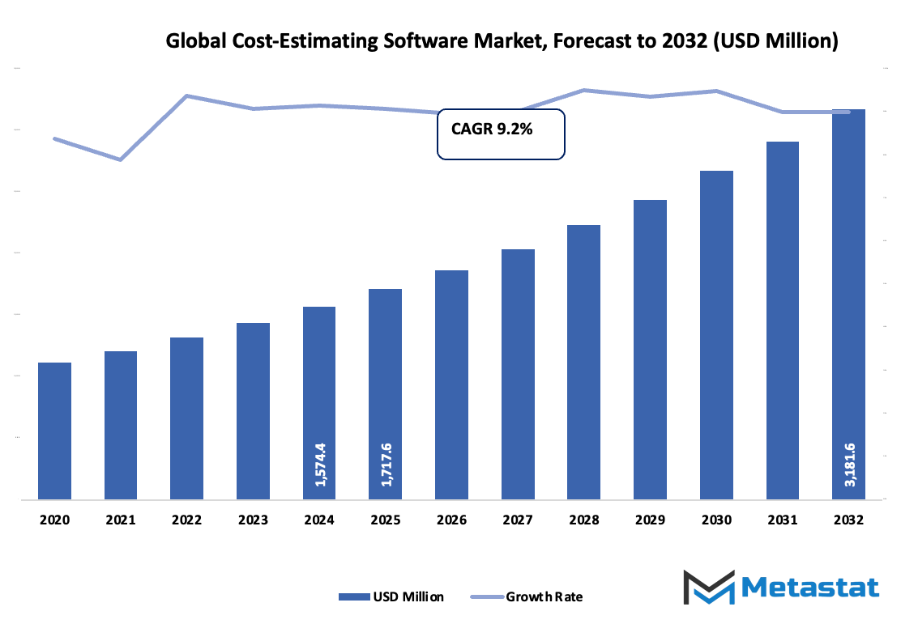
This decade will be a milestone era where traditional desktop software started making the shift to cloud-based tools, enabling them to integrate perfectly with project management and bookkeeping systems. At the same time, end users' expectations will increase, requiring more visibility, predictive analysis, and adaptable reporting capabilities. Firms will no longer accept basic cost estimates; they will require those that can do scenario planning and risk assessment to back up their decisions. Technological innovations such as artificial intelligence, machine learning, and big data analytics will restructure the market one after another. These technologies will make software capable of not only computing costs but also forecasting trends and detecting potential overruns in advance. While at the same time, updates to construction and procurement standards at the regulatory level will necessitate software updates to remain compliant, causing providers to become increasingly flexible and up-to-date data banks of codes and material prices. Today, the global cost-estimating software marketplace is ready to evolve even more.
With the expansion of virtual space, integration with IoT devices, augmented reality for projecting projects, and real-time monitoring of labour and materials will become the standard. Companies will increasingly seek software that reduces mistakes, saves time, and enables strategic planning throughout the project's stages. The market in the future will continue to improve, combining human brains with high computing capability to offer data-based accurate cost estimating for increasingly complex projects.
The global cost-estimating software market is mainly classified based on Deployment Type, Company Size, Industry,
On-Premise: On-premise deployment will still be attractive to organizations that prefer to own their data and systems. It will allow for customization of business needs and compliance needs. Organizations will choose on-premise solutions so that they can have complete control over software patches and security.
Cloud-Based: Cloud-based deployment will see broader use due to flexibility, scalability, and lower initial costs. Organizations can use real-time updates and remote collaboration features. The widespread adoption of cloud infrastructure will speed up implementation and enhance efficiency in cost estimation in different projects.
Small and Medium Businesses (SMEs): SMEs will benefit from cost-estimating software that is easy to use and inexpensive. SMEs will seek products that require minimal IT support while providing accurate cost estimations. SMEs will become more prevalent as they attempt to make budgeting easier and improve financial decision-making.
Large Companies: Large companies will believe in end-to-end solutions to manage complex projects and multiple teams. Large companies will require strong software that can integrate with the existing systems, handle bulk data, and provide strategic planning for resource allocation as well as controlling the cost.
Construction: Construction companies will increasingly adopt cost-estimating software to manage project budgets, material costs, and labour expenses. Accurate forecasting will improve efficiency, reduce waste, and enhance project delivery. The software will help in planning and controlling expenditures for large-scale infrastructure projects.
Manufacturing: Manufacturing firms will use cost-estimating software to optimize production costs, manage supply chains, and ensure competitive pricing. The software will allow companies to simulate scenarios, reduce financial risks, and maintain profitability in a competitive market.
Oil & Gas: The oil and gas sector will benefit from software that manages exploration, extraction, and operational costs. Accurate cost estimation will help control investments in equipment and safety measures. Companies will rely on these tools to improve project planning and financial forecasting.
Automotive: Automotive manufacturers will adopt cost-estimating software to streamline production, reduce material costs, and manage labor expenses. These tools will support new product development, cost optimization, and strategic planning to remain competitive in a fast-changing market.
Real Estate: Real estate companies will use cost-estimating software to predict construction expenses, property development costs, and project timelines. The software will help manage budgets efficiently and reduce financial risks while supporting large-scale residential and commercial developments.
Aerospace & Defense: Aerospace and defense firms will leverage cost-estimating software to handle complex projects with high precision. Accurate cost forecasts will be essential for program planning, resource allocation, and adherence to strict budgets while maintaining quality and compliance standards.
Other: Other industries, including energy, utilities, and logistics, will adopt cost-estimating software to manage expenses, optimize resource use, and enhance decision-making. The software will support a wide range of operations, ensuring efficient cost management and improved financial planning.
|
Forecast Period |
2025-2032 |
|
Market Size in 2025 |
$1717.6 Million |
|
Market Size by 2032 |
$3181.6 Million |
|
Growth Rate from 2025 to 2032 |
9.2% |
|
Base Year |
2025 |
|
Regions Covered |
North America, Europe, Asia-Pacific, South America, Middle East & Africa |
Rising need for accurate project cost forecasting in construction and infrastructure development: The global cost-estimating software market will witness growth due to the increasing demand for precise project cost forecasting. Accurate estimates help in minimizing budget overruns and delays, ensuring projects are completed within planned resources. The software will play a critical role in guiding financial decisions and optimizing resource allocation in large-scale construction and infrastructure initiatives.
Increasing adoption of digital tools to improve efficiency and reduce human error: The global cost-estimating software market will benefit from the growing use of digital tools across industries. These tools will streamline workflows, reduce manual errors, and save time. Automated cost calculation and project management features will ensure smoother operations, making processes more reliable and predictable, which will appeal to both small and large enterprises.
High upfront implementation and subscription costs for advanced solutions: The global cost-estimating software market will encounter challenges due to the significant upfront investment required for advanced tools. Subscription models and licensing fees can limit adoption among smaller businesses. The cost factor will influence purchasing decisions, requiring careful consideration of long-term benefits versus immediate expenses in budgeting processes.
Resistance to adoption due to lack of technical expertise among small businesses: The global cost-estimating software market will experience adoption challenges caused by insufficient technical skills among small enterprises. Limited knowledge in handling advanced software may result in slower uptake. Training programs, user-friendly interfaces, and support services will become essential to increase confidence and ease the transition to digital cost-estimating solutions.
Integration of AI and cloud-based platforms to provide real-time cost analytics and predictive insights: The global cost-estimating software market will see multiple opportunities as technology advances. Integration with artificial intelligence and cloud-based platforms will allow real-time analytics and predictive insights, improving decision-making. Businesses will leverage these innovations to anticipate cost changes, enhance planning accuracy, and optimize financial outcomes, making software a vital tool for future project management.
Based on geography, the global cost-estimating software market is divided into North America, Europe, Asia-Pacific, South America, and the Middle East & Africa.
North America is further divided into the U.S., Canada, and Mexico, whereas Europe consists of the UK, Germany, France, Italy, and the Rest of Europe.
Asia-Pacific is segmented into India, China, Japan, South Korea, and the Rest of Asia-Pacific.
The South America region includes Brazil, Argentina, and the Rest of South America, while the Middle East & Africa is categorized into GCC Countries, Egypt, South Africa, and the Rest of the Middle East & Africa.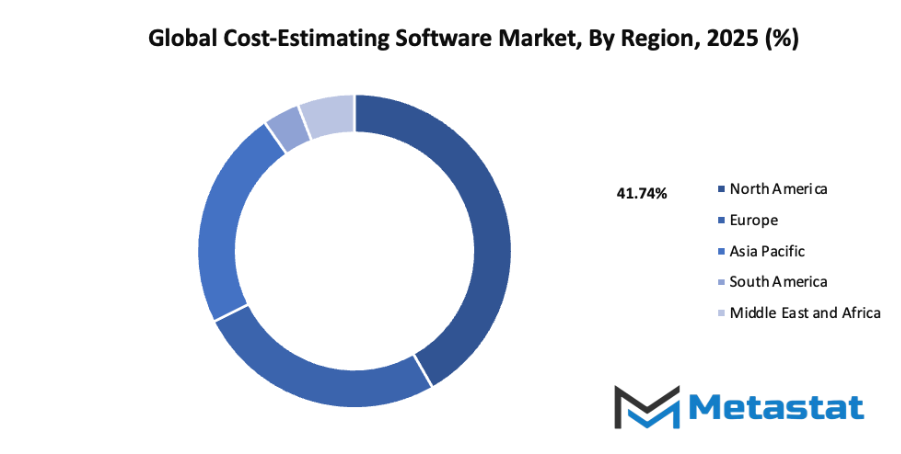
The global cost-estimating software market is set to experience significant growth as both international industry leaders and emerging regional competitors continue to drive innovation. The industry is a mix of established multinational companies and newer regional players, which together create a dynamic and competitive environment. Important competitors include Procore Technologies, Buildertrend, KBMAX, Cleopatra Enterprise, Kreo Software, Trimble Inc., ACCA Software, STACK Construction Technologies, Heavy Construction Systems Specialists LLC (HCSS), eTakeoff, On-Screen Takeoff, and CMiC. These companies provide solutions that help construction and engineering projects plan, budget, and manage costs more efficiently.
In the near future, the global market for cost-estimating software is expected to benefit from advancements in artificial intelligence and cloud-based technologies. These technologies will make software more intuitive, allowing companies to produce accurate cost projections in real time. Integration with other project management tools will further streamline workflows, reducing errors and improving project efficiency.
Regional competitors will play an increasingly important role as local providers adapt solutions to specific market needs. These companies are often quicker to respond to regulatory changes and localized construction practices, giving them an advantage in certain areas. At the same time, international leaders will continue to expand their global reach, offering robust solutions that appeal to large multinational firms.
The future of the industry will also see a focus on data-driven decision-making. Software that can analyze historical project data and predict cost trends will provide users with actionable insights, improving planning and resource allocation. Sustainability will become another key factor, with tools offering features that assess the environmental impact of construction projects alongside cost projections.
As competition grows, companies will invest in improving user experience and functionality. Intuitive interfaces, mobile accessibility, and integration with emerging technologies like augmented reality for visualization will make software more user-friendly and effective. The market will be defined by a balance between large companies offering comprehensive, feature-rich solutions and smaller, agile providers offering specialized, localized tools.
Market size is forecast to rise from USD 1717.6 million in 2025 to over USD 3181.6 million by 2032. Cost-Estimating Software will maintain dominance but face growing competition from emerging formats.
Overall, the global cost-estimating software market will continue to evolve as technology advances and competition increases. Companies that innovate while addressing local and international needs will shape the future, creating tools that not only estimate costs but also enhance the overall efficiency and sustainability of construction projects worldwide.
This research report categorizes the global cost-estimating software market based on various segments and regions, forecasts revenue growth, and analyzes trends in each submarket. The report analyses the key growth drivers, opportunities, and challenges influencing the global cost-estimating software market. Recent market developments and competitive strategies such as expansion, type launch, development, partnership, merger, and acquisition have been included to draw the competitive landscape in the market. The report strategically identifies and profiles the key market players and analyses their core competencies in each sub-segment of the global cost-estimating software market.
Find answers to common questions about this report
Global Cost-Estimating Software market is valued at $1717.6 million in 2025.
Global Cost-Estimating Software market is estimated to grow with a CAGR of 9.2% from 2025 to 2032.
Global Cost-Estimating Software market is estimated to reach $3181.6 million by 2032.
Top players operating in the Cost-Estimating Software industry includes Procore Technologies, Buildertrend, KBMAX, Cleopatra Enterprise, Kreo Software, and Others.
The analysts below cover Information & Technology research at Metastat Insights.
LEAD ANALYST
Utkarsh Khirodkar is a Lead Market Research Analyst at MetaStat Insight, specializing in market intelligence, technology sector assessments, and competitive strategy.

PRINCIPAL CONSULTANT - ENTERPRISE AI & EMERGING TECHNOLOGIES
Banking & Finance · Electronics and Semiconductor · Energy and Power · Healthcare IT · Information & Technology · Professional Services
Vijay Gunti is a Principal Consultant at MetaStat Insight, bringing over two decades of experience across enterprise digital transformation, technology strategy, and intelligent systems.

LEAD CONSULTANT - COMMUNICATION, TELECOM, AND IT
Electronics and Semiconductor · Information & Technology · Machinery & Equipment · Professional Services
Ravindra Sathe Consultants for Communication, Telecom, and IT at MetaStat Insight. He leads the firm's industry research initiatives across telecommunications infrastructure, digital connectivity, enterprise networking, and emerging information technology domains.
In the biological seed treatment space, registration timelines vary drastically between the European Union, Brazil, and North America. The MetaStat Insight research handled these cross-border regulatory barriers with genuine nuance, mapping commercialization pathways alongside historical field adoption rates. The segmentation between microbial strains and biochemical active ingredients was particularly well structured.
Our team was tracking whether regional recycling infrastructure could realistically absorb the growing volume of lithium iron phosphate batteries over the next decade. The report did a solid job separating announced hydrometallurgical plant capacity from active, permitted operational throughput. That distinction made the feedstock availability projections and regional recovery rate models far more credible than standard commercial overviews.
Tracking capacity expansion in single-use bioprocessing requires dependable data on raw material availability and cleanroom-grade polymer supply chains. The competitive landscape chapter gave a grounded evaluation of secondary component suppliers across North America and Asia-Pacific rather than simply reprinting press releases. Having that level of supplier benchmarking helped clarify dual-sourcing considerations for our clinical pipeline planning.
Explore related market intelligence reports worth reading alongside this one.