
LEAD ANALYST
Utkarsh Khirodkar is a Lead Market Research Analyst at MetaStat Insight, specializing in market intelligence, technology sector assessments, and competitive strategy.

Electronic Medical Records Market Size, Share, By Deployment Type (On-Premise EMR and Cloud-Based EMR), By Type (Integrated EMR Systems and Standalone EMR Systems), By Application (Clinical Application, Administrative Application, Reporting in Healthcare System, Healthcare Financing, and Others), By End User (Hospital, Clinics, Specialty Centers, and Others), Industry Analysis, Growth, Trends, and Forecast, 2026-2033
Report ID
MSI-4603
Published
April, 2026
Pages
320 Pages
Format
Report Details
Choose Your License
Electronic Medical Records Market
Global Electronic Medical Records market size is valued at USD 20.1 billion in 2025 and projected to grow at a CAGR of 6.2% during the forecast period, reaching USD 32.5 billion by 2033.
North America holds 37.3% of the market in 2025, with the U.S. leading the regional market.
On-Premises EMR segment accounts for a market share of 55.3% in 2025.
Key trends driving growth: Interoperability and digital health policy mandates, along with shift toward integrated clinical workflows, quality reporting, and data-driven care delivery
Opportunities include AI-enabled clinical documentation and decision support embedded within EMR workflows.
Key insight: Accelerated digital transformation in healthcare is strengthening the competitive intensity of the Global Electronic Medical Records Market.
The Global Electronic Medical Records market within the healthcare information technology industry is moving beyond conventional digitization into a phase shaped by clinical intelligence, deeper interoperability, and patient-centered data ecosystems. Hospitals and specialty clinics will no longer view electronic records only as repositories of patient histories; they will increasingly use them as active decision environments where structured data, imaging information, genomics, and remote monitoring inputs converge into unified clinical narratives. Vendors are developing platforms capable of synthesizing real-time diagnostics, wearable device inputs, and longitudinal treatment outcomes into contextual dashboards tailored for physicians, nurses, and administrative leaders.
Over the coming years, the industry will expand its role in home-based care coordination and value-based reimbursement frameworks. Systems will increasingly integrate predictive algorithms to help anticipate readmissions, medication conflicts, and disease progression patterns without disrupting clinical workflows. Cross-border data exchange will require compliance architectures aligned with privacy regulations such as HIPAA in the United States and GDPR in Europe, shaping cross-regional deployment strategies. Cloud-native infrastructure will become more widespread, enabling modular scalability and stronger cybersecurity protection against targeted breaches.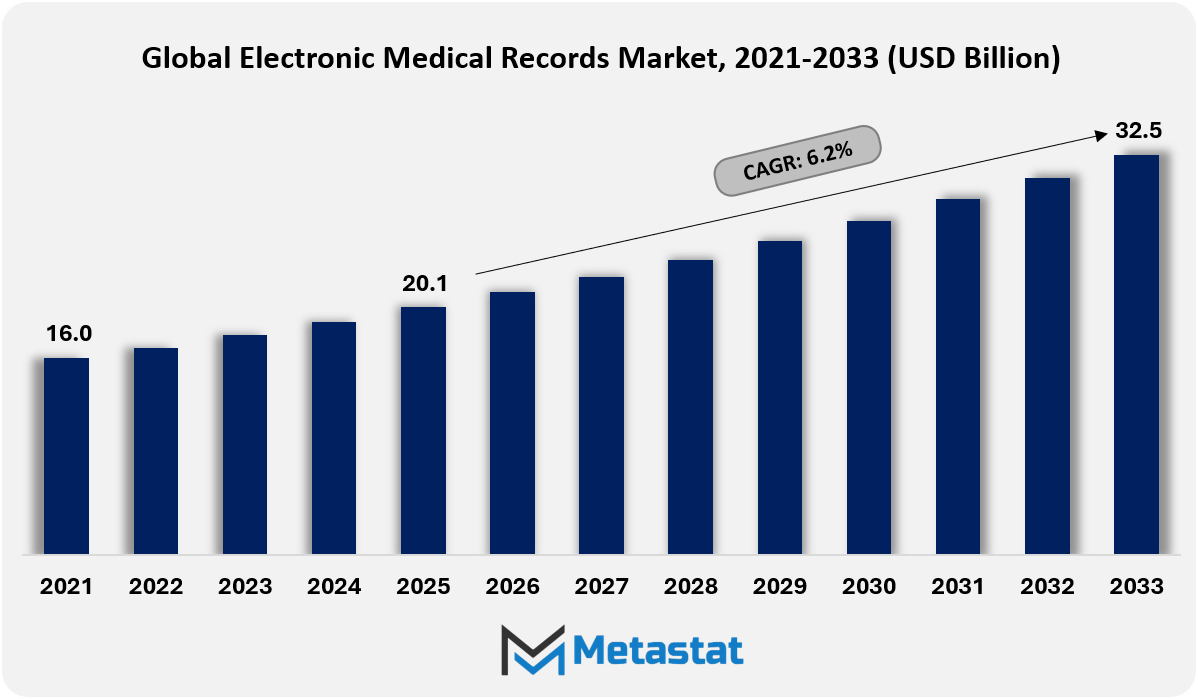
Interoperability and digital health policy mandates.
Global Electronic Medical Records market will witness structured expansion through stronger interoperability standards and institutional digital health policy mandates across developed and emerging economies. Regulatory bodies are promoting unified data exchange frameworks connecting hospitals, laboratories, pharmacies, and insurers. Standardized data protocols are reducing fragmentation and improving longitudinal patient data management. Cross-border compatibility initiatives are supporting coordinated treatment pathways, encouraging healthcare providers to modernize legacy systems and align operations with national digital transformation agendas.
Shift toward integrated clinical workflows, quality reporting, and data-driven care delivery
Global Electronic Medical Records market is expanding through rising demand for integrated clinical workflows that connect diagnostics, treatment planning, billing, and follow-up monitoring within a single platform. Healthcare institutions are adopting structured quality reporting systems linked directly to patient records. Real-time analytics dashboards are supporting outcome measurement, risk stratification, and population health management. Data-driven care delivery models are strengthening accountability, optimizing resource allocation, and improving evidence-based clinical decision-making across care settings.
High implementation and change-management burden across clinical teams
Global Electronic Medical Records market faces significant friction owing to high implementation costs and operational changes required across clinical teams. Migration from paper-based or fragmented digital systems requires infrastructure upgrades, workflow redesign, and extensive staff training. Productivity disruption during transition phases creates financial pressure, particularly for mid-sized healthcare facilities. Resistance to digital adoption among experienced practitioners will slow deployment timelines and increase project management complexity.
Cybersecurity exposure and privacy compliance complexity
Global Electronic Medical Records market will face heightened scrutiny regarding cybersecurity exposure and patient data protection responsibilities. The increasing frequency of ransomware attacks on healthcare networks is driving the need for advanced encryption, multi-factor authentication, and continuous threat monitoring systems. Regional data protection regulations are adding documentation and audit requirements. Failure to protect sensitive clinical information will result in legal liability, financial penalties, and reputational damage for healthcare providers.
AI-enabled clinical documentation and decision support embedded within EMR workflows
Global Electronic Medical Records market will unlock transformative opportunities through the integration of artificial intelligence tools within clinical documentation modules and decision support systems. Natural language processing solutions will automate physician note transcription, reduce administrative workload, and improve coding accuracy. Predictive analytics algorithms will support early disease detection and treatment optimization. Embedded AI capabilities will improve diagnostic precision, strengthen patient engagement strategies, and enhance long-term healthcare system efficiency.
The Global Electronic Medical Records market is classified based on Deployment Type, Type, Application, and End User.
On-Premises EMR segment is valued at USD 11.8 billion in 2026 and is projected to reach USD 11.4 billion by 2033, at a CAGR of -0.5% during the forecast period.
On-Premises EMR will remain relevant among large healthcare organizations seeking direct control over data governance and infrastructure. Future adoption will be supported by investment in secure servers, customized workflows, and internal IT capabilities, helping institutions meet compliance requirements, data residency standards, and long-term operational stability goals.
Cloud-Based EMR segment is valued at USD 9.5 billion in 2026 and is projected to reach USD 21.1 billion by 2033, at a CAGR of 12% during the forecast period.
Cloud-Based EMR will accelerate adoption through scalable storage, remote accessibility, and subscription-based cost models. Growth will align with digital health mandates, cybersecurity improvements, and interoperability requirements, enabling healthcare providers to access patient data across distributed networks with higher efficiency and centralized oversight.
Integrated EMR Systems segment is projected to reach USD 24.1 billion by 2033, at a CAGR of 8.2% during the forecast period.
Integrated EMR Systems will gain prominence through unified platforms that connect clinical, billing, laboratory, and pharmacy modules. Growth is being supported by rising demand for streamlined data exchange, predictive analytics integration, and coordinated care models, strengthening institutional capability for informed decision-making and long-term patient management.
Standalone EMR Systems segment is projected to reach USD 8.4 billion by 2033, at a CAGR of 1.8% during the forecast period.
Standalone EMR Systems will continue to see adoption among smaller healthcare facilities seeking focused record management solutions. Future demand will be supported by modular upgrades, cost efficiency, and simplified implementation processes, helping providers achieve digital documentation goals without extensive system integration or high infrastructure investment.
Clinical Application segment is projected to reach USD 16.1 billion by 2033.
Clinical applications will expand through advanced diagnostic support, electronic prescribing, and structured patient history documentation. Growth in this segment is being supported by AI-enabled clinical insights, real-time monitoring capabilities, and precision treatment initiatives, improving care quality, reducing medical errors, and strengthening long-term treatment outcomes.
Administrative Application segment is projected to reach USD 6.0 billion by 2033.
Administrative applications will improve operational management through appointment scheduling, resource allocation, and compliance tracking. Future development will include automation tools, workforce analytics, and centralized dashboards, supporting efficiency across healthcare institutions while strengthening regulatory documentation and audit readiness.
Reporting in Healthcare System segment is projected to reach USD 4.5 billion by 2033.
Reporting and Analytics will evolve through advanced analytics engines capable of generating regulatory, clinical, and financial reports. Segment expansion is being driven by performance benchmarking, population health monitoring, and data transparency requirements, enabling healthcare organizations to refine service delivery models and improve reporting accuracy.
Healthcare Financing segment is projected to reach USD 3.3 billion by 2033.
Billing and Reimbursement applications will support billing accuracy, insurance verification, and reimbursement tracking. Future development will rely on digital claims management systems, fraud detection tools, and real-time eligibility validation, helping strengthen financial sustainability across healthcare ecosystems.
Others segment is projected to reach USD 2.7 billion by 2033.
Other applications will include emerging functions such as telehealth integration, patient engagement portals, and mobile record access. Segment development will reflect rising digital literacy, expansion of remote care, and the growing importance of value-based healthcare frameworks, reinforcing connected health infrastructure across diverse service environments.
Hospital segment is projected to grow at a CAGR of 5.6% during the forecast period.
Hospitals will remain the dominant end-user segment in the Global Electronic Medical Records market owing to high patient volumes and complex care pathways. Investment is centered on enterprise-wide interoperability, cybersecurity resilience, and advanced analytics integration, supporting coordinated treatment planning and comprehensive data management across departments.
Clinics segment is projected to grow at a CAGR of 6.8% during the forecast period.
Clinics are adopting flexible and cost-effective systems tailored to outpatient care settings. Segment growth is supported by user-friendly interfaces, faster deployment models, and integration with diagnostic laboratories, enabling efficient patient documentation and continuity of care across community healthcare networks.
Specialty Centers segment is projected to grow at a CAGR of 7.4% during the forecast period.
Specialty Centers are increasingly implementing customized systems designed for focused clinical disciplines. Future demand is supported by specialized templates, imaging integration, and procedure-specific documentation tools, improving diagnostic accuracy, treatment tracking, and regulatory compliance across specialized care settings.
Others segment is projected to grow at a CAGR of 6.7% during the forecast period.
Other end users include long-term care centers, rehabilitation facilities, and home healthcare providers. Digital transformation across these settings is increasing demand for remote data access, coordinated care information, and outcome tracking tools, supporting broader healthcare delivery beyond traditional institutional environments.
Based on geography, the Global Electronic Medical Records market is divided into North America, Europe, Asia-Pacific, South America, Middle East, and Africa.
In North America, federal digitization mandates and incentive packages maintain to accelerate adoption throughout hospitals and outpatient networks inside the Electronic Medical Records market.
In North America, robust interoperability requirements and high healthcare IT spending push healthcare carriers to upgrade legacy structures inside the Electronic Medical Records market.
In Asia Pacific, expanding sanatorium infrastructure and growing private healthcare investments create essential growth avenues in the Electronic Medical Records market.
In Asia Pacific, government-led digital fitness missions and growing telehealth penetration open new implementation potentialities within the Electronic Medical Records market.
Across the Middle East, Africa, and South America, modernization of public healthcare structures and slow digital infrastructure enlargement generate steady demand momentum in the Electronic Medical Records market.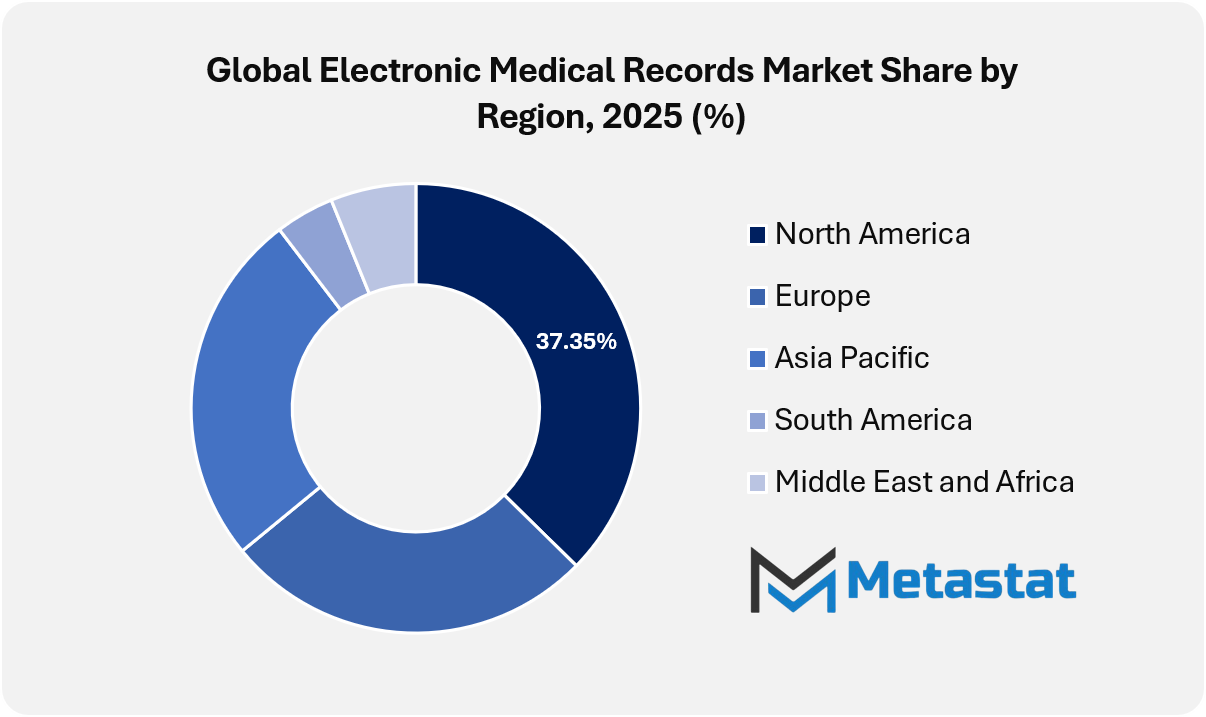
The global Electronic Medical Records market is growing steadily as healthcare providers shift from paper records to digital systems that improve accuracy, accessibility, and care coordination. Hospitals, clinics, and physician practices are investing in EMR platforms that support real-time patient data management, reduce manual errors, and improve clinical decision-making. Government support through digital health policies and funding programs is further strengthening market expansion. As patient volumes rise and data requirements become more complex, healthcare organizations are seeking systems that are reliable, secure, and easy to use.
Technology advancements will play a major role in shaping the future of EMR adoption. Cloud-based deployment models are gaining traction owing to lower upfront costs and improved remote accessibility to patient data. Integration with telehealth platforms, billing systems, and laboratory software is improving workflow efficiency and reducing duplication of effort. Artificial intelligence tools are also being embedded into EMR solutions to support predictive analytics, clinical documentation, and population health management. At the same time, data privacy and cybersecurity remain critical concerns, prompting providers to invest in stronger encryption and compliance capabilities.
Competition in the Global Electronic Medical Records market remains intense, with established companies and emerging providers offering specialized solutions across diverse healthcare settings. Key industry participants include Veradigm LLC, Cerner Corporation (Oracle), CureMD Corporation, eClinicalWorks, Epic Systems Corporation, Greenway Health, LLC., MEDITECH, Praxis EMR, NextGen Healthcare, AdvancedMD, Inc., McKesson Corporation, athenahealth, Inc., GE HealthCare, Bizmatics Inc., MEDFAR Clinical Solutions, TherapyNotes, LLC, Sevocity, Practice Fusion, Inc., Altera Digital Health, InterSystems, Netsmart Technologies, Inc., CompuGroup Medical, Koninklijke Philips N.V., MEDHOST, WellSky, AlayaCare, TELUS Health, CareCloud, Tebra, DrChrono, EMIS, and Elation Health. These companies are focusing on product innovation, strategic partnerships, and acquisitions to strengthen their market position and expand their customer base.
Looking ahead, the Global Electronic Medical Records market will continue to benefit from the growing need for coordinated care and value-based healthcare models. Providers are increasingly seeking platforms that support seamless information sharing across departments and broader healthcare networks. Smaller clinics are prioritizing flexible pricing models, while large hospital systems are demanding scalable platforms capable of managing complex clinical and administrative operations. With the continued expansion of digital health adoption worldwide, the Electronic Medical Records market will remain essential for improving patient care, operational efficiency, and long-term healthcare outcomes.
Market size is forecast to rise from USD 20.1 billion in 2025 to over USD 32.5 billion by 2033.
Beyond institutional settings, patient portals will evolve into interactive health management platforms where individuals can review diagnostics, schedule teleconsultations, and share controlled data segments with insurers or research institutions. Artificial intelligence layers will improve documentation accuracy and automate coding processes aligned with evolving healthcare data standards. As interoperability frameworks mature, digital records will integrate more seamlessly with laboratory information systems, pharmacy networks, and public health registries, supporting coordinated responses during epidemiological events. The market is increasingly positioning electronic record systems not just as digital charts, but as foundational infrastructure for precision medicine, population health analytics, and globally connected care delivery.
By Deployment Type:
By Type:
By Application:
By End User:
This research report categorizes the Electronic Medical Records market based on key segments and regions, forecasts revenue growth, and analyses trends in each submarket. The report analyses the key growth drivers, opportunities, and challenges influencing the Electronic Medical Records market. Recent market developments and competitive strategies such as expansion, product launch, partnership, merger, and acquisition have been included to draw the competitive landscape in the market.
The report strategically identifies and profiles the key market players and analyses their core competencies in each sub-segment of the Electronic Medical Records market.
|
Report Attributes |
Details |
|
Study Period |
2021-2033 |
|
Base Year |
2025 |
|
Estimated Year |
2026 |
|
Forecast Period |
2026-2033 |
|
Historical Period |
2021-2025 |
|
Growth Rate |
CAGR 6.2% from 2026 to 2033 |
|
Revenue Unit |
USD billion |
|
Segmentation |
By Deployment Type, Type, Application, End User, and Region |
|
By Region |
North America (By Deployment Type, Type, Application, End User, and Country)
|
|
|
Europe (By Deployment Type, Type, Application, End User, and Country)
|
|
|
Asia Pacific (By Deployment Type, Type, Application, End User, and Country)
|
|
|
South America (By Deployment Type, Type, Application, End User, and Country)
|
|
|
Middle East and Africa (By Deployment Type, Type, Application, End User, and Country)
|
Find answers to common questions about this report
Top players operating in the Electronic Medical Records industry include Veradigm LLC, Cerner Corporation (Oracle), CureMD Corporation, eClinicalWorks, Epic systems corporation, AND Greenway Health, LLC.
Global Electronic Medical Records market is estimated to reach USD 32.5 billion by 2033.
Interoperability and digital health policy mandates and Shift toward integrated clinical workflows, quality reporting, and data-driven care delivery are key driving factors, boosting the market.
The On-Premise EMR is the leading type segment in the Global market.
High implementation and change-management burden across clinical teams will hamper the market growth within the forecast period.
The Metastat Insights analysis shows that the North America Electronic Medical Records market size is estimated to be USD 10.9 billion by 2033.
North America region dominates the market.
The Metastat Insights study shows that the Global Electronic Medical Records market size was USD 20.1 billion in 2025.
The Global Electronic Medical Records market is expected to grow at a CAGR of 6.2% over the forecast period (2026-2033).
The analysts below cover Healthcare IT research at Metastat Insights.
LEAD ANALYST
Utkarsh Khirodkar is a Lead Market Research Analyst at MetaStat Insight, specializing in market intelligence, technology sector assessments, and competitive strategy.

LEAD PRINCIPAL ANALYST, PHARMA AND HEALTHCARE
Food and Beverages · Healthcare · Healthcare IT · Medical Devices
Ajay Devgire is the Lead Healthcare Analyst at MetaStat Insight, leading strategic research and market intelligence initiatives across the global healthcare domain.

PRINCIPAL CONSULTANT - ENTERPRISE AI & EMERGING TECHNOLOGIES
Banking & Finance · Electronics and Semiconductor · Energy and Power · Healthcare IT · Information & Technology · Professional Services
Vijay Gunti is a Principal Consultant at MetaStat Insight, bringing over two decades of experience across enterprise digital transformation, technology strategy, and intelligent systems.
Most industry reports on warehouse automation bundle autonomous mobile robots and fixed conveyor installations into the same top-level numbers, which complicates advisory work. This study split the market cleanly by payload tiers, navigation technology, and fleet management software layers. The regional forecast for Western Europe gave our team defensible adoption benchmarks when evaluating capital allocation for logistics clients, saving us days of secondary data scrubbing.
Analyzing the transition from natural gas to green hydrogen in iron ore reduction requires realistic infrastructure timelines. Meta stat insight supplied a detailed regional assessment of DRI plant conversion costs and scrap metal availability in North America and Western Europe. Their report carefully examined pellet quality specs and electrical grid access constraints without making oversimplified market assumptions. The research material served as a practical reference during internal technology roadmap discussions.
Integrating zero-trust access controls across legacy electronic health record systems involves complex compliance overhead. Team produced an analysis that clearly separated identity governance and administration tools from privileged access management platforms. Their evaluation of HIPAA and GDPR compliance features across cloud native solutions gave our architecture group clear baseline criteria. The custom data request regarding biometric authentication adoption in hospital networks was returned promptly with clear documentation.
Explore related market intelligence reports worth reading alongside this one.