
Europe Cat Litter Market
Europe Cat Litter Market Size, Share, By Product Type (Clumping and Non-Clumping), By Raw Material (Clay, Silica, Wood, Vegetal, and Pellets), By Distribution Channel (Specialized Pet Shops, Online Sales, Hypermarkets, and Others), Industry Analysis, Growth, Trends, and Forecast, 2026-2033
MSI-4567
February 27, 2026
255 Pages
Report Details
Comprehensive Market Analysis And Insights
Market Overview
The Europe Cat Litter market size is valued at USD 6,069.6 million in 2025. The market is projected to grow from USD 6,427 million in 2026 to USD 9,267 million by 2033, exhibiting a CAGR of 5.4% during the forecast period.
Europe Cat Litter market valued at USD 6,069.6 million in 2025, growing at a CAGR of 5.4% through 2033, with potential to exceed USD 9,267 million.
Clumping segment accounts for a market share of 70% in 2025.
Key trends driving growth: Rising cat ownership across urban households, supported by changing lifestyles and growing preference for companion animals.
Opportunities include expanding adoption of eco-friendly, biodegradable cat litter products aligned with sustainability-focused purchasing behaviour and growth of e-commerce and direct-to-consumer channels, improving product accessibility and brand reach across European markets.
Key insight: Premiumization and sustainability trends are reshaping competitive positioning within the Europe cat litter market.
The Europe cat litter market within the pet care and animal hygiene industry moves beyond traditional product narratives and enters a phase shaped by cultural habits. Household litter solutions in European cities will be treated not only as essential items for pets, also as lifestyle-compatible products with sustainability awareness built into interior design, odour management priorities and daily routines.
Future market behaviour will be influenced by regional living structures where compact apartments and shared residential environments will demand discreet, low-trace waste solutions. Product innovation will lean toward textural refinement, moisture response control and neutral sensory appearance, supporting clean homes without disrupting visual or olfactory comfort. European consumers will continue to favour solutions that blend performance with precision, encouraging manufacturers to rethink packaging, storage convenience and disposal experience rather than focusing solely on core utility.
Market Dynamics
Growth Drivers:
- Rising cat ownership across urban households, supported by changing lifestyles and growing preference for companion animals.
Europe cat litter market expands owing to sustained urban cat adoption, smaller household sizes and increased preference for companion animals. Urban living supports indoor cat care routines, driving higher recurring litter consumption. Compact apartments and shared residential environments reinforce steady need for indoor hygiene solutions across metropolitan areas.
- Increased demand for premium and specialized cat litter products, including clumping, odour-control, and natural variants, driven by higher consumer awareness.
Product innovation will steer the Europe cat litter market toward premium offerings with strong clumping performance, advanced odour control and natural compositions. Increased hygiene awareness and pet comfort priorities will influence purchase decisions. Future buyers will favor performance-led and health-focused formulations, supporting value-led market expansion across developed European economies.
Restraints and Challenges:
- Volatility in raw material prices, particularly for bentonite and plant-based inputs, impacting production costs.
Cost volatility across bentonite sourcing and plant-based inputs will influence Europe cat litter market economics. Price swings will affect manufacturing margins and pricing strategy. Long-term supply agreements and validation of alternative inputs will strengthen resilience and support stable product availability.
- Environmental concerns linked to non-biodegradable litter types, leading to regulatory pressure and shifting consumer sentiment.
Sustainability concerns will increase pressure on the Europe cat litter market, with heightened scrutiny of non-biodegradable litter types. Environmental regulation and consumer expectations will influence material selection and packaging choices. Compliance requirements will encourage portfolio shifts aligned with ecological standards and waste-reduction targets.
Opportunities:
- Expanding adoption of eco-friendly and biodegradable cat litter products aligned with sustainability-focused purchasing behaviour.
Eco-friendly consumption will open new growth paths for the Europe cat litter market through biodegradable and plant-derived litter solutions. Environment-focused buying behaviour will support innovation and brand differentiation. Future product development will emphasize low-impact inputs, circular manufacturing models and responsible sourcing practices across regional markets.
Market Segmentation Analysis
The Europe Cat Litter market is classified based on Product Type, Raw Material, and Distribution Channel.
By Product Type, the market is further segmented into:
- Clumping
Clumping segment is valued at USD 4,500.3 Million in 2026 and is projected to reach USD 6,574.3 Million by 2033, at a CAGR of 5.6% during the forecast period.
Clumping solutions will continue to be preferred owing to improved waste management efficiency and reduced cleaning effort. Product development will focus on rapid absorption, odour control and dust reduction. Over time, manufacturers will prioritize eco-friendly formulations to keep pace with the environmental policies shaping the Europe cat litter market.
- Non-Clumping
Non-Clumping segment is valued at USD 1,926.8 Million in 2026 and is projected to reach USD 2,692.6 Million by 2033, at a CAGR of 4.9% during the forecast period.
Non-clumping varieties will maintain relevance through affordability and simple disposal benefits. Demand will remain steady among cost-sensitive households and multi-pet environments. Future improvements will emphasize moisture retention and odour limitation, supporting balanced market participation without technical complexity.
By Raw Material, the market is divided into:
- Clay
Clay segment is projected to reach USD 7,468.9 Million by 2033, at a CAGR of 5.2% during the forecast period.
Clay alternatives will retain a substantial share owing to wide availability and strong absorption characteristics. Continued regulatory attention will encourage cleaner sourcing and better processing standards. Sustainable mining practices will shape long-term acceptance across the Europe cat litter market.
- Silica
Silica segment is projected to reach USD 1,112.3 Million by 2033, at a CAGR of 6.5% during the forecast period.
Adoption of silica materials will increase due to improved moisture control and extended use cycles. Premium positioning will support higher margins, while innovation will target a dust-free structure. Urban pet owners will increasingly prefer silica for hygiene efficiency and minimal maintenance requirements.
- Others (Wood, Vegetal, Pellets, etc.)
Others (Wood, Vegetal, Pellets, etc.) segment is projected to reach USD 685.8 Million by 2033, at a CAGR of 5.4% during the forecast period.
Alternative materials will gradually gain traction through biodegradable appeal and renewable sourcing. The wood and botanical blend will appeal to environmentally conscious consumers. Product refinement will enhance durability and odour control, positioning such materials as reliable long-term options within future-oriented strategies.
By Distribution Channel, the market is further divided into:
- Specialized Pet Shops
Specialized Pet Shops segment is projected to reach USD 1,872.5 million by 2033 and accounted for a 19.8% share in 2025.
Specialty pet shops will maintain strategic value through expert guidance and curated product lines. Consumer trust and personalized recommendations will continue to remain relevant. Expansion of private-label offerings will strengthen competitive position amid changing retail expectations.
- Internet Sales
Internet Sales segment is projected to reach USD 2,788.1 million by 2033 and accounted for a 28.6% share in 2025.
Internet sales will witness accelerated growth, supported by subscription models and doorstep delivery. Digital platforms will promote brand visibility and price comparison transparency. Convenience-driven shopping behaviour will strengthen online dominance in urban areas.
- Hypermarkets
Hypermarkets segment is projected to reach USD 3,710.9 million by 2033 and accounted for a 40.8% share in 2025.
Hypermarkets will meet high volume demand through competitive pricing and wide reach. Shelf visibility and bundled promotions will influence purchasing decisions. The scale of operations will allow continued penetration into both metropolitan and semi-urban consumer bases.
- Other Distribution Channels
Other Distribution Channels segment is projected to reach USD 895.5 million by 2033 and accounted for a 10.8% share in 2025.
Other distribution channels will include veterinary clinics and local retailers to support specific demand. Strategic partnerships and local outreach will increase market coverage. Such channels will contribute incremental value through targeted availability and trust-based engagement models.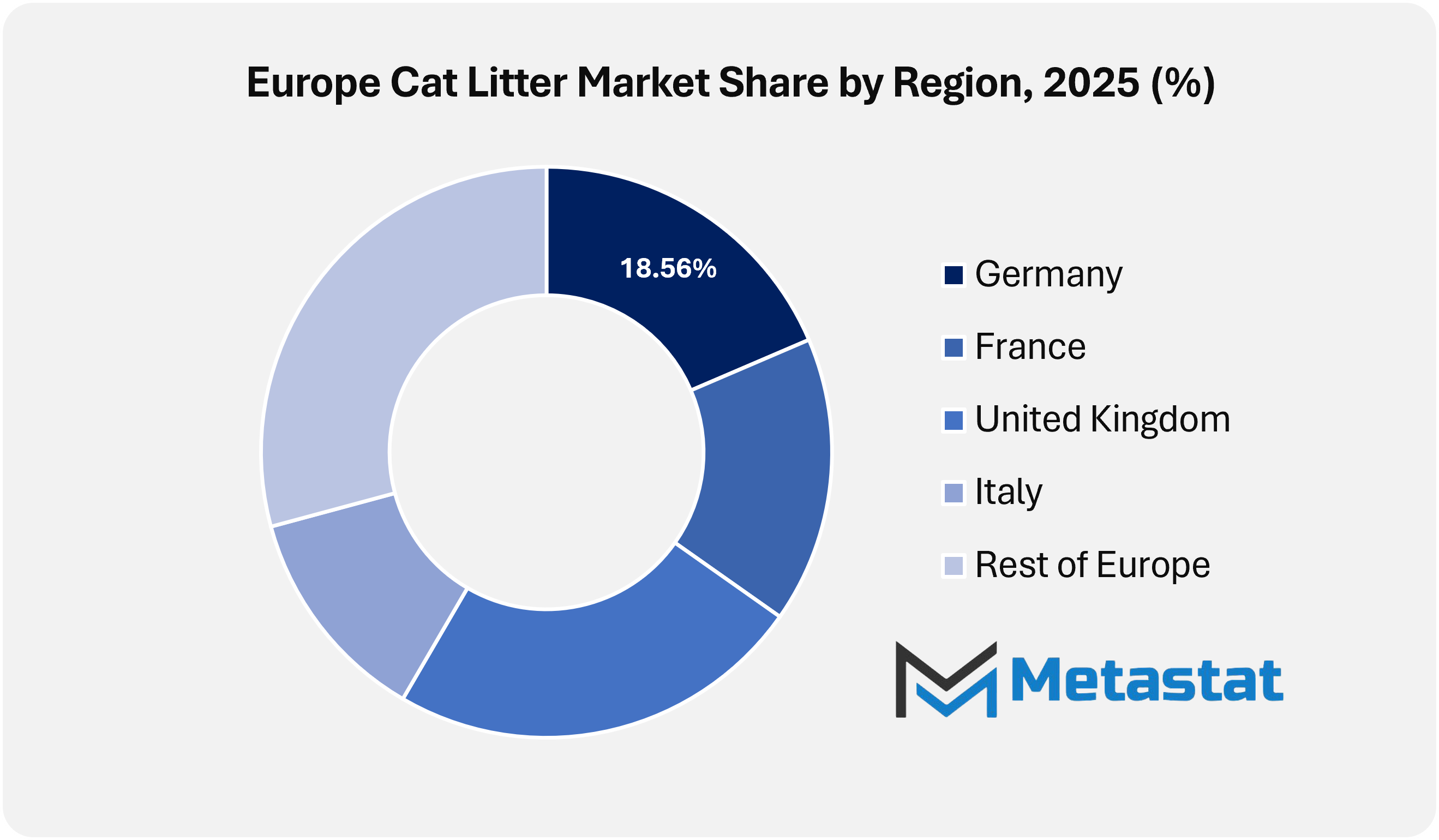
Competitive Landscape and Strategic Insights
The European cat litter market will continue to reflect changing pet care habits due to urban living and growing emotional attachment to companion animals. Cat ownership in European households will remain stable, driving continued demand for hygiene-focused products. Buyers are increasingly looking for materials associated with odour control, ease of disposal, and environmental awareness. Purchasing decisions will lean toward trusted brands with clear labelling and reliable performance rather than experimental options. Retail shelves and online platforms will showcase a balance between traditional clay-based products and new plant-based alternatives, supporting steady market movement.
Large multinational companies maintain a strong position due to wide distribution networks and established consumer confidence. Nestlé S.A. and Mars, Incorporated will benefit from brand identity built through long-term association in pet nutrition and care. The Clorox Company and Church & Dwight Co., Inc. will strengthen visibility through household familiarity and product consistency. Oil-Dri Corporation of America and Kent Corporation will maintain relevance through mineral expertise and manufacturing scale, supporting cost control while meeting regional quality standards.
Specialist brands will play an important role by addressing specific consumer needs, such as low dust, veterinary-backed formulas, or premium textures. Intersand and Dr. Elsey’s will appeal to pet owners by focusing on performance and comfort for sensitive cats. Pettex Limited and Land Energy Limited will support niche demand through locally focused offerings and alternative raw materials. Such players will influence purchasing patterns among consumers seeking differentiation beyond mass-market products, especially in urban centres where convenience and hygiene receive high priority.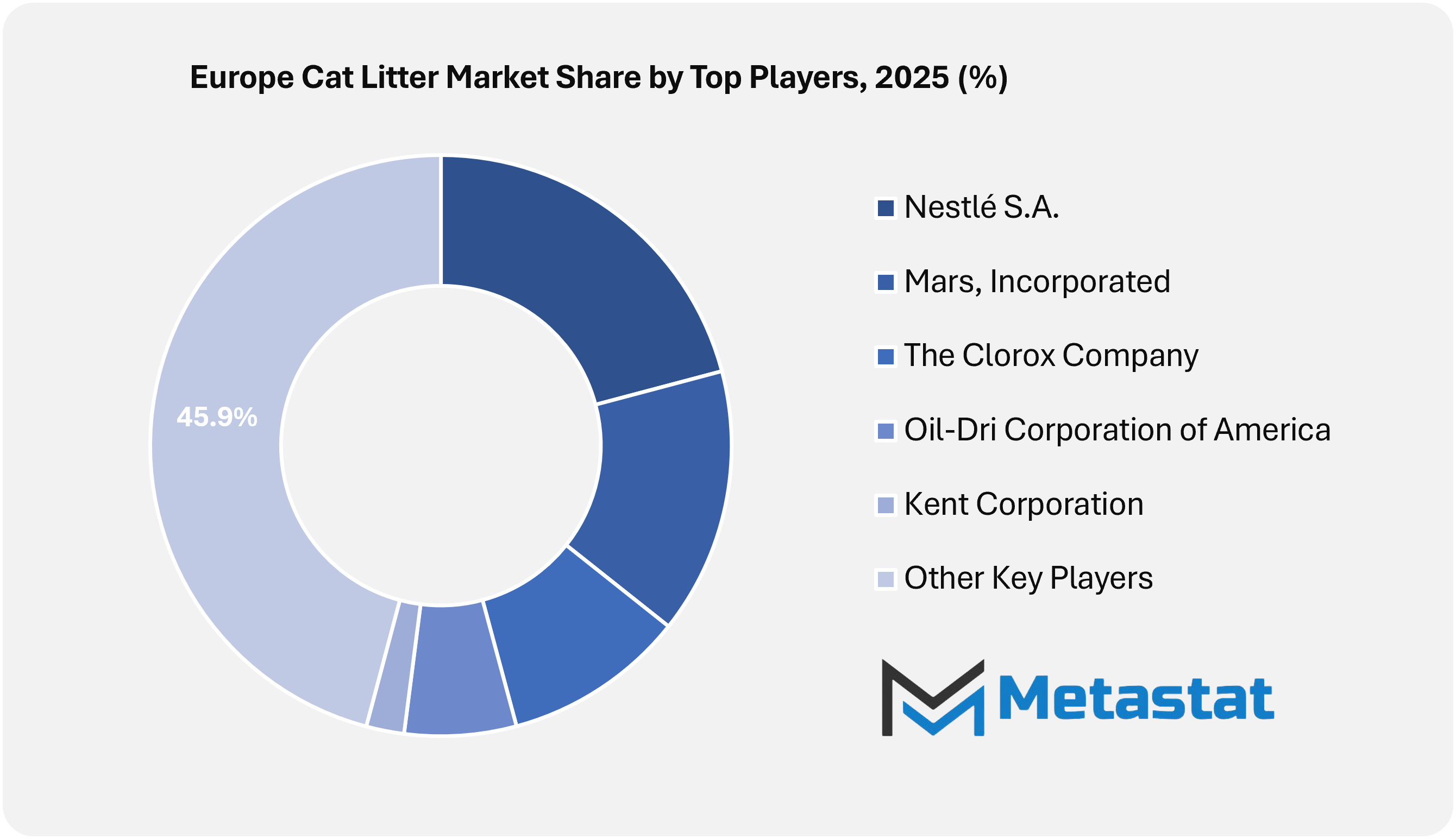
Innovation-driven companies will further shape the competitive dynamic by combining pet care with sustainability and lifestyle values. Brands will invest in biodegradable materials, better absorption technologies and packaging designed for easy storage and transportation. Price sensitivity will remain, although loyalty to products that deliver consistent results will increase. The Europe cat litter market will grow through a mix of established leaders and focused experts, creating a space where quality, trust and practicality will guide long-term growth.
Forecast and Future Outlook
Market size is forecast to rise from USD 6,069.6 million in 2025 to over USD 9,267 million by 2033.
Retail dynamics will shift toward curated selections offered through specialty pet stores and digital platforms, which will prioritize education-led shopping trips. Subscription-based replenishment models will become more sophisticated, addressing predictability in household consumption habits. Over time, the Europe cat litter market will position itself in the broader home care conversation, where pet ownership will seamlessly integrate with modern European living standards, shaping product direction through practicality, moderation and thoughtful design.
Cat Litter Market Key Segments:
By Product Type:
- Clumping
- Non-Clumping
By Raw Material:
- Clay
- Silica
- Others (Wood, Vegetal, Pellets)
By Distribution Channel:
- Specialized Pet Shops
- Internet Sales
- Hypermarkets
- Other Distribution Channels
Key Europe Cat Litter Industry Players
- Nestlé S.A.
- The Clorox Company
- Mars, Incorporated
- Oil-Dri Corporation of America
- Church & Dwight Co., Inc.
- Kent Corporation
- Intersand
- Elsey’s
- Land Energy Ltd.
- Pettex Limited
Report Coverage
This research report categorizes the Cat Litter market based on key segments and regions, forecasts revenue growth, and analyses trends in each submarket. The report analyses the key growth drivers, opportunities, and challenges influencing the Cat Litter market. Recent market developments and competitive strategies such as expansion, product launch, partnership, merger and acquisition have been included to outline the competitive landscape.
The report strategically identifies and profiles the key market players and analyses their core competencies in each sub-segment of the Cat Litter market.
|
Report Attributes |
Details |
|
Study Period |
2021-2033 |
|
Base Year |
2025 |
|
Estimated Year |
2026 |
|
Forecast Period |
2026-2033 |
|
Historical Period |
2021-2025 |
|
Growth Rate |
CAGR 5.4% from 2026 to 2033 |
|
Revenue Unit |
USD million |
|
Sales Volume Unit |
Kilotons |
|
Segmentation |
By Product Type, Raw Material, Distribution Channel, and Region |
|
By Product Type |
|
|
By Raw Material |
|
|
By Distribution Channel |
|
|
By Region |
Europe (By Product Type, Raw Material, Distribution Channel, and Country)
|
WHAT REPORT PROVIDES
- Full In-Depth Analysis of the Parent Industry
- Important Changes in Market and Its Dynamics
- Segmentation Details of the Market
- Former, On-Going, and Projected Market Analysis in Terms of Volume and Value
- Assessment Of Niche Industry Developments
- Market Share Analysis
- Key Strategies of Major Players
- Company Profiles of Key Players
- Unique Selling Propositions of Major Market Players
- Emerging Segments and Regional Growth Potential
- Key Strategic Recommendations
- Competitive Benchmarking
- Import Export Trade Statistics (Value and Volume)
Frequently Asked Questions
Find answers to common questions about this report
The Metastat Insight study shows that the Europe Cat Litter market size was USD 6,069.6 million in 2025.
The Europe Cat Litter market is likely to grow at a CAGR of 5.4% over the forecast period (2026-2033).
The Clumping is the leading type segment in the Europe market.
Rising cat ownership across urban households, supported by changing lifestyles and growing preference for companion animals, are key driving factors, boosting the market.
Europe Cat Litter market is estimated to reach USD 9,267 million by 2033.
Top players operating in the Cat Litter industry include Nestlé S.A., The Clorox Company, Mars, Incorporated, Oil-Dri Corporation of America, and Church & Dwight Co., Inc.
Choose Your License
Europe Cat Litter Market
Related Reports
Explore related market intelligence reports worth reading alongside this one.