
Global Digital Cross-Border Remittance Services Market
Global Digital Cross-Border Remittance Services Market Size, Share, By Transaction Channel (Provider Mobile Applications, Provider Web Platforms, Embedded/API-Enabled Partner Channels and Others (Messaging and USSD Interfaces)), By Funding Method (Bank Account / Account-to-Account Transfer, Debit Card, Credit Card and Digital Wallet / Mobile Payment, Stored-Value / Platform Balance), By Payout Method (Bank Account Deposit, Cash Pickup, Mobile Wallet / Mobile Money, Debit / Prepaid Card Deposit and Others (Home Delivery and Cardless ATM Cash-Out)), Industry Analysis, Growth, Trends, and Forecast, 2026-2033
MSI-5007
August 20, 2026
Updated
280 Pages
Historical
Base year
Forecast
Forecast period
Report Details
Comprehensive Market Analysis And Insights
Market Overview
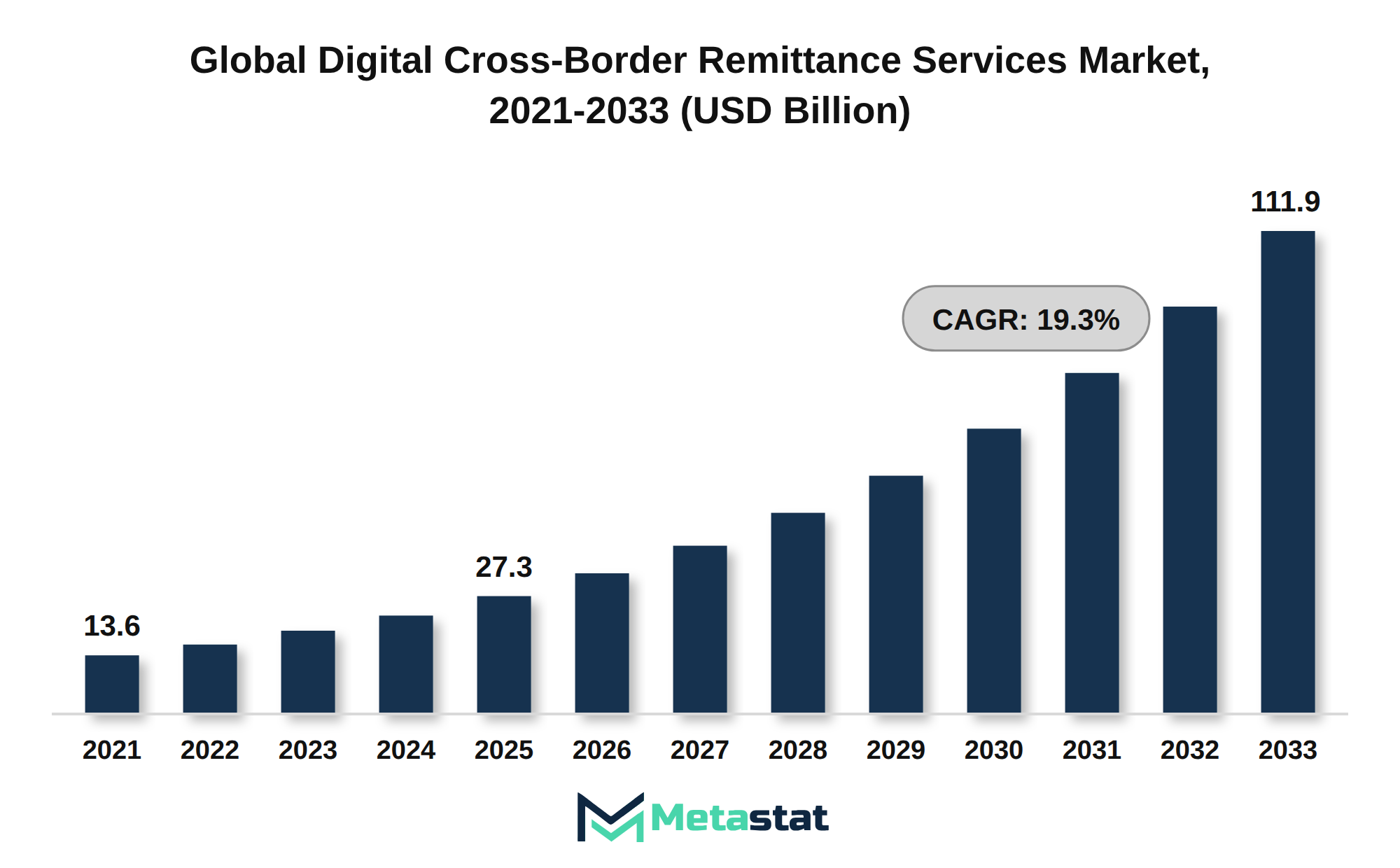
The global Digital Cross-Border Remittance Services market was valued at USD 27.3 billion in 2025 and is projected to reach USD 111.9 billion by 2033, growing at a CAGR of 19.3% over the forecast period.
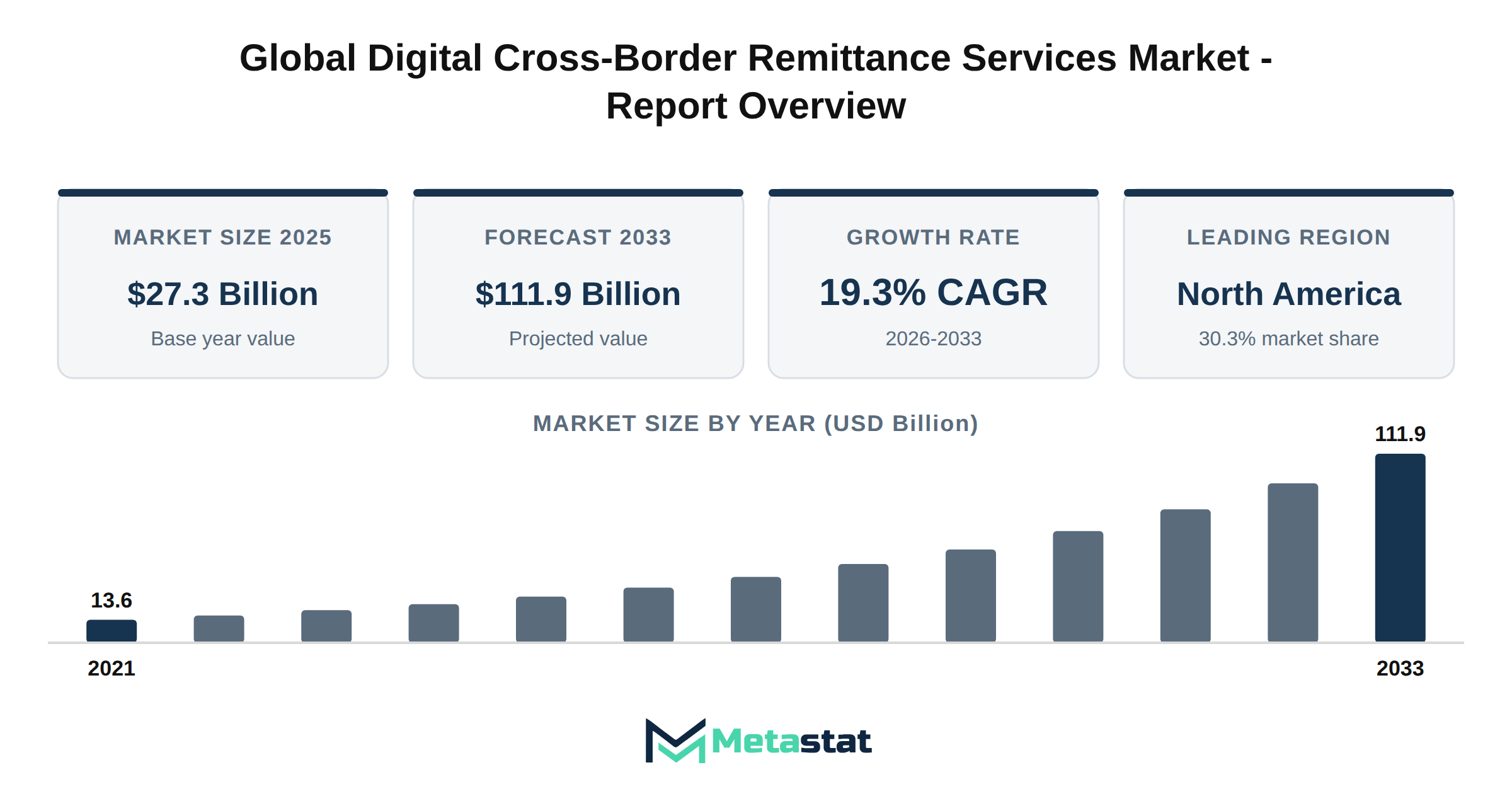
The Digital Cross-Border Remittance Services market reached USD 27.3 billion in 2025, reflecting significant growth from USD 13.6 billion in 2021. This upward trajectory demonstrates a compound annual growth rate (CAGR) of 19.3%, with expectations for the market to expand to USD 111.9 billion by 2033. Key drivers contributing to this growth include the increasing number of international workers and the rising demand for efficient and cost-effective remittance solutions.
High-volume remittance corridors exhibit significant economic activity, impacting transfer fees and foreign exchange spreads. Competitive pressure among service providers prompts continual adjustments in pricing, benefiting consumers through lower transaction costs. Integration of real-time payment rails enhances the speed and efficiency of transactions, responding to consumer demands for immediacy in fund availability.
Stablecoin-enabled remittance models show potential for reducing transaction costs and increasing efficiency in cross-border transfers. Regulatory compliance frameworks, including anti-money laundering (AML) and know your customer (KYC) protocols, play a critical role in maintaining consumer protection while building trust in the market. Enhancing digital identity verification processes contributes to fraud prevention measures, safeguarding users in an increasingly digital financial ecosystem.
Partnership and consolidation activity within the market indicates a trend towards creating more comprehensive service offerings. This consolidation enhances competitive positioning and broadens access to diverse funding and payout methods. The market reflects fragmentation, with numerous players competing for market share, stimulating innovation and adaptation to consumer preferences.
The Digital Cross-Border Remittance Services market experiences significant dynamics shaped by various economic factors. High-volume remittance corridors exhibit unique economics driven by the frequency and volume of transactions. Transfer fees and foreign exchange spreads serve because critical benchmarks, influencing consumer choices and service provider strategies. These economic elements create competitive pressures that impact pricing structures across the market.
Real-time payment rail integration stands out because a vital advancement, enabling faster transaction settlements and enhancing user experiences. This innovation drives increased adoption rates among consumers who prioritize immediacy in their remittance services. Stablecoin-enabled remittance models emerge because an alternative, offering potential for reduced transaction costs and improved liquidity in cross-border transactions.
Compliance with anti-money laundering (AML) and know-your-customer (KYC) regulations remains essential for market participants. These frameworks enhance consumer protection while ensuring the integrity of the remittance ecosystem. Fraud prevention and digital identity verification technologies are critical in safeguarding transactions, further enhancing user trust in the market.
Partnerships and consolidation activities among key players shape the competitive landscape, driving innovation and expanding service offerings. Regulatory compliance, standards, and geopolitical risk frameworks influence operational strategies and market positioning. Disruption in the market drives investments in research and development, leading to next-generation innovations that enhance service capabilities.
Sustainable transformation initiatives gain traction within the market, focusing on decarbonization efforts and the promotion of circular economy dynamics. These strategies align with evolving consumer preferences and regulatory expectations, positioning companies for long-term success. The intricacies of the supply chain landscape, logistics architecture, and sourcing dynamics illustrate the market's complexity.
Market fragmentation presents both challenges and opportunities, with mergers and acquisitions playing a crucial role in shaping the competitive environment. Understanding the value chain, procurement strategies, and customer journey dynamics is vital for market participants aiming to optimize their operations. Capital allocation and infrastructure investments emerge because key considerations, influencing future growth trajectories.
Macroeconomic headwinds, including inflationary pressures and currency volatility, affect market performance and consumer behavior. The strategic outlook for the Digital Cross-Border Remittance Services market hinges on a thorough analysis of these factors, alongside corporate imperatives aimed at driving innovation and efficiency. High-value recommendations for stakeholders focus on leveraging market opportunities while navigating the complexities of the evolving landscape.
Market Dynamics
Digital transformation fuels remittance growth
The Digital Cross-Border Remittance Services market experiences growth driven by advancements in digital transformation. Increased adoption of mobile applications and web platforms enhances transaction channels, streamlining the remittance process for consumers and businesses. Enhanced user experiences and improved security features attract digitally savvy customers, resulting in increased transaction volumes.
Investment in technological integration, including automation and artificial intelligence, significantly enhances operational efficiency. This integration reduces processing times and operational costs, benefiting service providers and end-users. The heightened focus on optimizing user experiences aligns with evolving consumer behaviors, particularly among younger demographics who prioritize convenience and speed in financial transactions.
Continued investment in digital infrastructure supports the market's expansion, enabling cross-border remittances to seamlessly connect diverse regions. This infrastructure development enhances access to payment channels, facilitating increased participation in the global economy. The market is projected to reach a value of USD 111.9 billion by 2033.
Macroeconomic factors drive remittance expansion
The Digital Cross-Border Remittance Services market experiences significant growth driven by favorable macroeconomic conditions. Economic indicators including GDP growth, rising disposable incomes, and urbanization enhance demand for cross-border remittances. Increased venture funding and public-private spending power contribute to an environment that supports financial technology innovations, improving the remittance process. Growth in international trade and improved trade corridors create opportunities for businesses and individuals to engage in cross-border transactions, thereby boosting market expansion.
The impact of shifting demographic patterns influences consumer behaviors within the market. An aging population, particularly in developed economies, leads to increased remittance flows from younger generations supporting family members abroad. Lifestyle changes and evolving buying preferences influence how consumers engage with digital remittance solutions. Enhanced convenience and accessibility drive adoption, enabling easy transactions across borders.
Technological integration and automation further enhance operational productivity and cost efficiency within the Digital Cross-Border Remittance Services market. The adoption of artificial intelligence and automation tools simplifies processes, reduces operational costs, and improves transaction speeds. Digital wallets and mobile payment methods facilitate instant transfers, aligning with consumer preferences for fast and convenient services. These developments contribute to a competitive market environment that encourages continued investment and innovation, ultimately driving growth.
Regulatory pressures hinder market growth
In the Digital Cross-Border Remittance Services market, regulatory pressures significantly impact operational flexibility and compliance costs. Increasingly stringent legal mandates impose burdens on service providers, resulting in heightened costs associated with compliance and potential penalties for non-adherence. Evolving regulations create challenges for companies in ensuring their services align with diverse legal frameworks across various regions. This complexity contributes to a slowdown in market expansion.
Macroeconomic headwinds impede growth prospects. Factors including inflationary pressures and geopolitical instability create an uncertain economic environment, affecting consumer confidence and spending on remittance services. The market experiences fluctuations in demand, particularly in regions heavily reliant on remittances for economic stability. This variability complicates long-term planning for service providers.
Infrastructure gaps further exacerbate challenges within the market. Insufficient technological infrastructure and connectivity deficits in certain regions hinder transaction processing. Deployment bottlenecks arise, delaying the introduction of innovative services and limiting market penetration. The need for significant capital investment in technology and infrastructure strains resources, impacting smaller players attempting to compete effectively.
Data security vulnerabilities and privacy concerns remain critical issues for the Digital Cross-Border Remittance Services market. Service providers face increasing scrutiny regarding the protection of sensitive customer information, necessitating investments in robust cybersecurity measures. Inadequate responses to these vulnerabilities could lead to reputational damage and loss of customer trust, ultimately affecting market growth.
The combination of regulatory pressures, macroeconomic challenges, infrastructure inadequacies, and security concerns creates a complex environment for the Digital Cross-Border Remittance Services market. These factors contribute to a restrained growth trajectory, affecting both the viability of existing players and the entry of new competitors.
Geopolitical fragmentation impacts remittance services
The Digital Cross-Border Remittance Services market faces challenges due to geopolitical fragmentation, which disrupts established financial flows and creates uncertainty for consumers and providers. Political tensions among nations lead to varying regulatory environments, complicating cross-border transactions. This fragmentation influences trade deficits and tariff friction, impacting the cost and efficiency of remittance services.
Technological disruptions further complicate the market landscape. Innovations in payment processing and the emergence of alternative financial technologies create both opportunities and pressures for traditional remittance providers. Interoperability friction among different platforms and technologies hampers transactions, leading to delays and increased costs for end users.
Economic factors including rising input costs and pricing compression contribute to margin pressures within the market. Increased competition from digital wallet services and peer-to-peer transfer platforms intensifies these pressures, forcing established players to adapt their pricing strategies. Workforce skill gaps and automation displacements challenge providers in meeting evolving consumer expectations and maintaining operational efficiency.
In addition, environmental sustainability demands influence market dynamics. Companies face mounting pressure to align with decarbonization mandates while managing their environmental lifecycle footprints. These sustainability requirements lead to increased operational costs, which are passed on to consumers, thereby affecting demand for remittance services.
Overall, the Digital Cross-Border Remittance Services market navigates a complex landscape shaped by geopolitical fragmentation, technological disruptions, economic pressures, and sustainability demands, necessitating strategic adaptations from providers to maintain competitive advantage.
Emerging Technologies Propel Remittance Innovation
The Digital Cross-Border Remittance Services market experiences significant growth driven by emerging technologies that enhance user experience and streamline transaction processes. The rise of mobile applications and web platforms increases accessibility for users, particularly in regions with limited banking infrastructure. Such technological advancements support the integration of digital wallets and mobile payments, facilitating faster and more efficient transfers.
Geographical expansion into developing markets creates significant opportunities for service providers. Access to reliable internet and mobile networks stimulates demand for digital remittance solutions, especially in South America and Southeast Asia. This expansion allows companies to tap into previously underserved populations, driving revenue growth and increasing market share.
Next-generation innovations, including blockchain technology, enhance security and transparency in transactions. These advancements address consumer concerns regarding fraud and transaction delays, building trust in digital cross-border remittance services. Increased adoption rates among users contribute to a positive outlook for the market.
Sustainability imperatives influence the industry, prompting companies to align operations with eco-friendly practices. Consumers increasingly prefer service providers that prioritize environmental, social, and governance (ESG) criteria, pushing companies to adapt their strategies accordingly. This alignment creates new market segments focused on sustainable and responsible remittance solutions.
The combination of technological disruptions, geographical expansion, and sustainability initiatives shapes the future trajectory of the Digital Cross-Border Remittance Services market. The continuous evolution of user preferences and digital procurement shifts encourages service providers to innovate and diversify their offerings, leading to enhanced market competitiveness.
Market Segmentation Analysis
The Global Digital Cross-Border Remittance Services market is segmented based on Transaction Channel, Funding Method, and Payout Method.
By Transaction Channel, the market is further segmented into:
- Provider Mobile Applications
- Provider Web Platforms
- Embedded/API-Enabled Partner Channels
- Others (Messaging and USSD Interfaces)
Provider Mobile Applications
Valued at USD 15.4 billion in 2026, the Provider Mobile Applications segment is projected to reach USD 53.2 billion by 2033, at a CAGR of 19.4% during the forecast period. Adoption of mobile applications for remittance services results from increasing smartphone penetration and rising digital literacy across various demographics. Consumers prefer the convenience and speed provided by mobile applications compared to traditional methods, influencing the overall market dynamics.
The segment expansion is supported by continuous technological advancements, including enhanced security measures and improved user experiences. Financial technology companies invest heavily in next-gen upgrades that facilitate real-time transactions and improve the customer journey. Such innovations attract a wider user base and contribute to the overall growth trajectory of the Digital Cross-Border Remittance Services market.
Changing consumption patterns indicate a significant shift toward digital channels for remittances. Many users prioritize low fees, ease of use, and fast transaction times, with mobile applications often fulfilling these demands efficiently. These shifts highlight the importance of adapting to evolving consumer preferences.
Regulatory compliance remains a critical factor influencing the segment. Financial institutions operating within this space face stringent requirements that ensure consumer protection and prevent fraud. Meeting these compliance standards involves ongoing investments in technology, impacting cost structures and pricing strategies.
Raw material sourcing plays a role in influencing pricing volatility within the segment. Companies face pressures related to operational costs, including technology maintenance and development. Strategic opportunity windows exist due to firms leveraging innovative solutions to differentiate their offerings, enhancing competitive positioning in the market.
Provider Web Platforms
Rapid advancements in digital technology drive significant growth in the Provider Web Platforms segment of the Digital Cross-Border Remittance Services market. The increasing adoption of online platforms for money transfers reflects a shift in consumer behavior towards digital solutions. Factors including convenience, lower transaction fees, and improved user experiences contribute to this trend. The ability to access services via various devices, including smartphones and computers, enhances user engagement and expands the customer base.
The Provider Web Platforms segment is estimated to reach USD 36.5 billion by 2033, at a CAGR of 18.3% during the forecast period. Enhanced security features and regulatory compliance further increase customer confidence, enabling more users to embrace these platforms for international money transfers. A growing number of financial institutions and fintech companies invest in innovative features, including real-time tracking and personalized customer support, fueling competitive dynamics within the market.
Investment in technology and infrastructure establishes the foundation for growth in this segment. The demand for integrations with other financial services, including banking and payment solutions, enables providers to offer comprehensive services that cater to diverse consumer needs. Ongoing efforts to streamline user interfaces contribute to improved customer satisfaction and retention.
The environment of the Digital Cross-Border Remittance Services market continues to evolve, with the Provider Web Platforms segment leading this transformation. While more users recognize the advantages of digital platforms, significant opportunities arise for growth and innovation. The competitive environment intensifies, with both established players and new entrants seeking to capture market share through enhanced offerings and strategic partnerships.
Embedded/API-Enabled Partner Channels
In the Digital Cross-Border Remittance Services market, the Embedded/API-Enabled Partner Channels segment is expected to reach USD 19.9 billion by 2033. Several factors drive growth in this segment, including an increasing demand for integration of payment solutions within existing platforms. Businesses actively seek to enhance customer experiences by providing quick and reliable remittance services directly through their applications, which encourages adoption among users.
Technological maturation influences the expansion of Embedded/API-Enabled Partner Channels. Innovations in API technology, including improved security features and transaction speed, encourage service providers to integrate these solutions into their offerings. This trend allows businesses to offer a wider range of financial services, meeting diverse consumer needs and increasing competition in the market.
Regulatory compliance standards impact the development of this segment. Governments around the world implement stringent regulations to ensure transparency and protect consumers, which influences how service providers design their applications and channels. This shift toward compliance necessitates investment in technology and infrastructure, ultimately affecting cost structures and pricing strategies within the market.
Strategic opportunity windows arise due to businesses recognizing the potential for Embedded/API-Enabled Partner Channels to disrupt traditional remittance methods. The ongoing digital transformation fuels interest in alternative funding methods and payout options, leading to increased investment in this segment. This results in a dynamic environment where businesses adapt to consumer preferences, ensuring continued growth within the Digital Cross-Border Remittance Services market.
Others (Messaging and USSD Interfaces)
Growing consumer preferences for convenient and efficient remittance solutions drive significant interest in the Others (Messaging and USSD Interfaces) segment within the Digital Cross-Border Remittance Services market. These platforms facilitate easy transactions by leveraging existing messaging applications and USSD technology, appealing to users in regions with limited access to traditional banking services. Increased smartphone penetration and improved internet connectivity are supporting the adoption of messaging-based platforms, enhancing user experience and transaction speed.
Investments in technological enhancements further support the segment's growth. Providers focusing on user-friendly interfaces and integration with existing messaging applications create an attractive proposition for users. Evolving regulatory compliance standards accommodate innovative financial technologies, enabling market players to expand their offerings while maintaining user trust. In a landscape characterized by rapid shifts in consumer behavior and technological advancements, this segment is projected to grow at a CAGR of 14.7% during the forecast period.
Market players investing in strategic partnerships with messaging platforms strengthen their service offerings. These collaborations facilitate wider reach and improve service reliability, positioning companies to capitalize on emerging opportunities in the remittance space. While the Digital Cross-Border Remittance Services market evolves, the Others (Messaging and USSD Interfaces) segment reflects broader trends of digital transformation and consumer demand for accessible financial solutions.
By Funding Method, the market is further segmented into:
- Bank Account / Account-to-Account Transfer
- Debit Card
- Credit Card
- Digital Wallet / Mobile Payment
- Stored-Value / Platform Balance
Bank Account / Account-to-Account Transfer
Valued at USD 11.1 billion in 2026, the Bank Account / Account-to-Account Transfer segment is projected to reach USD 38.4 billion by 2033, at a CAGR of 19.4% during the forecast period. This segment benefits from increasing consumer demand for easy money transfers, driven by the rise in cross-border transactions. The adoption of digital platforms enhances user experience while improving transaction speed and security, attracting a broader audience to these services.
Technological advancements play a vital role in segment expansion. Innovations in mobile banking and real-time payment systems streamline the transfer process, reducing reliance on traditional banking methods. Regulatory compliance and the establishment of certifications for digital services enhance trust among users, contributing to the segment's growth.
A shift in consumer preferences towards digital transactions influences the market landscape. Younger demographics exhibit a strong inclination towards using mobile applications for money transfers, pushing providers to invest in user-friendly interfaces and functionalities. The competitive environment encourages innovation, with firms introducing next-gen upgrades and enhanced product offerings to capture greater market share.
Cost structures associated with transactions remain favorable due to increased automation and reduced operational expenses. This efficiency enables service providers to offer competitive pricing, thus attracting more users. The Digital Cross-Border Remittance Services market anticipates continued growth, driven by these factors and the expansion of the segment.
Debit Card
Growth in the Debit Card segment of the Digital Cross-Border Remittance Services market stems from the increasing preference for digital payment solutions. Consumers prioritize convenience and speed, opting for debit cards due to their secure method for transferring funds across borders. This trend reflects broader changes in consumer behavior, with increasing reliance on digital platforms for financial transactions.
The segment is estimated to reach USD 28.5 billion by 2033, at a CAGR of 18.5% during the forecast period. This growth signals a significant shift in how individuals engage with remittance services, resulting from their embrace of options that provide immediate access to funds and lower transaction fees. Financial institutions and service providers respond by enhancing their offerings, ensuring compatibility with various digital wallets and payment platforms.
Technological maturation drives this expansion, with innovations that streamline the user experience. Enhanced security measures and user-friendly applications boost confidence among consumers, facilitating greater adoption of debit card transactions in remittances. Consequently, this segment attracts investment, leading to further advancements in payment technologies, which reinforce its competitive position within the market.
Regulatory compliance remains a critical factor for growth. While markets evolve, regulatory frameworks adapt to accommodate new digital payment methods. Compliance with these standards ensures that service providers maintain operational integrity and consumer trust. This dynamic establishes a favorable environment for the Debit Card segment, promoting its expansion within the broader digital remittance landscape.
Credit Card
Growth in the Credit Card segment of the Digital Cross-Border Remittance Services market stems from increasing consumer demand for efficient transaction experiences. Many users favor credit cards for international remittances owing to the convenience and security they provide. This preference aligns with broader trends toward digital payment solutions that simplify cross-border transactions.
Primary demand drivers include the rise of e-commerce and globalization, leading individuals and businesses to seek efficient payment methods for international transactions. The integration of advanced technologies in financial services enhances the user experience, attracting more customers to credit card options for remittances.
By 2033, the Credit Card segment is expected to reach USD 13.1 billion. This growth reflects the ongoing evolution of payment methods and consumer adoption of credit cards because a reliable funding option for remittances. The segment's expansion is further supported by partnerships between financial institutions and remittance service providers, allowing for improved access to services across various regions.
Regulatory compliance shapes the Credit Card segment. Adherence to international standards ensures the security and efficiency of cross-border transactions, building consumer trust. While financial regulations evolve, companies in the market adapt their offerings to meet new requirements, thus maintaining competitive positioning.
Technological advancements contribute significantly to the segment's growth. Innovations including mobile wallet integration and enhanced security features increase the appeal of credit card transactions for remittances. Firms investing in next-gen upgrades and technological maturation position themselves favorably within the market, capturing a larger share because consumer preferences shift towards digital solutions.
Digital Wallet / Mobile Payment
Growth in the Digital Wallet / Mobile Payment segment emerges from rising consumer interest in digital solutions for remittances. Factors driving this trend include increased smartphone penetration and user-friendly mobile applications that simplify the transaction process. Younger demographics, particularly digital natives, embrace mobile payments due to their convenience and speed, resulting in a shift toward digital channels for remittances. This segment is projected to grow at a CAGR of 20.9% during the forecast period.
Adoption of digital wallets aligns with broader technological advancements. Innovations in security protocols, including biometric authentication and end-to-end encryption, enhance user trust in mobile payment platforms. Regulatory compliance standards catering to user protection further reinforce the growth trajectory of this segment. While the market continues to evolve, partnerships between traditional financial institutions and tech companies are expected to expand, leading to an increase in service offerings and consumer choice.
The Digital Cross-Border Remittance Services market sees increasing competition among providers, which drives continuous product evolution. New features, including instant transfers and competitive exchange rates, emerge to meet customer expectations. Strategic opportunity windows arise for companies investing in next-gen upgrades and enhancing user experience. Overall, the digital wallet and mobile payment segment is expected to play a crucial role in shaping the future of cross-border remittance services.
Stored-Value / Platform Balance
Adoption of the Stored-Value / Platform Balance segment reflects a response to increasing consumer demand for efficient remittance options. Significant drivers include the rising number of digital wallets and the popularity of mobile payment platforms, which simplify the process of sending and receiving funds across borders. The ease of access to stored-value services encourages users to opt for digital solutions over traditional banking methods, enhancing the competitive edge of this segment within the Digital Cross-Border Remittance Services market.
The evolution of technology supports advancements in this segment, leading to the integration of features that improve user experience, including instant transfers and enhanced security measures. Innovations in blockchain and distributed ledger technology further strengthen the appeal of stored-value systems, facilitating faster transactions at lower costs. This technological maturation attracts a broader consumer base, contributing to market expansion.
Regulatory compliance remains a critical factor impacting the segment. Adhering to standards set by financial authorities ensures that service providers maintain consumer trust and operate within legal frameworks. This compliance not only safeguards users but enhances the credibility of the offerings in the market.
Competition among key players drives continuous improvement in service offerings, leading to better pricing structures and value propositions. Capital investment in technology and infrastructure by companies specializing in stored-value solutions positions them favorably to capture a larger market share. Strategic opportunity windows arise owing to shifts in consumer preferences towards digital transactions, with stored-value services ready to meet these evolving demands.
By Payout Method, the market is further segmented into:
- Bank Account Deposit
- Cash Pickup
- Mobile Wallet / Mobile Money
- Debit / Prepaid Card Deposit
- Others (Home Delivery and Cardless ATM Cash-Out)
Bank Account Deposit
Valued at USD 12.4 billion in 2026, the Bank Account Deposit segment is projected to reach USD 41.4 billion by 2033, at a CAGR of 18.8% during the forecast period. Increased adoption of digital banking services across various demographics contributes to this growth, particularly driven by consumers increasingly preferring convenient and secure transaction methods. The rise of e-commerce and international trade further drives demand for reliable remittance solutions, leading to higher utilization of bank account deposits for cross-border transactions.
Technological advancements serve because critical catalysts for segment expansion, enabling enhanced customer experiences through improved user interfaces and faster transaction processing times. Financial institutions are investing in next-generation upgrades, deploying advanced security measures to build consumer trust and ensure compliance with regulatory standards. This focus on security is particularly vital in an environment where consumers prioritize data privacy and protection against fraud.
Downstream application trends indicate a shift in consumption patterns, with businesses and individuals increasingly favoring bank account deposits due to their convenience and lower costs compared to traditional methods. Regulatory compliance standards continue to evolve, prompting businesses to adapt their operations to meet new requirements, further enhancing the attractiveness of this payout method. The market's competitive landscape will likely benefit from ongoing capital investments aimed at refining service offerings and expanding market reach, reinforcing bank account deposits because a preferred option in the Digital Cross-Border Remittance Services market.
Cash Pickup
Significant growth characterizes the Cash Pickup segment within the Digital Cross-Border Remittance Services market. This segment is projected to reach USD 28.1 billion by 2033, at a CAGR of 16.9% during the forecast period. Increasing remittance flows from migrant workers to their home countries drive demand for cash pickup services. This approach offers flexibility for recipients who prefer cash transactions over digital alternatives, particularly in regions with limited banking access.
Technological advancements in mobile and internet connectivity enhance the capabilities of cash pickup services, facilitating user-friendly interfaces for both senders and receivers. Improved operational efficiencies among service providers, coupled with strategic partnerships with local agents, contribute to expanding cash pickup networks. Regulatory compliance and consumer trust in these methods are essential for market growth, creating a secure environment for transactions.
Changing consumer preferences reflect a shift towards cash pickup, particularly in developing economies. Many consumers favor the immediacy and accessibility of cash transactions, further cementing the importance of this segment within the broader remittance landscape. While service providers adapt to these trends, the market is projected to experience robust developments, ensuring that cash pickup remains a preferred choice among users seeking reliable remittance solutions.
Mobile Wallet / Mobile Money
Growth in the Mobile Wallet / Mobile Money segment reflects a strong shift towards digital financial solutions, driven by increasing smartphone penetration and enhanced internet connectivity. Consumers seek instant remittance options, positioning mobile wallets because a preferred choice in the Digital Cross-Border Remittance Services market. The segment is expected to reach USD 31.5 billion by 2033.
Technological maturation within mobile payment platforms ensures robust security measures and user-friendly interfaces, leading to higher adoption rates. Financial institutions and fintech companies invest in next-gen upgrades to enhance functionality, contributing to market expansion. Strategic opportunities arise because businesses explore partnerships with telecommunications firms, further integrating payment capabilities into everyday mobile services.
Shifts in consumer behavior towards cashless transactions increase demand, aligning with global trends advocating for efficient and traceable remittance methods. Compliance with regulatory standards facilitates smoother market entry for new participants, ensuring consumer protection and building trust in mobile money solutions.
Competition within the sector intensifies because multiple providers innovate to capture market share. Players focus on offering lower transaction fees and competitive exchange rates, enhancing profitability while maintaining customer loyalty. The overall environment demonstrates substantial growth potential through continuous technological advancements and evolving consumer preferences, reinforcing the importance of the Mobile Wallet / Mobile Money segment in the broader Digital Cross-Border Remittance Services market.
Debit / Prepaid Card Deposit
Increasing acceptance of digital financial solutions drives growth in the Debit / Prepaid Card Deposit segment within the Digital Cross-Border Remittance Services market. Consumers increasingly prefer the convenience and speed of cashless transactions, contributing to a significant uptick in usage. Debit and prepaid card options offer efficient remittance services, appealing to users who prioritize accessibility and streamlined processes. This segment is projected to grow at a CAGR of 19.6% during the forecast period.
Technological advancements enhance user experience by integrating features including instant transfers and user-friendly interfaces. Financial institutions and remittance service providers focus on developing secure and efficient platforms to cater to the evolving needs of consumers. Continued competition in the market pushes organizations to innovate their service offerings, further fueling adoption rates.
Regulatory compliance standards impact operational strategies, driven by firms adapting to varying regional requirements. Adhering to these standards ensures trust and reliability among users, which ultimately leads to increased market penetration. The segment’s growth aligns with the broader trends in the Digital Cross-Border Remittance Services market, reflecting the ongoing shift towards digital financial solutions.
Others (Home Delivery and Cardless ATM Cash-Out)
Consumer demand for remittance services increasingly shifts toward innovative payout methods including home delivery and cardless ATM cash-out options. This trend results from the growing need for convenience and accessibility among users, particularly those in regions where traditional banking services remain limited. Enhanced customer experiences drive the adoption of these solutions, allowing recipients to access funds in a manner that aligns with their lifestyle and preferences.
Technological advancements contribute to segment expansion, with providers integrating next-generation features into their offerings. Enhanced security measures and the ability to facilitate real-time transactions increase user confidence and broader acceptance in the market. In addition, partnerships with local service providers create robust ecosystems that improve the effectiveness of home delivery and cardless ATM cash-out services.
Regulatory compliance remains a focal point, shaping the operational landscape for this segment. Adhering to standards ensures that service providers maintain trust and reliability among users while navigating potential market challenges. The segment's evolution will benefit from ongoing investments in technology and infrastructure, positioning it well for future growth within the Digital Cross-Border Remittance Services market.
By Region
Based on geography, the Global Digital Cross-Border Remittance Services market is divided into North America, Europe, Asia-Pacific, South America, Middle East, and Africa.
North America
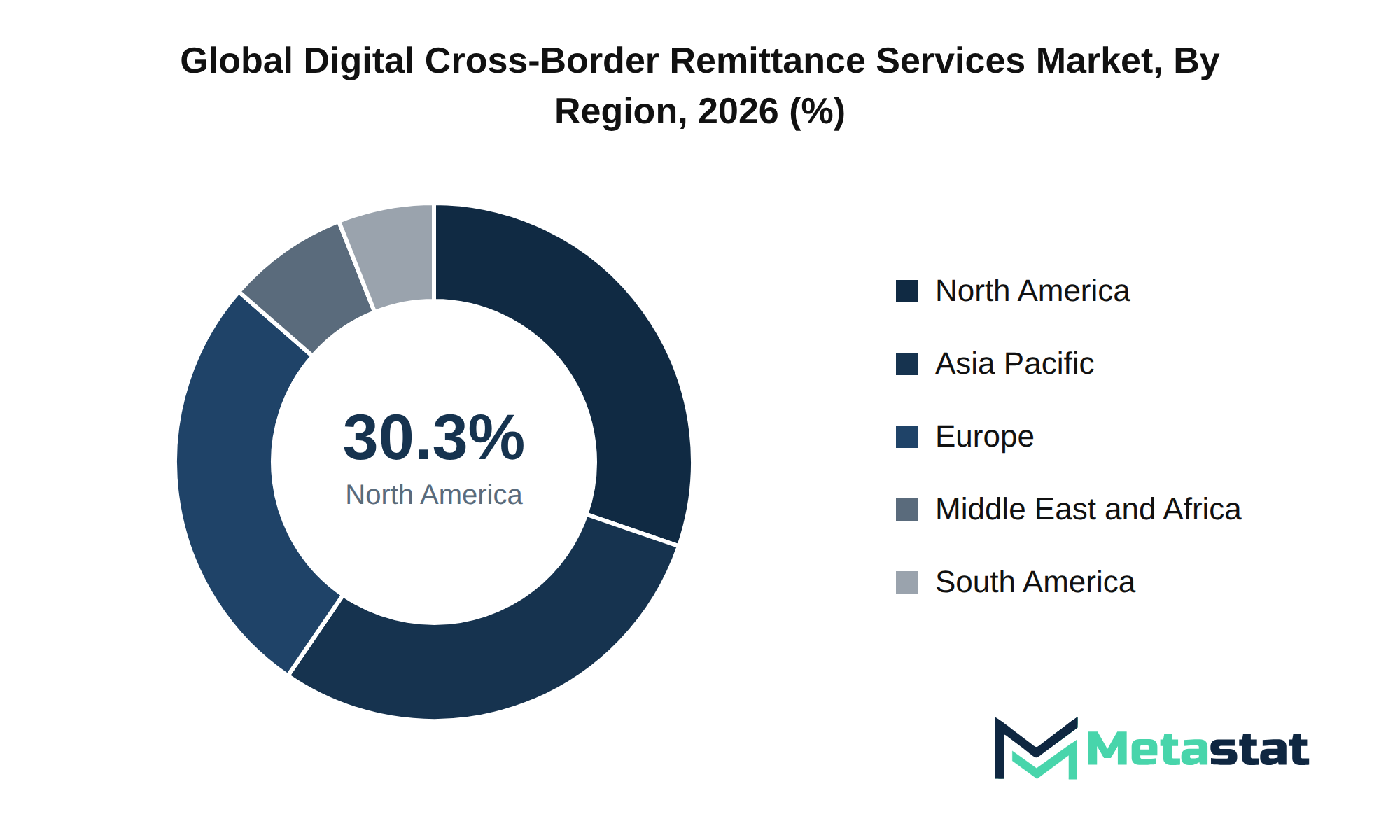
North America has established itself because a significant player in the Digital Cross-Border Remittance Services market, with a projected market size of USD 31.5 billion by the end of 2033, reflecting a CAGR of 19.3% throughout the forecast period. The region's share of the global market reached 30.3% in 2025, highlighting its importance in cross-border financial transactions.
Demand for remittance services in North America is driven by a combination of high migration rates and a strong expatriate community, particularly in the United States, Canada, and Mexico. The increasing reliance on mobile applications and digital platforms for remittance transactions enhances user experience and operational efficiency, contributing to rapid adoption rates across demographics.
Technological advancements and the proliferation of internet access have positioned North America because a leader in digital remittance solutions. A growing number of service providers are investing in embedded and API-enabled partner channels to streamline transactions and improve customer engagement. This trend influences the expansion of various segments within the market, including Provider Mobile Applications and Provider Web Platforms.
Regulatory frameworks in the region play a crucial role in shaping market dynamics, ensuring compliance and security in cross-border transactions. The competitive landscape features established players alongside innovative fintech solutions, creating a diverse ecosystem that addresses both consumer needs and compliance mandates.
Infrastructure modernization and localized manufacturing densities further enhance the region's capability to provide efficient remittance services. Strategic initiatives aimed at nearshoring and localized procurement are expected to drive the market's growth, increasing investments and enhancing service delivery across North America.
Europe
Europe represents a significant portion of the Digital Cross-Border Remittance Services market. Countries including Germany, France, the UK, Italy, Spain, and Russia display diverse consumer preferences and regulatory environments that influence market dynamics. Increasing cross-border trade and the demand for efficient remittance solutions drive growth in this region.
High-value replacement cycles and a shift towards digital financial services enhance the competitive landscape in Europe. Local compliance mandates drive the need for service providers to adapt their offerings, aligning with geographic regulatory frameworks. The presence of domestic market leaders creates a robust ecosystem for innovation and service delivery.
Emerging technologies in localized manufacturing and infrastructure modernization contribute to market expansion. Geopolitical fragmentation prompts strategic entry barriers that shape competitive strategies. Foreign direct investment flows into the region support the growth of remittance platforms, with localized procurement dynamics addressing unique consumer needs. The evolving landscape of the Digital Cross-Border Remittance Services market positions Europe because a key player in the global context.
Asia-Pacific
Asia-Pacific represents a significant portion of the Digital Cross-Border Remittance Services market, contributing 29.3% of the global market in 2025. This region demonstrates strong growth potential driven by increasing mobile penetration, evolving digital payment preferences, and a large immigrant population that relies on remittance services. Countries including China, India, and Southeast Asia are leading this expansion, demonstrating high adoption rates of mobile applications and digital wallets for remittance transactions.
Infrastructure modernization enhances service delivery and accessibility. Countries within the region are investing in digital infrastructure, which enables faster and more secure transactions. The rise of embedded and API-enabled partner channels supports integration with local payment systems, further boosting market participation. Emerging market front-runners, including India and Southeast Asia, exhibit dynamic growth patterns, driven by favorable regulatory frameworks and supportive government policies aimed at promoting digital financial services.
Localized procurement dynamics and cultural nuances influence consumer preferences in the market. Financial literacy initiatives and targeted marketing campaigns have encouraged wider adoption among users unfamiliar with digital remittance channels. Regional B2B buying behaviors reflect a shift toward integrated platforms that facilitate cross-border transactions, creating new opportunities for service providers.
The competitive landscape highlights domestic market participants, including MoneyGram International, The Western Union Company, and PayPal Holdings (Xoom), who are actively expanding their services to cater to regional demands. Vendor consolidation trends emerge owing to companies seeking to enhance their market positions through partnerships and acquisitions, further strengthening their presence in the Digital Cross-Border Remittance Services market.
South America
South America represents a niche segment within the Digital Cross-Border Remittance Services market, capturing 6.00% of the global market share in 2025. The region, with Brazil and Argentina leading the market, experiences unique challenges and opportunities. Brazil, serving because the largest market, benefits from its diverse economy and infrastructural developments that enhance accessibility to digital remittance solutions.
Argentina's economic fluctuations drive demand for remittance services, because households increasingly rely on international transfers for stability. The presence of several emerging players in the region indicates a competitive landscape that stimulates innovation and service diversity. Investments in technology and infrastructure modernization improve service delivery and efficiency, supporting the overall growth of the market.
Localized procurement dynamics play a crucial role in shaping market strategies, because vendors adapt to cultural nuances and consumer preferences. The market's incremental growth vectors highlight emerging trends, including the adoption of digital wallets and mobile payments, which connect with the tech-savvy population. With strategic entry barriers gradually lowering, foreign direct investment flows are expected to enhance the market further, leading to improved cross-border trade corridors.
Middle East and Africa
Saudi Arabia, UAE, and South Africa play essential roles in the Digital Cross-Border Remittance Services market. The region is marked by a strong growth trajectory, driven by increasing expatriate populations sending remittances back home. Infrastructure modernization efforts, particularly in financial technology, enable more efficient transactions and enhance service delivery in the region. Countries in the Middle East and Africa show a rising trend in digital financial solutions, which supports the adoption of mobile and web platforms for remittance services.
Competitive dynamics reflect a mix of established players and emerging firms focusing on localized offerings. Domestic market participants leverage their understanding of local cultures and consumer behaviors to enhance service penetration. Strategic entry barriers, including regulatory frameworks and local compliance mandates, shape the competitive landscape, influencing both market share and service availability. The Digital Cross-Border Remittance Services market experiences incremental growth vectors, driven by new technologies that facilitate cross-border transactions.
Investment flows into the region indicate strong foreign direct investment (FDI) trends, reinforcing the infrastructure needed for digital remittances. Regional resource availability and energy grid resiliency contribute positively, ensuring operational readiness for service providers. The market's growth potential, coupled with an increasing focus on localized procurement dynamics, positions the Middle East and Africa because a noteworthy contributor to the global remittance landscape.
Competitive Landscape and Strategic Insights
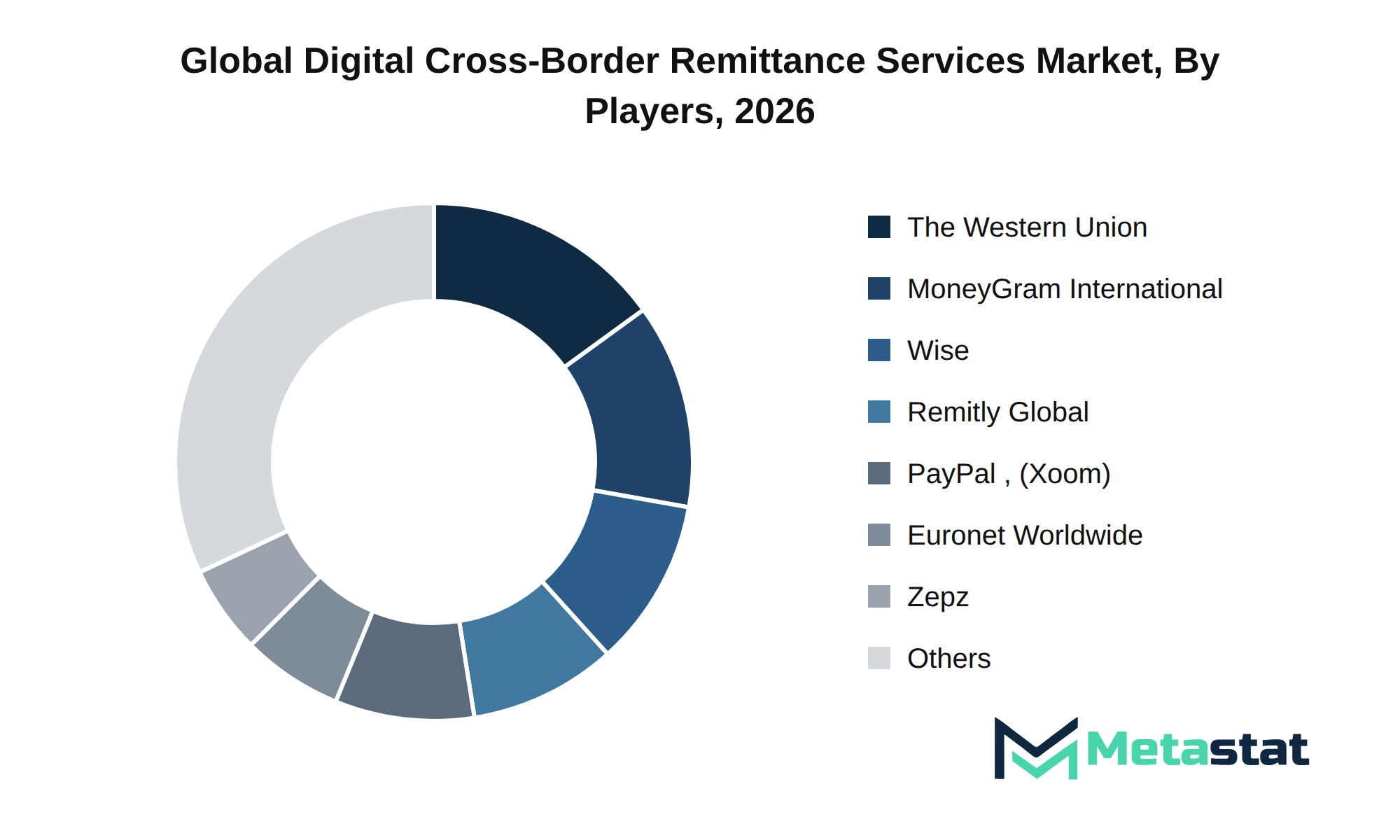
The Digital Cross-Border Remittance Services market features a dynamic competitive environment shaped by various strategic behaviors among key players. Mergers and acquisitions emerge owing to significant strategies, enabling companies including MoneyGram International, Inc and The Western Union Company to enhance their market presence and streamline operations. Strategic alliances and partnerships are prevalent, with firms like PayPal Holdings, Inc (Xoom) collaborating with technology providers to improve service delivery and user experience.
Commercial models and pricing architectures undergo continuous evolution, influenced by market demand and customer preferences. Companies including Wise plc and Remitly Global, Inc focus on offering competitive pricing while differentiating their services through innovative technology and enhanced customer support. The presence of strong intellectual property portfolios and proprietary technologies aids firms like Euronet Worldwide, Inc and Zepz in establishing technological defensibility within the market.
Future competitive outlooks reflect a focus on customer retention strategies amid rising competition. Firms prioritize establishing brand equity and reducing switching costs, enhancing loyalty among users. The market anticipates ongoing innovation and expansion, driven by addressing emerging consumer preferences and adapting to evolving regulatory landscapes.
Market size is forecast to rise from USD 27.3 billion in 2025 to over USD 111.9 billion by 2033. The base case reflects a compounded annual growth rate (CAGR) of 19.3%. Under a bullish scenario, accelerated adoption of digital technologies and enhanced regulatory support could strengthen demand, leading to increased investment in the Digital Cross-Border Remittance Services market. Conversely, a bearish scenario characterized by economic downturns and stringent regulatory restrictions could inhibit growth; however, the market remains resilient due to the fundamental necessity for cross-border transactions.
Several macroeconomic factors will influence the Digital Cross-Border Remittance Services market. Economic cycles and shifting consumer demands drive the need for innovative solutions. Next-generation technologies, including blockchain and artificial intelligence, integrate into existing systems, streamlining operations and enhancing user experiences. The commercialization of research and development initiatives further stimulates advancements in service delivery and cost efficiencies.
Regulatory developments play a crucial role in shaping market dynamics. Compliance milestones and evolving policies require companies to adapt quickly, ensuring alignment with international standards. Geopolitical changes influence trade corridors and global supply chains, impacting transaction volumes and methodologies. Strategic capital allocation directed towards infrastructure improvements and technology investments positions firms to capitalize on emerging opportunities within the market.
Identifying unmet needs within the enterprise sector reveals high-growth pockets. Focused efforts on executive-level strategic imperatives define competitive advantages. Establishing defensibility roadmaps allows businesses to navigate challenges effectively while pursuing future growth objectives.
Digital Cross-Border Remittance Services Market Key Segments
By Transaction Channel:
- Provider Mobile Applications
- Provider Web Platforms
- Embedded/API-Enabled Partner Channels
- Others (Messaging and USSD Interfaces)
By Funding Method:
- Bank Account / Account-to-Account Transfer
- Debit Card
- Credit Card
- Digital Wallet / Mobile Payment
- Stored-Value / Platform Balance
By Payout Method:
- Bank Account Deposit
- Cash Pickup
- Mobile Wallet / Mobile Money
- Debit / Prepaid Card Deposit
- Others (Home Delivery and Cardless ATM Cash-Out)
By Region:
- North America
- Europe
- Asia-Pacific
- South America
- Middle East and Africa
Key Global Digital Cross-Border Remittance Services Industry Players
- MoneyGram International, Inc
- The Western Union Company
- Wise plc
- Remitly Global, Inc
- Zepz
- Euronet Worldwide, Inc
- PayPal Holdings, Inc (Xoom)
- Paysend Group Limited
- Revolut Ltd
- OFX Group Limited
- TransferGo Ltd
- Nium Pte Ltd (Instarem)
- Taptap Send
- LemFi
- Skrill Limited
- ACE Money Transfer Limited
- Profee
- Panda Remit
- OrbitRemit Limited
- Mukuru
- NALA
- Global
- RemitBee Inc
- Chipper Cash
- Afriex
Report Coverage
The report strategically identifies and profiles the key market players and analyses their core competencies in each sub-segment of the Digital Cross-Border Remittance Services market.
Report Attributes | Details |
Study Period | 2021-2033 |
Base Year | 2025 |
Estimated Year | 2026 |
Forecast Period | 2026-2033 |
Historical Period | 2021-2025 |
Growth Rate | CAGR 19.3% from 2026 to 2033 |
Revenue Unit | USD billion |
Segmentation | By Transaction Channel, Funding Method, Payout Method, and Region |
By Region | North America (By Transaction Channel, Funding Method, Payout Method, and Country)
|
Europe (By Transaction Channel, Funding Method, Payout Method, and Country)
| |
Asia Pacific (By Transaction Channel, Funding Method, Payout Method, and Country)
| |
South America (By Transaction Channel, Funding Method, Payout Method, and Country)
| |
Middle East and Africa (By Transaction Channel, Funding Method, Payout Method, and Country)
|
What Report Provides
- Company Market Share, Revenue and Ranking for the Digital Cross-Border Remittance Services Market
- Key Market Leaders in the Digital Cross-Border Remittance Services Industry
- Full In-Depth Analysis of the Parent Industry Dynamics
- Industry Statistics and Important Changes Impacting the Market
- Segmentation Details of the Digital Cross-Border Remittance Services Market
- Historical, Ongoing and Projected Market Analysis
- Assessment of Niche Industry Developments and Trends
- Key Strategies of Major Players in the Digital Cross-Border Remittance Services Market
Frequently Asked Questions
Find answers to common questions about this report
The Digital Cross-Border Remittance Services market size was valued at USD 27.3 billion in 2025.
The Digital Cross-Border Remittance Services market is projected to grow at a CAGR of 19.3% during the forecast period from 2026 to 2033.
The North America Digital Cross-Border Remittance Services market size is estimated to reach USD 31.5 billion by 2033.
The segment leading the Digital Cross-Border Remittance Services market is the Provider Mobile Applications segment, with a projected value of USD 53.2 billion by 2033. This segment demonstrates the highest growth potential compared to other transaction channels.
Key drivers for the Digital Cross-Border Remittance Services market include advancements in digital transformation and increased adoption of mobile applications, enhancing transaction efficiency. Favorable macroeconomic conditions, including GDP growth and rising disposable incomes, further boost demand for remittance services, while technological integration improves operational productivity and reduces costs.
North America holds the dominant share of the Digital Cross-Border Remittance Services market, with a value of USD 31.5 billion projected for 2033, representing 30.3 percent of the total market.
Regulatory pressures, macroeconomic challenges, infrastructure inadequacies, and security concerns restrain growth in the Digital Cross-Border Remittance Services market. Increasingly stringent legal mandates raise compliance costs, while geopolitical fragmentation disrupts financial flows. insufficient technological infrastructure hinders transaction processing, creating barriers for service providers.
Advancements in digital transformation, including the increased adoption of mobile applications and web platforms, favor product adoption in the Digital Cross-Border Remittance Services market. Enhanced user experiences and improved security features attract digitally savvy customers, while investment in technological integration boosts operational efficiency and reduces costs for service providers and end-users.
The Digital Cross-Border Remittance Services market is estimated to reach a valuation of USD 111.9 billion by 2033.
Key players in the Digital Cross-Border Remittance Services market include MoneyGram International, Inc, The Western Union Company, Wise plc, Remitly Global, Inc, Zepz, Euronet Worldwide, Inc, and PayPal Holdings, Inc (Xoom).
Choose Your License
Global Digital Cross-Border Remittance Services Market
Related Reports
Explore related market intelligence reports worth reading alongside this one.
Global Enterprise Software-as-a-Service (SaaS) Market
Starting from
$2950