Global LLM Firewall Market Size, Share, By Component (Prompt/Input Firewall, Response/Output Firewall, Retrieval (RAG) Firewall, Agent & Tool-Call Runtime Protection, AI Discovery & Shadow AI Visibility Module, Professional & Managed Services and Others), By Deployment Mode (Cloud/SaaS API Gateway, Inline Network/Edge Proxy, On-Premises/Self-Hosted, Embedded SDK/Library-Based and Others), By Threat/Risk Coverage Type (Prompt Injection & Jailbreak Prevention, Sensitive Data Leakage & PII Protection, Toxic/Harmful Content & Output Moderation, Model Denial-of-Service & Resource Abuse Protection, Insecure Output & Malicious Code/URL Detection, Hallucination & Groundedness Control, Agentic Threats and Others), By End-Use Industry (BFSI, Healthcare & Life Sciences, IT & Telecommunications, Retail & E-Commerce, Government & Defense, Media, Technology & Software Platforms, Manufacturing and Others), Industry Analysis, Growth, Trends, and Forecast, 2026-2033
Report ID
MSI-4905
Published
August 12, 2026
Updated
Pages
286 Pages
Format
Market Size 2021
$139.4 Million
Historical
Market Size 2025
$268.4 Million
Base year
Market Size 2033
$1,015.9 Million
Forecast
CAGR 2025-2033
18.1%
Forecast period
Report Details
Comprehensive Market Analysis And Insights
Market Overview
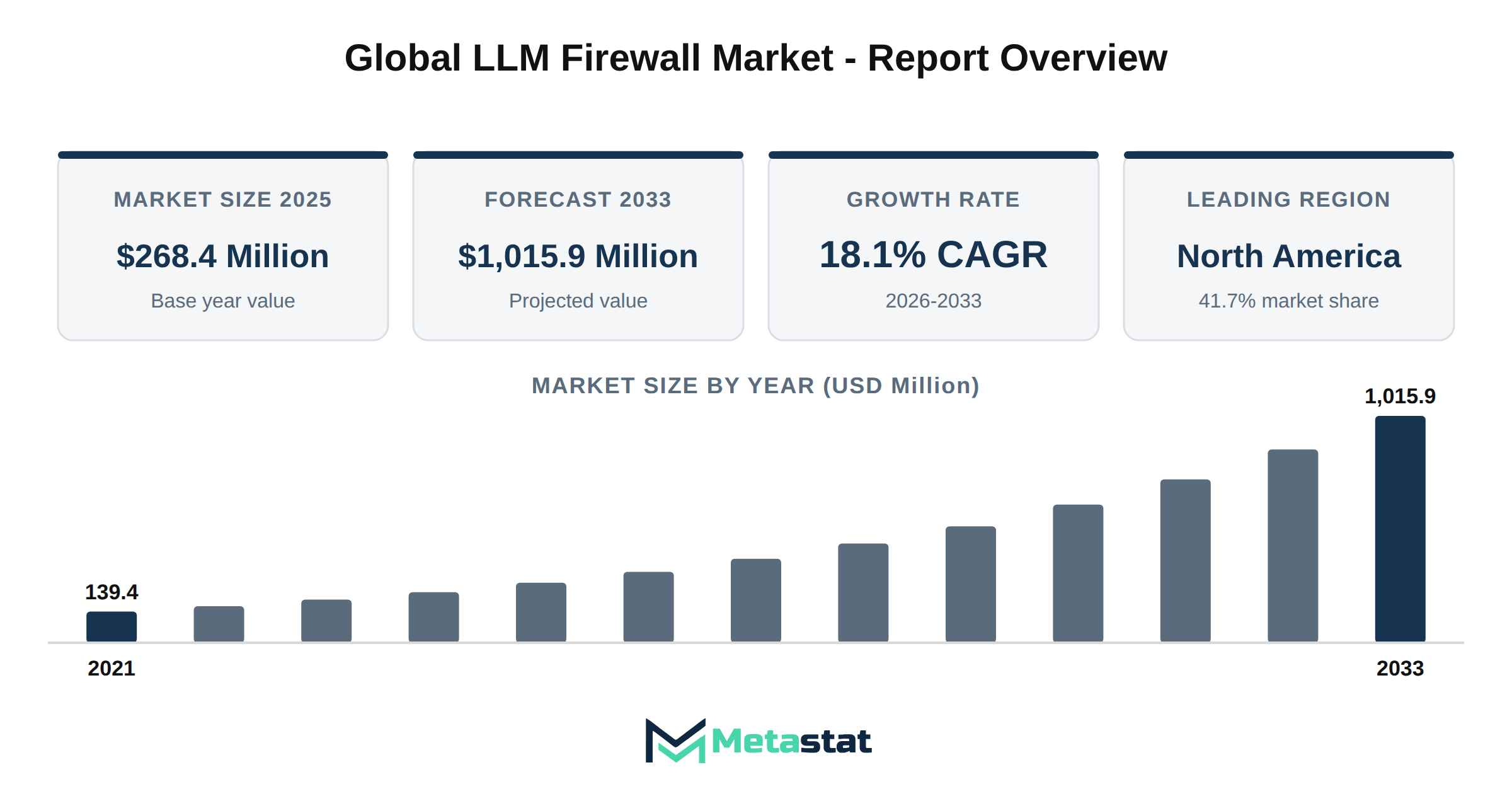
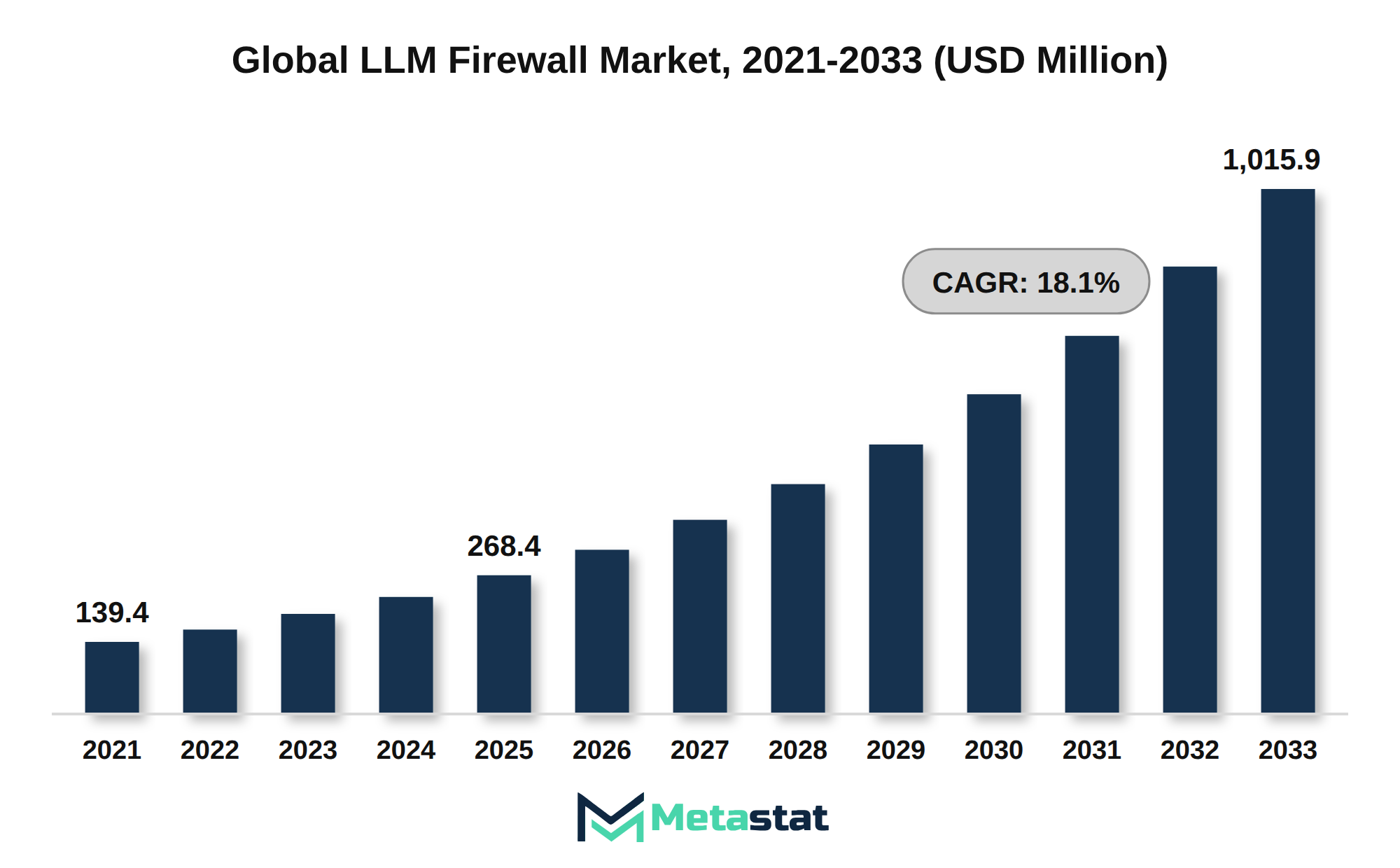
The global LLM Firewall market was valued at USD 268.4 million in 2025 and is projected to reach USD 1,015.9 million by 2033, growing at a CAGR of 18.1% over the forecast period.
The LLM Firewall market is projected to experience significant growth from USD 268.4 million in 2025 to USD 1,015.9 million by 2033, reflecting a compound annual growth rate (CAGR) of 18.1 percent. This upward trajectory is driven by increasing concerns over cybersecurity risks and the necessity for advanced protective measures against emerging threats. Enterprises across various sectors, particularly in finance, healthcare, and IT, prioritize investments in AI-driven security solutions to safeguard sensitive data and ensure compliance with regulatory standards.
Investment in AI security technologies is accelerating, with organizations allocating substantial budgets to enhance their defense mechanisms. The emphasis on compliance with regulations, including the EU AI Act and NIST AI RMF, shapes the operational landscape for AI security vendors. Enterprises increasingly seek solutions that not only address immediate security needs but align with long-term regulatory requirements, creating a market that values innovation and adaptability.
Vendor consolidation trends are reshaping the competitive environment, where larger firms acquire specialized providers to expand their capabilities. This consolidation allows for the integration of diverse technologies, enhancing the overall effectiveness of security offerings. A particular focus on pure-play vendors reinforces the market's commitment to specialized solutions that cater to complex security challenges.
Organizations in the LLM Firewall market face challenges related to latency and false-positive rates, which significantly impact user experience and operational efficiency. Continuous benchmarking against industry standards is essential to ensure that solutions deliver optimal performance while minimizing disruptions. Open-source and commercial guardrail adoption reflects a growing interest in balancing flexibility and security, driven by firms evaluating their strategies in light of geopolitical risks and compliance pressures.
The integration of agentic AI and the expansion of MCP security have become essential in shaping the LLM Firewall market. These advancements address the growing concerns regarding data security and the potential misuse of AI technologies. Enterprises across various sectors, particularly in BFSI and healthcare, emphasize the need for robust security measures, leading to increased investments in firewall solutions.
Consolidation trends among AI security vendors indicate a shift towards creating comprehensive security ecosystems. Mergers and acquisitions among leading players enhance capabilities and broaden service offerings, driving competitive dynamics. The consolidation enables companies to streamline operations and reduce costs, ultimately benefiting end-users through better pricing and improved service delivery.
The activity of pure-play vendor acquisition reflects a strategic focus on enhancing technological capabilities and expanding market reach. Companies including Amazon Web Services and Microsoft actively pursue acquisitions to integrate advanced AI-driven security features within their offerings, influencing overall market growth.
Regulatory frameworks, including the EU AI Act and NIST AI RMF, push organizations to adopt standardized security practices. Compliance with these regulations ensures that companies protect sensitive data while building trust and accountability. The market benefits from these regulatory drivers, resulting from organizations investing in LLM firewall solutions to meet compliance requirements.
Budget allocation for enterprise AI security has seen a notable increase, with organizations prioritizing investments to safeguard their digital assets. Enhanced allocation towards security measures reflects a proactive approach to managing escalating cybersecurity threats, particularly in industries including IT and telecommunications.
Benchmarking latency and false-positive rates remains critical in assessing the effectiveness of firewall solutions. Organizations increasingly seek to balance robust security with optimal user experience, prompting vendors to innovate and improve their technologies. The market's growth trajectory hinges on achieving this balance, ensuring that security does not compromise performance.
The ongoing debate between open-source and commercial guardrail adoption illustrates varying preferences among organizations. While open-source solutions offer flexibility and cost savings, commercial options provide enhanced support and reliability. Regulatory compliance and geopolitical risk frameworks further influence these decisions, shaping the market dynamics.
Disruption in the market drives research and development trajectories aimed at next-generation innovation. Companies invest in sustainable transformation and decarbonization initiatives, recognizing the importance of aligning with environmental standards. This strategic focus on sustainability not only addresses regulatory pressures but enhances brand reputation.
The supply chain landscape and logistics architecture play crucial roles in the LLM Firewall market. Efficient sourcing strategies and procurement processes directly impact the availability and affordability of firewall solutions. While companies navigate capital allocation and infrastructure investments, understanding these dynamics becomes essential for maintaining competitive advantage during macroeconomic headwinds.
Inflationary pressures and currency volatility introduce challenges that require careful management. Organizations in the LLM Firewall market adapt to these economic fluctuations to ensure profitability and sustainable growth. The strategic outlook hinges on navigating these complexities while capitalizing on emerging opportunities.
Corporate imperatives drive the strategic direction of organizations within the market. High-value recommendations focus on leveraging technological advancements and enhancing operational efficiencies, strengthening competitive positions. This strategic alignment positions companies for long-term success in an increasingly complex and competitive environment.
Market Dynamics
Digital transformation drives LLM Firewall demand
Digital transformation significantly influences the LLM Firewall market by accelerating the adoption of advanced cybersecurity measures. Organizations increasingly recognize the necessity of safeguarding their data and communication channels against emerging threats. This recognition stems from a combination of rising cyber threats and the proliferation of digital technologies across various sectors.
The expansion of cloud computing, artificial intelligence, and data analytics creates a critical need for robust firewall solutions to protect sensitive information and maintain operational integrity. Industries heavily reliant on technology, including finance, healthcare, and telecommunications, prioritize investment in LLM Firewall solutions to mitigate risks associated with data breaches and compliance failures.
Operational productivity enhancements and cost-efficiency initiatives further compel organizations to integrate LLM Firewalls into their cybersecurity strategies. By enabling automated and intelligent threat detection, these firewalls streamline security processes while reducing manual oversight. The ongoing evolution of consumer behaviors, driven by digitalization, mandates a more proactive approach to cybersecurity.
The LLM Firewall market is projected to grow owing to businesses increasingly allocating resources towards digital transformation initiatives and cybersecurity investments. This trend creates a competitive environment among providers of firewall solutions, prompting innovation and the development of advanced features tailored to specific industry needs.
Capital investment drives market expansion
The LLM Firewall market experiences significant growth supported by favorable capital investment environments. Increased interest in digital security solutions aligns with rising GDP growth and enhanced venture funding. Public-private spending power plays a critical role in facilitating investments across various sectors, enabling firms to strengthen their cybersecurity frameworks.
Industries including healthcare, finance, and retail increasingly invest in LLM Firewall technologies to protect sensitive data and mitigate emerging threats. The integration of advanced technologies, including artificial intelligence and machine learning, enhances the functionality of these firewalls, driving demand. Prioritizing cybersecurity investments improves operational resilience and enables organizations to adapt to evolving digital landscapes.
The anticipated expansion of the market is tied to ongoing capital investments. Projections indicate an increase in market size from USD 268.4 million in 2025 to USD 1,015.9 million by 2033, reflecting a compound annual growth rate of 18.1 percent. This growth highlights the critical importance of advanced security measures in safeguarding data integrity and maintaining competitive advantage.
Regulatory pressures and compliance hurdles
The LLM Firewall market faces significant challenges owing to increasing regulatory pressures and compliance hurdles. Stricter regulations regarding data security and privacy necessitate extensive compliance efforts across various industries. This trend particularly affects sectors including financial services, healthcare, and telecommunications, where stringent data protection laws impose operational complexities. Companies in these sectors absorb additional costs associated with compliance, impacting their overall budget allocation for LLM Firewall solutions.
Economic conditions further exacerbate these challenges. Macroeconomic headwinds, including inflationary pressures and capital stagnation, hinder the ability of organizations to invest in advanced firewall technologies. Companies encounter escalating operating costs, which restrict investment in new cybersecurity measures. Demand for LLM Firewall solutions experiences slowdowns in regions facing severe economic constraints.
Supply chain disruptions and geopolitical instability contribute to the uncertainty surrounding market growth. Such disruptions create difficulties in sourcing components necessary for deploying LLM Firewall systems, leading to delays and increased costs. This situation restricts service providers' ability to offer timely and efficient solutions, affecting competitive positioning in the market.
In addition, the rapid pace of technological advancement introduces the risk of obsolescence for existing firewall solutions. Organizations face pressure to continually upgrade their systems to stay ahead of emerging threats, which often requires substantial investments. The threat of substitution from alternative security solutions complicates market dynamics, driven by companies evaluating their options to ensure robust protection against cyber threats.
Infrastructure gaps and connectivity deficits represent additional barriers to market adoption. In regions where digital infrastructure remains underdeveloped, implementing advanced firewall technologies becomes challenging. Deployment bottlenecks arise where organizations lack the necessary resources or expertise to integrate these solutions effectively. Consequently, the overall growth trajectory of the LLM Firewall market slows, particularly in areas with limited digital ecosystems.
Human factors play a critical role in market development. A shortage of skilled labor and talent gaps in cybersecurity expertise hinder companies' ability to implement and manage LLM Firewall technologies effectively. Rising overhead costs associated with hiring and retaining qualified personnel strain organizational resources. This combination of factors influences the market's growth potential and competitive landscape.
Geopolitical tensions and supply chain volatility
The LLM Firewall market faces considerable challenges stemming from geopolitical fragmentation and trade deficits. These factors create uncertainty in sourcing materials and components, leading to price fluctuations and disrupted supply chains. The impact of these disruptions is felt across various industries, particularly in technology and telecommunications, which rely heavily on consistent access to high-quality inputs. Increased tariffs and trade barriers further complicate procurement processes, raising operational costs and hindering timely market entry.
Technological disruptions present another challenge for the market. Rapid advancements require continuous integration of new technologies, which demand significant investments in research and development. Companies struggle with interoperability issues, where existing systems adapt to new functionalities without compromising performance. This struggle leads to higher compliance overheads and evolving legal liabilities, which deter investment in LLM Firewall solutions.
Labor market dynamics contribute to the challenges faced by the LLM Firewall market. Workforce skill gaps hinder the industry's ability to implement advanced technologies effectively. Automation displacements create uncertainties regarding talent retention, driven by companies seeking to streamline operations while maintaining an adequately skilled workforce. Rising input costs and pricing compression further pressure margins, compelling companies to find innovative solutions to enhance profitability.
Environmental concerns increasingly influence market dynamics. Regulatory mandates on decarbonization and sustainability drive companies to adjust their operations, often requiring costly retrofitting and infrastructure upgrades. These barriers delay the adoption of LLM Firewall technologies, affecting long-term growth potential. The market navigates complex environmental lifecycle footprints, ensuring compliance while meeting customer demands for greener solutions.
Finally, intellectual property protection deficits and cybersecurity risks pose significant challenges for the LLM Firewall market. Companies face threats from data vulnerabilities and invest in robust security measures to protect proprietary information. These risks deter innovation and limit market entry for new players, ultimately impacting competition and growth prospects within the industry.
Growing adoption of advanced technologies creates substantial opportunities in the LLM Firewall market. Emerging regional demands for enhanced cybersecurity measures, particularly in sectors including healthcare, finance, and IT, drive investment in firewall solutions. Countries increasingly prioritize robust digital protections, leading to significant market expansion, particularly in North America and Europe.
Infrastructure modernization initiatives across various industries further stimulate market growth. Organizations replace outdated systems with next-generation solutions to enhance security protocols. This trend aligns with broader digital transformation efforts, propelling the integration of LLM Firewall technologies into existing frameworks.
Technological disruptions, including advancements in artificial intelligence and machine learning, shape the future of the market. Innovative firewall solutions that leverage these technologies improve threat detection and response times. This capability captures the interests of businesses seeking to mitigate risks associated with cyber threats effectively.
Sustainability imperatives and ESG-driven alignments significantly influence market dynamics. Companies strive to adopt environmentally friendly practices and align with evolving consumer expectations, prompting the integration of sustainable technologies within firewall solutions. This alignment enhances brand reputation and builds customer loyalty while driving revenue growth.
Strategic consolidation, cross-industry mergers, and acquisitions create avenues for market participants to expand their offerings. Collaborations between technology firms and cybersecurity specialists facilitate the development of comprehensive LLM Firewall solutions that address diverse customer needs. These strategic initiatives position companies competitively within the market.
Shifts in buying behavior, including digital procurement trends and changing commercial models, further influence the market landscape. Organizations prioritize efficiency and cost-effectiveness, driving demand for adaptable and scalable firewall solutions. Consequently, the LLM Firewall market experiences heightened growth and diversification opportunities.
Market Segmentation Analysis
The Global LLM Firewall market is segmented based on Component, Deployment Mode, Threat/Risk Coverage Type, and End-Use Industry.
By Component, the market is further segmented into:
Prompt/Input Firewall
Response/Output Firewall
Retrieval (RAG) Firewall
Agent & Tool-Call Runtime Protection
AI Discovery & Shadow AI Visibility Module
Professional & Managed Services
Others (Model Scanning, Red-Teaming Add-ons)
Prompt/Input Firewall
Growth in the Prompt/Input Firewall segment reflects heightened demand for advanced solutions that enhance the security of input data processing in machine learning applications. This demand results from the increasing sophistication of cyber threats and the necessity for businesses to protect sensitive information. Industries including finance, healthcare, and technology emphasize the need for effective prompt and input protection measures, driving adoption across various sectors.
The segment is valued at USD 81.8 million in 2026 and reaches USD 243.8 million by 2033, at a CAGR of 16.9% during the forecast period. This growth is supported by technological maturation and the continuous evolution of artificial intelligence applications, which demand robust security measures. Organizations seek solutions that facilitate compliance with regulatory standards, reinforcing the segment's relevance and expansion.
The transition towards next-generation upgrades in security technologies enhances the segment's growth trajectory. Companies invest in innovative solutions that provide comprehensive protection against prompt injection and other malicious activities. This trend results in a shift in consumption patterns, with end-users prioritizing security features that align with operational needs and risk management strategies.
Businesses recognize the importance of safeguarding data integrity, and adoption rates of prompt/input firewalls are expected to accelerate. This segment benefits from capital investments aimed at improving security infrastructures, leading to increased competition among providers. Continuous advancements in technology and strategic opportunities present a favorable outlook for the prompt/input firewall market within the broader LLM Firewall market.
Response/Output Firewall
Growth in the Response/Output Firewall segment stems from heightened demand for data protection and compliance with regulatory standards. Organizations increasingly prioritize safeguarding sensitive information, driving investments in advanced security solutions. The healthcare and financial sectors, dealing with stringent regulations, lead adoption, necessitating robust output protection mechanisms. Integration with next-generation technologies enhances the effectiveness of these firewalls, aligning with evolving cybersecurity landscapes.
The Response/Output Firewall segment is projected to reach USD 182.9 million by 2033, at a CAGR of 16.7% during the forecast period. This growth reflects a commitment to investing in secure communication channels that prevent data leakage and protect against malicious attacks. With evolving cyber threats, businesses recognize the importance of reliable output control, prompting further investments in this sector.
Technological maturation plays a significant role in shaping market dynamics. Enhanced capabilities, including real-time monitoring and automated threat detection, improve response times and overall efficiency. The increasing complexity of cyber threats necessitates sophisticated solutions, propelling demand for advanced firewalls. Organizations aim to leverage these technologies to gain a competitive edge, reinforcing the necessity for robust response mechanisms in the LLM Firewall market.
Retrieval (RAG) Firewall
Growth in the Retrieval (RAG) Firewall segment stems from increasing demand for advanced data retrieval techniques and the necessity for organizations to enhance their AI capabilities. Businesses increasingly adopt AI-driven solutions, creating a need for systems that efficiently access and process vast amounts of data. Industries including healthcare, IT, and telecommunications significantly drive this demand, with organizations seeking to maintain competitive advantages through improved data handling and security.
Technological maturation and next-gen upgrades significantly influence the segment's expansion. Advancements in machine learning and AI technologies contribute to more efficient retrieval processes, resulting in heightened interest from enterprises looking to integrate these innovations into their operations. Organizations recognize the potential of AI to enhance productivity and decision-making, leading to strong growth in investments in retrieval systems.
Regulatory compliance standards and certifications further impact the market by imposing requirements on data handling practices across various sectors. Organizations striving to comply with these regulations seek reliable retrieval solutions to safeguard sensitive information and ensure adherence to privacy standards. This focus on compliance drives demand for Retrieval (RAG) Firewalls, positioning the segment for sustained growth.
While organizations navigate the competitive environment, cost structures and pricing volatility present challenges. Companies investing in Retrieval (RAG) Firewalls face pressures related to production costs and pricing strategies. However, these dynamics do not hinder growth; rather, they prompt suppliers to innovate and streamline operations to maintain profitability.
The Retrieval (RAG) Firewall segment is expected to reach USD 162.5 million by 2033, indicating a strong trajectory fueled by demand for advanced data retrieval and compliance solutions within the broader LLM Firewall market.
Agent & Tool-Call Runtime Protection
Rapid advancements in machine learning technologies drive the Agent & Tool-Call Runtime Protection segment's growth. Organizations increasingly recognize the need for robust security measures to protect sensitive data and applications from sophisticated cyber threats. This requirement enhances demand across various industries, particularly in sectors including finance, healthcare, and technology, where data sensitivity is critical.
Technological maturation contributes to improving the capabilities of runtime protection solutions. The integration of next-generation security features, including real-time threat detection and automated response mechanisms, positions these solutions favorably against evolving threats. Continuous product evolution ensures that offerings remain competitive and effective, thereby increasing their appeal to potential customers. This ongoing development strengthens the market's overall resilience.
Consumption shifts reflect a growing trend toward adopting cloud-based solutions for runtime protection. Customers prioritize flexibility and scalability, prompting a shift from traditional on-premises systems to cloud-native alternatives. This transition supports the segment's expansion by aligning with market demands for agility and cost-effectiveness. Organizations increasingly seek solutions that enhance operational efficiency.
Regulatory compliance standards exert significant influence on the market. Stricter regulations surrounding data privacy and security compel organizations to invest in advanced protective measures. This scenario presents a strategic opportunity for vendors providing robust runtime protection solutions that meet these compliance requirements. Meeting these standards enhances market competitiveness.
Cost structures and pricing volatility impact decision-making for potential buyers. Organizations assess the total cost of ownership, including potential long-term savings associated with reduced data breaches and improved operational efficiency. These factors contribute to an anticipated CAGR of 21.6% for the segment during the forecast period, reflecting strong market confidence and growth potential. The focus on cost-effectiveness drives buyer interest.
AI Discovery & Shadow AI Visibility Module
Growing concerns over the visibility of artificial intelligence (AI) applications drive interest in the AI Discovery & Shadow AI Visibility Module within the LLM Firewall market. Organizations increasingly recognize the need for transparency in AI usage, leading to heightened demand for solutions that provide insights into AI tools and their underlying processes. This demand aligns with regulatory pressures for compliance, ensuring that organizations uphold standards in data usage and ethical AI deployment.
The expansion of this module derives from technological maturation. Advancements in AI detection and monitoring capabilities enhance the effectiveness of these solutions. Sophisticated algorithms and machine learning techniques enable better tracking and identification of shadow AI, which refers to unauthorized or unmonitored AI applications within an organization. Consequently, enterprises encounter fewer risks associated with data breaches and misuse of AI technologies.
Adoption of the AI Discovery & Shadow AI Visibility Module spans various industries, with sectors including finance, healthcare, and information technology facing intense scrutiny regarding AI compliance and security. Organizations in these fields prioritize investments in monitoring capabilities to mitigate potential liabilities associated with unregulated AI usage. Enhanced visibility into AI operations contributes to increased stakeholder trust and confidence in organizational practices.
Pricing volatility remains a consideration for organizations exploring the integration of visibility modules. Cost structures associated with implementation and maintenance impact decision-making processes, particularly for smaller enterprises. Long-term benefits derived from reduced risks and enhanced compliance justify initial investments, promoting a favorable outlook for market growth.
Strategic opportunity windows exist for technology providers focusing on next-gen upgrades. Innovations that streamline integration and simplify user interfacing capture interest from potential buyers. A robust value proposition strengthens competitive positioning within the market, enabling suppliers to differentiate their offerings and address evolving consumer needs effectively.
Professional & Managed Services
Growth in the Professional & Managed Services segment derives from increasing demand for specialized support in deploying and managing LLM Firewall solutions. Organizations face challenges in optimizing their firewall systems, prompting investments in professional services to enhance functionality and ensure effective integration within existing IT frameworks. This trend reflects a broader move toward outsourcing complex IT solutions, where companies prefer to leverage expert services to maintain competitive advantages in data protection and compliance.
Technological maturation shapes demand for professional and managed services. LLM Firewall technologies evolve, requiring organizations to seek assistance in navigating new features and ensuring that systems remain up to date. The integration of next-generation upgrades enhances the appeal of these services, which aid clients in maximizing the capabilities of their firewall investments. Consequently, providers of professional and managed services benefit from sustained demand driven by the continuous evolution of LLM Firewall technologies.
End-use dynamics within various sectors, including BFSI, healthcare, and IT, create a unique landscape for professional and managed services. These industries emphasize risk management and regulatory compliance, leading to an increased reliance on external expertise to navigate complex environments. The segment’s growth correlates with heightened awareness surrounding data security, where organizations prioritize investments in professional services to mitigate risks associated with advanced threats.
Consumption shifts toward cloud-based solutions further influence the demand for professional and managed services. Businesses increasingly adopt cloud-based LLM Firewall solutions, necessitating support in configuration, management, and security optimization. This trend leads to a growing service demand catered to organizations transitioning from traditional infrastructure to cloud environments. Such shifts reinforce the necessity for expert assistance and support, driving expansion opportunities within this segment.
Strategic opportunity windows emerge owing to organizations recognizing the value of ongoing support in maintaining optimal firewall performance. Increased emphasis on continuous improvement within cybersecurity frameworks compels businesses to invest in professional services that ensure adherence to evolving regulatory compliance standards. The proactive approach to security drives long-term partnerships between service providers and clients, enhancing the overall value proposition within the professional and managed services segment of the LLM Firewall market.
Others (Model Scanning, Red-Teaming Add-ons)
Growing interest in enhancing model security drives demand for components including model scanning and red-teaming add-ons. These tools play a critical role in identifying vulnerabilities and ensuring compliance with emerging security standards in various industries. Increased regulatory scrutiny and the need for robust cybersecurity measures accelerate adoption among organizations prioritizing data and model integrity.
Technological advancements contribute to the maturation of these components, driving innovation in threat detection and response capabilities. The evolution of artificial intelligence applications creates opportunities for integrating advanced security features that enhance overall system resilience. Adoption spans multiple sectors, including finance, healthcare, and technology, where safeguarding sensitive data against potential threats remains essential.
Investment in next-generation upgrades and enhanced functionalities is evident, reflecting a commitment to staying ahead of evolving cybersecurity challenges. The market experiences heightened competition driven by organizations seeking comprehensive solutions that address specific operational risks, positioning model scanning and red-teaming add-ons because vital components of modern security strategies. This strategic focus on resilience and compliance supports continued growth within the LLM Firewall market.
By Deployment Mode, the market is further segmented into:
Valued at USD 143.3 million in 2026, the Cloud/SaaS API Gateway segment is projected to reach USD 488.7 million by 2033, marking a CAGR of 19.2% during the forecast period. This growth results from increasing demand for scalable and flexible API management solutions, which enable organizations to efficiently manage and secure their application programming interfaces. The rise of cloud-native applications and services significantly drives adoption among enterprises seeking to enhance operational efficiency and improve integration across various platforms.
Technological advancements, including the integration of artificial intelligence and machine learning, further support segment expansion. These innovations facilitate automated threat detection and response, thereby enhancing security postures for organizations deploying APIs. Industries including IT and telecommunications, healthcare, and retail exhibit heightened interest in these solutions, leading to increased investment in the market.
Regulatory compliance standards play a significant role in shaping demand for Cloud/SaaS API Gateway solutions. Organizations face pressure to adhere to stringent data protection regulations, prompting investment in robust security measures to safeguard sensitive information. The market benefits from a continuous influx of capital investment aimed at developing next-generation upgrades and innovations.
Pricing volatility and margin pressures present challenges within the segment, with fluctuating costs of technology and services impacting overall profitability. Strategic opportunity windows arise for suppliers offering differentiated products that address specific industry needs, positioning themselves favorably within the competitive environment of the LLM Firewall market.
Inline Network/Edge Proxy
Significant growth in the Inline Network/Edge Proxy segment reflects rising demand for secure and efficient data handling methods in various industries. Innovations in network security technologies drive this trend, attributed to organizations increasingly focusing on protecting their digital infrastructures. The need for real-time threat detection and prevention fuels adoption, enabling businesses to safeguard sensitive information and maintain operational integrity.
Strong investment in next-generation upgrades enhances the capabilities of LLM Firewalls, particularly within the Inline Network/Edge Proxy segment. This evolution in product offerings supports integration with advanced machine learning algorithms and AI-driven analytics, improving threat response and overall system performance. While these technologies continue to mature, market dynamics shift toward solutions that provide comprehensive coverage against a broad range of potential vulnerabilities.
The Inline Network/Edge Proxy segment is estimated to reach USD 203.2 million by 2033, at a CAGR of 17.4% during the forecast period. This growth trajectory highlights the increasing significance of inline firewalls in addressing the complexities of modern cyber threats. The urgency for regulatory compliance standards and data protection measures accelerates adoption, particularly in sectors including finance, healthcare, and telecommunications.
Competitive pressures within the market lead to significant product evolution, with providers focusing on enhancing functionality and user experience. Strategic partnerships among technology companies drive innovation, creating tailored solutions that address specific industry challenges. Investments in supply chain resilience and raw material sourcing contribute to a more robust operational framework, supporting sustained growth within the Inline Network/Edge Proxy segment.
On-Premises/Self-Hosted
Adoption of On-Premises/Self-Hosted deployments signifies a strategic choice for organizations prioritizing data security and control over their digital assets. Factors driving this segment include heightened concerns regarding data breaches and compliance with regulatory standards, prompting firms to implement robust firewall solutions internally. Industries engaged in sensitive data handling, including healthcare and finance, particularly benefit from this deployment mode, which offers enhanced security measures tailored to their unique needs.
Market dynamics reflect a growing preference for self-hosted solutions, driven by a need for customization and integration within existing IT infrastructures. Organizations leverage this deployment mode to maintain direct oversight of their security protocols, minimizing risks associated with third-party services. The On-Premises/Self-Hosted segment is expected to reach USD 132.1 million by 2033, illustrating its increasing significance within the LLM Firewall market.
Technological advancements facilitate the evolution of On-Premises/Self-Hosted firewalls, enabling upgrades and integration with emerging threat detection technologies. This segment supports organizations in addressing evolving security challenges, ensuring they remain resilient against sophisticated cyber threats. A strong investment outlook and strategic opportunity windows emerge owing to firms recognizing the critical nature of maintaining secure environments for their operations.
Embedded SDK/Library-Based
Growing recognition of the benefits associated with embedded SDKs and library-based solutions drives robust demand within the Embedded SDK/Library-Based segment of the LLM Firewall market. These solutions provide integration capabilities, allowing organizations to enhance their security postures while minimizing disruption to existing workflows. The projected growth rate of 20.1% CAGR during the forecast period highlights the segment's significance in meeting the evolving cybersecurity needs of various industries.
Technological maturation plays a crucial role in this segment, with advancements in machine learning and artificial intelligence enabling more sophisticated threat detection and prevention mechanisms. Organizations increasingly adopt these tools to strengthen their defenses against emerging cyber threats. Regulatory compliance standards influence adoption, driven by organizations seeking to align their security strategies with evolving data protection regulations.
Investment in research and development further fuels product evolution, with firms continuously enhancing the capabilities of their embedded SDKs and library-based solutions. This ongoing innovation addresses current threats and anticipates future challenges, positioning organizations to respond effectively. The competitive landscape includes numerous key players including Akamai Technologies, Amazon Web Services, and Cisco Systems, each contributing to the segment's dynamism through diverse offerings and strategic partnerships.
Adoption trends highlight the importance of these solutions across various end-use industries, including BFSI, healthcare, and IT. Organizations increasingly prioritize data security in their digital transformation initiatives. The Embedded SDK/Library-Based segment is expected to capture a larger share of the LLM Firewall market throughout the forecast period.
Demand for cloud hyperscaler-native guardrail services is driven by the increasing complexity of managing AI models and the associated risks. Companies adopting these solutions focus on enhanced security and regulatory compliance, particularly in industries heavily reliant on data protection. The evolution of these services is driven by advancements in machine learning technologies, which require robust monitoring and protection mechanisms to mitigate risks including model theft and data poisoning. End-users recognize the necessity of maintaining compliance with stringent data protection regulations, creating a supportive environment for the adoption of innovative firewall solutions.
Investment in next-generation upgrades enhances the capabilities of these services, resulting in a sophisticated approach to AI model security. While organizations shift towards cloud-based operations, the demand for integrated and resilient security solutions increases. Companies involved in this market segment actively pursue strategic opportunities to develop comprehensive guardrail services that address emerging threats. The development of customizable solutions offers an avenue for meeting specific client needs, further driving market expansion.
Technological maturation within the sector presents opportunities for service providers to refine their offerings, ensuring alignment with evolving industry standards and user requirements. Continuous research and development efforts focus on enhancing the efficacy of guardrail services, promoting investment in advanced features and functionalities. Consequently, organizations are likely to experience improved operational efficiencies, reduced vulnerabilities, and enhanced overall security posture, reinforcing the value of these services in the LLM Firewall market.
By Threat/Risk Coverage Type, the market is further segmented into:
Prompt Injection & Jailbreak Prevention
Sensitive Data Leakage & PII Protection
Toxic/Harmful Content & Output Moderation
Model Denial-of-Service & Resource Abuse Protection
Insecure Output & Malicious Code/URL Detection
Hallucination & Groundedness Control
Agentic Threats (Tool Misuse, Memory Poisoning)
Others (Model Theft, Data Poisoning Detection)
Prompt Injection & Jailbreak Prevention
Valued at USD 75.3 million in 2026, the Prompt Injection & Jailbreak Prevention segment is projected to reach USD 223.5 million by 2033, demonstrating a compound annual growth rate (CAGR) of 16.8% during the forecast period. This growth results from increasing concerns regarding the integrity and security of AI models, particularly against threats posed by malicious actors seeking to manipulate or exploit these systems. Industries including finance, healthcare, and technology, which heavily rely on AI-driven applications, contribute significantly to this demand.
Adoption of advanced security measures against prompt injection and jailbreak scenarios is driven by the urgent need for organizations to protect sensitive data and maintain compliance with regulatory standards. The evolving threat landscape necessitates continual investments in next-generation upgrades and product evolution, ensuring that defense mechanisms stay ahead of potential vulnerabilities. Consequently, businesses perceive substantial operational and commercial value in implementing robust safeguards.
The urgency for enhanced security frameworks aligns with the market's broader objective of establishing trust in AI technologies. While organizations increasingly integrate AI into their operations, the demand for effective prompt injection and jailbreak prevention measures is expected to expand, reinforcing their role within the LLM Firewall market. This segment's growth reflects a strategic response to emerging challenges, emphasizing the importance of proactive security solutions in maintaining operational integrity and protecting end-user trust.
Sensitive Data Leakage & PII Protection
Increased focus on data privacy and protection significantly drives growth in the Sensitive Data Leakage & PII Protection segment. Regulatory requirements and compliance standards set by governments and industry bodies heighten the urgency for organizations to implement robust security measures. Industries including finance, healthcare, and telecommunications, which handle sensitive information, experience heightened pressures to safeguard personal identifiable information (PII) from unauthorized access and breaches. This heightened awareness and regulatory scrutiny lead to increased investments in advanced firewall solutions.
This segment is estimated to reach USD 182.9 million by 2033, at a CAGR of 17.4% during the forecast period. Demand for innovative technologies that enhance data security continues to rise, with organizations seeking next-gen upgrades and evolving product features. Investment in the latest technological advancements becomes essential for organizations aiming to maintain competitiveness within the market.
Growing collaboration among stakeholders creates an ecosystem that supports technological maturation and product evolution. Strategic opportunities emerge due to organizations prioritizing investments in solutions that address the complexities associated with data leakage and PII protection. The market's trajectory reflects a commitment to enhancing data security measures and ensuring compliance with stringent regulations.
Toxic/Harmful Content & Output Moderation
Significant growth in the Toxic/Harmful Content & Output Moderation segment reflects increasing scrutiny of artificial intelligence applications and their potential to generate harmful outputs. Regulatory compliance standards, driven by a growing focus on user safety and data protection, necessitate robust moderation mechanisms within large language models. End-use industries, particularly healthcare and finance, prioritize the implementation of advanced moderation tools to mitigate risks associated with toxic content. With the segment projected to reach USD 152.4 million by 2033, investment in this area signifies a growing recognition of the critical nature of output moderation in maintaining brand integrity and user trust.
Technological maturation enables the development of sophisticated algorithms that enhance moderation capabilities, allowing organizations to effectively filter and manage harmful content. The shift towards next-gen upgrades, including real-time monitoring and automated feedback loops, supports the expansion of this segment. Evolving consumer expectations drive businesses to seek solutions that comply with regulatory frameworks while aligning with ethical standards, influencing demand for innovative moderation technologies within the LLM Firewall market.
Model Denial-of-Service & Resource Abuse Protection
Significant growth in the Model Denial-of-Service & Resource Abuse Protection segment appears driven by increasing threats and vulnerabilities in the digital landscape. Organizations face escalating concerns regarding security breaches, necessitating robust protective measures against service denial and resource misuse. Industries including finance, healthcare, and technology prioritize implementing sophisticated firewalls to safeguard critical systems and data.
Technological advancements in artificial intelligence and machine learning enhance the effectiveness of these protective measures. Enhanced detection algorithms and real-time response capabilities improve system resilience against attacks. Customers recognize the importance of leveraging such innovations to maintain operational integrity and mitigate potential losses.
Increased regulatory compliance pressures further stimulate demand for these solutions. Organizations strive to adhere to stringent data protection regulations, which necessitate the implementation of comprehensive security measures. The growing emphasis on compliance influences investment decisions in advanced firewall technologies, driving market expansion.
Cost structures associated with implementing these protective measures often reflect the need for high-quality solutions. Organizations evaluate the trade-offs between upfront investments and long-term savings related to potential damages from breaches. Pricing volatility in the market influences purchasing decisions, with organizations seeking value while ensuring maximum protection.
Investment in the Model Denial-of-Service & Resource Abuse Protection segment is projected to grow at a CAGR of 18.2% during the forecast period. This trajectory reflects heightened awareness and urgency surrounding cybersecurity threats, highlighting the critical role of effective firewall solutions in the evolving LLM Firewall market.
Insecure Output & Malicious Code/URL Detection
Detection of insecure output and malicious code or URLs represents a key focus area within the LLM Firewall market. Increased cyber threats and sophisticated attacks emphasize the necessity for robust detection mechanisms that safeguard against potential vulnerabilities. Organizations across various sectors, including financial services and healthcare, drive demand for these capabilities to protect sensitive data and maintain customer trust.
Technological advancements, including artificial intelligence and machine learning, enhance the effectiveness of detection tools. More accurate identification of threats allows businesses to respond swiftly to incidents, minimizing the risk of breaches and operational disruption. Next-generation upgrades significantly contribute to the evolution of these detection mechanisms, increasing their relevance in a rapidly changing threat environment.
Regulatory compliance standards impose additional pressures on organizations to implement effective detection solutions. Compliance with data protection regulations further motivates investment in these technologies, ensuring that firms meet legal requirements while protecting valuable assets. While organizations prioritize cybersecurity, the integration of sophisticated detection capabilities becomes essential, reflecting a broader trend toward comprehensive security strategies.
Supply chain resilience plays a critical role in the effectiveness of detection mechanisms. The ability to source reliable technology and maintain operational stability is crucial for organizations aiming to enhance their security frameworks. Strategic opportunity windows arise owing to businesses seeking innovative solutions to address evolving threats, creating a favorable environment for growth within this sub-segment of the market.
Hallucination & Groundedness Control
Advancements in hallucination and groundedness control technologies drive heightened interest in ensuring reliable AI outputs. This control mechanism helps mitigate risks associated with false or misleading information generated by AI systems, crucial for sectors relying on accurate data, including healthcare and finance. Stringent regulatory compliance standards compel organizations to adopt strategies for maintaining data integrity and trustworthiness in AI applications.
Investments in AI training and development significantly influence the adoption of hallucination and groundedness control. Organizations increasingly recognize the importance of maintaining the credibility of AI-generated outputs to enhance user confidence. The integration of advanced algorithms and models enhances the ability to address hallucination issues, aligning with the strategic goals of various industries seeking to leverage AI safely.
Increased competition within the LLM Firewall market accelerates the need for innovative solutions to address hallucination risks. Companies are investing in next-generation upgrades to their AI systems, leading to enhanced performance and reliability. This technological maturation presents strategic opportunity windows for market players to differentiate their offerings and capture a larger share of the market.
Downstream applications benefit from robust hallucination and groundedness control measures, resulting in improved end-user experiences. Industries including education and media prioritize content accuracy and reliability, making these controls essential for compliance and user satisfaction. The ongoing evolution of AI technologies facilitates continuous improvements in these control mechanisms, contributing to overall market growth.
Pricing volatility and margin pressures specific to hallucination and groundedness control impact the cost structures of solution providers. Organizations balance investment in advanced technologies with the remain competitive in a rapidly changing market. This dynamic environment encourages strategic collaborations and partnerships to leverage shared resources and expertise.
Supply chain resilience becomes increasingly important owing to companies navigating potential disruptions in the sourcing of materials needed for developing effective hallucination and groundedness control solutions. Organizations that prioritize flexible supply chains position themselves to adapt to market changes and maintain a competitive edge. Ongoing efforts in product evolution ensure that the solutions remain relevant in addressing emerging challenges within the LLM Firewall market.
Agentic Threats (Tool Misuse, Memory Poisoning)
In the LLM Firewall market, agentic threats encompassing tool misuse and memory poisoning present significant challenges. These threats arise from the advanced capabilities of language models, which are manipulated for unauthorized purposes, leading to severe repercussions in security and data integrity. Adoption of effective mitigation strategies is driven by increasing recognition of the potential damage stemming from these vulnerabilities, where models are exploited to produce misleading or harmful outputs.
Various industries, particularly those engaging in sensitive data handling, prioritize protection against these threats. The financial services sector, healthcare providers, and technology firms experience heightened scrutiny over their data security practices, compelling them to invest in robust firewall solutions that address these specific risks. Regulatory compliance standards mandate the implementation of protective measures against misuse and exploitation, promoting a broader market response to these threats.
Technological maturation plays a critical role in shaping responses to agentic threats. Innovations in detection and mitigation techniques are expected to evolve rapidly, enhancing the capabilities of LLM firewall solutions. Increased investments in next-generation upgrades ensure that organizations anticipate and counteract emerging threats, creating a proactive approach to security.
Strategic opportunity windows exist for firms providing LLM firewall solutions tailored to address agentic threats. Companies that successfully integrate advanced AI capabilities into their defensive strategies position themselves favorably in the market. This approach enhances product offerings and contributes to overall industry growth. Heightened awareness of these threats drives demand for specialized solutions.
Continual advancements in product evolution will further influence market dynamics associated with agentic threats. While organizations adapt to changing threat landscapes, the emphasis on comprehensive security solutions becomes critical, ensuring protection against both tool misuse and memory poisoning. Proactive development of innovative strategies will be essential in maintaining industry competitiveness and safeguarding valuable data assets.
Others (Model Theft, Data Poisoning Detection)
Concerns regarding model theft and data poisoning detection increasingly drive demand for advanced protection solutions within the LLM Firewall market. Organizations recognize the potential consequences of data breaches and unauthorized access to proprietary models. High-profile cases of intellectual property theft and data integrity issues heighten the urgency for effective countermeasures. Industries focused on maintaining competitive advantages, including technology, finance, and healthcare, prioritize these detection capabilities to safeguard sensitive information and intellectual assets.
The necessity for next-gen upgrades aligns with the technological maturation of LLM firewalls, creating a clear path toward enhanced security measures. Investment in evolving technologies enables businesses to better address emerging threats. With the continuous development of sophisticated attack vectors, organizations rely on advanced detection methods to counteract potential risks effectively. Increased regulatory compliance standards regarding data protection further influence the adoption of robust security solutions, ensuring adherence to legal requirements while safeguarding organizational integrity.
Incorporating these detection capabilities into existing frameworks addresses immediate threats and enhances overall system resilience. The evolving landscape of cybersecurity demands a proactive approach, steering firms towards strategic opportunity windows. With significant focus on white-space analysis, businesses identify gaps in current offerings and seek innovative solutions to mitigate risks associated with model theft and data poisoning. Capital investment outlook remains positive, driven by firms recognizing the long-term benefits of robust LLM Firewall solutions.
By End-Use Industry, the market is further segmented into:
BFSI
Healthcare & Life Sciences
IT & Telecommunications
Retail & E-Commerce
Government & Defense
Media, Technology & Software Platforms
Manufacturing
Others (Education, Energy & Utilities)
BFSI
Valued at USD 68.6 million in 2026, the BFSI segment is projected to reach USD 203.2 million by 2033, reflecting a CAGR of 16.8% during the forecast period. Increased regulatory compliance standards and the growing need for enhanced data security drive demand for LLM firewalls in the banking, financial services, and insurance sectors. Financial institutions face significant challenges related to data breaches and cyber threats, prompting investments in advanced security measures.
The adoption of LLM firewalls aligns with the broader trend of digital transformation in the BFSI industry. Organizations actively seek next-gen upgrades to enhance their cybersecurity frameworks, thus creating a robust market for these solutions. The evolution of technology in this sector highlights a continuous shift towards integrating artificial intelligence-driven security measures, which further supports segment growth.
Investment in LLM firewalls addresses critical issues including sensitive data leakage and compliance with stringent regulations, ultimately leading to improved operational efficiencies. The BFSI sector's focus on securing customer trust and maintaining regulatory compliance creates strategic opportunity windows for market players. While organizations navigate challenges related to cost structures and pricing volatility, high demand for reliable and efficient security solutions persists. This demand positions the market for sustained growth.
Healthcare & Life Sciences
In the Healthcare & Life Sciences sector, demand for LLM Firewall solutions expands significantly owing to increasing regulatory compliance requirements and the need for robust data protection. Healthcare organizations face heightened scrutiny regarding patient data security, driving investment in advanced firewall technologies. Regulatory bodies enforce strict compliance standards to safeguard sensitive information, compelling institutions to adopt comprehensive cybersecurity measures.
Technological evolution in healthcare, including the adoption of electronic health records and telehealth services, generates an escalating need for reliable data security solutions. This sector's ongoing digital transformation leads to greater exposure to cyber threats, enhancing demand for LLM Firewall systems designed to mitigate these risks. The dynamics of cybersecurity within healthcare emphasize the importance of safeguarding patient data from breaches and unauthorized access.
Market growth in this segment reflects a commitment to maintaining high standards of operational integrity and patient confidentiality. The Healthcare & Life Sciences segment is projected to reach USD 152.4 million by 2033, at a CAGR of 19% during the forecast period. This substantial growth highlights the sector's proactive stance toward enhancing cybersecurity frameworks.
Investment in LLM Firewall technologies facilitates compliance with regulatory mandates and promotes trust among patients and stakeholders. While cyber threats evolve, healthcare entities prioritize solutions that offer advanced threat detection and mitigation capabilities, securing the integrity of patient information. The strategic adoption of LLM Firewall systems addresses emerging security challenges within the healthcare landscape.
IT & Telecommunications
Rapid advancements in technology within the IT and telecommunications sector drive substantial demand for LLM firewalls. Organizations increasingly adopt these solutions to fortify their applications against security threats, ensuring compliance with evolving regulatory standards. Heightened concerns surrounding data privacy and cyber threats compel companies to invest in robust security measures that mitigate risks associated with sensitive data leakage and unauthorized access. The ongoing digital transformation further accelerates the need for effective tools that adapt to the changing nature of cyber threats.
The segment is expected to reach USD 172.7 million by 2033, reflecting a growing recognition of the vital role these security solutions play in safeguarding critical infrastructure. This growth aligns with the broader trend of increasing reliance on cloud services and remote work environments, which heighten the exposure to potential threats. Consequently, organizations prioritize solutions that not only protect their assets but enhance operational efficiency.
Strategic investments in next-generation upgrades and product evolution play a significant role within the market, driven by businesses seeking innovative ways to stay ahead of emerging cyber threats. The competitive environment sees key players focusing on developing integrated solutions that address various threat types, including prompt injection and resource abuse protection. This trend highlights the importance of maintaining an agile approach to security, enabling organizations to adapt swiftly to new challenges.
Retail & E-Commerce
Increasing digitization and the shift towards online shopping significantly drive the demand for LLM Firewall solutions in the retail and e-commerce sector. Businesses in this segment prioritize protecting customer data and ensuring secure transactions, positioning cybersecurity because a critical component of their operational strategy. The surge in online fraud and data breaches necessitates robust security measures, leading to heightened investment in firewall solutions tailored for retail applications.
Technological advancements in artificial intelligence and machine learning enhance the capabilities of firewalls, providing more effective threat detection and response mechanisms. Retailers increasingly seek next-generation upgrades to safeguard against emerging vulnerabilities associated with digital transactions. This trend attracts investments and fuels ongoing development within the market, ensuring that cybersecurity solutions remain relevant and effective.
Compliance with regulatory standards regarding data protection and privacy influences procurement decisions among organizations in this segment. Retailers face substantial penalties for data breaches, motivating them to adopt comprehensive security measures. The integration of LLM Firewalls with existing IT infrastructure streamlines compliance efforts while fortifying defenses against potential threats.
Retailers experience pressure on cost structures due to heightened competition and the need for continuous technological innovation. Balancing effective cybersecurity measures with cost efficiency challenges businesses in their investment strategies. The anticipated growth in the Retail & E-Commerce segment is projected to grow at a CAGR of 18.6% during the forecast period, reflecting a strong commitment to enhancing security frameworks and adapting to the changing digital environment.
Overall, the LLM Firewall market within retail and e-commerce experiences dynamic shifts driven by the need for robust security solutions in response to evolving threats and regulatory pressures. This segment represents a key area of growth, with organizations investing in technologies that ensure the safety and integrity of customer interactions in online environments.
Government & Defense
Growing demand for cybersecurity solutions within the Government & Defense sector drives significant interest in the LLM Firewall market. Threats including data breaches, cyber espionage, and ransomware attacks prompt organizations to seek advanced protection measures. Regulatory compliance standards, including stringent governmental policies, necessitate the implementation of robust security measures, directly influencing market dynamics.
Technological maturation presents opportunities for next-generation upgrades in firewall capabilities. Enhanced algorithms and machine learning models contribute to effective threat detection and response, providing enhanced security for sensitive governmental data. This evolution encourages increased investment in firewall technologies, addressing unique challenges faced by defense organizations.
Challenges related to cost structures and pricing volatility affect budget allocations for cybersecurity initiatives. Government contracts often involve rigorous procurement processes, which delay the adoption of new technologies. Despite these challenges, the strategic importance of maintaining national security drives resilient demand for LLM firewalls, ensuring continued growth in this segment.
The Government & Defense sector emphasizes the importance of supply chain resilience and raw material sourcing. Disruptive alternatives in the form of emerging technologies, including quantum computing, could impact traditional firewall solutions. Organizations remain vigilant regarding technological obsolescence, continually assessing their cybersecurity strategies to adapt to evolving threats.
Strategic opportunity windows arise with increasing focus on defense modernization efforts. Investments in advanced technologies, including AI-driven solutions, shape the landscape for LLM firewalls, expanding their application across various defense operations. This trend highlights the critical nature of robust cybersecurity solutions, underpinning the continued expansion of the market.
Media, Technology & Software Platforms
Demand for LLM firewalls within the media, technology, and software platforms sector arises from the increasing reliance on digital infrastructures. Organizations actively seek to protect their systems from cyber threats, particularly given the sensitive nature of data handled in these industries. The introduction of advanced security measures builds trust and enhances user experience, which encourages broader adoption.
Technological maturation significantly impacts this segment, where innovations in artificial intelligence and machine learning drive the development of next-gen security solutions. These advancements enable organizations to deploy more effective and efficient firewalls, addressing new threats while improving response times. Continuous product evolution facilitates integration with existing platforms, appealing to a wider range of end-users.
End-use dynamics reflect a growing emphasis on regulatory compliance. Companies adhere to strict data protection standards, and meeting these requirements often necessitates investment in advanced firewall solutions, which help mitigate risks associated with data breaches. This focus on compliance protects organizations from potential legal repercussions and enhances their reputation in a competitive landscape.
Pricing volatility and margin pressures impact strategic decision-making. Organizations evaluate different firewall options, weighing the benefits of advanced features against budget constraints. Highly competitive pricing strategies among suppliers create cost-effective solutions, further stimulating market growth.
The potential for disruptive alternatives in the cybersecurity landscape adds complexity. Companies continuously assess emerging technologies and strategies that could provide comparable or enhanced protection at lower costs. This constantly evolving environment creates strategic opportunity windows for vendors who adapt quickly and offer innovative solutions.
Capital investment outlooks remain optimistic, driven by businesses prioritizing cybersecurity in their budgets. Investments in LLM firewall technologies enhance security and drive operational efficiencies, making them an attractive proposition for stakeholders across the media, technology, and software platforms sector. This focus on security measures is expected to significantly influence market expansion in the coming years.
Manufacturing
Demand for LLM firewalls in the manufacturing sector arises from increasing concerns regarding cybersecurity threats and the need for enhanced data protection. Industries within manufacturing face strict regulatory compliance standards, motivating investments in advanced security measures. Adoption of these firewalls supports manufacturers in safeguarding sensitive intellectual property and operational data. This reduces the risk of production disruptions caused by cyberattacks.
Segment expansion is propelled by technological maturation and the development of next-gen upgrades that improve the effectiveness of firewall solutions. Increased automation and reliance on connected devices in manufacturing processes heighten the necessity for robust cybersecurity measures. The integration of LLM firewalls in smart manufacturing and Industry 4.0 initiatives allows for better control of data flows. This mitigates risks associated with machine-to-machine communication.
Consumption shifts toward more sophisticated security solutions reflect the growing recognition of the importance of cybersecurity in maintaining competitive advantage. Manufacturers increasingly prioritize investments in LLM firewalls to ensure operational resilience and compliance with industry standards. The market responds to this demand by providing tailored solutions that meet the unique requirements of manufacturing environments.
Cost structures and pricing volatility influence purchasing decisions due to manufacturers seeking to balance comprehensive security measures with budget constraints. Margin pressures from rising operational costs require careful evaluation of security investments. Strategic opportunity windows arise because manufacturers recognize the potential for enhanced safety and efficiency through advanced firewall technologies. This leads to increased capital investment in the sector.
Supply chain resilience remains a critical focus, with raw material sourcing and logistics vulnerabilities impacting production timelines. LLM firewalls enhance the security of supply chain operations, reducing the risk of disruptions due to cyber threats. Manufacturers increasingly develop strategies to address substitution risks and disruptive alternatives. This ensures protection for their systems and data.
Technological obsolescence presents challenges due to new threats emerging in the cybersecurity landscape. Continuous product evolution and updates in LLM firewall offerings are essential to meet these challenges and support the ongoing needs of the manufacturing industry. While the market evolves, manufacturers gain access to innovative solutions that adapt to changing security requirements. This enables sustained growth and competitive positioning.
Others (Education, Energy & Utilities)
Demand for LLM firewalls within the education and energy sectors arises from the increased focus on data protection, compliance with regulatory standards, and the necessity for robust cybersecurity frameworks. Educational institutions adopt advanced technologies to facilitate online learning and administrative processes, leading to heightened vulnerabilities that necessitate protective measures. Energy and utility companies face strict regulatory compliance requirements regarding data privacy and security, prompting investments in LLM firewall technologies to safeguard sensitive information and network infrastructure.
Both sectors experience shifts in consumption patterns, transitioning towards cloud-based solutions that enhance accessibility and operational efficiency. This transition drives the adoption of LLM firewalls, driven by organizations seeking to secure their digital environments from evolving cyber threats. Technological maturation in firewall capabilities, including enhanced threat detection and response mechanisms, supports the expansion of this sub-segment. Organizations prioritize proactive security measures.
Investment in next-generation upgrades remains critical. Organizations within education and energy sectors strive to improve their defenses against increasingly sophisticated cyber threats. The evolving threat landscape compels these entities to seek innovative solutions that align with their operational needs. The market continues to attract capital investment aimed at developing advanced firewall technologies, which are essential for maintaining competitive advantage and ensuring data integrity.
By Region
Based on geography, the Global LLM Firewall market is divided into North America, Europe, Asia-Pacific, South America, Middle East, and Africa.
North America
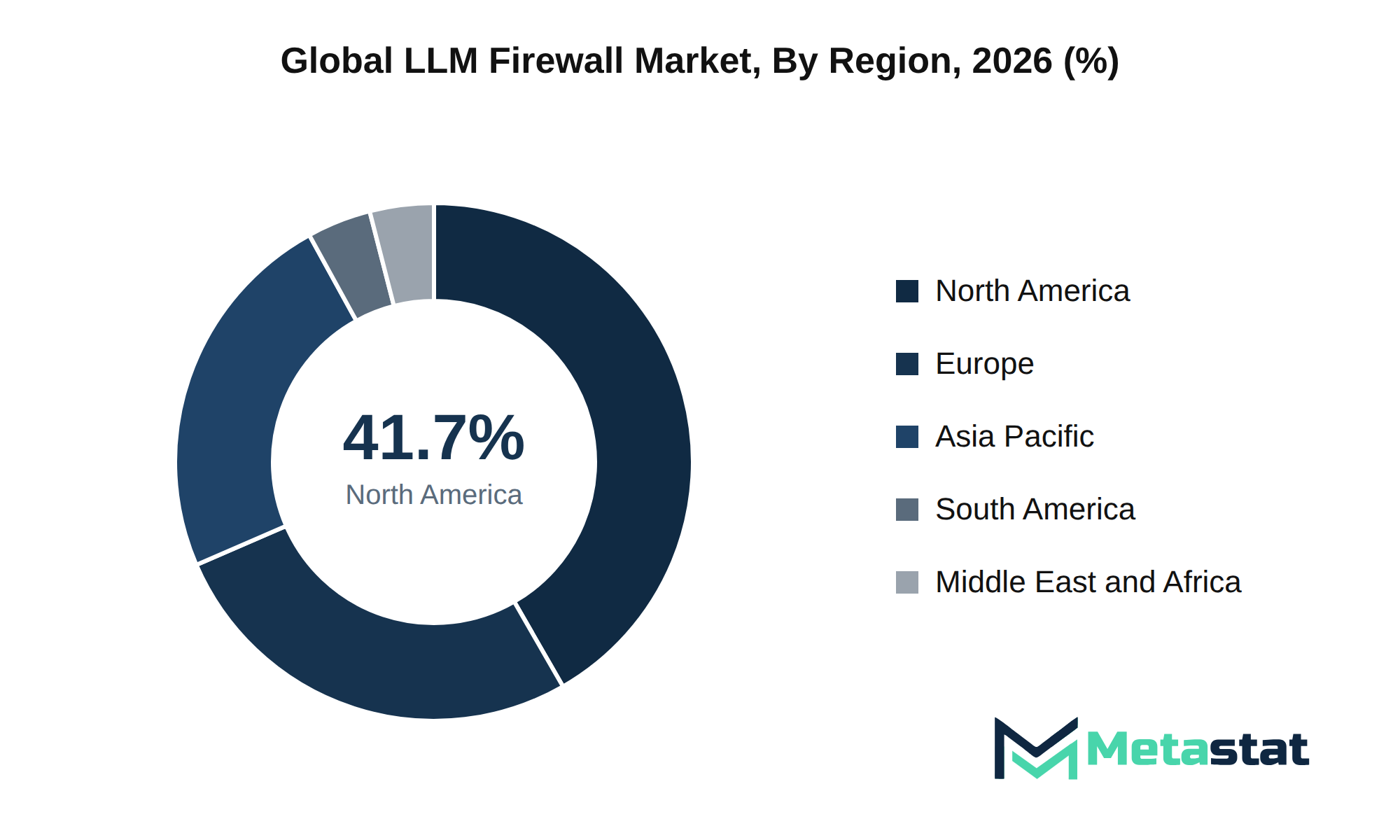
North America commands a share of the LLM Firewall market, accounting for 41.7% of the global market in 2025. This region expands at a CAGR of 18.1% within the forecast period, reaching a market size (TAM) of USD 396.2 million by the end of 2033.
Demand in North America stems from various industries, including IT and telecommunications, healthcare, and finance. The need for robust cybersecurity solutions drives adoption across these sectors. The emergence of threats including model theft and data poisoning enhances urgency around deploying LLM firewalls.
Investment in infrastructure modernization plays a critical role in the regional growth of the market. Organizations prioritize upgrading systems to meet evolving digital security demands, which boosts demand for advanced firewall solutions. Localized manufacturing densities support efficient service delivery and responsiveness to market needs.
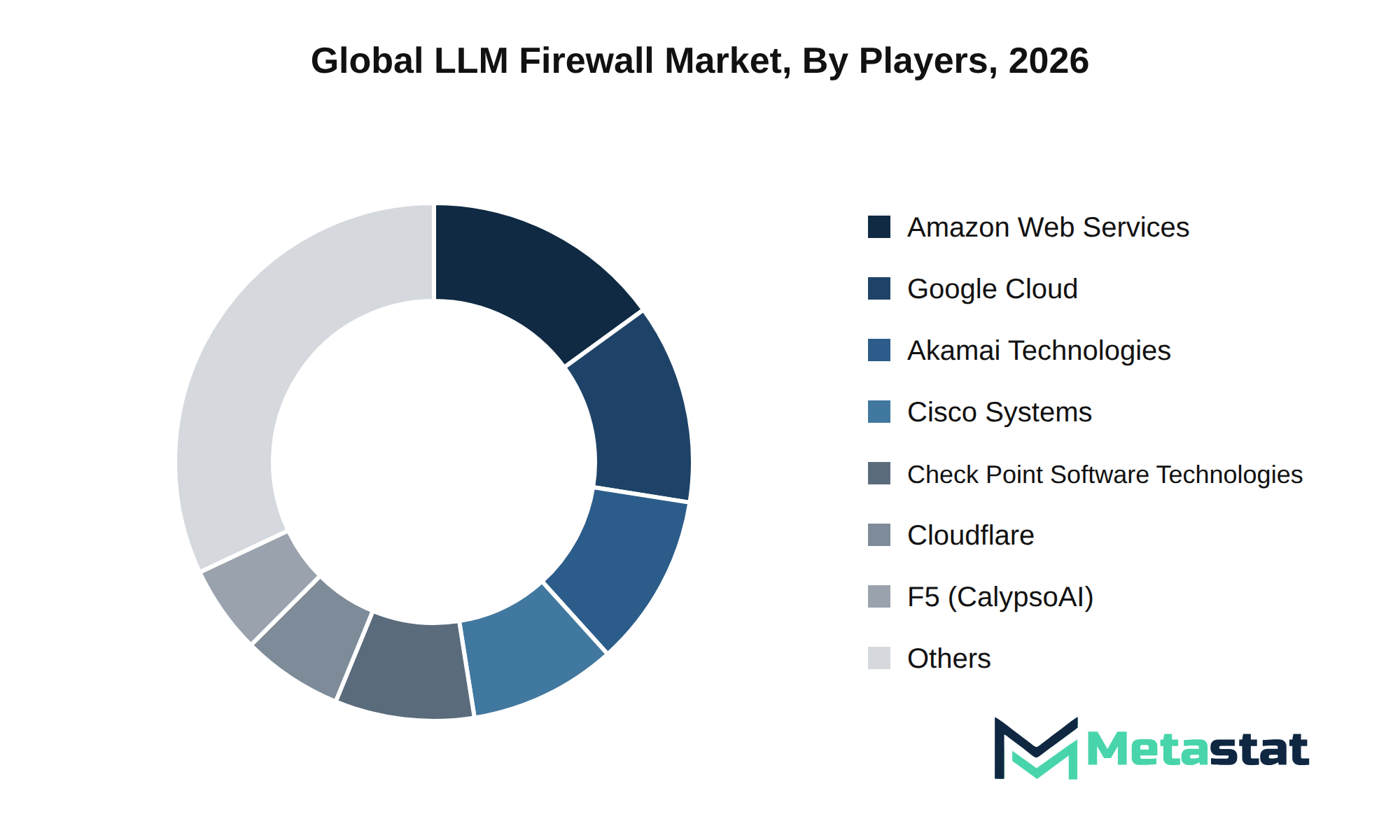
The competitive landscape features several key players, including Akamai Technologies, Amazon Web Services, and Cisco Systems, contributing to innovation and market dynamics. Strategic initiatives include partnerships and technology advancements that enhance product offerings and address specific regional requirements.
Regulatory frameworks in North America influence market dynamics significantly. Organizations comply with stringent local compliance mandates, creating a favorable environment for LLM Firewall adoption and promoting further investment and growth within the sector.
Europe
Europe's share of the global LLM Firewall market reflects substantial interest from various sectors. Countries including Germany, France, the UK, Italy, Spain, and Russia demonstrate significant investment in cybersecurity solutions to mitigate threats like data leakage and model abuse.
The market experiences growth driven by increasing digitalization across industries, with sectors like BFSI, healthcare, and IT leading the adoption of LLM firewalls. This trend is supported by heightened awareness of cybersecurity risks and regulatory requirements emphasizing data protection.
Germany emerges because a frontrunner in this market, leveraging its strong technological infrastructure and investment in digital transformation initiatives. Italy and Spain, while developing, exhibit a growing demand for advanced cybersecurity measures attributed to their modernization of IT frameworks.
Russia's unique geopolitical situation influences its LLM Firewall market dynamics, with a focus on localized solutions to address national security concerns. The rest of Europe presents a mix of matured and emerging markets, each adapting to the evolving threat landscape.
Investment in local manufacturing and supply chain regionalization becomes critical because companies respond to cross-border trade challenges. Ongoing geopolitical fragmentation leads to a shift in regional strategies, pushing firms to localize their operations to enhance compliance and responsiveness.
Continued growth in the market is expected, fueled by the increasing need for advanced threat detection and prevention mechanisms. The focus on agent and tool-call runtime protection is particularly notable, with vendors investing in solutions that address emerging threats in real-time.
Asia-Pacific
Growth in the LLM Firewall market within the Asia-Pacific region is fueled by several factors, including increasing cybersecurity threats and rising digitalization across various sectors. The region's robust demand is driven by key players in countries like China, Japan, and India, where technology adoption rates escalate rapidly. Infrastructure modernization initiatives further encourage market penetration, ensuring that businesses remain competitive in a dynamic environment.
China leads the way with significant investments in technology and cybersecurity measures, while Japan focuses on advanced digital solutions to enhance operational resilience. India exhibits high growth potential due to a strong IT sector and the increasing emphasis on data security, creating opportunities for market expansion. South Korea and Australia maintain strong cybersecurity frameworks, ensuring a conducive atmosphere for the adoption of LLM firewall solutions.
The rapid growth of cloud-based services in Southeast Asia creates additional demand for LLM firewalls, positioning the region because an emerging market front-runner. Local compliance mandates and regulatory frameworks further stimulate growth in underpenetrated territories. Regional competitive landscapes exhibit a mix of domestic market participants and global vendors, driving innovation and efficiency in the supply chain.
Forecast data indicates that the Asia-Pacific share of the global market stands at 23.5% in 2025, with continued growth expected through 2033. The presence of established players, including Akamai Technologies, Amazon Web Services, and Microsoft, creates a competitive environment, pushing advancements in technology and service delivery. The ongoing development of localized manufacturing densities and nearshoring initiatives supports the increasing demand for LLM firewall solutions across the region.
South America
Brazil and Argentina represent significant sources of demand within the LLM Firewall market, driven by the escalating need for cybersecurity solutions. Increasing awareness of cyber threats among businesses drives a shift towards enhanced security measures, especially in sectors including banking and finance, healthcare, and retail. The broader Rest of South America exhibits similar trends, with growing investments in IT infrastructure contributing to market expansion.
Infrastructure modernization significantly influences the region's development. Countries invest in upgrading their digital capabilities, creating an environment conducive to adopting advanced cybersecurity solutions. The local compliance landscape influences purchasing behavior, driven by businesses prioritizing solutions that meet regulatory requirements.
Domestic market participants, including local and international players, intensify competition by introducing innovative products tailored to regional needs. The market's growth dynamics reflect a combination of emerging technologies and evolving customer preferences, positioning South America because a key area for LLM Firewall adoption.
With a projected share of 4.00% of the global market in 2025, South America represents an underpenetrated territory within the sector. Strategic entry barriers exist, yet opportunities for foreign direct investment (FDI) continue to rise, supported by government initiatives aimed at enhancing the regional digital economy.
Middle East and Africa
The LLM Firewall market in the Middle East and Africa is positioned for growth, with the region accounting for 4.00% of the global market share in 2025. Demand arises from heightened cybersecurity needs driven by increasing digital transformation and regulatory compliance across industries. Countries including Saudi Arabia and the UAE show strong adoption rates, reflecting investments in infrastructure modernization and localized manufacturing capabilities. South Africa contributes to this growth through its expanding IT and telecommunications sector, alongside opportunities in emerging markets within the region. The consolidation of domestic market participants and the presence of international vendors further enhances competitive dynamics, promoting innovation and tailored solutions for local challenges.
Adoption rates are influenced by cultural nuances and distinct B2B buying behaviors prevalent in these markets. The drive towards nearshoring initiatives facilitates localized procurement, aligning with global supply chain regionalization trends. Energy grid resiliency and local infrastructure readiness support deployment, especially in cloud and SaaS models. The employment of high-value replacement cycles for legacy systems ensures ongoing investment in advanced firewall solutions. Overall, the LLM Firewall market in the Middle East and Africa is set for significant incremental growth, with opportunities emerging from both mature markets and underpenetrated territories.
Competitive Landscape and Strategic Insights
The LLM Firewall market experiences strategic consolidation driven by mergers and acquisitions, enhancing competitive positioning among key players. Companies including Amazon Web Services, Microsoft, and Cisco Systems actively pursue partnerships and collaborations to broaden their technological capabilities and market reach.
Product differentiation remains a vital strategy, with firms like Fortinet, Palo Alto Networks, and Check Point Software Technologies investing in research and development to create proprietary technology moats. Innovations in deployment modes, particularly cloud-based solutions, are essential for maintaining competitiveness in the market.
Barriers to entry and the threat of new entrants influence the competitive dynamics. Established companies leverage their intellectual property portfolios and brand equity to secure their positions. Customer retention strategies and switching costs play crucial roles in shaping long-term relationships with clients across various industries, including BFSI and healthcare.
The competitive outlook suggests a robust expansion trend in the LLM Firewall market, with players continuously adapting their go-to-market strategies to address evolving customer needs and technological advancements. This adaptation is expected to strengthen long-term demand and increase investment across the value chain.
Forecast and Future Outlook
The LLM Firewall market size is forecast to rise from USD 268.4 million in 2025 to over USD 1,015.9 million by 2033, reflecting a compound annual growth rate (CAGR) of 18.1%. This growth is driven by increased adoption of next-generation technologies, evolving regulatory requirements, and rising concerns over data security across various industries.
Heightened investments in advanced cybersecurity solutions support the bull case for the market. An expanding digital landscape and increasing instances of cyber threats spur this investment. Key sectors, including healthcare and finance, prioritize enhanced security measures, thereby accelerating market growth.
Potential challenges stemming from economic downturns or shifts in policy that limit spending on cybersecurity solutions characterize the bear case. Geopolitical tensions and supply chain disruptions influence purchasing decisions, particularly in regions heavily reliant on global trade.
Overall, the market presents significant opportunities for growth, driven by unmet enterprise needs and advancing technology integration. Strategic capital allocation and infrastructure commitments shape the market landscape over the forecast period.
The report strategically identifies and profiles the key market players and analyses their core competencies in each sub-segment of the LLM Firewall market.
Report Attributes
Details
Study Period
2021-2033
Base Year
2025
Estimated Year
2026
Forecast Period
2026-2033
Historical Period
2021-2025
Growth Rate
CAGR 18.1% from 2026 to 2033
Revenue Unit
USD million
Segmentation
By Component, Deployment Mode, Threat/Risk Coverage Type, End-Use Industry, and Region
By Region
North America (By Component, Deployment Mode, Threat/Risk Coverage Type, End-Use Industry, and Country)
United States
Canada
Mexico
Europe (By Component, Deployment Mode, Threat/Risk Coverage Type, End-Use Industry, and Country)
Germany
France
UK
Italy
Spain
Russia
Rest of the Europe
Asia Pacific (By Component, Deployment Mode, Threat/Risk Coverage Type, End-Use Industry, and Country)
China
Japan
India
South Korea
Australia
Southeast Asia
Rest of Asia Pacific
South America (By Component, Deployment Mode, Threat/Risk Coverage Type, End-Use Industry, and Country)
Brazil
Argentina
Rest of South America
Middle East and Africa (By Component, Deployment Mode, Threat/Risk Coverage Type, End-Use Industry, and Country)
Saudi Arabia
UAE
South Africa
Rest of Middle East and Africa
What Report Provides
Key Company Market Share, Revenue and Ranking for the LLM Firewall Market
Key Market Leaders in the LLM Firewall Industry
Full In-Depth Analysis of the Parent Industry
Industry Statistics and Important Changes in Market Dynamics
Find answers to common questions about this report
The LLM Firewall market size was valued at USD 268.4 million in 2025, according to the Metastat Insights study.
The LLM Firewall market is projected to grow at a CAGR of 18.1% during the forecast period from 2026 to 2033.
The North America LLM Firewall market size is estimated to reach USD 396.2 million by 2033.
The segment "Cloud/SaaS API Gateway" leads the LLM Firewall market with a projected value of USD 488.7 million by 2033, based on deployment mode.
Digital transformation drives the LLM Firewall market by increasing the demand for advanced cybersecurity measures. Organizations prioritize investments in LLM Firewall solutions to protect sensitive data and enhance operational resilience against rising cyber threats, particularly in sectors like finance, healthcare, and telecommunications.
North America holds the dominant share of the LLM Firewall market, accounting for 41.7 percent in 2025. This region is projected to reach USD 396.2 million by 2033.
The LLM Firewall market growth faces challenges from increasing regulatory pressures, compliance costs, and economic conditions including inflation and capital stagnation. supply chain disruptions and a shortage of skilled cybersecurity professionals hinder investment and implementation, ultimately affecting market expansion.
Factors favoring product adoption in the LLM Firewall market include the acceleration of digital transformation, increasing recognition of data protection needs, and the rise of cyber threats. Industries including finance, healthcare, and telecommunications prioritize investments in advanced firewall solutions to enhance operational resilience and ensure compliance with stringent regulations.
The LLM Firewall market is estimated to reach a valuation of USD 1,015.9 million by 2033.
Key players in the LLM Firewall market include Akamai Technologies, Amazon Web Services, Check Point Software Technologies, Cisco Systems, Cloudflare, Fortinet, IBM, and Microsoft.
Industrial RFID Reader Market Size, Share, Trends, 2033
Global Industrial RFID Reader market size: USD 3,640.6 million in 2025, forecast USD 8,153.6 million by 2033 at a 10.6% CAGR. Segment and regional data.
Industrial RFID Reader market, Industrial RFID Reader Market Size, Industrial RFID Reader Market Share, Industrial RFID Reader Market Analysis, Industrial RFID Reader Market Growth, Industrial RFID Reader Market Trends, Industrial RFID Reader Market Research Report, Industrial RFID Reader Market Forecast, Industrial RFID Reader, Industrial RFID Reader Market Research, Industrial RFID Reader Industry, Industrial RFID Reader Industry Report, Industrial RFID Reader Market Data, Industrial RFID Reader Statistics, Industrial RFID Reader Market Statistics, Industrial RFID Reader Industry Trends, Industrial RFID Reader Market Report, Industrial RFID Reader Market Trends, Industrial RFID Reader Market News, Industrial RFID Reader Forecasts, Industrial RFID Reader Market Intelligence Report, Industrial RFID Reader market 2033, Industrial RFID Reader market outlook, Industrial RFID Reader market segmentation, Industrial RFID Reader market drivers, Industrial RFID Reader market restraints, Industrial RFID Reader market opportunities, Industrial RFID Reader market CAGR, Industrial RFID Reader suppliers, Industrial RFID Reader manufacturers, Industrial RFID Reader market by region, North America Industrial RFID Reader market, Asia Pacific Industrial RFID Reader market, Europe Industrial RFID Reader market, Industrial RFID Reader market competitive landscape, Industrial RFID Reader market key players, Fixed RFID Readers market, UHF RFID Readers market, Warehouse and Conveyor Automation market, Logistics and Warehousing market.
Global Online Dating market size reached USD 3.7 billion in 2025 and is forecast to hit USD 7.8 billion by 2033 at a 9.6% CAGR. Segment and regional data.
Online Dating market, Online Dating Market Size, Online Dating Market Share, Online Dating Market Analysis, Online Dating Market Growth, Online Dating Market Trends, Online Dating Market Research Report, Online Dating Market Forecast, Online Dating, Online Dating Market Research, Online Dating Industry, Online Dating Industry Report, Online Dating Market Data, Online Dating Statistics, Online Dating Market Statistics, Online Dating Industry Trends, Online Dating Market Report, Online Dating Market Trends, Online Dating Market News, Online Dating Forecasts, Online Dating Market Intelligence Report, Online Dating market 2033, Online Dating market outlook, Online Dating market segmentation, Online Dating market drivers, Online Dating market restraints, Online Dating market opportunities, Online Dating market CAGR, Online Dating suppliers, Online Dating manufacturers, Online Dating market by region, North America Online Dating market, Asia Pacific Online Dating market, Europe Online Dating market, Online Dating market competitive landscape, Online Dating market key players, Online Dating Apps market, Online Matchmaking Services market, Subscription-Based Online Dating market, Mobile Applications Online Dating market.
Global Containers-As-A-Service (CAAS) market size: USD 7.8 billion in 2025, forecast USD 83.9 billion by 2033 at a 34.4% CAGR. Segment and regional data.