
LEAD ANALYST
Utkarsh Khirodkar is a Lead Market Research Analyst at MetaStat Insight, specializing in market intelligence, technology sector assessments, and competitive strategy.

Global Landfill Gas Market Size, Share, By System Function (Gas Collection and Extraction, Gas Conditioning and Treatment, Biomethane Upgrading, Power Generation and CHP, Flaring and Oxidation, Monitoring and Control), By Offering (Equipment and Systems, Engineering, Installation and Commissioning, Operations, Maintenance and Monitoring Services), By Application (Electricity Generation Only, Combined Heat and Power, Direct Thermal Use, RNG and Biomethane Production, Methane Abatement Only), By Landfill Operating Status (Active Landfills and Closed Landfills), Industry Analysis, Growth, Trends, and Forecast, 2026-2033
Report ID
MSI-5587
Published
October, 2026
Pages
295 Pages
Format
Historical
Base year
Forecast
Forecast period
Report Details
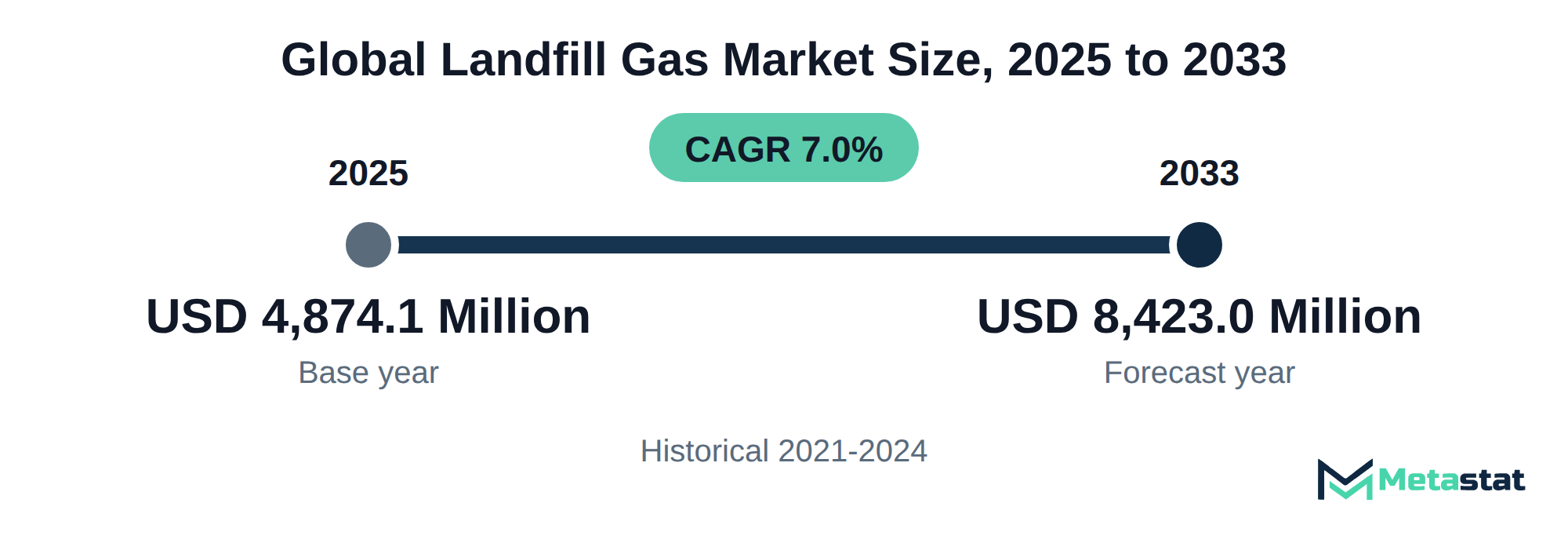
Market Valuation: Valued at $4,874.1 Million in 2025, projected to reach $8,423 Million by 2033 at a 7.0% CAGR.
Dominant Segment: Gas Collection and Extraction leads the Landfill Gas market, driven by the need for efficient methane management and compliance with environmental regulations.
Geographic Lead: North America is the leading region, accounting for 40.6% of the market in 2025, supported by established infrastructure and regulatory frameworks that promote landfill gas utilization.
What's Inside: The report provides a comprehensive analysis of market dynamics, competitive landscape, and detailed forecasts across various segments, including system functions and applications.
Emerging Opportunities: The biomethane upgrading segment is projected to grow at a CAGR of 9.9%, highlighting significant potential for stakeholders focused on renewable energy solutions.
Choose Your License
Global Landfill Gas Market
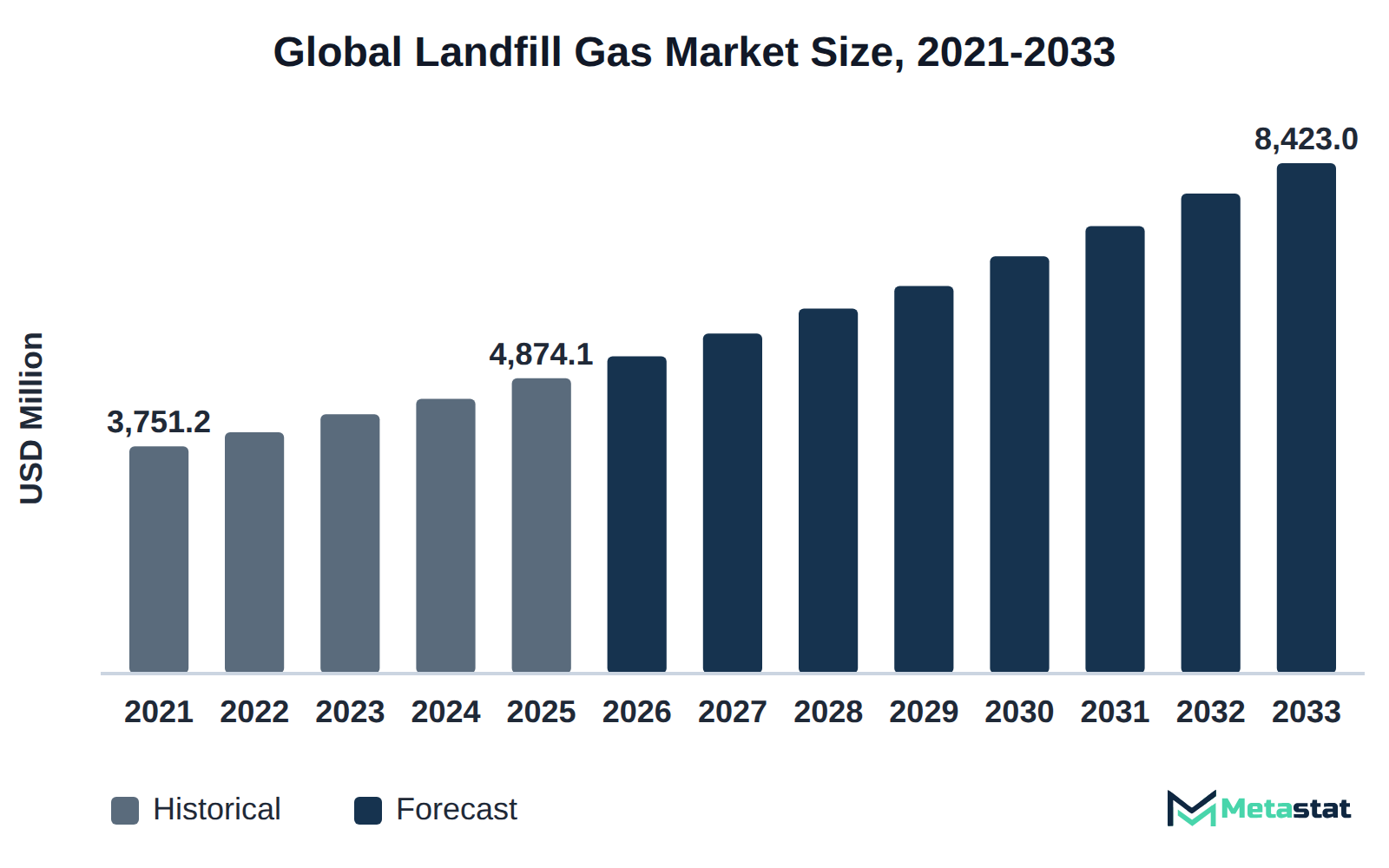
The global Landfill Gas market was valued at USD 4,874.1 million in 2025 and is projected to reach USD 8,423 million by 2033, growing at a CAGR of 7.0% over the forecast period.
The Landfill Gas market encompasses the collection, treatment, and utilization of methane and other gases emitted from landfills. Buyers invest in this market primarily to utilize renewable energy sources, comply with regulations, and reduce greenhouse gas emissions. The technologies involved enable organizations to convert landfill gas into electricity and heat, fulfilling growing energy demands while addressing environmental concerns.
Growth in the market is driven by increasing awareness of the benefits of renewable energy and waste management practices. The segment generating the highest revenue is Gas Collection and Extraction, which maximizes the efficiency of landfill operations. North America holds 40.6% of the market in 2025, with the US leading in 2026. This region's established infrastructure and regulatory support significantly contribute to its market dominance.
Innovation in gas conditioning and treatment technologies expands the potential of the Landfill Gas market. Demand for cleaner energy solutions continues to rise, propelling investments in advanced systems that improve gas quality and energy recovery. With ongoing advancements, the market is positioned for significant growth, attracting stakeholders focused on sustainable energy solutions.
The market consists of various segments, including gas collection, conditioning, treatment, and utilization of landfill gas. Buyers invest in this market due to increasing demand for sustainable energy solutions and regulatory requirements aimed at reducing greenhouse gas emissions. Effective landfill gas management drives expenditures, ensuring compliance with environmental standards while promoting renewable energy generation. The electricity generation segment represents the largest value in the market, attracting significant attention from investors and stakeholders seeking cleaner energy alternatives.
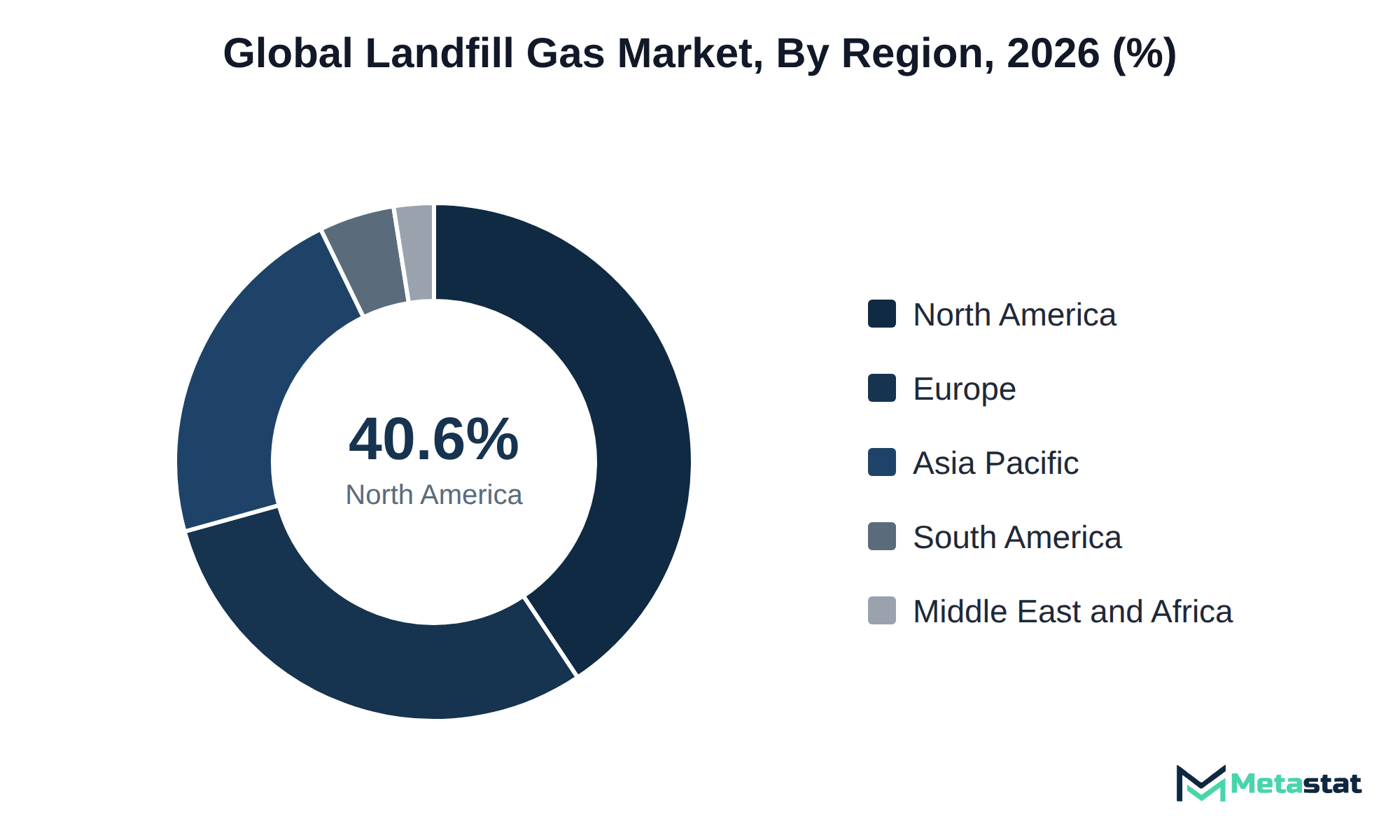
North America is projected to account for a significant share of the market in 2025, supported by its well-established infrastructure, regulatory support, and high levels of investment in landfill gas projects. Europe follows closely, accounting for 30% of the market, driven by stringent environmental policies and a growing focus on renewable energy. Asia Pacific, representing 22.1%, experiences rising interest in landfill gas technologies, reflecting regional commitments to improved waste management practices.
Growth in the landfill gas market is primarily driven by increasing adoption of renewable natural gas (RNG) and biomethane production technologies. Landfill sites are one feedstock source within the wider biogas industry that supports biomethane production. These advancements facilitate the conversion of landfill gas into usable energy, contributing to enhanced sustainability efforts. Strong demand for clean energy solutions leads to greater investments in equipment and systems, positioning the market for expansion throughout the forecast period.
Nitrogen removal and methane recovery influence the economics of biomethane projects within the Landfill Gas market. Efficient nitrogen removal enhances the quality of the produced biomethane, making it suitable for various applications, including integration into natural gas grids and fueling vehicles. Grid integration also links biomethane projects to oil and gas infrastructure. In this context, the demand for biomethane upgrading technologies is expected to rise, with projections indicating that this segment will reach a value of USD 2,136.9 million by 2033.
Advanced technologies for nitrogen removal, including pressure swing adsorption and gas separation membranes, enable higher yields of methane while maintaining compliance with stringent quality standards. These technologies improve the operational efficiency of biomethane production systems. Significant investments in upgrading infrastructure lead to better project financial viability and attract more stakeholders in the market.
Efficient methane recovery and nitrogen removal improve the competitiveness of biomethane projects in the broader energy sector. As energy policies and environmental regulations evolve, projects emphasizing these technologies are likely to secure more investment and drive growth in the biomethane sector.
Repowering decisions for gas engines in the Landfill Gas market are significantly influenced by the declining yield of landfill methane. The cost-effectiveness of existing systems often comes into question when methane production diminishes, prompting operators to reconsider their energy generation strategies. For instance, the estimated value of the Gas Collection and Extraction segment is projected to increase from USD 1,281 million in 2026 to USD 1,952.4 million by 2033, illustrating a growing focus on optimizing extraction processes to maintain profitability given changing landfill conditions.
Contract models in this market frequently revolve around performance-based agreements, where operators compensate energy providers based on the volume of gas produced. Such models create an incentive for continuous improvement in extraction techniques and overall system efficiency. As landfills age, operators experience a reduction in gas yield, compelling them to evaluate whether to invest in repowering or maintaining existing infrastructure. This decision directly impacts operational costs and revenue potential, shaping the competitive landscape within the market.
Understanding the relationship between declining methane yield and gas engine repowering decisions is essential for stakeholders in the Landfill Gas market. Effective management of contracts and procurement strategies in response to these dynamics enhances operational efficiency and supports long-term sustainability goals.
Closed landfills face unique challenges in managing residual gas emissions and ensuring environmental compliance. Low-calorific flares have emerged as effective solutions for mitigating these emissions, offering a way to safely burn off excess landfill gas. Flare monitoring helps operators confirm that burn-off activity stays within environmental compliance requirements. This technology enhances operational efficiency while minimizing potential air quality issues associated with closed landfills.
The Landfill Gas market reflects significant advancements in monitoring practices, including remote monitoring systems. These emission monitoring systems allow operators to oversee gas emissions in real time, enabling prompt responses to any irregularities. By 2033, the segment for Closed Landfills and Aftercare is projected to reach USD 2,540.4 million, demonstrating substantial commercial opportunity for companies that prioritize innovative monitoring solutions.
Investments in low-calorific flares and advanced remote monitoring systems enable landfill operators to maintain compliance while optimizing operations. This approach reduces long-term liabilities and helps companies meet regulatory demands within the Landfill Gas market.
Upgrading landfill gas to biomethane is more viable than generating electricity when conditions favor higher returns from biomethane production. The market for biomethane is projected to grow significantly, reflecting a compound annual growth rate (CAGR) of 9.9%. This growth stems from increasing demand for renewable natural gas (RNG), driven by energy policies and consumer preferences for cleaner energy sources.
Investment in biomethane systems, particularly for applications including RNG and biomethane production, offers competitive advantages. The market for electricity generation has a CAGR of 5.7%, indicating that the potential financial returns from upgrading landfill gas surpass those from traditional electricity generation methods. By focusing on biomethane production, operators benefit financially while contributing to sustainability goals.
With the growing emphasis on renewable energy, the landfill gas market presents opportunities for companies investing in biomethane technology. Prioritizing the upgrade of landfill gas to biomethane improves profitability and strengthens market position as energy markets evolve.
Growing interest in renewable energy sources increases investment in landfill gas technologies. Industries including waste management and energy production increasingly adopt landfill gas solutions due to their potential to generate renewable energy. Rising costs of traditional energy sources encourage firms to explore cost-effective alternatives, leading to increased landfill gas utilization in power generation. From 2026 to 2033, the market is projected to grow from USD 5,233.2 million to USD 8,423 million, reflecting a compound annual growth rate of 7%. This shift toward renewable energy indicates a significant driver within the landfill gas market, promoting heightened adoption and investment in related technologies.
Technological innovations in gas conditioning enhance the efficiency of landfill gas utilization. Improved processes for the removal of impurities, including nitrogen and moisture, lead to higher quality output. Enhanced gas conditioning systems minimize operational failures, ensuring consistent gas supply to end-users. This development attracts several buyers, including energy producers and industrial manufacturers, seeking reliable renewable energy sources.
Investment in advanced gas conditioning technologies results in increased adoption of landfill gas across multiple applications. The market experiences growth driven by rising demand for sustainable energy solutions, particularly in electricity generation and combined heat and power applications. Enhanced gas conditioning methods provide an opportunity for landfill operators to optimize gas recovery, thus maximizing revenue potential. The focus on reducing environmental impact further supports market expansion, with stakeholders prioritizing compliance with emission reduction targets.
Price volatility in the Landfill Gas market creates challenges for several buyer groups, particularly municipalities and waste management companies. Significant fluctuations in equipment and installation costs delay investment decisions, with budget constraints becoming more pronounced during economic instability. Higher costs associated with engineering and monitoring services directly impact project feasibility, leading to slower uptake in new installations. This situation forces buyers to reconsider or postpone projects aimed at upgrading existing landfill gas systems or establishing new facilities.
Such delays result in smaller orders and reduced overall market demand, hindering the expansion of operational capacity. The pressure to maintain cost efficiencies often leads to prioritizing essential replacements over upgrades, stalling technological advancement within the sector. These dynamics create a challenging environment for companies aiming to capture market share while maintaining profitability during fluctuating prices.
Suppliers in the Landfill Gas market face significant challenges related to increasing input costs. Fluctuations in the prices of equipment, materials, and labor influence overall project expenses. Many companies experience tighter profit margins due to these rising costs, prompting them to reassess their operational strategies. A trend toward long-term contracts with suppliers has emerged, enabling companies to stabilize costs and secure necessary materials. Investment in automation technologies reduces reliance on labor while enhancing operational efficiency. These measures support better cost management while meeting growing demand for landfill gas applications. However, ongoing price pressures continue to challenge profitability within the market.
Biomethane upgrading presents a significant growth opportunity within the Landfill Gas market, driven by increasing demand for renewable energy sources and supportive environmental policies. This segment exhibits a compound annual growth rate of 9.9%, highlighting its potential in the market landscape. The rising need for cleaner energy alternatives among various buyer groups, including municipalities and energy producers, fuels interest in biomethane projects. The technology behind biomethane production enables effective methane recovery and nitrogen removal, enhancing project economics and operational efficiency. With market investments in biomethane upgrading projected to reach USD 2,136.9 million by 2033, this segment is a strategic focus for stakeholders looking to capitalize on demand for sustainable energy solutions. The expansion of the Landfill Gas market in this area aligns with broader trends aiming for reduced greenhouse gas emissions and enhanced waste management practices.
The Global Landfill Gas market is segmented based on System Function, Offering, Application, and Landfill Operating Status.
This segment is essential for capturing and managing methane emissions from landfills, primarily by waste management companies and energy producers seeking to convert waste gases into renewable energy. The demand for efficient gas collection systems drives growth, influenced by increasing regulatory requirements for emissions control and the transition toward cleaner energy sources. Compared to other segments, including Gas Conditioning and Treatment, which has a CAGR of 7.4%, Gas Collection and Extraction experiences relatively slower growth. However, it remains vital for optimizing landfill gas management and reducing greenhouse gas emissions.
Gas Conditioning and Treatment segment is estimated to reach USD 1,383.1 million by 2033, at a CAGR of 7.4% during the forecast period. This segment focuses on the cleaning and preparation of landfill gas for further utilization, ensuring it meets the quality standards required for various applications. Key users of this segment include energy producers and waste management companies, who rely on effective gas conditioning to optimize energy output and comply with environmental regulations. The segment experiences growth driven by rising demand for cleaner energy sources and advancements in gas treatment technologies. Compared to other segments, this segment exhibits a moderate growth rate, reflecting its importance in maintaining operational efficiency while addressing environmental concerns related to landfill gas emissions. Enhanced treatment processes improve overall system performance, setting it apart from other segments within the broader market.
This segment focuses on converting landfill gas into high-quality biomethane, primarily for transportation and as a natural gas substitute. Adoption of biomethane upgrading technology is driven by increasing demand for renewable energy and stringent regulations on greenhouse gas emissions. The higher price associated with this segment reflects advanced processing requirements compared to other segments, including gas collection and extraction, which have lower capital intensity and operational costs. Biomethane upgrading's projected CAGR of 9.9% highlights its faster growth trajectory relative to the broader offerings in the market. This segment serves a diverse range of customers, including energy producers and municipal utilities, further enhancing its market significance.
Power Generation and CHP segment is projected to grow at a CAGR of 5.4% during the forecast period. This segment primarily focuses on converting landfill gas into electricity and useful thermal energy, serving industries seeking renewable energy solutions. The electricity output connects this segment to the broader power generation industry. Demand in this segment stems from industrial facilities and municipalities aiming to reduce reliance on fossil fuels and lower greenhouse gas emissions. Regulatory incentives promoting renewable energy adoption further drive market growth. Unlike other segments, this one emphasizes the dual use of energy, highlighting its role in supporting both electricity generation and combined heat production. The focus on energy efficiency differentiates this segment, appealing to buyers prioritizing sustainability while navigating rising energy costs.
Flaring and Oxidation involves the controlled burning of landfill gas to prevent the release of untreated methane into the atmosphere. This process serves municipalities and waste management companies by managing residual emissions while ensuring compliance with environmental regulations. Regulatory frameworks increasingly emphasize emission control, driving demand in this segment. Unlike other segments, Flaring and Oxidation typically experiences slower growth due to the preference for gas recovery and utilization technologies that offer higher economic returns. Companies focusing on emissions control face challenges related to evolving regulations and the need for efficient technologies that minimize flaring practices. The overall trend toward sustainable waste management practices fuels interest and investment in effective flaring solutions, benefiting both environmental initiatives and public health.
Monitoring and Control involves the use of advanced systems to oversee landfill operations, ensuring optimal gas management and compliance with environmental regulations. Operators and facility managers depend on this segment for accurate data to maintain safety and efficiency in gas collection and treatment processes. Key drivers influencing this segment include regulatory pressures for emissions monitoring and advancements in sensor technologies, including gas detection equipment, that enhance operational oversight. Compared to other segments within the System Function classification, Monitoring and Control experiences slower growth due to the high initial investment required for deploying sophisticated monitoring systems. However, the increasing focus on environmental sustainability and compliance presents continuous demand for these technologies, which support the overall objectives of the market.
Equipment and Systems segment is valued at USD 3,239.3 million in 2026 and is projected to reach USD 5,042 million by 2033, at a CAGR of 6.5% during the forecast period. This segment includes the equipment and systems that facilitate the collection, treatment, and recovery of landfill gas. Industries including waste management, energy generation, and environmental services employ these systems to optimize landfill gas recovery and reduce greenhouse gas emissions. A primary driver for this segment stems from increasing regulatory requirements surrounding waste management and environmental sustainability. This segment exhibits faster growth in comparison to others within its group, driven by technological advancements and the shift toward renewable energy solutions. Pricing dynamics differ from other segments, affecting investment decisions and overall market demand.
Engineering, Installation and Commissioning segment is estimated to reach USD 1,628.2 million by 2033, at a CAGR of 6.8% during the forecast period. This segment serves various stakeholders, including landfill operators and energy producers, by providing essential services to install and maintain gas collection systems efficiently. The rising focus on enhancing operational efficiency and compliance with environmental regulations drives demand for these services. Compared to other segments, this segment experiences moderate growth, reflecting a stable demand landscape, influenced by regulatory pressures and advancements in technology. The market remains competitive, with service providers emphasizing quality and reliability. Stakeholders prioritize cost-effectiveness alongside compliance, shaping operational decisions. The Engineering, Installation and Commissioning segment distinguishes itself from others by emphasizing tailored solutions for specific landfill conditions and operational requirements, ensuring alignment with evolving market dynamics.
Operations, Maintenance and Monitoring Services segment is expected to reach USD 1,752.8 million by 2033. This segment encompasses essential functions including regular inspections, repairs, and ongoing monitoring of landfill gas systems, ensuring efficient operation and compliance with environmental regulations. Waste management companies and landfill operators rely on these services to maintain optimal performance while addressing regulatory requirements. Increasing regulatory scrutiny surrounding emissions and environmental standards drives demand for these services. Compared to other segments, this segment experiences steady growth, with a CAGR of 6.8%, indicating a consistent need for maintenance and oversight. This growth pace reflects how much the Landfill Gas market relies on these services to sustain operations and enhance environmental compliance.
Electricity Generation Only segment is valued at USD 2,225.9 million in 2026 and is projected to reach USD 3,277.4 million by 2033, at a CAGR of 5.7% during the forecast period. This segment provides renewable electricity generated from landfill gas, primarily serving utility companies and industrial users seeking sustainable energy sources. Demand in this segment is influenced by increasing government incentives for renewable energy and stricter emissions regulations, which drive investment in clean energy technologies. Unlike other applications including Combined Heat and Power, which experiences a CAGR of 6.6%, this segment exhibits a slower growth trajectory due to unique infrastructure requirements and longer payback periods associated with electricity generation. The emphasis on renewable energy production aligns with broader environmental goals, positioning the market for continued expansion.
Combined Heat and Power segment is estimated to reach USD 1,157.3 million by 2033, at a CAGR of 6.6% during the forecast period. This segment focuses on generating both electricity and useful heat from landfill gas, serving industries and municipalities looking to optimize energy efficiency. Recovering useful heat in this way relates closely to waste heat recovery practices in industrial settings. Growing environmental regulations emphasizing reduced greenhouse gas emissions drive demand within this segment, with organizations increasingly seeking sustainable solutions for energy generation. Compared to other applications, Combined Heat and Power experiences a higher growth rate, reflecting broader adoption driven by the dual benefits of providing energy and supporting environmental goals. The market continues to evolve with advancements in technology, enhancing the efficiency and reliability of systems that harness landfill gas for Combined Heat and Power applications.
Direct Thermal Use segment is expected to reach USD 717.6 million by 2033. This segment focuses on using landfill gas directly for thermal energy applications, appealing primarily to industrial facilities and commercial users seeking to reduce dependency on conventional energy sources. Rising awareness of environmental sustainability significantly influences demand in this segment, driven by regulations targeting greenhouse gas emissions and the promotion of renewable energy initiatives. Compared to other segments, Direct Thermal Use features a unique position in pricing, focusing on immediate thermal applications rather than energy conversion processes. The segment’s growth trajectory differs; it experiences a more moderate expansion compared to others, aligning with an overall CAGR of 6.6%. Its strategic importance lies in providing immediate energy solutions while supporting the transition towards cleaner energy practices. The market anticipates sustained interest and investment in this area, enhancing its growth potential.
RNG and Biomethane Production segment is projected to grow at a CAGR of 9.9% during the forecast period. This segment focuses on converting landfill gas into renewable natural gas (RNG) and biomethane, which find applications in various industries, including transportation and heating. Increasing environmental regulations and the push for renewable energy sources drive this segment's growth. Unlike other applications, RNG and Biomethane Production offers a higher price point due to its specialized processing requirements and the value derived from cleaner energy alternatives. The adoption of RNG aligns with corporate sustainability goals, prompting industries to seek partnerships with suppliers for reliable sourcing. Companies operating in this market face pressures to innovate and improve efficiency, ensuring competitive pricing while meeting regulatory standards, ultimately contributing to the expansion of the market.
Methane Abatement Only focuses on reducing methane emissions from landfills, targeting environmental sustainability goals. This segment is significant for waste management companies and environmental regulators striving to mitigate climate change impacts. Regulatory pressures drive demand for methane abatement technologies, leading to increased investment in effective solutions. Buyers, primarily municipalities and private waste management firms, prioritize compliance with stringent emissions regulations, fueling the segment's relevance. Unlike other applications, the emphasis on methane reduction sets this segment apart, appealing to environmentally conscious stakeholders. The market experiences unique dynamics influenced by the growing recognition of methane's potency as a greenhouse gas, resulting in heightened interest in abatement strategies and technologies.
Active Landfills segment is valued at USD 3,769.7 million in 2026 and is projected to reach USD 5,882.6 million by 2033, at a CAGR of 6.6% during the forecast period. This segment focuses on managing active waste sites where landfill gas is generated and used for various applications. Energy producers and waste management companies use this segment to generate electricity and heat from the captured gas, supporting renewable energy goals. Growth in this segment is influenced by increasing regulations promoting waste-to-energy initiatives, which encourage the expansion of active landfills and the technologies associated with them. The Active Landfills segment experiences relatively steady growth, driven by the need for sustainable waste management solutions and energy recovery, rather than the rapid fluctuations seen in closed landfill operations.
Closed Landfills and Aftercare segment is estimated to reach USD 2,540.4 million by 2033, at a CAGR of 8.2% during the forecast period. This segment primarily focuses on managing and monitoring closed landfill sites, ensuring compliance with environmental regulations and mitigating any potential hazards. Operators in this segment include waste management companies and environmental consulting firms that oversee the long-term care and monitoring of former landfill sites. The growing emphasis on environmental sustainability drives demand for effective aftercare solutions, enhancing the safety and ecological integrity of these sites. Compared to the Active Landfills segment, which is projected to grow at a CAGR of 6.6%, the Closed Landfills and Aftercare segment experiences a faster growth rate. This distinction reflects increasing regulatory standards and public awareness surrounding landfill closure practices and aftercare management in the Landfill Gas market.
Based on geography, the Global Landfill Gas market is divided into North America, Europe, Asia-Pacific, South America, Middle East, and Africa.
Demand for the Landfill Gas market in North America is driven by various industries, including waste management and energy production. Regulatory frameworks emphasize the importance of landfill gas utilization to reduce greenhouse gas emissions. The integration of advanced technologies in gas collection and conditioning enhances operational efficiency, addressing environmental concerns effectively. By 2033, North America is projected to reach USD 3,279.9 million. The region accounted for 40.6% of the global market in 2025, indicating a strong presence in landfill gas infrastructure and services. Countries including the United States, Canada, and Mexico play significant roles in advancing landfill gas projects, with substantial investments focused on renewable energy initiatives.
In Europe, the landfill gas market demonstrates significant growth due to increasing regulatory pressure for waste management and renewable energy generation. Countries including Germany and the UK prioritize sustainability initiatives, driving substantial investments in landfill gas collection and utilization technologies. The region's focus on reducing greenhouse gas emissions aligns with the rising demand for energy-efficient solutions, particularly in power generation and biomethane production. Infrastructure development in waste management facilities enhances gas collection capabilities, contributing to market expansion. By 2025, Europe is projected to hold a 30.0% share of the global market, highlighting the strategic importance of this region.
In the Asia-Pacific region, the Landfill Gas market experiences significant growth driven by increasing investments in renewable energy and stringent environmental regulations. Countries like China and India lead the charge, focusing on waste management solutions that utilize landfill gas for energy production. Infrastructure improvements in waste management systems further enhance market potential. Technological advancements in gas collection and treatment systems support this shift by making landfill gas capture more efficient. South Korea and Australia are making strides in adopting these technologies, leading to increased operational capacity. The region's share of the global market reached 22.1% in 2025, reflecting robust demand for landfill gas solutions.
South America held a 4.7% share of the Landfill Gas market in 2025, offering distinct growth opportunities. Brazil and Argentina lead the demand for landfill gas due to an increasing focus on renewable energy and waste management solutions. Government initiatives promoting sustainable practices contribute to expanding investments in gas collection and utilization technologies. The need for efficient waste management systems drives the market, particularly in urban areas where landfill capacities are reaching limits. Infrastructure challenges persist in rural regions, hindering widespread adoption. However, growing awareness of environmental issues and the benefits of landfill gas recovery support the market's potential. The landfill gas market in South America is projected to grow steadily, aligning with global trends toward cleaner energy sources.
The Landfill Gas market in the Middle East and Africa focuses on sustainability and renewable energy initiatives. Demand predominantly arises from industries including waste management and energy production. Countries like Saudi Arabia and the UAE invest in infrastructure to enhance waste-to-energy projects, reflecting a commitment to environmental goals. South Africa presents opportunities for landfill gas utilization, driven by an increasing focus on reducing greenhouse gas emissions. The market's share of the global landscape is projected to expand through 2033. Regulatory frameworks supporting renewable energy projects influence investment decisions and drive growth in the market.
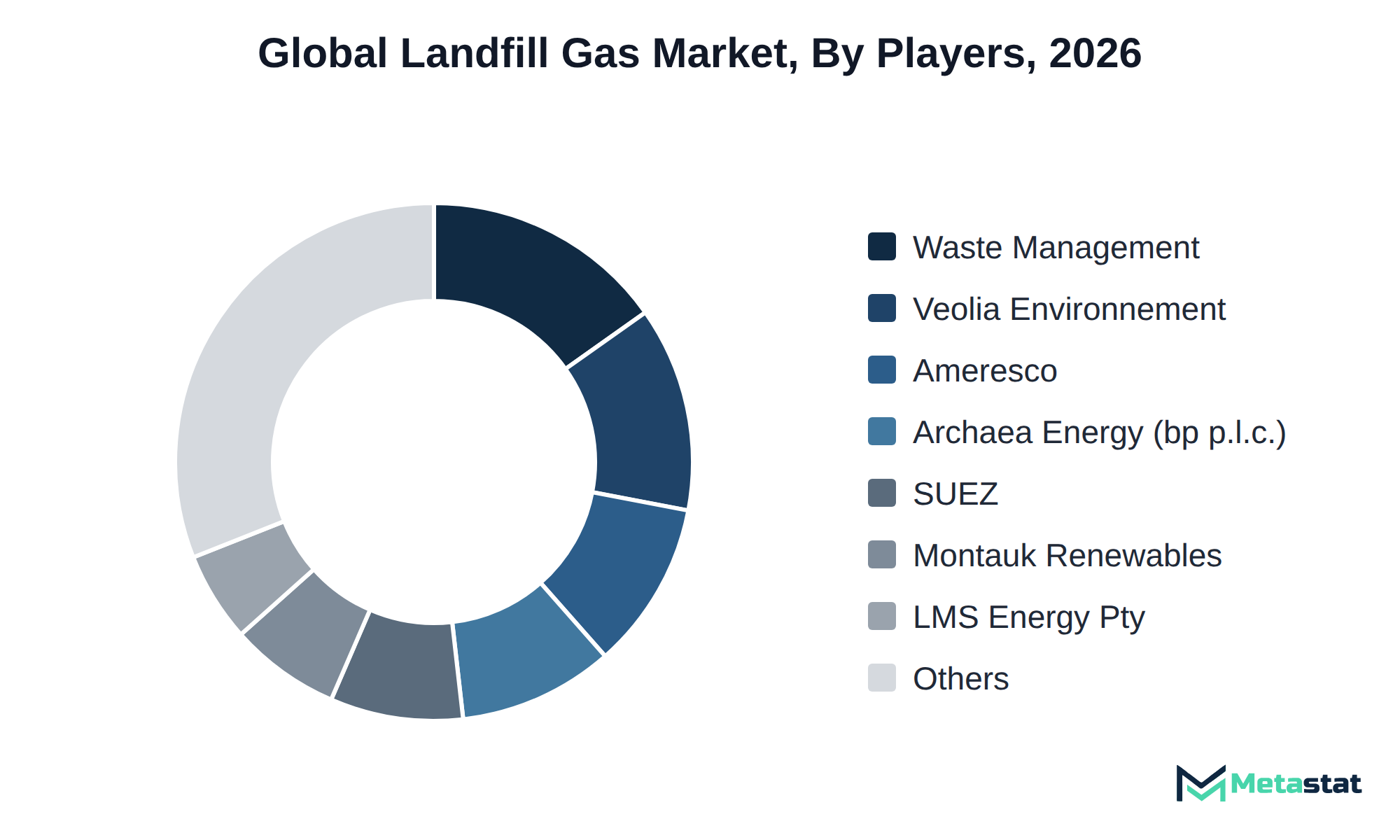
The competitive environment within the Landfill Gas market features various companies employing distinct strategies to capture market share. Companies differentiate themselves based on service types, product offerings, and operational capabilities. Buyers prioritize factors including price, certification, customization, and the overall service ecosystem when selecting suppliers.
Ameresco, Inc. emphasizes comprehensive solutions in the market, focusing on equipment and systems that enhance gas collection and extraction efficiency. Archaea Energy (bp p.l.c.) prioritizes innovative technologies in gas conditioning, addressing the growing demand for biomethane upgrading. Veolia Environnement S.A. concentrates on operational services and maintenance, ensuring reliable system performance across various landfill sites.
Achieving this growth relies on several key developments within the market. The RNG and Biomethane Production application segment presents significant potential, with a strong growth forecast driving further adoption. However, challenges related to regulatory frameworks and environmental policies hinder progress. These factors create uncertainty among investors and stakeholders, impacting market dynamics. North America, comprising 40.6% of the market share, is likely to influence overall growth trends. The combination of technological advancements and supportive regulations will play a crucial role in determining the trajectory of the Landfill Gas market in the coming years. Landfill gas projects also form part of the wider energy transition toward cleaner fuel sources.
By System Function: Gas Collection and Extraction, Gas Conditioning and Treatment, Biomethane Upgrading, Power Generation and CHP, Flaring and Oxidation, Monitoring and Control
By Offering: Equipment and Systems, Engineering, Installation and Commissioning, Operations, Maintenance and Monitoring Services
By Application: Electricity Generation Only, Combined Heat and Power, Direct Thermal Use, RNG and Biomethane Production, Methane Abatement Only
By Landfill Operating Status: Active Landfills, Closed Landfills and Aftercare
The report strategically identifies and profiles the key market players and analyses their core competencies in each sub-segment of the Landfill Gas market.
Report Attributes | Details |
Study Period | 2021-2033 |
Base Year | 2025 |
Estimated Year | 2026 |
Forecast Period | 2026-2033 |
Historical Period | 2021-2025 |
Growth Rate | CAGR 7.0% from 2026 to 2033 |
Revenue Unit | USD million |
Segmentation | By System Function, Offering, Application, Landfill Operating Status, and Region |
By Region | North America (By System Function, Offering, Application, Landfill Operating Status, and Country)
|
Europe (By System Function, Offering, Application, Landfill Operating Status, and Country)
| |
Asia Pacific (By System Function, Offering, Application, Landfill Operating Status, and Country)
| |
South America (By System Function, Offering, Application, Landfill Operating Status, and Country)
| |
Middle East and Africa (By System Function, Offering, Application, Landfill Operating Status, and Country)
|
Find answers to common questions about this report
The Landfill Gas market size was valued at USD 4,874.1 million in 2025.
The market is projected to grow at a CAGR of 7.0% during the forecast period from 2026 to 2033.
The North America Landfill Gas market size is estimated to reach USD 3,279.9 million by 2033.
Biomethane Upgrading leads the Landfill Gas market with a projected value of USD 2,136.9 million by 2033, based on its significant growth potential compared to other segments.
Key drivers for the Landfill Gas market include rising interest in renewable energy sources, which increases investment in landfill gas technologies. Technological innovations in gas conditioning improve efficiency, attracting buyers seeking dependable renewable energy solutions.
North America holds the dominant share of the Landfill Gas market, with a value of USD 3,279.9 million in 2033, representing 40.6 percent of the total market.
Price volatility in the Landfill Gas market restrains growth due to significant fluctuations in equipment and installation costs. These variations delay investment decisions for municipalities and waste management companies, resulting in slower uptake of new installations.
Growing demand for renewable energy sources and supportive environmental policies favor the adoption of biomethane upgrading within the Landfill Gas market. This segment's projected compound annual growth rate of 9.9% reflects its potential to enhance project economics and operational efficiency, attracting interest from municipalities and energy producers.
The Landfill Gas market is estimated to reach a valuation of USD 8,423 million by 2033.
Key players operating in the Landfill Gas market include Ameresco, Inc., Archaea Energy (bp p.l.c.), Waga Energy S.A., EDL, Veolia Environnement S.A., Waste Management, Inc., Montauk Renewables, Inc., and Re Sustainability Limited.
The analysts below cover Energy and Power research at Metastat Insights.
LEAD ANALYST
Utkarsh Khirodkar is a Lead Market Research Analyst at MetaStat Insight, specializing in market intelligence, technology sector assessments, and competitive strategy.

PRINCIPAL CONSULTANT - ENTERPRISE AI & EMERGING TECHNOLOGIES
Banking & Finance · Electronics and Semiconductor · Energy and Power · Healthcare IT · Information & Technology · Professional Services
Vijay Gunti is a Principal Consultant at MetaStat Insight, bringing over two decades of experience across enterprise digital transformation, technology strategy, and intelligent systems.

ENERGY & INFRASTRUCTURE INDUSTRY CONSULTANT
Automotive and Transportation · Electronics and Semiconductor · Energy and Power · Machinery & Equipment
Saurabh Vasant Ganvir consults for Energy & Infrastructure Industry at MetaStat Insight, specializing in renewable energy, solar EPC, and electric vehicle (EV) infrastructure markets.
Tracking ceramic matrix composite adoption in high-bypass aero engines requires strict attention to material qualification cycles and FAA airworthiness testing milestones. The MetaStat Insight team provided a detailed timeline of silicon carbide fiber manufacturing capacity and commercial foundry lead times. Having clear visibility into upstream thermal barrier coating supply helped us stress-test our long-term component procurement strategy.
Transitioning ultra-class mining haul trucks to alternative power requires concrete data on remote hydrogen refueling infrastructure economics. The report evaluated megawatt-scale electrolyzer installation expenses, onsite storage safety mandates, and heavy-duty fuel cell stack degradation under continuous duty cycles. That technical rigor helped our engineers benchmark realistic total operating cost horizons for off-highway fleet decarbonization.
Enterprise zero-trust network rollouts are often slowed down by multi-cloud transit latency and proprietary hardware retirement schedules. This study provided realistic total cost of ownership models comparing cloud-delivered security edge solutions against traditional hardware refreshes. The analysis of contract renewal lengths and software maintenance fees gave us clear visibility into enterprise replacement cycles over the next three to five years.
Explore related market intelligence reports worth reading alongside this one.