
LEAD ANALYST
Utkarsh Khirodkar is a Lead Market Research Analyst at MetaStat Insight, specializing in market intelligence, technology sector assessments, and competitive strategy.

Global Smart Water Management Market Size, Share, By Component (Smart Water Monitoring Hardware, Smart Water Software Platforms, Integration, Deployment and Managed Services), By Technology (Internet of Things (IoT), Artificial Intelligence and Machine Learning (AI & ML), Geographic Information Systems (GIS), Big Data and Analytics, Others (Blockchain, Cloud Computing)), By Application (Smart Metering and Customer Consumption Management, Water Distribution Network Monitoring and Leakage Management, Water Quality Monitoring and Compliance Management, Water and Wastewater Treatment Process Monitoring and Automation, Stormwater, Flood and Source-Water Monitoring, Others (Smart Irrigation and Rainwater Harvesting)), By End Use (Municipal Water and Wastewater Utilities, Industrial Facilities, Commercial and Institutional Facilities, Agriculture and Irrigation Operators, Residential and Real Estate Developments), Industry Analysis, Growth, Trends, and Forecast, 2026-2033
Report ID
MSI-5833
Published
November, 2026
Pages
266 Pages
Format
Historical
Base year
Forecast
Forecast period
Report Details
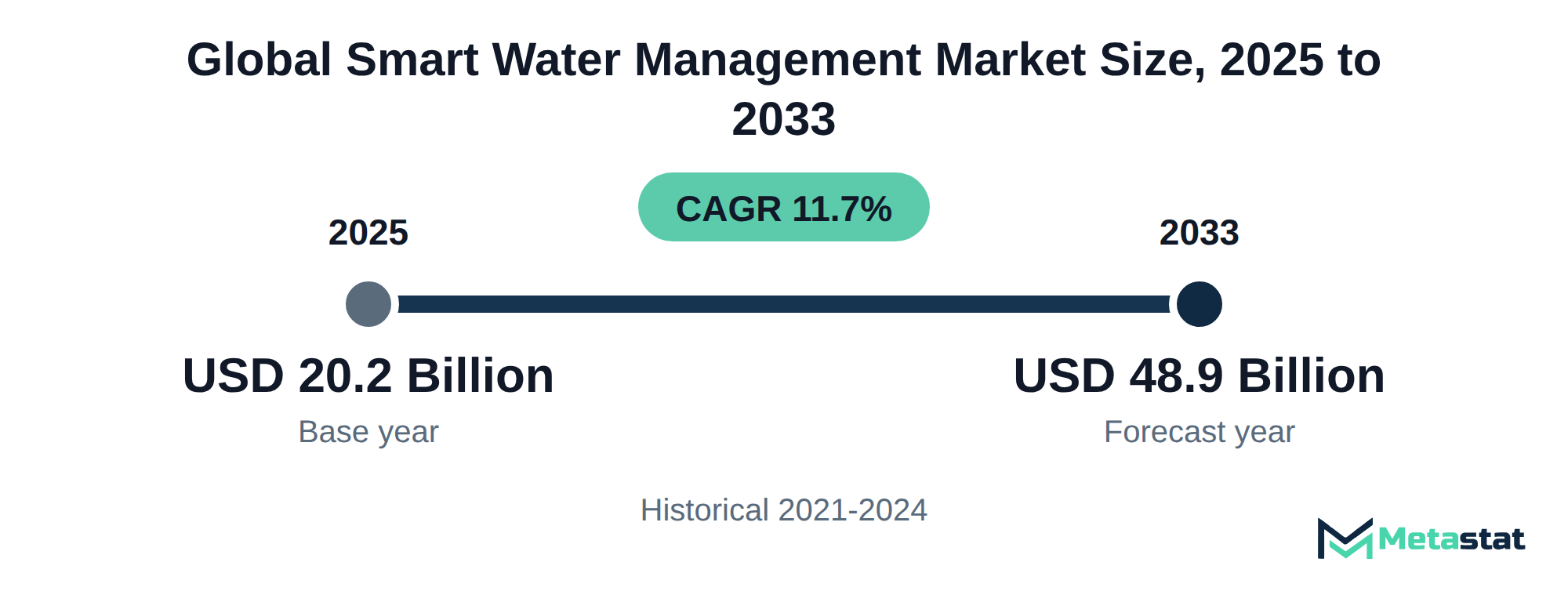
Market Valuation: Valued at $20.2 Billion in 2025, projected to reach $48.9 Billion by 2033 at a 11.7% CAGR.
Dominant Segment: Smart Water Monitoring Hardware leads the market, driven by the critical need for real-time data collection and analysis to manage water resources effectively.
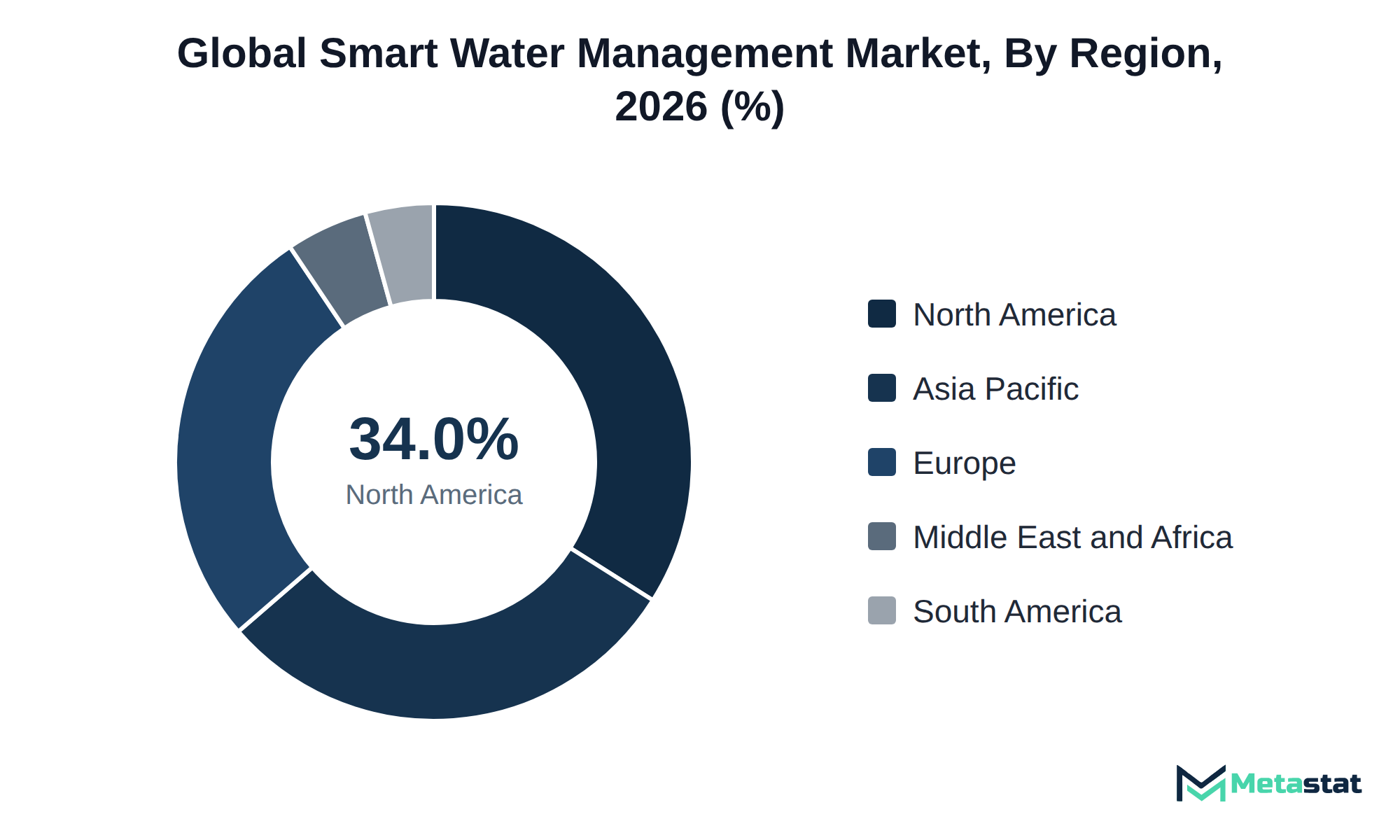
Geographic Lead: North America holds the largest market share at 34.0% in 2025, with the US projected to lead in 2026 due to significant investments in digital solutions and infrastructure modernization.
What's Inside: The report provides a comprehensive analysis of the competitive landscape, detailed segment breakdowns, and forecasts covering the period from 2026 to 2033.
Growth Drivers: The increasing emphasis on digitization and automation in water management systems is propelling market growth, alongside rising awareness of sustainable water management practices.
Emerging Technologies: The integration of advanced technologies like IoT and AI is enhancing operational efficiency and decision-making capabilities within the Smart Water Management market.
Choose Your License
Global Smart Water Management Market
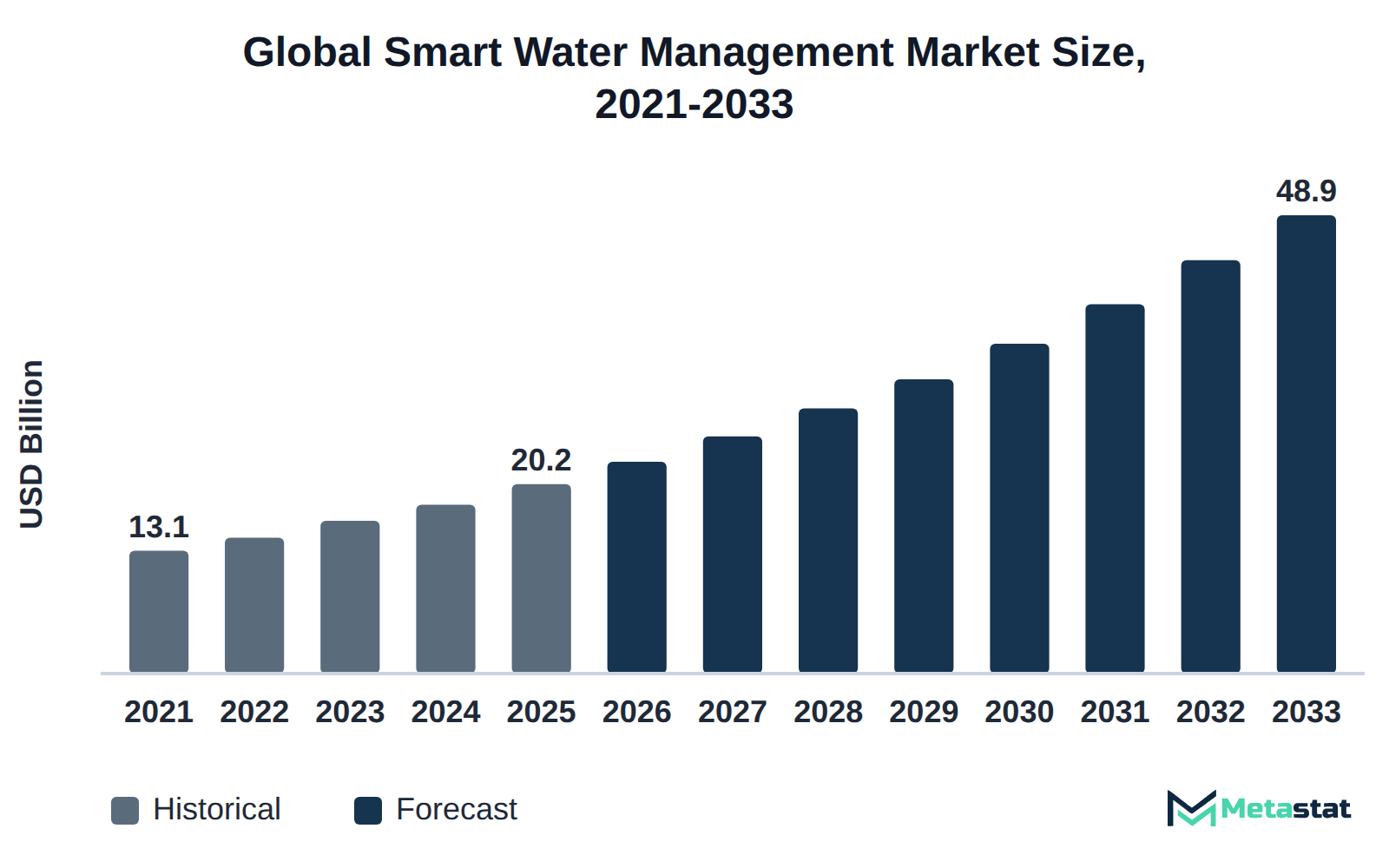
The global Smart Water Management market was valued at USD 20.2 billion in 2025 and is projected to reach USD 48.9 billion by 2033, growing at a CAGR of 11.7% over the forecast period.
The Smart Water Management market encompasses various technologies and solutions designed to optimize water usage, improve distribution efficiency, and ensure compliance with quality standards. Buyers invest in these systems to enhance operational performance, reduce costs, and meet regulatory requirements. The growing demand for sustainable water management practices drives investment from municipal utilities, industrial facilities, and agricultural operators seeking to maximize resource efficiency.
Recent growth in the market stems from the increasing emphasis on digitization and automation in water management systems. North America holds 34.0% of the market in 2025, with the US leading in 2026. The segment dedicated to Smart Water Monitoring Hardware represents the largest share of the market, reflecting the critical need for real-time data collection and analysis to manage water resources effectively. Other regions, including Europe and Asia Pacific, follow closely, indicating strong global interest in smart water technologies.
Investment in advanced technologies, including the Internet of Things (IoT) and Artificial Intelligence (AI), supports market expansion. These technologies enable better decision-making and improved operational efficiency. The integration of smart technologies into existing infrastructure allows for enhanced monitoring and management of water systems, addressing the increasing pressures of urbanization and climate change. These advances support more sustainable water management for municipal, industrial, and agricultural users.
The Smart Water Management market includes a variety of components, technologies, and applications aimed at enhancing the efficiency of water management systems. Buyers invest in these solutions to address the growing challenges of water scarcity, aging infrastructure, and regulatory pressures. The emphasis on smart technologies optimizes water conservation efforts and improves service delivery, driving substantial investments across municipal, industrial, and commercial sectors.
Growth in the market is fueled by increasing awareness of the need for sustainable water management practices. Among the segments, Smart Water Software Platforms represent the highest value, reflecting the rising demand for advanced analytics and management tools. The region's focus on investing in digital solutions and infrastructure modernization significantly contributes to its market share. North America is projected to maintain a significant share in 2025, with the US leading in 2026.
Technological advancements in areas like the Internet of Things (IoT) and Artificial Intelligence (AI) enhance the capabilities of smart water management solutions. These innovations facilitate real-time monitoring and data-driven decision-making, further supporting the sector's expansion. Ongoing investment in digital infrastructure across regions reinforces the market's growth trajectory and makes smart water solutions central to modern water management strategies.
IoT-enabled smart metering represents a significant shift in the Smart Water Management market, enhancing real-time water consumption intelligence. This technology facilitates precise monitoring and management of water usage, directly impacting operational efficiency and resource conservation. The market for smart metering is projected to expand significantly, with revenues expected to increase from USD 6 billion in 2026 to USD 11.8 billion by 2033, reflecting a compound annual growth rate (CAGR) of 10.1% during this period.
IoT integration in smart metering solutions allows utility providers to gather and analyze consumption data in real time. This real-time intelligence enables stakeholders to detect leaks, optimize distribution networks, and improve customer engagement through detailed consumption insights. Utilities adopting IoT-enabled metering systems experience reduced operational costs and enhanced service reliability.
This technology shift strengthens operational capabilities and aligns with the growing emphasis on sustainability and efficient resource management. Water scarcity represents a pressing global concern, and organizations deploying IoT solutions in their metering systems contribute to more sustainable water usage practices, positioning themselves favorably within the Smart Water Management market.
AI-driven leakage detection and predictive maintenance in water networks represent a significant transformation within the Smart Water Management market. These technologies enhance operational efficiency by identifying leaks in real time, reducing water loss and associated costs. The integration of artificial intelligence and machine learning in leakage detection allows for more accurate assessments and timely interventions, ultimately lowering operational expenses for utilities.
The Smart Water Management market anticipates strong demand for AI and machine learning solutions, with the artificial intelligence segment projected to reach USD 13.4 billion by 2033. This growth reflects increasing investments in advanced technologies that facilitate predictive maintenance and optimize resource allocation. Utilities adopting these solutions benefit from reduced labor costs and improved service levels, as they proactively address issues before escalating into major failures.
Contract models for these technologies often involve subscription-based pricing, ensuring that utilities maintain access to the latest software updates and technical support. This approach enables companies to manage expenses more effectively, adjusting their budgets in line with usage and specific needs. Utilities transitioning toward data-driven decision-making experience enhanced operational transparency and accountability, driving further growth within the market.
Digital water quality monitoring helps municipal water and wastewater utilities comply with regulatory standards. This buyer group faces unique challenges in maintaining water quality due to increasing regulatory scrutiny and the need for real-time data. In 2026, the municipal water and wastewater utilities segment is projected to reach USD 8.1 billion, illustrating the significant financial commitment required for compliance and monitoring solutions.
The integration of advanced technologies including Artificial Intelligence and Machine Learning (AI & ML) enhances the capabilities of water quality monitoring systems. By adopting these technologies, municipalities automate the detection of contaminants and ensure timely reporting to regulatory bodies. This proactive approach minimizes the risk of non-compliance penalties and builds public trust in water safety.
With the Smart Water Management market projected to reach USD 48.9 billion by 2033, investments in digital water quality monitoring systems represent a strategic opportunity for municipalities to strengthen operational efficiency. The emphasis on automated compliance tools positions these utilities to better manage resources and respond swiftly to any water quality issues, ultimately driving growth in this sector.
Smart water technologies significantly enhance the efficiency of municipal and industrial water management systems. For example, the integration of smart water monitoring hardware is projected to expand from USD 9.4 billion in 2026 to USD 18.6 billion by 2033, reflecting a compound annual growth rate (CAGR) of 10.3%. This growth reflects a broader trend toward adopting AI-driven solutions and IoT in water management, which streamline operations and improve resource allocation.
Municipal water utilities benefit from these advancements through improved leak detection and water quality monitoring, which directly affect operational costs and service reliability. The Smart Water Management market presents opportunities for enhanced data analytics, enabling utilities to optimize water distribution networks effectively. By leveraging real-time data, municipalities make informed decisions, minimizing water loss and ensuring compliance with regulatory standards. Consequently, this transformation in water management leads to improved sustainability practices and significant cost savings for municipal and industrial facilities alike.
The rising emphasis on water conservation significantly influences buyer behavior in the Smart Water Management market. Municipalities and industrial facilities increasingly prioritize sustainable practices due to growing environmental concerns and regulations. This shift drives investment in innovative water management solutions, facilitating better resource allocation and reducing waste. For example, the adoption of smart metering technologies enables consumers to monitor usage patterns, leading to a reduction in water consumption. The market is expected to grow due to this trend, with projections suggesting that the value will reach USD 48.9 billion by 2033. Buyers recognize that effective water management promotes sustainability and reduces operational costs, prompting a shift towards advanced solutions.
Innovations in smart water technologies drive efficiency gains and operational cost reductions for utilities and industrial users. The integration of advanced data analytics and machine learning enhances the ability to monitor and manage water distribution systems. These technologies facilitate predictive maintenance, minimizing downtime and repair costs. Enhanced sensor technologies offer real-time data collection, providing useful insights into system performance and water quality. This data-centric approach allows for optimized resource allocation and proactive issue resolution, boosting overall reliability in operations.
Investments in these technologies reflect shifting priorities toward sustainable and efficient water management practices. The expansion of the Smart Water Management market correlates with increasing demands from municipal and industrial sectors for innovative solutions that deliver measurable performance improvements. Growth in advanced solutions reduces operational costs and aligns with broader environmental goals. These advancements reinforce the market's position as a critical component in addressing global water challenges.
The demand for smart water management technologies faces significant limits due to price sensitivity among potential buyers. Municipal water and wastewater utilities experience budget constraints that slow technology adoption, leading to delayed infrastructure upgrades. This situation results in smaller orders and reduced investment in advanced solutions. The necessity for cost-effective alternatives significantly influences purchasing decisions, particularly in regions where budget allocations for water management are already stretched thin. Industrial facilities hesitate to invest in smart water technologies due to high initial costs and uncertain returns on investment. Lower awareness of the long-term benefits of these solutions exacerbates the situation, causing further delays in adoption. Overall, the Smart Water Management market experiences restrained growth in segments reliant on these buyers, highlighting the importance of addressing pricing structures to enhance market penetration.
Suppliers within the Smart Water Management market encounter significant challenges due to rising materials costs. These increased expenses impact profit margins and pricing structures, forcing suppliers to reassess operational strategies. In response, many companies invest in enhancing supply chain efficiencies and exploring alternative materials that offer cost benefits. Collaboration with manufacturers to negotiate better pricing terms has emerged as another tactic to mitigate these impacts. Several suppliers expand their value-added services, justifying higher prices and maintaining competitiveness despite increased costs. Such adjustments support ongoing market presence, even in a context where financial pressures remain pronounced. The demand for innovative solutions in water management continues to drive competition, requiring suppliers to adapt strategically to emerging market conditions.
This focus on cost management and strategic adaptation helps suppliers absorb financial strain while meeting changing customer needs. Suppliers who successfully implement these strategies position themselves to capitalize on growth opportunities, ensuring sustainability amid fluctuating material costs.
The market encounters significant growth opportunities within smart water software platforms, projected to reach USD 17.4 billion by 2033, reflecting a compound annual growth rate of 13.3%. This expansion stems from increased demand for advanced analytics and data-driven decision-making tools in managing water resources. Utilities and industries focus on optimizing operations and enhancing customer engagement through these platforms, resulting in improved efficiency and reduced operational costs. The integration of these software solutions supports the management of water distribution, quality monitoring, and compliance, aligning with the growing emphasis on sustainability and resource conservation. Buyers across municipal, industrial, and commercial sectors recognize the value of these platforms in achieving regulatory compliance and maximizing resource utilization. Adoption trends indicate a strong shift toward integrated solutions that provide real-time insights and performance metrics, positioning smart water software platforms as a crucial element in the ongoing transformation within the market.
The Global Smart Water Management market is segmented based on Component, Technology, Application, and End Use.
This segment focuses on hardware components for monitoring water usage and quality, primarily implemented by municipal water utilities, industrial facilities, and agricultural operators. Increasing regulatory pressure for real-time monitoring and the growing emphasis on water conservation drive demand for this segment. Compared to other components, including Smart Water Software Platforms, which achieve a higher CAGR of 13.3%, the hardware segment experiences slower growth due to longer adoption cycles and significant upfront investments. However, its critical role in enabling effective water management solutions ensures sustained interest from buyers seeking to enhance operational efficiency and compliance.
This segment serves utilities and municipalities by providing platforms for managing water resources efficiently, enhancing customer engagement, and ensuring regulatory compliance. Increased focus on digital transformation in water management drives demand for these platforms, particularly in the municipal and industrial sectors. In contrast to other components, this segment exhibits faster growth due to rising investments in advanced technologies and analytics capabilities, reflecting a shift towards data-driven decision-making. The integration of Artificial Intelligence and Machine Learning technologies further supports the segment's expansion, enabling predictive analytics and improved operational efficiencies. This differentiation illustrates the potential for higher returns on investment compared to hardware-based solutions, attracting buyers who prioritize long-term operational gains.
Integration, Deployment and Managed Services segment is expected to reach USD 12.8 billion by 2033. This segment focuses on providing comprehensive services required for the successful implementation and operational management of smart water technologies. Municipal water and wastewater utilities, industrial facilities, and commercial operators apply these services to enhance their water management capabilities. Demand for these services grows due to increasing investments in smart infrastructure and the need for efficient resource allocation. Unlike other components including Smart Water Monitoring Hardware and Smart Water Software Platforms, which experience higher growth rates, this segment offers steady growth at a CAGR of 10.9%. The segment's steady growth stems from its role in integrating systems and ensuring effective deployment, which stakeholders need for operational efficiency and regulatory compliance.
Internet of Things (IoT) segment is valued at USD 7.6 billion in 2026 and is projected to reach USD 14.8 billion by 2033, at a CAGR of 10% during the forecast period. This segment focuses on integrating smart devices and sensors to monitor and manage water resources for utilities and industrial users. The growing demand for real-time data and analytics drives IoT adoption, enabling better decision-making and resource allocation. Unlike other segments, the IoT segment benefits from rapid technological evolution, with considerable investment in connectivity solutions. The increasing emphasis on sustainability fuels the need for IoT technologies, distinguishing this segment with unique applications in smart metering and water quality monitoring. Evolving technologies position the segment to capture greater market share, reflecting the ongoing transition towards data-driven water management solutions.
Artificial Intelligence and Machine Learning (AI & ML) segment is estimated to reach USD 13.4 billion by 2033, at a CAGR of 14.2% during the forecast period. This technology enhances predictive analytics and operational efficiency for utilities and industrial facilities. Users leverage AI and ML for advanced data analytics, predictive maintenance, and real-time decision-making, significantly impacting cost management and resource optimization. Demand for this segment grows, driven by the increasing complexity of water systems and the critical need for efficient resource management. Compared to other segments, AI & ML stands out with the highest growth rate in the technology category, reflecting faster adoption among users who prioritize advanced solutions for water management challenges. Market expansion is supported by a growing focus on digital transformation and innovation within water utilities, creating a strong competitive advantage for early adopters of AI and ML technologies.
Geographic Information Systems (GIS) segment is expected to reach USD 6.5 billion by 2033. This segment is essential in mapping and analyzing water resource data, enabling effective planning and management for municipal water utilities and environmental agencies. Increasing demand for precise geographic insights supports the growth of GIS solutions, particularly in urban areas where infrastructure requires ongoing monitoring. While the GIS segment grows steadily, it operates at a slower pace compared to the Artificial Intelligence and Machine Learning segment, which has a compound annual growth rate of 14.2%. Buyers in the GIS segment prioritize accurate data visualization and analysis tools, distinguishing this segment from others that focus on real-time monitoring and automation. Enhanced regulatory compliance demands further fuel interest in GIS technologies, driving investment in systems that provide comprehensive environmental and resource assessments.
Big Data and Analytics segment is projected to grow at a CAGR of 12.6% during the forecast period. This segment provides critical insights and analytics for water utilities and municipalities to optimize water resource management. Utilities apply big data analytics to improve operational efficiency, monitor water quality, and predict system failures. The increasing demand for data-driven decision-making in water management significantly drives this segment. Compared to other technology segments, Big Data and Analytics experiences strong growth due to its capability to enhance performance and reduce costs. This segment stands out with higher potential for advancement relative to others, including Geographic Information Systems, which is expected to reach USD 6.5 billion by 2033. The Smart Water Management market benefits substantially from the integration of advanced analytics, ensuring a more sustainable and efficient water management approach.
This segment encompasses innovative technologies including blockchain and cloud computing, which influence data management and operational efficiency in water management systems. Utilities and service providers leverage these technologies for enhanced data security, decentralized record-keeping, and improved data accessibility. Prominent forces driving this segment include increasing regulatory demands for transparency and the need for advanced data analytics capabilities. This segment differs from others by emphasizing the integration of emerging technologies that enhance existing infrastructures, distinguishing it from traditional hardware and software offerings. Adoption barriers exist due to costs associated with implementing these advanced solutions, limiting accessibility for smaller operators. The collective impact of these factors shapes dynamics within the market, highlighting opportunities for growth and innovation.
This segment focuses on optimizing water usage and enhancing customer engagement through accurate metering and consumption tracking. Municipal utilities and industrial facilities leverage these technologies to improve operational efficiency and reduce wastage. The growing emphasis on water conservation and sustainable practices represents a significant driver for this segment. Compared to other application segments, Smart Metering and Customer Consumption Management experiences strong growth due to increasing regulatory pressure for efficient water usage and advancements in smart technologies. Its projected growth rate of 10.1% during this period highlights its critical role in the broader Smart Water Management market.
Water Distribution Network Monitoring and Leakage Management segment is estimated to reach USD 12.6 billion by 2033, at a CAGR of 12.9% during the forecast period. This segment focuses on tracking and managing water flow within distribution systems, ensuring efficient delivery while minimizing losses due to leaks. Municipal water utilities and industrial facilities apply these technologies to improve operational efficiency and comply with regulatory standards. Key factors driving growth include increasing investments in infrastructure modernization and heightened awareness of water conservation. This segment differentiates itself from others by its specific emphasis on leakage management, reflecting a targeted approach to mitigating water loss and optimizing resource usage, positioning it for faster growth compared to broader applications including Smart Metering. In the market, these trends highlight the critical role of effective water distribution management in addressing both environmental and economic challenges.
Water Quality Monitoring and Compliance Management segment is expected to reach USD 7.7 billion by 2033. This segment plays a critical role in ensuring water quality standards are met and compliance with regulatory requirements is maintained. Municipalities, industrial facilities, and environmental agencies apply this technology to monitor water quality and detect contaminants effectively. Growing awareness of water quality issues and stringent regulations drive demand within this segment. Compared to other segments, Water Quality Monitoring and Compliance Management experiences moderate growth, supported by increasing regulatory scrutiny and a focus on public health. The segment differentiates itself with a focus on compliance and quality assurance, requiring advanced technologies and solutions, unlike other segments that prioritize cost efficiency or operational automation. Demand is expected to rise steadily, reflecting ongoing commitment to safe and sustainable water management practices across various regions in the Smart Water Management market.
Water and Wastewater Treatment Process Monitoring and Automation segment is projected to grow at a CAGR of 12.5% during the forecast period. This segment facilitates the oversight and optimization of water treatment processes, enhancing efficiency and compliance for municipal utilities, industrial facilities, and agricultural operators. Increasing regulatory pressure on water quality and environmental protection drives demand for reliable monitoring solutions and higher investment in automation technologies. Compared to other segments in the Application category, this segment experiences faster growth due to stringent regulations and the critical need for efficient water treatment processes. The emphasis on automation technologies, alongside the need for real-time monitoring, distinguishes this segment from others, resulting in a more significant increase in investment backing. The adoption of advanced monitoring technologies aligns with broader trends in the Smart Water Management market, reflecting ongoing transformation within water and wastewater treatment technology.
Stormwater, Flood and Source-Water Monitoring focuses on managing and monitoring the quality and quantity of stormwater and floodwater, alongside source-water assessments. Utilities and municipalities apply this application to enhance water resource management and mitigate flood risks. Rising environmental concerns and stringent regulations concerning water quality drive demand in this segment. Compared to other applications, this segment faces unique challenges from natural disasters, necessitating advanced monitoring solutions. The emergence of smart technologies integrated with conventional systems to address these challenges highlights its distinction from segments like Water Quality Monitoring and Compliance Management, which primarily center around regulatory adherence. This segment finds relevance among buyers including government agencies and environmental organizations, prioritizing sustainable water management in response to climate change impacts. Investment in technologies like IoT and AI enhances data collection and analysis, improving decision-making processes in stormwater and flood management strategies.
This segment focuses on innovative practices including smart irrigation and rainwater harvesting, which optimize the use of water resources in agricultural and urban settings. End users include agricultural operators and urban planners who implement these practices to enhance water efficiency and sustainability. Key market drivers include growing concerns over water scarcity and the rising adoption of sustainable practices in agriculture. Unlike other segments, this area experiences slower growth due to varying levels of awareness and investment in advanced irrigation technologies compared to sectors including smart metering. The Smart Water Management market benefits from increased emphasis on environmental sustainability, influencing adoption among municipalities and agricultural sectors striving for efficiency.
The Municipal Water and Wastewater Utilities segment is valued at USD 8.1 billion in 2026 and is projected to reach USD 16.7 billion by 2033, at a CAGR of 10.9% during the forecast period. This segment serves municipalities and local governments focused on providing essential water and wastewater services to consumers. Key drivers include increasing population growth and urbanization, which drive demand for efficient water management solutions. Compared to other segments, this segment exhibits a steady growth trajectory, supported by regulatory requirements for improved service delivery and environmental compliance. Municipal utilities prioritize investments in smart technologies to improve water quality and reduce operational costs, making this segment highly competitive. The market is expected to expand as municipalities strive to modernize infrastructure and adopt innovative technologies that ensure sustainable water management.
Industrial Facilities segment is estimated to reach USD 13.6 billion by 2033, at a CAGR of 12.8% during the forecast period. This segment primarily involves the application of smart water management solutions in manufacturing and processing environments, enabling efficient water usage and compliance with environmental regulations. Key drivers for this segment include the increasing focus on sustainable practices and rising costs of water scarcity, compelling operators to adopt advanced technologies. Compared to other segments, this sub-segment experiences a faster growth rate, fueled by the urgency for industries to enhance water efficiency and reduce operational costs. Industrial Facilities differ from Municipal Water and Wastewater Utilities, which show slower growth due to established infrastructures and regulatory frameworks. The market reflects a significant shift towards innovative solutions that address operational efficiency and environmental responsibility.
Commercial and Institutional Facilities segment is expected to reach USD 7.2 billion by 2033. This segment serves various commercial and institutional entities, focusing on implementing efficient water management practices. The increasing emphasis on sustainability and operational efficiency drives demand from commercial facilities, including offices, hotels, and educational institutions. Regulatory changes aimed at reducing water consumption and improving water quality contribute to growth in this segment. Compared to other sub-segments, including Municipal Water and Wastewater Utilities, this segment has comparatively higher price sensitivity and a slower growth rate, registering a CAGR of 10.9%. With businesses increasingly investing in technology-driven solutions and sustainability measures, the Commercial and Institutional Facilities segment is expected to benefit substantially, reflecting trends evident in the broader Smart Water Management market.
Agriculture and Irrigation Operators segment is projected to grow at a CAGR of 12.9% during the forecast period. This segment serves agricultural producers and irrigation managers, focusing on efficiently managing water resources for crop production. The increase in global food demand drives the necessity for advanced irrigation technologies and practices. Adoption of precision agriculture techniques enhances water efficiency, reflecting a shift toward sustainable farming practices. This segment differentiates itself from others within the market due to its higher growth rate, contrasting with lower rates observed in segments including Commercial and Institutional Facilities. The emphasis on water conservation and smart irrigation technologies positions this segment for significant advancements in agricultural productivity and operational efficiency.
This segment focuses on Residential and Real Estate Developments, addressing the water management needs of housing sectors and property developers. It encompasses applications for efficient water usage, consumption monitoring, and quality management. Key drivers for this segment include increasing urbanization and the growing emphasis on sustainable practices in construction. These factors contribute to heightened demand for smart water solutions among residential developers and homeowners aiming to optimize water consumption and ensure compliance with regulations. Compared to other end-use segments, this sub-segment experiences varied growth dynamics, reflecting changing buyer priorities and technological advancements. The increased focus on energy-efficient and smart homes positions this segment uniquely within the broader market, aligning with the overall trend toward sustainable development.
Agriculture involves practices and technologies that enhance water management for farming and irrigation purposes. This segment serves farmers, agricultural businesses, and irrigation operators, focusing on optimizing water usage to increase crop yield and ensure sustainability. Demand for advanced irrigation solutions drives growth in this segment, reflecting a greater emphasis on resource efficiency due to climate change and water scarcity. Compared to other segments, agriculture experiences unique pressures, including seasonal reliance on water and the need for timely interventions. Smart irrigation systems and data analytics tools improve agricultural productivity. Innovations in this area provide competitive advantages, enabling operators to meet growing food production demands while minimizing water waste. The Smart Water Management market is projected to benefit from these advancements, influencing investment and technology adoption within the agriculture sector.
Based on geography, the Global Smart Water Management market is divided into North America, Europe, Asia-Pacific, South America, Middle East, and Africa.
In North America, demand for the Smart Water Management market is driven by significant investments in infrastructure modernization and the need for efficient water resource management. The United States, Canada, and Mexico prioritize smart technologies to enhance water conservation efforts and reduce operational costs in municipal and industrial sectors. Regulatory frameworks encourage the adoption of advanced metering and monitoring solutions, with public utilities increasingly integrating IoT and AI technologies into their systems. North America is projected to reach USD 15.6 billion by the end of 2033. The region's substantial share of 34.00% in the global market in 2025 highlights its leading role in driving innovation and growth within this market.
Europe holds a 27% share of the global market in 2025, driven by strong demand from municipal water utilities and industrial facilities. Countries including Germany, France, and the UK implement stringent regulations focused on water conservation and quality control. These regulations encourage investment in advanced monitoring and management solutions. Adoption of smart water technologies in the region is influenced by ongoing infrastructure upgrades and public awareness regarding sustainable water use. Advanced technologies, including Artificial Intelligence and Internet of Things, are essential for optimizing water distribution and minimizing losses. The Smart Water Management market experiences growth due to these regional factors, focusing on improving efficiency and reducing operational costs.
The region is important in the Smart Water Management market, driven by rapid urbanization and growing population pressures. Countries including China, India, and Japan experience heightened demand for efficient water management systems due to their large industrial bases and increasing water scarcity challenges. Government initiatives targeting smart city developments and sustainable water practices contribute to this trend. In Australia, advanced technologies for water management are essential in addressing the unique challenges posed by droughts and limited water resources. By 2025, the Asia-Pacific region is expected to command a 29.7% share of the global market, reflecting its key position in the ongoing transition toward smarter water solutions.
Brazil and Argentina contribute significantly to the Smart Water Management market, driven by aging infrastructure and increasing urbanization. The need for efficient water management systems has sparked investments in modern technologies. Specific initiatives focused on enhancing water quality monitoring and leakage management reflect growing concern over resource sustainability. In South America, the market holds a share of 4.3% in 2025, indicating potential growth opportunities for both municipal and industrial applications. Infrastructure challenges, coupled with the push for compliance with environmental standards, create a dynamic environment for market expansion. The focus on innovative practices strengthens demand across various sectors, particularly in urban areas where water scarcity poses significant challenges.
In the Middle East and Africa, demand for the Smart Water Management market arises primarily from municipal water and wastewater utilities focusing on improving service delivery and resource efficiency. Countries including Saudi Arabia and the UAE prioritize advanced technologies for monitoring and managing water resources due to arid climates and limited water availability. South Africa's ongoing investments in infrastructure modernization further drive demand, highlighting the need for effective water distribution and quality management systems. The region's share of the global market is projected at 5.1% in 2025, reflecting growing recognition of the importance of sustainable water management practices. Increased collaboration among governments and the private sector enhances the adoption of smart technologies, supporting overall market growth and resilience.
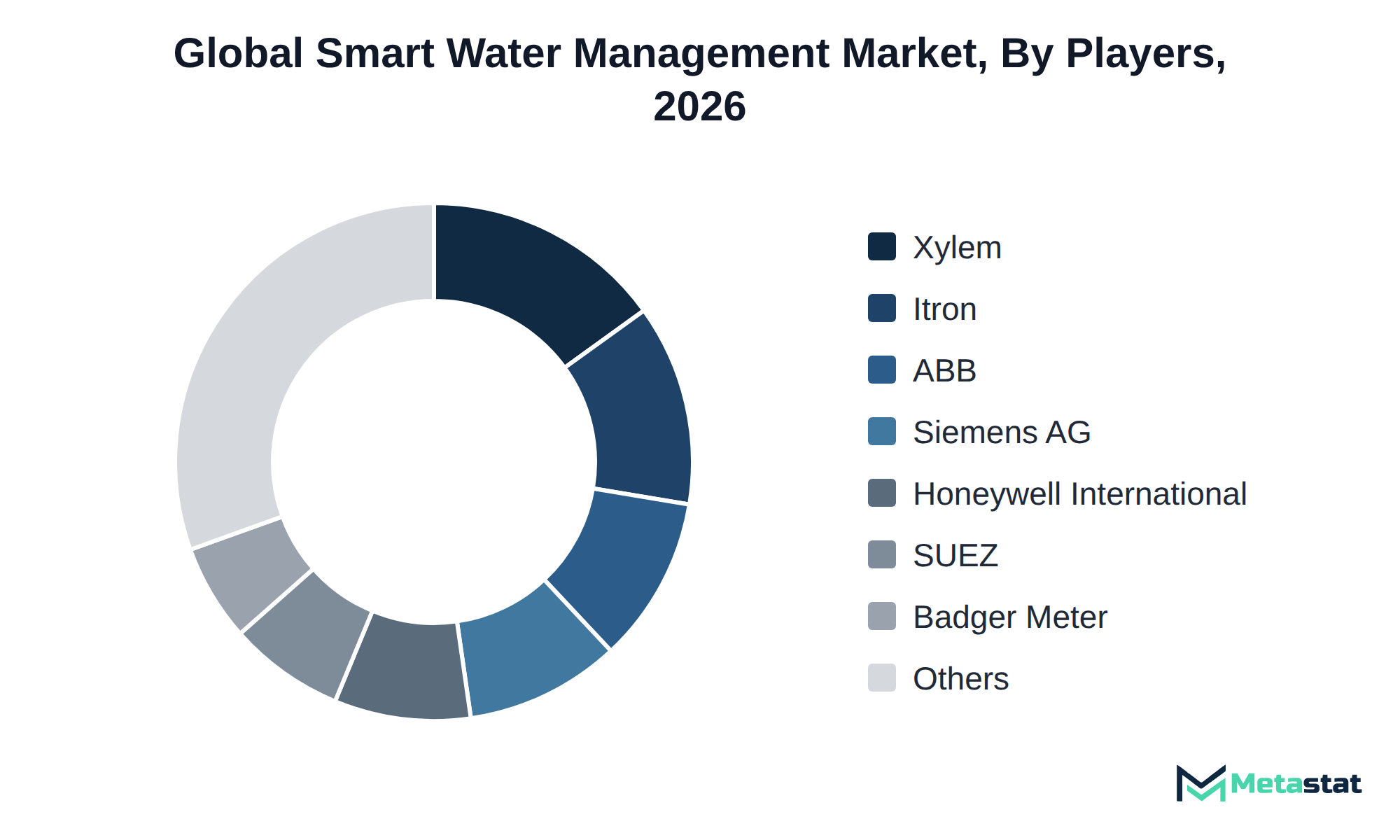
The Smart Water Management market features a mix of companies that focus on various components including hardware, software, and services. Companies like FluxGen Sustainable Technologies Private Limited and Xylem Inc. emphasize environmental sustainability and efficiency in water management solutions. Providers differentiate themselves through the integration of advanced technologies including the Internet of Things (IoT) and Artificial Intelligence, enabling enhanced data analytics and monitoring capabilities.
Buyers prioritize factors including price, service quality, and the ability to customize solutions based on specific operational needs. For instance, Itron, Inc. focuses on smart metering solutions that integrate seamlessly with existing infrastructures, while Badger Meter, Inc. offers specialized monitoring hardware designed for various applications. The emphasis on service and support ecosystems, coupled with compliance certifications, significantly influences buyer choices within the market.
Achieving this growth requires several key developments within the Smart Water Management market. The advancement of smart water software platforms, with an expected increase to USD 17.4 billion by 2033, further supports market expansion. The integration of technologies including Artificial Intelligence and Machine Learning (AI & ML) will drive efficiency, with the segment projected to reach USD 13.4 billion during the same period. Risks linked to regulatory challenges or economic downturns could hinder growth. For instance, North America's strong market presence, accounting for 34% of the global share, faces obstacles if municipalities struggle to secure funding for necessary infrastructure upgrades. Addressing these challenges while applying technological advances will be crucial for the market to reach its projected size.
By Component: Smart Water Monitoring Hardware, Smart Water Software Platforms, Integration, Deployment and Managed Services
By Technology: Internet of Things (IoT), Artificial Intelligence and Machine Learning (AI & ML), Geographic Information Systems (GIS), Big Data and Analytics, Others (Blockchain, Cloud Computing)
By Application: Smart Metering and Customer Consumption Management, Water Distribution Network Monitoring and Leakage Management, Water Quality Monitoring and Compliance Management, Water and Wastewater Treatment Process Monitoring and Automation, Stormwater, Flood and Source-Water Monitoring, Others (Smart Irrigation and Rainwater Harvesting)
By End Use: Municipal Water and Wastewater Utilities, Industrial Facilities, Commercial and Institutional Facilities, Agriculture and Irrigation Operators, Residential and Real Estate Developments, Agriculture
The report strategically identifies and profiles the key market players and analyses their core competencies in each sub-segment of the Smart Water Management market.
Report Attributes | Details |
Study Period | 2021-2033 |
Base Year | 2025 |
Estimated Year | 2026 |
Forecast Period | 2026-2033 |
Historical Period | 2021-2025 |
Growth Rate | CAGR 11.7% from 2026 to 2033 |
Revenue Unit | USD billion |
Segmentation | By Component, Technology, Application, End Use, and Region |
By Region | North America (By Component, Technology, Application, End Use, and Country)
|
Europe (By Component, Technology, Application, End Use, and Country)
| |
Asia Pacific (By Component, Technology, Application, End Use, and Country)
| |
South America (By Component, Technology, Application, End Use, and Country)
| |
Middle East and Africa (By Component, Technology, Application, End Use, and Country)
|
Find answers to common questions about this report
The Smart Water Management market size was valued at USD 20.2 billion in 2025.
The market is projected to grow at a CAGR of 11.7% during the forecast period from 2026 to 2033.
The North America Smart Water Management market size is estimated to reach USD 15.6 billion by 2033.
Smart Water Software Platforms lead the market with a projected value of USD 17.4 billion by 2033, surpassing other segments in growth potential.
Rising emphasis on water conservation significantly influences buyer behavior, with municipalities and industrial facilities prioritizing sustainable practices. The demand for innovative solutions in water management continues to drive competition, requiring suppliers to adapt strategically to emerging market conditions.
North America holds the dominant share of the Smart Water Management market, with a value of USD 15.6 billion projected for 2033, representing 34 percent of the total market. This region leads in market share compared to Europe and Asia Pacific, which follow with 27 percent and 29.7 percent, respectively.
The demand for smart water management technologies faces significant limits due to price sensitivity among potential buyers. Municipal water and wastewater utilities often experience budget constraints that slow technology adoption, leading to delayed infrastructure upgrades.
Factors favoring adoption in the Smart Water Management industry include increasing demand for smart water software platforms, projected to reach USD 17.4 billion by 2033. This growth results from the necessity for advanced analytics and data-driven decision-making tools that enhance operational efficiency and promote sustainability across various sectors.
The Smart Water Management market is estimated to reach a valuation of USD 48.9 billion by 2033.
Key players operating in the Smart Water Management market include FluxGen Sustainable Technologies Private Limited, Xylem Inc., Badger Meter, Inc., Itron, Inc., ABB Ltd., Schneider Electric SE, Siemens AG, and SUEZ SA.
The analysts below cover Energy and Power research at Metastat Insights.
LEAD ANALYST
Utkarsh Khirodkar is a Lead Market Research Analyst at MetaStat Insight, specializing in market intelligence, technology sector assessments, and competitive strategy.

PRINCIPAL CONSULTANT - ENTERPRISE AI & EMERGING TECHNOLOGIES
Banking & Finance · Electronics and Semiconductor · Energy and Power · Healthcare IT · Information & Technology · Professional Services
Vijay Gunti is a Principal Consultant at MetaStat Insight, bringing over two decades of experience across enterprise digital transformation, technology strategy, and intelligent systems.

ENERGY & INFRASTRUCTURE INDUSTRY CONSULTANT
Automotive and Transportation · Electronics and Semiconductor · Energy and Power · Machinery & Equipment
Saurabh Vasant Ganvir consults for Energy & Infrastructure Industry at MetaStat Insight, specializing in renewable energy, solar EPC, and electric vehicle (EV) infrastructure markets.
Evaluating secondary resin quality across post-consumer packaging streams requires reliable technical segmentation. MetaStat Insight delivered an objective assessment that distinguished between extrusion-grade flake pricing and optical sorting throughput limitations across Western Europe. The competitive positioning breakdown for licensed depolymerization technology providers answered several questions during our feedstock feasibility audit. Their team clarified regional trade restrictions on mixed plastic scrap quickly when our team submitted follow-up requests.
Evaluating sovereign cloud deployments for core banking platforms demands a clear view of data residency regulations and migration exit strategies. MetaStat Insight delivered an exhaustive review of regional latency tolerances, mainframe decommission milestones, and third-party vendor concentration risk. The regulatory compliance mapping across European and Asian financial jurisdictions gave our team a dependable baseline for multi-cloud infrastructure discussions.
Replacing petrochemical surfactants with bio-based alternatives requires realistic timelines on industrial precision fermentation scaling. The market research broke down commercialization timelines, feedstock sugar price sensitivities, and regional cosmetic ingredient regulatory approvals in Europe and East Asia. That supplier readiness mapping gave our formulations team reliable context when comparing renewable chemical sourcing roadmaps.
Explore related market intelligence reports worth reading alongside this one.
Starting from
$2950