
LEAD ANALYST
Utkarsh Khirodkar is a Lead Market Research Analyst at MetaStat Insight, specializing in market intelligence, technology sector assessments, and competitive strategy.

Global Water Pipeline Leak Detection System Market Size, Share, By Technology (Acoustic Sensors, Ultrasonic Sensors, Fiber Optic Sensors, Pressure Transducers, Thermal Cameras, Flow-Based Analytics, Conductive Sensing Cables and Others), By Application (Municipal Infrastructure, Industrial Water Networks, Agricultural Irrigation, Oil and Gas Facility Water Pipelines, Fire Protection Systems, Residential Water Networks and Commercial Water Networks), By Installation Type (Fixed External Systems with Remote Monitoring, Fixed External Systems with Local Readout, Fixed Inline Systems, Portable External Devices, Mobile Inline Inspection Devices and Remote Sensing Platforms), By End User (Water Utilities, Construction Firms, Agricultural Enterprises, Petrochemical Plant Operators, Fire Departments, Commercial Facility Owners and Residential Property Owners), Industry Analysis, Growth, Trends, and Forecast, 2026-2033
Report ID
MSI-5637
Published
October, 2026
Pages
253 Pages
Format
Historical
Base year
Forecast
Forecast period
Report Details
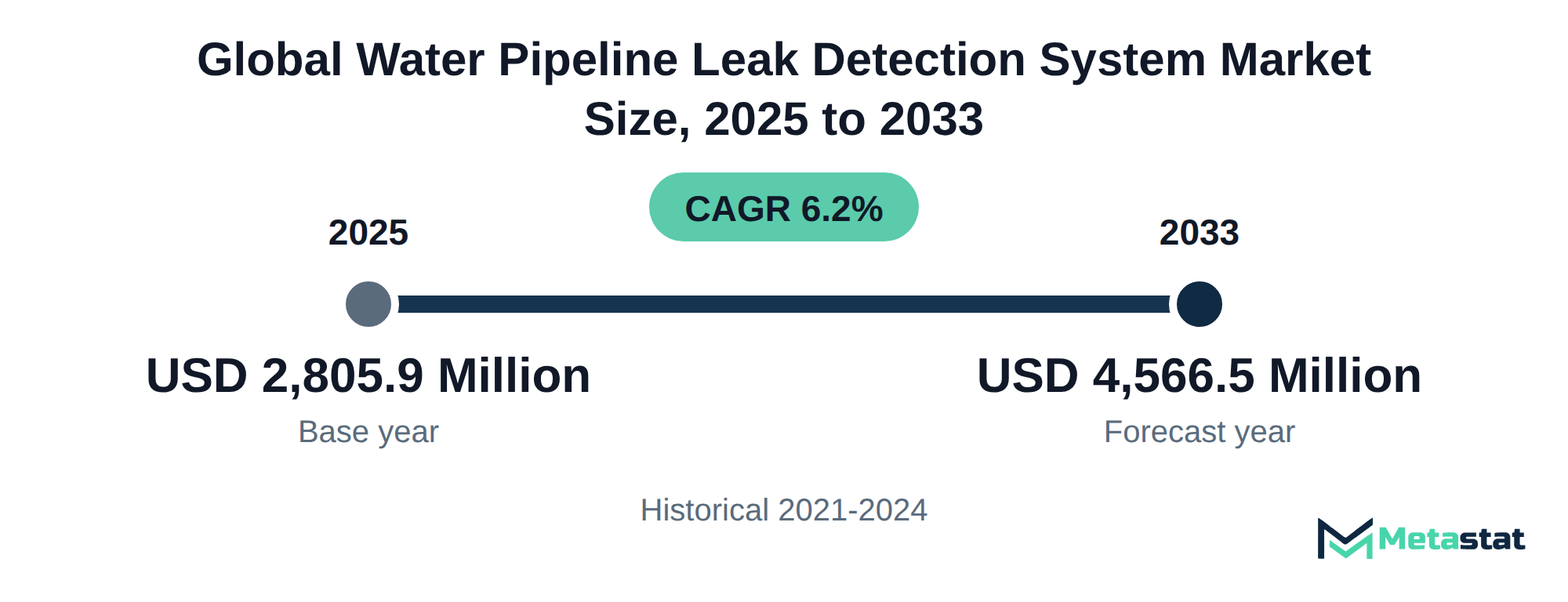
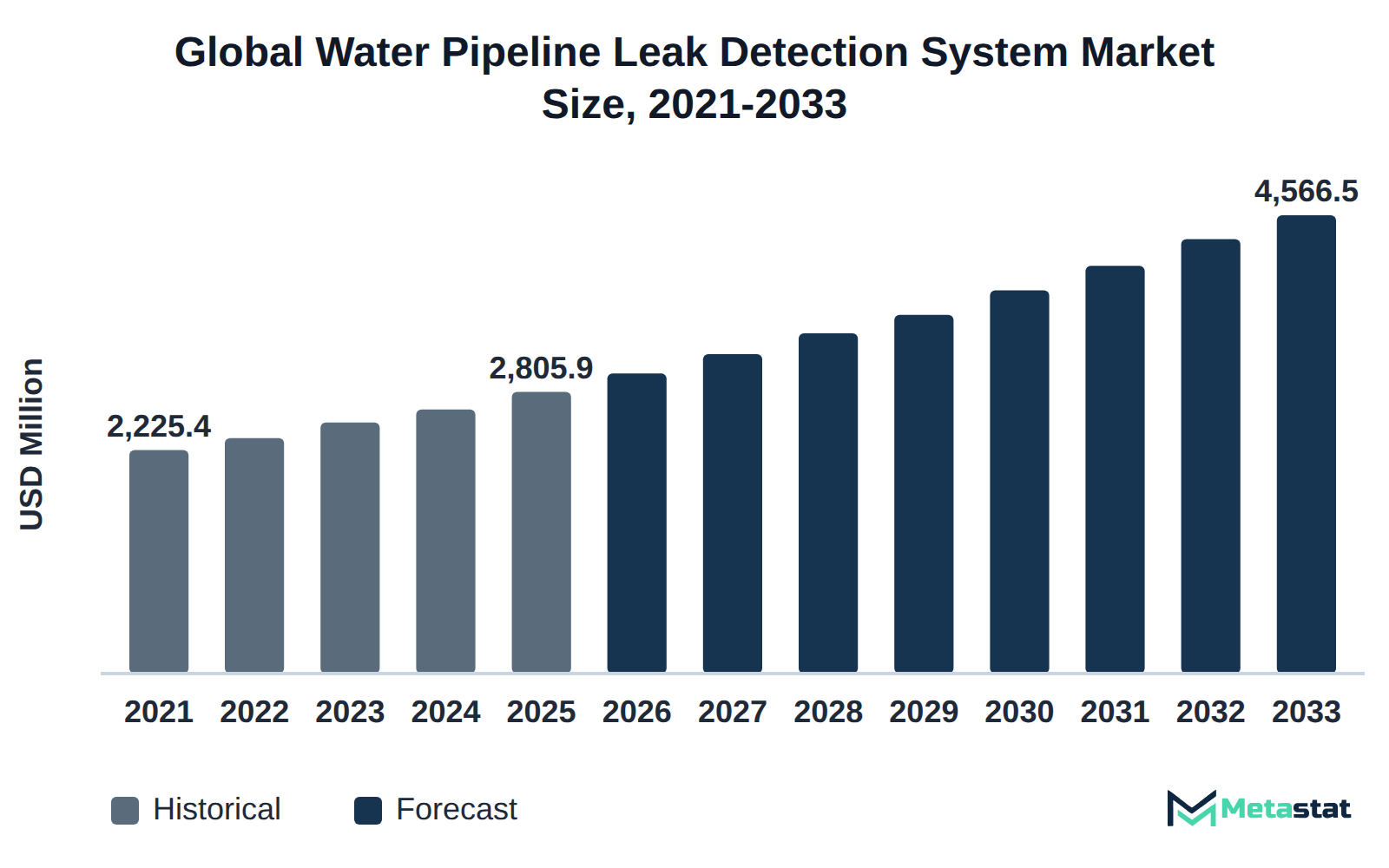
Market Valuation: Valued at $2,805.9 Million in 2025, projected to reach $4,566.5 Million by 2033 at a 6.2% CAGR.
Dominant Segment: Municipal infrastructure leads the market, driven by the critical need for effective management of urban water distribution networks and regulatory pressures for water conservation.
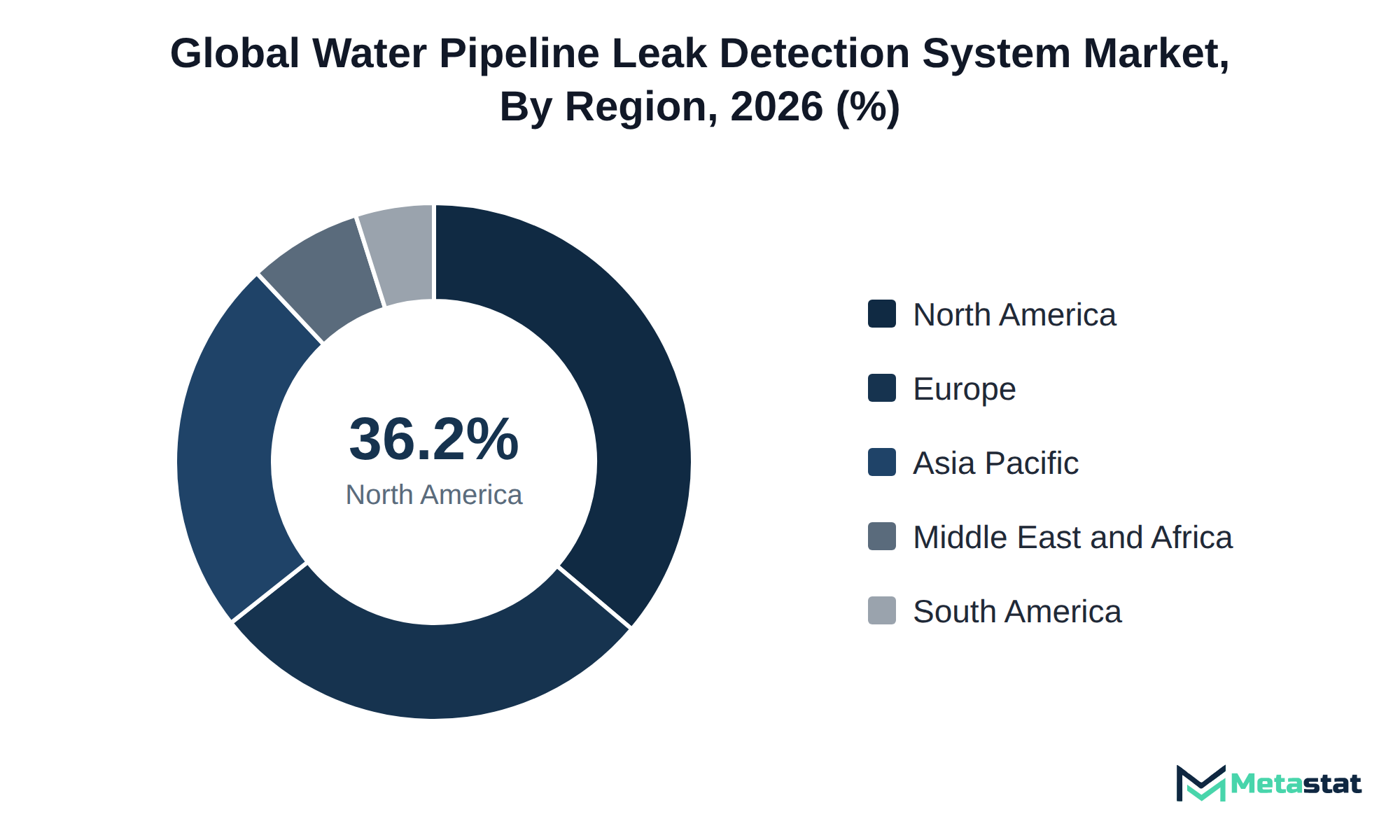
Geographic Lead: North America holds the largest market share, accounting for 36.2% in 2025, with the US expected to maintain this lead due to significant investments in water infrastructure and advanced technology adoption.
What's Inside: The report provides a comprehensive analysis of market dynamics, competitive landscape, and detailed segmentation by technology, application, installation type, and end user, covering the forecast period from 2026 to 2033.
Emerging Technologies: Technological advancements, particularly in acoustic and fiber optic sensors, are enhancing detection accuracy and operational efficiency, thereby driving market growth.
High Growth Potential: Fixed external systems with remote monitoring are projected to grow significantly, with a CAGR of 7.8%, reflecting the rising demand for real-time monitoring solutions among water utilities and construction firms.
Choose Your License
Global Water Pipeline Leak Detection System Market
The global Water Pipeline Leak Detection System market was valued at USD 2,805.9 million in 2025 and is projected to reach USD 4,566.5 million by 2033, growing at a CAGR of 6.2% over the forecast period.
The Water Pipeline Leak Detection System market encompasses technologies, applications, installation types, and end users focused on identifying and mitigating leaks within water pipelines. Buyers invest in these systems to enhance operational efficiency, reduce water loss, and comply with regulatory requirements. The need for reliable detection solutions drives spending, especially among water utilities, industrial operators, and agricultural enterprises seeking to optimize resource management.
Growth in the market is propelled by increasing awareness regarding water conservation and infrastructure maintenance. Municipal infrastructure emerges as the most valuable application segment, highlighting the importance of maintaining urban water distribution networks. North America holds 36.2% of the market in 2025, with the US leading in 2026. This region benefits from advanced technology adoption and significant investment in water infrastructure.
Advances in sensing solutions, including acoustic and fiber optic sensors, drive market expansion. These innovations enhance detection accuracy and reduce operational costs for users. While the market evolves, demand for leak detection systems is expected to rise, driving competition among key players to deliver effective and efficient solutions.
The market focuses on advanced technologies for monitoring water pipelines, which include a range of sensors and analytics. Buyers invest in these systems to enhance operational efficiency, reduce water loss, and mitigate environmental impacts, driven by increasing regulatory pressures and sustainability goals. Integrating these technologies helps utilities and industries maintain reliable water infrastructure, which leads to long-term cost savings and better service delivery.
Growth within the market is primarily propelled by the rising demand for effective leak detection solutions across various sectors, particularly municipal infrastructure. This segment holds the most value, reflecting the critical need for effective management of water resources. North America holds 36.2% of the market in 2025, with the US leading in 2026, reflecting the region's commitment to upgrading aging water infrastructure and investing in innovative solutions.
Advancements in sensor technologies, including acoustic and ultrasonic sensors, significantly enhance leak detection capabilities. These innovations support faster response times and reduce costs associated with water loss. Continued expansion of water infrastructure and growing emphasis on sustainable practices further support growth in the Water Pipeline Leak Detection System market, which remains a core part of water management strategies.
Permanent Acoustic Monitoring (PAM) technology helps water utilities detect leaks within municipal infrastructure. This technology employs a network of acoustic sensors that continuously monitor pipelines for sound patterns indicative of leaks. The increasing focus on reducing water loss from aging infrastructure drives the demand for PAM systems. In 2026, the revenue from Municipal Infrastructure applications in the Water Pipeline Leak Detection System market is projected to reach USD 1,587.1 million, expanding to USD 2,366.8 million by 2033, reflecting a compound annual growth rate (CAGR) of 5.9%.
Investments in PAM lead to substantial operational savings for water utilities, minimizing water loss and reducing the costs associated with repairs and service disruptions. By implementing this technology, utilities gain the ability to proactively identify issues before they escalate into costly failures, resulting in an improved bottom line. The integration of PAM in municipal water systems represents a shift towards smart water management solutions, aligning with the broader trend of sustainability and efficiency in the sector. Networked acoustic sensors of this kind belong to the wider field of IoT in water management. This shift positions the market for significant growth through 2033, driven by increased awareness of optimizing water resources.
Fiber optic sensing technology represents an innovative approach for monitoring long-distance water transmission pipelines. This technology excels in providing real-time data on water conditions, detecting leaks with high precision. The fiber optic sensors segment is projected to reach USD 469 million by 2033, reflecting growing adoption in this market. Investment in fiber optic technology typically involves upfront costs related to installation and calibration; however, the long-term benefits often justify these expenses.
Buyers of fiber optic sensing solutions frequently engage in contractual agreements that include service-level agreements and maintenance options. Such contracts stipulate performance metrics, ensuring that the technology meets specific operational standards. By establishing clear terms, buyers secure reliable service while maintaining cost predictability. This arrangement contributes to improved operational efficiency and reduced downtime, essential for industries reliant on extensive water networks. The flexibility in pricing and contract structures enables organizations to align procurement strategies with their operational budgets, enhancing adoption of these systems. Fiber optic sensing therefore helps organizations optimize resource management and improve infrastructure sustainability.
Flow-based leak detection systems serve vital roles within buildings and construction sites, ensuring the integrity of water pipelines. These systems use advanced technologies to monitor water flow and immediately identify leaks that could cause significant property damage and resource waste. Investments in such systems reflect the increasing awareness of sustainability and operational efficiency among construction firms. In the Water Pipeline Leak Detection System market, fixed inline systems represent a crucial segment.
Construction firms increasingly seek to integrate flow-based leak detection technologies into their projects. This approach fits alongside smart construction practices that rely on connected monitoring on site. This integration allows for real-time monitoring, minimizing water loss during construction and enhancing compliance with environmental regulations. The growth in demand for these systems highlights a shift toward proactive measures in managing water resources. The market's focus on fixed external systems with remote monitoring illustrates the commitment of industry players to adopt innovative solutions that address the distinct needs of construction sites.
Acoustic sensors emerge as the best technology for detecting leaks in plastic water pipelines. These sensors capitalize on the sound waves generated by water escaping from a pipeline, enabling precise localization of leaks. In 2026, the segment of acoustic sensors is expected to generate a revenue of USD 1,094.1 million, growing to USD 1,558.6 million by 2033, reflecting a compound annual growth rate of 5.2%. This growth highlights the increasing reliance on acoustic technology among operators in the Water Pipeline Leak Detection System market.
Ultrasonic sensors play a significant role, particularly in detecting leaks in thin-walled plastic pipes, where sound propagation is effective. With projected revenues of USD 680.9 million by 2033, ultrasonic sensors demonstrate their relevance in various applications, including municipal infrastructure and industrial water networks. The effectiveness of these technologies translates into reduced water loss and enhanced operational efficiency for utilities.
Adopting advanced leak detection technologies improves water resource management and supports the sustainability efforts of utility companies. Enhanced detection capabilities translate into operational savings and increased water conservation, which are essential for addressing the challenges of aging infrastructure and rising water demand.
Growing investment in municipal infrastructure significantly drives demand for leak detection technologies. Purchases of this kind form one part of broader spending on water and wastewater infrastructure solutions. Water utilities invest in advanced systems to improve operational efficiency and minimize water loss. Enhanced awareness of water resource management has resulted in increased scrutiny of aging pipeline networks. This shift prompts utilities to prioritize the adoption of Water Pipeline Leak Detection System solutions, further boosting their purchasing activities. This trend highlights the ongoing commitment of utilities to adopt better solutions for leak detection, ultimately promoting sustainability and effective management of water resources.
Adoption of innovative technologies significantly influences the effectiveness of leak detection systems within water pipelines. Advanced sensor technologies, including thermal cameras and flow-based analytics, enhance the precision of leak identification and monitoring. These technologies provide real-time data to detect anomalies, thereby reducing water loss and operational costs for utilities.
The increasing focus on system efficiency prompts water utilities to invest in these emerging technologies, which provide enhanced detection capabilities compared to traditional methods. This trend aligns with broader efforts to improve water management and sustainability across various sectors. The Water Pipeline Leak Detection System market benefits from this technological shift, with new sensor types evolving to address specific challenges faced in different environments.
Continuous innovation contributes to competitive differentiation among suppliers. Companies that prioritize the development of these advanced technologies strengthen their market positions while catering to the growing demand for efficient water management solutions. Investment in these innovations shapes the future of the market.
High installation costs present a significant barrier to the Water Pipeline Leak Detection System market, impacting the procurement decisions of water utilities and construction firms. These costs often lead to slower uptake of new technologies, resulting in delayed investments in leak detection systems. Many buyers prioritize budget constraints, leading to smaller orders and limited adoption of advanced monitoring solutions. The high capital required for installation and integration into existing infrastructure deters many potential users from upgrading or replacing outdated systems. In particular, smaller municipalities struggle to allocate sufficient funding for such investments, which restricts overall market growth. Consequently, the market experiences challenges in scaling up operations and expanding its reach, ultimately influencing demand for innovative solutions in the sector.
Compliance costs present a substantial challenge for suppliers within the Water Pipeline Leak Detection System market. Strict regulations and standards aimed at ensuring the reliability and safety of water systems increase operational costs. Suppliers invest in advanced technologies and training to meet these regulatory demands, impacting profit margins. A trend toward automation and smart technologies emerges to streamline compliance processes, enhancing efficiency and reducing long-term expenses. Suppliers increasingly collaborate with regulatory agencies to align their solutions with emerging standards while remaining competitive. This strategic alignment ensures that systems comply with regulations and offer superior value to end-users. Ongoing investment in compliance measures will shape market dynamics and help sustain supplier viability.
Fixed external systems with remote monitoring demonstrate significant growth potential within the Water Pipeline Leak Detection System market. This segment is projected to expand from USD 977.3 million in 2026 to USD 1,656.3 million by 2033, reflecting a compound annual growth rate (CAGR) of 7.8%. Increasing demand for real-time monitoring solutions among water utilities and construction firms drives adoption. These systems enable proactive leak detection, reducing operational costs and enhancing the efficiency of water management processes.
The rise in urbanization and aging infrastructure necessitates effective monitoring solutions, positioning fixed external systems with remote monitoring as a vital response to these challenges. After a leak is located, repair planning can involve trenchless pipeline rehabilitation to limit excavation. This trend points to demand for technologies that deliver broad coverage and reliable analytics. The market's focus on improving infrastructure resilience and sustainability aligns with the capabilities offered by these advanced systems, contributing to their anticipated market expansion.
The Global Water Pipeline Leak Detection System market is segmented based on Technology, Application, Installation Type, and End User.
These sensors monitor vibrations and sound waves, enabling early identification of leaks in water pipelines. Primarily used by water utilities, these sensors help maintain infrastructure integrity and reduce water loss in municipal systems. Demand for acoustic sensors is driven by increasing investments in water infrastructure and the need for efficient leak detection methods. Compared to other technologies, including ultrasonic sensors, which are projected to grow at a CAGR of 6.5%, acoustic sensors exhibit a slower growth rate. However, their widespread application in municipal infrastructure sets them apart from other segments that focus on industrial or agricultural uses.
Ultrasonic Sensors segment is estimated to reach USD 680.9 million by 2033, at a CAGR of 6.5% during the forecast period. These sensors employ high-frequency sound waves to detect leaks, making them suitable for a variety of applications. Municipal infrastructure, industrial water networks, and agricultural irrigation represent primary users, where the demand for precise leak detection drives adoption. Strong growth in urban areas fuels investments in smart water management solutions, enhancing the efficiency of water distribution. This segment offers advantages in terms of accuracy and reliability compared to other technologies. Ultrasonic Sensors exhibit a competitive pricing structure, appealing to water utilities aiming to mitigate losses effectively. The increasing focus on sustainability and resource management drives further interest and investment in this technology, distinguishing it within the broader market.
This technology enables precise monitoring of water pipelines, delivering real-time data for leak detection. Water utilities employ fiber optic sensors for their ability to cover long distances and provide continuous monitoring. Increasing demand for reliable and efficient leak detection systems drives growth in this segment. With a CAGR of 6.5%, this segment exhibits a growth rate higher than other technologies, including Acoustic Sensors, which have a CAGR of 5.2%. The competitive advantage of fiber optic sensors lies in their capacity for early leak detection, reducing operational costs and enhancing water conservation efforts. This segment's advanced capabilities make it a preferred choice for industries focusing on sustainability and efficiency, differentiating it from alternative technologies with varying applications and pricing structures.
Pressure transducers are critical components for monitoring water pressure in pipeline systems, ensuring the integrity and functionality of water distribution networks. These instruments belong to the broader category of process automation and instrumentation. This segment is projected to grow at a CAGR of 6.6% during the forecast period. Water utilities primarily deploy pressure transducers to detect leaks and irregularities within systems, enabling them to maintain optimal performance and minimize losses. The rising focus on efficient resource management drives demand for this technology. Compared to other segments, pressure transducers offer a competitive advantage due to their effectiveness in providing real-time data, which supports decision-making processes. This segment's growth trajectory is supported by a combination of technological advancements and increasing regulatory pressures on water management practices. The market anticipates significant contributions from this segment, reflecting its importance in the broader Water Pipeline Leak Detection System market.
Thermal cameras use infrared technology to detect temperature variations in water pipelines, effectively identifying leaks that other methods miss. Water utilities and industrial operators frequently employ this technology for real-time monitoring, facilitating quick responses to potential issues. The increasing demand for precision in leak detection drives interest in thermal cameras, particularly in environments where traditional methods face limitations. Compared to other technologies, this segment stands out for its potential to provide non-invasive inspection capabilities, which appeals to buyers seeking minimal disruption during installation. In the competitive landscape, thermal cameras differentiate themselves through advanced capabilities, allowing for faster detection of leaks in complex systems. This positions the segment favorably against traditional acoustic or ultrasonic sensors, promoting broader adoption across various sectors. The Water Pipeline Leak Detection System market continues to evolve, with thermal cameras contributing to innovative solutions for managing water resources efficiently.
Flow-Based Analytics involves the analysis of water flow data to detect anomalies and identify potential leaks within pipeline systems. This technology is used primarily by water utilities and industrial operators to enhance monitoring capabilities and ensure efficient water management. Demand for this segment is driven by the increasing need for real-time data analytics, which supports predictive maintenance and operational efficiency. Compared to other technologies like acoustic and fiber optic sensors, Flow-Based Analytics offers distinct advantages in terms of cost-effectiveness and ease of integration into existing systems. Buyers benefit from reduced water losses and improved resource management. These attributes position Flow-Based Analytics as a competitive option among various technologies in the Water Pipeline Leak Detection System market.
Conductive sensing cables employ electrical signals to detect leaks in water pipelines. This technology serves various applications, particularly in municipal infrastructure and industrial water networks. Water utilities and construction firms leverage conductive sensing cables for their effectiveness in real-time monitoring of water flow and pressure. Adoption of this technology is influenced by the increasing demand for efficient leak detection systems to minimize water loss. Unlike other technologies in the segment, conductive sensing cables offer distinct advantages in environments where electronic devices are prevalent, leading to strong demand from sectors requiring precise monitoring. The market experiences consistent growth, driven by ongoing enhancements in pipeline infrastructure and the push for sustainable water management solutions.
Tracer gas and satellite radar technologies represent advanced methodologies for detecting leaks in water pipelines. These technologies perform critical functions in identifying leaks that traditional methods miss, particularly in complex and extensive pipeline systems. Primarily employed by municipal water utilities and industrial operators, these solutions enhance leak detection capabilities while minimizing water loss and associated costs. The increasing focus on sustainability and water conservation drives demand for innovative detection solutions. Compared to other segments, including acoustic and ultrasonic sensors, this segment experiences slower growth due to higher complexity and cost of implementation. However, its unique capabilities position it effectively for niche applications in demanding environments, reinforcing its relevance in the Water Pipeline Leak Detection System market.
This segment encompasses systems designed for monitoring and maintaining water distribution networks in urban areas, addressing leaks in pipelines that supply water to municipalities. Water utilities and local governments are the primary users, motivated by the need for efficient water management and the reduction of water loss. Increased regulatory pressures regarding water conservation and sustainability initiatives drive the demand for advanced leak detection systems. Compared to other segments, Municipal Infrastructure experiences steady growth, reflecting consistent investment in public services. In contrast, sectors like Industrial Water Networks show a higher CAGR of 6.4%, indicating a more dynamic market landscape. Effective adoption of these systems ensures protection of valuable water resources and supports compliance with environmental standards.
Industrial Water Networks segment is estimated to reach USD 704.2 million by 2033, at a CAGR of 6.4% during the forecast period. This segment includes systems employed by industries that require significant amounts of water for production processes, including manufacturing and energy production. Companies operating in these sectors increasingly emphasize efficiency and environmental responsibility, driving demand for advanced leak detection systems that help minimize water loss. Compared to other segments, including Municipal Infrastructure, which is projected to experience a CAGR of 5.9%, the Industrial Water Networks segment exhibits faster growth. This distinction arises from the high cost of water in industrial applications, prompting organizations to invest in technologies that prevent leaks and reduce operational costs. The adoption of these systems enhances sustainability efforts across various industrial sectors.
Agricultural Irrigation segment is expected to reach USD 187.7 million by 2033. This segment serves agricultural enterprises focused on optimizing water usage for irrigation purposes. Leak detection complements irrigation automation by helping operators confirm that water reaches the intended fields. Increasing emphasis on efficient water management and sustainability drives demand for advanced leak detection technologies in agricultural settings. Farmers and agricultural operators seek to minimize water loss and maintain crop health, further propelling investment in these systems. Compared to other application segments, Agricultural Irrigation experiences slower growth, influenced by varying regional adoption rates and differing prioritization of water management strategies. In contrast to more rapidly growing segments including Municipal Infrastructure, projected to reach USD 2,366.8 million by 2033, the Agricultural Irrigation segment reflects unique challenges and opportunities within the market.
Oil and Gas Facility Water Pipelines segment is projected to grow at a CAGR of 5.7% during the forecast period. This segment focuses on the detection of leaks within water pipelines used across oil and gas infrastructure, enhancing operational efficiency and minimizing environmental impact. Operators in the oil and gas sector prioritize the accuracy of leak detection technologies to prevent costly disruptions and environmental hazards. The increased emphasis on regulatory compliance drives the adoption of advanced leak detection systems. Differing from other segments, the oil and gas pipeline application experiences a more specialized demand due to the critical nature of its operations. Increased investments in technology solutions tailored for this sector reflect a keen focus on enhancing safety and compliance. The market for water pipeline leak detection systems is expected to continue expanding, with the need for reliable monitoring solutions becoming increasingly essential in safeguarding resources and infrastructure.
Fire Protection Systems serve to detect and mitigate water leaks within active fire safety infrastructure, enhancing the reliability of emergency response measures. Used by fire departments and safety organizations, these systems maintain continuous monitoring of pipeline integrity, ensuring rapid identification of potential leaks. The increasing focus on safety regulations and standards drives demand in this segment, pushing stakeholders to invest in advanced leak detection solutions. Compared to other applications, Fire Protection Systems face unique challenges in terms of regulatory compliance and the necessity for real-time monitoring. This segment's emphasis on safety prioritization differentiates it from others including Municipal Infrastructure and Industrial Water Networks, which focus more on operational efficiency and cost savings. The Water Pipeline Leak Detection System market continues to evolve, with technological advancements enhancing the capabilities of fire protection applications.
Residential Water Networks focus on the distribution of water within residential areas, addressing issues including leaks and inefficiencies. Water utilities and property owners apply these systems to maintain water quality and conserve resources. The increasing awareness of water conservation and the impact of leaks on utility costs drive demand for leak detection solutions in this segment. Unlike larger applications, including municipal infrastructure, the residential network segment experiences slower growth due to lower investment levels typically associated with residential settings. Cost constraints and the affordability of advanced technologies remain key challenges impacting the adoption of these systems. Effective leak detection enhances operational efficiency and assists in meeting regulatory requirements, ultimately benefiting both utilities and consumers.
Commercial Water Networks serve essential functions in urban settings, facilitating the distribution of water to various businesses and facilities. These networks are employed by water utilities and commercial entities that require reliable water supply systems. A significant driver for this segment is the increasing focus on infrastructure modernization, aimed at reducing water loss and improving efficiency. This trend is evident in the adoption of advanced leak detection technologies tailored for commercial applications. Compared to other applications within the market, Commercial Water Networks exhibit distinct characteristics, including different pricing structures and unique buyer demographics, reflecting specific operational requirements and regulatory pressures. This differentiation sets it apart from segments including Municipal Infrastructure and Industrial Water Networks, which experience faster growth rates and varying market dynamics.
Fixed External Systems with Remote Monitoring segment is valued at USD 977.3 million in 2026 and is projected to reach USD 1,656.3 million by 2033, at a CAGR of 7.8% during the forecast period. These systems operate by continuously monitoring water pipelines, providing real-time data to utilities and other stakeholders. Water utilities primarily apply this technology to prevent leaks, reduce water loss, and maintain efficient operations. The increasing emphasis on sustainability and regulatory pressure for water conservation drives investment in these systems. Compared to other segments, including Fixed External Systems with Local Readout, this segment experiences faster growth due to its ability to offer remote monitoring capabilities, which enhance operational efficiency. The market for Fixed External Systems with Remote Monitoring demonstrates strong potential for expansion, reflecting broader trends within the Water Pipeline Leak Detection System market.
Fixed External Systems with Local Readout segment is estimated to reach USD 448.9 million by 2033, at a CAGR of 2.8% during the forecast period. This category employs systems that provide immediate data display on-site, catering primarily to water utilities and construction firms. These systems offer localized monitoring, which enhances the ability to identify leaks promptly. Demand in this segment derives from the growing emphasis on efficient water management and the importance of minimizing water loss. Comparatively, this segment experiences slower growth than Fixed External Systems with Remote Monitoring, projected at a CAGR of 7.8%. The need for immediate access to data without the requirement for remote connectivity differentiates this segment, making it appealing for specific applications within the Water Pipeline Leak Detection System market, particularly in less extensive infrastructure networks.
Fixed Inline Systems segment is expected to reach USD 1,169.5 million by 2033. These systems integrate directly within the water pipelines, facilitating continuous monitoring for potential leaks and ensuring optimal performance. Primarily used by water utilities and industrial operations, this segment benefits from increasing investments in infrastructure and strict regulatory standards aimed at reducing water loss. The anticipated growth rate of this segment, driven by a CAGR of 6.6%, indicates a stronger performance compared to other installation types. Demand stems from the necessity for real-time data and proactive maintenance measures, reducing long-term operational costs. Fixed Inline Systems distinguish themselves by offering higher price points and advanced technological solutions, appealing to organizations focused on efficiency and sustainability. The Water Pipeline Leak Detection System market reflects a growing emphasis on innovative monitoring technologies, positioning this sub-segment as a vital player in the overall market.
Portable External Devices segment is projected to grow at a CAGR of 4% during the forecast period. This segment includes portable equipment for leak detection in various water pipeline systems, appealing to a diverse range of users including utility companies, construction firms, and agricultural enterprises. Key drivers include the increasing emphasis on efficient water management and the ongoing effort to minimize water loss in various infrastructure settings. Compared to Fixed Systems, Portable External Devices offer flexibility and adaptability, allowing for on-site assessments in challenging environments. This segment differentiates itself from Fixed External Systems with Local Readout, which is anticipated to grow at a slower CAGR of 2.8%, highlighting a distinct demand for portable solutions in the market.
Mobile Inline Inspection Devices consist of portable tools designed for real-time leak detection in water pipelines. Used by water utilities and engineering firms, these devices enhance operational efficiency by providing immediate assessments of pipeline integrity. The growing emphasis on infrastructure maintenance and water conservation drives adoption in this segment. Compared to other installation types, including Fixed External Systems, which experience a CAGR of 7.8%, mobile devices exhibit slower growth patterns due to budget constraints within utility departments. However, their flexibility and ease of deployment appeal to various end users, particularly in scenarios requiring rapid response to leak detection, thereby reinforcing their importance within the Water Pipeline Leak Detection System market. The demand for innovative solutions that address environmental challenges further strengthens the market position of mobile inspection technologies.
Remote sensing platforms employ advanced technologies for detecting water leaks across extensive pipeline networks. These systems are typically employed by water utilities and industrial operators, enabling efficient monitoring and management of water resources. Demand for these platforms is driven by the increasing need for real-time monitoring solutions that enhance the reliability of water distribution systems. Compared to other installation types, remote sensing platforms often command higher prices due to their sophisticated technology and the value they provide in preventing costly water losses. This segment addresses the challenges posed by aging infrastructure and rising water scarcity, making it an essential part of the broader Water Pipeline Leak Detection System market. Enhanced accuracy and coverage differentiate remote sensing platforms from other options, ensuring more effective leak detection across various applications.
Water Utilities segment is valued at USD 1,548.3 million in 2026 and is projected to reach USD 2,304.7 million by 2033, at a CAGR of 5.8% during the forecast period. This segment primarily serves public and private water supply companies responsible for managing water distribution systems. The increasing focus on reducing water loss and improving operational efficiency drives demand for advanced leak detection technologies. Water Utilities' adoption of these systems differs from other segments due to the regulatory emphasis on maintaining water quality and minimizing environmental impact. Compared to Agricultural Irrigation and Industrial Water Networks, Water Utilities feature a more significant growth trajectory, attributed to heightened regulations and public awareness regarding water conservation. The market for these technologies continues to expand, reflecting the critical role of water utilities in sustainable resource management.
Construction Firms segment is estimated to reach USD 286.3 million by 2033, at a CAGR of 7.6% during the forecast period. This segment is significant in the detection of leaks during construction projects, focusing on ensuring water pipeline integrity in new developments. Growth is driven by increased infrastructure spending and regulatory requirements for leak detection. Compared to other end-user segments, Construction Firms exhibit a higher growth rate, reflecting the expanding construction industry and heightened awareness of water conservation and management. The combination of innovative technologies and stringent standards significantly influences adoption, leading to greater demand for advanced leak detection systems tailored for construction applications. Investment in efficient leak detection technologies enhances project execution, reducing delays and costs associated with water loss.
Agricultural Enterprises segment is expected to reach USD 170.3 million by 2033. This segment focuses on detecting leaks in water pipelines used for irrigation and other agricultural applications, addressing the critical need to maintain water efficiency in farming operations. Key factors influencing this segment include the growing emphasis on sustainable agricultural practices and advancements in leak detection technology. Compared to other segments, Agricultural Enterprises is anticipated to have a slower growth rate, driven by the specific needs of agricultural operations and a limited number of buyers. Adoption barriers include the initial investment costs associated with implementing such systems. The Water Pipeline Leak Detection System market recognizes the crucial importance of this segment in enhancing water conservation efforts and optimizing resource use in agriculture.
This segment is projected to grow at a CAGR of 5.8% during the forecast period. Petrochemical plant operators monitor and maintain the integrity of water pipelines integral to their operations using water pipeline leak detection systems. The increasing emphasis on environmental regulations drives investments in leak detection technologies, ensuring compliance and reducing potential liabilities. Rising operational costs associated with water loss stimulate demand for advanced monitoring solutions. Compared to other end-user segments, including construction firms, which grow at a faster rate of 7.6%, petrochemical plant operators focus on maintaining existing infrastructure and compliance with regulations rather than expanding capacity. This distinct focus influences the pace of adoption and overall market dynamics, making it critical for suppliers to tailor their offerings to meet the specific needs of petrochemical operators in the market.
Fire departments enhance their operational efficiency in emergency situations by employing leak detection systems. These systems play a critical role in ensuring the integrity of water supply lines essential for firefighting efforts. Demand for these systems is driven by growing awareness of public safety and the need for effective resource management, prompting fire departments to integrate advanced technologies into their operations. Compared to sectors like municipal infrastructure, adoption in fire departments reflects heightened urgency for reliability and responsiveness, albeit at a potentially slower growth rate due to budget constraints and prioritization of other firefighting equipment. Fire departments operate under unique regulatory pressures, further influencing their purchasing decisions within the Water Pipeline Leak Detection System market. The market's ongoing evolution focuses on enhancing technology to meet these specific demands, leading to improvements that align with safety and efficiency standards.
This segment encompasses Other Industrial Operators, which use leak detection systems to safeguard water ecosystems and optimize operational efficiencies. Industries including manufacturing and infrastructure benefit from these systems to reduce water loss and improve sustainability practices. Demand in this segment is driven by increasing regulatory pressures to enhance resource management, compelling operators to invest in advanced detection technologies. This segment distinguishes itself from others by focusing on varied industrial applications, often at a lower price point compared to more specialized markets, while addressing the unique needs of diverse operational environments. Expansion in this area is supported by technological advancements that enhance detection capabilities, driving further integration of these systems in industrial operations. The Water Pipeline Leak Detection System market reflects a growing emphasis on efficiency and accountability across various sectors.
Commercial Facility Owners encompass a diverse group of businesses that depend on reliable water supply systems for their operations. This segment includes various property management firms, retail businesses, and service industries requiring consistent water access. Increasing focus on sustainability and cost efficiency drives investment in advanced leak detection technologies. Adoption of these systems allows facility owners to minimize water loss, which directly impacts operational costs and sustainability goals. Compared to other segments, Commercial Facility Owners exhibit higher price sensitivity due to cost constraints faced by smaller businesses. However, growing awareness of water conservation fuels demand for these technologies, positioning this segment for notable growth within the Water Pipeline Leak Detection System market. The market's continuous evolution toward innovative and cost-effective solutions enhances the ability of these facility owners to maintain efficient operations.
Residential Property Owners represent individuals or families who own homes and require efficient solutions for monitoring water leaks in their property pipelines. The increasing adoption of smart home technologies drives demand for leak detection systems, enabling homeowners to manage water usage and prevent costly damages. This segment differs from others in the market by focusing on individual property concerns rather than large-scale municipal or industrial applications. Pricing strategies for devices targeting residential users tend to be more accessible, allowing for broader adoption among homeowners. Regulatory pressures around water conservation enhance the need for effective leak detection solutions in residential settings, making it a critical area for growth within the market.
This segment includes leak survey contractors, who specialize in detecting leaks within water pipeline systems. These contractors play a vital role in various industries, including municipal infrastructure and industrial water networks, focusing on maintaining water integrity and ensuring efficient resource management. Demand for specialized leak detection services continues to rise due to increasing regulatory pressure to minimize water loss and improve sustainability practices. The unique expertise of these contractors differentiates them from other end users; they often employ advanced technologies and methodologies that require skilled personnel. Investment in these services contributes to operational efficiencies while addressing growing concerns surrounding water conservation. The Water Pipeline Leak Detection System market benefits from this segment's emphasis on precise leak detection, supporting overall market expansion.
Based on geography, the Global Water Pipeline Leak Detection System market is divided into North America, Europe, Asia-Pacific, South America, Middle East, and Africa.
The robust demand for advanced leak detection technologies in North America stems from a growing emphasis on water conservation and infrastructure management. Water utilities in the United States, Canada, and Mexico represent significant buyers, driven by the imperative to mitigate water loss and enhance pipeline efficiency. With a projected market value of USD 1,580.5 million by the end of 2033, the region captures 36.2% of the global Water Pipeline Leak Detection System market in 2025. Innovations in acoustic and ultrasonic sensors greatly influence the landscape, offering enhanced capabilities for real-time monitoring and analytics. The development of municipal infrastructure remains a critical focus, further propelling market growth due to governments prioritizing investments in sustainable water management solutions.
Europe accounts for 28.2% of the global total in 2025 for the Water Pipeline Leak Detection System market. This region experiences strong demand driven by the need for effective solutions to manage aging infrastructure and increasing water scarcity. Countries including Germany and the UK prioritize the implementation of advanced leak detection technologies within municipal systems to enhance efficiency and reduce water loss. Regulatory initiatives in these nations support investments in modernizing water management systems, further contributing to market growth. The industrial water networks and agricultural sectors in France and Italy increasingly adopt leak detection systems to optimize resource management. Investments in innovative technologies, including acoustic and fiber optic sensors, play a crucial role in improving detection capabilities across diverse applications.
In the Asia-Pacific region, the demand for the Water Pipeline Leak Detection System market benefits from rapid urbanization and the expansion of municipal infrastructure. Countries like China and India invest significantly in enhancing their water management systems, driven by increasing populations and industrial growth. Local water utilities actively seek advanced solutions to mitigate water loss and improve operational efficiencies. The region’s diverse industrial landscape, including agricultural and oil and gas sectors, further stimulates the adoption of leak detection technologies. By 2025, the region is projected to account for 23.7% of the global market, highlighting its important role in the overall growth trajectory. Strategic investments in technology and infrastructure improvements will support continued expansion in the Water Pipeline Leak Detection System market through 2033.
The Water Pipeline Leak Detection System market in South America exhibits distinct characteristics driven by specific local conditions. Brazil and Argentina stand out as key markets, with increasing investments in infrastructure aimed at improving water management and conservation. The region's share of the global market is projected at 4.9% in 2025, highlighting opportunities for growth. Local governments prioritize initiatives that enhance the efficiency of municipal water networks, creating demand for advanced leak detection solutions. The market gains momentum due to heightened awareness of water resource management, driven by the effects of climate change impacting water supply reliability. This environment generates a growing interest in technologies that ensure operational efficiency and sustainability within water supply systems.
The Middle East and Africa present unique dynamics in the Water Pipeline Leak Detection System market, with a growing emphasis on efficient water management practices. Key countries, including Saudi Arabia and the UAE, invest significantly in infrastructure improvements, driven by increasing urbanization and challenges related to water scarcity. South Africa's initiatives to enhance water supply reliability further support the demand for advanced leak detection technologies. The region demonstrates a strong commitment to adopting innovative solutions that enhance operational efficiencies. Companies operating in this region focus on developing technologies that align with local regulatory requirements and environmental considerations, contributing to overall market growth.
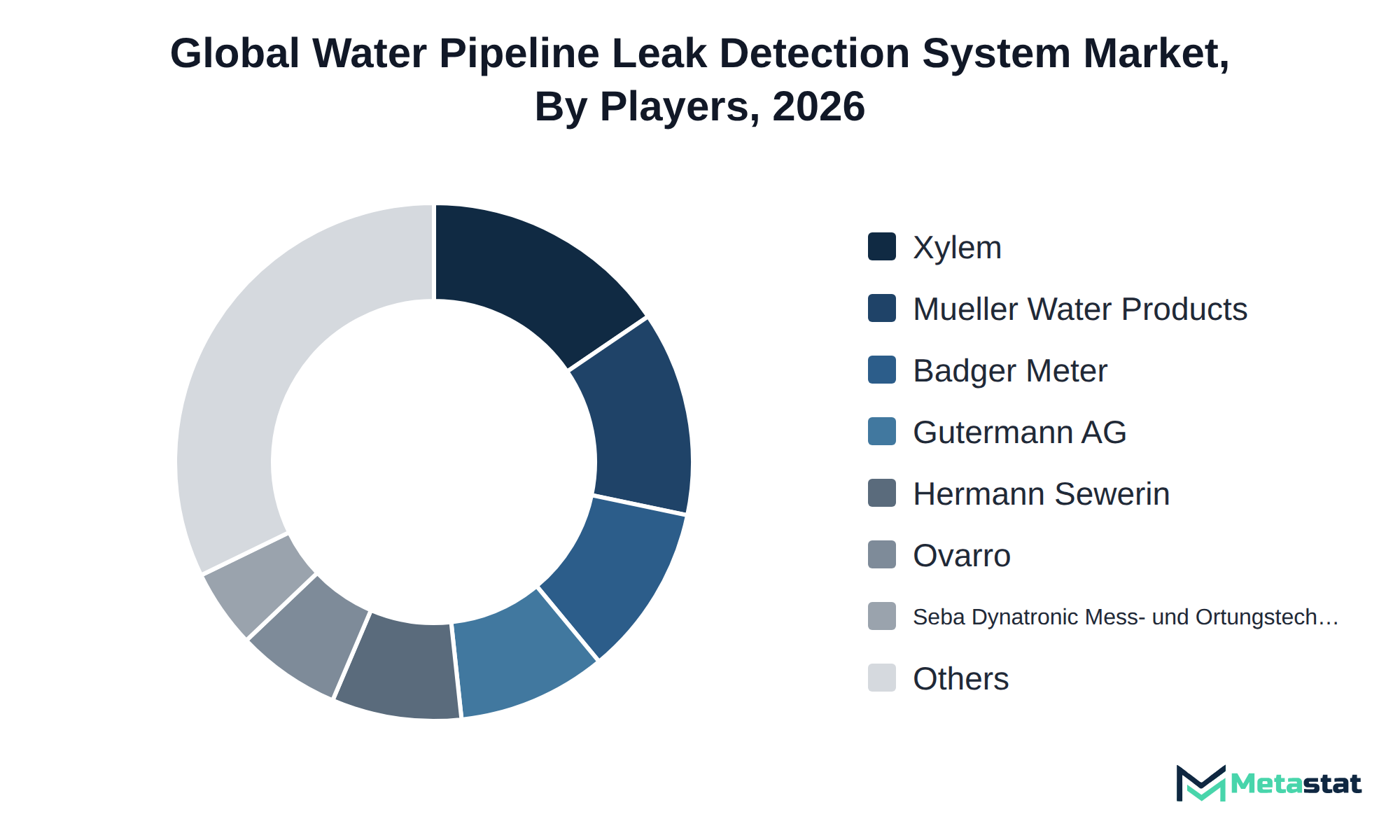
Competition within the Water Pipeline Leak Detection System market features a variety of players focusing on distinct technologies and service options. Companies differentiate themselves based on pricing strategies, product certification, customization capabilities, and service offerings, which are essential factors influencing buyer decision-making.
Xylem Inc. emphasizes advanced water technology solutions, positioning itself to address the needs of water utilities and industrial applications. Badger Meter, Inc. concentrates on innovative water metering technology, enhancing efficiency for various end users, including agricultural enterprises. This metering focus places the company within the broader smart utility metering space. SUEZ provides comprehensive water management services, ensuring effective leak detection while promoting sustainability across municipal and industrial water networks.
Mueller Water Products, Inc. delivers specialized solutions tailored for municipal infrastructure, supporting robust operational needs. Itron, Inc. focuses on smart water management systems, integrating leak detection with data analytics to optimize resource allocation. Teledyne Technologies Incorporated supplies high-precision sensors and monitoring technology, catering to various sectors including oil and gas facility water pipelines.
The market's growth relies on several key developments. First, fixed external systems with remote monitoring are expected to grow from USD 977.3 million in 2026 to USD 1,656.3 million by 2033, reflecting significant investment in proactive leak management. Second, the rising adoption of ultrasonic sensors, anticipated to reach USD 680.9 million by 2033 with a CAGR of 6.5%, supports the need for solutions that enhance pipeline integrity. However, risks including budget constraints in key regions like North America, where the market is forecasted to reach USD 1,580.5 million by 2033, could hinder growth. Addressing these challenges while capitalizing on opportunities in emerging markets will shape the trajectory of the Water Pipeline Leak Detection System market.
By Technology: Acoustic Sensors, Ultrasonic Sensors, Fiber Optic Sensors, Pressure Transducers, Thermal Cameras, Flow-Based Analytics, Conductive Sensing Cables, Others (Tracer Gas, Satellite Radar)
By Application: Municipal Infrastructure, Industrial Water Networks, Agricultural Irrigation, Oil and Gas Facility Water Pipelines, Fire Protection Systems, Residential Water Networks, Commercial Water Networks
By Installation Type: Fixed External Systems with Remote Monitoring, Fixed External Systems with Local Readout, Fixed Inline Systems, Portable External Devices, Mobile Inline Inspection Devices, Remote Sensing Platforms
By End User: Water Utilities, Construction Firms, Agricultural Enterprises, Petrochemical Plant Operators, Fire Departments, Other Industrial Operators, Commercial Facility Owners, Residential Property Owners, Others (Leak Survey Contractors)
The report strategically identifies and profiles the key market players and analyses their core competencies in each sub-segment of the Water Pipeline Leak Detection System market.
Report Attributes | Details |
Study Period | 2021-2033 |
Base Year | 2025 |
Estimated Year | 2026 |
Forecast Period | 2026-2033 |
Historical Period | 2021-2025 |
Growth Rate | CAGR 6.2% from 2026 to 2033 |
Revenue Unit | USD million |
Segmentation | By Technology, Application, Installation Type, End User, and Region |
By Region | North America (By Technology, Application, Installation Type, End User, and Country)
|
Europe (By Technology, Application, Installation Type, End User, and Country)
| |
Asia Pacific (By Technology, Application, Installation Type, End User, and Country)
| |
South America (By Technology, Application, Installation Type, End User, and Country)
| |
Middle East and Africa (By Technology, Application, Installation Type, End User, and Country)
|
Find answers to common questions about this report
The Water Pipeline Leak Detection System market size was valued at USD 2,805.9 million in 2025.
The market is projected to grow at a CAGR of 6.2% during the forecast period from 2026 to 2033.
The North America Water Pipeline Leak Detection System market size is estimated to reach USD 1,580.5 million by 2033.
The leading segment in the Water Pipeline Leak Detection System market is Municipal Infrastructure, with a projected value of USD 2,366.8 million by 2033. This segment surpasses others based on its significant growth potential and market share.
Growing investment in municipal infrastructure significantly drives demand for leak detection technologies. High installation costs present a significant barrier to the market, impacting procurement decisions and leading to slower uptake of new technologies.
North America holds the dominant share of the Water Pipeline Leak Detection System market, with a value of USD 1,580.5 million projected for 2033, representing 36.2 percent of the total market.
High installation costs present a significant barrier to the Water Pipeline Leak Detection System market, impacting procurement decisions and leading to slower uptake of new technologies. Compliance costs associated with strict regulations increase operational expenses for suppliers, affecting profit margins and overall market dynamics.
Growing investment in municipal infrastructure and increasing focus on operational efficiency favor adoption of leak detection technologies. Enhanced awareness of water resource management drives water utilities to prioritize advanced systems, promoting effective management and reducing water loss.
The Water Pipeline Leak Detection System market is estimated to reach a valuation of USD 4,566.5 million by 2033.
Key players operating in the Water Pipeline Leak Detection System market include Xylem Inc., Mueller Water Products, Inc., Badger Meter, Inc., Gutermann AG, Hermann Sewerin GmbH, Ovarro Limited, and Teledyne Technologies Incorporated.
The analysts below cover Energy and Power research at Metastat Insights.
LEAD ANALYST
Utkarsh Khirodkar is a Lead Market Research Analyst at MetaStat Insight, specializing in market intelligence, technology sector assessments, and competitive strategy.

PRINCIPAL CONSULTANT - ENTERPRISE AI & EMERGING TECHNOLOGIES
Banking & Finance · Electronics and Semiconductor · Energy and Power · Healthcare IT · Information & Technology · Professional Services
Vijay Gunti is a Principal Consultant at MetaStat Insight, bringing over two decades of experience across enterprise digital transformation, technology strategy, and intelligent systems.

ENERGY & INFRASTRUCTURE INDUSTRY CONSULTANT
Automotive and Transportation · Electronics and Semiconductor · Energy and Power · Machinery & Equipment
Saurabh Vasant Ganvir consults for Energy & Infrastructure Industry at MetaStat Insight, specializing in renewable energy, solar EPC, and electric vehicle (EV) infrastructure markets.
Evaluating sovereign cloud deployments for core banking platforms demands a clear view of data residency regulations and migration exit strategies. MetaStat Insight delivered an exhaustive review of regional latency tolerances, mainframe decommission milestones, and third-party vendor concentration risk. The regulatory compliance mapping across European and Asian financial jurisdictions gave our team a dependable baseline for multi-cloud infrastructure discussions.
Replacing petrochemical surfactants with bio-based alternatives requires realistic timelines on industrial precision fermentation scaling. The market research broke down commercialization timelines, feedstock sugar price sensitivities, and regional cosmetic ingredient regulatory approvals in Europe and East Asia. That supplier readiness mapping gave our formulations team reliable context when comparing renewable chemical sourcing roadmaps.
Tracking ceramic matrix composite adoption in high-bypass aero engines requires strict attention to material qualification cycles and FAA airworthiness testing milestones. The MetaStat Insight team provided a detailed timeline of silicon carbide fiber manufacturing capacity and commercial foundry lead times. Having clear visibility into upstream thermal barrier coating supply helped us stress-test our long-term component procurement strategy.
Explore related market intelligence reports worth reading alongside this one.
Starting from
$2950