
LEAD ANALYST
Utkarsh Khirodkar is a Lead Market Research Analyst at MetaStat Insight, specializing in market intelligence, technology sector assessments, and competitive strategy.

Global AI in Energy Market Size, Share, By Offering (AI Software and Platforms and AI Implementation and Managed Services), By Application (Renewable Generation and Storage Optimization, Asset Performance and Predictive Maintenance, Grid Optimization and Control, Demand and Generation Forecasting, Exploration, Drilling and Well Optimization, Safety, Inspection and Environmental Monitoring, Energy Trading and Dispatch), By Deployment Model (Cloud, On-Premises and Hybrid), By End-Use Industry (Electricity Networks and Retail Utilities, Upstream Oil and Gas, Renewable Power and Storage Operators, Conventional and Nuclear Power Generators, Midstream and Downstream Oil and Gas), Industry Analysis, Growth, Trends, and Forecast, 2026-2033
Report ID
MSI-5789
Published
November, 2026
Pages
274 Pages
Format
Historical
Base year
Forecast
Forecast period
Report Details
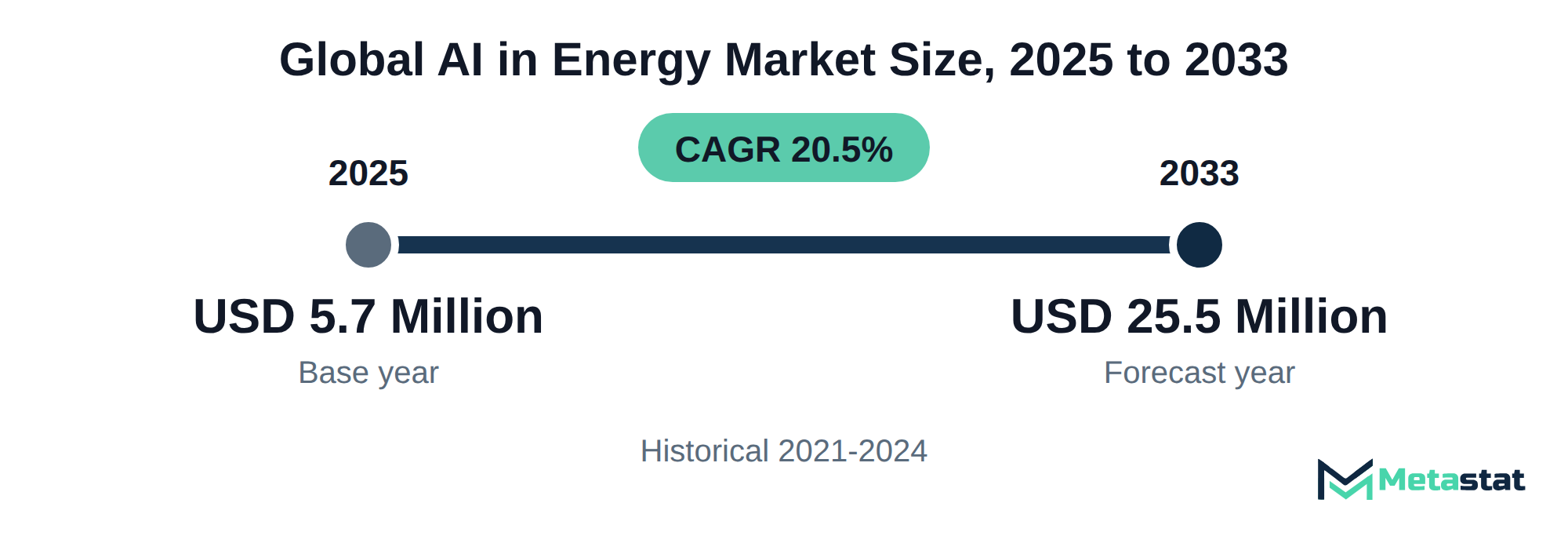
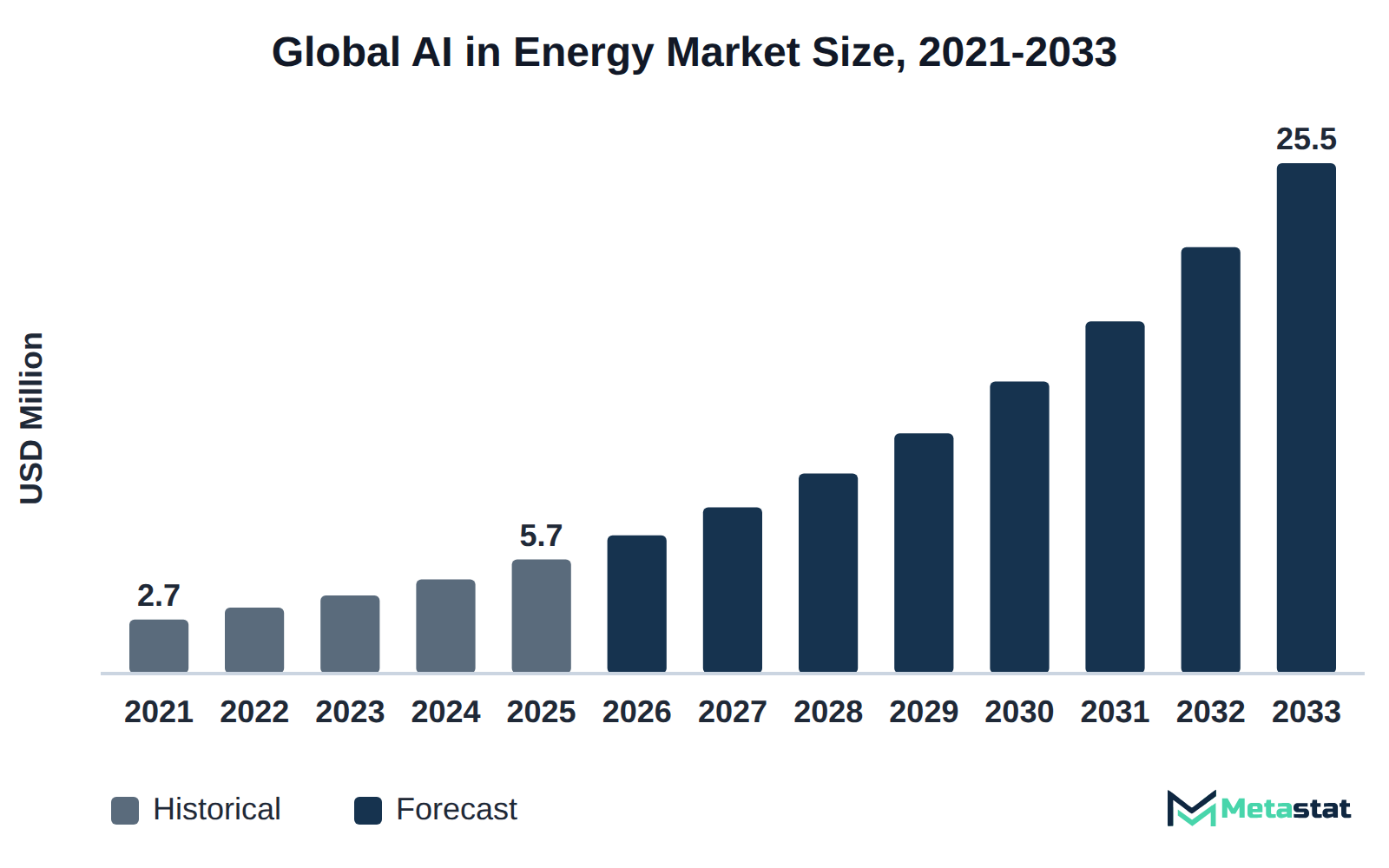
Market Valuation: Valued at $5.7 Million in 2025, projected to reach $25.5 Million by 2033 at a 20.5% CAGR.
Dominant Segment: The renewable generation and storage optimization segment leads the market, driven by the increasing demand for AI-driven solutions that enhance energy efficiency and resource management.
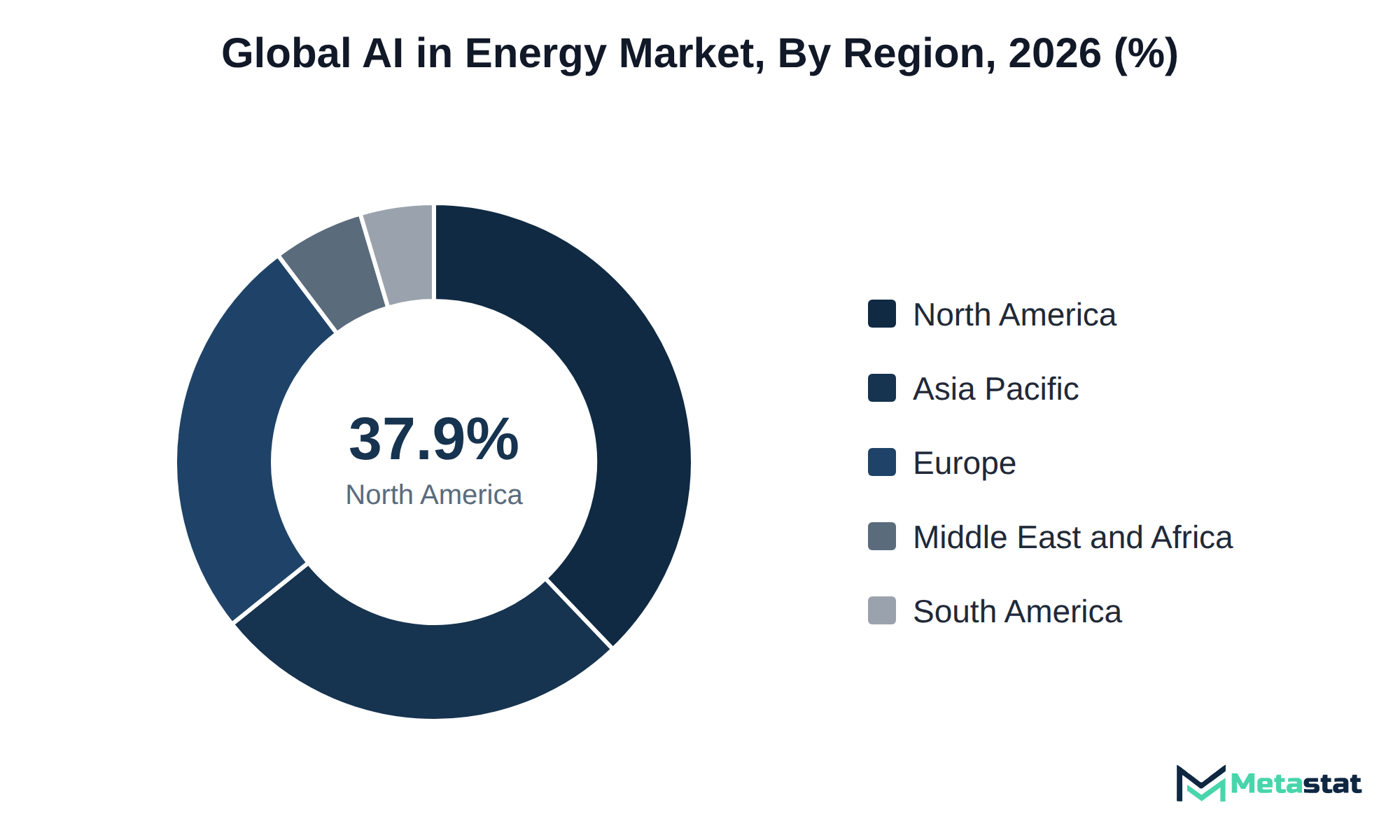
Geographic Lead: North America is the leading region, capturing 37.9% of the market in 2025, with the U.S. expected to maintain its dominance through 2026.
What's Inside: The report provides a comprehensive analysis of the competitive landscape, market dynamics, and detailed forecasts spanning from 2026 to 2033, covering various segments and deployment models.
AI Software Advancements: Technological advancements in AI software are a key growth driver, optimizing operations and enhancing decision-making processes across the energy sector.
Price Sensitivity Challenges: Price sensitivity among buyers, particularly in the renewable power segment, poses challenges to market adoption, impacting investment decisions and growth potential.
Choose Your License
Global AI in Energy Market
The global AI in Energy market was valued at USD 5.7 million in 2025 and is projected to reach USD 25.5 million by 2033, growing at a CAGR of 20.5% over the forecast period.
The AI in Energy market encompasses a range of offerings, including software, platforms, implementation services, and managed services tailored for the energy sector. Buyers invest in this market to enhance operational efficiency, optimize resource allocation, and improve decision-making through advanced analytics and predictive capabilities. The increasing complexity of energy systems and the growing emphasis on sustainability drive the need for innovative solutions that streamline operations and reduce costs.
One of the primary growth drivers in the market is the rising demand for renewable generation and storage optimization. This segment stands out due to its potential for significant impact on energy efficiency and sustainability. North America holds 37.9% of the market in 2025, with the US leading in 2026. In comparison, Europe and Asia Pacific follow closely, capturing 25.5% and 26.4% of the market, respectively. The competition among these regions highlights the global emphasis on transitioning toward cleaner energy solutions.
AI software and platforms represent the segment with the most value, reflecting a shift toward digitalization in the energy sector. The anticipated growth in AI implementation and managed services further supports this trend. Organizations strive to enhance their operational capabilities, and investments in AI-driven technologies help meet evolving energy demands and regulatory requirements.
The AI in Energy market includes advanced technologies and solutions that enhance operational efficiencies and drive performance improvements within the energy sector. Buyers allocate budgets towards these offerings to optimize energy production, manage resources effectively, and ensure compliance with regulatory standards. This investment helps buyers manage energy complexity while addressing sustainability goals and operational challenges.
Significant growth in the market stems from the increasing adoption of renewable energy sources and the shift towards intelligent grid systems. Among the various segments, AI Software and Platforms represent the highest value, reflecting a growing demand for data-driven decision-making tools. This region's established energy infrastructure and technological capabilities drive substantial investment in AI applications.
The rising need for predictive maintenance and efficient resource management fuels the market's expansion. Efforts to improve asset performance and reduce operational costs contribute to this trend, with industries focused on enhancing their overall efficiency. Ongoing advancements in AI technology attract investments aimed at transforming energy operations and promoting sustainable practices.
Artificial intelligence is transforming drilling and well intervention practices within the energy sector. The adoption of AI technologies enhances accuracy in exploration and production processes. Specifically, AI applications optimize drilling operations through predictive analytics, which anticipate equipment failures and facilitate proactive maintenance strategies. Directional drilling is one drilling operation where such analytics can be applied. This capability significantly reduces downtime and operational costs, contributing to improved efficiency.
By 2033, the AI in Energy market for drilling and well intervention is projected to achieve a value of USD 5 million, reflecting a growing emphasis on advanced technologies in the upstream oil and gas industry. The integration of AI-driven solutions enables operators to analyze vast datasets, leading to more informed decision-making and increased productivity. Enhanced drilling performance maximizes recovery rates and supports sustainability goals by minimizing environmental impact.
While the industry evolves, reliance on AI technologies for drilling optimization and well intervention strategies reinforces the role of digital transformation in energy operations. This trend helps businesses stay competitive, since the effectiveness of AI applications directly influences profitability and operational success.
The pricing models for AI solutions in energy, particularly related to grid flexibility and renewable forecasting, exhibit significant variation. Many providers offer tiered pricing structures based on usage or capacity, which supports scalability for buyers. For instance, the deployment of AI software and platforms is projected to expand from USD 4.7 million in 2026 to USD 16.9 million by 2033, reflecting growing adoption across utilities. Buyers typically negotiate contracts that align with their operational needs and future growth plans, ensuring flexibility in their investments.
This pricing approach encourages utility companies and renewable operators to adopt AI technologies without the burden of substantial upfront costs. Incremental payment plans and subscription models enhance budget management for these buyers. Performance-based pricing is also emerging, linking costs to the efficacy of AI solutions in optimizing grid operations. Establishing performance metrics is likely to influence contract negotiations, leading to a more results-driven relationship between buyers and suppliers.
The integration of AI in Energy for predictive maintenance of critical assets significantly enhances operational efficiency and reduces unplanned downtime. The segment focused on Asset Performance and Predictive Maintenance is projected to reach USD 4.6 million by 2033, reflecting a compound annual growth rate of 20.2%. This growth is driven by the increasing adoption of AI-driven analytics in sectors including electricity networks and retail utilities, where timely maintenance of infrastructure is crucial.
Companies operating in this sector use AI technologies to analyze data from equipment sensors, enabling early detection of potential failures. This proactive approach reduces maintenance costs and supports efficient operations, which is essential in high-demand environments. Minimizing unplanned outages enhances customer satisfaction and improves overall service delivery.
The AI in Energy market serves diverse industries seeking to optimize their maintenance strategies. For organizations in electricity and utilities, the advanced capabilities offered by AI tools translate to better resource allocation and improved asset lifespan. Enterprises that implement these predictive maintenance solutions experience greater operational reliability and a stronger competitive advantage.
AI in Energy technologies significantly enhance well production efficiency by optimizing drilling and production processes. By applying AI-driven predictive analytics, operators forecast optimal production rates and identify potential equipment failures before they occur. This predictive capability is critical in the upstream oil and gas sector, where timely insights directly impact operational costs and overall productivity.
The AI in Energy market reflects a commitment to advanced technologies in well optimization. For instance, AI Implementation and Managed Services is projected to reach USD 8.6 million by 2033, demonstrating the increasing reliance on these technologies. Companies including SLB and Halliburton Company actively invest in AI solutions to streamline operations, maximizing output and reducing downtime.
Incorporating AI solutions into well production enhances operational efficiency and leads to significant cost savings. By minimizing unplanned outages and optimizing resource allocation, companies improve their competitive edge. This trend highlights the growing importance of AI in Energy, transforming traditional practices into data-driven decision-making that supports sustainable growth in the energy sector.
Growing investment in renewable energy solutions drives demand for advanced technologies that optimize generation and storage processes. Electricity networks and retail utilities are increasingly adopting AI solutions to enhance operational efficiencies and manage complex energy demands. The surge in environmentally conscious practices among consumers and regulators drives this trend, encouraging utilities to modernize their infrastructure. With an estimated market value of USD 8.6 million by 2033 for electricity networks and retail utilities, the AI in Energy market experiences substantial growth potential. This shift influences purchasing decisions and increases the need for innovative strategies capable of integrating various renewable energy sources. Companies focusing on renewable generation and storage optimization experience heightened activity, resulting in increased competition and advancements in technology. The pursuit of greater sustainability within the energy sector accelerates this transformation.
Technological advancements in AI software facilitate improved decision-making processes in energy management. These innovations optimize operations by analyzing vast amounts of data to enhance efficiency and reduce costs. Utility companies and energy producers increasingly rely on AI to streamline operations, ultimately resulting in enhanced performance metrics. The integration of AI software in energy systems enables predictive analytics and real-time monitoring, allowing for informed strategic planning and resource allocation. This trend generates increased investment in AI solutions, enhancing the market's overall growth trajectory. The demand for effective energy management continues to rise, driving substantial expansion in the AI in Energy market as buyers seek advanced software solutions that address emerging challenges.
The continued evolution of AI capabilities supports the development of sophisticated applications across various energy sectors. The market experiences a surge in adoption rates, driven by the necessity for accurate forecasting and efficient resource management. Overall, these advancements contribute significantly to the competitive landscape, positioning AI as a critical component of modern energy strategies.
The AI in Energy market faces constraints driven by price sensitivity among potential buyers, particularly within the renewable power and storage operators segment. Higher upfront costs associated with AI implementations deter smaller companies from investing in these technologies, leading to slower uptake of advanced solutions. Enterprises hesitate to commit to new systems without assured returns, impacting their decision-making process. This reluctance manifests in smaller orders and delayed replacements of aging infrastructure, which hampers overall efficiency improvements. The market experiences challenges in achieving its full growth potential, particularly in regions where capital investment remains constrained. The ongoing need for budget-friendly solutions remains critical for broader acceptance among various buyer groups.
Reduced spending on technological upgrades limits the scalability of AI applications in energy management. Many organizations prioritize immediate operational needs over long-term investments in innovative technologies. This prioritization further restricts the market's expansion while companies grapple with balancing cost-effectiveness and technological advancements.
Suppliers in the AI in Energy market encounter significant challenges related to talent acquisition and retention. The demand for skilled professionals capable of implementing advanced AI solutions has heightened, creating intense competition among companies for a limited talent pool. This situation drives up talent costs, straining operational budgets and impacting profit margins. Companies are responding by investing in training and development programs to enhance the skill sets of existing employees while collaborating with educational institutions to create a new generation of talent. These initiatives aim to create a sustainable workforce proficient in AI technologies tailored for the energy sector. This emphasis on talent development addresses immediate staffing needs and positions companies to innovate and remain competitive. Addressing these workforce challenges is critical for suppliers seeking to maximize operational efficiency and profitability.
The renewable generation and storage optimization segment presents a significant opportunity within the market. This segment is projected to achieve a compound annual growth rate (CAGR) of 21.4%, highlighting the growing interest in AI-driven solutions that enhance energy efficiency and resource management. Buyers in this area consist primarily of renewable power and storage operators looking to improve operational efficiencies and reduce costs. The demand for advanced AI applications, particularly those focused on optimizing energy generation, aligns closely with the global shift towards sustainable practices and the integration of renewable resources into existing energy systems. Investment in AI software and platforms that facilitate these optimizations reflects strong potential for growth in the AI in Energy market.
The Global AI in Energy market is segmented based on Offering, Application, Deployment Model, and End-Use Industry.
This segment focuses on delivering advanced software and platform solutions that enhance operational efficiency and decision-making in the energy sector. Utilities and energy operators employ these tools to optimize processes, improve asset management, and facilitate data analytics. A significant demand driver for this segment stems from the increasing need for digital transformation within energy companies, driven by the goal to streamline operations and reduce costs. Given its CAGR of 20%, growth in this segment surpasses that of AI Implementation and Managed Services, indicating a strong shift toward software-centric solutions in the industry. This evolution highlights a clear preference among buyers for solutions that integrate with existing systems and provide scalable options for future needs.
AI Implementation and Managed Services segment is estimated to reach USD 8.6 million by 2033, at a CAGR of 21.7% during the forecast period. This segment focuses on providing organizations with the necessary support to implement and manage AI solutions, ensuring optimal performance in energy applications. Utilities and energy companies apply these services to enhance operational efficiencies, particularly in areas like predictive maintenance and asset performance optimization. A strong demand driver includes the increasing reliance on AI technologies to improve decision-making processes and operational visibility. The growth of this segment outpaces AI Software and Platforms, which has a CAGR of 20%, highlighting its critical role in enabling users to effectively adopt and leverage AI solutions. Organizations continue to seek advanced capabilities to address evolving challenges, and the demand for implementation and managed services is expected to grow significantly in the market.
Renewable Generation and Storage Optimization segment is valued at USD 1.7 million in 2026 and is projected to reach USD 6.7 million by 2033, at a CAGR of 21.4% during the forecast period. This segment focuses on enhancing the efficiency of renewable energy generation and optimizing energy storage systems, primarily by utility companies, renewable energy developers, and storage system operators. Demand for this segment is driven by the growing emphasis on sustainable energy solutions and the increasing need for grid reliability, particularly in regions integrating more renewable sources. Compared to other applications in the market, this segment exhibits a higher growth rate than Grid Optimization and Control. The higher growth reflects the urgent need to improve renewable energy output and integrate storage capabilities effectively.
This segment focuses on optimizing the performance and reliability of energy assets through predictive analytics, enabling operators to identify and mitigate potential failures before they occur. Utility companies and renewable power operators drive demand for these solutions, with maintaining high asset availability directly impacting profitability. Asset performance management software is a closely related category for these operators. Increased emphasis on efficiency and reliability in energy production fuels growth in this area. Compared to other segments, including Renewable Generation and Storage Optimization, which exhibits a CAGR of 21.4%, Asset Performance and Predictive Maintenance maintains a slightly slower growth trajectory. This distinction arises from the more mature nature of its technologies and applications, which have been in use longer than emerging solutions focused on generation and storage optimizations. The market continues to evolve, driven by advancements in data analytics and machine learning.
Grid Optimization and Control segment is expected to reach USD 4.1 million by 2033. This segment focuses on enhancing the efficiency and reliability of electricity distribution networks through AI technologies. Utilities and energy management companies apply these solutions to optimize grid performance, manage loads, and ensure stable energy delivery. The segment experiences significant growth driven by the increasing need for reliable energy supply and the integration of renewable energy sources. Adoption of smart grid technologies supports this growth, with a CAGR of 20.2%, making it slower compared to other segments like Renewable Generation and Storage Optimization. The focus on energy security and sustainability separates this segment from AI Implementation and Managed Services, where service-based solutions dominate. The market's trajectory reflects the urgency for innovative solutions that address grid management challenges, particularly due to the rising complexity of energy systems fueled by renewable integration.
Demand and Generation Forecasting segment is projected to grow at a CAGR of 21.3% during the forecast period. This segment focuses on predicting energy demand and generation patterns, enabling utilities and energy providers to optimize operational efficiency. Energy networks apply these forecasts to enhance reliability and manage resource allocation effectively. Growth in this segment is driven by increasing reliance on renewable energy sources, which necessitate accurate forecasting to balance supply and demand. Compared to other applications, this segment features faster growth, with a significant emphasis on integration with AI technologies to evolve forecasting methodologies. Investment in advanced algorithms and data analytics tools enhances forecasting accuracy, leading to improved decision-making for stakeholders in the energy sector. The market supports energy operators in achieving better efficiency and sustainability goals through effective demand and generation forecasting.
Exploration, Drilling and Well Optimization focuses on enhancing efficiency in drilling processes and optimizing well production. Major players within the upstream oil and gas sector apply AI technologies for improved decision-making and operational effectiveness. Demand for this segment arises from the reduction of operational costs and enhancement of productivity. This segment experiences growth driven by advancements in AI that facilitate better exploration techniques and predictive analytics. Compared to other segments, including Renewable Generation and Storage Optimization, it demonstrates slower growth; however, technological innovations in this field attract high investment levels. The AI in Energy market sees significant interest in this sub-segment due to its strategic importance in resource management and operational safety, positioning it uniquely within the broader context of energy applications.
Safety, Inspection and Environmental Monitoring involves the use of AI technologies to enhance the effectiveness of systems designed to ensure safety and compliance within the energy sector. This segment serves industries focused on maintaining operational safety and environmental standards by providing real-time monitoring and predictive capabilities. Increasing regulatory pressures drive adoption, compelling energy firms to invest in advanced safety solutions. The constant need to minimize risks associated with environmental impacts pushes organizations toward AI-driven insights. Compared to other segments, this area experiences different dynamics, with a potentially slower growth trajectory influenced by the critical need for comprehensive safety regulations and protocols. The market's evolving landscape emphasizes the importance of integrating innovative monitoring solutions for improved safety outcomes.
Energy trading and dispatch involves optimizing the buying and selling of electricity to ensure efficient distribution and utilization of energy resources. Wholesale electricity trading is a central activity within this segment. This segment serves various industry players, including energy retailers, utilities, and grid operators, who rely on accurate market data and advanced analytics to make informed trading decisions. Demand for this segment is primarily driven by the increasing complexity of energy markets and the need for real-time decision-making to manage supply and demand effectively. Unlike other applications, energy trading and dispatch focuses on market dynamics and price optimization, distinguishing it from segments including asset performance and grid control. The market benefits from advancements in data analytics and machine learning, enhancing trading strategies and operational efficiencies.
Energy research and customer service automation employs AI technologies to streamline operations and enhance customer interactions in the energy sector. This segment serves energy providers and utility companies focused on improving service delivery and operational efficiency. Demand for innovative tools in customer engagement and research methodologies drives adoption within this segment. Unlike other applications, this area experiences slower growth due to the established nature of traditional customer service practices and reluctance to adopt new technologies. Companies adopting these solutions prioritize enhancing customer satisfaction and operational performance. The market for AI in Energy benefits from the increasing emphasis on customer experience and the need for data-driven decisions, positioning this segment as essential for long-term strategic planning.
Cloud deployment in the AI in Energy market is valued at USD 3.5 million in 2026 and is projected to reach USD 14.6 million by 2033, at a CAGR of 22.6% during the forecast period. This segment supports organizations in utilizing AI technologies for various applications, including predictive maintenance and energy management, allowing users to optimize operations and reduce costs. Key drivers include the increasing need for scalable solutions that adapt to the rapidly changing energy landscape. Demand for cloud services surpasses that of on-premises solutions, which face limitations in flexibility and scalability. The anticipated growth for this segment outpaces others, reflecting a shift towards cloud-based architectures that facilitate better data management and analysis, essential for informed decision-making in energy management. By 2033, the cloud deployment segment is expected to become a key element for energy sector innovations.
The On-Premises segment is estimated to reach USD 5.4 million by 2033, at a CAGR of 15.3% during the forecast period. This deployment model involves hosting AI solutions on local servers, providing organizations with greater control over their data and systems. Primarily employed by large enterprises in the energy sector, On-Premises solutions cater to firms requiring stringent data security and compliance protocols. Growth within this segment is driven by increasing concerns regarding data privacy and regulatory requirements that necessitate data storage on-site. Energy cybersecurity requirements add to these data protection concerns. Compared to cloud-based models, which achieve a CAGR of 22.6%, On-Premises adoption exhibits slower growth due to higher upfront costs and complexities associated with implementation. Nevertheless, the On-Premises segment plays a critical role in the broader AI in Energy market by providing tailored solutions that meet specific operational needs.
Hybrid deployment in the AI in Energy market is expected to reach USD 5.4 million by 2033. This model integrates both cloud and on-premises solutions, appealing to companies seeking flexibility in their operations. Organizations adopt hybrid deployment to balance the benefits of cloud computing with the control offered by on-premises infrastructure. Demand for this segment is driven by the increasing need for real-time data processing and analytics capabilities, particularly among utility companies and energy operators. Compared to the cloud segment, which has a higher growth rate of 22.6%, hybrid's growth reflects a conservative shift towards more integrated solutions. By 2033, hybrid deployment is expected to serve critical functions in energy management systems, enhancing operational efficiency and reducing costs for buyers in the market.
Electricity Networks and Retail Utilities segment is valued at USD 2.2 million in 2026 and is projected to reach USD 8.6 million by 2033, at a CAGR of 21.2% during the forecast period. This segment optimizes the overall efficiency of electricity distribution and enhances customer service through advanced AI technologies. Utilities, including grid operators and retail energy providers, leverage AI-driven solutions for tasks including demand forecasting and operational efficiency. Strong demand for improved grid reliability and enhanced energy management drives growth in this segment. Compared to other segments, this sub-segment experiences a higher growth rate, reflecting increased investment in AI technologies to meet evolving customer needs and regulatory requirements. The focus on integrating renewable energy sources into existing infrastructures further supports this segment's expansion. Innovations in AI applications tailored for utility operations contribute to increased operational effectiveness and competitiveness in the market.
Upstream Oil and Gas segment is estimated to reach USD 5 million by 2033, at a CAGR of 18.9% during the forecast period. This segment primarily serves companies involved in oil and gas exploration and production, focusing on enhancing operational efficiency and reducing costs through advanced analytics and machine learning. Increasing complexities in exploration environments and the demand for cost-effective extraction methods drive growth in this segment. Compared to other segments, the Upstream Oil and Gas segment exhibits a slower growth rate, influenced by fluctuating fossil fuel prices and regulatory changes impacting operations. Investment in AI technologies within this sphere enhances predictive maintenance and asset management, aligning with broader trends observed in the AI in Energy market.
The Renewable Power and Storage Operators segment is expected to reach USD 6 million by 2033. This segment focuses on optimizing the performance and storage capabilities of renewable energy resources, serving operators who manage solar, wind, and other renewable power assets. Increasing regulatory support for renewable energy integration fuels demand, with stakeholders prioritizing sustainable practices and advanced technology to enhance efficiency. Growth in this segment occurs at a CAGR of 21.4%, differentiating it from other segments including Asset Performance and Predictive Maintenance, which has a lower growth rate of 20.2%. The emphasis on energy storage solutions positions this segment uniquely within the AI in Energy market, addressing the critical need for reliable energy supply driven by variable generation patterns.
Conventional and Nuclear Power Generators is projected to grow at a CAGR of 18.2% during the forecast period. This segment caters primarily to electricity generation facilities focused on traditional and nuclear energy sources. Operators in this segment seek to enhance operational efficiency and ensure compliance with stringent safety regulations. Growth in this area is driven by the global push for cleaner energy practices, necessitating improved safety measures and operational oversight. Compared to other segments, including Electricity Networks and Retail Utilities, which experience a higher growth rate at a CAGR of 21.2%, the Conventional and Nuclear Power Generators segment presents a more gradual expansion. This difference highlights the varying dynamics of demand in the market, with traditional energy sectors adapting to meet emerging technological advancements while maintaining regulatory compliance.
The Midstream and Downstream Oil and Gas segment focuses on the transportation and processing of oil and gas products, including refining and distribution. Operators in this segment apply AI technologies to enhance efficiency in logistics, monitor pipeline integrity, and optimize refinery processes. Key forces driving this segment include the rising demand for energy efficiency and the imperative to reduce operational costs. Improved predictive maintenance capabilities, driven by AI integration, help companies minimize downtime and streamline operations. Compared to other segments, the Midstream and Downstream Oil and Gas segment experiences slower growth due to the capital-intensive nature of operations and regulatory challenges, which hinder rapid adoption. In the AI in Energy market, this segment's unique focus on operational efficiency and safety compliance sets it apart from others that prioritize renewable energy solutions or grid optimization.
This sub-segment encompasses district energy systems and commercial energy management solutions, focusing on optimizing energy distribution and consumption across various sectors. District energy systems serve municipalities and large complexes, enabling efficient heating and cooling solutions, while commercial energy management targets businesses aiming to enhance energy efficiency and reduce costs. Factors driving growth in this sub-segment include the increasing demand for sustainable energy practices and the need for improved energy efficiency among enterprises. This segment experiences slower growth compared to other applications, reflecting a more specialized market with distinct buyer needs. Energy providers and large enterprises prioritize innovation in energy management to improve operational efficiency, differentiating this segment from broader applications in the market.
Based on geography, the Global AI in Energy market is divided into North America, Europe, Asia-Pacific, South America, Middle East, and Africa.
Demand within the North American market is driven by robust investments in renewable energy projects and advancements in smart grid technologies. The region's focus on optimizing energy generation and distribution reflects a strong commitment to enhancing efficiency and sustainability. Countries like the United States, Canada, and Mexico are experiencing significant growth in AI applications that support renewable generation and storage optimization. North America holds a share of 37.9% of the global AI in Energy market in 2025. The market is projected to reach USD 8.8 million by the end of 2033, with a compound annual growth rate (CAGR) of 20.5% fueling growth. Strategic initiatives and regulatory frameworks play an important role in shaping the adoption of AI technologies, ensuring that stakeholders remain competitive in an evolving energy landscape.
Germany, France, and the UK emerge key countries driving demand in the AI in Energy market, particularly within the renewable generation and storage optimization sector. High investments in renewable energy infrastructure, coupled with stringent emissions regulations, support the adoption of AI technologies. Italy and Spain experience increased interest in AI solutions for enhancing grid optimization and control. The presence of established utility companies in these nations encourages collaboration with technology providers, leading to innovative applications of AI. Russia's growing emphasis on energy efficiency and reducing operational costs aligns with the market's expansion. Overall, Europe holds a share of 25.5% in the global market, with a projected value of USD 6.9 million by 2026 and expected growth to USD 25.5 million by 2033.
Rapid advancements in AI technologies drive significant adoption within the energy sector across Asia-Pacific. Countries including China and India emphasize renewable energy initiatives, resulting in increased investment in AI solutions for renewable generation and storage optimization. Infrastructure improvements in these nations enhance the efficiency of energy distribution networks, supporting the growth of the AI in Energy market. The focus on grid optimization and control ensures reliability and stability within electricity networks, a critical aspect for South Korea and Japan. Australia actively explores AI applications in asset performance and predictive maintenance, aligning with global sustainability goals. By 2025, the region is expected to capture 26.4% of the global market share, reflecting strong demand for AI-driven innovations.
Brazil and Argentina drive demand within the AI in Energy market primarily through their efforts to enhance energy efficiency and transition towards renewable sources. Both countries benefit from government initiatives that promote renewable energy projects, influencing investments in AI technologies. The market share for South America stands at 4.6% in 2025, reflecting a growing interest in optimizing energy production and consumption. In Brazil, advancements in grid optimization and control applications play a crucial role in improving energy distribution. Argentina's focus on renewable generation and storage optimization aligns with global sustainability trends, resulting in increasing adoption rates of AI solutions. Overall, South America's unique regulatory environment and strategic investments in energy infrastructure significantly contribute to the market's projected growth in the coming years.
In the Middle East and Africa, the drive for advanced technologies within the energy sector reflects a growing focus on sustainability and modernization. Saudi Arabia and the UAE actively invest in renewable energy initiatives, creating significant demand for solutions that enhance energy efficiency and integration. South Africa, with its diverse energy landscape, sees increasing reliance on AI in Energy applications to optimize grid management and improve resource allocation. The market is poised for growth, supported by government initiatives aimed at enhancing energy infrastructure and reducing carbon emissions. In this region, the share of the global market in 2025 stands at 5.7%, indicating a solid foundation for ongoing developments in AI technologies tailored for energy management. The adoption of AI is expected to transform operational capabilities across various sectors, ensuring improved performance and reliability.
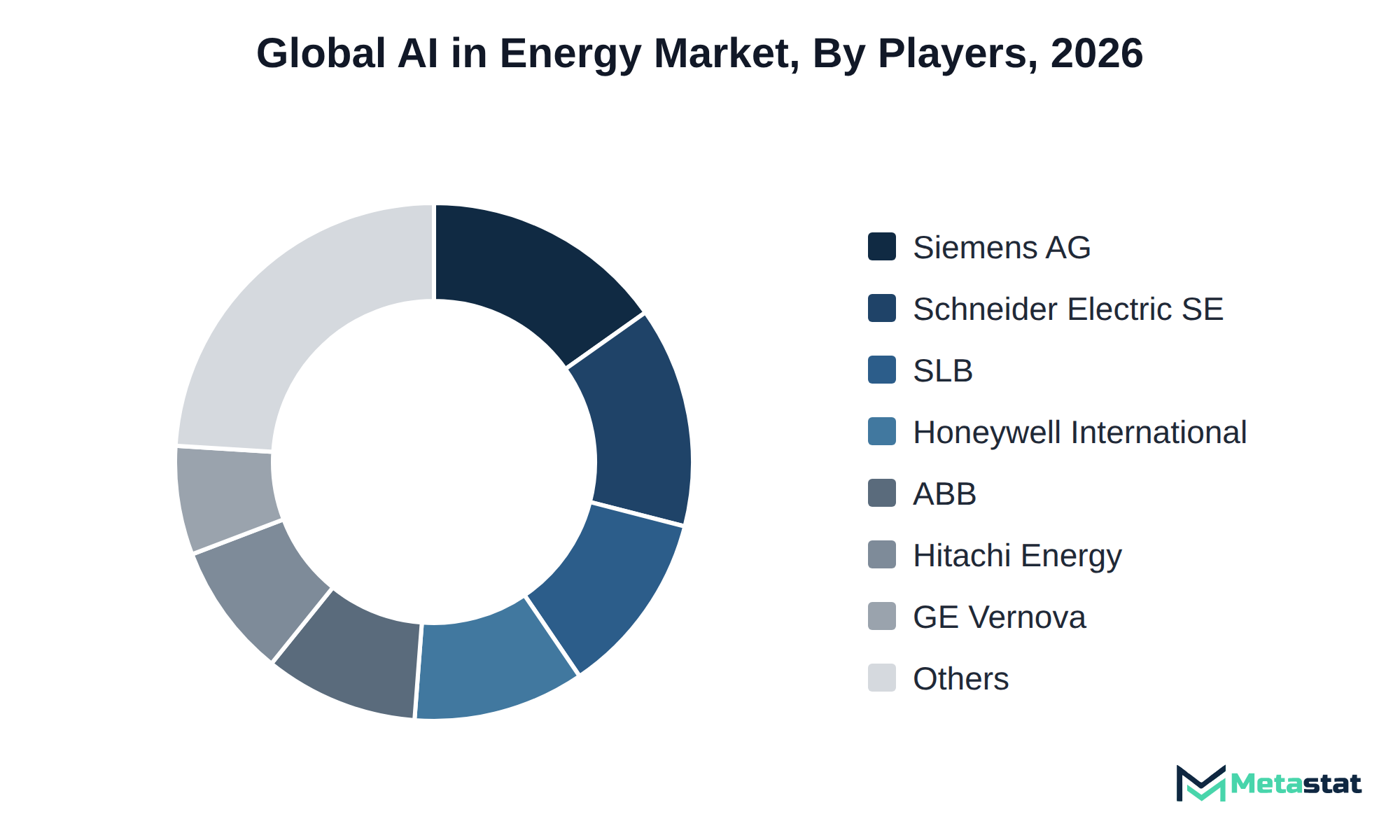
Companies in the AI in Energy market compete through various strategies that highlight their unique offerings and capabilities. Key differentiators include pricing, customization, ecosystem compatibility, and service quality, which significantly influence buyer decisions.
Major players like SLB and Siemens AG emphasize technological innovation, offering advanced AI software and platforms tailored for energy management. GE Vernova Inc. and Schneider Electric SE prioritize solutions in renewable generation and storage optimization, focusing on integration and performance efficiency.
Firms like Honeywell International Inc. and IBM leverage their extensive service networks to provide implementation and managed services, enhancing customer engagement through responsive support. Companies including Tesla, Inc. and Hitachi Energy Ltd. advance AI applications in grid optimization and control, driving efficiency improvements across various energy sectors.
Achieving this growth relies on several developments within the AI in Energy market. A significant driver includes the increasing adoption of AI software and platforms for renewable generation and storage optimization, which is expected to enhance operational efficiencies in this segment. The expansion of cloud deployment models will facilitate scalability and accessibility, thereby attracting more players in the market. The North American region, projected to account for USD 8.8 million by 2033, will lead this growth through substantial investments in AI technologies across electricity networks and retail utilities.
However, potential risks exist that could hinder market progress, including regulatory challenges and the slow pace of technology integration. These factors particularly impact the AI implementation and managed services segment, which requires careful alignment with industry standards and regulations. Addressing these risks effectively will be essential to realize the full potential of the market, ensuring sustained growth and innovation in the years ahead.
By Application: Renewable Generation and Storage Optimization, Asset Performance and Predictive Maintenance, Grid Optimization and Control, Demand and Generation Forecasting, Exploration, Drilling and Well Optimization, Safety, Inspection and Environmental Monitoring, Energy Trading and Dispatch, Others (Energy Research and Customer Service Automation)
By Deployment Model: Cloud, On-Premises, Hybrid
By End-Use Industry: Electricity Networks and Retail Utilities, Upstream Oil and Gas, Renewable Power and Storage Operators, Conventional and Nuclear Power Generators, Midstream and Downstream Oil and Gas, Others (District Energy and Commercial Energy Management)
The report strategically identifies and profiles the key market players and analyses their core competencies in each sub-segment of the AI in Energy market.
Report Attributes | Details |
Study Period | 2021-2033 |
Base Year | 2025 |
Estimated Year | 2026 |
Forecast Period | 2026-2033 |
Historical Period | 2021-2025 |
Growth Rate | CAGR 20.5% from 2026 to 2033 |
Revenue Unit | USD million |
Segmentation | By Offering, Application, Deployment Model, End-Use Industry, and Region |
By Region | North America (By Offering, Application, Deployment Model, End-Use Industry, and Country)
|
Europe (By Offering, Application, Deployment Model, End-Use Industry, and Country)
| |
Asia Pacific (By Offering, Application, Deployment Model, End-Use Industry, and Country)
| |
South America (By Offering, Application, Deployment Model, End-Use Industry, and Country)
| |
Middle East and Africa (By Offering, Application, Deployment Model, End-Use Industry, and Country)
|
Find answers to common questions about this report
The AI in Energy market size was valued at USD 5.7 million in 2025.
The market is projected to grow at a CAGR of 20.5% during the forecast period from 2026 to 2033.
The North America AI in Energy market size is estimated to reach USD 8.8 million by 2033.
AI Software and Platforms leads the market with a value of USD 16.9 million in 2033, based on its projected growth compared to other segments.
Growing investment in renewable energy solutions drives demand for advanced technologies that optimize generation and storage processes. The surge in environmentally conscious practices among consumers and regulators encourages utilities to modernize their infrastructure.
North America holds the dominant share of the AI in Energy market, with a projected value of USD 8.8 million in 2033, representing 37.9 percent of the total market. This figure surpasses the shares of other regions, including Europe and Asia Pacific.
Price sensitivity among potential buyers, particularly within the renewable power and storage operators segment, restrains growth in the AI in Energy market. Higher upfront costs associated with AI implementations deter smaller companies from investing, resulting in slower uptake of advanced solutions.
Several factors favor adoption in the AI in Energy industry, including the increasing demand for energy efficiency and resource management solutions. The renewable generation and storage optimization segment is projected to achieve a compound annual growth rate of 21.4%, reflecting strong interest among renewable power and storage operators in AI-driven technologies.
The AI in Energy market is estimated to reach a valuation of USD 25.5 million by 2033.
Key players operating in the AI in Energy market include SLB, GE Vernova Inc., Siemens AG, Schneider Electric SE, Hitachi Energy Ltd., and Honeywell International Inc. These companies focus on providing AI-driven solutions and services tailored to the energy sector.
The analysts below cover Energy and Power research at Metastat Insights.
LEAD ANALYST
Utkarsh Khirodkar is a Lead Market Research Analyst at MetaStat Insight, specializing in market intelligence, technology sector assessments, and competitive strategy.

PRINCIPAL CONSULTANT - ENTERPRISE AI & EMERGING TECHNOLOGIES
Banking & Finance · Electronics and Semiconductor · Energy and Power · Healthcare IT · Information & Technology · Professional Services
Vijay Gunti is a Principal Consultant at MetaStat Insight, bringing over two decades of experience across enterprise digital transformation, technology strategy, and intelligent systems.

ENERGY & INFRASTRUCTURE INDUSTRY CONSULTANT
Automotive and Transportation · Electronics and Semiconductor · Energy and Power · Machinery & Equipment
Saurabh Vasant Ganvir consults for Energy & Infrastructure Industry at MetaStat Insight, specializing in renewable energy, solar EPC, and electric vehicle (EV) infrastructure markets.
Scaling antibody-drug conjugate manufacturing hinges on contract manufacturing availability for high-potency active ingredients. The MetaStat Insight analysis looked closely at global cleanroom slot constraints, bioconjugation batch failure rates, and supply chain redundancies between the US, Europe, and India. The supplier capability matrix proved genuinely useful for our team when mapping secondary source options across our clinical pipeline.
Floating offshore wind feasibility relies heavily on specialized installation vessel availability and port crane limits, which most broad renewable energy forecasts ignore. The report delivered a thorough analysis of dry dock capacity, mooring chain supply constraints, and raw material pricing trends for deepwater anchor installations. It served as a solid independent sanity check for our offshore project capital expenditure assumptions.
Assessing commercial microgrid software adoption requires looking past top-level installation numbers and examining utility interconnection queues. The research provided verifiable data on average permitting timelines, tariff structures, and battery storage integration costs across regional utility territories. That grounded perspective was valuable for our team when building five-year demand projections for industrial microgrid controllers.
Explore related market intelligence reports worth reading alongside this one.