
LEAD ANALYST
Utkarsh Khirodkar is a Lead Market Research Analyst at MetaStat Insight, specializing in market intelligence, technology sector assessments, and competitive strategy.

Global Managed Services Market Size, Share, By Service Type (Managed Infrastructure Services, Managed Security Services, Managed Network Services, Managed Data Center Services, Managed Communication Services, Managed Mobility Services, Managed Application Services, Managed Backup and Recovery Services) and By Deployment Model (On-Premises, Cloud-Based, Hybrid) and By Enterprise Size (Large Enterprises, Small and Medium Enterprises (SMEs)) and By End-Use Industry (BFSI, IT and Telecom, Government, Healthcare, Manufacturing, Retail and E-Commerce, Media and Entertainment) Industry Analysis, Growth, Trends, and Forecast, 2026-2033
Report ID
MSI-3307
Published
November, 2026
Pages
296 Pages
Format
Historical
Base year
Forecast
Forecast period
Report Details
Market Valuation: Valued at $404.4 Million in 2025, projected to reach $832.1 Million by 2033 at a 9.4% CAGR.
Dominant Segment: The Managed Infrastructure Services segment leads the market, driven by the need for businesses to modernize their IT frameworks and enhance operational resilience.
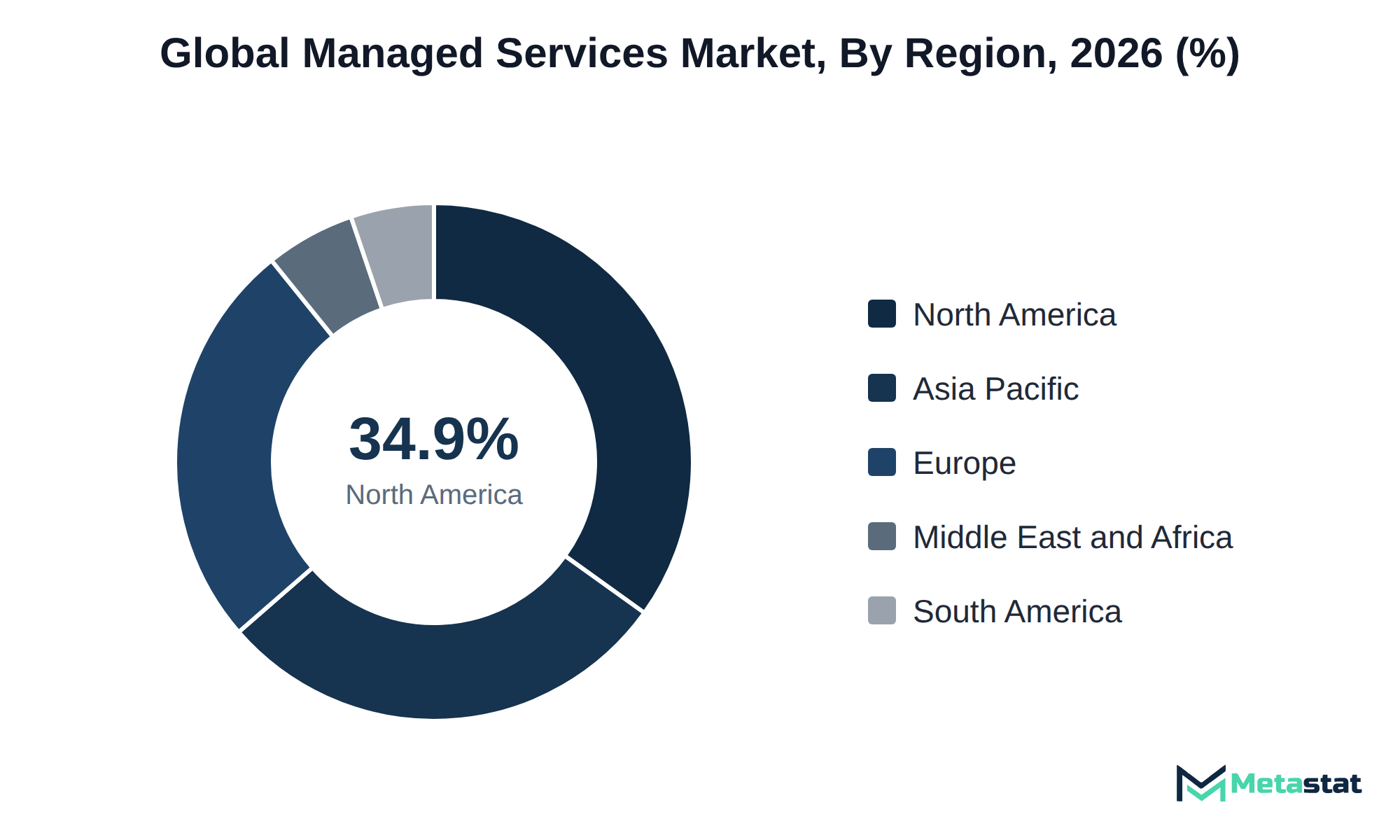
Geographic Lead: North America is the leading region, accounting for 34.9% of the market in 2025, supported by its advanced technological infrastructure and high adoption rates of managed services.
What's Inside: This report provides a comprehensive analysis of the competitive landscape, service type segmentation, and a detailed forecast window from 2026 to 2033.
Rising Demand for Managed Security Servi: The Managed Security Services segment is experiencing significant growth, driven by increasing cyber threats and regulatory pressures, with a projected value of USD 163.8 million by 2033.
Cloud-Based Solutions Growth: The cloud-based delivery model is anticipated to reach USD 343 million by 2033, reflecting a strong demand for flexibility and scalability in IT operations.
Choose Your License
Global Managed Services Market
The global Managed Services market was valued at USD 404.4 million in 2025 and is projected to reach USD 832.1 million by 2033, growing at a CAGR of 9.4% over the forecast period.
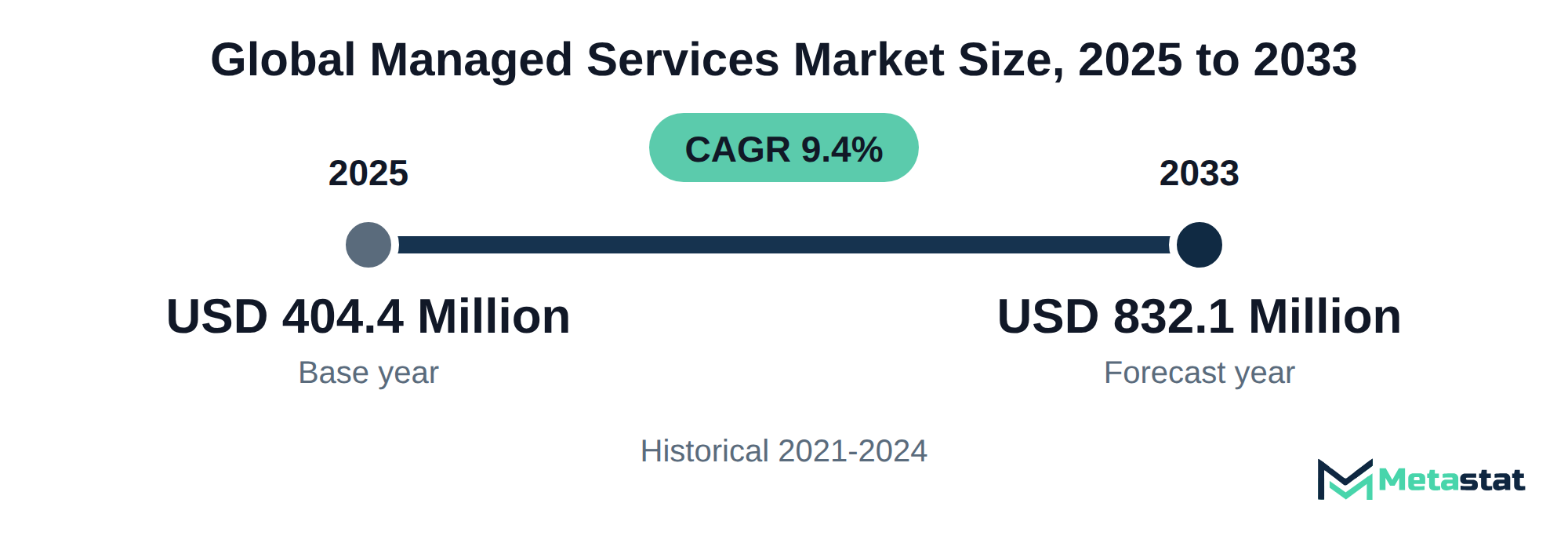
The Managed Services market covers services designed to optimize IT operations across sectors. Buyers invest in these services to enhance operational efficiency, reduce costs, and focus on core business activities. Growing reliance on technology and increasingly complex IT environments drive organizations to seek external expertise, giving them access to specialized skills and resources.
Significant growth in the market is fueled by the rising demand for managed security services, which address the growing threat landscape and compliance requirements faced by organizations. North America holds 34.9% of the market in 2025, with the US leading in 2026. The region's advanced technological infrastructure and high adoption rates of managed services contribute to its dominant position compared to Europe and the Asia Pacific, which hold 25.6% and 28.7%, respectively.
The managed infrastructure services segment represents the largest share of the market, driven by the need for businesses to modernize their IT frameworks. Organizations increasingly recognize the strategic importance of these services in ensuring business continuity and enhancing operational resilience. Ongoing digital transformation across industries further accelerates investment in managed services, reflecting a shift towards more agile and scalable IT solutions.
The Managed Services market addresses the increasing demand for advanced IT solutions, enabling organizations to enhance efficiency and reduce operational costs. Buyers invest in these services to streamline their IT infrastructure, manage complexities, and maintain competitive advantage. The segment focusing on Managed Security Services stands out due to the rising emphasis on cybersecurity, prompting organizations to allocate significant resources towards securing their systems and data.
Growth in the market is propelled by several factors, with the rapid adoption of cloud-based solutions emerging as a primary driver. Organizations are shifting towards cloud environments to enhance flexibility and scalability while minimizing costs. This region's advanced technological landscape and growing spending on managed services reflect its important role in the market's expansion.
In addition to North America, the Asia Pacific region, accounting for 28.7% of the market, presents substantial potential due to increasing digital transformation initiatives. Demand for managed services in this region comes from a growing base of small and medium enterprises that want to use advanced technologies without heavy investments in infrastructure. This trend creates opportunities for sustained growth in the Managed Services market.
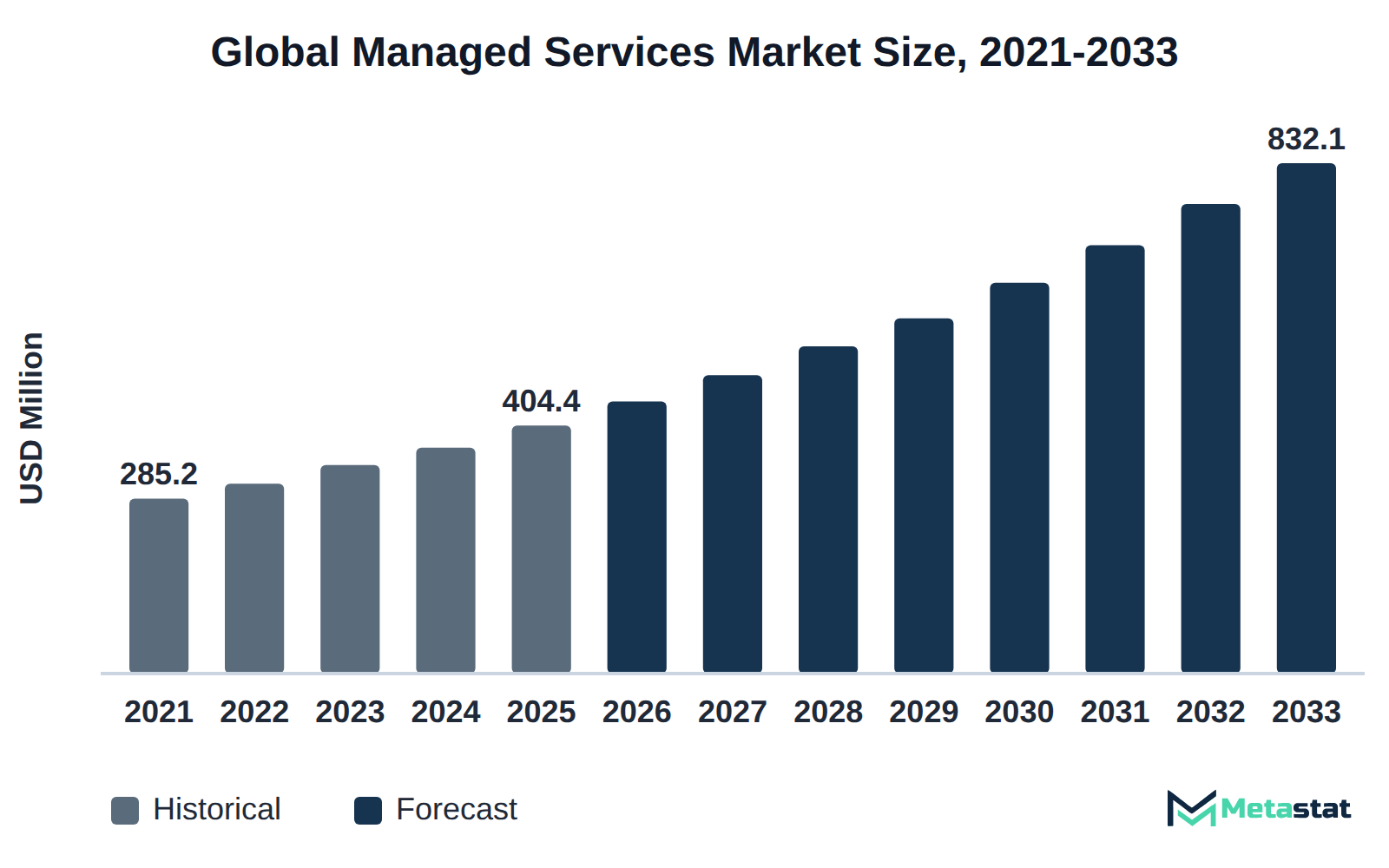
The growing complexity of hybrid and multi-cloud environments significantly drives enterprises to outsource IT operations. The increasing reliance on diverse cloud services complicates management, security, and compliance efforts for organizations. The Managed Security Services segment is projected to reach USD 163.8 million by 2033, reflecting substantial investment in outsourced security solutions. This trend signals a shift from traditional in-house management to specialized providers capable of addressing intricate security challenges.
The transition to hybrid and multi-cloud infrastructures often overwhelms internal IT teams, leading to inefficient resource allocation and potential vulnerabilities. With managed services, companies streamline operations and rely on experts for their IT needs while focusing on core business functions. The Managed Services market supports this evolution, enabling businesses to enhance operational efficiency and reduce risks associated with cloud adoption.
Managed Security Services represent the fastest-growing layer of outsourced IT, with an anticipated value of USD 163.8 million by 2033. This segment is characterized by a shift in pricing models that reflects the increasing complexity and sophistication of security needs among organizations. Buyers increasingly favor flexible, outcome-based pricing structures that align costs with the actual usage and performance of services. This approach enhances budget predictability and aligns the financial interests of service providers and clients.
In addition to traditional models based on flat fees or hourly rates, managed services agreements often include subscription-based pricing, tiered service levels, and pay-as-you-go options. Such diversity caters to a range of enterprise sizes, from large corporations to small and medium enterprises seeking tailored solutions without the burden of excessive upfront costs. This flexibility lets buyers adjust their investment as needs change, particularly in cybersecurity.
Organizations increasingly prioritize security, making a responsive pricing model essential for service providers aiming to capture market share. The Managed Services market is projected to grow at a compound annual growth rate of 9.4% from 2025 to 2033. This makes adaptable pricing strategies important for service providers that want to strengthen their competitive positioning while meeting client demands.
Government and regulated sectors are increasingly rewriting managed IT contracts with a strong focus on compliance and artificial intelligence (AI) integration. This shift stems from heightened scrutiny on data protection and privacy regulations, compelling organizations to prioritize security measures within their IT frameworks. In these sectors, the demand for Managed Security Services is particularly pronounced, with an anticipated value of USD 163.8 million by 2033, reflecting a compound annual growth rate (CAGR) of 11.3%. This growth reflects a significant transformation in how governmental entities and regulated industries approach IT security, emphasizing the need for enhanced risk management and compliance adherence.
The integration of AI within managed services facilitates advanced analytics and threat detection, allowing organizations to respond to security incidents more effectively. Such capabilities ensure that government and regulated sectors maintain compliance with evolving regulations while optimizing operational efficiency. This trend in managed services contributes to an increase in contract values and long-term commitments, driving a competitive edge in the market.
Cloud-based delivery models in the Managed Services market demonstrate significant growth potential, driven by increasing demand for flexibility and scalability. By 2033, the cloud-based segment is projected to reach USD 343 million, reflecting a compound annual growth rate (CAGR) of 11.1%. This growth stems from organizations seeking to enhance operational efficiency and reduce overhead costs, which cloud-based solutions effectively support.
Hybrid models present a compelling option, combining the benefits of both on-premises infrastructure and cloud services. The hybrid segment is anticipated to achieve a value of USD 244.4 million by 2033, offering businesses a balanced approach that improves resource allocation while maintaining control over sensitive data. Such flexibility appeals to various industries, particularly those in regulated sectors, where data security remains critical.
On-premises models remain important within the market, particularly among large enterprises that prioritize data control. By 2033, the on-premises segment is expected to reach USD 244.7 million. While this model provides advantages in data security and compliance, it often requires higher upfront investments and ongoing maintenance costs compared to cloud-based options.
Ultimately, organizations will determine the best delivery model based on their specific needs, regulatory requirements, and budgetary constraints. The strategic choice between cloud-based, hybrid, or on-premises models directly influences operational efficiency and shapes a company's competitive position within the Managed Services market.
Organizations increasingly migrate to cloud-based solutions, driving substantial spending in the Managed Services market. This shift is particularly evident among small and medium enterprises (SMEs) seeking to enhance operational efficiency and reduce infrastructure costs. The transition to cloud technologies allows firms to scale resources dynamically and optimize their IT expenditures. The demand for managed cloud services is expected to grow significantly, with an anticipated value of USD 343 million by 2033. This growth reflects a broader trend in the market, where enterprises prioritize flexibility and cost-effectiveness in their IT strategies.
Investment in cloud-based managed services enhances productivity through improved management and resource allocation. This trend indicates a strategic alignment of IT investments with business objectives across various sectors, reinforcing the competitive landscape.
Increased adoption of managed services among SMEs illustrates a significant change in market dynamics, promoting innovative approaches to IT management.
The integration of AI-driven automation in managed services enhances operational efficiency and service delivery. Automation technologies streamline repetitive tasks, enabling service providers to allocate resources toward more strategic initiatives. This shift attracts enterprises aiming to reduce operational expenditures while boosting service responsiveness. Industries including BFSI and healthcare increasingly adopt these solutions due to their reliance on real-time data processing and decision-making. The managed services market benefits from this trend, with service providers establishing partnerships and investing in AI capabilities to stay competitive. Organizations strive for greater agility and efficiency, which drives strong growth in demand for advanced, AI-enabled managed services. Investment strategies and competitive positioning among market players evolve, encouraging innovation and service evolution. The market is anticipated to experience substantial growth driven by the continuous need for enhanced automation and intelligent service offerings.
Rising costs of managed services limit adoption among small and medium enterprises (SMEs). Price sensitivity within this buyer group leads to slower uptake of services, resulting in delayed decisions regarding outsourcing IT operations. High service fees, alongside competing internal IT investments, create challenges for SMEs striving to optimize their budgets while maintaining efficient operations. This price pressure influences purchasing behavior, driving smaller order volumes and extended replacement cycles for existing IT infrastructure. Price increases in the managed services market complicate financial planning for these businesses, leading to reduced investment in necessary technological upgrades. As a result, the market struggles to engage SMEs, which may slow overall growth and innovation within the sector.
Large enterprises, while better positioned financially, experience the effects of escalating costs, impacting their budgeting strategies and service selection. Increased scrutiny on return on investment hampers their willingness to engage with managed service providers, affecting overall demand within the market.
Rising talent costs represent a significant challenge in the managed services market. The demand for skilled professionals, particularly in IT and cybersecurity, has surged due to increased complexity in systems and evolving technologies. Several suppliers face difficulties in attracting and retaining experienced personnel, impacting service delivery and profit margins. In response, organizations are investing in training programs to upskill existing employees while exploring partnerships with educational institutions to create a pipeline of qualified graduates. This strategic focus on talent development aims to mitigate labor shortages and enhance service capabilities. Companies prioritize automation to streamline operations and reduce dependency on manual processes, allowing them to allocate resources more effectively. Such strategic adjustments are essential for maintaining competitive positioning and meeting client demands in a changing market environment.
Growth in the Managed Services market is significantly influenced by rising demand for managed security services. The increasing frequency and sophistication of cyber threats drive organizations to seek robust security solutions, particularly within sectors including BFSI and healthcare, where data protection is critical. Enterprises face regulatory pressure and heightened security expectations, leading to investments in managed security services becoming a strategic priority. Providers in this market segment offer advanced security measures, including threat detection and incident response, to address these challenges effectively. The anticipated growth in this segment highlights a substantial opportunity for service providers to enhance their offerings and capture market share in an evolving security landscape.
The Global Managed Services market is segmented based on Service Type, Deployment Model, Enterprise Size, and End-Use Industry.
Managed Infrastructure Services segment is valued at USD 89.6 million in 2026 and is projected to reach USD 159.4 million by 2033, at a CAGR of 8.6% during the forecast period. This segment focuses on the management and optimization of an enterprise's IT infrastructure, including servers, storage, and networking resources. Large enterprises often use these services to enhance operational efficiency and improve resource allocation. The increasing complexity of IT environments drives demand for managed infrastructure services, especially among organizations seeking to reduce operational risks and enhance performance. This segment's growth rate of 8.6% surpasses that of managed data center services. Investment in this area reflects a strategic shift toward outsourcing, enabling businesses to streamline operations while focusing on core competencies. The Managed Services market presents significant opportunities for providers offering tailored solutions that meet specific infrastructure needs.
Managed Security Services protect organizations against cyber threats, helping to ensure data integrity and compliance with various regulations. Key users include financial institutions, healthcare providers, and government entities, which prioritize security to safeguard sensitive information. The increasing frequency of cyberattacks drives demand for enhanced security measures, with many organizations opting for outsourced solutions to mitigate risks. Compared to other segments, this one exhibits faster growth, benefiting from heightened regulatory scrutiny and the evolving threat landscape. Demand remains strong, reflecting the critical need for security strategies across multiple industries. The market for these services is expected to expand significantly, driven by an ongoing focus on cybersecurity and the necessity for businesses to adapt to emerging threats.
Managed Network Services segment is expected to reach USD 115.2 million by 2033. This segment provides essential support for organizations in managing their network infrastructure, ensuring reliable connectivity and efficient data flow. Enterprises, particularly in sectors like BFSI and IT, increasingly rely on these services to enhance operational efficiency and reduce downtime. The growing demand for cloud-based solutions drives adoption, owing to their scalability and flexibility. Managed Network Services exhibit a higher growth rate compared to Managed Infrastructure Services, with a CAGR of 8.6%. The focus on enhancing cybersecurity measures and network performance further drives this segment. Organizations prioritize secure and reliable network environments, pushing providers to innovate continuously and address evolving challenges in connectivity.
Managed Data Center Services segment is projected to grow at a CAGR of 8.5% during the forecast period. This segment includes various services related to the management, maintenance, and optimization of data center operations, crucial for organizations heavily relying on data processing and storage. Enterprises in sectors including IT, finance, and healthcare apply these services to ensure optimal performance and reliability of their data infrastructures. The increasing demand for efficient data management solutions drives growth, with organizations seeking to enhance their operational resilience. Compared to other segments, Managed Data Center Services experience a moderate growth rate, driven by enterprises' ongoing need for stable and secure data environments, positioning this segment favorably within the market.
Managed Communication Services facilitate the management of communication tools and technologies across organizations, enhancing collaboration and connectivity. This segment primarily serves businesses seeking to streamline their communication processes, ensuring efficient information exchange and improved productivity. Growing demand for effective communication solutions drives the uptake of these services, particularly among large enterprises that prioritize effective communication strategies. In contrast to other service types, Managed Communication Services exhibit slower growth rates due to higher initial investments required for deployment and integration. Varying customer preferences toward unified communication platforms and services impact adoption rates, differentiating this segment from more rapidly expanding alternatives including Managed Security Services.
Managed Mobility Services focuses on facilitating the management of mobile devices, applications, and data within organizations. This segment supports enterprises in optimizing their mobile strategies, enhancing productivity, and ensuring security across various mobile platforms. Enterprises, particularly those in technology-driven sectors, increasingly adopt managed mobility services to streamline operations and improve employee efficiency. Demand for these services receives momentum from the growing reliance on mobile solutions in business operations. This segment experiences different dynamics than others in the service type category, with potential for significant growth driven by the increasing adoption of mobile enterprise applications and solutions. In contrast to more traditional managed services, mobility services align with faster technological advancements and evolving consumer expectations, positioning them uniquely in the market.
Managed Application Services involves the management and optimization of software applications for organizations. This segment caters to various enterprises, providing essential support for application deployment, maintenance, and updates. Companies in industries including healthcare, finance, and retail rely on these services to enhance operational efficiency and focus on core competencies. One significant driver for this segment is the increasing reliance on digital applications, which has led businesses to seek specialized support. Compared to other segments, Managed Application Services typically exhibits higher pricing due to the expertise required for software management and customizations. This segment's growth trajectory differs from Managed Security Services, which is projected to experience faster expansion due to heightened security concerns across sectors. Investment in application management aligns with the broader trend within the Managed Services market, reflecting a shift towards optimizing software performance and user experience.
Managed Backup and Recovery Services focus on the protection and restoration of data within organizations. This segment serves various industries, including healthcare, finance, and government, where data security is critical. Demand for these services is driven by increasing cyber threats and regulatory compliance requirements. Organizations prioritize safeguarding sensitive information, leading to heightened investments in backup and recovery solutions. Compared to other service types, this segment experiences strong growth due to its essential role in disaster recovery planning and data integrity. Unlike Managed Network Services, which have a more gradual adoption curve, Managed Backup and Recovery Services reflect an urgent need for reliable data protection solutions. The Managed Services market evolves, with investment in these services becoming a priority for companies looking to maintain operational resilience.
This sub-segment encompasses managed information and managed print services, focusing on optimizing document workflows and enhancing data management for organizations. Users typically include businesses across various sectors, particularly in industries that rely heavily on document processing and information management. Significant forces driving demand in this segment involve the increasing emphasis on operational efficiency and cost reduction. Clients actively seek solutions that streamline printing processes and improve information accessibility. Compared to other service types, this sub-segment experiences slower growth due to higher upfront investment requirements and the availability of alternative in-house solutions. However, the continuous evolution of technology and the need for secure information management present opportunities for service providers to innovate and cater to emerging client needs more effectively.
The On-Premises segment is valued at USD 162.2 million in 2026 and is projected to reach USD 244.7 million by 2033, at a CAGR of 6% during the forecast period. This segment typically supports large enterprises and specific operational needs, providing dedicated infrastructure on-site. Demand for On-Premises services emerges from organizations requiring stringent data control and compliance with regulatory standards. Growth in this segment proceeds at a slower pace compared to the Cloud-Based segment, which is projected to grow at a CAGR of 11.1%. The On-Premises approach incurs higher initial costs, which influences purchasing decisions among smaller enterprises, pushing them toward more flexible, cloud-based solutions. The market exhibits a distinct preference for On-Premises services in sectors where data security and privacy remain critical.
Organizations apply cloud-based managed services to enhance flexibility, scalability, and operational efficiency in their IT environments. Businesses across various sectors, including BFSI and healthcare, increasingly adopt these solutions to streamline processes and reduce infrastructure costs. The strong growth in this segment is driven by rising demand for digital transformation initiatives and the shift from traditional on-premises models to cloud solutions. Compared to other deployment models, the cloud-based approach experiences faster expansion due to its ability to accommodate growing data needs and facilitate remote working. The Managed Services market reflects this transition while organizations prioritize efficiency and cost-effectiveness in their IT strategies.
Hybrid deployment models are expected to reach USD 244.4 million by 2033. This model integrates on-premises infrastructure with cloud-based solutions, appealing to organizations seeking flexibility and scalability. Businesses adopt hybrid services to balance control and efficiency, allowing them to manage sensitive data on-premises while leveraging the cloud for less critical applications. The significant growth in this segment is driven by increasing demand for flexible IT solutions, enabling organizations to adapt to evolving business needs. Hybrid models exhibit a higher growth rate compared to on-premises solutions, with a CAGR of 6% for on-premises versus 11.1% for hybrid, reflecting a shift in buyer preferences. Enterprises increasingly favor hybrid models for their ability to enhance operational efficiency while maintaining security and compliance. This competitive edge positions the hybrid segment as a crucial player in the Managed Services market.
Large Enterprises segment is valued at USD 289.9 million in 2026 and is projected to reach USD 509.1 million by 2033, at a CAGR of 8.4% during the forecast period. This segment primarily serves large organizations that require comprehensive management of their IT infrastructure and services, allowing for enhanced efficiency and performance. Driving forces include the increasing complexity of IT environments and the demand for specialized expertise, which contribute to higher operational costs for these enterprises. Compared to small and medium enterprises, this segment experiences slower growth, reflecting the larger scale and investment requirements associated with managing complex infrastructures. The Managed Services market benefits from ongoing digital transformation trends, which further enhance the need for scalable and adaptable solutions tailored to large enterprises.
Small and Medium Enterprises (SMEs) segment is estimated to reach USD 323 million by 2033, at a CAGR of 11.2% during the forecast period. This segment focuses on delivering tailored managed services to businesses with limited resources and technical expertise. SMEs access these services to obtain advanced technology and support without substantial capital expenditure. Growing recognition of digital transformation drives demand, enabling these enterprises to compete effectively in their respective markets. High costs associated with specialized talent often hinder their capacity to manage IT infrastructure independently, highlighting the role of managed services in alleviating this burden. Compared to larger enterprises, SMEs exhibit a faster growth trajectory due to increasing reliance on cloud-based solutions and managed security services, reflected in the notable CAGR of 11.2%. This growth positions SMEs as a vital component of the managed services market, contributing significantly to overall market expansion.
BFSI segment is valued at USD 115.2 million in 2026 and is projected to reach USD 200.7 million by 2033, at a CAGR of 8.2% during the forecast period. This segment encompasses banking, financial services, and insurance sectors, focusing on providing tailored managed services that enhance operational efficiency and security. A significant factor driving growth in this segment is the increasing demand for regulatory compliance and robust security measures to protect sensitive financial data. In comparison to other segments, BFSI experiences a steady growth trajectory, reflecting higher investment requirements for security and compliance solutions. Financial institutions prioritize managed services to address complex IT environments, which differ from other sectors that prioritize compliance and security enhancements over cost reduction. The market's emphasis on specialized service delivery highlights the unique dynamics influencing the BFSI segment.
IT and Telecom segment is estimated to reach USD 145.4 million by 2033, at a CAGR of 8% during the forecast period. This segment focuses on providing managed services to organizations in the information technology and telecommunications sectors, facilitating efficient operation and integration of technology. Demand for IT and Telecom services arises from increasing complexities in technology management and the ongoing need for cybersecurity. Organizations in this segment seek solutions to enhance operational efficiency and safeguard data. The growing emphasis on digital transformation drives investments in managed services, distinguishing this segment with consistent growth compared to others. This segment differs from BFSI and Healthcare, which experience faster growth due to higher regulatory demands and unique data management requirements. The market presents an evolving environment for service delivery, impacting overall competitiveness across various sectors.
The Government segment is expected to reach USD 104.1 million by 2033. This segment primarily serves public sector organizations, facilitating the management of IT resources, security, and infrastructure. Adoption is driven by increasing demands for data security and efficiency in service delivery. The market experiences growing interest from government bodies aiming to enhance operational capabilities and optimize costs. Compared to other segments, the Government segment displays slower growth, reflecting a CAGR of 8.2%, which contrasts with the higher growth seen in sectors like Healthcare, with a CAGR of 12.1%. The need for compliance with regulatory standards further influences demand, establishing a unique position within the Managed Services market.
The healthcare segment is projected to grow at a CAGR of 12.1% during the forecast period. This segment serves hospitals, clinics, and other healthcare providers, focusing on improving operational efficiency and patient care. Key drivers for this segment include the increasing demand for advanced healthcare solutions and the shift towards digital transformation in the healthcare sector. Compared to other segments, the healthcare segment experiences faster growth due to heightened investment in technology and compliance with stringent regulations. In 2026, the estimated value for healthcare services stands at USD 104.1 million, with an anticipated increase reflecting the growing emphasis on managing health data and improving service delivery. This emphasis on digital health solutions distinguishes it from other segments, contributing to its rapid expansion within the Managed Services market.
Manufacturing involves the application of managed services to optimize production processes, enhance operational efficiency, and support supply chain management. This segment serves businesses within the manufacturing sector, where technology integration and data management play critical roles. Key drivers of demand include the need for automation and real-time analytics, which support improved decision-making and responsiveness to market changes. Compared to other segments, including Healthcare and BFSI, Manufacturing faces unique challenges related to regulatory compliance and the integration of IoT devices. The growing focus on Industry 4.0 promotes the adoption of advanced managed services, further differentiating this segment from the other segments in the Managed Services market.
Retail and E-Commerce plays a critical role in providing diverse services to enhance operational efficiency and customer engagement. Companies within this sector employ managed services to streamline processes, improve logistics, and optimize inventory management. Key drivers for this segment include increasing online shopping trends and the growing necessity for robust cybersecurity measures to protect sensitive customer data. Unlike other segments, the Retail and E-Commerce sector experiences significant demand fluctuations driven by seasonal shopping behaviors and promotional events, which contributes to a unique operating environment. This sub-segment often encounters challenges related to rapid technological advancements and evolving consumer expectations that necessitate continuous adaptation. Given its dynamic nature, investment in managed services becomes essential for retailers to maintain competitiveness and ensure customer satisfaction, thereby strengthening overall growth within the Managed Services market.
Media and Entertainment involves the delivery of content through various channels, including television, film, music, and digital platforms. This segment targets companies and organizations focused on producing and distributing entertainment content, alongside advertising and marketing activities. Increased demand for high-quality content and rapid advancements in technology drive growth in this sector. The shift toward streaming services and digital distribution channels creates opportunities for managed services to enhance operational efficiency and scalability. Compared to other segments, Media and Entertainment exhibits unique characteristics, including a heightened focus on content security and copyright management due to its reliance on intellectual property. The Managed Services market supports these needs, ensuring that media companies operate effectively in an increasingly competitive environment.
This sub-segment includes managed services for energy and utilities, transportation, and education sectors. These services focus on enhancing operational efficiency, ensuring compliance with regulations, and providing robust data management solutions. Organizations in energy, utilities, and transportation sectors employ managed services to streamline their operations, minimize downtime, and optimize resource allocation. Educational institutions leverage these services for scalable IT support, data security, and innovative learning solutions. Demand in this segment is driven by the increasing complexity of regulatory requirements and the necessity for digital transformation across these industries. Compared to other segments, including BFSI or healthcare, this sub-segment experiences slower growth due to legacy systems and budget constraints within these industries. However, the ongoing push for modernization is expected to stimulate interest in adopting managed services, contributing to the overall growth of the Managed Services market.
Based on geography, the Global Managed Services market is divided into North America, Europe, Asia-Pacific, South America, Middle East, and Africa.
Demand for managed services in North America is driven by significant investment in technology infrastructure across various sectors, including BFSI and healthcare. The focus on digital transformation fuels the adoption of managed security and network services. Regulatory frameworks encourage organizations to enhance their cybersecurity posture, resulting in increased spending on managed security services. By the end of 2033, North America is projected to reach USD 271.5 million. The region accounts for 34.9% of the global market in 2025. Countries including the United States, Canada, and Mexico continue to demonstrate strong growth potential due to higher demand for cloud-based solutions and the optimization of IT operations. The managed services market in North America benefits from a competitive landscape featuring key players who offer innovative solutions tailored to meet diverse client needs.
In Europe, the Managed Services market is driven by robust demand from the BFSI and IT and Telecom sectors. Countries including Germany, France, and the UK exhibit significant investment in technology infrastructure, enhancing the adoption of managed services. The regulatory environment in this region emphasizes data protection and cybersecurity, influencing enterprises to seek managed security services. With a market share of 25.6% in 2025, Europe contributes significantly to global revenue. The growing focus on cloud-based solutions, particularly in Spain and Italy, supports the market's expansion. Overall, the demand landscape points toward a continued upward trajectory, reflecting both industry needs and regulatory compliance.
Asia-Pacific is expected to contribute 28.7% to the Managed Services market in 2025. The region exhibits strong demand driven by industries including BFSI, healthcare, and IT and telecom, where organizations increasingly depend on managed services for enhanced operational efficiency and security. Infrastructure developments, particularly in cloud computing and data centers, facilitate expanded service availability across countries like China, Japan, and India. Regulatory support for digital transformation in these markets encourages enterprises to adopt managed services, aiding in compliance and risk management. The ongoing shift towards cloud-based solutions significantly shapes the market landscape, aligning with the region's growing emphasis on innovation and technology adoption.
In South America, the market relies on emerging sectors including BFSI and healthcare for demand growth. Brazil and Argentina serve key players, with increased investments in technology driving the need for managed services. The market holds a share of 5.2% in 2025, reflecting the region's potential. Local enterprises focus on enhancing operational efficiency through managed infrastructure and security services. The growing emphasis on data security and compliance stimulates demand within the healthcare industry. Enhanced connectivity and digital transformation initiatives significantly contribute to the evolving dynamics of the managed services market.
The Managed Services market in the Middle East and Africa experiences unique dynamics driven by the increasing emphasis on digital transformation across various industries. Notable sectors including BFSI and healthcare contribute to demand, with enterprises in these fields seeking to enhance operational efficiency and security. Growth in cloud adoption complements the shift towards managed services, facilitating improved service delivery. The region's share of the global market is projected at 5.6% in 2025, reflecting increasing interest in these offerings. Countries like Saudi Arabia and the UAE actively pursue technology initiatives that promote the usage of managed services, positioning themselves as regional leaders. South Africa's developing tech ecosystem further supports the growing adoption of these services, creating opportunities for providers in the market.
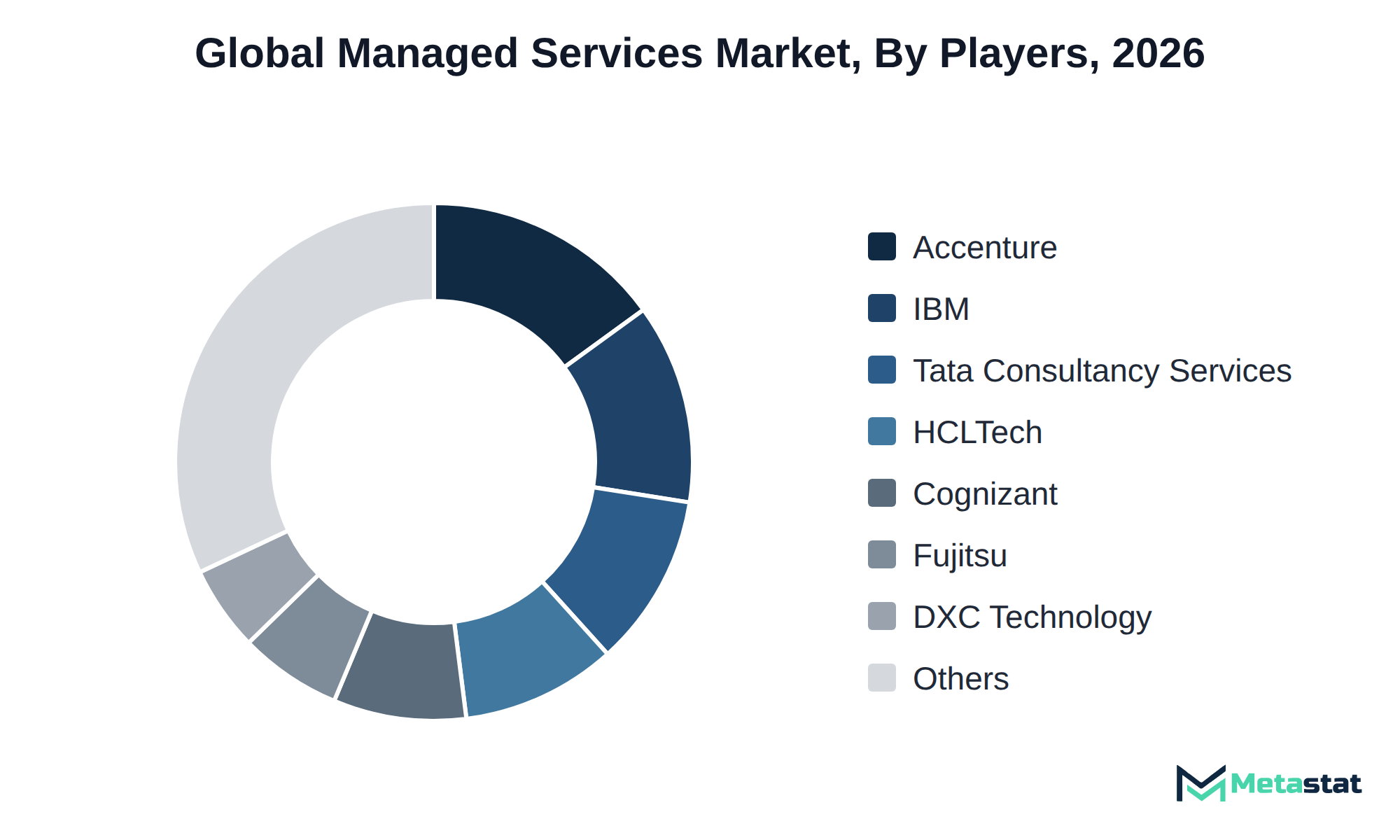
The Managed Services market exhibits competitive dynamics driven by various service types and deployment models. Companies focus on different aspects including customization, pricing, certification, and the ecosystem they create. Managed Infrastructure Services and Managed Security Services have gained traction due to heightened concerns about data protection and operational efficiency.
Accenture and IBM emphasize their extensive service portfolios, addressing diverse client needs across industries. Accenture focuses on integration of advanced technologies, while IBM uses its strong brand reputation and technical expertise to attract large enterprises. Companies like HCLTech and Tata Consultancy Services emphasize their ability to customize solutions, appealing to businesses seeking tailored managed services that fit specific operational requirements.
Pricing strategies in the market influence buyer decisions, alongside the reputation for service reliability and support. Firms including Fujitsu and DXC Technology highlight their commitment to comprehensive managed services, appealing to small and medium enterprises and large enterprises. The competitive dynamics evolve, reflecting the shifting demands in the Managed Services market.
This growth relies on several key developments within the Managed Services market. This shift reflects the increasing need for flexible and scalable solutions among various enterprises. Second, Managed Security Services is anticipated to experience a growth trajectory, reaching USD 163.8 million by 2033, driven by the rising importance of cybersecurity across industries including BFSI, which requires enhanced data protection measures. Economic uncertainties and budget constraints within organizations slow the adoption of managed services, particularly impacting small and medium enterprises (SMEs) that struggle to invest in these solutions. Overall, the market's trajectory toward USD 832.1 million hinges on successful technological advancements and organizations' willingness to allocate resources for managed services.
By Service Type: Managed Infrastructure Services, Managed Security Services, Managed Network Services, Managed Data Center Services, Managed Communication Services, Managed Mobility Services, Managed Application Services, Managed Backup and Recovery Services, Others (Managed Information, Managed Print Services)
By Deployment Model: On-Premises, Cloud-Based, Hybrid
By Enterprise Size: Large Enterprises, Small and Medium Enterprises (SMEs)
By End-Use Industry: BFSI, IT and Telecom, Government, Healthcare, Manufacturing, Retail and E-Commerce, Media and Entertainment, Others (Energy and Utilities, Transportation, Education)
The report strategically identifies and profiles the key market players and analyses their core competencies in each sub-segment of the Managed Services market.
|
Report Attributes |
Details |
|
Study Period |
2021-2033 |
|
Base Year |
2025 |
|
Estimated Year |
2026 |
|
Forecast Period |
2026-2033 |
|
Historical Period |
2021-2025 |
|
Growth Rate |
CAGR 9.4% from 2026 to 2033 |
|
Revenue Unit |
USD million |
|
Segmentation |
By Service Type, Deployment Model, Enterprise Size, End-Use Industry, and Region |
|
By Region |
North America (By Service Type, Deployment Model, Enterprise Size, End-Use Industry, and Country)
|
|
Europe (By Service Type, Deployment Model, Enterprise Size, End-Use Industry, and Country)
|
|
|
Asia Pacific (By Service Type, Deployment Model, Enterprise Size, End-Use Industry, and Country)
|
|
|
South America (By Service Type, Deployment Model, Enterprise Size, End-Use Industry, and Country)
|
|
|
Middle East and Africa (By Service Type, Deployment Model, Enterprise Size, End-Use Industry, and Country)
|
Find answers to common questions about this report
The Managed Services market size was valued at USD 404.4 million in 2025.
The market is projected to grow at a CAGR of 9.4% during the forecast period from 2026 to 2033.
The North America Managed Services market size is estimated to reach USD 271.5 million by 2033.
Managed Security Services leads the Managed Services market with a projected value of USD 163.8 million by 2033. This segment demonstrates the highest growth potential compared to others in the market.
Rising demand for cloud-based solutions is driving substantial spending in the market, particularly among small and medium enterprises seeking operational efficiency. Increased adoption of managed security services reflects the growing need for robust security solutions amid rising cyber threats.
North America holds the dominant share of the Managed Services market, with a value of USD 271.5 million projected for 2033. This region accounts for 34.9 percent of the total market share.
Rising costs of managed services limit adoption among small and medium enterprises (SMEs), leading to slower uptake of services and delayed decisions regarding outsourcing IT operations. Increased scrutiny on return on investment hampers large enterprises' willingness to engage with managed service providers, affecting overall demand within the market.
The increasing reliance on cloud technologies among small and medium enterprises (SMEs) enhances operational efficiency and reduces infrastructure costs, favoring adoption. the integration of AI-driven automation in managed services improves service delivery and attracts enterprises aiming for greater agility and efficiency.
The Managed Services market is estimated to reach a valuation of USD 832.1 million by 2033.
Key players operating in the Managed Services market include Accenture, IBM, Tata Consultancy Services, HCLTech, Fujitsu, DXC Technology, Infosys, and Cognizant.
The analysts below cover Information & Technology research at Metastat Insights.
LEAD ANALYST
Utkarsh Khirodkar is a Lead Market Research Analyst at MetaStat Insight, specializing in market intelligence, technology sector assessments, and competitive strategy.

PRINCIPAL CONSULTANT - ENTERPRISE AI & EMERGING TECHNOLOGIES
Banking & Finance · Electronics and Semiconductor · Energy and Power · Healthcare IT · Information & Technology · Professional Services
Vijay Gunti is a Principal Consultant at MetaStat Insight, bringing over two decades of experience across enterprise digital transformation, technology strategy, and intelligent systems.

LEAD CONSULTANT - COMMUNICATION, TELECOM, AND IT
Electronics and Semiconductor · Information & Technology · Machinery & Equipment · Professional Services
Ravindra Sathe Consultants for Communication, Telecom, and IT at MetaStat Insight. He leads the firm's industry research initiatives across telecommunications infrastructure, digital connectivity, enterprise networking, and emerging information technology domains.
Tracking maintenance cycle demand for secondary flight display units and terrain collision avoidance systems across regional jet fleets involves complex aftermarket dynamics. MetaStat Insight provided practical analysis separating airline retrofit programs from OEM forward-fit production schedules in North America and Southeast Asia. The supplier matrix highlighted component obsolescence timelines without resorting to vague generalizations. The dataset served as a dependable reference during our annual program review meetings.
Evaluating secondary resin quality across post-consumer packaging streams requires reliable technical segmentation. MetaStat Insight delivered an objective assessment that distinguished between extrusion-grade flake pricing and optical sorting throughput limitations across Western Europe. The competitive positioning breakdown for licensed depolymerization technology providers answered several questions during our feedstock feasibility audit. Their team clarified regional trade restrictions on mixed plastic scrap quickly when our team submitted follow-up requests.
Evaluating sovereign cloud deployments for core banking platforms demands a clear view of data residency regulations and migration exit strategies. MetaStat Insight delivered an exhaustive review of regional latency tolerances, mainframe decommission milestones, and third-party vendor concentration risk. The regulatory compliance mapping across European and Asian financial jurisdictions gave our team a dependable baseline for multi-cloud infrastructure discussions.
Explore related market intelligence reports worth reading alongside this one.
Starting from
$2950