
LEAD ANALYST
Utkarsh Khirodkar is a Lead Market Research Analyst at MetaStat Insight, specializing in market intelligence, technology sector assessments, and competitive strategy.

Global Non-Manufacturing MRP Software Market Size, Share, By Deployment Mode (On-Premises and Cloud), By Enterprise Size (Small, Medium, and Large Enterprises), By Industry Vertical (Healthcare Providers, Pharmacy, Foodservice, Hospitality, Retail, E-commerce, Wholesale, Distribution, Transportation, Logistics, Utilities, Facility Services, Education, Public Sector, Agriculture, Agri-Inputs Distribution, and Others), Industry Analysis, Growth, Trends, and Forecast, 2026-2033
Report ID
MSI-4554
Published
February, 2026
Pages
311 Pages
Format
Report Details
Choose Your License
Non-Manufacturing MRP Software Market
The global Non-Manufacturing MRP Software market size was valued at USD 1,701.7 million in 2025. The market is projected to grow from USD 1,797.5 million in 2026 to USD 2,570.5 million by 2033, exhibiting a CAGR of 5.2% during the forecast period.
Global Non-Manufacturing MRP Software market valued at USD 1,701.7 million in 2025, growing at a CAGR of 5.2% through 2033, with potential to exceed USD 2,570.5 million.
North America held 56.3% share in 2025, with the U.S. leading the region.
On-Premises segment accounted for a market share of 56.6% in 2025, supported by data residency, security, and compliance requirements.
Key trends driving growth: Rising SKU complexity and omni-channel fulfilment require demand-driven replenishment and tighter inventory visibility across multi-location networks.
Key opportunity includes Al-enabled demand sensing and autonomous replenishment (using POS/IoT/telematics signals) to optimize service inventory and supplier collaboration.
Key insight: The global non-manufacturing MRP software market reflects a transition toward digitally integrated service operations driven by real-time planning requirements despite challenges associated with complexity and data security.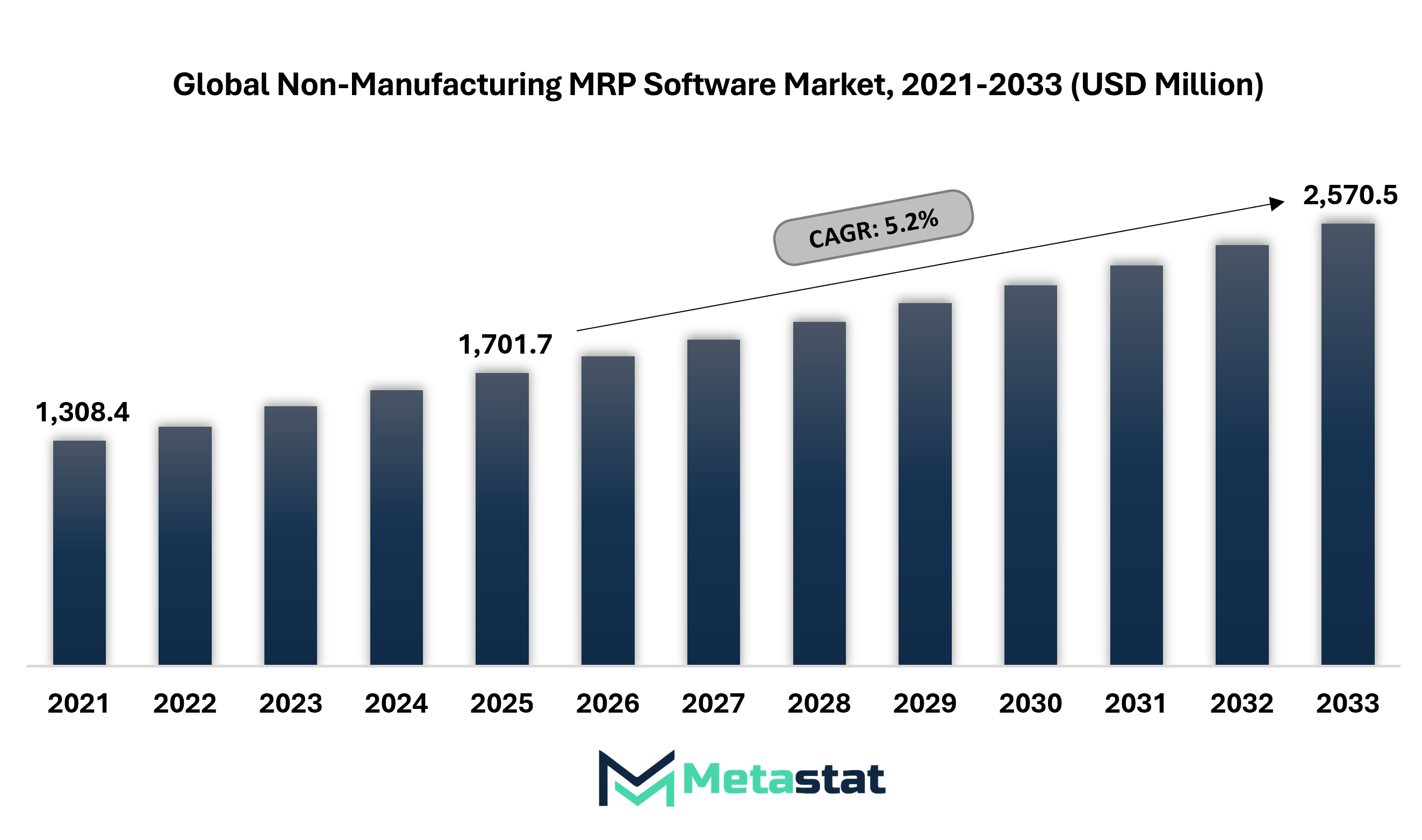
The global non-manufacturing MRP software industry within the enterprise software market will move surpass traditional planning narratives and redefine how service-driven organizations will interpret operational intelligence. The marketplace will no longer be focused solely on inventory mechanics. The software will address complex service workflows where time, expertise, digital assets, and contractual commitments will serve as planning inputs. Financial institutions, healthcare networks, logistics providers, and professional services firms will increasingly rely on systems that translate abstract operational variables into structured execution models.
Future platforms will shift from transaction scheduling to predictive orchestration. The software architecture will interpret demand signals derived from service consumption patterns, customer behaviours, regulatory calendars and workforce availability. The systems will calculate resource alignment in advance, minimizing idle capacity while maintaining service continuity. Decision-making will rely on scenario modeling rather than static forecasts, enabling enterprises to simulate outcomes before allocating budget or staffing.
The global non-manufacturing MRP software market will progress through increasing product diversity and distributed fulfilment models. Demand-driven replenishment will support accurate stock positions across all locations. Enhanced inventory visibility will enable coordinated planning across digital and physical channels, supporting faster response cycles, improved availability and controlled costs within complex service-oriented networks.
Growth in the global non-manufacturing MRP software market will reflect service operations that depend on timely availability of materials. Real-time stock tracking will support field execution and service continuity. Automated purchasing will reduce delays and errors, while waste reduction practices will strengthen margin protection in service-heavy operating environments.
The global non-manufacturing MRP software market will face resistance driven by outdated beliefs associated with the factory-centric planning model. Legacy ERP systems will reinforce slow decision cycles and cautious change management. Such perceptions will restrict modernization efforts, thereby slowing the adoption of digital planning in service-based organizations despite clear operational relevance.
Operational limitations within the global non-manufacturing MRP software market will arise from inconsistent master data quality. Incorrect item records, misaligned locations and unreliable lead times will undermine forecast results. A fragmented system scenario will further reduce returns on investment, limiting confidence in plan outputs and long-term scalability.
Future expansion in the global non-manufacturing MRP software market will emerge through intelligent demand sensing capabilities. AI-powered evaluation of POS, IoT and telematics alerts will guide autonomous replenishment decisions. Such progress will strengthen service inventory optimization and support proactive supplier collaboration in digitally connected environments.
The global Non-Manufacturing MRP Software market is mainly classified based on Deployment Mode, Enterprise Size, and Industry Vertical.
On-Premises segment was valued at USD 1,016.7 million in 2026 and is projected to reach USD 1,357.5 million by 2033, at a CAGR of 4.2% during the forecast period.
The On-Premises segment within the global non-manufacturing MRP software market will continue to attract organizations seeking direct control over internal systems. Future adoption will focus on data security, optimized workflows, and internal compliance standards. Long-term investments will support stable operations, predictable performance, and structured integration with existing enterprise infrastructure.
Cloud segment was valued at USD 780.8 million in 2026 and is projected to reach USD 1,213 million by 2033, at a CAGR of 6.5% during the forecast period.
Cloud-based segment will gain strong momentum due to scalability, cost efficiency and faster system upgrades. The global non-manufacturing MRP software market will see a growing preference for remote access and centralized data visibility. The future demand will be higher in geographically dispersed operations that support speedier decision cycles and continuous enhancements of the system.
Small and Medium Enterprises segment is projected to reach USD 1,120.4 million by 2033, at a CAGR of 6.7% during the forecast period.
Small and medium enterprises will be increasingly using advanced planning tools to enhance operational discipline and reduce manual dependency. Affordable subscription models, easy-to-use interface, and guided automation will support future growth in the global non-manufacturing MRP software market. Strategic use will increase forecasting accuracy and resource coordination.
Large Enterprises segment is projected to reach USD 1,450.1 million by 2033, at a CAGR of 4.2% during the forecast period.
Large enterprises will opt for complete software frameworks that facilitate complex operational structures. The global non-manufacturing MRP software market will evolve toward deeper analytics, multi-location coordination, and higher transaction volumes. Future implementations of enterprise resource planning solutions will emphasize predictive planning, system interoperability, and enterprise-wide visibility.
Healthcare Providers segment is projected to reach USD 170.9 million by 2033 with a share of 7.2% in 2025.
Healthcare providers will be increasingly dependent on digital planning systems for supplies, services, and operational continuity. The global non-manufacturing MRP software market will contribute to future models of healthcare with efficiency, alignment to regulations, and seamless service delivery through structured planning and accurate demand forecasting.
Pharmacy segment is projected to reach USD 133.6 million by 2033 with a share of 5.2% in 2025.
Pharmacy operations will install planning software to enhance inventory control and minimize supply gaps. Compliance tracking, expiration management, and purchase synchronization will support adoption in pharmacy operations. The facilities will become increasingly digitized in planning, with increases in reliability of service and cost control.
Foodservice & Hospitality segment is projected to reach USD 208.2 million by 2033 with a share of 7.7% in 2025.
Volatile demand and supply variability will be managed by structured planning systems within the food service and hospitality sectors. Waste reduction, demand forecasting, and supplier coordination will align future solutions with sustainable growth priorities across service operations.
Retail & E-commerce segment is projected to reach USD 555.8 million by 2033 with a share of 20.2% in 2025.
Retail and e-commerce operations will implement planning software solutions that help manage high transaction volumes and dynamic demand patterns. The global Non-Manufacturing MRP Software Market will evolve toward real-time inventory visibility, auto-replenishment, and fact-based planning to support competitive positioning.
Wholesale & Distribution segment is projected to reach USD 496.1 million by 2033 with a share of 18.7% in 2025.
Wholesale and distribution mechanisms will depend on planning solutions to ensure the flow of supplies and optimal storage utilization. The future growth of the Global Non-Manufacturing MRP Software Market will depend on route planning and demand synchronization across distribution points.
Transportation & Logistics segment is projected to reach USD 395.9 million by 2033 with a share of 15.3% in 2025.
Additionally, logistics and transportation activities are to incorporate planning tools to enhance schedule accuracy and resource use. The Global Non-Manufacturing MRP Software Market will facilitate the development of future systems, which would revolve around clarity in business activities, optimal costs, and reliability of services in loosely coupled systems.
Utilities & Facility Services segment is projected to reach USD 254.6 million by 2033 with a share of 10.4% in 2025.
Utilities and facility services will adopt structured planning tools to manage maintenance cycles and service continuity. The global non-manufacturing MRP software market will evolve towards predictive maintenance planning, asset lifecycle tracking and improved operational flexibility.
Education & Public Sector segment is projected to reach USD 82.4 million by 2033 with a share of 4.1% in 2025.
Education and public sector institutions will use planning software to manage resources, budgets and service delivery. Within the global non-manufacturing MRP software market, future adoption will be supported by transparency, accountability, and data-driven operational planning.
Agriculture & Agri-Inputs Distribution segment is projected to reach USD 158.7 million by 2033 with a share of 6.5% in 2025.
Agriculture and agri-input distribution segments will rely on planning systems to align supply cycles with seasonal demand. The global non-manufacturing MRP software market will enable future improvements in distribution efficiency, stock planning and resource coordination in rural and urban markets.
Others segment is projected to reach USD 114.2 million by 2033 with a share of 4.7% in 2025.
Additional industry segments will adopt planning solutions to standardize operations and support long-term efficiency. The global non-manufacturing MRP software market will continue to expand across diverse service-oriented sectors driven by digital transformation and structured operational planning.
Based on geography, the global Non-Manufacturing MRP Software market is divided into North America, Europe, Asia-Pacific, South America, Middle East, and Africa.
North America Non-Manufacturing MRP Software Market is set to expand at a CAGR of 5.2% within the forecast period, reaching a market size (TAM) of USD 1337.7 million by the end of 2033.
In North America, broader digital maturity in service industries will drive demand for MRP software that supports complex scheduling and compliance requirements.
The adoption of cloud-based enterprise solutions among non-manufacturing organizations will accelerate software deployment across the North America sector.
In Asia Pacific, the rapid expansion of IT-enabled services will create opportunities for scalable MRP platforms to suit diverse operating models.
The increasing investment in digital transformation by service sector enterprises will open new avenues for localized and cost-effective MRP solutions in the Asia Pacific region.
Middle East and Africa and South America will present stable potential, driven by gradual enterprise digitalization, growing software awareness, and long-term modernization initiatives in non-manufacturing sectors.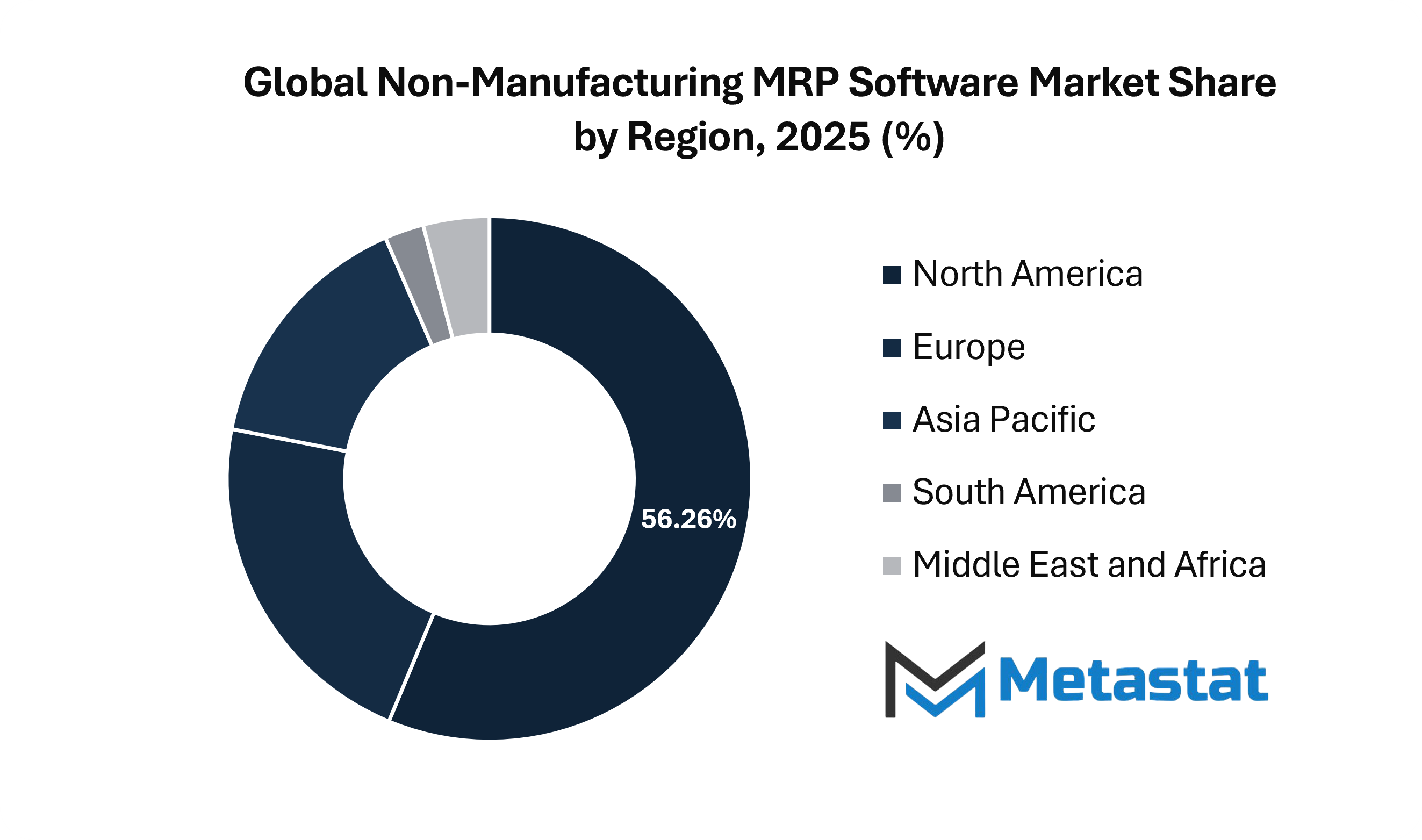
The global non-manufacturing MRP software market is continuously attracting interest, owing to rising demand for established planning and resource coordination in service-oriented industries. Organizations involved in distribution, food services, healthcare, and mission-based operations depend upon MRP software to control workflow, stock visibility, scheduling, and monetary alignment. Unlike production-centric structures, these solutions focus on service efficiency, demand forecasting, and operational clarity. Businesses will increasingly look for systems that simplify choice making even as helping increase without increasing operational pressures.
Many established players shape the market by offering flexible equipment designed for non-manufacturing needs. The Forterro 123Insight solution supports medium-sized enterprises by improving planning accuracy and operational transparency. Rootstock Software focuses on cloud-based solutions that integrate closely with enterprise systems while supporting scalability and real-time insights. QT9 Software and MRPeasy attract small to medium-sized businesses by offering practical features that support inventory tracking, order management, and reporting without complex implementation. These companies will remain relevant due to their ability to solve the daily operational challenges faced by service-driven organizations.
Large enterprise-focused providers also play a major role in strengthening the market structure. Oracle Corporation through NetSuite Inc. provides integrated MRP capabilities that combine finance, supply planning and customer operations within a single integrated system. Infor supports non-manufacturing sectors through industry-specific software that improves planning accuracy and resource utilization. Microsoft Corporation contributes through its business applications ecosystem, allowing companies to align MRP functions with broader enterprise tools. Odoo S.A. offers modular solutions that appeal to organizations seeking customization and cost control while maintaining system flexibility.
Emerging and niche vendors add depth to the competitive landscape by focusing on specific needs. VicinityFood addresses food and beverage service operations with targeted planning tools, while Katana Technologies OÜ supports modern service-based businesses that value visual planning and ease of use. Skala and Algo, via Intuiflow, focus on demand-driven planning models that help organizations respond to changing service needs. The key players, supported by innovation and customer-centric growth, will contribute to market scale by offering adaptable solutions in line with evolving operational expectations in non-manufacturing industries.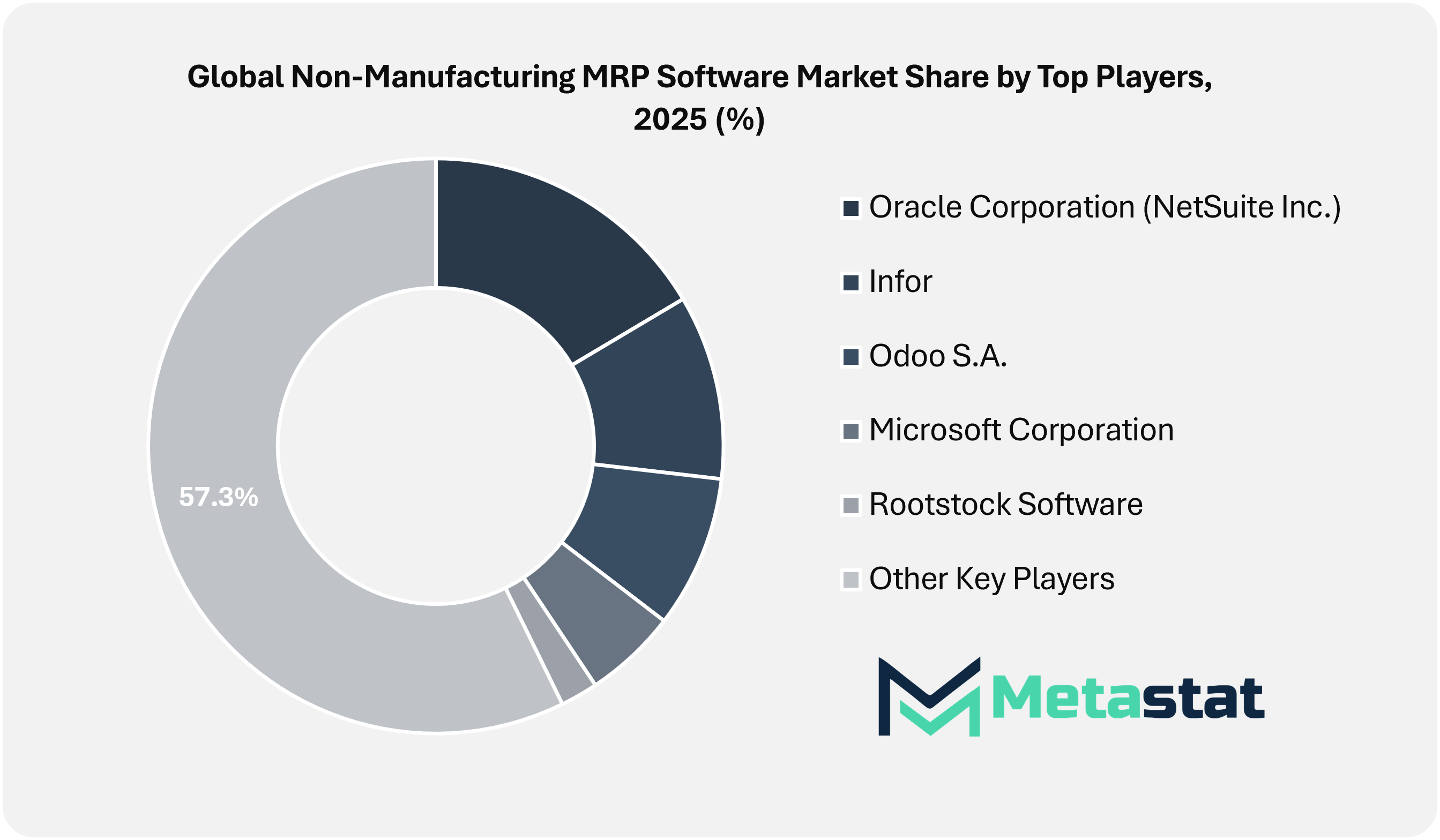
Market size is forecast to rise from USD 1,701.7 million in 2025 to over USD 2,570.5 million by 2033.
The global non-manufacturing MRP software market will also impact organizational structure. Planning authority will decentralize, granting departmental leaders-controlled visibility into enterprise-wide resources without fragmenting oversight. Organizations will start managing their staff like they manage physical assets, using skill data, certification timelines, and usage rates to guide choices. Soon, tech advances will aim at better system coordination. An open design will make it easy to link with payment systems, customer service platforms, and AI data analysis. Businesses that value flexibility, accuracy, and responsibility in service-based markets are likely to succeed. This shift will place company resource planning software at the core of operations, not just as a supporting tool.
This research report categorizes the Non-Manufacturing MRP Software market based on key segments and regions, forecasts revenue growth, and analyses trends in each submarket. The report analyses the key growth drivers, opportunities, and challenges influencing the Non-Manufacturing MRP Software market. Recent market developments and competitive strategies such as expansion, product launch, development, partnership, merger, and acquisition have been included to draw the competitive landscape in the market.
The report strategically identifies and profiles the key market players and analyses their core competencies in each sub-segment of the Non-Manufacturing MRP Software market.
|
Report Attributes |
Details |
|
Study Period |
2021-2033 |
|
Base Year |
2025 |
|
Estimated Year |
2026 |
|
Forecast Period |
2026-2033 |
|
Historical Period |
2021-2025 |
|
Growth Rate |
CAGR 5.2% from 2026 to 2033 |
|
Revenue Unit |
USD Million |
|
Segmentation |
By Deployment Mode, Enterprise Size, Industry Vertical, and Region |
|
By Region |
North America (By Deployment Mode, Enterprise Size, Industry Vertical, and Country)
|
|
Europe (By Deployment Mode, Enterprise Size, Industry Vertical, and Country)
|
|
|
Asia Pacific (By Deployment Mode, Enterprise Size, Industry Vertical, and Country)
|
|
|
South America (By Deployment Mode, Enterprise Size, Industry Vertical, and Country)
|
|
|
Middle East and Africa (By Deployment Mode, Enterprise Size, Industry Vertical, and Country)
|
Find answers to common questions about this report
The Metastat Insights study shows that the global Non-Manufacturing MRP Software market size was USD 1,701.7 million in 2025.
The global Non-Manufacturing MRP Software market is likely to grow at a CAGR of 5.2% over the forecast period (2026-2033).
The Metastat Insights analysis shows that the North America Non-Manufacturing MRP Software market size is estimated to be USD 1,337.7 million by 2033.
The Retail & E-commerce is the leading type segment in the global market.
Rising SKU complexity and omni-channel fulfillment require demand-driven replenishment and tighter inventory visibility across multi-location networks and service workflows (kits/recipes, spare parts, field jobs) need near real-time stock, automated purchasing, and waste reduction to protect margins are key driving factors, boosting the market.
North America region dominates the market.
Global Non-Manufacturing MRP Software market is estimated to reach USD 2,570.5 million by 2033.
Top players operating in the Non-Manufacturing MRP Software industry include Forterro (123 Insight), Rootstock Software, QT9 Software, MRPeasy, and Oracle Corporation (NetSuite Inc.).
The analysts below cover Information & Technology research at Metastat Insights.
LEAD ANALYST
Utkarsh Khirodkar is a Lead Market Research Analyst at MetaStat Insight, specializing in market intelligence, technology sector assessments, and competitive strategy.

PRINCIPAL CONSULTANT - ENTERPRISE AI & EMERGING TECHNOLOGIES
Banking & Finance · Electronics and Semiconductor · Energy and Power · Healthcare IT · Information & Technology · Professional Services
Vijay Gunti is a Principal Consultant at MetaStat Insight, bringing over two decades of experience across enterprise digital transformation, technology strategy, and intelligent systems.

LEAD CONSULTANT - COMMUNICATION, TELECOM, AND IT
Electronics and Semiconductor · Information & Technology · Machinery & Equipment · Professional Services
Ravindra Sathe Consultants for Communication, Telecom, and IT at MetaStat Insight. He leads the firm's industry research initiatives across telecommunications infrastructure, digital connectivity, enterprise networking, and emerging information technology domains.
Scaling antibody-drug conjugate manufacturing hinges on contract manufacturing availability for high-potency active ingredients. The MetaStat Insight analysis looked closely at global cleanroom slot constraints, bioconjugation batch failure rates, and supply chain redundancies between the US, Europe, and India. The supplier capability matrix proved genuinely useful for our team when mapping secondary source options across our clinical pipeline.
Floating offshore wind feasibility relies heavily on specialized installation vessel availability and port crane limits, which most broad renewable energy forecasts ignore. The report delivered a thorough analysis of dry dock capacity, mooring chain supply constraints, and raw material pricing trends for deepwater anchor installations. It served as a solid independent sanity check for our offshore project capital expenditure assumptions.
Assessing commercial microgrid software adoption requires looking past top-level installation numbers and examining utility interconnection queues. The research provided verifiable data on average permitting timelines, tariff structures, and battery storage integration costs across regional utility territories. That grounded perspective was valuable for our team when building five-year demand projections for industrial microgrid controllers.
Explore related market intelligence reports worth reading alongside this one.
Starting from
$2950
Starting from
$2950