
LEAD ANALYST
Utkarsh Khirodkar is a Lead Market Research Analyst at MetaStat Insight, specializing in market intelligence, technology sector assessments, and competitive strategy.

Global 3D Rendering Software Market Size, Share, By Rendering Type (Real-Time Rendering, Pre-Rendered, and Distributed Rendering), By Deployment Type (On-Premise, Cloud-Based, and Hybrid), By Application (Architectural Visualization, Product Visualization, Animation, Visual Effects, Gaming, and Virtual Reality), By End User (Architects, Animators, Game Developers, Industrial Designers, and Educational Institutions), Industry Analysis, Growth, Trends, and Forecast, 2026-2033
Report ID
MSI-4733
Published
May, 2026
Pages
313 Pages
Format
Report Details
Choose Your License
3D Rendering Software Market
Global 3D Rendering Software market size is valued at USD 8.4 million in 2025 and projected to grow at a CAGR of 13.2% during the forecast period, reaching USD 22.8 million by 2033.
North America holds 32.9% in 2025 with US leading the market share in 2025.
Real-Time Rendering segment account for a market share of 47.0% in 2025.
Key trends driving growth: Rising demand for high-quality visual content across media, gaming, and architectural visualization propels adoption of advanced rendering solutions, along with increasing use of real-time rendering and immersive technologies such as VR and AR accelerates software deployment across design and entertainment sectors.
Opportunities include expansion of cloud-based rendering and GPU-as-a-service platforms creates scalable and cost-efficient opportunities for broader market penetration.
Key insight: The Global 3D Rendering Software market is gaining momentum owing to digital design transformation, demand for immersive visualization, faster processing capabilities, and expanding creator ecosystems.
The Global 3D Rendering Software market across digital content creation and enterprise design industries is moving beyond traditional image generation into integrated visualization environments. Rendering platforms are becoming core production tools for concept development, engineering reviews, cinematic output, architectural previews, and virtual product presentation. Businesses increasingly rely on rendering software to shorten approval cycles, improve design communication, reduce physical prototyping dependency, and strengthen stakeholder decision-making.
Over the coming years, rendering workflows will shift toward connected ecosystems where asset libraries, computing power, review tools, and collaboration features operate within unified production environments. The Global 3D Rendering Software market will support faster iteration cycles, scalable remote collaboration, and output customization based on device type, platform requirements, and project complexity. AI-based denoising, real-time previews, procedural asset workflows, and distributed cloud computing will reshape rendering productivity and production economics.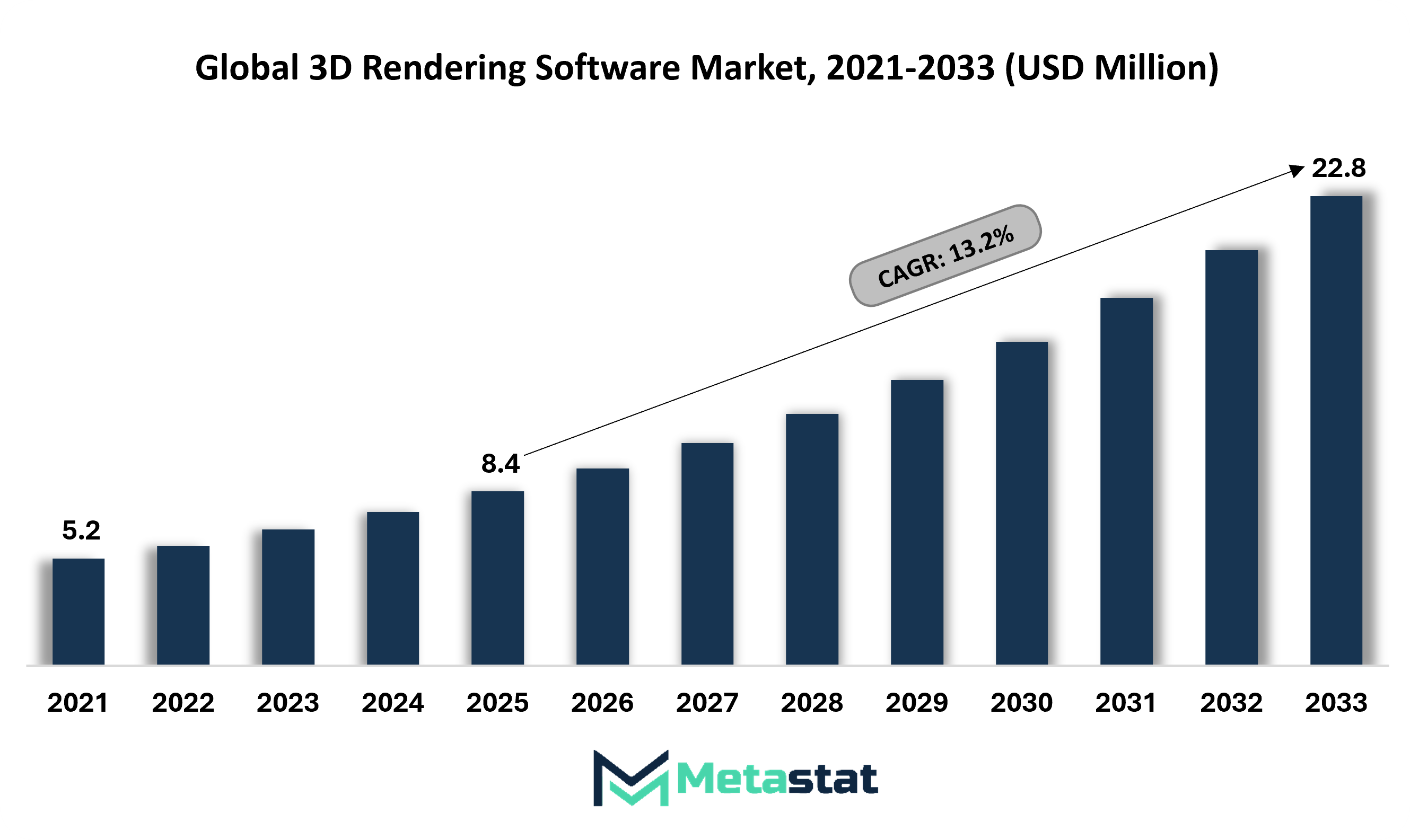
Rising demand for high-quality visual content across media, gaming, and architectural visualization propels adoption of advanced rendering solutions.
Growing preference for cinematic visuals, detailed game environments, and realistic building previews is increasing investment in advanced rendering platforms. Studios, game developers, architects, and design firms are seeking faster output, richer textures, accurate material simulation, and sharper lighting effects. Future adoption is set to expand across advertising, virtual showrooms, digital twins, e-commerce product visualization, and premium presentation workflows.
Increasing use of real-time rendering and immersive technologies such as VR and AR accelerates software deployment across design and entertainment sectors.
Real-time engines support instant scene updates, faster approvals, interactive reviews, and immersive presentations. Virtual reality and augmented reality are strengthening user engagement across product demonstrations, training modules, retail displays, gaming experiences, and simulation-based learning. Future expansion indicates stronger software adoption across education, healthcare visualization, live event production, industrial training, and immersive enterprise applications.
High hardware requirements and software costs limit accessibility for small-scale users and independent creators.
Powerful processors, advanced graphics cards, GPU memory requirements, and paid software licenses create entry barriers for startups, freelancers, and small studios. Budget pressure slows upgrades and reduces experimentation with premium rendering tools. Future adoption will depend on lower-cost pricing models, lighter software packages, browser-based rendering access, and wider availability of affordable cloud computing resources.
Steep learning curve and need for skilled professionals restrict widespread adoption across non-technical user segments.
Complex interfaces, technical configuration settings, and deep workflow requirements require structured training before users achieve effective output. Many companies face delays in hiring, onboarding, workflow migration, and project execution. Future adoption will improve through simplified dashboards, guided automation, template libraries, embedded tutorials, and stronger training programs for emerging creative talent.
Expansion of cloud-based rendering and GPU-as-a-service platforms creates scalable and cost-efficient opportunities for broader market penetration.
Cloud infrastructure reduces local hardware dependency and supports remote collaboration with flexible rendering capacity. Subscription access helps companies control spending while managing large workloads during peak production cycles. Future opportunity remains strong across global enterprises, small studios, animation houses, architectural firms, and fast-moving digital production networks.
The Global 3D Rendering Software market is classified based on Rendering Type, Deployment Type, Application, and End User.
Real-Time Rendering segment is valued at USD 4.5 million in 2026 and is projected to reach USD 12.0 million by 2033, at a CAGR of 15.1% during the forecast period.
Real-time rendering is gaining strong adoption through instant scene updates, rapid material changes, interactive previews, and faster design approvals. Interactive workflows support architectural reviews, product previews, simulation-based training, and immersive content creation. Future progress points toward sharper visuals, lower latency, better physics accuracy, and wider device compatibility across professional environments.
Pre-Rendered segment is valued at USD 3.6 million in 2026 and is projected to reach USD 7.7 million by 2033, at a CAGR of 11.4% during the forecast period.
Pre-rendered solutions remain valuable for cinema-grade imagery, marketing visuals, and premium animation projects where image precision carries high importance. Advanced lighting, shadows, reflections, and texture depth improve visual appeal and production quality. Future development indicates faster output cycles, reduced hardware pressure through cloud rendering, and richer visual quality for creative studios.
Distributed Rendering segment is valued at USD 1.4 million in 2026 and is projected to reach USD 3.1 million by 2033, at a CAGR of 11.5% during the forecast period.
Distributed rendering supports large workloads by allowing multiple connected systems to process complex projects in parallel. Large animation scenes, engineering models, architectural walkthroughs, and film sequences benefit from shorter completion timelines. Future adoption will rise through smarter resource balancing, automated scaling, improved energy efficiency, and stronger integration across production networks.
On-Premises segment is projected to reach USD 6.8 million by 2033, at a CAGR of 10% during the forecast period.
On-premises deployment attracts enterprises requiring direct infrastructure control, internal security policies, predictable performance, and tighter governance for sensitive projects. Dedicated hardware supports consistent rendering speed during heavy workloads and confidential production cycles. Future improvements will include stronger GPU clusters, efficient storage systems, private render farms, and deeper workflow integration within enterprise environments.
Cloud-Based segment is projected to reach USD 12.5 million by 2033, at a CAGR of 16.1% during the forecast period.
Cloud-based deployment expands access through remote processing power, subscription pricing, and flexible capacity during peak workloads. Small studios and growing companies gain access to advanced rendering capacity without large upfront capital expenditure. Future momentum will increase through faster global networks, instant scalability, stronger data security, and smoother collaboration across locations.
Hybrid segment is projected to reach USD 3.5 million by 2033, at a CAGR of 10.9% during the forecast period.
Hybrid deployment combines internal systems with external cloud resources for balanced cost control, data governance, and operational flexibility. Core files will remain internal while overflow rendering workloads move to the cloud during deadline-driven production periods. Future strategies will favor automated workload shifting, stronger security layers, and efficient multi-site coordination.
Architectural Visualization segment is projected to reach USD 5.8 million by 2033.
Architectural visualization uses rendering software for realistic buildings, interiors, landscape plans, and urban design concepts before construction begins. Detailed previews support faster approvals, stronger buyer confidence, improved client communication, and reduced design revision cycles. Future adoption will expand through interactive walkthroughs, environmental lighting analysis, sustainable design simulations, and smart city planning models.
Product Visualization segment is projected to reach USD 4.2 million by 2033.
Product visualization supports realistic previews for electronics, furniture, automobiles, consumer goods, and industrial products across design and marketing stages. Accurate textures, materials, reflections, and product finishes improve presentation quality and buyer engagement. Future adoption will emerge through instant customization views, online configurators, digital catalogs, and faster prototype decisions across manufacturing sectors.
Animation and Visual Effects segment is projected to reach USD 4.7 million by 2033.
Animation and visual effects rely on rendering software for films, advertising campaigns, streaming content, gaming cinematics, and digital storytelling. Fine motion detail, cinematic lighting, realistic textures, and scene depth remain essential value drivers. Future adoption will follow automated scene optimization, faster frame generation, AI-assisted rendering, and broader virtual production usage.
Gaming segment is projected to reach USD 5.0 million by 2033.
Gaming applications require rendering tools for environments, characters, action scenes, lighting effects, and responsive visual performance. Strong graphics quality improves player engagement, platform competitiveness, and game monetization potential. Future direction indicates realistic physics, larger open worlds, smoother frame rates, ray tracing adoption, and stronger immersion across platforms.
Virtual Reality segment is projected to reach USD 3.1 million by 2033.
Virtual reality relies on rendering software for responsive environments, depth accuracy, low-latency visuals, and natural motion perception. Training, education, healthcare, retail, and entertainment applications create broad commercial value. Future opportunities will rise through lighter headsets, richer sensory design, realistic multi-user virtual spaces, and improved enterprise adoption.
Architects segment is projected to grow at a CAGR of 12.5% during the forecast period.
Architects use rendering platforms for concept presentations, client approvals, material comparisons, spatial planning, and construction visualization. Visual clarity supports stronger communication across project stages and reduces approval delays. Future adoption will increase through sustainable design simulations, smart building previews, BIM integration, and integrated planning ecosystems.
Animators segment is projected to grow at a CAGR of 12.4% during the forecast period.
Animators rely on rendering systems for character scenes, motion storytelling, lighting balance, texture quality, and final sequence output. Reliable rendering speed improves delivery schedules across studios and post-production teams. Future trends will include AI-assisted frame enhancement, efficient scene management, and richer visual depth for digital media.
Game Developers segment is projected to grow at a CAGR of 15.7% during the forecast period.
Game developers require rendering tools for world creation, character assets, effects design, lighting optimization, and performance testing. Strong visual quality supports competitive launches and stronger player retention. Future development will center on procedural content generation, realistic lighting engines, asset automation, and faster development pipelines.
Industrial Designers segment is projected to grow at a CAGR of 12.6% during the forecast period.
Industrial designers use rendering software for machinery concepts, appliance models, ergonomic studies, product variants, and presentation visuals. Accurate form assessment supports better product refinement before manufacturing begins. Future usage will grow through material simulation, digital twins, virtual prototyping, and integrated manufacturing planning tools.
Educational Institutions segment is projected to grow at a CAGR of 13% during the forecast period.
Educational institutions adopt rendering platforms for design learning, engineering education, media courses, animation training, and research visualization. Practical software exposure improves workforce readiness and industry-aligned technical skills. Future adoption will come through digital labs, remote learning access, cloud-based licenses, and industry-linked curriculum programs for advanced technical skills.
Based on geography, the Global 3D Rendering Software market is divided into North America, Europe, Asia-Pacific, South America, Middle East, and Africa.
North America is witnessing strong adoption owing to mature creative software ecosystems, advanced GPU infrastructure, large media production spending, and high investment in visualization technologies.
Europe represents a significant region in the 3D Rendering Software market, supported by strong adoption across architecture, automotive design, gaming, animation, product visualization, and media production.
Asia-Pacific offers significant opportunities for the 3D Rendering Software market through expanding gaming industries, construction activity, animation outsourcing, and rising digital creator communities.
Across the Middle East, Africa, and South America, the 3D Rendering Software market is progressing through gradual digital infrastructure development, urban development projects, media digitization, and rising interest in virtual design tools.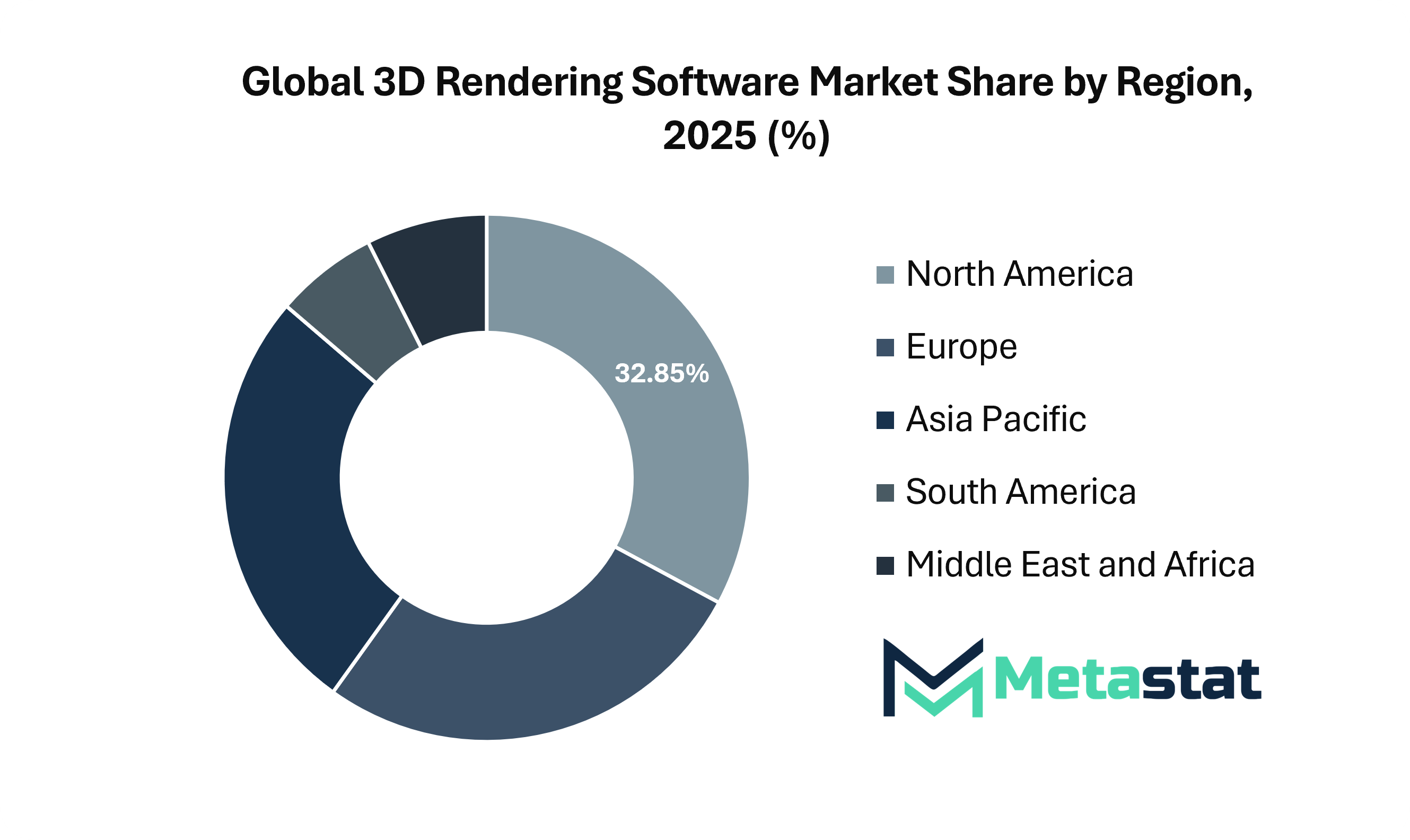
The Global 3D Rendering Software Market is expanding with rising need for sharper visuals across design, gaming, film, retail, education, and architecture. Companies are adopting faster tools to convert ideas, models, and concepts into realistic visual outputs. Improved cloud access and stronger graphics processors have enabled creative teams to collaborate and render projects across multiple locations. Users now prefer platforms that save time, reduce manual steps, support live edits, and improve output consistency. Small studios, freelancers, and students are also entering the market owing to wider access to subscription software, open-source tools, and cloud-based rendering resources. Market expansion is closely linked to content creation, e-commerce product visualization, digital building plans, virtual production, and interactive customer presentation workflows.
Major providers compete through rendering speed, ease of use, file compatibility, plug-in ecosystems, cloud integration, and output quality. Autodesk, Inc. and Adobe Inc. serve creative professionals and enterprises seeking integrated design and visualization workflows. NVIDIA Corporation and Advanced Micro Devices, Inc. support the ecosystem through GPU innovation that improves rendering performance and processing efficiency. Epic Games, Inc. and Unity Software Inc. connect real-time engines with artists, developers, architects, and immersive content creators. Blender Foundation strengthens open-source access for beginners, independent creators, and professional studios. Chaos Software EOOD, Maxon Computer GmbH, and Luxion ApS are trusted for high-quality visualization, animation, and photorealistic rendering output.
Adoption is also rising among architects, product manufacturers, educators, healthcare visualization teams, and industrial planners. Robert McNeel & Associates, Bentley Systems, Incorporated, Graphisoft SE, and Vectorworks, Inc. help transform technical models into clear design presentations. Dassault Systèmes SE and PTC Inc. support engineering workflows where model accuracy, product detail, and simulation readiness carry high importance. Side Effects Software Inc. and The Foundry Visionmongers Limited are valued in visual effects, compositing, animation, and advanced production pipelines. Pixar Animation Studios has influenced rendering standards through animation technology, storytelling quality, and production-grade visual innovation. Clients seek tools that handle large files, team reviews, version control, and reliable export outputs without delays during demanding production schedules.
New use cases in online retail, virtual tours, training demonstrations, digital twins, and immersive commerce will continue to support software spending. Mobile viewing and browser-based tools make project reviews easier for clients and non-technical stakeholders. OTOY, Inc., Reallusion, Inc., Marmoset LLC, Next Limit Technologies S.L., Random Control S.L., and Act-3D B.V. add platform diversity across different budgets and workflow needs. Companies such as Glare Technologies Limited, cebas Visual Technology Inc., Dimension 5 PTE. LTD., and Planetside Software LLC widen buyer choice across specialized rendering requirements. Future success will favor transparent pricing, stable performance, workflow interoperability, cloud scalability, and strong learning resources for users across multiple industries.
Market size is forecast to rise from USD 8.4 million in 2025 to over USD 22.8 million by 2033.
The Global 3D Rendering Software market is expected to increasingly integrate with AI-generated asset creation, natural language scene controls, procedural design workflows, and distributed cloud compute environments. Regulatory attention around content authenticity, copyright ownership, synthetic media disclosure, and IP rights will influence future workflows while commercial use expands across industries.
This research report categorizes the 3D Rendering Software market based on key segments and regions, forecasts revenue growth, and analyses trends in each submarket. The report analyses the key growth drivers, opportunities, and challenges influencing the 3D Rendering Software market. Recent market developments and competitive strategies such as expansion, product launch, partnership, merger, and acquisition have been included to draw the competitive landscape in the market.
The report strategically identifies and profiles the key market players and analyses their core competencies in each sub-segment of the 3D Rendering Software market.
|
Report Attributes |
Details |
|
Study Period |
2021-2033 |
|
Base Year |
2025 |
|
Estimated Year |
2026 |
|
Forecast Period |
2026-2033 |
|
Historical Period |
2021-2025 |
|
Growth Rate |
CAGR 13.2% from 2026 to 2033 |
|
Revenue Unit |
USD million |
|
Segmentation |
By Rendering Type, Deployment Type, Application, End User, and Region |
|
By Region |
North America (By Rendering Type, Deployment Type, Application, End User, and Country)
|
|
Europe (By Rendering Type, Deployment Type, Application, End User, and Country)
|
|
|
Asia Pacific (By Rendering Type, Deployment Type, Application, End User, and Country)
|
|
|
South America (By Rendering Type, Deployment Type, Application, End User, and Country)
|
|
|
Middle East and Africa (By Rendering Type, Deployment Type, Application, End User, and Country)
|
Find answers to common questions about this report
Top players operating in the 3D Rendering Software industry include Autodesk, Inc., Adobe Inc., NVIDIA Corporation, Epic Games, Inc., and Unity Software Inc.
Global 3D Rendering Software market is estimated to reach USD 22.8 million by 2033.
North America region dominates the market.
High hardware requirements and software costs limit accessibility for small-scale users and independent creators. will hamper the market growth within the forecast period.
The Global 3D Rendering Software market is expected to grow at a CAGR of 13.2% over the forecast period (2026-2033).
Rising demand for high-quality visual content across media, gaming, and architectural visualization propels adoption of advanced rendering solutions. and Increasing use of real-time rendering and immersive technologies such as VR and AR accelerates software deployment across design and entertainment sectors. are key driving factors, boosting the market.
The Metastat Insights study shows that the Global 3D Rendering Software market size was USD 8.4 million in 2025.
The Real-Time Rendering is the leading type segment in the Global market.
The Metastat Insights analysis shows that the North America 3D Rendering Software market size is estimated to be USD 6.7 million by 2033.
The analysts below cover Information & Technology research at Metastat Insights.
LEAD ANALYST
Utkarsh Khirodkar is a Lead Market Research Analyst at MetaStat Insight, specializing in market intelligence, technology sector assessments, and competitive strategy.

PRINCIPAL CONSULTANT - ENTERPRISE AI & EMERGING TECHNOLOGIES
Banking & Finance · Electronics and Semiconductor · Energy and Power · Healthcare IT · Information & Technology · Professional Services
Vijay Gunti is a Principal Consultant at MetaStat Insight, bringing over two decades of experience across enterprise digital transformation, technology strategy, and intelligent systems.

LEAD CONSULTANT - COMMUNICATION, TELECOM, AND IT
Electronics and Semiconductor · Information & Technology · Machinery & Equipment · Professional Services
Ravindra Sathe Consultants for Communication, Telecom, and IT at MetaStat Insight. He leads the firm's industry research initiatives across telecommunications infrastructure, digital connectivity, enterprise networking, and emerging information technology domains.
Tracking capacity expansion in single-use bioprocessing requires dependable data on raw material availability and cleanroom-grade polymer supply chains. The competitive landscape chapter gave a grounded evaluation of secondary component suppliers across North America and Asia-Pacific rather than simply reprinting press releases. Having that level of supplier benchmarking helped clarify dual-sourcing considerations for our clinical pipeline planning.
When evaluating distributed energy resource management systems, standard research summaries tend to gloss over the operational differences between front-of-the-meter utility deployments and behind-the-meter industrial sites. The MetaStat Insight report addressed those distinctions directly, especially regarding software interoperability standards and grid interconnection backlogs. The five-year market sizing across regional transmission organizations provided actionable context for our grid modernization strategy.
Most industry reports on warehouse automation bundle autonomous mobile robots and fixed conveyor installations into the same top-level numbers, which complicates advisory work. This study split the market cleanly by payload tiers, navigation technology, and fleet management software layers. The regional forecast for Western Europe gave our team defensible adoption benchmarks when evaluating capital allocation for logistics clients, saving us days of secondary data scrubbing.
Explore related market intelligence reports worth reading alongside this one.