
LEAD ANALYST
Utkarsh Khirodkar is a Lead Market Research Analyst at MetaStat Insight, specializing in market intelligence, technology sector assessments, and competitive strategy.

Global Interior Design, Space Planning, and 3D Visualization Software Market Size, Share, By Platform (Desktop, Web-Based Tools, Mobile Applications, and Tablet Applications), By Application (Individual and Enterprise), By Deployment (Cloud and On-Premises), By End-user (Interior Designers, Architects, Real Estate Developers, Agents, Furniture, Home Décor Retailers, Construction Firms, Contracting Firms, DIY Homeowners, Facility Managers, and Others), Industry Analysis, Growth, Trends, and Forecast, 2026-2033
Report ID
MSI-4617
Published
April, 2026
Pages
320 Pages
Format
Report Details
Choose Your License
Interior Design, Space Planning, and 3D Visualization Software Market
Global Interior Design, Space Planning, and 3D Visualization Software market size is valued at USD 7.6 billion in 2025 and projected to grow at a CAGR of 11.6% during the forecast period, reaching USD 18.3 billion by 2033.
North America holds 32.0% in 2025 with US leading the market share in 2025.
Desktop segment accounts for a market share of 43.7% in 2025.
Key trends driving growth: Increasing adoption of digital design tools across architecture, real estate, and home improvement sectors accelerates software demand, Rising need for immersive client visualization and faster project approvals drives usage of 3D rendering solutions
Opportunities include integration of AI, AR, and VR technologies enhances real-time visualization and interactive design capabilities, creating advanced market potential.
Key insight: Digital-first design workflows and immersive visualization technologies are transforming how spaces are conceptualized and executed, strengthening the growth trajectory of the Global Interior Design, Space Planning, and 3D Visualization Software market.
The Global Interior Design, Space Planning, and 3D Visualization Software market is witnessing strong growth owing to increasing demand for efficient, precise, and visually engaging design solutions. These software platforms enable professionals to create detailed layouts, simulate lighting conditions, and visualize design concepts with high accuracy.
Technological advancements in rendering engines, real-time visualization, and cloud computing are enhancing software capabilities. Designers can now collaborate seamlessly with clients and stakeholders, enabling faster decision-making and improved project outcomes. Rising demand from residential, commercial, and retail sectors further drives adoption. Real estate developers and architects are increasingly using 3D visualization tools to present projects, improve customer engagement, and reduce design errors. These factors continue to support expansion of the Global Interior Design, Space Planning, and 3D Visualization Software market.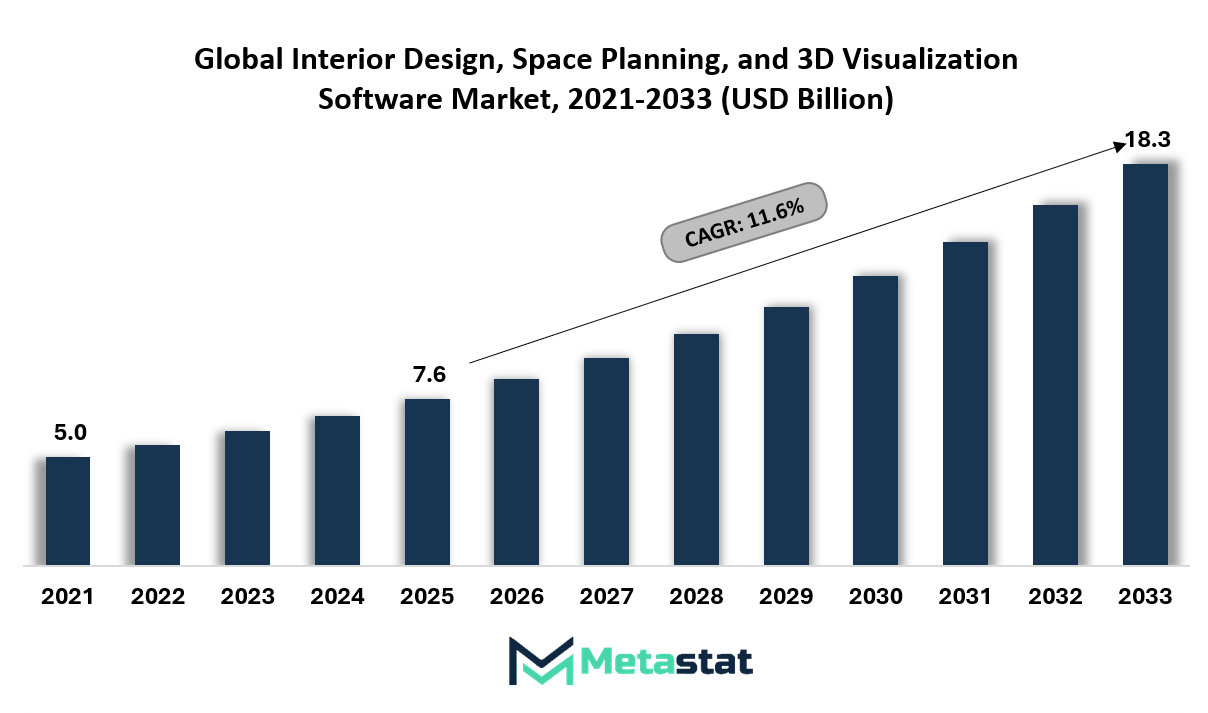
Increasing adoption of digital design tools across architecture, real estate, and home improvement sectors accelerates software demand.
Widespread digital transformation across architecture firms, real estate developers, and renovation service providers will continue to expand demand in the Global Interior Design, Space Planning, and 3D Visualization Software Market. Advanced design platforms will enable efficient drafting, accurate modeling, and seamless collaboration, leading to improved project timelines and stronger design precision across multiple industry applications.
Rising need for immersive client visualization and faster project approvals drives usage of 3D rendering solutions
Growing emphasis on client-centric design processes will encourage adoption of advanced 3D rendering solutions in the Global Interior Design, Space Planning, and 3D Visualization Software Market. Enhanced visualization capabilities will support realistic previews, allowing stakeholders to assess layouts, materials, and lighting conditions, leading to faster approvals and reduced project revisions.
High software licensing costs and subscription fees limit adoption among small and independent designers
High pricing structures associated with advanced design software will remain a barrier for freelance designers and small-scale firms operating in the Global Interior Design, Space Planning, and 3D Visualization Software Market. Budget constraints will affect purchasing decisions, limiting access to premium tools and slowing digital transformation across price-sensitive user segments.
Steep learning curve and requirement for skilled professionals restrict widespread utilization
Technical complexity associated with professional-grade design software requires specialized training and expertise, creating adoption challenges within the Global Interior Design, Space Planning, and 3D Visualization Software Market. Limited availability of skilled professionals slows implementation, while training investments increase operational burden for companies adopting advanced design technologies.
Integration of AI, AR, and VR technologies enhances real-time visualization and interactive design capabilities, creating advanced market potential
Technological advancements in artificial intelligence, augmented reality, and virtual reality will redefine design workflows in the Global Interior Design, Space Planning, and 3D Visualization Software Market. Real-time interaction, predictive design recommendations, and immersive walkthrough experiences will improve decision-making, strengthen customer engagement, and open new opportunities across residential and commercial design projects.
The Global Interior Design, Space Planning, and 3D Visualization Software market is classified based on Platform, Application, Deployment, and End-user.
Desktop segment is valued at USD 3.7 billion in 2026 and is projected to reach USD 7.2 billion by 2033, at a CAGR of 10% during the forecast period.
Desktop platforms will continue supporting advanced design workflows through high processing power, detailed rendering features, and strong project handling capacity. Professional users prefer desktop solutions for precision, stability, and integration with complex tools, enabling accurate visualization, detailed layouts, and efficient execution in the Global Interior Design, Space Planning, and 3D Visualization Software Market.
Web-Based Tools segment is valued at USD 3.1 billion in 2026 and is projected to reach USD 7.4 billion by 2033, at a CAGR of 13.4% during the forecast period.
Web-based tools will expand accessibility through browser-based interfaces, removing installation barriers and supporting collaborative environments. Seamless updates, real-time sharing, and remote access will improve productivity across distributed teams. Businesses will adopt these tools to streamline communication, accelerate project timelines, and maintain centralized design data across multiple stakeholders.
Mobile & Tablet Applications segment is valued at USD 1.7 billion in 2026 and is projected to reach USD 3.7 billion by 2033, at a CAGR of 11.6% during the forecast period.
Mobile and tablet applications will strengthen flexibility through portable design capabilities, enabling quick edits, visualization, and client presentations from any location. Touch-based interaction improves usability, while integration with cloud platforms ensures synchronization. Growing reliance on mobility supports faster decision-making and on-site modifications within design workflows.
Individual segment is projected to reach USD 6.4 billion by 2033, at a CAGR of 10.6% during the forecast period.
Individual usage will rise with growing interest in personal space customization and accessible design tools. Affordable solutions with intuitive interfaces will attract freelancers and hobby users. Simplified features combined with visualization capabilities will enable independent creators to produce professional-quality layouts without extensive technical knowledge or significant financial investment.
Enterprise segment is projected to reach USD 12 billion by 2033, at a CAGR of 12.2% during the forecast period.
Enterprise adoption will accelerate driven by demand for scalable solutions that support large projects and collaborative workflows. Advanced features, including integration with project management systems and analytics, will improve operational efficiency. Organizations will rely on these platforms to maintain consistency, manage multiple stakeholders, and deliver high-quality outputs within strict timelines.
Cloud segment is projected to reach USD 12.2 billion by 2033.
Cloud deployment will gain strong momentum through scalability, cost efficiency, and remote accessibility. Continuous updates, data security enhancements, and collaborative functions will drive adoption across industries. Organizations will prefer cloud-based environments for seamless integration, lower infrastructure dependency, and improved workflow coordination across geographically dispersed teams.
On-Premises segment is projected to reach USD 6.2 billion by 2033.
On-premises deployment will remain relevant for organizations requiring high data control and customized configurations. Sensitive project environments and regulatory compliance requirements will sustain demand. Dedicated infrastructure supports secure data management, while internal control enables tailored integration with existing enterprise systems and processes.
Interior Designers & Architects segment is projected to grow at a CAGR of 11.2% during the forecast period.
Interior Designers & Architects remain primary users, leveraging advanced visualization tools for concept development and client presentations. Precision, customization, and realistic rendering improve design accuracy. Continuous technological advancements support creative exploration and efficient project execution across residential and commercial segments.
Real Estate Developers & Agents segment is projected to grow at a CAGR of 12.2% during the forecast period.
Real Estate Developers & Agents will use visualization software to present properties through immersive experiences. Virtual walkthroughs and 3D layouts improve customer engagement and decision-making. Marketing strategies will increasingly rely on digital visualization to showcase projects before physical completion, improving sales conversion rates.
Furniture & Home Décor Retailers segment is projected to grow at a CAGR of 12.4% during the forecast period.
Furniture & Home Décor Retailers will adopt design software to deliver customized shopping experiences. Visualization tools allow customers to preview products within simulated environments. Stronger customer engagement and improved purchase confidence will support sales growth and reinforce brand differentiation in competitive markets.
Construction & Contracting Firms segment is projected to grow at a CAGR of 12.8% during the forecast period.
Construction & Contracting Firms will integrate design software to improve planning accuracy and project coordination. Visualization tools help identify potential issues before execution. Better communication among teams reduces errors, optimizes resource allocation, and improves overall project performance across construction phases.
DIY Homeowners segment is projected to grow at a CAGR of 10.5% during the forecast period.
DIY Homeowners will increasingly adopt user-friendly software to design and plan personal spaces. Accessible interfaces and guided tools simplify design processes. Growing interest in home improvement projects will drive adoption, enabling users to create customized layouts without professional assistance.
Facility Managers segment is projected to grow at a CAGR of 10.9% during the forecast period.
Facility Managers will use design and space planning tools to optimize layout efficiency and resource utilization. Visualization capabilities support renovation planning and space allocation decisions. Digital solutions improve operational control, enabling effective management of commercial and institutional properties.
Others segment is projected to grow at a CAGR of 10% during the forecast period.
Other users, including educational institutions and event planners, will adopt such software for specialized applications. Visualization tools support training, planning, and presentation requirements across various sectors. Expanding use cases will contribute to broader market penetration and continued innovation across diverse industries.
Based on geography, the Global Interior Design, Space Planning, and 3D Visualization Software market is divided into North America, Europe, Asia-Pacific, South America, Middle East, and Africa.
North America leads the market supported by strong adoption of advanced design technologies and the presence of major software providers.
Europe maintains solid demand driven by established architecture, renovation, and interior design industries.
Asia-Pacific will record strong growth owing to rapid urbanization, infrastructure expansion, and increasing digitalization across design workflows.
South America is witnessing steady adoption supported by growing real estate activity and rising use of visualization tools in residential and commercial projects.
The Middle East and Africa are gaining traction with increasing construction activity and rising awareness of digital design and space planning tools.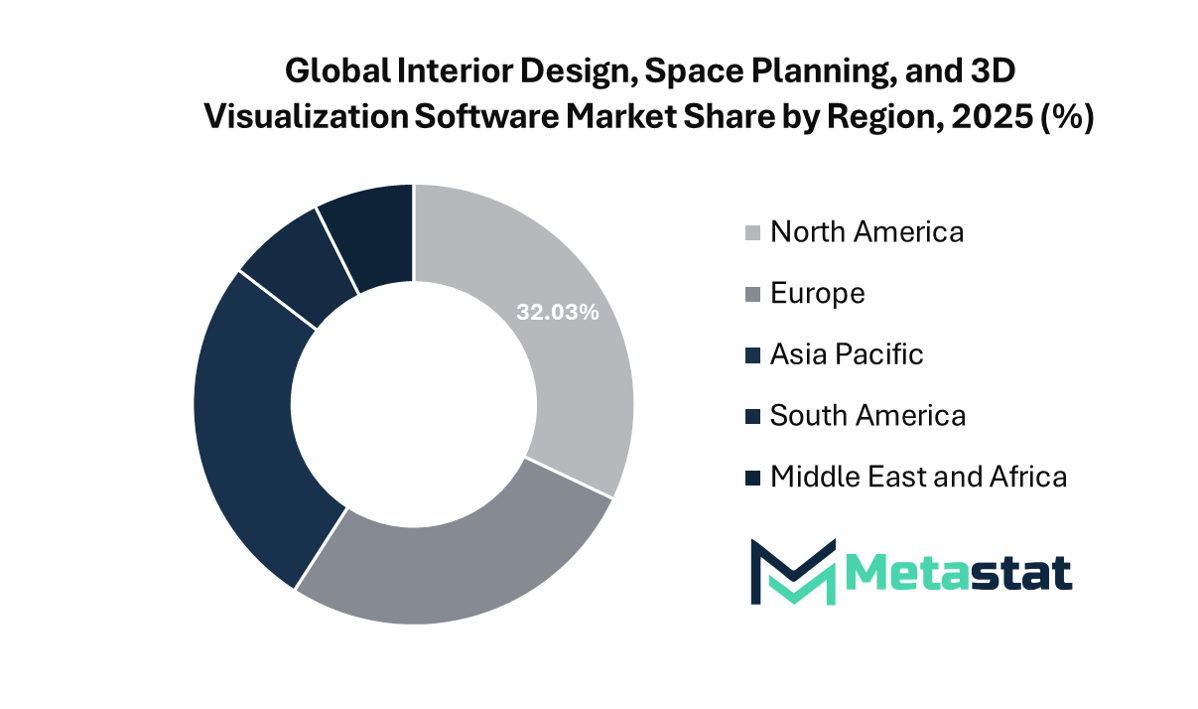
The global interior design, space planning, and 3D visualization software market is expanding steadily as individuals and enterprises seek efficient ways to plan and present spaces. These tools help designers, architects, and homeowners convert concepts into clear visual layouts before physical execution begins. Improved computing power and user-friendly interfaces continue to replace conventional sketching methods, making the design process faster and more accurate. Demand is also rising as customers increasingly expect realistic previews that support confident decision-making.
A major factor driving the market is the shift toward digital workflows across construction and real estate. Companies use 3D visualization to reduce errors, save time, and improve communication across teams. Cloud-based platforms are also becoming increasingly popular, enabling users to access projects from anywhere and collaborate in real time. With hybrid and remote work models becoming more common, these tools will play a larger role in connecting designers and clients across locations. In addition, virtual reality and augmented reality features will further improve how designs are presented and experienced.
Many established companies are shaping this industry through advanced solutions and continuous innovation. Leading players include Autodesk, Inc., Trimble Inc. (SketchUp), and Dassault Systèmes SE (HomeByMe), which offer robust tools for both professionals and entry-level users. Firms such as Vectorworks, Inc. and Chief Architect, Inc. focus on detailed architectural design, while Epic Games, Inc. (Twinmotion) and Chaos Group provide strong visualization and rendering capabilities. These companies continue to improve software performance, making it easier to create realistic visual outputs.
Other important participants include Graphisoft SE, Beijing Coohom Technology Co., Ltd., Planner 5D, and RoomSketcher AS, which serve a broad range of users from hobbyists to professionals. Platforms such as Foyr LLC, Infurnia Interior Design Pvt. Ltd., and Cedreo SAS focus on simplifying workflows and accelerating project delivery. Meanwhile, companies such as Houzz Inc. and Hexagon AB expand the ecosystem by connecting design, planning, and real-world execution.
As competition intensifies, companies will focus more on ease of use, affordability, and integration with other tools. Emerging companies such as Roomle Service GmbH, EasternGraphics GmbH, Palette CAD GmbH & Co. KG, Maticad S.r.l., Punch! Software, LLC, ashampoo GmbH & Co. KG, and Rayon Design Labs Pvt. Ltd. are also contributing fresh innovation to the market. As technology improves, these solutions will become accessible to a wider audience, supporting growth across both residential and commercial design projects worldwide.
Market size is forecast to rise from USD 7.6 billion in 2025 to over USD 18.3 billion by 2033.
The Global Interior Design, Space Planning, and 3D Visualization Software market is expected to witness strong growth owing to increasing demand for digital design solutions and immersive visualization technologies. Future developments will focus on AI-driven automation, real-time collaboration, and integration with emerging technologies such as virtual reality and augmented reality. These advancements enhance design efficiency and improve client engagement.
By Platform:
By Application:
By Deployment:
By End-user:
This research report categorizes the Interior Design, Space Planning, and 3D Visualization Software market based on key segments and regions, forecasts revenue growth, and analyses trends in each submarket. The report analyses the key growth drivers, opportunities, and challenges influencing the Interior Design, Space Planning, and 3D Visualization Software market. Recent market developments and competitive strategies such as expansion, product launch, partnership, merger, and acquisition have been included to draw the competitive landscape in the market.
The report strategically identifies and profiles the key market players and analyses their core competencies in each sub-segment of the Interior Design, Space Planning, and 3D Visualization Software market.
|
Report Attributes |
Details |
|
Study Period |
2021-2033 |
|
Base Year |
2025 |
|
Estimated Year |
2026 |
|
Forecast Period |
2026-2033 |
|
Historical Period |
2021-2025 |
|
Growth Rate |
CAGR 11.6% from 2026 to 2033 |
|
Revenue Unit |
USD billion |
|
Segmentation |
By Platform, Application, Deployment, End-user, and Region |
|
By Region |
North America (By Platform, Application, Deployment, End-user, and Country)
|
|
Europe (By Platform, Application, Deployment, End-user, and Country)
|
|
|
Asia Pacific (By Platform, Application, Deployment, End-user, and Country)
|
|
|
South America (By Platform, Application, Deployment, End-user, and Country)
|
|
|
Middle East and Africa (By Platform, Application, Deployment, End-user, and Country)
|
Find answers to common questions about this report
Top players operating in the Interior Design, Space Planning, and 3D Visualization Software industry include Autodesk, Inc., Trimble Inc. (SketchUp), Dassault Systèmes SE (HomeByMe), Vectorworks, Inc., Chief Architect, Inc., and Cyncly.
North America region dominates the market.
High software licensing costs and subscription fees limit adoption among small and independent designers will hamper the market growth within the forecast period.
Global Interior Design, Space Planning, and 3D Visualization Software market is estimated to reach USD 18.3 billion by 2033.
Increasing adoption of digital design tools across architecture, real estate, and home improvement sectors accelerates software demand and rising need for immersive client visualization and faster project approvals drives usage of 3D rendering solutions are key driving factors, boosting the market.
The Global Interior Design, Space Planning, and 3D Visualization Software market is expected to grow at a CAGR of 11.6% over the forecast period (2026-2033).
The Metastat Insights analysis shows that the North America Interior Design, Space Planning, and 3D Visualization Software market size is estimated to be USD 5.5 billion by 2033.
The Metastat Insights study shows that the Global Interior Design, Space Planning, and 3D Visualization Software market size was USD 7.6 billion in 2025.
The analysts below cover Information & Technology research at Metastat Insights.
LEAD ANALYST
Utkarsh Khirodkar is a Lead Market Research Analyst at MetaStat Insight, specializing in market intelligence, technology sector assessments, and competitive strategy.

PRINCIPAL CONSULTANT - ENTERPRISE AI & EMERGING TECHNOLOGIES
Banking & Finance · Electronics and Semiconductor · Energy and Power · Healthcare IT · Information & Technology · Professional Services
Vijay Gunti is a Principal Consultant at MetaStat Insight, bringing over two decades of experience across enterprise digital transformation, technology strategy, and intelligent systems.

LEAD CONSULTANT - COMMUNICATION, TELECOM, AND IT
Electronics and Semiconductor · Information & Technology · Machinery & Equipment · Professional Services
Ravindra Sathe Consultants for Communication, Telecom, and IT at MetaStat Insight. He leads the firm's industry research initiatives across telecommunications infrastructure, digital connectivity, enterprise networking, and emerging information technology domains.
Decarbonizing industrial thermal processes hinges on refrigerant regulations and compressor efficiency limits. Metastat Insights delivered a thorough market analysis that evaluated natural refrigerants like CO2 and hydrocarbons against synthetic low-GWP alternatives. The breakdown of utility incentives and grid capacity constraints across key European manufacturing hubs offered valuable perspective. The follow-up conversation with their sector analysts addressed our specific questions on mechanical vapor recompression systems efficiently.
Assessing 200mm wafer transition schedules and substrate supply bottlenecks requires precise technical intelligence. MetaStat Insight supplied an actionable breakdown comparing planar and trench MOSFET architectures across automotive and industrial drive markets. The regional capacity estimates for Asia-Pacific foundries helped clarify lead-time uncertainties during our strategic planning session. When we needed additional clarification on high-purity raw material sourcing, their analyst team responded with helpful context within twenty-four hours.
Tracking maintenance cycle demand for secondary flight display units and terrain collision avoidance systems across regional jet fleets involves complex aftermarket dynamics. MetaStat Insight provided practical analysis separating airline retrofit programs from OEM forward-fit production schedules in North America and Southeast Asia. The supplier matrix highlighted component obsolescence timelines without resorting to vague generalizations. The dataset served as a dependable reference during our annual program review meetings.
Explore related market intelligence reports worth reading alongside this one.