
LEAD ANALYST
Utkarsh Khirodkar is a Lead Market Research Analyst at MetaStat Insight, specializing in market intelligence, technology sector assessments, and competitive strategy.

Global LTE and 5G Broadcast Market Size, Share, By Broadcast Technology (LTE eMBMS, 5G FeMBMS, 5G Multicast and Broadcast Services, Hybrid LTE and 5G Broadcast), By Component (Infrastructure and Radio Equipment, Core Network and Middleware Software, Devices, Chipsets and SDKs, Integration and Managed Services), By Application (Live Media and Sports, Mobile TV and OTT Delivery, Public Warning and Emergency Communications, Connected Vehicles and OTA Updates, Enterprise and Private 5G Production, File and Software Distribution), By End-Use Industry (Mobile Network Operators, Broadcasters and Content Providers, Media Production and Live Events, Public Safety and Government, Automotive and Mobility, Enterprises and Venues), Industry Analysis, Growth, Trends, and Forecast, 2026-2033
Report ID
MSI-5739
Published
November, 2026
Pages
267 Pages
Format
Historical
Base year
Forecast
Forecast period
Report Details
Market Valuation: Valued at $1,011 Million in 2025, projected to reach $2,297.5 Million by 2033 at a 10.8% CAGR.
Dominant Segment: The 5G FeMBMS segment leads the market, driven by its capacity for higher data rates and lower latency, making it essential for high-quality multimedia content delivery.
Geographic Lead: North America is the leading region, holding 33.9% of the market in 2025, supported by robust infrastructure and high mobile technology adoption.
What's Inside: The report provides an in-depth analysis of market dynamics, competitive landscape, and forecasts from 2026 to 2033, covering various technologies, components, applications, and end-use industries.
Growth Opportunities: Significant growth is anticipated in the Connected Vehicles and OTA Updates segment, projected to achieve a CAGR of 13.4%, highlighting the demand for real-time vehicle services.
Market Challenges: Infrastructure limitations pose challenges to market growth, as inadequate network coverage can hinder the deployment of advanced broadcasting solutions.
Choose Your License
Global LTE and 5G Broadcast Market
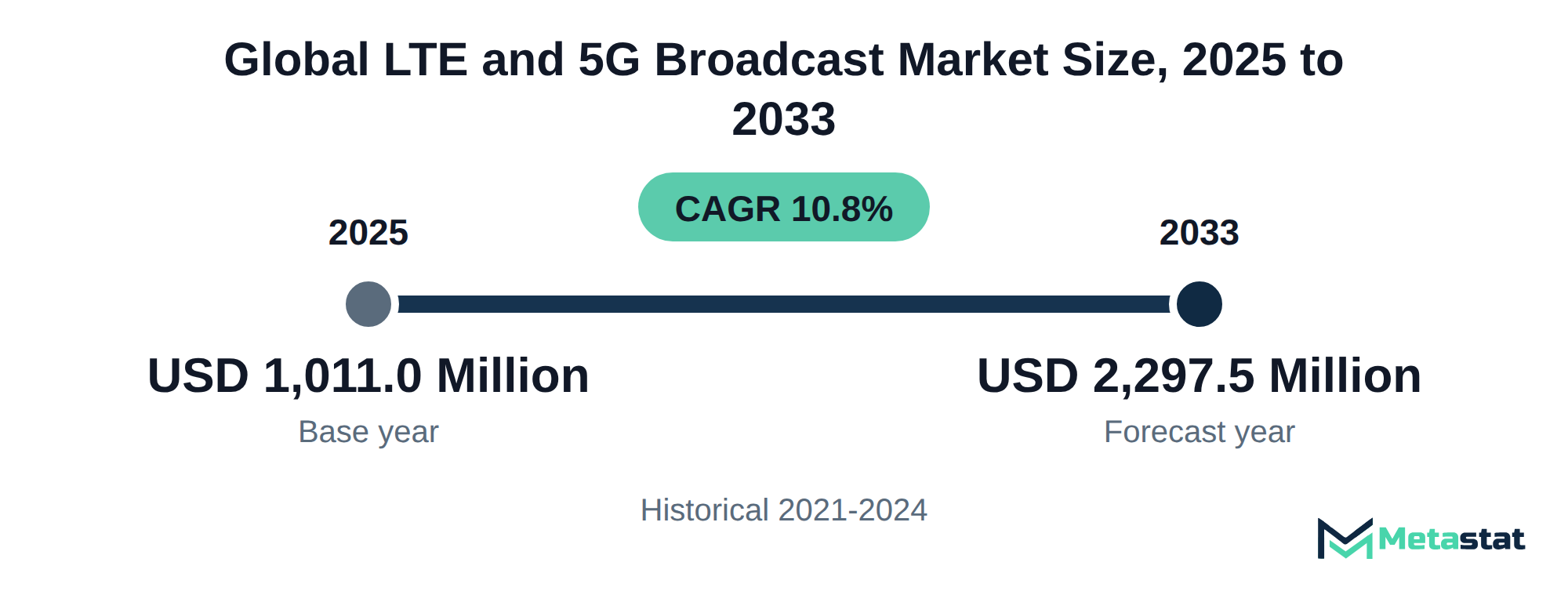
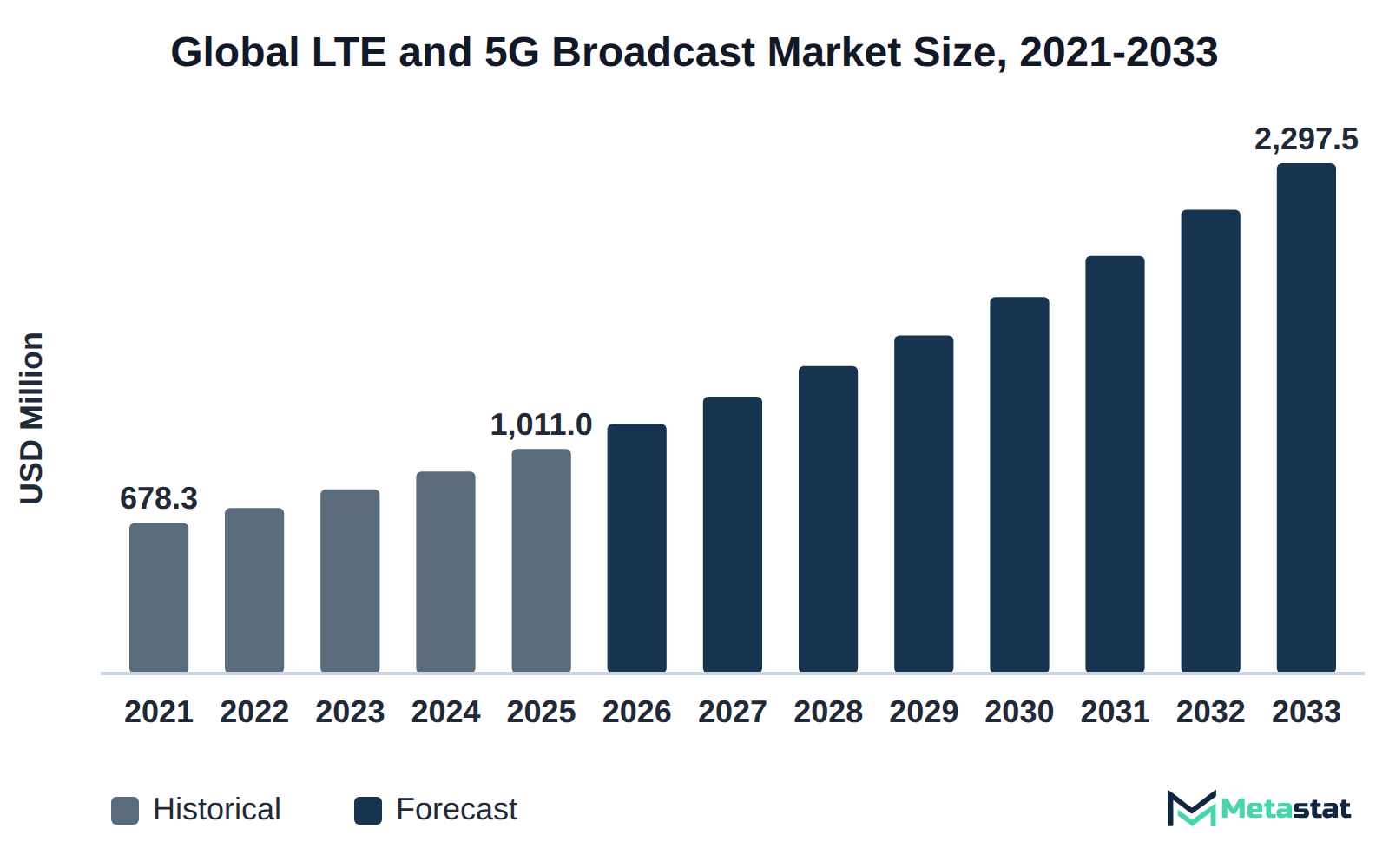
The global LTE and 5G Broadcast market was valued at USD 1,011 million in 2025 and is projected to reach USD 2,297.5 million by 2033, growing at a CAGR of 10.8% over the forecast period.
The LTE and 5G Broadcast market encompasses technologies and services that facilitate the delivery of multimedia content over mobile networks. This market addresses the growing demand for high-quality video streaming, live broadcasting, and interactive media experiences. Buyers invest in these solutions to enhance user engagement and improve service delivery, particularly in sectors including entertainment, media, and public safety. The increasing reliance on mobile devices for content consumption drives spending in this area.
Growth in the market is propelled by advancements in broadcasting technologies, particularly the shift towards 5G networks. The segment generating the most value is 5G FeMBMS, which offers improved efficiency and higher data rates compared to traditional broadcasting methods. North America holds 33.9% of the market in 2025, with the US leading in 2026. This region benefits from strong infrastructure and a high adoption rate of mobile technologies, positioning it as a leader in the LTE and 5G Broadcast market.
Investment in hybrid broadcasting solutions represents a significant growth driver, allowing operators to use both LTE and 5G capabilities. The integration of these technologies enables efficient content delivery and supports diverse applications, including mobile TV and connected vehicles. Industries increasingly recognize the advantages of enhanced broadcasting solutions, positioning the market for sustained expansion throughout the forecast period.
The LTE and 5G Broadcast market includes services and technologies designed to enhance multimedia content delivery via mobile networks. Buyers invest in this market to improve user experiences, expand service offerings, and meet the increasing demand for high-quality broadcasting. Growth in mobile data consumption and the shift toward mobile-first strategies among businesses drive spending across various sectors, including telecommunications and media.
Growth in the LTE and 5G Broadcast market is primarily fueled by the rising adoption of 5G infrastructure, which supports advanced broadcasting capabilities. The segment of 5G Multicast and Broadcast Services holds significant value within the market, reflecting the industry's transition toward more efficient and high-capacity broadcasting solutions. The segment's position highlights strong demand for innovative broadcasting solutions among mobile network operators and content providers.
Investments in next-generation broadcasting technologies enhance operational efficiencies and expand market reach. The continuous evolution of consumer expectations for content delivery necessitates ongoing advancements in broadcasting methodologies. Stakeholders focus on integrating new technologies to capture emerging opportunities within the LTE and 5G Broadcast market.
The integration of 5G broadcast networks enhances live sports coverage and media production by delivering high-quality streaming services with minimal latency. This technology enables smooth transmission of high-definition content to a large audience simultaneously, fulfilling the growing demand for real-time sports experiences. In the LTE and 5G Broadcast market, the 5G FeMBMS segment is projected to reach USD 751.3 million by 2033, reflecting a compound annual growth rate of 14.5%. This growth signifies a shift towards advanced broadcasting solutions that improve viewer engagement and accessibility.
Broadcasters and content providers increasingly adopt 5G technologies to enhance audience interaction and offer immersive viewing experiences. The ability to connect multiple devices and support various applications facilitates innovative formats including augmented reality and enhanced graphics during live events. This trend positions 5G broadcast networks as critical enablers of next-generation media production, driving increased investment in advanced infrastructure and equipment.
The ongoing evolution within the market highlights opportunities for companies to differentiate their offerings. Providers that effectively use 5G capabilities capture significant market share, catering to an audience that increasingly seeks high-quality, immediate content delivery. This shift shows how 5G is transforming live sports and media production, in line with broader digitization and interactivity trends within the industry.
Pricing structures in the LTE and 5G Broadcast market reflect the evolving landscape of broadcasting technologies. Buyers typically engage through a combination of upfront costs and ongoing service fees, which align with the need for dependable infrastructure. The Infrastructure and Radio Equipment segment is projected to grow from USD 372 million in 2026 to USD 714.5 million by 2033, highlighting the financial commitments required for advanced solutions.
Contract models incorporate tiered pricing, allowing for scaling based on user demands or data consumption. Mobile Network Operators, primary buyers, seek predictability in costs while accommodating a shifting user base. This approach supports budgeting and financial forecasting, particularly when integrating 5G technologies into existing networks. Strategic partnerships formed during contract negotiations further impact pricing dynamics, significantly influencing market entry strategies.
Understanding pricing and contract models remains critical for stakeholders in the LTE and 5G Broadcast market. Decisions about technology investments directly affect operational efficiency and return on investment, guiding the trajectory of future growth in broadcasting capabilities.
Public safety and emergency communications increasingly rely on one-to-many delivery systems enabled by advanced broadcasting technologies. These requirements overlap with mission critical communication networks used by emergency services. The LTE and 5G Broadcast market facilitates this need through innovations in public warning systems. By 2033, the application for public warning and emergency communications is projected to reach USD 442.3 million, highlighting the growing reliance on these technologies for critical information dissemination during emergencies.
Connected vehicles represent another significant area driving the demand for effective broadcasting solutions. The integration of mobile video within these vehicles enhances communication, navigation, and entertainment functionalities. The requirement for reliable broadcast services ensures that drivers receive timely information, thereby enhancing road safety and passenger experience. With the increasing complexity of vehicular communication systems, the LTE and 5G Broadcast market supplies the necessary infrastructure, supporting various applications, including real-time traffic updates and emergency alerts.
Mobile video services, particularly in live media and sports, are expanding rapidly, with this segment anticipated to grow to USD 598.5 million by 2033. The demand for high-quality broadcasting solutions during major sporting events and live broadcasts ensures that content providers leverage advanced technologies to deliver effective viewing experiences. This trend significantly influences the competitive dynamics of the market, compelling companies to enhance their offerings to capture the growing audience and meet customer expectations.
Deploying LTE and 5G broadcast services requires infrastructure with several critical components. Key elements include infrastructure and radio equipment, core network and middleware software, and integration services. By 2033, revenue for infrastructure and radio equipment is projected to reach USD 714.5 million, reflecting a compound annual growth rate of 9.8%. This significant increase highlights growing investment in necessary hardware. In 5G deployments, this hardware includes 5G radio units.
Core network and middleware software is essential in managing data traffic and ensuring effective service delivery. By 2033, this segment is expected to generate USD 672 million in revenue, demonstrating the importance of advanced software solutions in the market. Integration and managed services further enhance operational efficiency and system interoperability, contributing to overall service reliability.
The LTE and 5G broadcast market relies on these foundational components to support diverse applications, including live media and sports, mobile TV, and public safety communications. A well-developed infrastructure improves service quality and drives market growth and competition among service providers. Companies that invest in upgrading their infrastructure position themselves to capture greater market share and cater to evolving consumer demands.
Mobile network operators are investing heavily in infrastructure upgrades to meet rising consumer demand for high-quality multimedia content delivery. This shift occurs due to an increase in mobile video consumption, driven by changing viewer habits and the popularity of mobile streaming services. The growing expectation for reliable access to content significantly impacts network capacity and quality. In the LTE and 5G Broadcast market, the value is projected to reach USD 1,123.2 million in 2026, reflecting a compound annual growth rate of 10.8%. Enhanced mobile network capabilities directly support superior user experiences and drive adoption in various applications, including sports and live events. The transition towards 5G further accelerates this growth, with network operators prioritizing investments that enhance service quality and expand coverage. These upgrades overlap with wider 5G network and tower deployment activity.
Increased demand for live media and sports applications reflects the market's trajectory. Operators adapt to these changes, ensuring that infrastructure investments yield competitive advantages while expanding consumer engagement.
Technological advancements in broadcasting drive the shift towards hybrid LTE and 5G Broadcast solutions. These solutions integrate both technologies to enhance content delivery capabilities across various platforms. Mobile network operators face increasing consumer expectations for high-quality multimedia experiences, fueling the transition towards these sophisticated broadcasting systems. The combination of LTE and 5G technologies enables operators to deliver high-quality video and audio content with minimal latency. This demand is particularly evident in live media applications, where reliable and high-speed transmission proves critical. Consequently, the LTE and 5G Broadcast market observes heightened investments in hybrid solutions to satisfy the growing appetite for engaging content. The emergence of such technologies facilitates improved network efficiency, allowing operators to optimize resources while meeting user demands for diverse applications.
Insufficient infrastructure presents a significant challenge to the LTE and 5G Broadcast market. Mobile network operators experience slower uptake of advanced broadcasting solutions due to inadequate network coverage and capacity. This constraint leads to smaller orders for equipment and services, impacting overall revenue growth in the market. Regions with underdeveloped telecommunications infrastructure struggle to implement the necessary upgrades, resulting in delayed deployment of LTE and 5G broadcast technologies. Consequently, broadcasters and content providers face difficulties in delivering high-quality multimedia content, which directly affects consumer engagement and satisfaction. Investment in infrastructure upgrades remains critical for improving access to innovative broadcasting solutions, driving competitive differentiation among service providers. Addressing these infrastructure challenges is essential for realizing the potential of the LTE and 5G Broadcast market, restricting market expansion and innovation opportunities.
Profitability remains a significant challenge within the LTE and 5G Broadcast market, influenced by escalating input costs for infrastructure and technology. Suppliers face mounting expenses associated with advanced broadcasting equipment and software development. Fluctuating material prices and the demand for high-quality components exert pressure on margins, complicating operational sustainability.
In response, suppliers implement cost-control measures, including optimizing supply chain efficiencies and investing in innovative technologies that reduce reliance on expensive materials. Collaborative partnerships with manufacturers and integration of emerging technologies aim to enhance production capabilities while minimizing costs. These strategies help suppliers maintain competitive pricing and adapt to market fluctuations while meeting growing consumer demands and maintaining service quality.
The 5G multicast services segment is projected to reach USD 708.8 million by 2033, highlighting significant potential for expansion. Factors driving this growth include increasing demand for high-quality multimedia content delivery and the need for efficient distribution methods. Mobile network operators and content providers form the primary buyer groups, seeking solutions that enhance user experience and optimize bandwidth utilization. The growth of connected devices and the rise of mobile video consumption further stimulate the adoption of 5G multicast services. Innovations in infrastructure and technology enable a smooth transition from traditional broadcasting models to advanced 5G solutions, supporting the market's trajectory. This shift enhances operational efficiency and positions stakeholders for competitive advantage in an evolving digital landscape.
The Global LTE and 5G Broadcast market is segmented based on Broadcast Technology, Component, Application, and End-Use Industry.
LTE eMBMS segment is valued at USD 495.8 million in 2026 and is projected to reach USD 658.2 million by 2033, at a CAGR of 4.1% during the forecast period. This technology enables efficient multimedia content delivery over mobile networks, primarily serving mobile network operators and broadcasters. The demand for LTE eMBMS is driven by the increasing need for enhanced viewer experiences, particularly in live media and sports. Unlike its counterparts, this segment exhibits slower growth compared to 5G FeMBMS, which anticipates a CAGR of 14.5%. The lower growth rate reflects the maturity of LTE-based solutions and the ongoing transition towards more advanced 5G technologies. Consequently, LTE eMBMS's role remains essential for existing infrastructures, focusing on optimizing current broadcasting capabilities while supporting future advancements.
This technology facilitates efficient multimedia content delivery over mobile networks, attracting broadcasters and content providers focused on high-quality transmissions. The rising demand for high-quality streaming experiences in live media and sports drives this segment, with a notable push from evolving consumer preferences for enhanced viewing experiences. Compared to other broadcast technologies, 5G FeMBMS exhibits a faster growth trajectory, supported by its capacity to handle higher data rates and lower latency. This segment contrasts with LTE eMBMS, which is projected to grow at a CAGR of 4.1%, indicating stronger market adoption for 5G capabilities. The emphasis on content-rich applications strengthens the relevance of 5G FeMBMS in the telecommunications landscape.
5G Multicast and Broadcast Services segment is expected to reach USD 708.8 million by 2033. This segment provides efficient delivery of multimedia content over mobile networks, catering to demands from mobile network operators, content providers, and broadcasters. A key driver of growth involves the increasing consumer preference for high-quality streaming services and live events, which necessitate advanced broadcasting capabilities. The segment exhibits a faster growth trajectory compared to components like LTE eMBMS, which holds a CAGR of 4.1%. Enhanced quality and flexibility of 5G technologies contribute to this expansion, offering better user experiences in live media, sports, and emergency communications applications. Integration of AI and machine learning into service offerings further enhances operational efficiency, positioning players in this segment competitively within the LTE and 5G Broadcast market.
Hybrid LTE and 5G Broadcast is projected to grow at a CAGR of 11.6% during the forecast period. This segment serves numerous applications, particularly in enhancing multimedia content delivery for mobile network operators and content providers. Demand is driven by the need for higher-quality broadcasting services and integration of LTE and 5G technologies. This segment stands out with a faster growth trajectory compared to LTE eMBMS, which is expected to achieve a CAGR of 4.1%. The unique combination of LTE and 5G capabilities offers improved efficiency and flexibility for operators, allowing them to cater to diverse customer needs. This differentiation positions the hybrid approach as a critical solution in the evolving LTE and 5G Broadcast market, addressing increasing consumer expectations for high-performance multimedia services.
This segment consists of the essential hardware that supports the deployment and operation of LTE and 5G Broadcast services, primarily used by mobile network operators and content providers. Increasing demand for high-quality multimedia content fuels investments in infrastructure and radio equipment, enhancing overall service delivery. Compared to other components, this segment experiences steady growth driven by the need for advanced communication technologies. The focus on upgrading existing infrastructure to accommodate more users and higher data rates differentiates it from the other segments in this group, which do not exhibit the same level of investment or immediate growth potential. With the ongoing rollout of 5G networks, the infrastructure and radio equipment segment significantly influences the future of broadcast services.
Core Network and Middleware Software segment is estimated to reach USD 672 million by 2033, at a CAGR of 10.8% during the forecast period. This segment comprises essential software solutions that facilitate communication between various network components, enabling efficient data management and service delivery across mobile networks. Mobile operators and service providers rely on these solutions to streamline operations and enhance service offerings. Growth in this segment is driven by the increasing demand for advanced network functionalities and the need for effective integration of services. Compared to other segments, Core Network and Middleware Software demonstrates a steady growth rate, owing to its fundamental role in supporting both LTE and 5G technologies. The projected growth rate aligns with broader trends in the LTE and 5G Broadcast market, highlighting the critical nature of this segment in achieving enhanced operational efficiency and improved customer experiences.
The Devices, Chipsets and SDKs segment is expected to reach USD 472.1 million by 2033. This segment encompasses the hardware and software components that enable the development and deployment of LTE and 5G broadcasting solutions. Key users include mobile network operators and device manufacturers, who rely on these components to deliver high-quality media content and services to end users. The growing demand for advanced mobile applications and services drives the segment's expansion, supported by the increasing adoption of 5G technology. Compared to other components, including Infrastructure and Radio Equipment, this segment experiences slower growth with a CAGR of 9.8% during the forecast period. Its strategic significance lies in enabling innovative applications across various industries, highlighting its unique position within the LTE and 5G Broadcast market.
Integration and Managed Services segment is projected to grow at a CAGR of 10.6% during the forecast period. This segment encompasses the provision of essential support and management for broadcasting technologies, targeting mobile network operators and content providers who rely on optimized infrastructure and effective integration of services. Rising demand for sophisticated broadcasting solutions, including enhanced media delivery and real-time content updates, drives growth in this segment. Unlike Infrastructure and Radio Equipment, which experiences a higher projected growth rate at 9.8%, Integration and Managed Services focus on streamlining operations for existing systems rather than establishing new hardware. This segment addresses operational efficiency, helping businesses get more value from their investments in broadcasting technologies.
Live Media and Sports segment is valued at USD 312.1 million in 2026 and is projected to reach USD 598.5 million by 2033, at a CAGR of 9.8% during the forecast period. This segment serves primarily broadcasters and content providers who employ advanced broadcasting technologies for live sports events and media coverage. Increasing consumer demand for instant access to live content drives growth within this segment, pushing network operators to enhance their infrastructure. Compared to other application segments, Live Media and Sports demonstrates a relatively stable growth rate, reflecting a consistent interest in live events. While Mobile TV and OTT Delivery shows a slightly higher CAGR of 10.2%, Live Media and Sports maintains significant demand due to the unique appeal of live programming, ensuring continued investment from both private and public sector players. The LTE and 5G Broadcast market benefits significantly from advancements in technology that facilitate real-time content delivery and enhance viewer engagement.
Mobile TV and OTT Delivery segment is estimated to reach USD 487.1 million by 2033, at a CAGR of 10.2% during the forecast period. This segment caters to consumers seeking access to a variety of television programming and on-demand content through internet-connected devices. Growth in this area is driven by increasing consumer demand for flexible viewing options and the expansion of high-speed internet access. Unlike other segments, the Mobile TV and OTT Delivery segment exhibits a higher growth rate than the Live Media and Sports segment, which has a CAGR of 9.8%. The competitive landscape remains dynamic, with various providers offering diverse pricing models and subscription options that enhance accessibility and user experience. This ongoing evolution positions this segment as a key contributor to the overall growth of the LTE and 5G Broadcast market.
Public Warning and Emergency Communications segment is expected to reach USD 442.3 million by 2033. This segment plays a critical role in enhancing public safety during emergencies, serving government agencies and first responders. The increasing frequency of natural disasters and public safety incidents drives demand for reliable communication systems that ensure timely alerts and information dissemination. This area experiences growth due to its essential nature, with a projected CAGR reflecting heightened investment in emergency preparedness. The urgency surrounding public safety initiatives creates a unique market dynamic, distinguishing it from segments focused on entertainment or general communication. Effective integration of LTE and 5G technologies into emergency services creates significant opportunities for innovation and improves response capabilities, aligning with broader trends within the LTE and 5G Broadcast market.
Connected Vehicles and OTA Updates segment is projected to grow at a CAGR of 13.4% during the forecast period. This segment focuses on providing real-time over-the-air updates and services to vehicles, enhancing user experience and connectivity. Automotive manufacturers and technology providers deliver these services for fleet management and consumer applications. The rising demand for advanced driver assistance systems (ADAS) and infotainment solutions drives growth in this segment. Investments in high-speed networks support the delivery of updates and services, differentiating it from other segments including Mobile TV and OTT Delivery, which experience slower growth. With a focus on innovation, the Connected Vehicles and OTA Updates segment presents a unique opportunity for companies to capture a share of the expanding market.
Enterprise and Private 5G Production focuses on the deployment of dedicated 5G networks for enterprises, enhancing operational efficiency and enabling new use cases. Organizations across various sectors, including manufacturing, logistics, and healthcare, leverage private 5G networks for real-time data processing, automation, and secure communications. Demand for customized solutions drives this segment, with businesses seeking tailored connectivity options that traditional networks cannot adequately provide. Unlike other applications within the market, this segment shows a distinct emphasis on security and reliability, catering to industries where data privacy holds priority. The integration of advanced technologies including edge computing and IoT devices further supports growth, ensuring enterprises benefit from increased speed and reduced latency in communications. Overall, this segment stands out through its specialized focus and the growing trend toward digital transformation across industries.
File and Software Distribution serves a critical function in delivering essential digital content and applications to end-users. This segment finds application among various sectors, including education, entertainment, and enterprise-level solutions. Increased demand for efficient software deployment processes acts as a significant driver. The growing reliance on cloud computing services and digital distribution platforms accelerates adoption, enabling organizations to streamline updates and manage applications effectively. Compared to other segments, this area experiences unique dynamics, with potential for higher price points due to the specialized nature of services offered. While segments including Live Media and Sports focus on real-time content delivery, File and Software Distribution emphasizes reliability and security in data transmission, appealing to businesses prioritizing operational efficiency. The integration of advanced technologies in this segment enhances its attractiveness to organizations seeking innovative solutions in a competitive environment.
This segment focuses on applications related to smart cities and education, leveraging advanced broadcasting technologies to enhance connectivity and information dissemination. Smart city initiatives employ LTE and 5G technologies to improve infrastructure, promote efficient resource management, and enable real-time data exchange. Educational institutions deploy these technologies to facilitate remote learning, support interactive classrooms, and provide access to digital resources. The demand for enhanced connectivity drives growth in this segment, resulting from an increasing emphasis on digital transformation in urban planning and education systems. Compared to other segments, this area exhibits slower growth due to the complexities involved in implementing technology across diverse environments and sectors. The challenge of integrating legacy systems within existing infrastructures further influences adoption rates, differentiating this segment from faster-growing applications in media and entertainment.
Mobile Network Operators segment is valued at USD 493.2 million in 2026 and is projected to reach USD 905.2 million by 2033, at a CAGR of 9.1% during the forecast period. This segment serves telecommunications companies that rely on efficient broadcasting and communication technologies to deliver services to consumers. Driving forces include the growing demand for faster and more reliable mobile connectivity, driven by increasing smartphone usage and mobile data consumption. Compared to other segments, Mobile Network Operators exhibit moderate growth, supported by a consistent influx of subscribers and technological upgrades. While segments like 5G FeMBMS show faster growth rates, Mobile Network Operators maintain stable demand for broadcast services, emphasizing reliability and coverage. This balance positions them uniquely within the LTE and 5G Broadcast market, creating opportunities for investment in advanced infrastructure and service offerings.
The Broadcasters and Content Providers segment is estimated to reach USD 499.7 million by 2033, at a CAGR of 10.4% during the forecast period. This segment primarily serves television and online content providers, enabling them to deliver high-quality broadcasts to audiences. The growing demand for diverse content delivery options drives this segment, particularly among mobile network operators and content creators seeking to enhance viewer engagement. Integration of advanced broadcasting technologies facilitates efficient content distribution. Compared to other segments, this sub-segment experiences moderate growth, with a notable CAGR, focusing on providing specialized services tailored to the needs of content providers. This differentiation in the market highlights its unique position, supporting the increasing popularity of streaming services and live broadcasts.
Media Production and Live Events segment is expected to reach USD 271.1 million by 2033. This segment serves the needs of broadcasters, event organizers, and media companies, facilitating real-time content delivery and audience engagement. Growing demand for high-quality live broadcasting and enhanced viewer experiences drives the segment's growth. The increasing adoption of 5G technology supports improved transmission speeds and reduced latency, enabling more immersive content creation and distribution. Compared to other segments, this segment experiences a distinctive growth trajectory, with a specific focus on the dynamic nature of live events. Operational investments in advanced broadcasting infrastructure and equipment continue to shape the market landscape, creating opportunities for innovation in content delivery and audience interaction.
Public Safety and Government segment is projected to grow at a CAGR of 12.3% during the forecast period. This segment ensures effective communication during emergencies and critical situations, serving primarily government agencies and first responders. Increased investments in advanced communication technologies, driven by rising demand for reliable and secure networks, support this segment's growth. Compared to other segments, including Mobile Network Operators, which grow at a CAGR of 9.1%, the Public Safety and Government segment demonstrates faster expansion due to heightened awareness of public safety. Enhanced regulatory frameworks supporting the adoption of advanced communications in emergency services further contribute to this trajectory, positioning the segment as a key participant in the LTE and 5G Broadcast market. The market's focus on providing robust connectivity aligns with the specific needs of public safety entities, ensuring efficient management of resources during critical incidents.
Automotive and Mobility encompasses solutions for connected vehicles and advanced transportation systems, facilitating real-time communication and enhanced navigation features. This segment serves automotive manufacturers and operators, enabling reliable connectivity for applications like in-car entertainment, vehicle tracking, and traffic management. Increasing demand for driver assistance technologies significantly drives growth in this area. The necessity for integrated communication systems strengthens the adoption of LTE and 5G technologies. Compared to other segments, Automotive and Mobility experiences a more rapid evolution due to the increasing emphasis on safety standards and regulatory compliance. These factors contribute to its distinct positioning within the LTE and 5G Broadcast market.
This segment serves Enterprises and Venues, leveraging advanced broadcasting technologies to enhance communication and connectivity in various environments. Key users include event organizers, corporate entities, and venue operators who apply these technologies for live events, presentations, and real-time engagement with audiences. A significant driver for this segment involves growing demand for high-quality video streaming and interactive content, driven by increasing consumer expectations for effective experiences. The transition toward digital solutions for communication and event management supports adoption. Compared to other segments within the End-Use Industry, Enterprises and Venues experience different growth trajectories, influenced by the distinct requirements of users who prioritize reliable and high-performance solutions tailored to their operational needs. The LTE and 5G Broadcast market is expected to evolve, presenting opportunities for innovation and enhanced service offerings in this area.
This segment focuses on applications relevant to education and smart cities, leveraging innovative broadcasting technologies to improve connectivity and information distribution. Educational institutions employ these technologies to enhance learning experiences, providing real-time access to content and resources for students and educators. Demand drivers include the increasing importance of digital learning environments and smart city initiatives, which emphasize efficient communication networks. This sub-segment differs from others through its unique application in public sector projects and educational settings, often requiring tailored solutions to meet specific regulatory and operational needs. Compared to segments including Mobile Network Operators, pricing dynamics exhibit variability due to the diverse requirements of different educational institutions and smart city projects. The LTE and 5G Broadcast market is expected to evolve, with growing interest in how these technologies shape the future of urban living and learning.
Based on geography, the Global LTE and 5G Broadcast market is divided into North America, Europe, Asia-Pacific, South America, Middle East, and Africa.
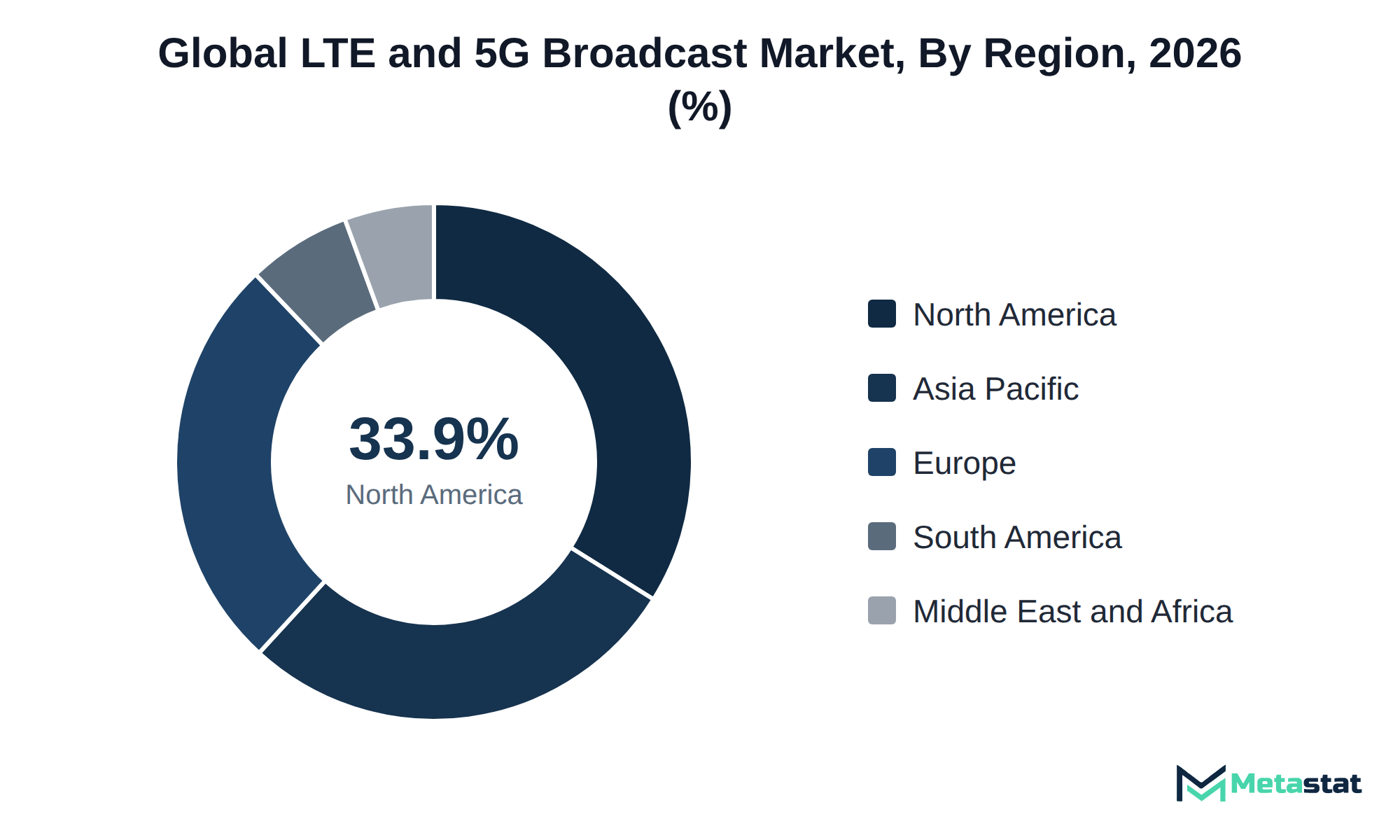
North America excels in the LTE and 5G Broadcast market, projected to reach USD 745.5 million by the end of 2033. Strong demand primarily arises from Mobile Network Operators, who require advanced infrastructure to support increasing connectivity. The region accounts for 33.9% of the global market share in 2025, reflecting significant investment in broadcasting technologies. In this region, the presence of established telecommunications companies facilitates rapid deployment of innovative services. The United States, Canada, and Mexico each contribute to the demand through their respective investments in network expansion and enhancement. Increased focus on live media events and mobile content delivery further drives market growth, particularly within the Live Media and Sports segment. Resilience in these sectors positions North America as a critical player in the evolution of broadcasting technologies.
Demand for the LTE and 5G Broadcast market in Europe is driven by significant investments in infrastructure and the increasing adoption of mobile broadband services. Countries like Germany and the UK prioritize advancements in broadcasting technology, while France and Italy focus on enhancing connectivity and content delivery. The region benefits from robust regulatory frameworks that encourage innovation and competitiveness among mobile network operators and broadcasters. By 2025, Europe is projected to hold a 26.1% share of the global market, reflecting strong growth potential. The rising use of mobile devices and the increasing consumption of digital content contribute to the expansion of applications including mobile TV and OTT delivery. These trends enhance user experience and drive revenue growth across various sectors, positioning Europe as a key player in the LTE and 5G Broadcast market.
The Asia-Pacific region holds a share of the market. Demand in this area arises from sectors including mobile network operators and broadcasters, primarily driven by the rising consumption of digital content and the need for improved connectivity. Countries like China and India are actively investing in infrastructure enhancements to support advanced broadcast services, including 5G Multicast and Broadcast Services. South Korea and Japan lead in technology adoption, benefiting from a strong emphasis on innovation and research. Integration of advanced broadcasting technologies into connected vehicles and mobile applications presents further opportunities within the region. The LTE and 5G Broadcast market displays growth potential, supported by increasing mobile data usage and evolving consumer preferences.
The broadcasting landscape in South America presents unique characteristics that influence demand within the LTE and 5G Broadcast market. Countries like Brazil and Argentina drive momentum through growing interest in mobile broadcasting technologies, particularly for live media and sports applications. The market benefits from increasing connectivity infrastructure and rising investment in telecommunications, enhancing user experiences. By 2025, South America will account for 6.5% of the global market share, indicating significant growth potential. The region's focus on public safety and emergency communications further influences demand dynamics, with governments prioritizing advancements in these sectors. Such developments create an environment conducive to the ongoing evolution of broadcasting solutions.
The LTE and 5G Broadcast market in the Middle East and Africa benefits from growing investments in mobile infrastructure, particularly in Saudi Arabia and the UAE. These countries prioritize modernizing telecommunications to enhance connectivity and support multimedia services. Notable initiatives focus on improving broadcast capabilities for live events and emergency communications, benefiting from advanced technologies. South Africa contributes significantly, driven by efforts to enhance public safety communication. This growth reflects increasing demand for reliable broadcasting solutions. The rise in mobile network operators seeking to implement innovative broadcasting technologies across various sectors supports this expansion.
The LTE and 5G Broadcast market displays a competitive environment shaped by various strategic behaviors among companies. Key players differentiate themselves through their offerings in broadcast technology, components, applications, and end-use industries. Buyers prioritize factors including price, service quality, customization, and integration into existing ecosystems when selecting suppliers.
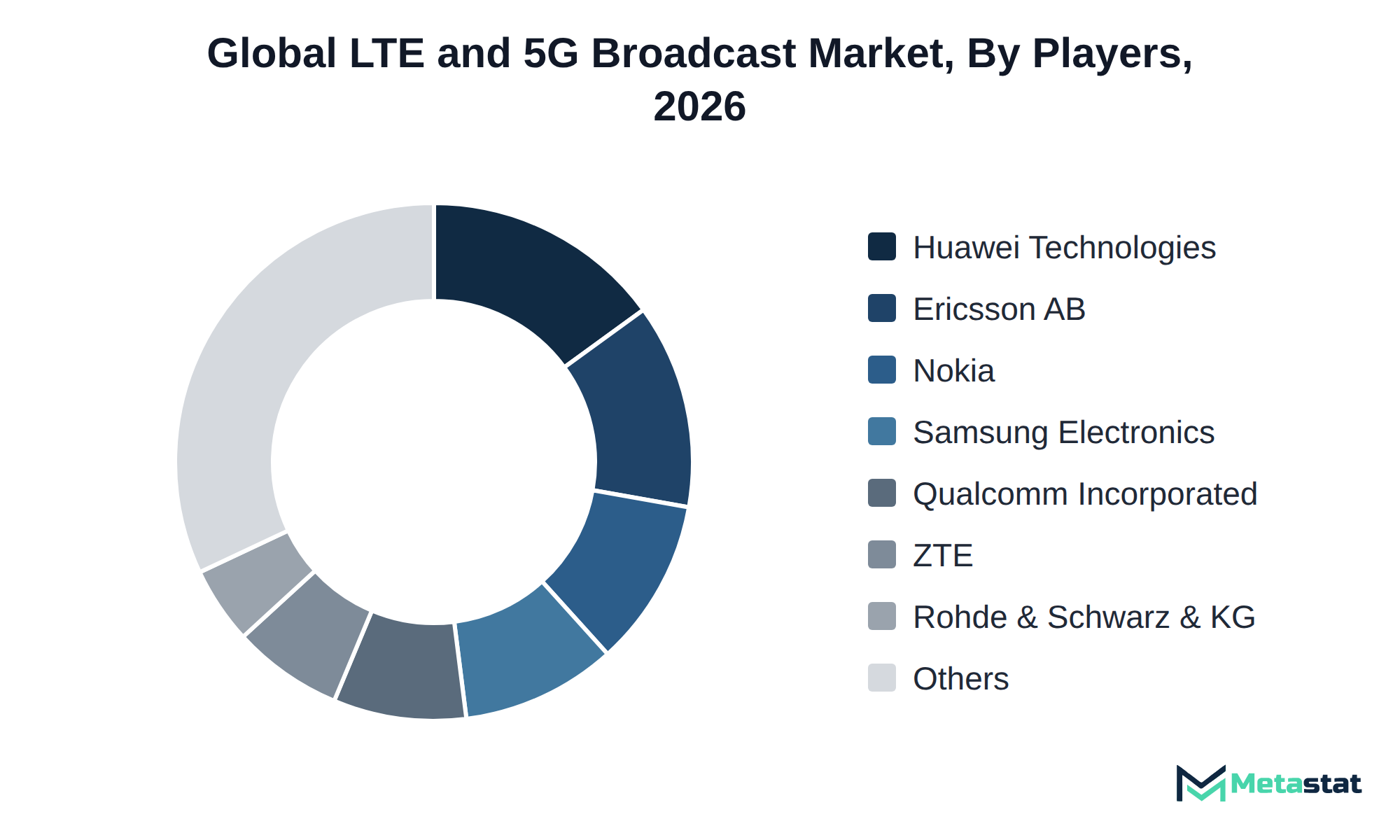
Firms like Huawei Technologies Co., Ltd. and Ericsson AB focus on advancing infrastructure and radio equipment tailored for LTE eMBMS and 5G technologies, while Qualcomm Incorporated emphasizes device and chipset innovation to enhance performance in mobile communications. Samsung Electronics Co., Ltd. concentrates on hybrid broadcast solutions that combine LTE and 5G capabilities, addressing diverse consumer demands.
Companies including Nokia Corporation and ZTE Corporation offer comprehensive solutions that integrate broadcast services with core network software, appealing to mobile network operators seeking operational efficiency. ENENSYS Technologies and GatesAir, Inc. enhance their competitive stance through specialized services for live media and sports applications, focusing on customer-specific needs in the LTE and 5G Broadcast market.
Achieving this growth in the LTE and 5G Broadcast market relies on several key developments. First, the expansion of 5G FeMBMS technology will drive increased demand for multicast and broadcast services, particularly among Mobile Network Operators and Broadcasters. This segment is anticipated to experience significant growth, with a projected CAGR of 14.5%. Second, the integration of Infrastructure and Radio Equipment is essential for supporting the necessary network enhancements, which have a projected CAGR of 9.8% through 2033. Investments in Core Network and Middleware Software will further facilitate operational efficiency and support market growth. However, a potential risk exists in the form of regulatory challenges that could impede the swift deployment of new technologies. Stricter regulations or delays in approval processes across various regions could slow down the implementation of critical infrastructure upgrades, particularly in North America and Europe, where significant market shares reside. Overall, the future outlook for the LTE and 5G Broadcast market remains strong, driven by technological advancements and regulatory environments.
By Component: Infrastructure and Radio Equipment, Core Network and Middleware Software, Devices, Chipsets and SDKs, Integration and Managed Services
By Application: Live Media and Sports, Mobile TV and OTT Delivery, Public Warning and Emergency Communications, Connected Vehicles and OTA Updates, Enterprise and Private 5G Production, File and Software Distribution, Others (Smart City and Education)
By End-Use Industry: Mobile Network Operators, Broadcasters and Content Providers, Media Production and Live Events, Public Safety and Government, Automotive and Mobility, Enterprises and Venues, Others (Education and Smart Cities)
The report strategically identifies and profiles the key market players and analyses their core competencies in each sub-segment of the LTE and 5G Broadcast market.
Report Attributes | Details |
Study Period | 2021-2033 |
Base Year | 2025 |
Estimated Year | 2026 |
Forecast Period | 2026-2033 |
Historical Period | 2021-2025 |
Growth Rate | CAGR 10.8% from 2026 to 2033 |
Revenue Unit | USD million |
Segmentation | By Broadcast Technology, Component, Application, End-Use Industry, and Region |
By Region | North America (By Broadcast Technology, Component, Application, End-Use Industry, and Country)
|
Europe (By Broadcast Technology, Component, Application, End-Use Industry, and Country)
| |
Asia Pacific (By Broadcast Technology, Component, Application, End-Use Industry, and Country)
| |
South America (By Broadcast Technology, Component, Application, End-Use Industry, and Country)
| |
Middle East and Africa (By Broadcast Technology, Component, Application, End-Use Industry, and Country)
|
Find answers to common questions about this report
The LTE and 5G Broadcast market size was valued at USD 1,011 million in 2025.
The market is projected to grow at a CAGR of 10.8% during the forecast period from 2026 to 2033.
The North America LTE and 5G Broadcast market size is estimated to reach USD 745.5 million by 2033.
The leading segment in the LTE and 5G Broadcast market is LTE eMBMS, with a projected value of USD 658.2 million by 2033. This segment demonstrates a compound annual growth rate of 4.1 percent during the forecast period.
Key drivers for the LTE and 5G Broadcast market include rising consumer demand for high-quality multimedia content delivery and the transition towards 5G technologies. Increased mobile video consumption significantly impacts infrastructure investments, supporting market growth.
North America holds the dominant share of the LTE and 5G Broadcast market, with a value of USD 745.5 million in 2033, representing 33.9 percent of the total market.
Insufficient infrastructure presents a significant challenge, leading to slower uptake of advanced broadcasting solutions and impacting overall revenue growth. Profitability remains constrained by escalating input costs for infrastructure and technology, exerting pressure on margins and complicating operational sustainability.
The increasing demand for high-quality multimedia content delivery and the need for efficient distribution methods significantly favor adoption in the LTE and 5G Broadcast market. Innovations in infrastructure and technology facilitate the transition to advanced 5G solutions, enhancing operational efficiency and providing competitive advantages.
The LTE and 5G Broadcast market is estimated to reach a valuation of USD 2,297.5 million by 2033.
Key players operating in the LTE and 5G Broadcast market include Huawei Technologies Co., Ltd., Ericsson AB, Nokia Corporation, ZTE Corporation, Qualcomm Incorporated, Samsung Electronics Co., Ltd., and Verizon Communications Inc.
The analysts below cover Information & Technology research at Metastat Insights.
LEAD ANALYST
Utkarsh Khirodkar is a Lead Market Research Analyst at MetaStat Insight, specializing in market intelligence, technology sector assessments, and competitive strategy.

PRINCIPAL CONSULTANT - ENTERPRISE AI & EMERGING TECHNOLOGIES
Banking & Finance · Electronics and Semiconductor · Energy and Power · Healthcare IT · Information & Technology · Professional Services
Vijay Gunti is a Principal Consultant at MetaStat Insight, bringing over two decades of experience across enterprise digital transformation, technology strategy, and intelligent systems.

LEAD CONSULTANT - COMMUNICATION, TELECOM, AND IT
Electronics and Semiconductor · Information & Technology · Machinery & Equipment · Professional Services
Ravindra Sathe Consultants for Communication, Telecom, and IT at MetaStat Insight. He leads the firm's industry research initiatives across telecommunications infrastructure, digital connectivity, enterprise networking, and emerging information technology domains.
Transitioning ultra-class mining haul trucks to alternative power requires concrete data on remote hydrogen refueling infrastructure economics. The report evaluated megawatt-scale electrolyzer installation expenses, onsite storage safety mandates, and heavy-duty fuel cell stack degradation under continuous duty cycles. That technical rigor helped our engineers benchmark realistic total operating cost horizons for off-highway fleet decarbonization.
Enterprise zero-trust network rollouts are often slowed down by multi-cloud transit latency and proprietary hardware retirement schedules. This study provided realistic total cost of ownership models comparing cloud-delivered security edge solutions against traditional hardware refreshes. The analysis of contract renewal lengths and software maintenance fees gave us clear visibility into enterprise replacement cycles over the next three to five years.
Scaling antibody-drug conjugate manufacturing hinges on contract manufacturing availability for high-potency active ingredients. The MetaStat Insight analysis looked closely at global cleanroom slot constraints, bioconjugation batch failure rates, and supply chain redundancies between the US, Europe, and India. The supplier capability matrix proved genuinely useful for our team when mapping secondary source options across our clinical pipeline.
Explore related market intelligence reports worth reading alongside this one.