
LEAD ANALYST
Utkarsh Khirodkar is a Lead Market Research Analyst at MetaStat Insight, specializing in market intelligence, technology sector assessments, and competitive strategy.

Global Procurement Analytics Market Size, Share, By Deployment Model (Cloud-Based, On-Premises, Hybrid), By Solution Type (Spend Analytics, Supplier Performance Analytics, Supplier Risk Analytics, Sourcing Analytics, Contract Analytics, Procure-to-Pay Analytics, Savings and Cost Analytics), By Organization Size (Large Enterprises, Small and Medium-Sized Enterprises), By End-Use Industry (Consumer Goods and Retail, Manufacturing, BFSI, Healthcare and Life Sciences, IT and Telecommunications, Energy and Utilities, Transportation and Logistics, Public Sector, Others), Industry Analysis, Growth, Trends, and Forecast, 2026-2033
Report ID
MSI-5839
Published
November, 2026
Pages
267 Pages
Format
Historical
Base year
Forecast
Forecast period
Report Details
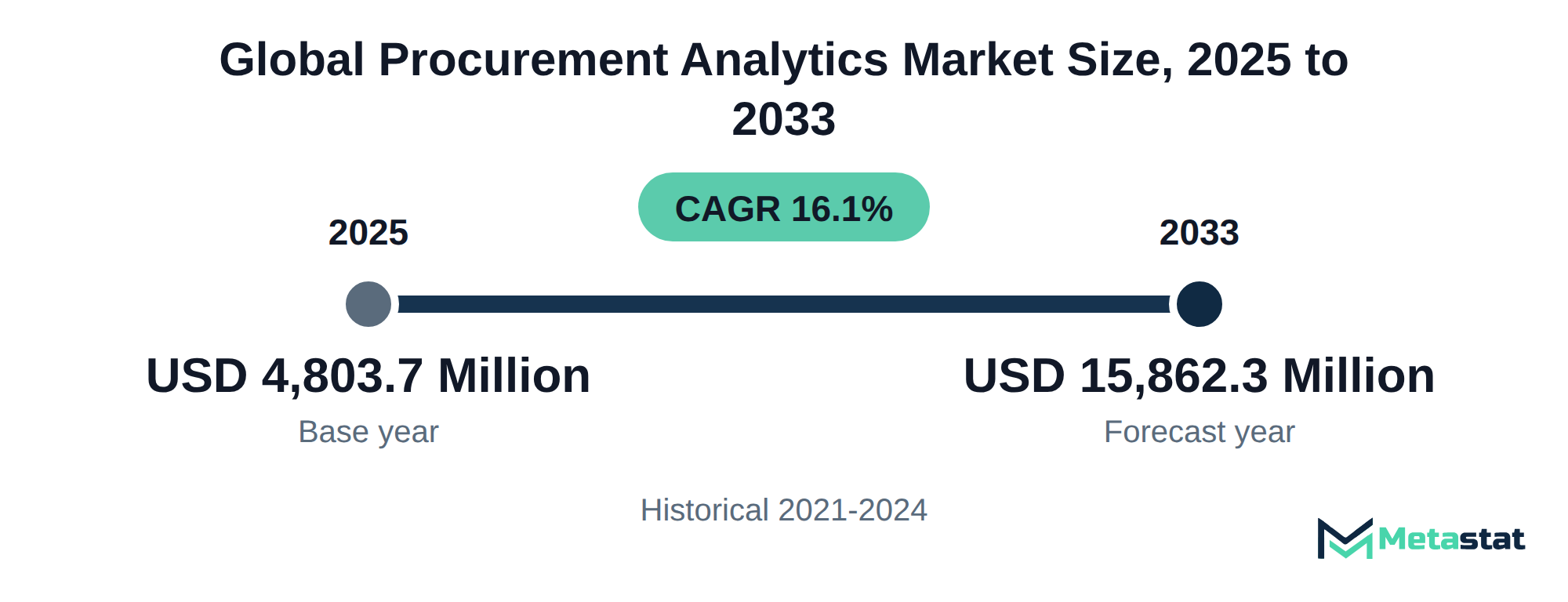
Market Valuation: Valued at $4,803.7 Million in 2025, projected to reach $15,862.3 Million by 2033 at a 16.1% CAGR.
Dominant Segment: The Cloud-Based segment leads the Procurement Analytics market, driven by increasing demand for flexible and scalable solutions that enhance procurement strategies.
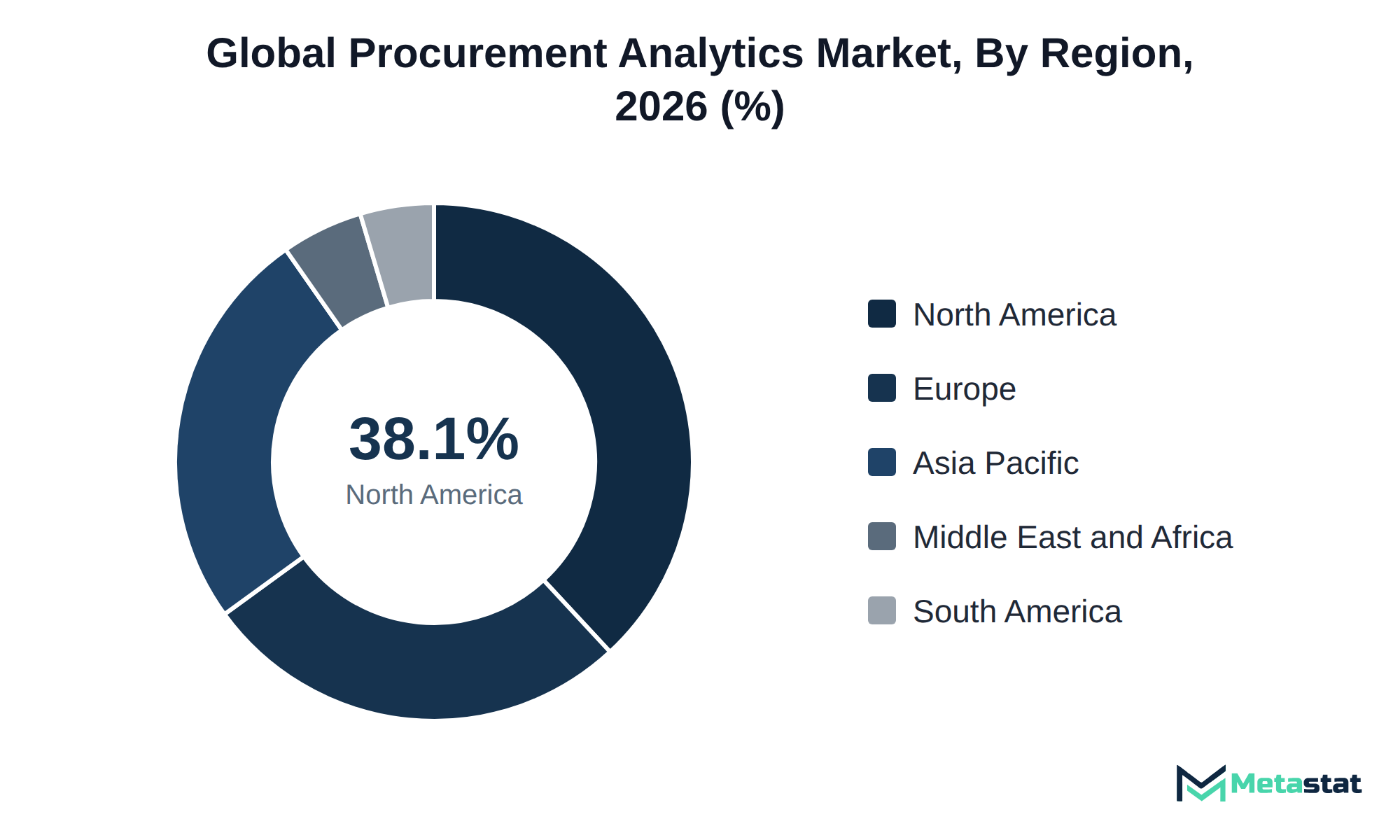
Geographic Lead: North America is the leading region, holding 38.1% of the market in 2025, with the US expected to maintain this dominance due to its strong technological infrastructure and high adoption of advanced analytics.
What's Inside: The report provides comprehensive competitive coverage, detailed analyses of various deployment models and solution types, and forecasts extending to 2033.
High Growth in Small and Medium-Sized En: Small and medium-sized enterprises are experiencing rapid growth in procurement analytics, with a CAGR of 18.2%, as they increasingly seek affordable, data-driven insights to enhance operational efficiency.
Choose Your License
Global Procurement Analytics Market
The global Procurement Analytics market was valued at USD 4,803.7 million in 2025 and is projected to reach USD 15,862.3 million by 2033, growing at a CAGR of 16.1% over the forecast period.
The Procurement Analytics market encompasses tools and solutions that enable organizations to analyze their procurement processes, optimize spending, and enhance supplier relationships. Buyers invest in these solutions to gain insights that drive cost efficiencies, improve decision-making, and enhance overall procurement strategies. The growing emphasis on data-driven decision-making among organizations fuels this investment, particularly within sectors where procurement is central to operational success.
Growth in the market is primarily driven by the increasing demand for cloud-based solutions, which offer flexibility and scalability. The Cloud-Based segment stands out, projected to reach USD 10,408.8 million by 2033. North America holds 38.1% of the market in 2025, with the US leading in 2026. This region's strong technological infrastructure and high adoption rates of advanced analytics solutions contribute to its dominant position.
The rising focus on supplier performance and risk management analytics supports market expansion. Organizations recognize the importance of maintaining robust supplier relationships and mitigating risks associated with procurement. This recognition drives further adoption of procurement analytics solutions, enhancing operational efficiencies and competitive positioning within the global market.
The Procurement Analytics market includes various solutions that assist organizations in managing their procurement strategies effectively. Investments in these solutions stem from the need for enhanced visibility into spending, improved supplier performance, and strategic decision-making capabilities. Buyers from sectors including consumer goods and retail, manufacturing, and BFSI prioritize analytics tools to optimize procurement processes and reduce operational costs.
Growth in the market is propelled by the increasing adoption of cloud-based deployment models, which provide scalability and flexibility. Among the solution types, Spend Analytics stands out, enabling organizations to track and analyze spending patterns comprehensively. North America is projected to account for 38.1% of the market in 2025, with the US expected to lead in 2026. Europe and Asia Pacific follow with market shares of 26.9% and 25.3% in 2025, contributing to overall expansion.
Investment in procurement analytics is driven by the demand for data-driven insights to enhance operational efficiency and competitive advantage. Organizations continuously seek ways to streamline procurement processes while managing risks associated with supplier performance. The market's evolution reflects a broader trend towards digitization and the increasing importance of analytics in driving business success.
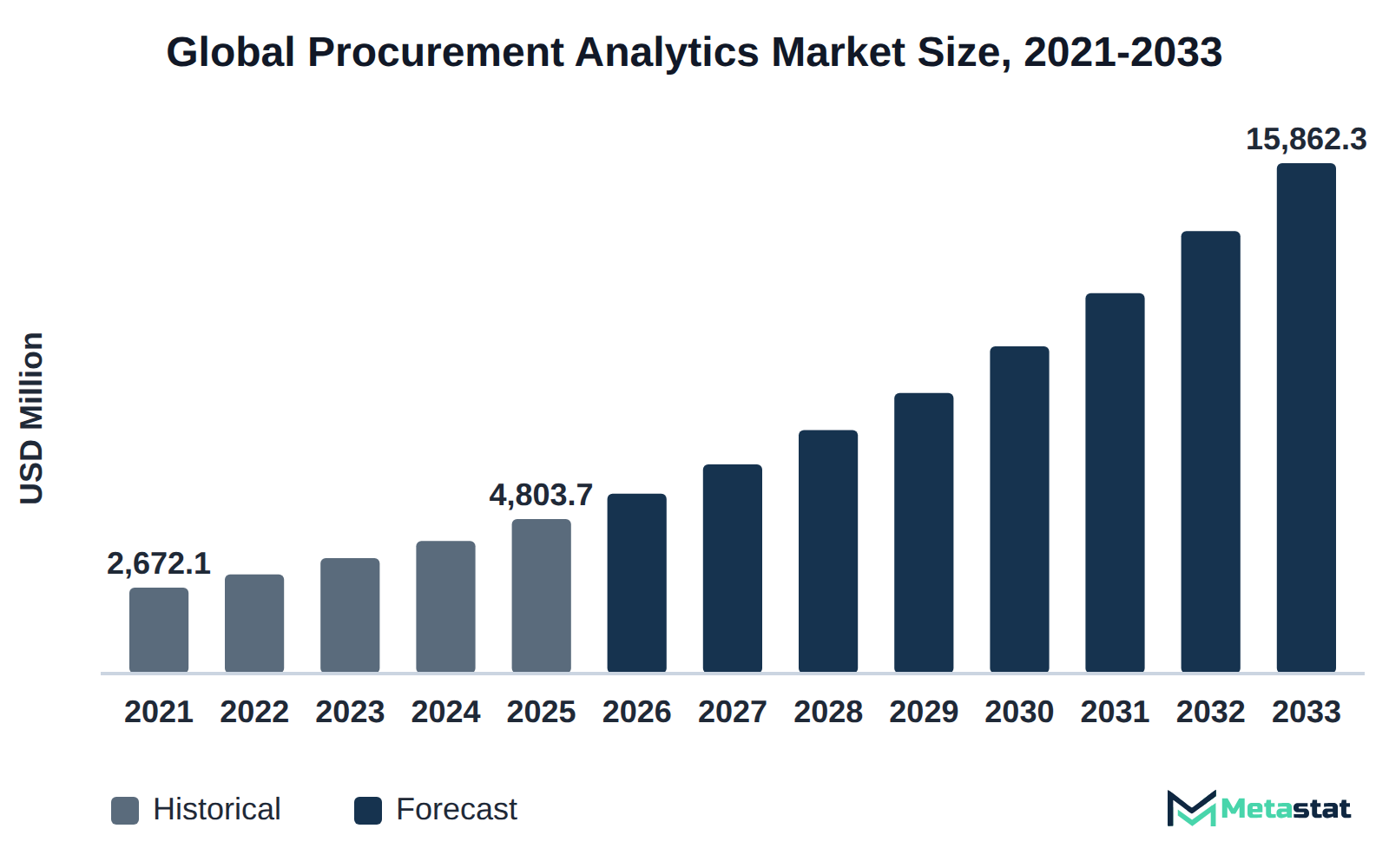
AI-driven spend visibility technology enhances procurement strategies by providing real-time insights into spending patterns and supplier performance. This shift enables organizations to accurately track expenditures, identify cost-saving opportunities, and streamline procurement processes. The Procurement Analytics market reflects this evolution, with spend analytics projected to expand from USD 1,346.8 million in 2026 to USD 3,622.9 million by 2033, indicating a compound annual growth rate of 15.2%. Such advancements allow organizations to optimize budget management and enhance supplier relationships.
By applying enterprise AI technologies, companies automate data analysis, resulting in more informed decision-making and increased operational efficiency. This capability allows procurement teams to align spending with organizational goals, ultimately driving down costs while improving service levels. Growth in AI-driven solutions points to a shift toward data-centric procurement practices, which helps organizations compete as business conditions change.
Pricing models for cloud-based procurement analytics shape how organizations engage with these solutions. Subscription-based models have gained prevalence, providing users with predictable costs and access to ongoing updates and support. This approach aligns with the increasing adoption of cloud services, where flexibility and scalability drive decision-making. In 2026, the revenue from cloud-based procurement analytics is projected to reach USD 3,544 million, reflecting a growing preference among organizations for this model.
Contract models vary, with several vendors offering tiered pricing based on usage or features. This flexibility allows buyers to tailor their investments according to specific needs and budget constraints. For instance, several small and medium-sized enterprises (SMEs) opt for basic packages that cover essential functionalities, while large enterprises often invest in comprehensive solutions that encompass advanced analytics and predictive capabilities. The projected revenue for cloud-based procurement analytics is expected to reach USD 10,408.8 million by 2033, indicating strong market growth driven by these adaptable pricing strategies.
Understanding these pricing and contract models is essential for organizations in the procurement analytics market, because they affect both budgeting and the overall value derived from the technology. By aligning purchasing decisions with strategic objectives, businesses enhance operational efficiency and improve supplier relationship management.
Integration of procurement data across global supply chains presents significant opportunities for buyers in the Procurement Analytics market, particularly for large enterprises. The complexity of supply chains often results in fragmented data, hindering effective decision-making. Large enterprises, characterized by annual revenues exceeding USD 3,758.3 million in the procurement analytics segment by 2026, face unique challenges in consolidating data from various sources. These challenges arise from managing multiple vendor relationships, regulatory requirements, and diverse operational processes. Electronic data interchange is one established method for standardizing how purchasing documents are exchanged with suppliers.
Effective procurement data integration enables large enterprises to enhance visibility and streamline operations, ultimately driving cost efficiencies and improving supplier collaboration. Cloud-based solutions are projected to grow from USD 3,544 million in 2026 to USD 10,408.8 million by 2033. This trend shows enterprises using technology to centralize procurement functions. The adoption of advanced analytics solutions will further facilitate real-time data access, enabling informed strategic decisions.
Emphasizing data integration becomes critical for large enterprises to improve agility and competitiveness in a changing market. The Procurement Analytics market gives businesses data-driven insights to manage these complexities and optimize procurement strategies.
Predictive analytics significantly enhances supplier selection and procurement decisions by enabling organizations to make data-driven choices. This approach leverages historical data and advanced algorithms to forecast supplier performance, leading to more informed procurement strategies. This growth reflects increasing adoption of analytical tools that streamline supplier evaluation processes.
Organizations employing predictive analytics benefit from improved supplier performance metrics, which allow for precise assessments of reliability and risk. This capability supports businesses in identifying high-performing suppliers while minimizing the potential for disruptions. Consequently, integrating predictive analytics into procurement strategies optimizes supplier relationships and improves overall operational efficiency. Market expansion points to strong demand for solutions that help organizations refine procurement operations and achieve better financial outcomes.
Trends show heightened interest in spend analytics among large enterprises, driven by the necessity for improved cost management and operational efficiency. Organizations seek solutions that provide comprehensive visibility into spending patterns, enabling more informed decision-making. This shift leads large enterprises specifically to prioritize data-driven insights to optimize procurement strategies, addressing the challenges posed by rising costs and complex supply chains. This strong demand indicates a transformation in procurement practices, emphasizing the importance of strategic spend analysis for competitive advantage.
Growing adoption among small and medium-sized enterprises further illustrates the trend. These organizations increasingly recognize the value of analytics in streamlining procurement processes, enhancing supplier relationships, and generating savings. The market expansion aligns with this increased emphasis on data-driven procurement, creating new opportunities for solution providers.
Enhancements in supplier collaboration and technology integration drive advancements in the Procurement Analytics market. Increased connectivity among suppliers facilitates real-time data sharing, enabling organizations to gather insights for better decision-making. The integration of advanced analytics into procurement processes allows firms to assess supplier performance and risks more comprehensively, improving strategic sourcing. Cloud-based analytics solutions support effective communication, allowing businesses to respond quickly to market changes.
This integration benefits sectors including manufacturing and consumer goods, where supply chain efficiency and supplier relationships are critical. Organizations experience improved operational efficiencies and cost savings through enhanced analytics capabilities. The growth in cloud-based solutions, driven by the demand for agile procurement strategies, results in robust market adoption. Companies embracing these technologies achieve competitive advantages by optimizing supplier management and procurement processes, contributing to the overall expansion of the market.
High pricing associated with advanced procurement analytics solutions constrains adoption among small and medium-sized enterprises. These organizations operate with limited budgets and prioritize immediate cost savings over long-term investment in analytics tools. Consequently, many delay implementing these solutions or opt for less comprehensive alternatives, resulting in slower uptake of advanced analytics capabilities.
This pricing pressure leads to reduced order sizes and lower overall spending on procurement analytics. Several market participants in the consumer goods and retail sectors hesitate to invest in comprehensive analytics solutions, impacting market growth. Larger enterprises allocate substantial budgets for procurement analytics, while smaller organizations face higher barriers to entry, affecting the market's overall expansion and innovation levels.
Limited awareness of the benefits provided by procurement analytics tools further exacerbates this issue. Organizations lacking understanding of the potential return on investment refrain from adopting these technologies, hindering market potential.
Profitability in the procurement analytics market faces challenges due to escalating pricing pressures. Suppliers encounter difficulties in maintaining margins while navigating increasing costs associated with technology, data integration, and skilled workforce requirements. These financial constraints compel suppliers to innovate pricing strategies by offering flexible subscription models and tiered pricing options that cater to different client needs. Suppliers invest in automation and process enhancements to optimize operational efficiency, reducing costs in the long run. The emphasis on demonstrating value through analytics solutions drives firms to focus on delivering tangible results that justify pricing. Increasing competition within the market necessitates differentiation through service offerings, leading suppliers to explore partnerships and collaborations to enhance their capabilities. Overall, these responses aim to sustain profitability and market share in a challenging environment.
Rapid growth in the Procurement Analytics market aligns with small and medium-sized enterprises pursuing enhanced operational efficiency and cost management strategies. This segment experiences a compound annual growth rate of 18.2% due to increasing demand for data-driven insights among these organizations. These enterprises prioritize affordability and accessibility in procurement solutions, driving innovation and competition within the market. The shift toward cloud-based models facilitates broader adoption, enabling smaller organizations to use sophisticated analytics previously available only to larger counterparts.
Changing supplier relationships and the growing emphasis on risk management contribute to this trend. Small and medium-sized enterprises increasingly focus on supplier performance analytics and risk analytics to optimize their procurement strategies. The market's focus on delivering tailored solutions for these organizations addresses their unique challenges and operational requirements, thereby driving growth in this segment. Ultimately, the expansion of procurement analytics offerings for small and medium-sized enterprises represents a significant opportunity for market participants.
The Global Procurement Analytics market is segmented based on Deployment Model, Solution Type, Organization Size, and End-Use Industry.
This segment provides organizations with scalable solutions for spend analytics, supplier performance assessment, and risk management, supporting data-driven decision making. Predominantly used by large enterprises, cloud-based solutions offer flexibility and accessibility, enhancing operational efficiency. Growth in this segment benefits from increasing demand for real-time insights and advanced analytics to optimize procurement strategies. It exhibits a faster growth rate than the On-Premises segment, which shows a CAGR of 11.9%. The ongoing shift towards digital transformation and the increasing need for integrated systems further support the expansion of this segment, making it a critical focus for organizations aiming for competitiveness in the market.
On-Premises solutions are estimated to reach USD 2,874.2 million by 2033, at a CAGR of 11.9% during the forecast period. These systems serve organizations that prioritize data security and control, opting for on-site deployment over cloud alternatives. Industries including manufacturing and healthcare adopt this segment, relying on robust data governance due to regulatory requirements. Growth in the segment is influenced by rising demand for secure data management and the desire for customized solutions tailored to specific organizational needs. Compared to cloud-based options, the on-premises segment demonstrates slower growth, reflecting higher upfront costs and maintenance requirements, appealing mainly to large enterprises that support such investments. In contrast, organizations with tighter budgets lean toward cloud-based solutions, which present lower initial costs and easier scalability.
Hybrid deployment models are projected to reach USD 2,579.2 million by 2033. This model caters to organizations requiring a blend of both cloud-based and on-premises solutions, facilitating flexibility in procurement processes. Companies in various sectors adopt hybrid models to optimize their procurement strategies, balancing the advantages of cloud technology with the control provided by on-premises installations. Demand for hybrid models is supported by increasing recognition of the need for tailored solutions that address specific business requirements. A notable driver for this segment is the growth of small and medium-sized enterprises, which exhibit a faster adoption rate, reflected by a compound annual growth rate of 18.2%. This growth rate surpasses the on-premises segment, which has a CAGR of 11.9%. Such dynamics highlight the distinct advantages hybrid solutions offer in catering to diverse organizational needs while enhancing overall procurement efficiency.
This segment facilitates the analysis of spending patterns, enabling organizations to optimize their procurement processes and improve supplier relationships. Key buyers of Spend Analytics solutions include large enterprises and small to medium-sized enterprises seeking enhanced cost management. The growing emphasis on data-driven decision-making increases demand for these solutions. Competition with other segments including Supplier Performance Analytics and Supplier Risk Analytics influences market dynamics, with Spend Analytics exhibiting faster growth compared to On-Premises solutions, which have a CAGR of 11.9%. The increasing complexity of supply chains drives the adoption of Spend Analytics, as organizations strive for improved transparency and efficiency in procurement practices.
Supplier Performance Analytics segment is estimated to reach USD 2,319.1 million by 2033, at a CAGR of 15.5% during the forecast period. This segment focuses on evaluating supplier performance metrics, essential for organizations striving to enhance procurement efficiency and supplier collaboration. Companies across various sectors, particularly in manufacturing and consumer goods, leverage this segment to monitor suppliers' adherence to contracts, quality standards, and delivery timelines. A notable driver for this segment is the increasing demand for transparent supply chains and robust supplier relationships. Compared to other segments, Supplier Performance Analytics experiences a faster growth rate due to heightened emphasis on performance measurement, with a CAGR of 15.5%, surpassing many traditional analytics solutions. This emphasis correlates with the growing need for real-time data analysis to support strategic procurement decisions, ensuring organizations maintain a competitive edge in the evolving market.
Supplier Risk Analytics segment is expected to reach USD 1,962.2 million by 2033. This analytics solution assists organizations in identifying, assessing, and mitigating risks associated with suppliers. Companies across various industries adopt this segment to enhance decision-making related to supplier selection and management, thereby improving operational resilience. Key drivers for this segment include increasing regulatory scrutiny and the growing emphasis on risk management strategies within enterprise governance, risk and compliance programs. Unlike other segments, Supplier Risk Analytics experiences significant growth, with a CAGR of 15.5%, reflecting heightened awareness of supplier vulnerabilities. This growth trajectory sets it apart from Spend Analytics, which demonstrates a slightly lower growth rate of 15.2%. The market's focus on risk mitigation aligns with broader trends in supply chain management, where understanding supplier risk has become critical for maintaining competitiveness.
Sourcing Analytics is projected to grow at a CAGR of 15.1% during the forecast period. This segment focuses on analyzing sourcing data to identify and evaluate potential suppliers, optimize procurement strategies, and enhance cost efficiency. Typically used by procurement and supply chain professionals in various industries, Sourcing Analytics aids in making informed decisions regarding supplier selection and contract negotiations. Demand for this segment is driven by the increasing need for organizations to streamline sourcing processes and achieve better supplier relationships. Compared to other solution types, Sourcing Analytics experiences slightly slower growth than Supplier Performance Analytics, which has a CAGR of 15.5%. Its emphasis on cost optimization and strategic sourcing positions it as a vital tool for organizations aiming to enhance procurement capabilities. The growth of the segment aligns with the increasing adoption of data-driven decision-making in the market.
Contract Analytics involves the evaluation and management of contracts across an organization’s procurement activities. This segment is essential for organizations aiming to enhance compliance, mitigate risks, and ensure contract performance. Typically used by procurement professionals and legal teams, Contract Analytics facilitates informed decision-making and strategic planning. Demand for this segment is driven by the increasing need for organizations to streamline contract lifecycle management and enhance visibility into contractual obligations. Compared to other segments, including Spend Analytics, which experiences a CAGR of 15.2%, Contract Analytics operates within a more niche area, resulting in slower growth. This segment captures attention due to its focus on risk management, compliance, and efficiency, making it relevant across various industries seeking to optimize procurement processes.
Procure-to-Pay Analytics streamlines the procurement process by integrating purchasing and payment functions in a cohesive platform. This solution is predominantly used by large enterprises and organizations seeking to enhance efficiency in their financial operations. Demand for Procure-to-Pay Analytics is shaped by the growing emphasis on automating procurement processes to achieve greater transparency and control over spending. This segment shows a different growth trajectory compared to others; while other solution types exhibit higher market valuations, Procure-to-Pay Analytics focuses on integrating purchasing with payment systems, which supports a strong return on investment for organizations. Businesses confront the complexities of managing supplier relationships and payment processes, and the adoption of this analytical approach continues to expand, reinforcing its role in the Procurement Analytics market. Accounts payable automation addresses the payment stage of the same procure-to-pay workflow.
Savings and Cost Analytics focuses on evaluating and optimizing procurement expenditures to enhance financial performance. Organizations apply this segment to identify potential savings, track spending patterns, and improve overall cost efficiency. Large enterprises adopt this solution to gain insights into their procurement practices, facilitating data-driven decision-making. Key drivers for this segment include the increasing emphasis on cost reduction and the ongoing digital transformation within procurement processes. Compared to other segments, including Spend Analytics, Savings and Cost Analytics experiences slower growth; however, it serves a critical role in financial oversight and strategic planning. By enabling organizations to pinpoint inefficiencies and capture savings opportunities, this segment significantly contributes to the goals of the Procurement Analytics market, supporting enhanced profitability and sustainability.
The large enterprise procurement analytics segment is valued at USD 3,758.3 million in 2026 and is projected to reach USD 9,967.9 million by 2033, at a CAGR of 15% during the forecast period. Organizations in this segment apply procurement analytics to optimize spending, evaluate supplier performance, and mitigate risks associated with their supply chains. Increasing emphasis on strategic sourcing and the necessity for data-driven decision-making drive market demand. Large enterprises, equipped with extensive resources and complex supply chains, typically invest in advanced analytics solutions. This segment exhibits a higher growth rate compared to smaller organizations, driven by a growing recognition of the strategic value of procurement analytics. The anticipated CAGR of 15% reflects a robust commitment to leveraging analytics for operational efficiency and cost management, differentiating this segment from small and medium-sized enterprises with more limited adoption rates. The Procurement Analytics market continues to evolve as organizations recognize the critical role analytics plays in enhancing procurement strategies.
The small and medium-sized enterprise procurement analytics segment is estimated to reach USD 5,894.4 million by 2033, at a CAGR of 18.2% during the forecast period. This segment enables smaller organizations to leverage procurement analytics for enhancing operational efficiency and cost management. Increased competition in the market drives small and medium-sized enterprises to adopt these solutions for better decision-making and resource allocation. Unlike larger enterprises, which rely more heavily on comprehensive analytics solutions, small and medium-sized enterprises prioritize cost-effective options tailored to their specific needs. The segment's expected growth surpasses other organizational sizes, indicating strong demand for accessible procurement analytics solutions tailored to the unique challenges faced by smaller firms. Focus on affordability and scalability influences purchasing decisions in this segment, leading to a dynamic environment for innovative solutions in the Procurement Analytics market.
Consumer Goods and Retail segment is valued at USD 1,015.1 million in 2026 and is projected to reach USD 2,736.2 million by 2033, at a CAGR of 15.2% during the forecast period. This segment serves retailers and manufacturers focused on optimizing supply chain efficiency, including retail sourcing and procurement, and enhancing customer satisfaction. Rising demand for data-driven insights influences the growth of this segment, reflecting the broader trend of digital transformation in retail. Compared to other segments, Consumer Goods and Retail demonstrates significant growth potential, driven by advancements in predictive analytics and consumer behavior analysis. This segment’s CAGR surpasses that of Supplier Performance Analytics, which stands at 15.5%, highlighting its competitive positioning within the market. Ongoing emphasis on inventory management and demand forecasting continues to drive adoption among organizations aiming to streamline operations and maximize profitability.
Manufacturing segment is estimated to reach USD 2,641.1 million by 2033, at a CAGR of 16.4% during the forecast period. This segment serves industries focused on optimizing their procurement processes, enhancing supply chain efficiency, and minimizing costs. Key players in manufacturing leverage procurement analytics to gain insights into supplier performance, assess risks, and improve sourcing strategies. Rapid technological advancements, including the adoption of cloud-based solutions, drive growth in this segment. Compared to other segments, manufacturing shows significant growth due to increasing demand for efficient resource allocation and cost control strategies. The sector's unique challenges, including fluctuating raw material prices and supply chain disruptions, increase the need for effective procurement analytics tools, supporting its expansion in the market.
BFSI segment is expected to reach USD 2,006.6 million by 2033. This segment involves financial services, including banking, insurance, and investment firms, using procurement analytics to enhance operational efficiency, mitigate risks, and improve supplier relationships. Growth in this segment is largely driven by the increasing importance of data-driven decision-making among financial institutions, which rely on analytics to optimize spending and manage supplier performance effectively. Compared to other segments, the BFSI segment anticipates steady growth at a CAGR of 16.4%, indicating robust demand for analytics solutions. Heightened regulatory requirements and an emphasis on risk management prompt financial organizations to invest in advanced analytics tools to navigate complex procurement challenges, positioning this segment for significant expansion in the market.
The Healthcare and Life Sciences segment is projected to grow at a CAGR of 18.1% during the forecast period. This segment plays a critical role in managing procurement processes for healthcare providers, pharmaceutical companies, and life sciences organizations, focusing on optimizing supplier relationships and ensuring compliance with regulatory standards. Key driving forces include the increasing emphasis on cost control and data-driven decision-making, pushing organizations to adopt advanced analytics for improved procurement strategies in healthcare supply chain management. Compared to other segments, this segment demonstrates faster growth, leveraging technology to enhance operational efficiency and mitigate risks associated with supplier performance and regulatory compliance. With a projected value of USD 2,006.6 million by 2033, the segment reflects strong demand for tailored analytics solutions, positioning it favorably within the broader market landscape.
Telecommunications companies leverage procurement analytics to optimize purchasing decisions, enhance supplier relationships, and manage costs effectively. This segment primarily serves large-scale enterprises and telecommunications providers, who rely on data-driven insights to streamline procurement processes. The growing demand for advanced analytics tools in this space is driven by the increasing complexity of supply chains and the necessity for real-time data analysis. In contrast to other segments, this area experiences distinct challenges due to rapid technological advancements and regulatory requirements impacting costs. The market reflects a shift toward greater adoption of innovative solutions, emphasizing the importance of analytics in maintaining competitive advantage. The emphasis on digital transformation and operational efficiency further drives investment in procurement analytics, particularly among organizations prioritizing data-driven decision-making.
Energy and Utilities plays a critical role in managing and optimizing the procurement processes for organizations involved in energy production, distribution, and consumption. This segment supports businesses in enhancing operational efficiencies and reducing costs through data-driven insights. Companies in this sector face unique challenges, including fluctuating energy prices and regulatory compliance, which drive demand for advanced procurement analytics solutions. The focus on sustainability and renewable energy initiatives further drives the adoption of these technologies, differentiating this segment from other industries with potentially slower growth rates. The need for robust analytics tools becomes evident, enabling firms to make informed decisions that align with strategic objectives, contributing to overall market growth. Increasing investment in technology solutions tailored for the energy and utilities sector indicates a commitment to embracing innovative practices in procurement analytics.
Transportation and Logistics plays an essential role in managing the flow of goods and services between various points of the supply chain. Companies operating in this segment apply procurement analytics to enhance operational efficiency, optimize route planning, and manage supplier relationships effectively. The segment experiences growth driven by increasing global trade and the need for efficient supply chain management. Companies in this sector face challenges related to fluctuating fuel prices and regulatory compliance, which impact operational costs. Compared to other segments, Transportation and Logistics experiences slower growth due to heightened competition and the complexity of integrating advanced analytics into existing systems. Overall, the growth of procurement analytics in this segment supports improved decision-making, reduced operational costs, and enhanced service delivery.
The Public Sector segment focuses on governmental agencies and public institutions that enhance operational efficiency, transparency, and accountability in their procurement processes through procurement analytics. This segment prioritizes compliance with regulations and effective resource allocation to optimize public spending. Growing emphasis on data-driven decision-making within government bodies drives demand for procurement analytics solutions tailored to meet specific public sector needs. Unlike other segments, including Consumer Goods and Retail, which emphasize consumer trends, the Public Sector segment experiences slower growth due to budget constraints and complex regulatory frameworks. However, increasing adoption of digital technologies and a focus on enhancing public service delivery create opportunities for investment in advanced procurement analytics solutions. The Procurement Analytics market reflects a trend towards enhancing transparency and efficiency in government operations.
This sub-segment includes industries including hospitality, education, media, and entertainment. Organizations within these sectors leverage procurement analytics to streamline their purchasing processes, optimize supplier relationships, and enhance overall operational efficiency. Demand for procurement analytics in this sub-segment is driven by the increasing complexity of supply chains and the necessity for cost management in competitive environments. Unlike other segments, which focus on larger scale industrial applications, this sub-segment prioritizes agility and adaptability due to the diverse needs of its buyer base. Industries in this category face unique challenges in data integration and regulatory compliance, influencing adoption rates. This focus on specialized requirements differentiates it from other segments in the market that experience more uniform growth trends. The market continues to innovate in response to these dynamics, facilitating better decision-making across various operational tiers.
Based on geography, the Global Procurement Analytics market is divided into North America, Europe, Asia-Pacific, South America, Middle East, and Africa.
North America stands out in the Procurement Analytics market, driven by a high concentration of large enterprises in industries including consumer goods, manufacturing, and healthcare. The need for enhanced visibility and control over procurement processes fuels adoption among organizations seeking to optimize costs and improve supplier relationships. Specific regulations related to compliance and risk management in sectors like BFSI contribute to the demand for robust analytics solutions. By 2033, North America is projected to reach USD 5,696.1 million, reflecting a share of the global market at 38.1% in 2025. The advanced technological infrastructure in countries like the United States, Canada, and Mexico supports the integration of cloud-based analytics platforms, enabling organizations to utilize real-time data for strategic decision-making.
Demand for procurement analytics in Europe relies heavily on industries including manufacturing and consumer goods. Countries like Germany and France demonstrate significant investment in technology to enhance operational efficiency. The growing emphasis on data-driven decision-making drives businesses to adopt advanced analytics solutions. In 2025, Europe accounts for 26.9% of the global market share, with a projected increase in adoption through 2033. Regulatory frameworks promoting transparency and accountability in procurement processes further influence market dynamics. This environment supports growth for the procurement analytics market, allowing organizations to leverage insights for strategic sourcing and supplier management.
Strong demand for the Procurement Analytics market in Asia-Pacific stems from the increasing emphasis on data-driven decision-making across various industries. Countries including China, India, and Japan exhibit significant investment in enhancing procurement practices, driven by the growing complexity of supply chains and a focus on cost reduction. The region's rapid digital transformation, particularly in sectors including manufacturing and consumer goods, contributes to the expanding adoption of analytics solutions. Infrastructure improvements in technology and connectivity facilitate access to advanced procurement analytics tools, allowing organizations to optimize their procurement strategies. By 2025, the market share in Asia-Pacific is projected to reach 25.3%, reflecting the region's integral role in the global procurement analytics landscape.
In South America, the Procurement Analytics market is projected to experience steady growth, driven primarily by increasing demand from industries including consumer goods and retail. Brazil and Argentina stand out as significant contributors to market expansion, with organizations in these countries focusing on optimizing procurement processes to enhance efficiency and reduce costs. The market share in South America is expected to reach 4.6% by 2025, reflecting the growing recognition of the value of data-driven insights. Organizations in this region are beginning to invest in cloud-based solutions, which enable greater flexibility and scalability in procurement operations. The market benefits from a favorable regulatory environment that encourages the adoption of advanced analytics, positioning South America for enhanced competitiveness in the global landscape.
Emerging economies within the Middle East and Africa show a growing interest in analytics solutions to enhance procurement strategies across various sectors. Countries like Saudi Arabia and the UAE drive demand through substantial investments in technology and efforts to improve supply chain efficiency. The market benefits from a push towards digital transformation initiatives that enhance decision-making capabilities and operational performance.
This region holds a share of 5.1% of the global market in 2025. South Africa contributes to this growth by integrating procurement analytics within its key industries, including manufacturing and retail. The focus on data-driven insights facilitates better supplier management and risk assessment, which are vital for navigating market uncertainties. The Procurement Analytics market is anticipated to experience steady growth within this region, supported by these strategic developments and local market conditions.
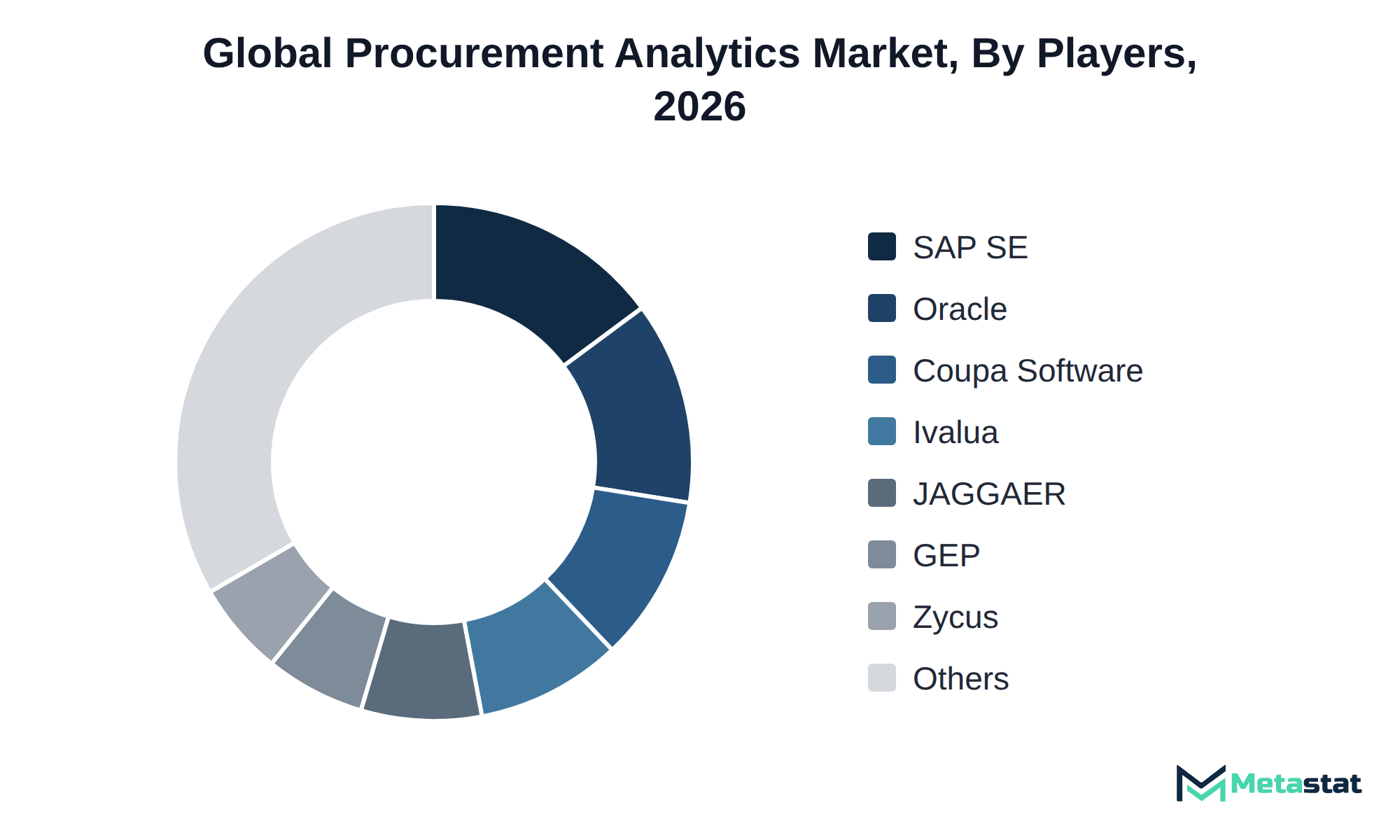
The Procurement Analytics market features a diverse set of companies competing across various dimensions. Key players include SAP SE, Coupa Software Inc., Oracle Corporation, and Ivalua Inc., which emphasize cloud-based solutions to streamline procurement processes. This market consists of both cloud-based and on-premises deployment models, catering to the distinct preferences of buyers regarding implementation and management.
Buyers prioritize factors including pricing, customization, service quality, and integration within existing ecosystems. For instance, JAGGAER focuses on providing tailored solutions for specific industries, enhancing the user experience through customizable features. Zycus Inc. emphasizes supplier performance analytics, which helps organizations manage vendor relationships effectively. In contrast, GEP concentrates on delivering comprehensive spend visibility and optimization solutions, assisting buyers in making informed procurement decisions. This competitive environment drives innovation and facilitates growth, aligning with evolving demands in the procurement analytics sector.
Procurement Analytics market growth to USD 15,862.3 million by 2033 relies on several key developments. First, the adoption of cloud-based deployment models is expected to drive substantial growth, particularly within large enterprises that require agile solutions for data management. The cloud-based segment is projected to expand at a CAGR of 16.6%, reflecting the increasing preference for scalability and cost-effectiveness. Second, the rise in demand for spend analytics will further support the Procurement Analytics market. This segment anticipates a transition from USD 1,346.8 million in 2026 to USD 3,622.9 million by 2033, driven by organizations seeking enhanced insights into their procurement activities. However, the market faces risks related to economic fluctuations and budget constraints, which could hinder investment in advanced analytics solutions. Regions including North America, contributing 38.1% of the market share, will play an important role in the growth trajectory. Balancing these factors will determine whether the market reaches its forecasted potential.
By Deployment Model: Cloud-Based, On-Premises, Hybrid
By Solution Type: Spend Analytics, Supplier Performance Analytics, Supplier Risk Analytics, Sourcing Analytics, Contract Analytics, Procure-to-Pay Analytics, Savings and Cost Analytics
By Organization Size: Large Enterprises, Small and Medium-Sized Enterprises
By End-Use Industry: Consumer Goods and Retail, Manufacturing, BFSI, Healthcare and Life Sciences, IT and Telecommunications, Energy and Utilities, Transportation and Logistics, Public Sector, Others (Hospitality, Education, Media and Entertainment)
The report strategically identifies and profiles the key market players and analyses their core competencies in each sub-segment of the Procurement Analytics market.
Report Attributes | Details |
Study Period | 2021-2033 |
Base Year | 2025 |
Estimated Year | 2026 |
Forecast Period | 2026-2033 |
Historical Period | 2021-2025 |
Growth Rate | CAGR 16.1% from 2026 to 2033 |
Revenue Unit | USD million |
Segmentation | By Deployment Model, Solution Type, Organization Size, End-Use Industry, and Region |
By Region | North America (By Deployment Model, Solution Type, Organization Size, End-Use Industry, and Country)
|
Europe (By Deployment Model, Solution Type, Organization Size, End-Use Industry, and Country)
| |
Asia Pacific (By Deployment Model, Solution Type, Organization Size, End-Use Industry, and Country)
| |
South America (By Deployment Model, Solution Type, Organization Size, End-Use Industry, and Country)
| |
Middle East and Africa (By Deployment Model, Solution Type, Organization Size, End-Use Industry, and Country)
|
Find answers to common questions about this report
The Procurement Analytics market size was valued at USD 4,803.7 million in 2025.
The market is projected to grow at a CAGR of 16.1% during the forecast period from 2026 to 2033.
The North America Procurement Analytics market size is estimated to reach USD 5,696.1 million by 2033.
The leading segment in the Procurement Analytics market is Cloud-Based deployment, projected to reach USD 10,408.8 million by 2033. This segment outpaces others in growth, driven by a compound annual growth rate of 16.6%.
Heightened interest in spend analytics among large enterprises drives demand for improved cost management and operational efficiency. Growing adoption among small and medium-sized enterprises reflects the increasing recognition of analytics value in streamlining procurement processes and enhancing supplier relationships.
North America holds the dominant share of the Procurement Analytics market, with a value of USD 5,696.1 million projected for 2033, representing 38.1 percent of the total market.
High pricing associated with advanced procurement analytics solutions constrains adoption among small and medium-sized enterprises. These organizations often operate with limited budgets and prioritize immediate cost savings over long-term investment in analytics tools, resulting in slower uptake of advanced analytics capabilities.
Several factors favor adoption in the procurement analytics industry. The increasing emphasis on data-driven insights among small and medium-sized enterprises drives demand for tailored solutions. the shift toward cloud-based models enhances accessibility, enabling these organizations to leverage advanced analytics previously available only to larger firms.
The Procurement Analytics market is estimated to reach a valuation of USD 15,862.3 million by 2033.
Key players operating in the Procurement Analytics market include SAP SE, Coupa Software Inc., Oracle Corporation, Ivalua Inc., JAGGAER, and Zycus Inc.
The analysts below cover Information & Technology research at Metastat Insights.
LEAD ANALYST
Utkarsh Khirodkar is a Lead Market Research Analyst at MetaStat Insight, specializing in market intelligence, technology sector assessments, and competitive strategy.

PRINCIPAL CONSULTANT - ENTERPRISE AI & EMERGING TECHNOLOGIES
Banking & Finance · Electronics and Semiconductor · Energy and Power · Healthcare IT · Information & Technology · Professional Services
Vijay Gunti is a Principal Consultant at MetaStat Insight, bringing over two decades of experience across enterprise digital transformation, technology strategy, and intelligent systems.

LEAD CONSULTANT - COMMUNICATION, TELECOM, AND IT
Electronics and Semiconductor · Information & Technology · Machinery & Equipment · Professional Services
Ravindra Sathe Consultants for Communication, Telecom, and IT at MetaStat Insight. He leads the firm's industry research initiatives across telecommunications infrastructure, digital connectivity, enterprise networking, and emerging information technology domains.
Scaling antibody-drug conjugate manufacturing hinges on contract manufacturing availability for high-potency active ingredients. The MetaStat Insight analysis looked closely at global cleanroom slot constraints, bioconjugation batch failure rates, and supply chain redundancies between the US, Europe, and India. The supplier capability matrix proved genuinely useful for our team when mapping secondary source options across our clinical pipeline.
Floating offshore wind feasibility relies heavily on specialized installation vessel availability and port crane limits, which most broad renewable energy forecasts ignore. The report delivered a thorough analysis of dry dock capacity, mooring chain supply constraints, and raw material pricing trends for deepwater anchor installations. It served as a solid independent sanity check for our offshore project capital expenditure assumptions.
Assessing commercial microgrid software adoption requires looking past top-level installation numbers and examining utility interconnection queues. The research provided verifiable data on average permitting timelines, tariff structures, and battery storage integration costs across regional utility territories. That grounded perspective was valuable for our team when building five-year demand projections for industrial microgrid controllers.
Explore related market intelligence reports worth reading alongside this one.