
LEAD ANALYST
Utkarsh Khirodkar is a Lead Market Research Analyst at MetaStat Insight, specializing in market intelligence, technology sector assessments, and competitive strategy.

Global Enterprise Artificial Intelligence Market Size, Share, By Deployment Model (Cloud, On-Premises and Hybrid), By Technology (Machine Learning and Predictive AI, Generative AI, Natural Language Processing, Computer Vision and Others (Agentic AI, Intelligent Automation)), By Application (Enterprise Decision Support & Analytics, Customer Service & Support, Sales & Marketing, Finance & Accounting, IT & Cybersecurity Operations, Human Resources & Workforce Management, Supply Chain & Procurement, Operations & Manufacturing, Research & Product Development and Others (Legal, Risk & Compliance)), By End-Use Industry (BFSI, IT & Telecommunications, Healthcare & Life Sciences, Retail & Consumer Goods, Manufacturing, Automotive & Transportation, Energy & Utilities, Government & Defense, Media & Entertainment and Others (Education, Professional Services, Travel & Hospitality)), Industry Analysis, Growth, Trends, and Forecast, 2026-2033
Report ID
MSI-5438
Published
October, 2026
Pages
299 Pages
Format
Historical
Base year
Forecast
Forecast period
Report Details
Market Valuation: Valued at $32.9 Billion in 2025, projected to reach $423.4 Billion by 2033 at a 37.6% CAGR.
Dominant Segment: Enterprise Decision Support & Analytics is the leading application segment, driven by organizations' demand for data-driven insights that streamline planning, forecasting, and execution.
Fastest-Growing Technology: Generative AI is the fastest-growing technology segment, forecast to reach USD 135.1 billion by 2033, as enterprises accelerate adoption for content creation, automation, and knowledge management.
Deployment Model Shift: Cloud deployment is expanding rapidly, projected to reach USD 241 billion by 2033, as enterprises favor scalable, subscription-based access to AI capabilities over traditional on-premises solutions.
Geographic Lead: North America holds 38.0% of the market in 2025, with the US leading due to mature digital infrastructure and early enterprise adoption of AI-driven solutions.
What's Inside: The report provides detailed segmentation by deployment model, technology, application, and end-use industry, with competitive analysis, market dynamics, and forecasts through 2033.
Choose Your License
Global Enterprise Artificial Intelligence Market
The global Enterprise Artificial Intelligence market was valued at USD 32.9 billion in 2025 and is projected to reach USD 423.4 billion by 2033, growing at a CAGR of 37.6% over the forecast period.
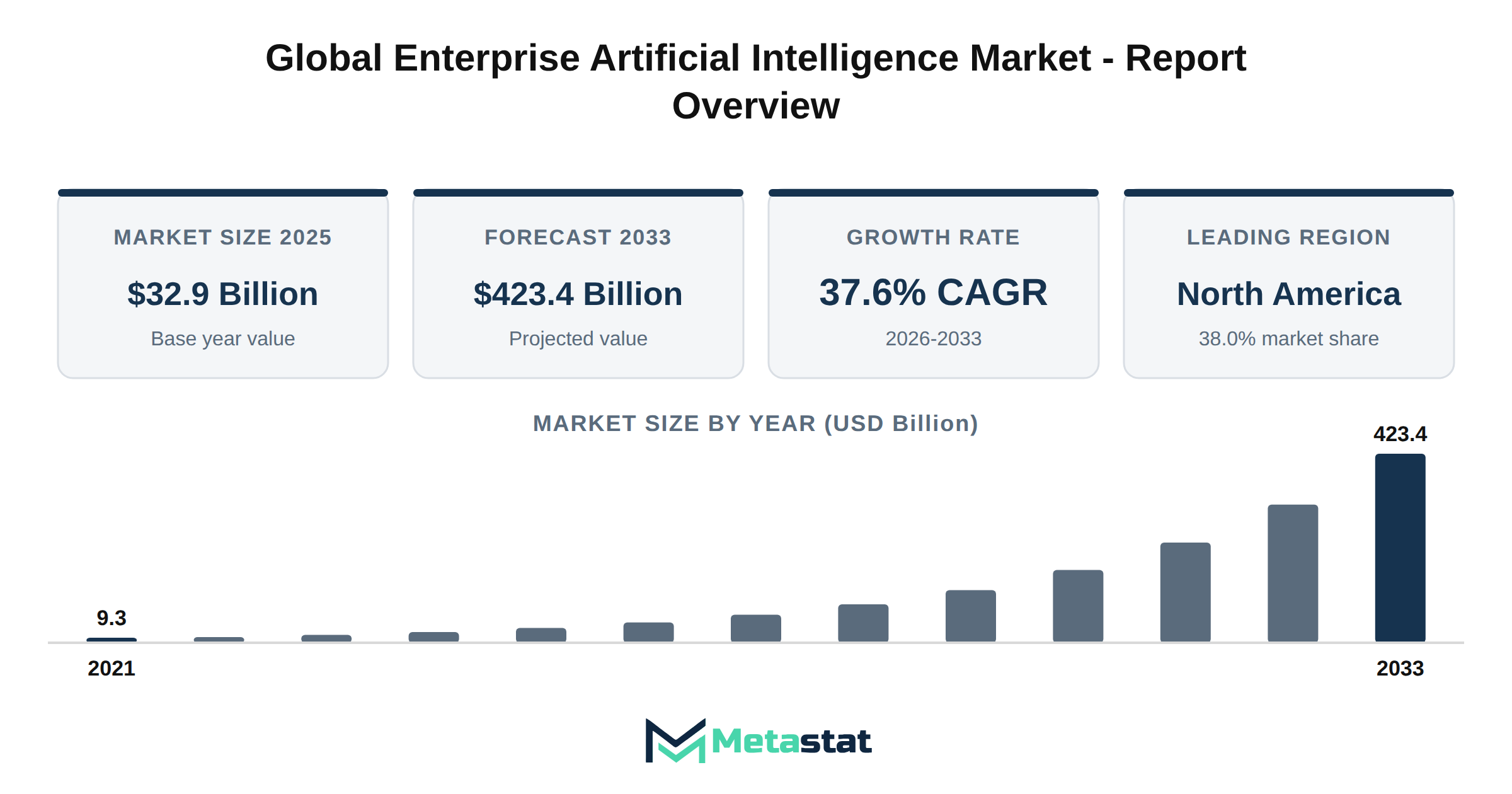
The Enterprise Artificial Intelligence market covers software and platforms that automate and optimize business operations, decision-making, and customer engagement for large organizations. Buyers include financial institutions, technology and telecom enterprises, and healthcare providers who seek to improve efficiency, reduce operational costs, and enable data-driven strategies. Adoption shifted from early experimentation to mainstream deployment when organizations prioritized intelligent automation and advanced analytics to remain competitive.
Expansion is propelled by the ability of enterprise AI to deliver measurable performance gains, particularly in areas including decision support, customer service, and predictive analytics. Enterprise Decision Support & Analytics is the largest application segment by value, reflecting strong investment from organizations seeking insights from vast and complex data alongside broader advancements in big data analytics. North America holds 38.0% of the market in 2025. The US leads in 2026, a position supported by mature digital infrastructure and early enterprise adoption of AI-driven solutions.
Growth is driven primarily by the rapid integration of generative AI and machine learning in core business functions. Enterprises increasingly deploy these technologies to streamline workflows and personalize customer interactions, mirroring adoption patterns observed across generative AI in marketing. Demand and spend have increased significantly. The market benefits from a robust supplier ecosystem, including Microsoft Corporation, International Business Machines Corporation, Amazon Web Services, Inc., Google LLC, NVIDIA Corporation, and Salesforce, Inc., who focus on scalable, secure, and industry-specific AI offerings.
For enterprise buyers, investment in artificial intelligence addresses the demand for scalable solutions that increase efficiency, accuracy, and responsiveness. Decision support and analytics lead demand, reflecting organizations’ push for data-driven insights that streamline planning and execution. Buyers allocate budgets to platforms that automate complex workflows and enhance customer interactions. They seek measurable returns in productivity and competitive differentiation. The market covers a spectrum of technologies, from machine learning and generative AI to natural language processing, each serving distinct operational priorities and risk profiles.
Among all application segments, enterprise decision support and analytics generate the highest value, indicating organizations’ focus on intelligence that delivers business impact over routine automation. North America holds 38.0% of the market in 2025, with the US leading in 2026. This regional concentration reflects the maturity of digital infrastructure and the appetite for advanced analytics among large enterprises in the US and Canada. Buyers in these markets drive adoption through demand for customized, integrated solutions that align with compliance and security requirements.
Growth in the market stems primarily from the expanding role of generative AI technologies that extend automation into creative, adaptive, and conversational tasks. Enterprises prioritize innovation and speed to market, so investment in these advanced capabilities accelerates, directly impacting both deployment scale and overall spend. The market’s trajectory reflects an ongoing shift from basic process automation to intelligent, context-aware systems that support strategic decision-making and growth.
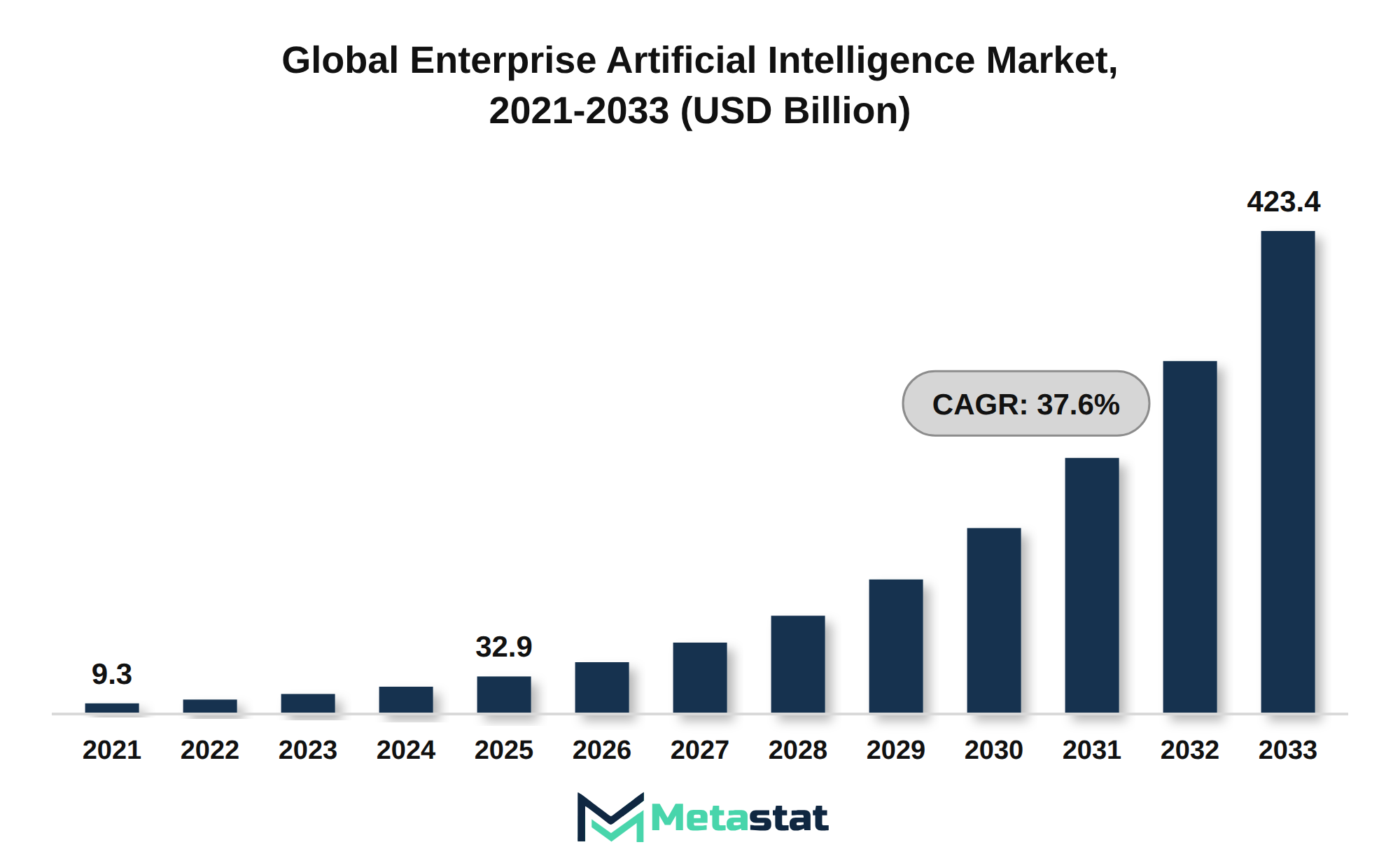
Enterprise AI agents are becoming a central factor in transforming workflow automation and decision intelligence within enterprises. These agents function as orchestrators that independently execute tasks, interpret unstructured data, and communicate with both human employees and digital systems. The shift toward agentic AI is visible in the rapid commercial traction of Generative AI, which is projected to reach USD 135.1 billion in the technology segment by 2033. Enterprises in sectors including banking, retail, and healthcare are now deploying AI agents to streamline repetitive processes, respond to customer inquiries, and synthesize insights from vast data sources.
Adoption of advanced AI agents drives a new phase in enterprise operations, where automated workflows are no longer limited to rule-based actions but involve adaptive decision-making and multimodal data interpretation. AI agents integrate with enterprise resource planning, dedicated business continuity management software, and supply chain platforms to automate approvals, support compliance, and recommend business strategies. These automated workflows frequently support broader operational resilience programs coordinated through business continuity management software. This expansion of capability addresses the complexity and velocity of modern enterprise demands, reducing cycle times and freeing skilled staff for higher-value tasks. Demand for these agent-based solutions is increasing, resulting in investment from both technology suppliers and buyers seeking competitive differentiation through operational agility and faster decision cycles. AI agent integration is expected to drive higher contract values for providers and establish new performance benchmarks across the market.
Purchasing models for generative AI in the Enterprise Artificial Intelligence market are shifting rapidly while organizations in customer service, finance, and enterprise operations seek scalable and flexible access to advanced capabilities. Buyers in these sectors increasingly favor subscription-based cloud offerings, which enable them to ramp up or scale down usage based on project demands and operational cycles. The appeal of cloud deployment is clear in the market, with the cloud segment projected to reach USD 241 billion by 2033, reflecting a compound annual growth rate of 38.8 percent. This model reduces upfront capital expenditure and aligns ongoing costs with actual consumption, which is especially attractive to enterprises managing fluctuating workloads or experimenting with new AI-driven use cases.
Contract terms for generative AI software in the Enterprise Artificial Intelligence market are evolving to support pilot projects, tiered pricing structures, and usage-based billing. In customer service, organizations often enter short-term agreements to evaluate the impact of generative AI on call deflection rates and automated query resolution through AI-powered contact center analytics, minimizing long-term financial risk while building an internal business case. Financial institutions pursue granular, modular licenses that allow integration into multiple workflows, including fraud detection and prevention or compliance, without locking in to a single-vendor suite. Across enterprise operations, buyers negotiate for integration support and regular model updates, leveraging competition among solution providers to secure favorable terms. The shift toward flexible contracts and modular deployment expands commercial flexibility, lowers the barrier to entry for mid-sized enterprises, and accelerates experimentation with generative AI at scale.
Security-sensitive organizations in sectors including BFSI and healthcare are prioritizing hybrid AI deployment strategies to manage compliance and data sovereignty requirements without compromising operational innovation. These buyers frequently face heightened regulatory scrutiny, particularly when handling sensitive customer or patient data, driving adoption of hybrid models that balance on-premises control with the scalability of cloud resources. In the Enterprise Artificial Intelligence market, the hybrid deployment segment is forecast to reach USD 111.6 billion by 2033, reflecting sustained demand among organizations that require both advanced analytics and tight data governance.
Governance frameworks for hybrid AI deployments emphasize auditability, location-specific data processing, and robust access controls. For security-sensitive buyers, hybrid architectures support use cases that keep certain data within national borders while leveraging cloud-driven AI workloads for less sensitive operations. This duality addresses operational constraints that pure cloud or on-premises models cannot fully resolve. Solution providers in the Enterprise Artificial Intelligence market are expanding offerings tailored to hybrid environments, supporting integration of legacy systems with AI-driven applications in a secure and compliant manner. The commercial consequence is an acceleration of hybrid-specific tooling and professional services, with vendors differentiating on compliance capabilities and integration flexibility to capture a larger share of high-value, risk-averse enterprise clients.
Enterprise Artificial Intelligence is driving measurable changes in business operations and workforce productivity by automating decision support and analytics. Within the Enterprise Artificial Intelligence market, the Enterprise Decision Support & Analytics application segment is projected to increase from USD 8.1 billion in 2026 to USD 76.7 billion in 2033. This rapid growth reflects the shift among enterprises toward data-driven processes, where AI-powered analytics streamline complex decision-making, reduce manual intervention, and eliminate operational bottlenecks. In sectors including BFSI, IT & Telecommunications, and Healthcare & Life Sciences, organizations implement AI-driven analytics to speed up forecasting, risk management, and resource allocation. Automation of routine analysis and reporting enables employees to focus on higher-value tasks, resulting in productivity gains and cost efficiencies. These changes support operational improvements and allow companies to achieve greater scale with existing workforces, reshaping business processes across industries.
Widespread adoption of cloud-based deployment models is driving the Enterprise Artificial Intelligence market by reducing integration complexity and upfront investment. Organizations that previously delayed adoption due to capital expenditure or IT resource limitations now access AI capabilities through scalable, on-demand cloud platforms. This shift is especially pronounced among enterprises undergoing digital transformation initiatives, where rapid deployment and lower maintenance requirements align with evolving IT strategies. The cloud segment is projected to generate USD 241 billion by 2033, reflecting a compound annual growth rate of 38.8% from 2026 to 2033. This expansion enables vendors to serve a broader customer base, including those in industries with dynamic scalability requirements including retail and telecommunications. Cloud-based solutions support faster time-to-value and easier updates, encouraging enterprises to expand their use of AI across business functions. Accelerated innovation cycles and increased buyer willingness to experiment with and scale new AI-driven applications are strengthening long-term demand in this segment.
High initial integration costs restrict adoption among mid-sized enterprises and cost-sensitive sectors. Integrating complex AI technologies with legacy business systems often requires extensive customization, specialized talent, and significant investment in training and process redesign. For organizations outside the largest financial or technology verticals, these upfront expenses delay procurement decisions or result in smaller pilot deployments rather than scaled rollouts. The market faces slower uptake where IT budgets remain constrained or where long payback periods reduce executive support for new technology commitments. This effect is pronounced in industries that rely on on-premises infrastructure or operate with thin margins, leading to a more gradual replacement cycle and limiting annual contract value growth. Cost barriers remain a significant restraint on the overall pace of digital transformation, even while solution capabilities expand rapidly within this segment.
Specialist talent costs are climbing across the artificial intelligence sector, with suppliers in the Enterprise Artificial Intelligence market confronting an intense battle for experienced developers, data scientists, and AI architects. While the demand for advanced capabilities rises among enterprise clients, the limited pool of high-skill professionals drives up compensation and retention premiums, compressing margins for both established suppliers and newer entrants. Many suppliers have responded by increasing investment in upskilling programs and forming partnerships with academic institutions to secure a pipeline of talent, but these approaches often require several years to yield measurable cost relief. The result is persistent upward pressure on operational expenses, which restricts flexibility in pricing for enterprise contracts and pushes suppliers to focus on scalable automation and off-the-shelf solutions. Intense competition for expertise ultimately increases time-to-market for new offerings and reduces the scope for differentiation in the Enterprise Artificial Intelligence market.
Generative AI presents the strongest opportunity for growth within the Enterprise Artificial Intelligence market, supported by its segment-leading projected value of USD 135.1 billion by 2033 and a compound annual growth rate of 41.9 percent. Demand for tailored content creation, marketing automation, and dynamic knowledge management is driving rapid adoption among enterprises seeking to differentiate customer engagement and product innovation. Vendors addressing this segment with scalable, fine-tunable models and usage-based business models are positioned to capture new revenue, with organizations moving beyond pilot phases to full-scale deployment. Increased interest from IT and business leaders in reducing manual workloads and accelerating creative output through advanced generative solutions is influencing adoption patterns. Solutions that integrate with enterprise data and compliance requirements facilitate broader adoption and open additional opportunities for recurring revenue streams.
The Global Enterprise Artificial Intelligence market is segmented based on Deployment Model, Technology, Application, and End-Use Industry.
Demand in this segment is driven by enterprises in retail, IT, and financial services seeking rapid scalability and access to advanced artificial intelligence capabilities without the infrastructure investment required for on-premises solutions. Cloud models facilitate faster deployment cycles and lower upfront costs, appealing to organizations needing flexible computing resources for machine learning and analytics projects. Compared to on-premises, the cloud sub-segment stands out for its faster growth rate, with its 38.8% CAGR surpassing the 33.5% forecast for on-premises deployment. This acceleration results from shifting enterprise priorities toward subscription-based services and broader adoption of remote and hybrid work arrangements. Cloud deployment is progressively displacing traditional models among organizations prioritizing speed, cost efficiency, and integration with existing digital ecosystems. Companies including Microsoft Corporation, Amazon Web Services, Inc., Google LLC, Salesforce, Inc., and Oracle Corporation have expanded offerings to capture this demand.
Estimated to reach USD 70.8 billion by 2033 at a CAGR of 33.5%, this segment supports enterprise buyers requiring dedicated control over infrastructure and data. On-premises deployments see heightened demand from organizations managing sensitive information, including financial institutions, government agencies, and industries with strict regulatory frameworks. For these buyers, local deployment offers direct oversight of security, compliance, and latency that cloud solutions do not match. The segment grows slower than cloud-based options, which hold a 38.8% CAGR, reflecting stronger price sensitivity and capital expenditure hurdles for on-premises buyers. Despite this, investment continues from sectors prioritizing data residency and customization over pure scalability. Integration cost and ongoing maintenance create higher total cost of ownership, yet persistent regulatory and governance requirements sustain on-premises adoption. This segment stands out for its focus on high-assurance operational environments and longer technology refresh cycles compared to cloud and hybrid alternatives.
Enterprises adopting a hybrid deployment model are integrating both on-premises infrastructure and cloud environments to deliver artificial intelligence solutions that require data residency assurance and scalable processing. Buyers in highly regulated industries, including financial services and healthcare, select hybrid deployments to balance internal control with external flexibility. The market sees hybrid models supporting organizations that face complex compliance requirements while seeking to accelerate analytics and automation capabilities. This segment attracts organizations that demand customization and have significant existing IT investments. Compared to cloud, hybrid deployments appeal to buyers with mixed legacy and new workloads, but the segment does not match the cloud's 38.8% CAGR. Demand in the hybrid segment is influenced by ongoing regulation around data localization and by rising enterprise-scale digital transformation projects, both of which support stable investment in this approach. In the broader market, hybrid adoption reflects an operational preference for risk management and resilience.
Valued at USD 14.7 billion in 2026 and projected to reach USD 117.9 billion by 2033, this segment is set to advance at a CAGR of 34.7%. Machine learning and predictive AI solutions are adopted by organizations seeking to automate forecasting, risk modeling, and operational optimization across core verticals. Enterprises in sectors like BFSI, IT & telecommunications, and manufacturing deploy these tools to enhance fraud detection, personalize customer experiences, and drive real-time analytics, supporting more accurate decisions and lower process costs. Compared with generative AI, which carries a higher CAGR of 41.9% and is forecast to reach USD 135.1 billion by 2033, this segment is expanding at a slightly slower pace, yet remains foundational for enterprises prioritizing structured data analysis and predictive outcomes. Demand is propelled by the market’s focus on data-driven strategies, with buyers attracted to the capability of machine learning to streamline processes and optimize resource allocation across large-scale deployments. Regulatory compliance and the requirement for explainable AI in regulated industries further distinguish this segment’s adoption profile within the market.
Estimated to reach USD 135.1 billion by 2033 at a CAGR of 41.9%, Generative AI is positioned as the fastest-growing technology segment in the Enterprise Artificial Intelligence market. This segment encompasses solutions that autonomously generate new content, including text, images, and code, leveraging advanced neural network architectures. Primary users include enterprises in sectors with high volumes of unstructured data, where enhancing automation in customer interaction, product design, and content management delivers rapid operational gains. Generative AI differs from Machine Learning and Predictive AI by supporting not just prediction and classification but original content creation, drawing strong demand from marketing, R&D, and digital transformation initiatives. The segment’s 41.9% CAGR outpaces Machine Learning and Predictive AI’s 34.7%, reflecting rapid enterprise adoption driven by competitive differentiation and improved personalization, which are critical buying triggers. Technology advances and the entrance of specialist providers including OpenAI, Anthropic PBC, and Cohere Inc. are accelerating deployment, with cost and scalability improvements supporting broader integration across industries.
Natural Language Processing segment is expected to reach USD 74.6 billion by 2033. This segment supports organizations aiming to automate the interpretation of text and speech, enabling advanced search, information extraction, and conversational interfaces in customer-facing and internal applications. Demand for this segment is fueled by buyers in banking, healthcare, retail, and professional services seeking to extract insights from unstructured data and streamline multi-lingual communication. Demand accelerates where large volumes of documents, customer inquiries, or compliance materials require rapid, accurate processing. Compared to Generative AI, which is projected to reach USD 135.1 billion and holds a faster CAGR, Natural Language Processing is adopted by buyers seeking precision in language understanding over the creative generation of content. The segment stands out for broad adoption among regulated industries and its role in powering enterprise search, compliance monitoring, and virtual assistant functions where interpretive accuracy drives operational efficiency.
Projected to grow at a CAGR of 35.4% during the forecast period, computer vision is gaining traction among manufacturing, automotive, and healthcare enterprises integrating visual data analysis into core workflows. Organizations deploy computer vision for quality inspection, defect detection, facial recognition, and inventory tracking, where large-scale visual data processing drives operational improvements. In contrast to machine learning and predictive AI, which is anticipated at a 34.7% CAGR, computer vision achieves a marginally faster expansion rate, reflecting accelerating demand for automated image and video analytics. A primary force for this segment is the rapid increase in industrial automation and the proliferation of connected cameras and sensors that supply high-resolution data streams into enterprise systems. Compared to generative AI, which is projected to reach a higher overall segment value of USD 135.1 billion by 2033, computer vision focuses more on structured tasks that require advanced pattern recognition. Adoption is strongest among sectors with complex physical assets, particularly where safety, compliance, or process visibility issues drive investment in commercial security infrastructure. Growth in this segment supports broader digital transformation initiatives within enterprises.
Agentic AI and intelligent automation address advanced orchestration tasks by integrating autonomous decision-making with process automation. Enterprises across manufacturing, logistics, and energy adopt these technologies to compress manual workflows and delegate high-frequency, low-complexity decisions to algorithms. Demand growth reflects organizations seeking to streamline continuous operations without the extensive training data requirements or creative output focus of machine learning and generative AI. In the Enterprise Artificial Intelligence market, adoption of agentic AI appeals to buyers prioritizing operational reliability and efficiency over the adaptability offered by predictive AI or the content generation strengths of generative AI. This segment draws interest from mature industries with legacy system dependencies, where integration with existing platforms and deterministic output outweigh the need for rapid innovation. Compared to other technology segments in the Enterprise Artificial Intelligence market, buyers in this segment are more risk-averse and focus on measurable improvements in throughput, compliance, and uptime. This creates a distinct adoption curve and positions agentic AI and intelligent automation as the preferred solution in highly regulated or asset-intensive sectors.
This segment delivers AI-powered tools for executives, managers, and data teams to accelerate complex decision-making, strategic forecasting, and cross-functional reporting. Buyers in financial services, retail, and manufacturing prioritize these solutions to gain faster insights, optimize resource allocation, and respond to shifts in customer demand. Rapid adoption is driven by the increasing scale and granularity of enterprise data, combined with a sharpened focus on real-time analytics to support operational agility. Decision support and analytics is outpacing sales and marketing applications, which lack a comparable CAGR, reflecting enterprise interest in comprehensive intelligence over narrower automation. Within the Enterprise Artificial Intelligence market, decision support solutions rely on machine learning and predictive analytics to distinguish themselves from manual reporting or traditional business intelligence. Higher spend from industries managing high-stakes or regulated decisions positions this segment a priority for technology investment across the Enterprise Artificial Intelligence market.
Estimated to reach USD 67 billion by 2033, this segment advances at a CAGR of 38.6% during the forecast period. Customer Service & Support solutions are adopted by enterprises in retail, telecommunications, banking, and services to automate interactions, streamline omni-channel engagement, and resolve customer issues in real time. Buyers are driven by the imperative to reduce service costs while improving 24/7 responsiveness and satisfaction metrics - triggers that accelerate investment in conversational AI, virtual agents, and intelligent ticketing. The market increasingly sees business process outsourcing firms and digital-first retailers shifting from rudimentary chatbots to AI-powered agents that handle complex queries and escalate cases when required. With a CAGR of 38.6%, this segment outpaces Sales & Marketing applications, which are projected at USD 51 billion by 2033, pointing to customer support’s higher velocity of adoption. Regulatory exposure remains lower for this segment compared to finance and analytics, supporting faster deployment cycles for several market participants.
Sales & Marketing segment is expected to reach USD 51 billion by 2033. Marketing executives and commercial teams use these solutions to personalize campaigns, automate lead management, and analyze customer engagement patterns in real time. The segment draws demand from businesses seeking to optimize advertising spend and accelerate conversion rates using predictive analytics and audience targeting. Unlike Finance & Accounting or Customer Service & Support, Sales & Marketing deployments prioritize campaign ROI and customer journey insights, driving continuous upgrades in both software capabilities and data connectivity. Growth within this segment reflects the shift toward data-driven decision-making across retail, consumer goods, and digital commerce industries. Integration with third-party platforms and social media channels strengthens value for buyers seeking to close attribution gaps and maximize budget efficiency. Sales & Marketing solutions focus on top-line revenue generation rather than operational efficiency, which explains why the segment attracts rapid investment from marketing-driven organizations. Product innovation and the proliferation of customer data sources support continued expansion in this application area.
Finance & Accounting segment is projected to grow at a CAGR of 37.7% during the forecast period. This segment serves corporate finance teams, shared services centers, and enterprise accounting departments seeking to automate transaction processing, streamline compliance, and improve forecasting accuracy. Adoption is propelled by the complexity and volume of financial data, with large enterprises driving demand to reduce error rates and accelerate financial close cycles. Unlike Enterprise Decision Support & Analytics, which grows at 37.7% but targets a wider array of business users, Finance & Accounting solutions are tailored to regulatory reporting, reconciliation, and cost control. Demand in this area is influenced by increasing regulatory scrutiny and the operational cost pressure in sectors including BFSI and manufacturing. In this market, product advances in intelligent automation and audit trail generation strengthen adoption by supporting risk mitigation and transparent workflows. The market for Finance & Accounting AI services, including accounts payable automation, differentiates itself from Sales & Marketing or Customer Service applications, where speed and personalization outweigh compliance and auditability.
Securing digital assets and infrastructure against increasingly sophisticated threats drives adoption of IT & Cybersecurity Operations solutions in the Enterprise Artificial Intelligence market. Enterprises in banking, telecom, and critical infrastructure rely on these applications to automate threat detection, incident response, and compliance monitoring. Regulatory pressure and the scale of attacks motivate large organizations to invest in tools that support rapid, data-driven cyber defense. This sub-segment attracts buyers with heightened risk exposure and regulatory scrutiny, setting it apart from applications like sales and marketing, which target growth rather than risk mitigation. Demand is shaped by the integration of machine learning for anomaly detection and the growing complexity of hybrid IT environments, where legacy systems intersect with cloud deployments. Unlike other application segments in the Enterprise Artificial Intelligence market, buyers in IT & Cybersecurity Operations place a premium on real-time responsiveness and accuracy, reflecting their operational and reputational exposure to cyber incidents.
Workforce management solutions automate talent acquisition, onboarding, scheduling, and performance tracking by deploying advanced artificial intelligence. Specialized tools within this segment serve human resources professionals aiming to improve employee engagement and retention while enhancing decision-making with real-time data. Demand for workforce management is driven by the shift toward hybrid and distributed workforces, which increases complexity for HR teams. Buyers in this segment include large enterprises and multinational organizations that face pressure to reduce administrative overhead and improve workforce agility. Compared to applications including customer service or enterprise analytics, workforce management emphasizes integration with legacy HR platforms and compliance with regional labor regulations, leading to unique technical and operational requirements. Adoption is supported by the need for scalable automation in AI in recruitment that addresses the challenges of global labor pools and dynamic employment models.
Supply chain and procurement applications automate sourcing, inventory optimization, supplier selection, and risk monitoring for enterprise buyers aiming to reduce costs and enhance operational visibility. Buyers are largely multinational manufacturers, consumer goods enterprises, and logistics operators seeking to streamline procurement cycles and improve resilience against disruptions. Increasing adoption is driven by the complexity of global logistics networks and the demand for real-time data integration from suppliers and partners. Unlike customer service or sales and marketing, which focus primarily on external-facing interactions, supply chain and procurement solutions integrate with internal resource planning systems and extensive supplier databases, often requiring more advanced process customization and industry-specific compliance. Adoption in this segment typically involves longer implementation cycles and higher integration costs compared to other application groups in the market. Regulatory compliance and data privacy requirements in cross-border supply chains further differentiate this segment, driving specialized software development and consultancy spending for buyers investing in these solutions.
Automating shop-floor processes and optimizing equipment scheduling define the Operations & Manufacturing application, where manufacturers and industrial enterprises deploy artificial intelligence tools to reduce downtime, streamline production, and enhance quality control. Adoption in this segment is strongly driven by the competitive pressure to boost output while minimizing waste and unplanned maintenance, supporting both high-mix and high-volume manufacturing. The segment’s user base consists of discrete and process manufacturers that require scalable solutions for predictive maintenance, anomaly detection, and robotics orchestration. Compared with Sales & Marketing or Customer Service & Support, Operations & Manufacturing addresses domain-specific requirements and longer deployment cycles, resulting in different adoption patterns across heavy industry and electronics. Unlike IT & Cybersecurity Operations, which centers on risk mitigation, this segment focuses on operational efficiency gains and cost reduction. Industrial buyers are increasingly prioritizing platforms that integrate with existing manufacturing execution systems and industrial IoT devices, reinforcing demand for tailored solutions. Regulatory requirements for traceability and safety further influence the adoption pace in sectors including automotive and pharmaceuticals, shaping the technology roadmap for this segment.
Developing prototypes, modeling product behavior, and accelerating scientific experimentation define the focus of research and product development applications in enterprise settings. Pharmaceutical companies, automotive manufacturers, and technology firms integrate advanced artificial intelligence systems to improve design simulation accuracy, shorten development cycles, and uncover novel insights from complex datasets. In this segment, urgency to outpace rivals in innovation and reduce R&D spending through automation and predictive analytics drives adoption. Adoption trends differ from operational segments including sales and marketing, with buyers prioritizing scalable infrastructure and custom model training. Technology buyers in research-driven industries push for solutions that enable faster iteration, in contrast to analytics or customer service applications that address broader business functions. Barriers include the complexity of integrating AI-driven platforms with legacy research tools and the demand for specialized talent to develop domain-specific models. These distinct requirements shape both pricing and vendor selection criteria for this segment.
Legal, risk, and compliance applications automate contract review, regulatory monitoring, fraud detection, and case management for organizations with high exposure to legal obligations or risk events. Demand in this segment is driven by regulatory complexity and the high cost of manual compliance, particularly in sectors including banking, insurance, healthcare, and energy. Enterprises in these industries seek to streamline legal workflows and demonstrate auditability while reducing operational risk. Unlike analytics or customer service applications, adoption is motivated less by revenue generation and more by risk mitigation and the avoidance of penalties or reputational loss. Legal, risk, and compliance solutions are influenced by evolving regulations and the emergence of industry-specific standards, making up a distinct buying dynamic. Barriers to broader adoption include concerns related to explainability, audit trails, and model validation in highly regulated settings. Buyers in this segment prioritize transparency and regulatory readiness in their automation investments.
USD 8.3 billion in 2026 and USD 73.5 billion by 2033 define the projected trajectory for BFSI, with a CAGR of 36.6% that outpaces IT & Telecommunications at 36.5% during the same period. Banks, insurers, and capital market entities drive demand in this segment, deploying artificial intelligence to automate fraud detection, streamline compliance, and personalize financial product offerings. Large volumes of transactional data and strict regulatory reporting requirements create a sustained incentive to invest in advanced analytics and machine learning. Compared to other end-use industries, BFSI buyers often prioritize risk management and operational efficiency, leading to accelerated adoption of AI-powered solutions. Adoption in this segment stands out for its focus on regulatory technology and real-time anomaly detection, which differs from retail or healthcare segments that emphasize customer engagement or patient outcome optimization. Financial institutions invest to reduce losses, meet compliance mandates, and compete on speed and accuracy.
Estimated to reach USD 60.5 billion by 2033, IT & Telecommunications is projected to advance at a CAGR of 36.5% during the forecast period. Enterprises in this segment deploy artificial intelligence technologies to streamline network management, automate customer onboarding, and enhance predictive maintenance of infrastructure. Adoption is driven by the exponential growth of data volumes stemming from 5G rollout and digital service expansion, prompting telecom operators and IT service providers to invest in scalable, cloud-based solutions. This buyer group places a premium on rapid deployment and integration with legacy systems, setting it apart from sectors including BFSI or Healthcare & Life Sciences that face tighter compliance requirements. IT & Telecommunications outpaces IT & Cybersecurity Operations in both growth and absolute value, reflecting broader use cases across customer experience, network optimization, and operational automation. Providers serving this segment address unique challenges of real-time data processing and uninterrupted service demands, which shapes technology adoption cycles and investment priorities.
Expected to reach USD 62.4 billion by 2033, healthcare and life sciences is driven by the adoption of advanced analytics and automation in clinical research, diagnostics, and patient management. Hospitals, pharmaceutical companies, and research institutions rely on the market to improve patient outcomes, streamline drug discovery, and optimize operational efficiency. Unique to this segment, regulatory requirements and data privacy concerns shape solution adoption and vendor qualification, compared to more commercially driven segments including retail and consumer goods. While growth is significant, the healthcare and life sciences segment does not exhibit the fastest CAGR in the market, with retail and consumer goods advancing at 38.7%. Demand in this segment is influenced by the integration of real-world data and the shift toward personalized medicine, setting it apart from manufacturing or government buyers who prioritize process automation or public service optimization. These dynamics reinforce the strategic role of data security and compliance in guiding technology investment.
Projected to grow at a CAGR of 38.7% during the forecast period, retail and consumer goods is the fastest expanding end-use industry segment in the Enterprise Artificial Intelligence market. Retailers and consumer brands deploy these solutions to personalize shopping experiences, optimize inventory, and forecast demand shifts across physical and online channels. Uptake is driven by the sector’s requirement to interpret vast consumer datasets, respond quickly to trend signals, and streamline merchandising without eroding margins. The pace of adoption in retail and consumer goods outstrips that of BFSI and IT & Telecommunications, reflecting a greater urgency among retailers to differentiate through automated recommendations and real-time pricing engines. In this segment, competitive intensity, seasonal demand variability, and a shift toward omnichannel fulfillment drive the need for rapid, data-driven decisions that directly influence sales growth and customer retention. Pricing is highly sensitive, with buyers prioritizing solutions that deliver measurable ROI within short retail cycles.
Automotive, electronics, and process industries use artificial intelligence tools in manufacturing to automate visual inspection, predictive maintenance, and real-time process optimization. Adoption is driven by the pressure to reduce downtime and defects while raising throughput, especially in facilities targeting high-precision or high-volume output. Many manufacturers seek to integrate advanced analytics and machine learning for quality control and yield enhancement, replacing manual inspection and fixed-logic automation systems. While BFSI and IT & Telecommunications sub-segments display rapid expansion with clear figures, manufacturing buyers focus on leveraging platforms to support both flexible and continuous production environments. Compared to verticals where regulatory compliance or customer-facing automation prevails, this segment prioritizes production efficiency and asset reliability. The need for domain-specific models that address proprietary processes often influences product selection and vendor integration. Technology providers differentiate themselves by offering industrial-grade solutions that support interoperability with legacy shop-floor systems and facilitate scaling from pilot to plant-wide deployment.
Intelligent automation in automotive and transportation enables manufacturers, mobility providers, and logistics companies to optimize vehicle design, predictive maintenance, fleet routing, traffic management, and driver assistance. Demand in this segment is driven by the critical requirement to reduce operational downtime, lower accident rates, and enhance supply chain visibility for commercial fleets. The integration of generative artificial intelligence and advanced machine learning models is accelerating real-time data analytics on telematics and sensor streams, supporting adaptive routing and proactive diagnostics. Unlike verticals including BFSI and healthcare, procurement decisions for automotive and transport applications frequently prioritize scalability and compatibility with embedded hardware, rather than back-office process automation or compliance. Regulation around autonomous vehicle testing and data security further shapes product development cycles, influencing both the adoption rate and the type of solutions deployed. Vehicle manufacturers and large logistics operators drive spending, seeking operational efficiency and safety improvements through next-generation artificial intelligence platforms tailored to sector-specific requirements.
Energy and utilities companies deploy artificial intelligence to manage power generation, demand forecasting, grid stability, and asset performance. These enterprises turn to the market to address complex challenges in grid balancing, outage prediction, and renewable energy integration. Rising investments in decarbonization and grid modernization drive adoption, particularly where utilities face pressure to optimize energy efficiency and lower emissions. Compared with segments including BFSI or retail, energy and utilities buyers operate with longer asset lifecycles and stricter regulatory compliance requirements. This often results in more involved procurement cycles and prioritization of operational resilience over rapid feature adoption. The market for this sector is shaped by the demand for scalable analytics, automation of network management, and integration of distributed energy resources, setting it apart from industries focused on customer engagement or financial products.
National security agencies, defense ministries, and intelligence organizations use advanced analytics and automation to process surveillance data, optimize logistics, and improve threat detection. Adoption in this segment is driven by the escalating complexity of emerging threats and the push for real-time situational awareness. Unlike segments including BFSI or Healthcare & Life Sciences, buyers in government and defense prioritize resilient, auditable, and secure artificial intelligence architectures that support compliance with stringent regulatory mandates. Implementation cycles in this segment often extend due to procurement regulations and the integration requirements of legacy defense systems. Vendors serving this space in the Enterprise Artificial Intelligence market adapt their offerings to meet the demands for classified data handling and mission-critical reliability. Pricing in this segment is influenced by long evaluation cycles and the customization required for national security applications, distinguishing it from commercial buyers in the broader Enterprise Artificial Intelligence market who focus on rapid deployment and ROI.
Media and entertainment companies integrate artificial intelligence to power content recommendation engines, enhance editing workflows, drive automated subtitles and translations, and personalize user experiences across streaming and publishing platforms. Studios, broadcasters, digital content producers, and video-on-demand providers deploy these solutions to segment audiences, optimize advertising inventory, and generate synthetic content. A primary demand driver for this segment is the rapid shift of consumer engagement to digital and on-demand channels, increasing the volume and complexity of content requiring real-time curation and monetization. Adoption in media and entertainment differs from other end-use industry segments by prioritizing personalization and audience analytics over process automation or compliance. While manufacturing and government segments focus on operational efficiency and risk management, media and entertainment buyers seek competitive advantage through differentiated user engagement and faster content turnaround. As technology advances in generative models and natural language processing, adoption within this segment is expected to increase further.
Education institutions, professional services firms, and travel and hospitality operators deploy artificial intelligence to personalize learning, streamline client delivery, and enhance guest engagement. In education, adaptive learning platforms recommend course material and monitor student progress, driving adoption among universities and training providers seeking to improve learning outcomes and reduce instructor workload. Professional services organizations automate document analysis and workflow management to deliver faster client insights with fewer manual errors, influencing adoption in legal, consulting, and accounting practices. Travel and hospitality businesses implement intelligent chatbots and dynamic pricing engines to optimize booking conversions and tailor guest communications, boosting their competitiveness in a service-driven environment. Compared with segments including BFSI or retail, demand in this group is propelled by a focus on service differentiation and efficiency gains rather than regulatory compliance or large-scale transaction automation. The market responds to these priorities by enabling highly configurable, user-facing solutions that address sector-specific needs. Distinct buyer profiles and lower initial volumes differentiate this segment from industrial and government adopters in the market.
Based on geography, the Global Enterprise Artificial Intelligence market is divided into North America, Europe, Asia-Pacific, South America, Middle East, and Africa.
Financial services, technology firms, and healthcare organizations in the United States, Canada, and Mexico drive the region’s adoption of advanced enterprise artificial intelligence solutions. The presence of large enterprises with high digital maturity, deep IT budgets, and strong privacy standards supports rapid uptake. Decision support, analytics, and generative AI-based applications gain traction in sectors where operational efficiencies and intelligence-driven automation deliver measurable ROI. North America is projected to reach USD 147.8 billion by the end of 2033, capturing 38.00% of global value in 2025. Enterprises in the region accelerate demand by integrating these technologies to streamline workflows and enable cognitive automation at scale. Cloud-first deployment models and a robust network of software, cloud, and chip providers further strengthen the region’s infrastructure foundation. Early adopter behavior and a focus on augmenting knowledge work differentiate North America’s outlook for enterprise artificial intelligence adoption.
Advanced manufacturing companies in Germany and the UK invest heavily in AI-driven quality control and predictive analytics, reflecting a regional focus on operational efficiency and compliance with evolving digital standards. Financial institutions in France and Spain prioritize intelligent process automation to enhance risk management, with adoption rates supported by strong regulatory frameworks for data privacy and transparency. The Enterprise Artificial Intelligence market in Europe accounted for 24.00% of the global share in 2025, underlining a high concentration of enterprise buyers in sectors with complex compliance and efficiency requirements. Increasing adoption of generative AI and machine learning models within healthcare and life sciences organizations across Italy and the Rest of Europe is driven by the demand for clinical decision support and patient data management. The region benefits from cross-border collaborations and a skilled workforce, accelerating the integration of advanced AI solutions in both established and emerging industries.
Technology investment from China, India, and Southeast Asia has produced a surge in enterprise adoption of advanced analytics, generative AI, and natural language processing solutions, reflecting the region's competitive digital transformation efforts. In 2025, Asia Pacific accounts for 27.00% of the global Enterprise Artificial Intelligence market, with large-scale organizations in financial services, telecommunications, and fast-growing e-commerce driving substantial spending on AI tools. Buyers in these countries often prioritize cloud deployment models to overcome infrastructure limitations and access scalable computing, driving collaboration with major providers. Rising adoption in healthcare and manufacturing is underpinned by government-led digital initiatives and an expanding base of skilled technology professionals. Local startups and global vendors both intensify competition, expanding the variety and sophistication of AI solutions available in the region.
Brazil and Argentina account for growing technology investment across South America, with financial institutions and telecommunications operators accelerating adoption of data-driven automation. The region demonstrates growing participation in global enterprise artificial intelligence adoption, supported by increased spending on scalable cloud platforms and cost-effective analytics tools. In Brazil, business process automation and customer intelligence programs are priorities for large enterprises seeking operational resilience and efficiency gains. Argentina exhibits rising demand for solutions that address fraud detection and risk management, particularly in banking and insurance. Across the rest of South America, regulatory reforms and digital transformation initiatives in public sector agencies encourage vendors to introduce tailored, Spanish and Portuguese-language Enterprise Artificial Intelligence market offerings. This shift shapes buyer preferences toward flexible deployment models and localized support, underpinning steady growth prospects for the market in the region.
Regional demand across the Middle East and Africa is driven by investment in digital transformation within public and private sectors, with Saudi Arabia and the UAE prioritizing advanced analytics and automation in national development initiatives. Financial institutions, telecommunications providers, and healthcare operators in these countries are scaling up deployments of enterprise artificial intelligence to improve operational resilience and support data-driven decision making. The region accounted for 5.00% of global revenue in 2025, reflecting early-stage adoption compared with larger markets, yet policy support for AI skills development and technology infrastructure is accelerating uptake in both established hubs and emerging economies. South Africa stands out through enterprise artificial intelligence investment in multilingual natural language processing, enabling organizations to expand digital service access across diverse linguistic communities. Demand in the Middle East and Africa is influenced by rapid population growth and ongoing urbanization, which create demand for scalable digital solutions in areas including smart city management, public health, and financial services.
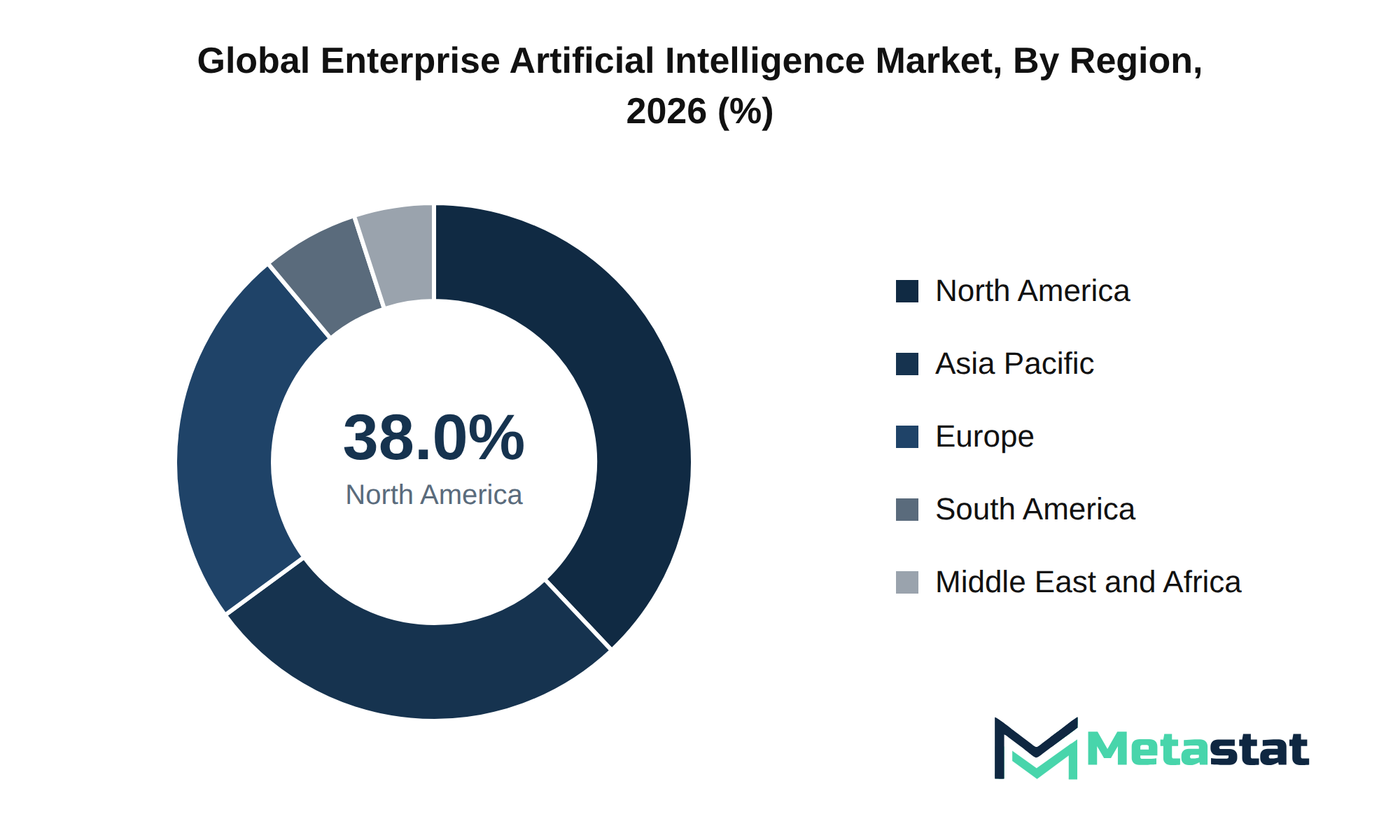
Competition in the Enterprise Artificial Intelligence market centers on technological breadth, deployment flexibility, and the ability to address complex enterprise demands across industries. Buyers evaluate providers based on scalability, integration with existing enterprise systems, and the strength of AI-driven analytics or automation capabilities. Price remains a factor, but differentiation increasingly occurs in value-added services including custom model development, advanced analytics, and domain-specific expertise tailored to verticals like BFSI, healthcare, and retail.
Cloud-native vendors including Amazon Web Services, Inc., Google LLC, and Microsoft Corporation focus on scalable AI infrastructure, enabling rapid deployment and smooth integration with broader enterprise cloud ecosystems. Microsoft Corporation leverages its enterprise software portfolio to drive adoption. Google LLC concentrates on advanced AI model delivery and data management. NVIDIA Corporation strengthens its position through AI acceleration hardware supporting deep learning and generative AI, which underpins both cloud and on-premises platforms.
Vendors including SAP SE and Oracle Corporation target enterprise process automation and workflow optimization, integrating AI tools within their established business software suites. DataRobot, Inc. and Dataiku specialize in accessible AI model development, enabling a broader range of enterprise users to deploy predictive analytics without deep data science expertise. OpenAI and Anthropic PBC emphasize generative AI model innovation, supporting organizations seeking advanced conversational and content-generation solutions. These strategies reflect a focus on usability and innovation for diverse enterprise needs.
Buyers increasingly value platforms that support hybrid deployment across cloud and on-premises environments, a demand reflected in the rising share of hybrid models. Customization, integration support, and ongoing upgrades are frequent decision points. The field includes a mix of full-stack providers, cloud specialists, and pure-play AI innovators, with competition shaped by technology focus and alignment with evolving enterprise priorities.
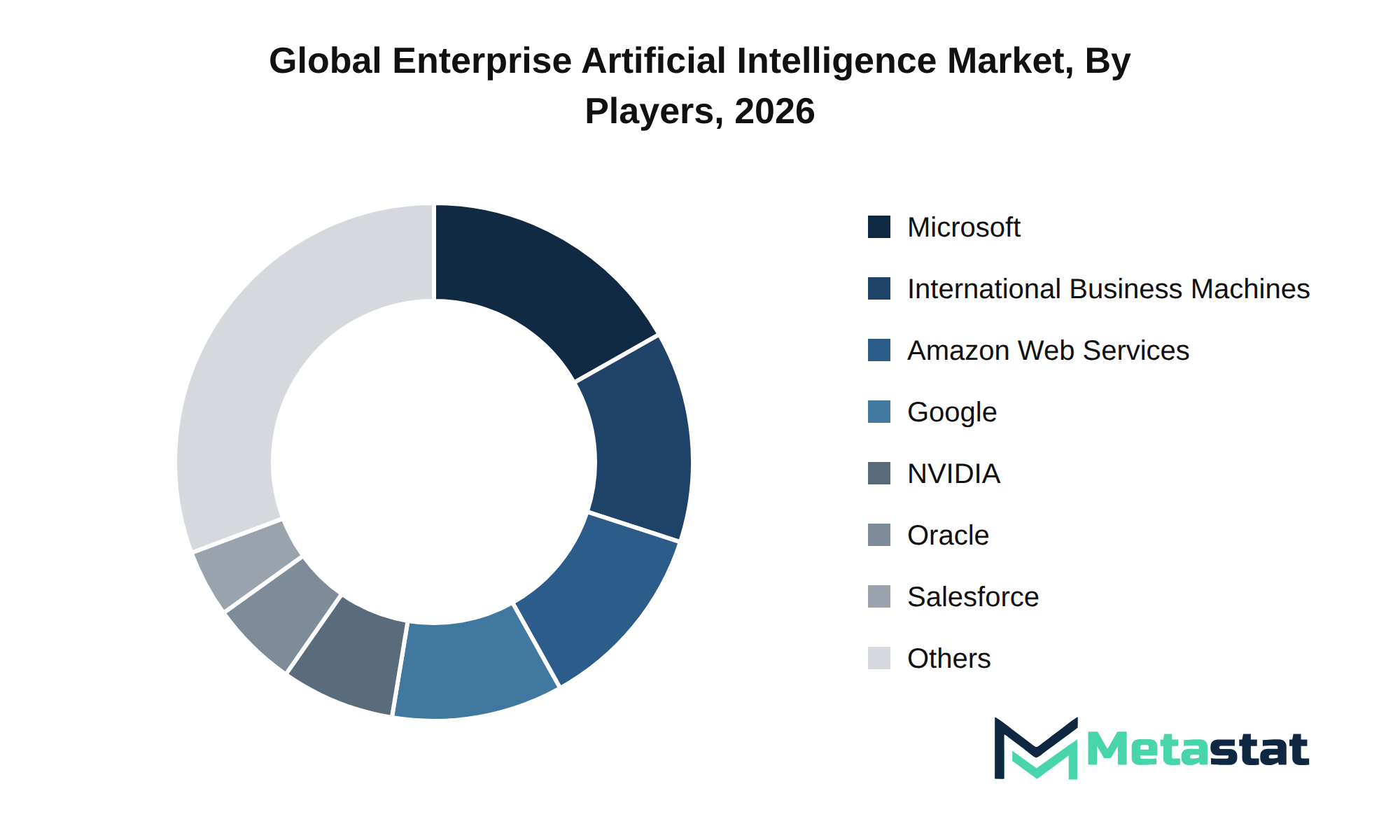
For the Enterprise Artificial Intelligence market to achieve this projection, three developments stand out. First, rapid adoption of cloud-based AI platforms drives both scalability and accessibility, with the Cloud deployment segment projected to reach USD 241 billion by 2033. Enterprises increasingly shift from on-premises to cloud and hybrid models to support distributed workforces and integrate advanced algorithms at lower upfront cost. Second, accelerating enterprise integration of generative AI transforms business functions, reflected in the Technology segment’s forecast that Generative AI will reach USD 135.1 billion by 2033. This adoption, particularly notable in IT & Telecommunications and Retail & Consumer Goods, expands use cases across analytics, content creation, and customer engagement. Third, North America’s ongoing investment and leadership in AI infrastructure, accounting for 38% of global share and expected to reach USD 147.8 billion by 2033, reinforces global momentum and standard-setting. The main risk for the Enterprise Artificial Intelligence market is a shortage of advanced AI talent and implementation expertise, which restricts deployment speed, particularly in regions and industries with fewer resources or legacy IT systems. This talent gap delays integration, slowing overall growth relative to forecast expectations.
By Deployment Model: Cloud, On-Premises, Hybrid
By Technology: Machine Learning and Predictive AI, Generative AI, Natural Language Processing, Computer Vision, Others (Agentic AI, Intelligent Automation)
By Application: Enterprise Decision Support & Analytics, Customer Service & Support, Sales & Marketing, Finance & Accounting, IT & Cybersecurity Operations, Human Resources & Workforce Management, Supply Chain & Procurement, Operations & Manufacturing, Research & Product Development, Others (Legal, Risk & Complianc
By End-Use Industry: BFSI, IT & Telecommunications, Healthcare & Life Sciences, Retail & Consumer Goods, Manufacturing, Automotive & Transportation, Energy & Utilities, Government & Defense, Media & Entertainment, Others (Education, Professional Services, Travel & Hospitality)
The report strategically identifies and profiles the key market players and analyses their core competencies in each sub-segment of the Enterprise Artificial Intelligence market.
|
Report Attributes |
Details |
|
Study Period |
2021-2033 |
|
Base Year |
2025 |
|
Estimated Year |
2026 |
|
Forecast Period |
2026-2033 |
|
Historical Period |
2021-2025 |
|
Growth Rate |
CAGR 37.6% from 2026 to 2033 |
|
Revenue Unit |
USD billion |
|
Segmentation |
|
|
By Region |
North America (By Deployment Model, Technology, Application, End-Use Industry, and Country)
|
|
|
|
Asia Pacific (By Deployment Model, Technology, Application, End-Use Industry, and Country)
|
|
|
|
|
Middle East and Africa (By Deployment Model, Technology, Application, End-Use Industry, and Country)
|
Find answers to common questions about this report
The Enterprise Artificial Intelligence market size was valued at USD 32.9 billion in 2025.
The projected CAGR is 37.6% for the forecast period from 2026 to 2033.
The North America Enterprise Artificial Intelligence market size is estimated to reach USD 147.8 billion by 2033.
Generative AI leads the type segment with a projected value of USD 135.1 billion in 2033, the highest among all technology segments. This figure surpasses Machine Learning and Predictive AI, which is projected at USD 117.9 billion in 2033.
Key drivers include rapid adoption of cloud-based deployment models that lower integration complexity and upfront investment, and accelerated growth in generative AI, projected to reach USD 135.1 billion by 2033, driven by demand for tailored content creation and marketing automation.
North America holds the dominant share with 38 percent of the global total. This region is projected to reach USD 147.8 billion by 2033, the highest value among all regions.
High initial integration costs restrict adoption among mid-sized enterprises and cost-sensitive sectors, delaying procurement decisions or resulting in smaller pilot deployments. Specialist talent costs are climbing, compressing supplier margins and increasing time-to-market for new offerings.
Generative AI is supporting adoption through its ability to deliver tailored content creation, marketing automation, and dynamic knowledge management for enterprises. Scalable, fine-tunable models and usage-based business models encourage organizations to expand deployments beyond pilot stages, opening new revenue opportunities for vendors.
The Enterprise Artificial Intelligence market is estimated to reach a valuation of USD 423.4 billion by 2033.
Key players in the industry include Microsoft Corporation, International Business Machines Corporation, Amazon Web Services, Inc., Google LLC, NVIDIA Corporation, Salesforce, Inc., and Oracle Corporation.
The analysts below cover Information & Technology research at Metastat Insights.
LEAD ANALYST
Utkarsh Khirodkar is a Lead Market Research Analyst at MetaStat Insight, specializing in market intelligence, technology sector assessments, and competitive strategy.

PRINCIPAL CONSULTANT - ENTERPRISE AI & EMERGING TECHNOLOGIES
Banking & Finance · Electronics and Semiconductor · Energy and Power · Healthcare IT · Information & Technology · Professional Services
Vijay Gunti is a Principal Consultant at MetaStat Insight, bringing over two decades of experience across enterprise digital transformation, technology strategy, and intelligent systems.

LEAD CONSULTANT - COMMUNICATION, TELECOM, AND IT
Electronics and Semiconductor · Information & Technology · Machinery & Equipment · Professional Services
Ravindra Sathe Consultants for Communication, Telecom, and IT at MetaStat Insight. He leads the firm's industry research initiatives across telecommunications infrastructure, digital connectivity, enterprise networking, and emerging information technology domains.
Evaluating calorific value requirements and air permit compliance across municipal waste facilities requires localized data. Metastat Insight structured their analysis around operational throughput capacity and feedstock composition variations in Latin America and Eastern Europe. Their competitive mapping of sorting equipment vendors helped clarify technology differences between optical separators and heavy media systems. The study provided an objective baseline during our capital expenditure reviews.
Decarbonizing industrial thermal processes hinges on refrigerant regulations and compressor efficiency limits. Metastat Insights delivered a thorough market analysis that evaluated natural refrigerants like CO2 and hydrocarbons against synthetic low-GWP alternatives. The breakdown of utility incentives and grid capacity constraints across key European manufacturing hubs offered valuable perspective. The follow-up conversation with their sector analysts addressed our specific questions on mechanical vapor recompression systems efficiently.
Assessing 200mm wafer transition schedules and substrate supply bottlenecks requires precise technical intelligence. MetaStat Insight supplied an actionable breakdown comparing planar and trench MOSFET architectures across automotive and industrial drive markets. The regional capacity estimates for Asia-Pacific foundries helped clarify lead-time uncertainties during our strategic planning session. When we needed additional clarification on high-purity raw material sourcing, their analyst team responded with helpful context within twenty-four hours.
Explore related market intelligence reports worth reading alongside this one.