
LEAD ANALYST
Utkarsh Khirodkar is a Lead Market Research Analyst at MetaStat Insight, specializing in market intelligence, technology sector assessments, and competitive strategy.

Global Traceability as a Service (TaaS) Market Size, Share, By Offering (Traceability Software Platforms, Integration & Implementation Services, Managed Traceability Services and Support & Maintenance Services), By Technology (Cloud and SaaS Platforms, Blockchain and Distributed Ledger Technology, IoT and Sensor-Based Traceability, RFID, QR Code and Barcode Technologies and AI and Machine Learning Analytics), By Application (Regulatory Compliance & Reporting, Product Recall & Safety Management, Quality Management & Product Genealogy, Anti-Counterfeiting & Brand Protection, Supply Chain Visibility & Inventory Tracking, Responsible Sourcing & Chain-of-Custody Verification, Sustainability & Digital Product Passports and Consumer Transparency & Product Authentication), By End-Use Industry (Food & Beverage, Pharmaceuticals & Life Sciences, Automotive & Mobility, Electronics & Semiconductors, Textiles, Apparel & Footwear, Metals, Mining & Batteries, Chemicals & Materials, Consumer Goods & Cosmetics, Retail & Logistics and Others (Aerospace & Defense, Specialized Industrial Applications)), Industry Analysis, Growth, Trends, and Forecast, 2026-2033
Report ID
MSI-5432
Published
October, 2026
Pages
254 Pages
Format
Historical
Base year
Forecast
Forecast period
Report Details
Market Valuation: Valued at $2,728.1 Million in 2025, projected to reach $7,410.1 Million by 2033 at a 13.3% CAGR.
Dominant Segment: Traceability Software Platforms lead the market, projected to reach USD 4,508.3 million by 2033, driven by demand for real-time analytics, data aggregation, and digital product passport readiness.
Geographic Lead: North America holds the largest share at 35.1% in 2025, supported by stringent regulatory frameworks, high digital infrastructure adoption, and early investment by major manufacturers.
Fastest-Growing Technology: Blockchain and Distributed Ledger Technology is the fastest-growing technology segment, expected to reach USD 1,610.2 million by 2033 with a CAGR of 15.5%, due to rising needs for tamper-evident audit trails and anti-counterfeiting.
Leading End-Use Industry: Food & Beverage is the largest end-use industry, forecast to rise from USD 570 million in 2026 to USD 1,253.8 million by 2033, as regulatory and consumer scrutiny drive adoption for safety and compliance.
What's Inside: The report provides segment-wise market sizing by offering, technology, application, and end-use industry, regional share analysis, competitive landscape, and forecasts from 2026 to 2033.
Choose Your License
Global Traceability as a Service (TaaS) Market
The global Traceability as a Service (TaaS) market was valued at USD 2,728.1 million in 2025 and is projected to reach USD 7,410.1 million by 2033, growing at a CAGR of 13.3% over the forecast period.
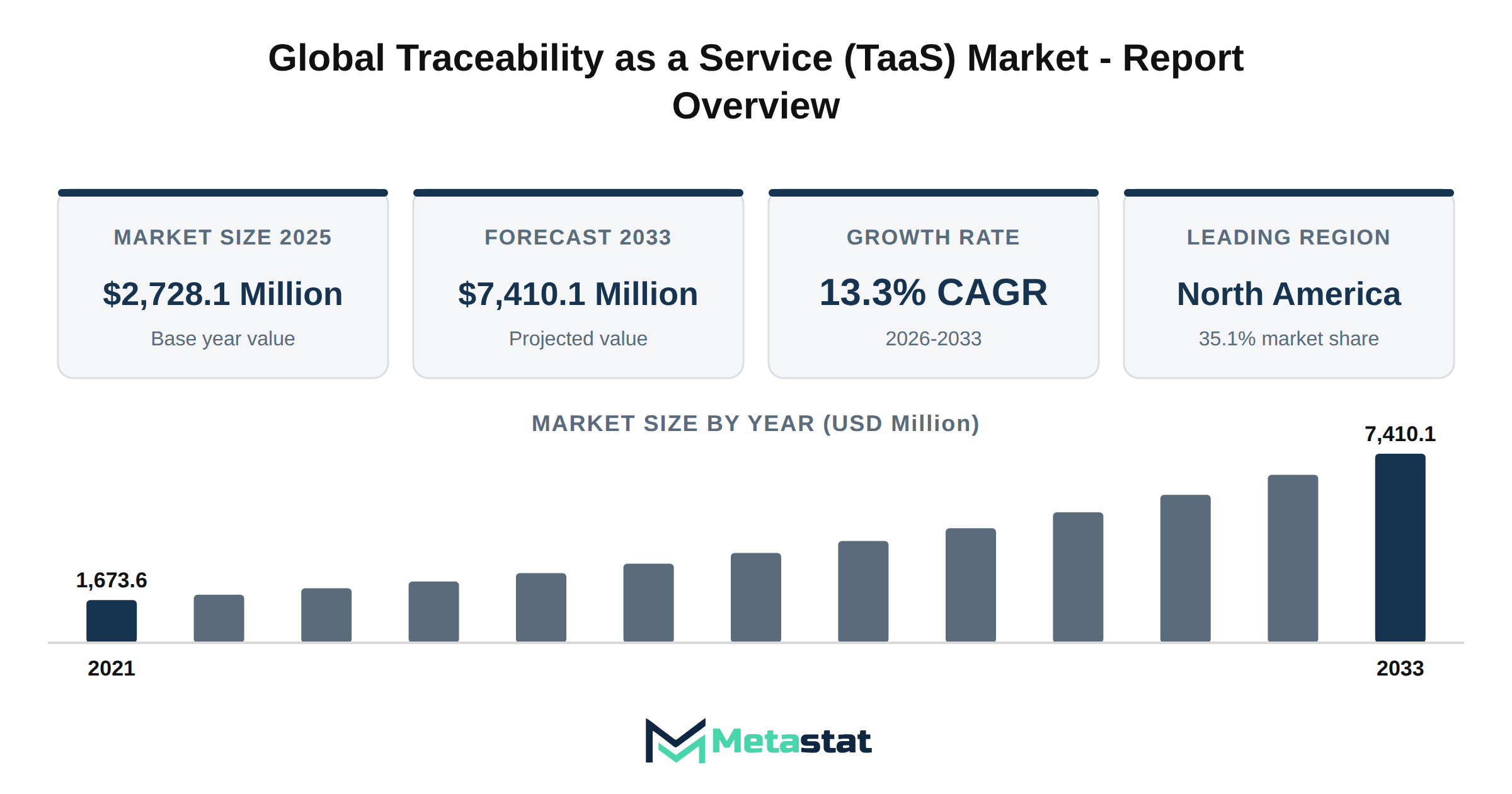
Traceability as a Service (TaaS) market solutions deliver cloud-based platforms and managed services that track, authenticate, and report product movement and provenance across complex supply chains. In electronic subassemblies, unit-level serialized tracking connects directly to component provenance in the automotive microcontrollers supply chain. Buyers in regulated industries, particularly food and beverage, pharmaceuticals, and automotive, invest in these offerings to satisfy compliance, deploy anti-counterfeiting solutions, and respond rapidly to recalls. Traceability software platforms account for the largest share of market value, driven by their ability to centralize data, enable real-time monitoring, and support integration of advanced analytics for continuous quality improvement.
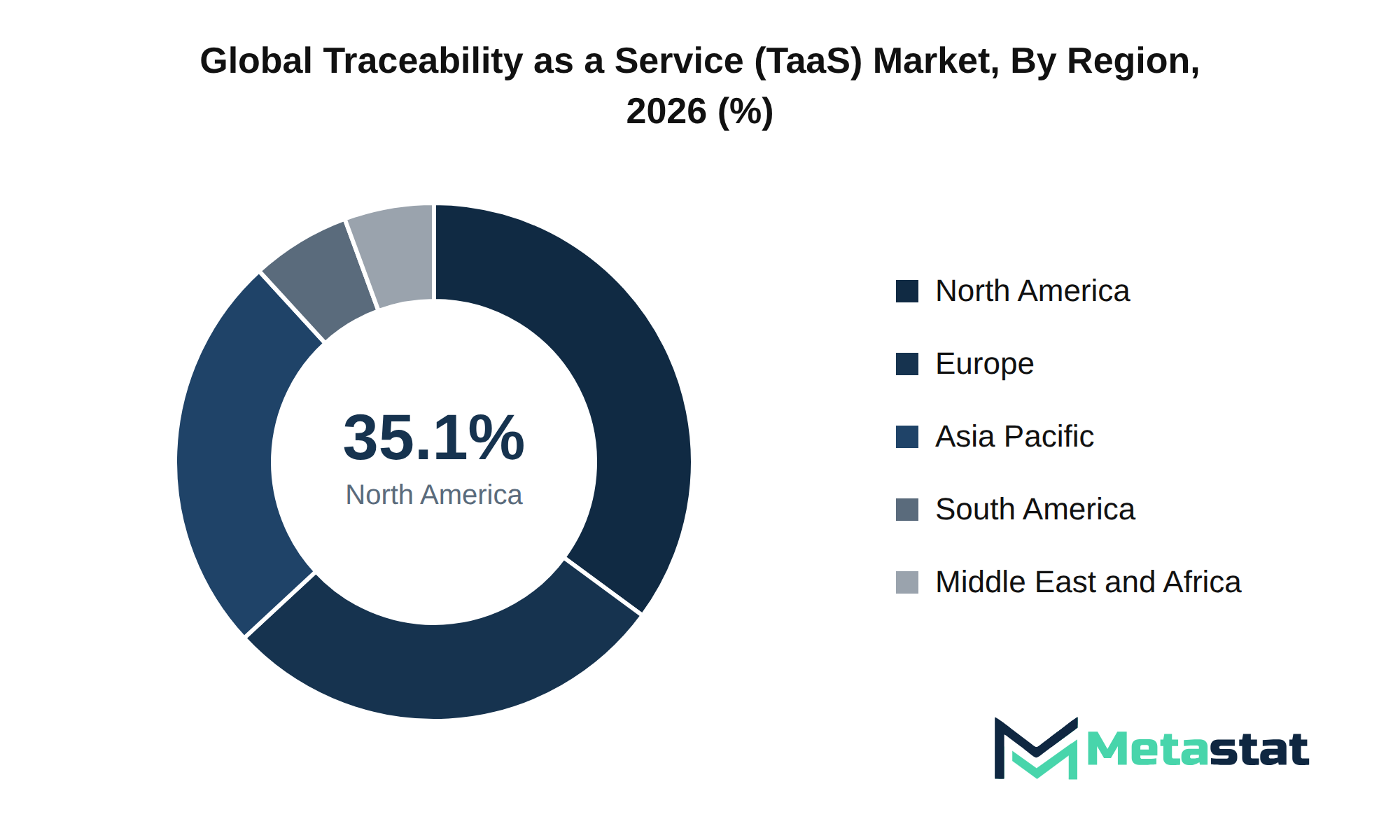
North America holds 35.1% of the market in 2025, with the US leading in 2026. This region benefits from stringent regulatory frameworks, high digital infrastructure adoption, and early investment by major manufacturers. In comparison, Europe and Asia Pacific follow with 28% and 25.1% of the share, reflecting regional priorities around food safety, pharmaceutical serialization, and supply chain transparency. Buyers in these regions allocate budgets to platforms that simplify audit readiness and streamline compliance documentation, resulting in higher adoption rates among multinational enterprises and high-value exporters.
Rising regulatory complexity drives growth in the Traceability as a Service (TaaS) market. Organizations encounter increasing scrutiny over supply chain integrity, documentation, and sustainability claims, accelerating investment in green technology and sustainability tools across sectors with global distribution networks. This demand for end-to-end visibility fuels investment in traceability software that offers rapid deployment, scalability, and integration with open source software frameworks powering distributed ledger and IoT protocols.
Buyers turn to Traceability as a Service (TaaS) market offerings to address regulatory, operational, and reputational requirements for tracking products, components, or ingredients throughout global supply chains. Spending rises when compliance obligations tighten, consumer scrutiny intensifies, or operational risks prompt greater transparency. The market covers software platforms, integration and implementation services, managed traceability services, and ongoing support, aligning closely with broader operations transformation initiatives across food and beverage, pharmaceuticals, automotive, electronics, and consumer goods. Buyers select providers for their ability to deliver scalable, real-time traceability, support integration with existing enterprise systems, and facilitate rapid response to recalls or audits. Tracking critical component histories also enriches operational diagnostics used in automotive predictive maintenance systems.
Traceability Software Platforms generate the most value in the Traceability as a Service (TaaS) market, supported by demand for digitalized, data-driven supply chain oversight. These platforms offer configurable workflows, analytics, and secure data exchange, which appeals to buyers managing high product volumes and complex compliance needs. Blockchain and IoT-based solutions become more prominent when buyers require verifiable, tamper-resistant records. These capabilities prove critical for industries facing frequent product recalls, brand protection challenges, or requirements to document chain-of-custody for sustainability claims.
North American buyers demonstrate a strong preference for service-based traceability, reflecting the region’s high concentration of regulated industries and advanced digital infrastructure. Stricter enforcement of supply chain regulations and product safety mandates drives organizations to upgrade legacy systems and adopt advanced digital traceability solutions. Investment in these solutions aims to mitigate compliance risks and improve operational visibility, strengthening long-term demand across the region.
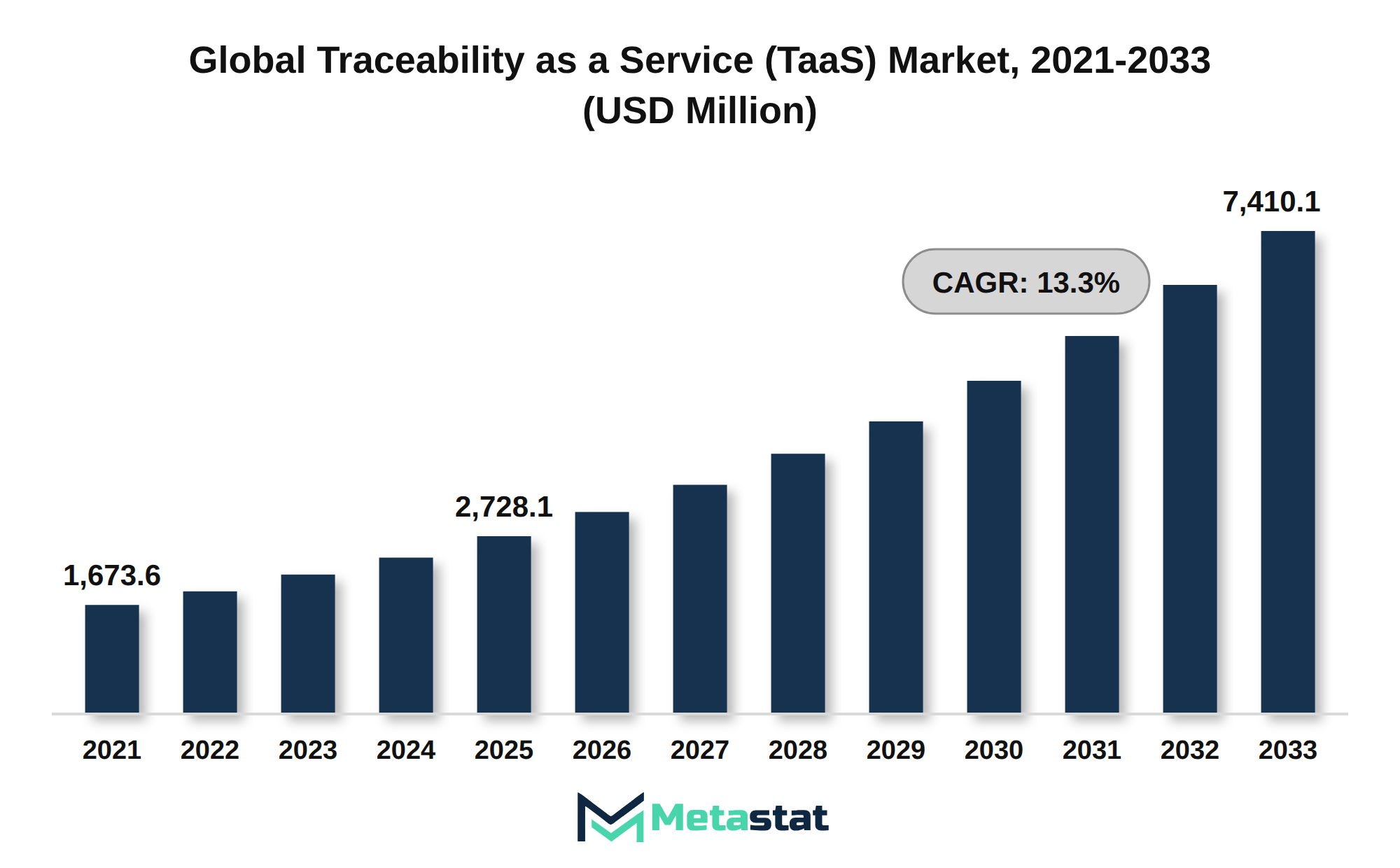
Cloud-native traceability platforms are transforming how supply chain visibility extends across multiple tiers and geographies, enabling organizations to aggregate, analyze, and respond to real-time data flows that would otherwise remain siloed. In the Traceability Service (TaaS) market, cloud and SaaS platforms account for a significant portion of technological adoption, with a projected value of USD 2,085.2 million in 2033, up from USD 957.6 million in 2026. This growth reflects rapid enterprise migration from on-premise and bespoke solutions toward scalable, cloud-native models that streamline integration and deliver continuous updates.
Manufacturers and brands facing increasingly fragmented supplier networks leverage these cloud-native platforms to automate data capture from sensors, IoT devices, and third-party sources. This supports transparency requirements and compliance obligations that span borders. Blockchain and distributed ledger technology, projected to reach USD 1,610.2 million in 2033, further strengthens multi-tier traceability by securing complex chains of custody and providing tamper-evident records.
The commercial impact for buyers includes reduced onboarding times for new suppliers, lower total cost of ownership compared to legacy systems, and improved responsiveness to recalls or disruptions. Regulatory bodies set more stringent expectations for chain-of-custody verification, driving adoption of cloud-native platforms and expanding procurement and risk management processes across diverse industries. This technology-driven shift accelerates the volume and type of buyers able to deploy agile traceability solutions, deepening penetration into sectors including food and beverage, pharmaceuticals, and automotive.
Blockchain, IoT, and AI technologies are transforming how buyers access, purchase, and pay for solutions in the Traceability as a Service (TaaS) market. Enterprises increasingly seek contract models that support rapid onboarding and flexible scaling. Cloud and SaaS platforms stand out for their subscription-driven pricing. Buyers in food and beverage, pharmaceuticals and life sciences, and electronics manufacturing prioritize these models to minimize upfront investment and align costs with usage. In 2026, the Cloud and SaaS Platforms segment is projected to reach USD 957.6 million. This reflects robust adoption of these contract frameworks in environments where operational flexibility delivers commercial advantage.
Blockchain and distributed ledger technology further influence buyer decisions by enabling transaction-level traceability and facilitating pay-per-use or outcome-based models. Vendors leverage these capabilities to offer modular and scalable solutions. These solutions serve industries where regulatory compliance and anti-counterfeiting are critical. Buyers opt for service contracts that link payments to verifiable outcomes, including shipment authentication or product genealogy insights. This approach reduces risk and shifts spend from capital to operational budgets.
IoT and AI integration enhances value by automating data capture and analytics. Tiered pricing based on connected asset volume or data processed appeals to supply chain operators and manufacturers managing diverse product categories or seasonal demand swings. Evolving contract models drive solution providers to offer transparent, usage-based pricing and clear service-level terms. Enterprise buyers seeking measurable operational and financial benefits increasingly prefer these offerings.
Enterprises in regulated sectors are accelerating investments in traceability solutions in response to rising legislative requirements for product data transparency. The introduction of digital product passports has triggered a shift in compliance strategy among manufacturers, retailers, and suppliers, particularly in industries with complex value chains. These passports function as dynamic records, aggregating data on a product’s composition, origin, and lifecycle, which regulators increasingly require for market access and consumer communication.
Within the Traceability as a Service (TaaS) market, regulatory compliance and reporting applications are expanding in line with these mandates. The fact sheet shows that regulatory compliance and reporting applications are forecast to grow from USD 563.6 million in 2026 to USD 1,196.0 million by 2033. This expansion reflects increasing adoption among enterprises seeking to avoid penalties, respond to audits more efficiently, and build trust with downstream buyers. Suppliers in the food and beverage, pharmaceuticals and life sciences, and automotive sectors are particularly affected, given the prevalence of safety, sustainability, and anti-counterfeiting regulations targeting these industries.
The commercial impact for vendors in the Traceability as a Service (TaaS) market is a rise in demand for configurable platforms and managed services that streamline compliance with digital passport and reporting requirements. Buyers prioritize solutions supporting multi-jurisdictional mandates, integration with ERP and supply chain systems, and automation of verification processes. This shift favors providers with robust data integration capabilities and regulatory expertise, supporting higher-value service models and long-term customer retention.
Traceability Service has accelerated adoption of real-time product provenance and compliance management, particularly in industries facing regulatory scrutiny and supply chain complexity that create operational risk. In food and beverage, for example, pressure from buyers and governments to validate origin and handling has driven rapid uptake of traceability platforms. Food and beverage buyers are shifting toward digital solutions, supported by the segment's projected rise from USD 570 million in 2026 to USD 1,253.8 million in 2033. This trajectory demonstrates that digital traceability is replacing legacy paper-based or manual record-keeping, reducing compliance workloads and improving response times for recalls or audits.
Companies adopting TaaS solutions integrate automated data capture in production and distribution, generating digital product genealogies. This capability strengthens compliance management, especially for product recall and safety management, which is forecast to reach USD 952.9 million by 2033. In pharmaceuticals and life sciences, compliance demands drive uptake of platforms that flag discrepancies in real time, supporting regulatory reporting and audit defense. Beyond cost saving, the shift to TaaS creates new commercial opportunities: brands build trust by providing transparent provenance, and suppliers differentiate on verified authenticity. While the market matures, buyers in highly regulated sectors are prioritizing integrated, scalable solutions that demonstrate compliance and resilience under increasing global oversight.
High-profile food safety incidents have intensified the focus on origin tracing throughout the supply chain, prompting food and beverage companies to accelerate investment in TaaS solutions. Regulatory and consumer scrutiny over contamination, mislabeling, and recalls drives procurement priorities toward digital traceability solutions that offer rapid response capabilities. Buyers in the food and beverage sector now prioritize platforms with real-time tracking and reporting functions, supporting compliance and reducing financial and reputational risk from product withdrawals. This shift has contributed to food and beverage holding the largest end-use industry share, with the segment projected to reach USD 1,253.8 million by 2033. More stringent requirements from global retailers and importers further reinforce demand for scalable TaaS solutions, supporting sustained double-digit growth for the sector through the forecast period.
High initial investment requirements for enterprise-grade traceability software platforms and managed services restrict adoption for small and mid-sized manufacturers. These organizations often delay or scale down digital traceability deployments, prioritizing essential operational upgrades over advanced product genealogy or compliance features. For cost-sensitive buyers in segments including automotive, electronics, and textiles, spending on Traceability as a Service (TaaS) solutions remains focused on regulatory compliance rather than full end-to-end visibility. This tendency results in longer sales cycles and limited contract values, especially where organizations operate on thin margins or lack dedicated technology budgets. Pricing for advanced cloud-based platforms and integration services continues to challenge wider rollout, particularly among businesses in emerging economies. Slower penetration occurs in sectors with fragmented supply chains and limited IT resourcing.
Providers in the Traceability as a Service (TaaS) market face increasing wage and retention expenses for skilled software developers, data engineers, and security specialists. Demand for expertise in blockchain, cloud-native architectures, and real-time analytics drives compensation benchmarks higher, particularly in North America and Europe. Suppliers compete for limited high-skill talent to deliver scalable, secure, and customizable platforms, which increases payroll outlays. This intensifies pressure on operating margins, especially for firms balancing complex implementation with managed services. In response, Traceability as a Service (TaaS) market suppliers invest in workforce development, pursue automation to streamline code delivery, and expand recruitment to lower-cost regions. These actions support service quality while keeping cost structures aligned with tightening profit expectations. Revenue growth forecasts outpace headcount expansion, prompting continuous reassessment of talent acquisition and retention strategies.
Blockchain and distributed ledger technology present the strongest growth opportunity in the Traceability as a Service (TaaS) market. This segment is projected to reach USD 1,610.2 million by 2033, registering a 15.5% compound annual growth rate, outpacing all other technology segments. Blockchain’s decentralized architecture addresses persistent challenges around data manipulation, provenance fraud, and fragmented documentation in multi-tier global supply chains. Enterprises in sectors including electronics, luxury goods, and raw materials adopt traceability solutions leveraging blockchain to build tamper-evident audit trails that secure each product’s journey. Startups and established providers expand their portfolios to offer blockchain-integrated traceability platforms, responding to intensifying demand for supplier accountability and anti-counterfeiting. Delivering immutable, transparent records positions blockchain as a technology of choice for organizations prioritizing trust and end-to-end visibility beyond basic compliance requirements. This segment is expected to accelerate revenue and expand its addressable customer base.
The Global Traceability as a Service (TaaS) market is segmented based on Offering, Technology, Application, and End-Use Industry.
Valued at USD 1,760.2 million in 2026 and projected to reach USD 4,508.3 million by 2033, traceability software platforms post a CAGR of 14.4%, outpacing both Integration & Implementation Services (10.8%) and Support & Maintenance Services (8.4%). These platforms enable organizations in food and beverage, pharmaceuticals, consumer goods, and electronics to standardize and automate tracking, genealogy, and audit functions, supporting compliance and transparency initiatives. The strongest driver for this segment is the expanding use of multi-tier data aggregation and real-time analytics by enterprises prioritizing end-to-end supply chain visibility and digital product passport readiness. Buyers who select software platforms over services-focused sub-segments seek permanent automation and integration, resulting in higher upfront spend and longer procurement cycles. Intensifying regulatory requirements for granular product data in developed markets drive software platforms to become essential infrastructure for buyers investing in digitalization and risk management.
Integration & Implementation Services segment is estimated to reach USD 1,119.7 million by 2033, at a CAGR of 10.8% during the forecast period. This segment covers services that configure, adapt, and deploy traceability solutions to client-specific environments, supporting supply chain participants that require tailored integration with existing IT systems or multi-enterprise networks. Demand in this segment is strongest among large manufacturers and logistics providers seeking to minimize operational disruption when migrating from legacy tracking systems to cloud-based Traceability as a Service (TaaS) platforms. Regulatory shifts in food safety and pharmaceuticals trigger surges in project work, with solution providers facilitating compliance and ensuring that chain-of-custody records meet evolving mandates. The Integration & Implementation Services segment grows at a slower pace than Traceability Software Platforms within Traceability as a Service (TaaS), reflecting a service model driven by project cycles rather than recurring subscriptions. Buyer priorities in this segment often center on risk reduction, onboarding speed, and bridging on-premises and cloud environments, setting it apart from managed or support service buyers.
Managed Traceability Services segment is expected to reach USD 1,182.7 million by 2033. These services provide end-to-end oversight of traceability workflows, typically managed by third-party solution providers for enterprises seeking outsourced compliance, supply chain visibility, and risk mitigation without building an internal team. Adoption concentrates among multinational food producers, pharmaceutical manufacturers, and branded consumer goods companies that require regulatory-grade audit trails and rapid deployment for global operations. Demand reflects a shift toward subscription-based, fully managed models, where buyers prioritize operational simplicity, continuous compliance updates, and outsourced technical support. Compared to the higher-growth Traceability Software Platforms segment, which advances at a 14.4% CAGR, Managed Traceability Services address buyers with limited IT capacity or those operating in regions with complex regulatory requirements. Resistance to higher recurring service fees and concerns about data control has tempered uptake among smaller manufacturers, but cost transparency and predictable service-level agreements make this approach attractive for risk-averse enterprises. Managed Traceability Services play a distinct role by aligning outsourced expertise with compliance-driven digitalization goals for companies seeking less hands-on digital transformation.
Support & Maintenance Services segment is projected to grow at a CAGR of 8.4% during the forecast period. These services are purchased by organizations that rely on continuous traceability to meet industry standards and safeguard supply chain transparency. Buyers include food and beverage producers, pharmaceutical companies, and manufacturers in regulated sectors, who expect consistent system uptime and rapid technical assistance. Ongoing platform upgrades, cybersecurity updates, and system troubleshooting drive recurrent spending in this segment. Compared with Traceability Software Platforms, which advance at a 14.4% CAGR, this segment exhibits slower growth, reflecting its established role following initial deployment rather than a primary investment. Cost sensitivity shapes purchasing decisions, with buyers prioritizing predictable pricing and long-term vendor relationships over feature differentiation. Support contracts deliver stability and assurance that sustain compliance and minimize operational disruptions while global supply chains grow more complex. Vendors tailor scalable support models to sector-specific uptime and regulatory requirements.
Enterprises in sectors including food and beverage, pharmaceuticals, and automotive select these platforms to streamline deployment and centralize supply chain data management without on-premises hardware. Demand rises with the shift from capital-intensive legacy software to scalable models, supporting rapid compliance with evolving traceability mandates and enabling easier multi-site adoption. This segment’s CAGR of 11.8%, while robust, trails Blockchain and Distributed Ledger Technology in the Traceability Service (TaaS) market, which posts a faster 15.5% CAGR. Pricing flexibility and integration with enterprise resource planning systems distinguish Cloud and SaaS Platforms from sensor-oriented or RFID-based alternatives. Buyers in the Traceability Service (TaaS) market report that software subscription models reduce upfront cost and shorten adoption cycles compared to traditional perpetual licensing.
Pharmaceutical, electronics, and high-value consumer goods manufacturers drive adoption due to escalating demands for anti-counterfeiting, chain-of-custody verification, and immutable product provenance. Buyers in these industries prioritize trust and tamper-evidence, relying on blockchain to meet regulatory and consumer transparency requirements that traditional cloud or IoT platforms address less robustly. Blockchain and distributed ledger technology achieves faster adoption than Cloud and SaaS Platforms (11.8% CAGR), reflecting a transition from legacy database models toward decentralized, cryptographically secure architectures. Ongoing sector-specific mandates and the high cost of undetected fraud or diversion incentivize investment in this segment, which positions blockchain and distributed ledger technology as a premium choice for traceability solutions.
IoT and Sensor-Based Traceability segment is expected to reach USD 1,656.9 million by 2033. Sensor-based systems support real-time data capture on product location, environmental conditions, and handling, which has become essential for industries where quality and safety compliance hinge on in-process monitoring. Manufacturing operations in food and beverage, pharmaceuticals, and automotive sectors rely on these solutions to track perishable goods, temperature-sensitive products, and components through complex supply routes. Demand is driven by the Traceability as a Service (TaaS) market’s expansion into supply chains that require granular visibility, supporting rapid identification of anomalies and reducing costly recalls. Compared with RFID, QR Code and Barcode Technologies, which have a CAGR of 10.6%, IoT and sensor-based traceability is expected to outpace them on absolute value by 2033, with buyers shifting toward automated, continuous monitoring rather than intermittent scanning. This segment stands apart in the Traceability as a Service (TaaS) market for enabling both compliance and operational optimization, appealing to buyers with high liability exposure and stringent process controls.
RFID, QR Code and Barcode Technologies segment is projected to grow at a CAGR of 10.6% during the forecast period. These technologies underpin item-level traceability by providing unique identifiers that enable rapid tracking and data capture throughout supply and distribution processes. Industries including food and beverage, pharmaceuticals, automotive, and retail rely on these systems for inventory accuracy, anti-counterfeiting, and recall management. Adoption in this segment accelerates where cost-sensitive buyers seek scalable, established solutions that integrate into existing workflows with minimal technical barriers. This segment draws buyers aiming for immediate compliance or operational efficiency without the infrastructure investment required for higher-growth segments like blockchain and distributed ledger technology, which carries a CAGR of 15.5%. While pricing for RFID and barcode solutions generally sits below emerging alternatives, their ubiquity and interoperability make them foundational for volume-driven sectors. Preference for these proven technologies continues wherever buyers prioritize reliability, cost control, and broad partner compatibility.
AI and machine learning analytics introduce advanced data interrogation to traceability solutions, enabling real-time anomaly detection, predictive insights, and automated decision support for supply chains. Manufacturers and regulated industries deploy these analytics to extract intelligence from vast product movement and compliance data, supporting quality management and fraud detection. Demand for AI-driven tools has surged due to increasingly complex global supply chains and escalating regulatory scrutiny, particularly from food, pharmaceutical, and electronics producers responding to dynamic risk profiles. Unlike cloud or blockchain platforms, AI and machine learning analytics focus on optimizing process efficiency and reducing manual review time rather than core data storage or security. Enterprises with high data volumes have increased adoption, with pricing trends reflecting the premium placed on automation and predictive capability. Platform providers respond to these shifts by integrating analytics modules, creating differentiation among those seeking to enable greater operational agility for their clients.
Regulatory Compliance & Reporting is valued at USD 563.6 million in 2026 and is projected to reach USD 1,196 million by 2033, recording a CAGR of 11.3% during the forecast period. This segment addresses the traceability demands of sectors with stringent and evolving compliance obligations, including pharmaceuticals, life sciences, and food and beverage. Demand rises on regulatory mandates for digital recordkeeping, transparent audits, and rapid product recall readiness. Regulatory Compliance & Reporting serves as a core capability for manufacturers and distributors responding to global frameworks on product safety and anti-fraud requirements. Product Recall & Safety Management is projected to reach USD 952.9 million by 2033 at a CAGR of 12%, but Regulatory Compliance & Reporting captures higher absolute spend from industries with heavy compliance exposure despite moving at a slightly slower pace. Heightened scrutiny from authorities and the threat of sanctions or market exclusion influence investment, positioning this segment as a structural pillar in traceability solutions. Buyers in this segment show less price sensitivity than those focused on supply chain visibility, reflecting the risk and cost implications of non-compliance within traceability solutions.
This segment serves manufacturers and distributors who require rapid, accurate identification and removal of defective or hazardous products from supply chains. Food and beverage, pharmaceuticals, and automotive sectors drive adoption, reflecting strict liability standards and increasing regulatory oversight. Regulatory tightening in North America and Europe, particularly in food safety and pharmaceutical supply chains, prompts organizations to upgrade recall processes for compliance and risk mitigation. Unlike Regulatory Compliance & Reporting, which grows at a slower CAGR of 11.3%, Product Recall & Safety Management expands more quickly, indicating more urgent demand for incident-driven response tools. Buyers in this segment prioritize systems that provide instant trace-back and automated communication with retailers and consumers, supporting both brand protection and legal compliance. Heightened public scrutiny and escalating reputational losses from recalls further increase the readiness of enterprise clients to invest in advanced traceability capabilities, reinforcing this segment’s importance for manufacturers and distributors seeking to manage risk and compliance.
Quality Management & Product Genealogy segment is expected to reach USD 919.6 million by 2033. This segment enables manufacturers and regulated industries to track process conformity, monitor production deviations, and document component genealogy from raw material to finished product. Buyers in food, automotive, and electronics sectors adopt these solutions to support supplier auditing and respond to rising customer and regulatory demands for documented quality assurance. Growing pressure from brand owners and supply chain partners drives adoption, especially in export-oriented industries where non-compliance triggers costly recalls or lost contracts. Unlike Regulatory Compliance & Reporting, which is forecast at a higher value of USD 1,196 million by 2033 and centers on documentation for authorities, Quality Management & Product Genealogy focuses on continuous product improvement and risk reduction. Growth in this segment reflects demand for system integration with manufacturing execution and quality management platforms. High configurability and real-time traceability features differentiate this segment from product recall solutions, which concentrate on containment rather than proactive quality assurance.
Anti-Counterfeiting & Brand Protection segment is projected to grow at a CAGR of 12.8% during the forecast period. This segment addresses a critical requirement for brands in pharmaceuticals, luxury goods, electronics, and consumer products to safeguard against illicit trade and counterfeit infiltration. Buyers in this segment include brand owners and manufacturers exposed to revenue loss and reputational damage from counterfeit products. Stricter regulatory enforcement and heightened consumer expectations for product authenticity propel adoption, driving traceability investments that exceed the pace of Quality Management & Product Genealogy, which does not report a higher CAGR. Unlike segments focused on compliance or quality lineage, this segment prioritizes authentication mechanisms and digital identifiers that verify provenance at the unit level. In the Traceability Service (TaaS) market, rapid technology adoption and regulatory scrutiny have led to increased spending on secure serialization and item-level tracking. This trend aligns with the push by multinational brands to protect intellectual property and maintain consumer trust in global supply chains.
End users deploy supply chain visibility and inventory tracking solutions to achieve real-time monitoring of product movement, inventory status, and sourcing across multiple tiers of suppliers. Manufacturers in sectors including automotive, electronics, and food and beverage drive adoption, seeking continuous data on stock levels, provenance, and delivery timelines. In the Traceability as a Service (TaaS) market, demand for this application intensifies with disruptions in global supply chains and rising customer expectations for order accuracy and transparency reshaping procurement and logistics priorities. Enterprises pursuing resilience and risk mitigation select these solutions to automate alerts for shortages, bottlenecks, or compliance gaps, limiting manual oversight and stockouts. This segment tends to attract buyers with large, complex operations, while anti-counterfeiting or regulatory compliance applications often cater to regulated or high-value verticals. Anti-counterfeiting and regulatory functions in the Traceability as a Service (TaaS) market respond to security and mandate-driven adoption, whereas supply chain visibility and inventory tracking pivots on cost efficiency and operational continuity for high-volume, multi-site operators.
Responsible sourcing and chain-of-custody verification solutions address the requirement for transparent tracking of materials, components, and finished goods from origin to end user. These systems serve brands, manufacturers, and suppliers in sectors including food and beverage, electronics, mining, and textiles that face external pressure from regulators and large retail customers to prove ethical sourcing and prevent fraud. Regulatory mandates in the European Union and North America demand rigorous documentation and proof of supply chain provenance, driving adoption across high-value and highly scrutinized sectors. This segment is distinguished by buyers with strong compliance-driven requirements, frequently integrating chain-of-custody modules with supplier audit and responsible sourcing tools. Unlike applications focused on recalls or quality management, responsible sourcing and chain-of-custody verification require more complex multi-tier supplier data, heightening integration challenges and increasing reliance on emerging decentralized ledger technologies. Demand for these solutions rises while traceability shifts from optional value-add to a procurement prerequisite for multinational buyers.
Digital product passport initiatives and sustainability traceability tools provide detailed, standardized data on the environmental and social impact of goods throughout their lifecycle. Brands in sectors including electronics, apparel, and chemicals deploy these solutions to meet evolving legislative requirements, strengthen their ethical sourcing claims, and appeal to environmentally conscious consumers. Growth in this segment results from the convergence of regulatory mandates across Europe and Asia Pacific with mounting pressure from global buyers for validated sustainability credentials. Regulatory harmonization and voluntary industry pledges influence digital product passport adoption more than immediate financial risk, unlike product recall or anti-counterfeiting solutions. Buyers for these tools are often sustainability or compliance teams, while supply chain managers prioritize operational risk, shifting the procurement dynamic. This segment bridges regulatory technology and consumer-facing transparency, with technology vendors collaborating with certification bodies and industry consortia to define data formats and interoperability standards.
Verification processes in the Consumer Transparency & Product Authentication segment provide end users with access to origin, handling, and authenticity data directly related to individual items. This function is in high demand among brands in consumer goods, apparel, luxury products, and food and beverage who address heightened expectations for proof of ethical sourcing, ingredient integrity, and product safety. Technology suppliers support these buyers by integrating authentication features into mobile apps, QR codes, and NFC tags, creating a direct channel for sharing verified information with consumers at point of sale or post-purchase. The market draws on this demand in response to increasing consumer distrust of unverified claims and a rise in counterfeit activity, particularly in premium and regulated categories. Unlike segments centered on regulatory compliance or recall, this application targets direct end-user engagement and marketing differentiation, which influences adoption patterns when brands invest to strengthen loyalty and defend price premiums. In this segment, buyers face reputational risk and seek to convert transparency into measurable revenue impact.
This segment serves manufacturers, processors, and retailers who demand end-to-end product visibility to address safety, authenticity, and regulatory requirements. Rising consumer scrutiny and frequent regulatory updates drive adoption, with buyers aiming to prevent contamination and fraud while meeting strict standards for traceability. The Traceability Service (TaaS) market in food and beverage stands out for this regulatory-driven demand, with compliance pressures leading to higher investment in digital platforms. Growth for this segment is slightly slower than that of Electronics & Semiconductors, where the CAGR reaches 14.1%, reflecting more incremental uptake in food and beverage compared to the rapid, innovation-driven needs in electronics. In the Traceability Service (TaaS) market, price sensitivity and the diversity of supply chains create unique barriers to rapid, uniform adoption for food and beverage companies compared to pharmaceutical or electronics sectors.
Estimated to reach USD 1,136.7 million by 2033 and projected at a CAGR of 12.3% through the forecast period, this segment addresses the traceability requirements unique to pharmaceuticals and life sciences. Regulatory mandates on drug traceability, serialization, and anti-counterfeiting drive adoption among pharmaceutical manufacturers, contract development organizations, and global distributors. Evolving compliance standards and the demand for end-to-end batch visibility influence both operational priorities and technology investment. Compared to segments like Food & Beverage, pharmaceuticals faces higher regulatory scrutiny and product safety risks, which push buyers to prioritize advanced traceability capabilities and data integrity tools. Digital solutions have expanded their role in ensuring product authenticity and supply chain security for this segment. Heightened regulatory enforcement and the complexity of global sourcing distinguish this segment from others, resulting in a faster adoption pace and sustained investment through 2033.
Expected to reach USD 954.4 million by 2033, this segment centers on solutions that address real-time traceability for vehicle parts, components, and finished automobiles. Automakers, suppliers, and mobility service providers rely on these tools to comply with evolving regulations, mitigate risks of counterfeit parts, and coordinate complex supply chains that often span multiple continents. Heightened regulatory scrutiny and consumer demand for transparency have accelerated adoption. The traceability function supports recall management, warranty validation, and ethical sourcing, which have become central priorities for global automotive brands. Pharmaceuticals & Life Sciences is forecast to reach USD 1,136.7 million by 2033, while the Automotive & Mobility segment operates at a lower revenue base and involves different buyer priorities, with a primary focus on supply chain resilience and post-sale accountability. Higher component turnover and diverse sourcing requirements drive further uptake of traceability services in this segment, making it responsive to both compliance and operational efficiency imperatives. Digital capabilities continue to influence procurement strategies and partnerships across the automotive sector, supporting growth in traceability services for this industry.
Projected to expand at a CAGR of 14.1% through 2033, demand in electronics and semiconductors reflects heightened pressure on manufacturers to ensure end-to-end supply chain transparency and quality assurance. Buyers in this segment include original equipment manufacturers, component suppliers, and contract assemblers, who require precise part-level traceability to meet customer audits and regulatory requirements. The Traceability Service (TaaS) market in electronics and semiconductors distinguishes itself through rapid adoption of digital platforms and advanced data capture technologies, supporting recalls, counterfeit prevention, and compliance in a globalized, high-velocity environment. This segment grows faster than pharmaceuticals and food due to the complexity and value density of electronic components, which drives a premium for robust traceability services. Technology-driven quality demands and a rising global focus on intellectual property protection position the electronics and semiconductors segment among the primary contributors to the Traceability Service (TaaS) market's expansion.
Supply chain transparency and responsible sourcing have moved to the forefront for buyers in textiles, apparel, and footwear. Brands and manufacturers in this segment use traceability solutions to monitor raw material origins, ensure compliance with sustainability goals, and authenticate finished products to prevent counterfeiting. Stringent expectations from both global retailers and conscious end customers have supported the shift to digital platforms that capture environmental and social performance data at each step of the value chain. Adoption is influenced by demands for ethical production and evolving sustainability regulations, which show greater intensity in textiles compared to segments including automotive and chemicals. In food or pharmaceuticals, traceability requirements are often driven primarily by safety or regulatory mandates, while fashion buyers focus on consumer-facing transparency and brand reputation. Suppliers in this space differentiate their offering by integrating material tracking and chain-of-custody verification with blockchain, digital ID, or advanced labeling technologies. These capabilities support competitive positioning for fashion brands while meeting new regulatory requirements that emerge in this segment.
Battery manufacturers and mining operators turn to traceability for compliance and risk management across mineral extraction, processing, and final assembly. Regulatory pressure on responsible sourcing and environmental due diligence intensifies demand in this segment, with buyers spanning upstream mining companies, battery producers, and metals processors. Unlike the Food & Beverage or Pharmaceuticals & Life Sciences segments, buyers in metals, mining, and batteries operate in highly globalized and fragmented raw material supply networks, often facing greater exposure to new regulations and customer sustainability expectations. The market receives interest from this segment due to requirements for auditable records that prove ethical sourcing and chain-of-custody for critical raw materials, including cobalt, lithium, and rare earths. Solutions within this segment frequently integrate blockchain or distributed ledger platforms to close trace gaps, providing proof of origin and ESG compliance where traditional systems fall short.
Tracking solutions for the chemicals and materials industry enable continuous documentation of raw material origin, batch genealogy, and compliance to hazardous material regulations. Chemical producers and materials suppliers rely on these solutions for mandatory reporting, audit readiness, and to secure supply chain integrity where safety and liability risks are high. Regulatory pressure in this segment is strong, with regional and international frameworks driving adoption of digital traceability and chain-of-custody verification. Buyers in this segment require traceability across complex, multi-tiered supply chains involving intermediates, blending, and cross-border trade, which differs from the requirements in food or pharmaceuticals. Pricing sensitivity is heightened compared to consumer goods, since bulk material transactions operate on tight margins. The market in chemicals and materials is further influenced by the growing focus on sustainable sourcing and compliance with environmental stewardship mandates. Vendors addressing this segment deploy platforms that integrate with laboratory information management systems and support real-time audit trails, reinforcing the value proposition of traceability services for industrial buyers.
Personal care product manufacturers, cosmetics brands, and consumer goods companies rely on traceability solutions to address demand for ingredient transparency, ethical sourcing, and rapid response to quality issues. In this segment, brand owners integrate digital tracking platforms to monitor product movement from raw material procurement through packaging and retail. Traceability solutions adoption by consumer goods suppliers responds to heightened consumer expectations for proof of sustainability claims and allergen control. Adoption reflects the growing volume of premium and high-turnover SKUs, with buyers in this segment requiring digital solutions that manage rapid changeovers and diverse packaging configurations. Cosmetics and consumer brands, unlike food or pharmaceutical verticals, prioritize traceability features that support marketing differentiation and regulatory assurance, rather than direct safety recall. Technology providers in the traceability solutions market gain traction among companies seeking to validate cruelty-free or vegan claims and to safeguard against gray market diversion by tracking individual units through global distribution networks.
Retail and logistics companies implement traceability solutions to manage increasingly complex global supply chains, control shrinkage, and comply with stricter regulations on product origin and handling. This segment addresses the requirements of retailers, distributors, and third-party logistics providers facing pressure to deliver transparent, real-time tracking from point of manufacture to final sale. A major force driving adoption is the shift in consumer expectations toward immediate access to product provenance and movement data, placing operational demands on both traditional retailers and e-commerce platforms. Compared to food, pharmaceutical, or electronics segments, retail and logistics buyers prioritize scalable, user-friendly platforms that support high SKU counts, rapid stock turnover, and cross-border compliance without the heavy customization typical in manufacturing-focused industries. Regulatory drivers, including anti-fraud rules and sustainability mandates, exert a direct influence on purchasing decisions, while price sensitivity and the need for rapid deployment create a distinct technology and vendor selection process compared to capital-intensive sectors. Buyer priorities shift amid growing supply chain risks, shaping demand patterns throughout this segment.
Solutions in the Others (Aerospace & Defense, Specialized Industrial Applications) segment address advanced traceability requirements for highly regulated and complex industries. Aerospace and defense manufacturers, along with operators in specialized industrial applications, implement track-and-trace to safeguard product integrity, meet defense and civil aviation mandates, and control the flow of sensitive or mission-critical components. Demand in this segment is driven by rigorous compliance obligations, including the detailed audit trails and end-to-end visibility that regulators and clients require in aerospace and defense supply chains. Unlike food, beverage, or consumer goods buyers, organizations in this group often manage higher-value, lower-volume inventories, leading to a preference for highly customized traceability platforms with stronger data security features and integration with legacy systems. Suppliers competing for this segment differentiate through their ability to deliver tailored solutions that address stringent regulatory and security requirements. These buyers influence product development priorities by demanding interoperability, certification support, and real-time analytics aligned to industry-specific standards.
Based on geography, the Global Traceability as a Service (TaaS) market is divided into North America, Europe, Asia-Pacific, South America, Middle East, and Africa.
Regulatory-driven digitalization and heightened compliance obligations drive strong adoption of Traceability offerings among United States manufacturers and distributors. Major food, pharmaceutical, and electronics suppliers accelerate integration of traceability software platforms in response to federal and state mandates for end-to-end supply chain visibility. Cloud and SaaS-based solutions attract sustained investment, reflecting the region’s mature IT infrastructure and prioritization of scalable, real-time data access. In Canada and Mexico, multinational supply chain integration and North American trade linkages increase demand for unified traceability platforms that streamline cross-border reporting and risk management. North America holds a 35.1% share of the global market in 2025, with projected value reaching USD 2,362.3 million by 2033. Stakeholders prioritize agile compliance, recall readiness, and consumer trust, reinforcing the market’s concentration in this region.
With a 28.00% share of global spend in 2025, Europe demonstrates strong uptake of traceability solutions driven by regulatory harmonization and digitalization among manufacturers in Germany, France, and the UK. Stricter enforcement of product origin, safety, and sustainability reporting fuels investment in advanced digital traceability platforms, particularly among industrial exporters and technology-focused enterprises. The Traceability Service (TaaS) market in Europe benefits from widespread supplier integration and ecosystem collaboration, reflecting an established infrastructure for real-time data exchange and compliance automation. Rapid adoption among automotive, electronics, and life sciences sectors shapes demand, with buyers adapting processes to support both international regulatory mandates and voluntary industry certifications. The market in Europe is further distinguished by a focus on interoperability standards and secure data sharing, which accelerates supplier onboarding and reduces compliance friction across multi-country operations.
In Asia-Pacific, robust digital infrastructure investment by governments and private industry supports rapid uptake of advanced traceability platforms, particularly in China, Japan, and India. The region demonstrates strong participation from export-driven manufacturing sectors, which drives demand for traceability solutions. Regulatory pressures on product provenance and compliance reporting intensify demand for traceability integration, especially among electronics, automotive, and pharmaceutical manufacturers. Enterprise buyers in Southeast Asia accelerate adoption to maintain access to global supply chains and satisfy multinational audit requirements. Software platform upgrades deployed by large manufacturers in China and South Korea influence both adoption rates and the sophistication of traceability solutions implemented. Growth in the Traceability as a Service (TaaS) market across Asia-Pacific is further supported by a shift toward cloud-based traceability systems, which provides scalability and streamlined multi-country compliance.
Domestic producers in Brazil and Argentina accelerate adoption of Traceability to address increasing scrutiny across agricultural exports and processed food supply chains. The region’s share of global spend in 2025 reflects heightened pressure from international buyers for transparent documentation of product origin and quality. Emerging compliance demands from trade partners push local manufacturers to integrate digital traceability into their systems, improving their competitive position in export markets. In Brazil, large agricultural conglomerates and food processors invest in digital traceability platforms to verify ethical sourcing and meet strict import requirements. Argentina observes similar activity, with technology rollouts focused on grain, beef, and specialty crop supply chains. Traceability in South America is shaped by the region’s reliance on export-driven industries and the ongoing shift toward digitized, verifiable supply chains demanded by global buyers.
Adoption in Saudi Arabia, the UAE, and South Africa is shaped by requirements for digital verification and secure supply chain records across critical import-dependent sectors. Traceability as a Service (TaaS) offerings appeal to food, pharmaceuticals, and metals industries seeking to counter illicit trade and ensure compliance with emerging product authentication mandates. Buyers in these countries prioritize platforms that deliver end-to-end visibility, with secure cloud and sensor-based technologies supporting cross-border regulatory pressures and quality concerns. The region experiences heightened demand for solutions that address local counterfeiting challenges and reduce exposure to non-compliance risks. Investments by national governments in digital identification and serialization initiatives drive further migration to TaaS platforms supporting transparency and trade facilitation.
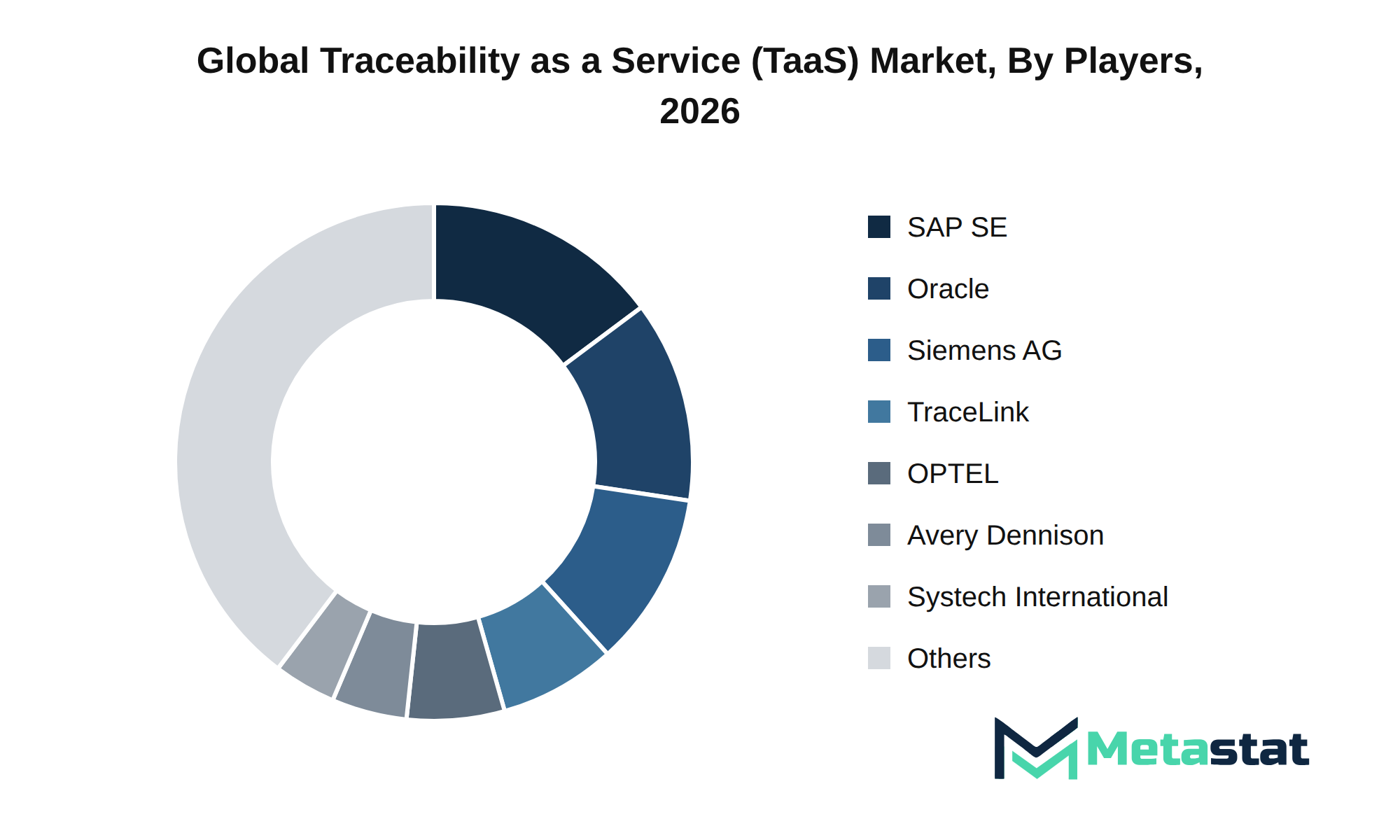
Competition in the Traceability as a Service (TaaS) market aligns around the breadth of digital platforms, the depth of customization, and the ability to serve regulated and high-value industries. Suppliers include enterprise software vendors, process automation specialists, and providers focused on implementation and managed services. Buyers discriminate on interoperability, audit and compliance capabilities, and the maturity of integration between traceability platforms and existing enterprise systems.
SAP SE, Oracle Corporation, and Siemens AG address large-scale traceability requirements through expansive software platforms tailored for sectors including food and beverage, pharmaceuticals, and electronics. These companies emphasize platform extensibility and support for supply chain digitalization. TraceLink Inc. focuses on pharmaceuticals and life sciences, tailoring its offering to regulatory compliance and serialization. OPTEL Group and Systech International provide product authentication and anti-counterfeiting solutions, supporting brand protection and secure product genealogy.
Several providers, including TrusTrace AB and Sourcemap Inc., deliver solutions for responsible sourcing and chain-of-custody verification, targeting manufacturers and retailers seeking transparent supply chains. Companies including Avery Dennison Corporation and Kezzler integrate IoT, barcode, and RFID solutions to enhance physical asset tracking and consumer transparency. Buyers in this market prioritize compliance, scalability, and the ability to streamline recall or provenance processes, driving suppliers to differentiate on technical depth and vertical expertise.
Achieving this forecast depends first on continued adoption of traceability software platforms, which are projected to generate the highest segment revenue, reaching USD 4,508.3 million by 2033. Expanding deployment of cloud, SaaS, and blockchain-enabled traceability solutions in sectors including pharmaceuticals, food and beverage, and automotive supports this trajectory, reflecting supplier efforts to address regulatory compliance and reporting requirements. Growth in regions with robust digital infrastructure, particularly North America, which is expected to account for USD 2,362.3 million by 2033, further strengthens the outlook. However, the potential for slower integration in price-sensitive end-use industries or limited adoption of advanced technologies in South America and the Middle East and Africa remains a critical risk. Delays in digital transformation or resistance to migrating legacy systems restrict overall spending. Double-digit annual expansion through 2033 is projected, contingent on technology uptake and sector-wide investment in transparent supply chains. Sustained regulatory pressures and ongoing digitalization trends anchor this outlook.
By Offering: Traceability Software Platforms, Integration & Implementation Services, Managed Traceability Services, Support & Maintenance Services
By Technology: Cloud and SaaS Platforms, Blockchain and Distributed Ledger Technology, IoT and Sensor-Based Traceability, RFID, QR Code and Barcode Technologies, AI and Machine Learning Analytics
By Application: Regulatory Compliance & Reporting, Product Recall & Safety Management, Quality Management & Product Genealogy, Anti-Counterfeiting & Brand Protection, Supply Chain Visibility & Inventory Tracking, Responsible Sourcing & Chain-of-Custody Verification, Sustainability & Digital Product Passports, Consumer Transparency & Product Authentication
By End-Use Industry: Food & Beverage, Pharmaceuticals & Life Sciences, Automotive & Mobility, Electronics & Semiconductors, Textiles, Apparel & Footwear, Metals, Mining & Batteries, Chemicals & Materials, Consumer Goods & Cosmetics, Retail & Logistics, Others (Aerospace & Defense, Specialized Industrial Applications)
The report strategically identifies and profiles the key market players and analyses their core competencies in each sub-segment of the Traceability as a Service (TaaS) market.
|
Report Attributes |
Details |
|
Study Period |
2021-2033 |
|
Base Year |
2025 |
|
Estimated Year |
2026 |
|
Forecast Period |
2026-2033 |
|
Historical Period |
2021-2025 |
|
Growth Rate |
CAGR 13.3% from 2026 to 2033 |
|
Revenue Unit |
USD million |
|
Segmentation |
By Offering, Technology, Application, End-Use Industry, and Region |
|
By Region |
North America (By Offering, Technology, Application, End-Use Industry, and Country)
|
|
|
|
Asia Pacific (By Offering, Technology, Application, End-Use Industry, and Country)
|
|
|
|
|
Middle East and Africa (By Offering, Technology, Application, End-Use Industry, and Country)
|
Find answers to common questions about this report
The Traceability as a Service (TaaS) market size was valued at USD 2,728.1 million in 2025.
The market is projected to grow at a CAGR of 13.3% during the forecast period from 2026 to 2033.
The North America Traceability as a Service (TaaS) market size is estimated to reach USD 2,362.3 million by 2033.
Traceability Software Platforms lead by value among type segments, reaching USD 4,508.3 million in 2033. This segment holds the highest forecast value compared to Integration & Implementation Services and Managed Traceability Services.
Heightened regulatory and consumer scrutiny over food safety and product authenticity drives accelerated adoption of digital traceability solutions. Blockchain and distributed ledger technology enable secure, tamper-evident audit trails, expanding demand for advanced platforms across industries seeking end-to-end supply chain visibility.
North America holds the dominant share with 35.1 percent of the total market by regional share. This region leads on a percentage basis compared to Europe at 28 percent and Asia Pacific at 25.1 percent.
High initial investment requirements for traceability software platforms and managed services restrict adoption for small and mid-sized manufacturers. Rising wage and retention expenses for skilled software and data professionals increase payroll costs and pressure operating margins.
Stricter regulatory and consumer scrutiny, increased risk of product recalls, and the need for real-time supply chain visibility drive adoption, especially among food and beverage companies. High-profile safety incidents and requirements from global retailers reinforce investment in digital traceability solutions.
The Traceability as a Service (TaaS) market is estimated to reach a valuation of USD 7,410.1 million by 2033.
Companies active in traceability as a service include SAP SE, Oracle Corporation, Siemens AG, TraceLink Inc., OPTEL Group, Systech International, and Körber AG.
The analysts below cover Information & Technology research at Metastat Insights.
LEAD ANALYST
Utkarsh Khirodkar is a Lead Market Research Analyst at MetaStat Insight, specializing in market intelligence, technology sector assessments, and competitive strategy.

PRINCIPAL CONSULTANT - ENTERPRISE AI & EMERGING TECHNOLOGIES
Banking & Finance · Electronics and Semiconductor · Energy and Power · Healthcare IT · Information & Technology · Professional Services
Vijay Gunti is a Principal Consultant at MetaStat Insight, bringing over two decades of experience across enterprise digital transformation, technology strategy, and intelligent systems.

LEAD CONSULTANT - COMMUNICATION, TELECOM, AND IT
Electronics and Semiconductor · Information & Technology · Machinery & Equipment · Professional Services
Ravindra Sathe Consultants for Communication, Telecom, and IT at MetaStat Insight. He leads the firm's industry research initiatives across telecommunications infrastructure, digital connectivity, enterprise networking, and emerging information technology domains.
Standard industry briefs frequently blur the operational distinctions between isobaric pressure exchangers and centrifugal turbines. In this study, MetaStat Insight categorized mega-scale desalination tenders across the GCC and Mediterranean basins by membrane replacement frequencies and salinity tolerances. Their primary research helped us evaluate local content requirements in Saudi Arabia and the UAE without relying on marketing literature. We found the segment-level equipment replacement estimates grounded and well-reasoned throughout.
The technical breakdown of ISO 20022 migration readiness across correspondent banking corridors was remarkably thorough. Rather than treating cross-border corporate payments as a single block, the report drew a useful distinction between multilateral netting platforms and domestic instant payment rails across ASEAN economies. MetaStat Insight highlighted regulatory constraints on foreign exchange liquidity management that many publications gloss over. The research material offered practical clarity for our platform development roadmap.
Our group needed clearer visibility into out-of-autoclave processing timelines for high-temperature thermoplastic composites. MetaStat Insight delivered an objective assessment that contrasted automated fiber placement scrap rates with traditional thermoset prepreg layup cycles. The supplier landscape mapped out primary resin suppliers and tape slitting capacity across France, Germany, and Japan with solid technical accuracy. Their analyst handled our questions on precursor supply risks during an unscheduled inquiry call, providing clear, unembellished context.
Explore related market intelligence reports worth reading alongside this one.