
LEAD ANALYST
Utkarsh Khirodkar is a Lead Market Research Analyst at MetaStat Insight, specializing in market intelligence, technology sector assessments, and competitive strategy.

India OOH and DOOH Market Size, Share, By Media Type (Static (Traditional) OOH and Digital OOH), By Format (Billboards and Hoardings, Street Furniture, Transit Advertising, Place-Based Media and Others (Ambient, Wallscapes and Specialty Formats)), By Location Environment (Roadside and Highways, Airports, Metro and Railway, Bus and Transit Hubs, Malls and Retail Locations, Commercial and Corporate Spaces and Others (Cinema, Stadiums and Entertainment Venues)), By End-User Industry (FMCG and Consumer Goods, Automotive, Retail and E-commerce, BFSI, Telecommunications and Technology, Real Estate and Construction, Healthcare and Pharmaceuticals, Media and Entertainment and Others (Education, Government, Energy and Utilities)), Industry Analysis, Growth, Trends, and Forecast, 2026-2033
Report ID
MSI-5422
Published
October, 2026
Pages
299 Pages
Format
Historical
Base year
Forecast
Forecast period
Report Details
Market Valuation: Valued at $547.7 Million in 2025, projected to reach $779.1 Million by 2033 at a 4.5% CAGR.
Dominant Segment: Static (traditional) OOH holds the largest market share at 80.5%, driven by enduring demand from FMCG, retail, and automotive sectors for high-visibility and cost-efficient placements.
Fastest Growth: Digital OOH is projected to reach USD 285 million by 2033 at a CAGR of 13%, fueled by increasing urbanization, adoption of digital display technologies, and demand for data-driven, real-time advertising solutions.
Leading Format: Billboards and hoardings remain the preferred format, forecast to grow from USD 225 million in 2026 to USD 269.7 million by 2033, supported by their broad demographic reach and strategic placement in high-traffic areas.
Key Location Environment: Roadside and highways dominate spending, expected to reach USD 313.5 million by 2033, while airports and bus/transit hubs demonstrate strong growth due to rising passenger volumes and premium audience targeting.
What's Inside: The report provides detailed segmentation by media type, format, location environment, and end-user industry, with market sizing, growth trends, segment forecasts through 2033, and analysis of drivers, challenges, and regulatory factors.
Choose Your License
India OOH and DOOH Market
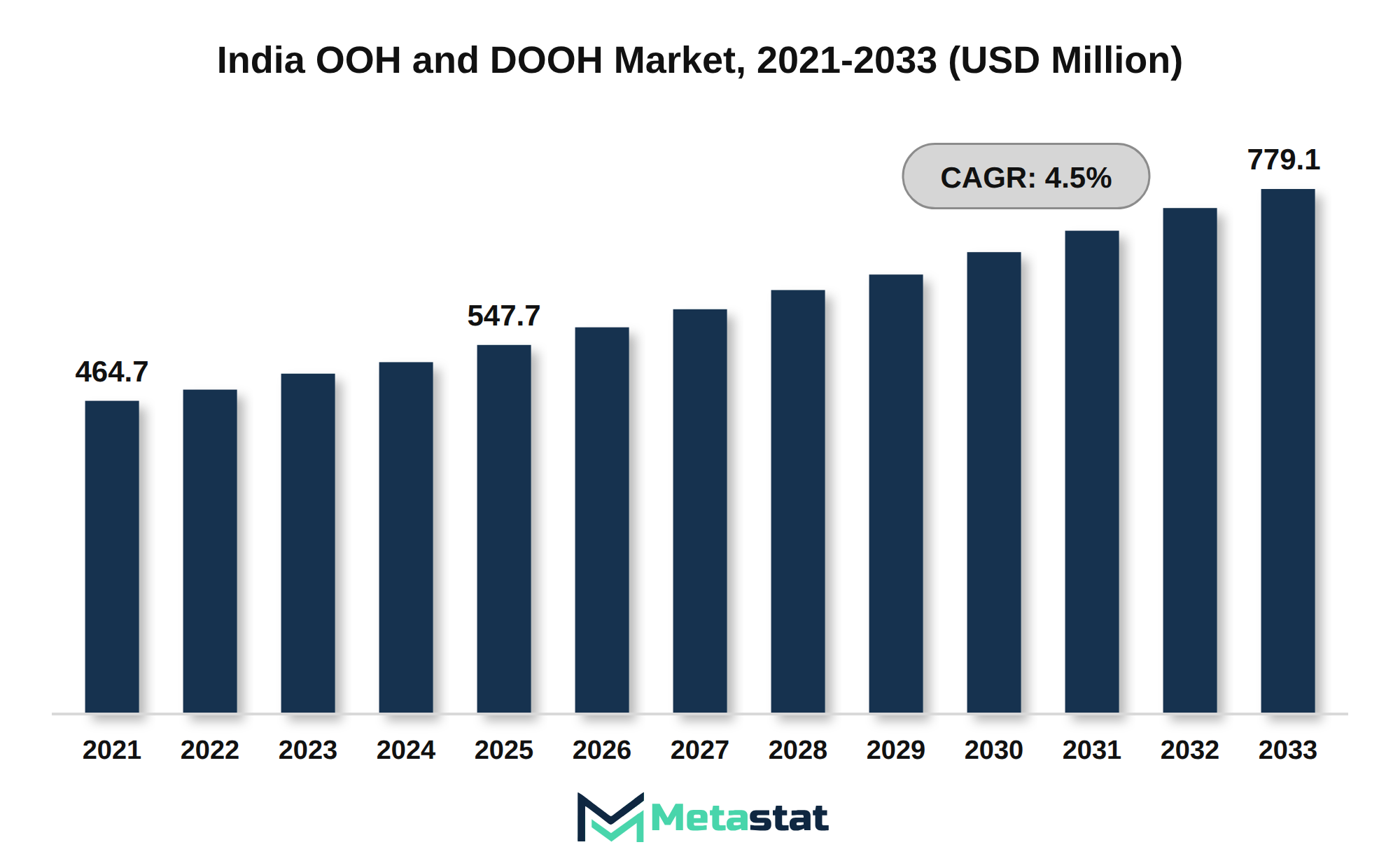
The India OOH and DOOH market was valued at USD 547.7 million in 2025 and is projected to reach USD 779.1 million by 2033, growing at a CAGR of 4.5% over the forecast period.
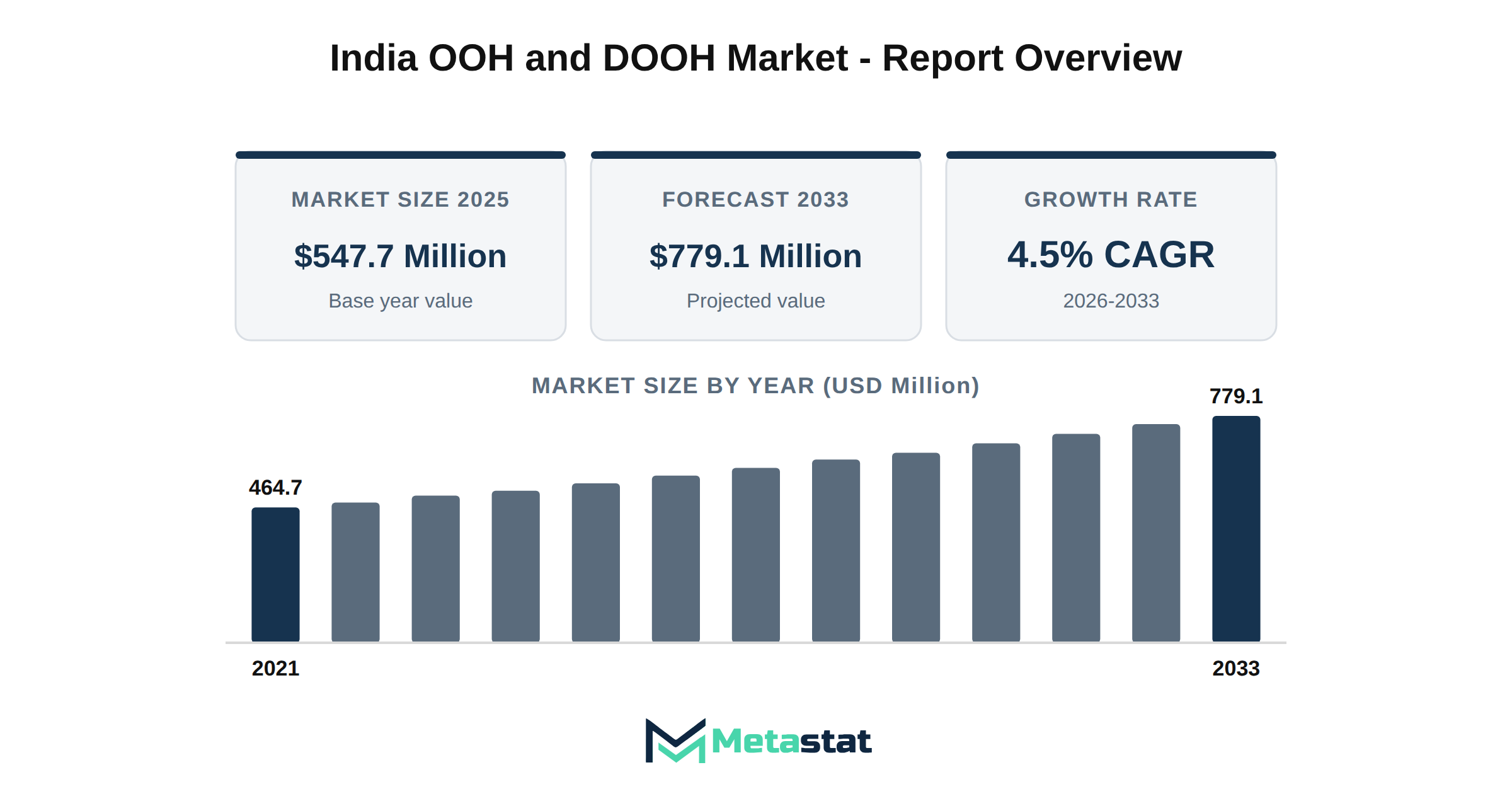
This progression represents a compound annual growth rate of 4.5 percent during the forecast period. The market stood at USD 464.7 million in 2021, rising to USD 481.4 million in 2022, USD 505.0 million in 2023, and USD 522.2 million in 2024 before reaching its 2025 base year value.
Static (traditional) formats accounted for 80.5 percent of the market share, while digital OOH formats represented 19.5 percent. Static OOH is expected to grow from USD 453.0 million in 2026 to USD 494.1 million in 2033, with a CAGR of 1.2 percent. Digital OOH is anticipated to reach USD 285.0 million by 2033, supported by a CAGR of 13 percent. The shift toward digital formats reflects greater adoption of digital display technologies and data-driven campaigns coordinated by the broader marketing services sector, enabling advertisers to reach urban audiences with dynamic content and real-time adjustments.
Billboards and hoardings are set to expand from USD 225.0 million in 2026 to USD 269.7 million by 2033, marking a CAGR of 2.6 percent. Street furniture is projected to reach USD 96.8 million by 2033, with a CAGR of 3.7 percent. Transit advertising formats are forecast to achieve USD 263.0 million by 2033. Place-based media is expected to register a CAGR of 7.1 percent. Demand for targeted, context-specific advertising in retail and entertainment venues is increasing as brands seek to engage consumers at high-dwell locations and during key decision-making moments.
Roadside and highway environments are anticipated to grow from USD 259.0 million in 2026 to USD 313.5 million by 2033, at a CAGR of 2.8 percent. Airports are projected to reach USD 138.9 million by 2033, supported by a CAGR of 5.2 percent. Metro and railway segments are forecast to achieve USD 113.9 million by 2033. Bus and transit hubs are expected to expand at a CAGR of 3.7 percent, reflecting rising investment in transit-focused advertising infrastructure that attracts advertisers targeting daily commuters and travelers. Modern transit media networks increasingly interface with broader intelligent transportation systems that track vehicle arrival times and passenger flows.
Digital formats are projected to accelerate adoption in the India OOH and DOOH market, with Digital OOH expected to reach USD 285 million by 2033 at a CAGR of 13 percent. This segment is expanding on the back of increasing urbanization and demand for more interactive and data-driven advertising strategies, particularly among technology-focused brands and agencies seeking higher engagement and dynamic content delivery. The shift toward digital formats is influencing campaign planning and measurement, as advertisers prioritize platforms that support real-time content updates and audience analytics. This reflects broader budget shifts across the wider digital advertising industry, where cross-channel targeting and programmatic execution take precedence.
Meanwhile, static or traditional out-of-home formats maintain a strong presence, forecast to reach USD 494.1 million in 2033, growing at a CAGR of 1.2 percent. The enduring relevance of traditional formats reflects ongoing demand from sectors where broad visibility and cost efficiency remain priorities, including FMCG and consumer goods, which are forecast to increase spending from USD 110.9 million in 2026 to USD 145.1 million in 2033, at a 3.9 percent CAGR. These sectors continue to value static placements for their reach and lower operational complexity compared to digital alternatives.
Street furniture is anticipated to reach USD 96.8 million by 2033, growing at a CAGR of 3.7 percent, reflecting increased utilization in metropolitan and tier-2 cities for targeted campaigns. Transit advertising, encompassing airports, metro, and railway locations, is gaining traction, with airport placements alone set to reach USD 138.9 million and grow at a 5.2 percent CAGR by 2033. This trend is driven by rising passenger volumes and premium audience targeting opportunities for automotive and BFSI sectors, the latter expected to advance at a 5.4 percent CAGR through 2033. These developments indicate a shift toward formats and locations that offer both scale and segmentation for advertisers.
Roadside and highway placements are projected to expand from USD 259 million in 2026 to USD 313.5 million in 2033 at a CAGR of 2.8 percent, supported by infrastructure development and increased vehicle traffic. Retail and e-commerce brands continue to invest in high-frequency locations, with their segment forecast to reach USD 131.4 million by 2033. These investments reflect the commercial value of reaching consumers in transit and at points of purchase, supporting brand recall and conversion.
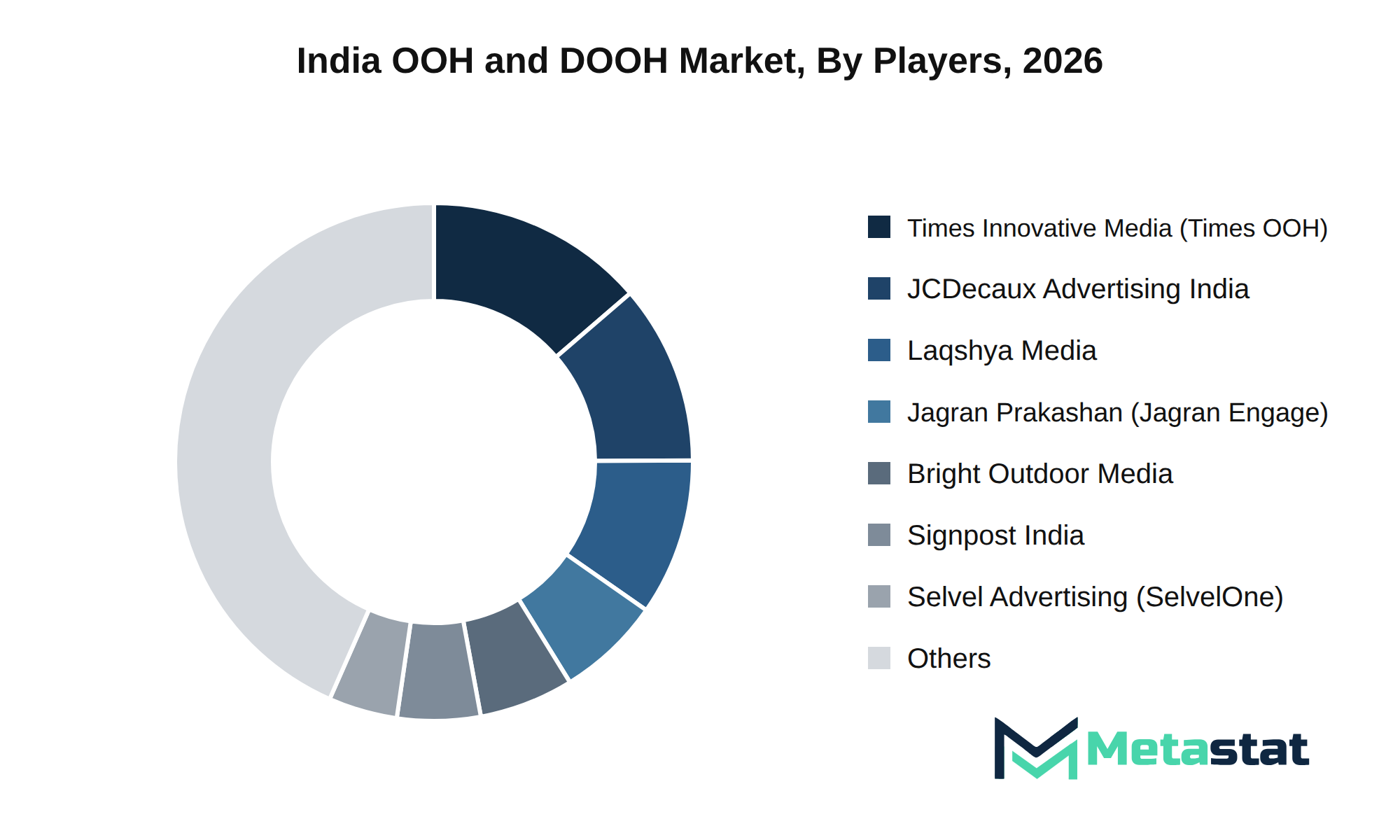
Major players in the India OOH and DOOH market include Times Innovative Media Limited (Times OOH), Laqshya Media Group, JCDecaux Advertising India Private Limited, Signpost India Limited, Bright Outdoor Media Limited, and Jagran Prakashan Limited (Jagran Engage). These companies expand presence and diversify offerings to address the evolving requirements of advertisers across urban and transit environments.
Rising urbanization and large-scale infrastructure investments are fueling sustained expansion in the India OOH and DOOH market. Growth in metropolitan populations is driving higher footfall across transit hubs, commercial districts, malls, and roadside corridors, creating dense touchpoints for brand messaging. Strategic infrastructure upgrades, including new highways, metro lines, airports, and retail precincts, expand the available inventory and support increased deployment of both static and digital formats. Along major arterial corridors, these developments parallel the municipal deployment of smart variable message signs designed for real-time motorist communication.
Advertisers benefit from these developments by targeting high-traffic locations and optimizing campaign reach among diverse demographics. Infrastructure-led asset modernization strengthens the effectiveness of OOH and DOOH campaigns, making these channels central to integrated brand strategies in urban India.
Infrastructure expansion and asset renewal not only improve visibility but support broader adoption of digital technologies. This enables higher engagement and dynamic content delivery in the India OOH and DOOH market, reinforcing its position as a preferred medium for advertisers seeking both scale and local relevance.
Rapid digital transformation across India’s advertising sector is reshaping operational models and increasing the effectiveness of out-of-home (OOH) and digital out-of-home (DOOH) campaigns. Integrated software platforms, automation, and data-driven targeting enable advertisers to optimize placements and adapt creatives in real time. This supports a quick response to shifting consumer engagement patterns. The adoption of digital OOH, projected to reach USD 285 million by 2033 on a 13.0% compound annual growth rate, illustrates the tangible impact of these technological investments. This transition lowers marginal costs by streamlining campaign management and reporting. End users benefit from a higher return on investment.
Digital innovation is particularly influential for sectors that value immediate audience feedback and adaptive content delivery, including retail and e-commerce brands collaborating with retail marketing consulting services to construct in-store and placed-based retail media networks. Enhanced measurement capabilities and dynamic content scheduling help advertisers refine messaging and align with evolving urban mobility. The market is capturing increased interest from brands seeking flexible, scalable solutions. Improved campaign agility attracts new spending and encourages established buyers to allocate larger shares of their marketing budgets to these formats, strengthening market growth prospects through the forecast period.
Upfront capital investment and ongoing operating costs present a significant barrier to both new entrants and established providers in the India OOH and DOOH market. Static (traditional) out-of-home formats account for the majority share, with 80.5 percent of the market. Investment-heavy digital infrastructure remains limited in comparison. The continued stability of static inventory draws strong parallels to the durable structures analyzed across the architectural signage industry, where physical wayfinding and exterior brand installations require minimal digital overhead. Expanding or upgrading to digital out-of-home solutions requires substantial expenditure on commercial screens, content distribution hardware, and maintenance services procured through the professional audio-visual industry. These capital-intensive requirements restrict the pace of digital adoption by increasing the financial burden on operators, with the effect especially pronounced in regional or smaller urban areas where revenue potential is lower.
Operating costs for OOH and DOOH campaigns continue to escalate. Rising workforce overhead and inflationary pressures on materials, utilities, and technology drive these increases. For the India OOH and DOOH market, escalating expenses challenge profitability and reduce margins. Formats with slower growth rates, including static OOH, are projected to expand at only a 1.2 percent CAGR through 2033. These financial constraints delay scaling and reduce experimentation with innovative digital formats. Advertisers face limits on their capacity to allocate larger budgets to OOH and DOOH channels. The result is a restrained transition to higher-value digital formats and a slower market evolution compared to markets with lower entry and operating costs.
Fragmented regulatory requirements across Indian states generate substantial compliance overhead in the India OOH and DOOH market. Market participants face divergent advertising codes, local permissions, and environmental mandates, which frequently shift and require continual monitoring. These inconsistencies force providers to adapt campaigns and assets to varying rules. The result is increased administrative outlay and delays in deployment.
Complexity intensifies for digital OOH operators, who integrate dynamic content and data-driven campaigns across multiple jurisdictions. Regulatory ambiguity regarding permissible content, data privacy, and environmental limits compounds risk, making capital allocation and scaling of digital formats more unpredictable. This restricts the operational efficiency of both national agencies and regional players. The pace at which new formats, including digital OOH projected to reach USD 285 million by 2033, are rolled out across diverse city and transit environments slows, resulting from these challenges.
Resulting delays and recurring compliance costs reduce effective margins, particularly for smaller firms, limiting new market entry and slowing innovation cycles. For the India OOH and DOOH market, ongoing regulatory fragmentation remains a persistent operational barrier, capping the speed at which digital and place-based media expand and constraining the ability of providers to respond to changing client and audience expectations.
Intensifying focus on sustainability is reshaping the competitive priorities within the India OOH and DOOH market. Growing demand from advertisers for environmentally responsible solutions is encouraging providers to invest in green transformations, including energy-efficient displays and recyclable materials. This shift aligns with the environmental, social, and governance (ESG) values increasingly prioritized by national and global brands operating in India. Providers that integrate eco-friendly practices and materials into their offerings enhance their appeal among large corporate buyers aiming to demonstrate environmental stewardship.
Regulatory signals favoring sustainability further stimulate innovation in product design and operations. The opportunity extends beyond compliance to encompass differentiation, particularly for suppliers delivering advanced digital platforms that reduce energy consumption and waste generation. Operational upgrades involving asset life-cycle extension and retrofitting of traditional formats support a transition towards greener portfolios, reducing replacement frequency and supporting total cost of ownership for advertisers. Increased investment in eco-friendly formats is expected to enable providers to capture new business from sectors with strict ESG mandates and expand their commercial reach in an evolving procurement environment.
The India OOH and DOOH market is segmented based on Media Type, Format, Location Environment, and End-User Industry.
Enduring preference among major brand advertisers for high-visibility, high-frequency placements remains a primary demand driver for Static (Traditional) OOH in the India OOH and DOOH market. With a segment valuation of USD 453 million in 2026 and a projected rise to USD 494.1 million by 2033 at a CAGR of 1.2%, sustained consumption derives from established campaign models in consumer goods, retail, and automotive sectors. These industries rely on traditional billboards and hoardings for consistent market outreach, where simplicity and scale support brand reinforcement across both urban and emerging regional markets.
Regulatory requirements governing display formats, placement locations, and messaging content impose compliance costs, yet the mature nature of static media streamlines certification processes relative to digital alternatives. While static OOH faces growing competition from digital formats, lower ongoing maintenance costs and resilient supply chains for substrates and printing materials enable stable pricing models. Limited exposure to raw material volatility and established logistics channels reduces the risk of margin pressure, supporting continued capital deployment in refurbishment and network densification rather than wholesale next-generation upgrades.
The pace of technological obsolescence remains low in this sub-segment, since static media are not subject to rapid hardware or software evolution cycles. Disruptive substitution risks are contained by the persistent value that traditional formats deliver for mass-awareness and regulatory-compliant messaging. Opportunities reside in underpenetrated rural corridors and high-traffic localities, where digital adoption is slower and static inventory expansion addresses untapped brand demand. Static (Traditional) OOH offers predictable cash flow, low capital intensity for maintenance, and resilience against volatility in both input and operational costs.
Advertisers in India are shifting budgets toward dynamic displays, interactive kiosks, and programmatic media buying, which is accelerating the growth of Digital OOH across key metropolitan centers and transport corridors. The segment is estimated to reach USD 285 million by 2033, registering a CAGR of 13% during the forecast period. Primary demand drivers include the rising adoption of data-driven targeting and real-time content management by retail, automotive, and FMCG brands, resulting in higher engagement rates and more measurable campaign outcomes compared to traditional static OOH channels. Consumer expectations for contextually relevant messaging in high-traffic environments have supported adoption across airports, metro stations, and premium retail zones, with regulatory authorities increasingly specifying digital display standards and urban planning policies that encourage high-resolution, low-power LED panels.
Technological maturation, including 4G/5G connectivity, cloud-based content scheduling platforms, and the integration of computer vision for audience analytics, has enabled scalable deployments and facilitated upgrades. Product evolution in the form of flexible, weatherproof display hardware and remote diagnostics is reducing service downtime and maintenance costs, supporting margin stability for providers despite a competitive pricing environment. Cost structures are influenced by upfront investment in digital screens, software licensing, and periodic upgrades, while operating margins reflect both advertising rates and network efficiency. Operators specializing in place-based media and data-augmented formats are addressing unmet demand for digitally networked solutions in Tier II and Tier III cities. Domestic sourcing of display components supports supply chain stability, yet substitution risks from mobile and in-app advertising require continuous innovation and capital investment to sustain share in the market.
Brand advertisers and local businesses continue to prioritize billboards and hoardings for high-visibility campaigns in the India OOH and DOOH market. This segment is valued at USD 225 million in 2026 and is projected to reach USD 269.7 million by 2033, at a CAGR of 2.6% during the forecast period. Product launches, retail expansion, and sustained urban footfall reinforce demand, making static large-format placements a preferred choice for rapid message delivery and broad demographic reach. Strategic locations along arterial roads and commercial zones underpin high occupancy rates. Operators secure stable revenue streams even while the market shifts toward digital alternatives.
Technological maturation in printing, weatherproofing, and illumination improves durability, visual impact, and compliance with evolving safety and environmental standards. Digital OOH achieves faster growth, but billboards and hoardings retain resilience due to lower technology adoption barriers and cost-effective mass exposure. Regulatory frameworks on placement, zoning, and illumination intensity require ongoing operator investment in certifications and adaptation to policy revisions, which affects margin structures and licensing cycles.
Price competition intensifies during festival seasons and political campaigns, creating short-term volatility in leasing rates and advertising spend. Raw material costs for substrates, inks, and mounting hardware influence supplier margins, especially during periods of commodity inflation. Substitution risk from digital screens is present, but many downstream applications including retail launches and regional brand building sustain demand for static hoardings. Opportunity exists in Tier II and Tier III cities, where lower media saturation and infrastructure upgrades enable market penetration. Capital investment flows favor upgrades in material quality and modular installation systems, improving deployment speed and resilience under variable weather conditions. Billboards and hoardings remain a fundamental channel for broad audience engagement and consistent revenue generation in the India OOH and DOOH market.
Street furniture advertising is projected to reach USD 96.8 million in the India OOH and DOOH market by 2033, expanding at a CAGR of 3.7% over the forecast period. Demand growth in this format results from its integration into public infrastructure, where bus shelters, benches, and kiosks provide high dwell-time exposure in densely trafficked urban zones. Municipalities and city planners increasingly incorporate advertising assets during urban renewal and smart city projects, which drives wider adoption by both national brands and local enterprises seeking granular geographic targeting.
Advancements in modular construction and the use of durable, weather-resistant materials have reduced ongoing maintenance costs, improving operating margins for asset owners. Cost structures remain sensitive to raw material price fluctuations, particularly for steel and composite panels, impacting profitability during periods of input cost volatility. Although digital upgrades have begun to emerge in select metropolitan centers, the bulk of the segment’s revenue remains anchored in static formats, with digital street furniture adoption progressing at a measured pace due to installation and connectivity requirements.
Regulatory compliance for street furniture centers on municipal contracts and advertising permissions, introducing a layer of administrative complexity that extends project lead times and increases upfront costs. Policy changes or urban design mandates influencing public space aesthetics create periodic risk of asset removal or enforced modifications. Substitution pressure from mobile-centric advertising and disruptive alternatives including rideshare-based digital screens remains moderate, since street furniture delivers a physical, context-rich presence in high-traffic daily commuter environments.
The capital investment outlook shows steady expansion, supported by demand for new installations in emerging urban corridors and ongoing lifecycle upgrades across established city centers. White-space analysis highlights underpenetrated second-tier cities where street furniture inventory remains limited, offering structured growth opportunities with urbanization and public transport networks expanding. Supply chain resilience is strengthened by diversified sourcing agreements, but logistics bottlenecks during large urban infrastructure rollouts occasionally challenge deployment timelines.
Stable growth in the street furniture segment is shaped by infrastructure-led demand, evolving material technology, and regulatory shifts impacting deployment and utilization models.
Transit advertising is expected to reach USD 263 million by 2033, driven by advertisers targeting high-frequency commuter routes and urban mobility corridors in major Indian cities. This segment leverages a captive urban audience, with brands increasing investments in placements on metro trains, buses, and transit shelters that deliver sustained consumer exposure and recall. Adoption rates benefit from public transportation expansion projects across Tier I and Tier II cities, which broaden inventory and attract national and regional advertisers seeking to optimize reach in cost-efficient environments.
Segment growth is supported by product innovation, including digital-enabled transit formats and real-time content triggers that offer enhanced audience targeting and engagement. These technological upgrades help brands align campaigns with shifting commuter patterns and peak traffic hours, increasing campaign effectiveness. Regulatory oversight in this segment remains concentrated on local transportation authorities, which determine ad inventory allocation, size, and placement standards, creating distinct operational frameworks in each urban market and influencing compliance-related costs and lead times.
Rising costs of acquiring and maintaining premium transit locations contribute to ongoing margin pressures, especially during periods of fluctuating footfall or economic uncertainty. Providers differentiate offerings through bundled campaigns across multiple transit modes, which helps mitigate pricing volatility and reinforce supply chain resilience. Disruptive alternatives, including in-app advertising and ride-sharing platforms, introduce substitution risk, prompting investment in creative transit media solutions and data-driven measurement tools. Capital allocation is concentrating on next-generation digital transit solutions, presenting an opportunity for suppliers equipped to deliver flexible, scalable inventory that meets evolving advertiser demands in the market.
Intensified targeting of consumers in malls, airports, hospitals, and educational institutions has made place-based media a high-growth format within the India OOH and DOOH market. This sub-segment is projected to expand at a CAGR of 7.1% during the forecast period, driven by sustained investment in venue-specific advertising solutions that deliver captive audience engagement and measurable outcomes. Brands across healthcare, retail, BFSI, and entertainment sectors are prioritizing place-based strategies to reach high-value consumers in controlled environments, supporting higher conversion rates and premium pricing relative to general outdoor formats.
Greater adoption of digital displays and contextual content triggers in place-based venues is facilitating precise audience segmentation, real-time campaign optimization, and data-driven measurement. This technological maturation is accelerating migration from static signage to dynamic formats, especially in premium locations with high dwell times. Venue operators and advertisers are aligning on shared revenue models, boosting capital investment in digital infrastructure and integrated software platforms that streamline content delivery and compliance management.
While place-based media in the India OOH and DOOH market faces increased competition from in-app and digital streaming advertising, its location-specific reach and contextual relevance remain difficult to replicate with alternative channels. Cost structures reflect investments in advanced display technology and ongoing content management, with margin pressures emerging where footfall volatility or regulatory constraints limit inventory monetization. Underserved venues and Tier 2 cities present opportunities, as rapid commercial development is creating new potential for targeted OOH campaigns. Focus on locally sourced hardware and content services supports long-term capital investment and reduces substitution risk in this expanding segment.
Ambient, wallscape, and specialty OOH formats continue to draw advertiser interest through their ability to create distinctive, high-impact brand activations in India’s urban and semi-urban spaces. These formats employ non-traditional surfaces, architectural elements, and tailored environments to deliver immersive campaigns in locations that conventional billboards or transit media do not reach. Brand strategies increasingly incorporate these formats to generate buzz around product launches, cultural events, and seasonal promotions, leveraging location-specific creativity to overcome advertising fatigue and deliver measurable audience engagement.
In the India OOH and DOOH market, adoption of specialty formats is influenced by evolving consumer mobility patterns and a heightened demand for hyperlocal, contextual messaging. Advertisers from sectors including automotive, consumer goods, retail, and real estate seek out ambient and wallscape installations to secure exclusivity in densely populated neighborhoods and emerging commercial zones. Regulatory scrutiny on public space usage and municipal permissions introduces planning complexity, requiring compliance with unique local standards for each installation. Despite these hurdles, the flexibility and novelty of specialty formats encourage agencies and brands to pursue bespoke creative solutions that traditional formats cannot provide.
Cost structures in this segment reflect a combination of custom fabrication, specialized installation, and ongoing maintenance, leading to volatility in campaign pricing and compressed margins during competitive bidding cycles. Raw material sourcing is shaped by both quality requirements and urban policy, with supply chain resilience becoming critical when city-level restrictions or sudden demand spikes disrupt timelines. The threat of technological obsolescence is less pronounced than in digital formats, but disruptive alternatives including augmented reality overlays and experiential pop-ups create a dynamic environment that requires continuous investment in creative capabilities and project management. Untapped potential exists in transit-oriented developments and redeveloped heritage areas, offering brands opportunities to differentiate themselves through innovative specialty format campaigns.
Advertisers in the roadside and highways segment are projected to increase spending, with the segment valued at USD 259 million in 2026 and expected to reach USD 313.5 million by 2033, recording a CAGR of 2.8%. High-frequency exposure to vehicular and intercity audiences across major transport corridors drives sustained demand. Brands targeting commuter, long-distance traveler, and logistics traffic generate recurring campaigns, incentivizing continuous upgrades in display quality and durability.
Regulatory standards on highway safety and visual distraction influence both asset placement and creative execution, requiring strict compliance from operators. Shifts in compliance introduce cost structures that affect margins for smaller providers. Established suppliers benefit from scale in material sourcing and asset maintenance. Pricing volatility remains limited in this sub-segment compared to urban digital screens, reflecting the standardized nature of static installations along regulated corridors.
Technological maturation centers on weather-resistant materials, anti-glare coatings, and modular billboard infrastructure that streamlines installation and servicing. Although digital upgrades progress more slowly than in urban environments, premium sites near toll plazas and major interchanges attract targeted investment in digital OOH, supporting higher-margin campaigns. Disruptive risks from alternative media remain contained. The unique, uninterrupted dwell time highways provide supports continued relevance for this format, enabling advertisers to capture attention from audiences that are otherwise difficult to reach, even as digital adoption accelerates in other environments.
Automotive, FMCG, and telecom brands dominate segment consumption, responding to the high recall and reach of highway placements. Operators with established networks are positioned to absorb regulatory costs and respond to evolving compliance standards. The segment’s supply chain resilience benefits from domestic sourcing of structural materials, limiting exposure to import shocks. Roadside and highway advertising retains a sizeable and defensible share through 2033.
Premium brands and global advertisers are intensifying their focus on airport environments to reach high-value, time-rich travelers and business executives, directly supporting demand for out-of-home and digital out-of-home solutions in this segment. Airport advertising is estimated to reach USD 138.9 million by 2033, expanding at a CAGR of 5.2% during the forecast period. Demand is underpinned by airport passenger growth, new terminal developments in metro and tier-2 cities, and rising international traffic, which collectively drive footfall and campaign efficacy for both static and digital media assets.
Digitization is reshaping adoption cycles within airports. Brands use large-format LED screens, interactive kiosks, and real-time content management to engage audiences at baggage claims, departure gates, and lounges. Hyper-targeted messaging based on traveler profiles and flight schedules increases relevance for advertisers and allows airports to optimize asset utilization and diversify non-aeronautical revenue streams. This trend is strengthening long-term contracts and raising entry barriers for less technologically equipped competitors in the market.
Regulatory compliance in airport environments requires adherence to national aviation safety standards, site-specific approvals, and security protocols. These factors extend lead times and shape permissible media formats. Cost structures involve higher upfront investments in digital infrastructure, ongoing software licensing, and premium slot pricing linked to passenger volume and dwell times. Margin pressures are offset by the opportunity to command premium CPMs and secure exclusive deals for high-traffic locations. This supports capital reinvestment and next-generation upgrades in both digital and static inventory.
Supply chain resilience depends on reliable digital equipment suppliers, efficient installation, and rapid maintenance cycles. These elements minimize downtime and safeguard campaign commitments. Risks from digital obsolescence and substitution influence capital investment strategies, leading to a preference for scalable, upgradeable systems and futureproofed content delivery platforms. Airports retain unique audience capture capabilities, while evolving traveler demographics and mobility patterns open opportunities for programmatic integrations, augmented reality activations, and cross-platform brand storytelling within the market.
Intensified mobility within India's metropolitan regions is generating heightened demand for targeted advertising in metro and railway environments, with the segment expected to reach USD 113.9 million by 2033. Daily commuter volumes and the captive nature of metro and railway audiences create prime opportunities for both static and digital out-of-home campaigns. Retail, FMCG, and technology brands increasingly leverage high-frequency exposure to drive recall and conversion among urban travelers, supporting consistent revenue streams for media owners and transit authorities. Constraints affecting segment expansion stem from space allocation limits, evolving safety standards, and periodic government-driven policy shifts, which impact campaign duration and permissible content. Certification requirements around digital display brightness, content scheduling, and ambient light sensitivity are shaping procurement and deployment strategies for both static and digital assets.
Adoption of digital OOH formats is outpacing static signage in new metro stations, supported by infrastructure upgrades and enhanced connectivity, driving a shift in advertiser preference toward programmable and data-driven campaigns. This transition introduces pricing volatility and margin compression for operators relying on legacy inventory, requiring capital infusion for next-generation hardware and integration of analytics platforms. Strategic investment opportunities exist in retrofitting older stations with scalable digital solutions to meet evolving advertiser demands. Substitution risk from mobile advertising remains contained due to the uninterrupted dwell time and contextual relevance unique to metro and railway environments. Supply chain resilience is reinforced by established relationships with domestic hardware manufacturers and local systems integrators, limiting exposure to international logistics disruptions. The segment’s capital outlook remains positive, backed by ongoing public transport expansions and rising brand competition for high-impression formats in India’s transit corridors, supporting a robust medium-term growth runway.
Commercial advertisers are capitalizing on the sustained footfall and daily commuter density at bus and transit hubs, driving segment growth at a projected CAGR of 3.7% through 2033. Multi-modal integration across Indian cities increases the strategic relevance of these transit environments, incentivizing brands to target hyper-local audiences and working professionals with high message frequency and repeated exposure. Demand within this sub-segment intensifies during peak travel periods and festival seasons, supporting higher occupancy rates and premium pricing for advertising spaces positioned at primary boarding points and interchange corridors.
Technological maturation in digital display capabilities and remote content management is gradually improving inventory turnover and campaign flexibility for operators, though analog formats continue to dominate in most locations. Advertisers are increasingly favoring data-driven campaign planning, aligning creative assets and message sequencing with the flow of commuters through different zones of transit infrastructure. This transition supports operational efficiency for media owners but introduces pricing volatility and margin pressures when digital upgrades require significant upfront investment relative to traditional static signage.
Policy guidance at the municipal and state levels influences the cost structure and compliance standards for advertising installations at transportation nodes. Regulatory clarity on permitted formats, illumination levels, and environmental impact governs entry barriers and enforces operational discipline. Capital investment opportunities remain focused on high-traffic urban centers and intercity transit corridors, where infrastructure modernization and public-private partnerships are expanding the available inventory. New transit routes and multimodal hubs opening create selective potential for untapped advertising inventory, particularly in Tier-2 and Tier-3 cities where organized OOH remains underpenetrated. Supply chain risks are limited for this sub-segment, with local sourcing for physical assets prevailing and limited substitution threats from digital alternatives in non-metro locations. The market is expected to benefit from the scalable nature of bus and transit hub advertising, allowing advertisers to match campaign scope with localized audience density.
Expanding consumer engagement strategies by retail brands and mall operators is intensifying demand for innovative OOH and DOOH advertising within malls and retail locations. High consumer footfall and premium retail environments have positioned this sub-segment as a focal point for advertisers seeking audience targeting precision and extended dwell times. Integration of digital signage, interactive displays, and programmatic ad placements is increasing, with brands leveraging advanced analytics to optimize campaign effectiveness and enhance shopper experiences. Regulatory frameworks for indoor advertising in India require compliance with safety standards and content guidelines, influencing campaign design and approval timelines.
Cost structures in this sub-segment reflect a balance between upfront investment in advanced display technologies and recurring maintenance or content-refresh costs. Pricing volatility often results from seasonality in retail traffic and shifting promotional cycles among key tenants, which directly impacts occupancy rates for advertising inventory. Margin pressures intensify during periods of lower retail spending or when disruptive alternatives including influencer-driven digital marketing campaigns attract advertising budgets away from physical mall environments. Resilience in sourcing hardware components and digital content management platforms remains a concern. Any logistical vulnerability or raw material sourcing disruption delays campaign rollouts.
Technological obsolescence surfaces in this segment when legacy static formats lose competitiveness against data-driven, interactive, or augmented reality-enabled displays. Strategic opportunities arise for providers equipped to deploy scalable, next-generation digital networks that deliver measurable outcomes for advertisers targeting urban, affluent consumers. Analysis identifies emerging mall clusters and under-penetrated retail corridors within tier II and tier III cities, where capital investment in OOH and DOOH infrastructure supports incremental market growth. Retail-focused media owners and technology integrators are expected to pursue new partnerships, enabling agile adaptation to evolving consumption patterns and retail property developments.
Workplace expectations are shifting and Grade-A office developments are expanding, strengthening demand for OOH and DOOH advertising in commercial and corporate spaces. High density of decision-makers and professionals in these environments attracts premium campaigns from BFSI, telecommunications, technology, and professional services. This concentration of the target audience supports ongoing investments in both static and digital displays. Lobby areas, elevator banks, and building exteriors see particularly strong activity, where high dwell time maximizes messaging exposure.
Digital OOH is gaining traction in corporate settings, driven by wider acceptance of programmatic media buying among enterprise advertisers and property managers. Data-driven audience targeting, dayparting, and dynamic content updates are increasingly common. Flexible workspace models and rising footfall from co-working tenants encourage adoption of interactive and upgradeable formats. Brands use these formats to tailor campaigns to changing occupant profiles and daily schedules.
Owners and operators of commercial properties focus on compliance with municipal signage codes and digital display brightness standards, especially in premium business districts. Regulatory adherence shapes the range of permissible formats and the viability of large-format installations, influencing investment strategies for both advertisers and property managers. Volatility in digital hardware pricing and recurring technology refresh cycles introduce margin pressures, particularly for suppliers with limited economies of scale. Competitive advantage in this segment now depends on the ability to offer advanced display technologies and smooth integration with building management systems. This shift is changing how suppliers position their offerings and prioritize innovation.
Supply chain resilience depends on sourcing high-quality digital display components and maintaining secure installation logistics. Disruptions in global electronics supply affect equipment lead times. Substitution risks emerge with the growing use of workplace mobile apps and internal communication networks, which function like alternative channels for corporate messaging. Large-format OOH and DOOH displays continue to deliver unique value through public visibility and non-intrusive engagement. Providers able to deliver tailored, digitally enabled solutions that align with the branding and security requirements of large occupiers in the market are positioned to expand their presence among commercial and corporate spaces.
Leading brands and entertainment promoters are directing advertising investment toward cinema complexes, stadiums, and entertainment venues to leverage concentrated audience attention during live events, film screenings, and high-profile gatherings. This sub-segment benefits from the unique dwell time and engagement levels these environments deliver, allowing for immersive campaigns that integrate with the entertainment experience. National and regional advertisers in sectors including consumer electronics, beverages, sportswear, and digital services use these venues for experiential activations and real-time campaign launches aligned with major releases or sporting fixtures.
Technology upgrades in digital signage, high-resolution LED screens, and interactive formats are reshaping the advertising value proposition in cinemas and stadiums. These advancements support dynamic content delivery, including audio-visual synchronization with event programming and targeted messaging based on event type. Product evolution continues to emphasize both large-format digital displays and creative static installations that complement the entertainment context while adhering to venue-specific safety and visibility standards.
Regulatory oversight of advertising content and safety compliance in stadiums and cinemas introduces requirements for authorized certifications, periodic audit procedures, and adherence to guidelines on screen placement, brightness, and emergency evacuation protocols. Such standards influence the cost structure, with capital outlay concentrated on technology procurement, premium display rights, and content customization for event-centric deployments. Pricing volatility occasionally arises around major sporting seasons or film festival windows when demand for prime positions surges, compressing margins for late entrants or smaller advertisers.
Supply chain resilience remains critical, particularly for the deployment of next-generation LED installations and interactive kiosks, which often rely on imported components and specialist installation teams. Disruptive alternatives, including virtual advertising overlays in live broadcasts and digital engagement via mobile platforms, introduce substitution risk, particularly for advertisers focused on younger urban audiences. Strategic opportunities in this sub-segment emerge around marquee national events and blockbuster film launches, where early investment in venue partnerships and content innovation delivers longer campaign visibility and exclusive access to high-value demographics. Untapped potential exists in local entertainment arenas and regional film circuits, where tailored OOH and DOOH solutions bridge urban-rural audience engagement gaps and support incremental capital investment from both advertisers and venue operators.
Rising product launch frequency and high-volume advertising rotations from major fast-moving consumer goods brands anchor demand within this segment. Valued at USD 110.9 million in 2026 and projected to reach USD 145.1 million by 2033, with a CAGR of 3.9%, this growth reflects aggressive brand building, new product introductions, and recurring campaigns targeting urban and peri-urban audiences. FMCG and consumer goods advertisers leverage both static and digital OOH channels to capitalize on rapid urbanization, shifting consumption patterns, and the surge in organized retail, with visibility and geographic reach serving primary campaign selection criteria.
Market expansion in the FMCG and consumer goods segment is reinforced by the availability of advanced audience targeting and real-time campaign optimization technologies, which enable granular measurement of campaign effectiveness and accelerate adoption of DOOH platforms. Demand for compliance with advertising codes and regulatory standards, including content certification and location-based restrictions, has heightened, prompting advertisers to seek partners with robust compliance practices. Margin pressures stemming from fluctuating input costs and competitive pricing dynamics continue to shape media buying strategies, resulting in increased scrutiny of ROI benchmarks and greater emphasis on programmatic buying and performance-linked media contracts.
Supply chain resilience for this segment depends on stable sourcing of display materials, media inventory availability, and reliable distribution of campaign assets across high-footfall locations. Disruptive risks, including shifts to influencer marketing or direct-to-consumer digital channels, drive ongoing innovation in OOH creative formats and integration with omnichannel campaigns to sustain relevance. Strategic opportunities for capital investment are emerging in high-density retail corridors and transportation hubs, where underutilized inventory presents avenues for incremental audience reach. The integration of data-driven content triggers, dynamic creative optimization, and next-generation display hardware supports rapid technology adoption among FMCG and consumer goods advertisers, sustaining expansion through the forecast period.
Automotive brands are intensifying their engagement with out-of-home and digital out-of-home advertising in India, targeting consumers throughout the vehicle purchase journey from awareness to post-sale retention. Automotive is estimated to reach USD 96.8 million by 2033, expanding at a 5% CAGR, reflecting both the increasing volume of new model launches and heightened competition among domestic and global manufacturers. Demand is anchored by the sector's focus on urban audiences, where high-traffic OOH sites and dynamic DOOH formats enable precise targeting of aspirational, digitally connected buyers in key metropolitan corridors.
Advanced digital OOH solutions are gaining traction among automotive advertisers, supporting real-time, data-driven campaigns that adapt messaging based on location, time of day, and audience demographics. These technologies facilitate immersive brand storytelling and interactive consumer experiences, driving measurable outcomes for both passenger vehicle and two-wheeler segments. Increasing automotive marketing budgets for OOH and DOOH are channeled toward high-visibility assets at major intersections, arterial roads, and lifestyle destinations, further strengthening segment expansion within the market.
Automotive sector OOH and DOOH adoption is shaped by regulatory compliance related to advertising content, placement, and illumination standards, with most campaigns managed through established agencies that navigate municipal and state-level policy headwinds. Margin pressures result from rising media buying costs in premium urban locations and intermittent price fluctuations linked to festival and launch periods. Brand owners are actively addressing cost structures by optimizing campaign mix and leveraging digital integrations, while maintaining compliance with shifting certification requirements and local advertising codes. Substitution risk from digital-only advertising remains contained, with automotive brands continuing to rely on high-impact OOH and DOOH channels for reach and brand recall. Capital investment in innovative formats and dynamic creative platforms signals sustained commitment to the automotive sub-segment, with growth potential in emerging tier 2 and tier 3 cities offering further opportunities for advertisers and media owners.
Intensive competitive pressures among retail chains and e-commerce platforms are fueling targeted investment in out-of-home and digital out-of-home advertising across India. This segment is expected to reach USD 131.4 million by 2033, reflecting a persistent shift toward omnichannel consumer engagement strategies. Direct-to-consumer brands are proliferating. Digital adoption among urban shoppers is rising. These trends accelerate adoption of data-driven DOOH formats for dynamic, real-time campaign delivery. Retail marketers are leveraging advanced audience analytics and geo-targeting solutions to increase campaign effectiveness and measure return on advertising spend, driving greater allocation toward OOH and DOOH placements within high-traffic commercial zones.
Rapid technological maturation is enabling retailers to deploy interactive displays and programmatic DOOH ads tailored for peak retail and festival periods, supporting higher conversion rates. E-commerce platforms are capitalizing on DOOH’s flexibility for flash sales, product launches, and hyperlocal promotions, encouraging both impulse purchases and brand loyalty. Evolving regulatory standards and local compliance requirements around digital signage and public advertising are shaping campaign planning, requiring investment in certified hardware and compliant content workflows. This regulatory focus raises short-term cost structures but stabilizes the long-term operating environment for advertisers and media owners in the market.
Shifts in consumption patterns, driven by younger, digitally native consumers, prompt retailers to accelerate digital upgrades and experiment with next-generation media formats. Market participants face persistent margin pressures from rising media inventory costs and seasonal pricing volatility, particularly during peak shopping events and festival cycles. Strategic opportunities remain for brands that capture whitespace through differentiated storytelling and context-aware advertising, especially in untapped tier-2 and tier-3 urban markets. Ongoing capital investment in supply chain resilience and robust content management platforms reduces the risk of technological obsolescence and strengthens the segment’s outlook within the market.
Financial institutions, insurers, and fintech brands are deepening their investment in out-of-home and digital out-of-home advertising, targeting urban consumers with campaigns focused on brand trust, new product awareness, and digital adoption. The BFSI segment is projected to grow at a CAGR of 5.4% during the forecast period, reflecting sustained marketing budgets allocated to both static and digital formats across high-traffic locations. This expansion is supported by a strategic shift toward omnichannel brand presence, with BFSI advertisers seeking to maintain top-of-mind recall across multiple consumer touchpoints in India's urban centers.
Adoption of digital OOH within the BFSI segment is accelerating, driven by the demand for dynamic content delivery, regional language customization, and real-time campaign optimization in response to regulatory shifts and emerging fintech competitors. Upgrades in screen resolution, programmatic buying, and data-driven audience targeting are enabling BFSI brands to tailor messaging for both retail banking and insurance products, optimizing ROI while complying with industry advertising standards and disclosure norms. Cost structures remain under scrutiny, with margin pressures emerging from increased inventory pricing during premium time slots, particularly in metro and business district environments.
Supply chain reliability in digital OOH hardware sourcing and maintenance is becoming critical to uninterrupted campaign execution for BFSI brands. Substitution risk from mobile and social media advertising channels drives ongoing capital investment in integrated OOH-DOOH strategies and measurement solutions, supporting this segment’s ability to capture incremental share of marketing budgets. BFSI advertisers are positioned to reach underserved micro-market clusters, particularly where digital banking penetration is rising but digital media saturation remains limited.
Expanding digital connectivity and the proliferation of smart devices have positioned telecommunications and technology brands as leading innovators in OOH and DOOH advertising in India. These advertisers leverage real-time data and advanced audience segmentation to deploy highly contextual and responsive campaigns, targeting both urban and emerging digital consumers. The market’s shift toward digital formats aligns with evolving consumer media consumption, where technology-driven brands prioritize omnichannel engagement and seek to drive app downloads, product launches, and customer acquisition at scale.
Competitive intensity within this segment is heightened by rapid product life cycles and continuous technological upgrades in the telecommunications and technology sector. Campaigns increasingly focus on promoting next-generation networks, streaming services, and device launches, requiring sophisticated creative assets and integration with digital touchpoints. Regulatory considerations, including advertising standards for data privacy and wireless infrastructure, impact creative strategies and campaign deployment. End-user adoption of 5G, IoT, and cloud-based solutions further influences advertising content and placement decisions, reshaping downstream application priorities.
Pricing volatility and margin pressure result from fluctuating media buying costs and the premium attached to dynamic digital inventory. Supply chain resilience for hardware-enabled OOH solutions depends on timely sourcing of digital display components and uninterrupted logistics, with substitution risk present from alternative digital marketing platforms. Capital investment outlook for telecommunications and technology advertisers indicates a sustained focus on scalable, high-impact OOH and DOOH assets, targeting underpenetrated urban transit corridors and tech-enabled retail environments. The segment’s appetite for disruptive alternatives and early adoption of new formats supports ongoing product evolution and cross-industry innovation.
Urbanization and sustained infrastructure investments are accelerating demand for out-of-home and digital out-of-home advertising within the real estate and construction segment. Developers and property management firms are leveraging high-visibility OOH and DOOH platforms to drive pre-launch awareness, highlight project milestones, and reinforce project branding. Strategic deployment of large-format billboards and digital screens along emerging corridors and near new construction sites reflects a shift toward data-driven targeting and immersive content delivery. This adoption is influenced by the competitive imperative to differentiate in an increasingly crowded property market, with an emphasis on premium locations and high dwell-time zones for maximum campaign effectiveness.
Technological advances are reshaping campaign management and content personalization for real estate marketers engaging with OOH and DOOH channels. Integration of programmatic advertising and real-time analytics enables finer audience segmentation and campaign optimization, particularly in urban growth centers. However, advertisers within real estate and construction are navigating cost volatility linked to regulatory compliance, municipal permitting, and variable media tariffs - factors that exert pressure on campaign margins and influence creative strategy decisions. Supply chain constraints for digital assets, combined with the risk of technological obsolescence in media hardware, drive ongoing capital investment toward scalable, upgradable display networks.
Regulatory compliance standards and evolving policy frameworks around outdoor advertising present both headwinds and expansion windows for this sub-segment. Restrictions on signage formats, illumination levels, and site-specific approvals delay activation and raise cost structures, prompting advertisers to prioritize early engagement with local authorities and invest in compliant display technologies. Substitution risks from digital channels remain moderated by the unique ability of OOH and DOOH formats to deliver scale, impact, and contextual relevance at physical touchpoints - attributes that are critical for real estate project launches and sustained branding. Opportunities for real estate and construction advertisers are expanding through the adoption of advanced display technologies and inventive site activations that align with urban development trends and consumer mobility patterns.
Pharmaceutical launches, vaccination drives, and preventive health campaigns are triggering a steady rise in targeted OOH and DOOH advertising by healthcare and pharmaceutical brands. Hospitals, diagnostic chains, medical device companies, and over-the-counter (OTC) product manufacturers are allocating larger budgets to increase visibility in high-traffic public environments. Regulatory guidance governing medical advertising imposes strict standards on content, disclosures, and permissible messaging, which raises compliance costs and constrains creative execution compared with other sectors. Approvals and certifications are required for advertising pharmaceuticals and health-related products, driving a preference for static OOH inventory in controlled settings and high-trust locations.
Digital OOH formats in the market are emerging in awareness campaigns, seasonal drives, and rapid-response public health messaging, reflecting growing digitalization within the sector. However, message duration limits, technical obsolescence risks, and location restrictions increase cost pressures and require close alignment of campaign planning with regulatory approval cycles. Innovative display technologies and data-driven targeting are expanding the addressable base, but adoption rates depend on risk assessment regarding privacy standards and misinformation controls.
Margin optimization for healthcare and pharmaceutical advertisers is influenced by pricing shifts, particularly during national health emergencies or outbreaks, when demand for public messaging surges and inventory tightens. Supply chain continuity for campaign materials and digital assets is essential to maintain consistency during periods of high awareness activity. Investment decisions are shaped by return-on-investment evaluation, the evolving compliance landscape, and the competitive push for brand trust, with formats supporting medical product launches, health advisories, and population-scale education initiatives attracting the most attention from advertisers in this segment.
India’s media and entertainment sector is driving distinctive advertising demand within the India OOH and DOOH market, propelled by the surge in content launches, streaming service expansions, and live event promotions across metros and tier-1 cities. Content distributors and film studios require large-scale, high-frequency campaigns to build pre-release anticipation, which translates to a dynamic preference for blended static and digital formats targeting urban audiences. DOOH platforms support rapid creative adaptation and synchronized cross-channel campaigns, meeting the rapid pace of promotional cycles for movies, series, and events.
Next-generation digital displays positioned at high-traffic locations are enabling media brands to deliver time-sensitive promotional content while tracking campaign effectiveness through real-time analytics. The sector’s OOH adoption curve is influenced by the simultaneous rise of on-demand content and fragmented audience attention, which necessitate innovative visual storytelling and data-driven targeting. Increased pressure on advertising margins results from short campaign windows and content acquisition costs, prompting media agencies to optimize spend through programmatic DOOH and flexible buying options.
Regulatory frameworks around content certification and advertising standards demand strict compliance, especially for film, OTT, and broadcast promotions displayed in public spaces. This compliance environment influences campaign design and execution timelines. The competitive environment for the India OOH and DOOH market is further shaped by the prospect of disruptive alternatives, including influencer-driven digital campaigns and in-app advertising, which extend the reach of entertainment brands beyond physical displays. Capital investment in dynamic display infrastructure and data integration platforms enables media and entertainment advertisers to maximize audience engagement and campaign agility within India’s evolving OOH and DOOH market.
Public sector campaigners, educational institutions, and utilities are reshaping demand patterns in the India OOH and DOOH market through a blend of awareness initiatives, regulatory disclosures, and community engagement programs. Investments in digital technologies support real-time communication of educational content, public service information, and policy announcements, reflecting compliance with evolving governmental standards and certifications. These organizations frequently prioritize high-footfall locations and transit corridors for maximum visibility, supporting both traditional and digital deployments while navigating regulatory approvals specific to content, duration, and placement.
Cost structures in this sub-segment remain sensitive to fluctuations in government and institutional advertising budgets, with margin pressures intensifying during periods of fiscal tightening or policy change. Pricing volatility is further influenced by mandates for social messaging, which are often subject to non-commercial rate caps. Supply chain resilience depends on the ability to source compliant display materials and secure timely installation for time-bound campaigns, particularly during national initiatives or emergencies. Substitution risk increases when budget allocations shift toward digital government portals and mobile platforms, while disruptive alternatives including app-based citizen communication prompt agencies to evaluate the balance between mass-reach OOH channels and targeted digital outreach.
Opportunities arise where public-private partnerships enable investments in advanced display infrastructure, including smart digital screens and integrated data-driven campaign management tools. Capital investment outlays adjust in response to government priorities for digital literacy, energy transition awareness, and disaster response communications, positioning this segment as a critical channel for public impact. Underpenetrated geographies and demographically diverse regions offer further expansion potential as regulatory frameworks standardize and technology adoption advances within institutional end-users.
Competition in the market centers on established companies and technology-driven entrants, with concentration in both static and digital outdoor advertising. Companies including Times Innovative Media Limited (Times OOH), Laqshya Media Group, JCDecaux Advertising India Private Limited, Signpost India Limited, Bright Outdoor Media Limited, Jagran Prakashan Limited (Jagran Engage), and Selvel Advertising Private Limited (SelvelOne) operate extensive display networks across urban and transit corridors. These firms support high switching costs and brand equity among advertisers by offering integrated portfolios of static and digital formats, bundled solutions, and long-term contracts with major consumer goods, automotive, and retail brands.
Strategic alliances, joint ventures, and cross-industry partnerships increasingly influence competition, particularly in the digital segment. Companies deploy content management platforms and data-driven audience targeting to strengthen their position while digital OOH is projected to reach USD 285.0 million by 2033, reflecting a 13.0% CAGR. This expansion drives technology adoption, with proprietary display and analytics solutions and localized R&D investment supporting differentiation and commercial defensibility. Several established players pursue procurement scale and supply chain integration to streamline deployment, reduce unit costs, and maintain visibility in high-traffic locations including airports and metro stations.
Barriers to entry remain high due to regulatory approvals for premium sites, long-term lease arrangements, and capital requirements for digital infrastructure. Incumbents maintain share by leveraging relationships with municipal authorities and transit operators. This environment restricts disruption by new entrants in the static OOH segment, which holds an 80.5% share by media type. Digital-first firms are expanding through targeted investments in proprietary programmatic platforms and creative networks, increasing innovation and accelerating industry restructuring within the digital OOH category.
Value chain integration and brand equity dynamics shape competitive strategies, with companies focusing on comprehensive service models and technological defensibility. Competition is expected to intensify as more organizations invest in proprietary content management, real-time analytics, and audience measurement, while established firms defend share through network scale, procurement leverage, and integrated media offerings. The commercial environment continues to favor organizations that balance digital transformation investment with operational scale across traditional OOH assets.
The India OOH and DOOH market is projected to expand at a 4.5% CAGR, with growth shaped by macroeconomic drivers, downstream demand shifts, and regulatory changes. Economic cycles influence advertising spend. Periods of robust economic performance support higher investments in physical and digital outdoor media. Downturns drive a more cautious approach to campaign budgets, with spend concentrated on high-ROI formats. Core industry maturation in FMCG, automotive, and retail is set to enhance allocation into advanced digital out-of-home, reflecting increased brand competition and urbanization trends. This maturation is expected to reinforce demand for innovative display solutions.
Structural consumption shifts underpin greater DOOH adoption, particularly with rising consumer mobility in urban corridors. Integration of next-generation technologies, including programmatic buying and dynamic creative optimization, accelerates commercialization timelines in the sector. Product life-cycles for digital formats are shortening, increasing refresh rates and enabling more adaptive advertising strategies. Regulatory evolution is underway. Imminent compliance milestones related to content governance and public space advertising are expected to reshape campaign design and location selection. Clearer policy enforcement horizons encourage long-term inventory planning.
Geopolitical realignments and evolving trade corridors impact supply chain reliability for hardware deployment. Lead times for digital signage rollouts shift in response. Regional supply chain shifts prompt strategic capital allocation toward more resilient sourcing and logistics. Infrastructure commitments, particularly investments in transit, airports, and commercial hubs, create new CapEx investment vectors for both static and digital formats. Unmet enterprise needs in data-driven campaign measurement present high-growth pockets for technology suppliers.
Executive-level strategies focus on inventory aggregation, analytics integration, and compliance readiness. Future growth in the market is expected to concentrate around digital format proliferation, regional format diversification, and adaptive regulatory alignment. Accelerated infrastructure investment, regulatory clarity, and rapid technological adoption would support bullish scenarios. Economic contraction or protracted policy uncertainty restricts brand spend and deployment scale, resulting in bearish conditions.
By Media Type: Static (Traditional) OOH, Digital OOH
By Format: Billboards and Hoardings, Street Furniture, Transit Advertising, Place-Based Media, Others (Ambient, Wallscapes and Specialty Formats)
By Location Environment: Roadside and Highways, Airports, Metro and Railway, Bus and Transit Hubs, Malls and Retail Locations, Commercial and Corporate Spaces, Others (Cinema, Stadiums and Entertainment Venues)
By End-User Industry: FMCG and Consumer Goods, Automotive, Retail and E-commerce, BFSI, Telecommunications and Technology, Real Estate and Construction, Healthcare and Pharmaceuticals, Media and Entertainment, Others (Education, Government, Energy and Utilities)
The report strategically identifies and profiles the key market players and analyses their core competencies in each sub-segment of the OOH and DOOH market.
|
Report Attributes |
Details |
|
Study Period |
2021-2033 |
|
Base Year |
2025 |
|
Estimated Year |
2026 |
|
Forecast Period |
2026-2033 |
|
Historical Period |
2021-2025 |
|
Growth Rate |
CAGR 4.5% from 2026 to 2033 |
|
Revenue Unit |
USD million |
|
Segmentation |
Find answers to common questions about this report
The India OOH and DOOH market reached a value of USD 547.7 million in 2025, according to Metastat Insights.
The India OOH and DOOH market is projected to register a CAGR of 4.5% from 2026 to 2033. This steady growth rate reflects increasing adoption of digital out-of-home advertising solutions and expanding investments in urban advertising infrastructure across the country.
Static (Traditional) OOH leads the India OOH and DOOH market by media type, accounting for 80.5% of the market share. This segment holds a significantly larger share compared to Digital OOH, which accounts for 19.5%.
Rising urbanization and large-scale infrastructure investments are expanding high-traffic advertising locations in India, driving OOH and DOOH market growth. Rapid digital transformation, including automation and data-driven targeting, supports higher campaign effectiveness and attracts increased advertiser spending, especially in urban centers.
High upfront capital and escalating operating costs restrict the pace of digital OOH adoption in India, particularly outside major urban centers. Fragmented regulatory requirements across states increase compliance overhead and delay deployment, limiting market entry and slowing innovation in both OOH and DOOH formats.
Rising urbanization, large-scale infrastructure investments, and rapid digital transformation are favoring product adoption in the India OOH and DOOH market. Enhanced measurement capabilities, dynamic content delivery, and improved campaign agility attract advertisers seeking scalable, data-driven solutions in high-traffic urban environments.
The OOH and DOOH market is estimated to reach a valuation of USD 779.1 million by 2033.
Key players in the India OOH and DOOH market include Times Innovative Media Limited (Times OOH), Laqshya Media Group, JCDecaux Advertising India Private Limited, Signpost India Limited, Bright Outdoor Media Limited, Jagran Prakashan Limited (Jagran Engage), and Selvel Advertising Private Limited (SelvelOne). These companies have established strong networks and advanced digital solutions, supporting their competitive presence across major cities and commercial hubs.
Static (traditional) OOH holds the largest share with 80.5 percent of the India OOH and DOOH market, reflecting its dominance over digital formats.
Digital OOH in India is projected to reach USD 285 million by 2033, supported by a compound annual growth rate of 13.0 percent.
The analysts below cover Information & Technology research at Metastat Insights.
LEAD ANALYST
Utkarsh Khirodkar is a Lead Market Research Analyst at MetaStat Insight, specializing in market intelligence, technology sector assessments, and competitive strategy.

PRINCIPAL CONSULTANT - ENTERPRISE AI & EMERGING TECHNOLOGIES
Banking & Finance · Electronics and Semiconductor · Energy and Power · Healthcare IT · Information & Technology · Professional Services
Vijay Gunti is a Principal Consultant at MetaStat Insight, bringing over two decades of experience across enterprise digital transformation, technology strategy, and intelligent systems.

LEAD CONSULTANT - COMMUNICATION, TELECOM, AND IT
Electronics and Semiconductor · Information & Technology · Machinery & Equipment · Professional Services
Ravindra Sathe Consultants for Communication, Telecom, and IT at MetaStat Insight. He leads the firm's industry research initiatives across telecommunications infrastructure, digital connectivity, enterprise networking, and emerging information technology domains.
Our team was tracking whether regional recycling infrastructure could realistically absorb the growing volume of lithium iron phosphate batteries over the next decade. The report did a solid job separating announced hydrometallurgical plant capacity from active, permitted operational throughput. That distinction made the feedstock availability projections and regional recovery rate models far more credible than standard commercial overviews.
Tracking capacity expansion in single-use bioprocessing requires dependable data on raw material availability and cleanroom-grade polymer supply chains. The competitive landscape chapter gave a grounded evaluation of secondary component suppliers across North America and Asia-Pacific rather than simply reprinting press releases. Having that level of supplier benchmarking helped clarify dual-sourcing considerations for our clinical pipeline planning.
When evaluating distributed energy resource management systems, standard research summaries tend to gloss over the operational differences between front-of-the-meter utility deployments and behind-the-meter industrial sites. The MetaStat Insight report addressed those distinctions directly, especially regarding software interoperability standards and grid interconnection backlogs. The five-year market sizing across regional transmission organizations provided actionable context for our grid modernization strategy.
Explore related market intelligence reports worth reading alongside this one.
Starting from
$2950