
LEAD ANALYST
Utkarsh Khirodkar is a Lead Market Research Analyst at MetaStat Insight, specializing in market intelligence, technology sector assessments, and competitive strategy.

Global Enterprise Networking Market Size, Share, By Component (Hardware, Software and Services), By Type (Ethernet Switches, Enterprise Routers and Gateways, Wireless LAN, SD-WAN and WAN Edge Solutions, Network Security and Secure Access, Network Management, Monitoring and Automation, Network Virtualization and SDN and Others (Application Delivery Controllers, WAN Optimization)), By Organization Size (Small and Medium Enterprises and Large Enterprises), By End-Use Industry (BFSI, IT and Telecommunications, Government and Public Sector, Healthcare, Education, Retail and E-Commerce, Manufacturing, Energy and Utilities, Transportation and Logistics and Others (Hospitality, Media and Entertainment, Professional Services)), Industry Analysis, Growth, Trends, and Forecast, 2026-2033
Report ID
MSI-5440
Published
October, 2026
Pages
277 Pages
Format
Historical
Base year
Forecast
Forecast period
Report Details
Market Valuation: Valued at $125.6 Billion in 2025, projected to reach $263.2 Billion by 2033 at a 9.6% CAGR.
Dominant Segment: Hardware accounts for the most value in the Enterprise Networking market, driven by sustained demand for switches, routers, and wireless LAN infrastructure that support network modernization and reliable access for remote and on-premises users.
Fastest-Growing Segment: Software is projected to deliver the fastest growth, reaching USD 88.2 billion by 2033 at a CAGR of 11.1%, fueled by strong demand for network management, automation, and security platforms that enable agility and cloud integration.
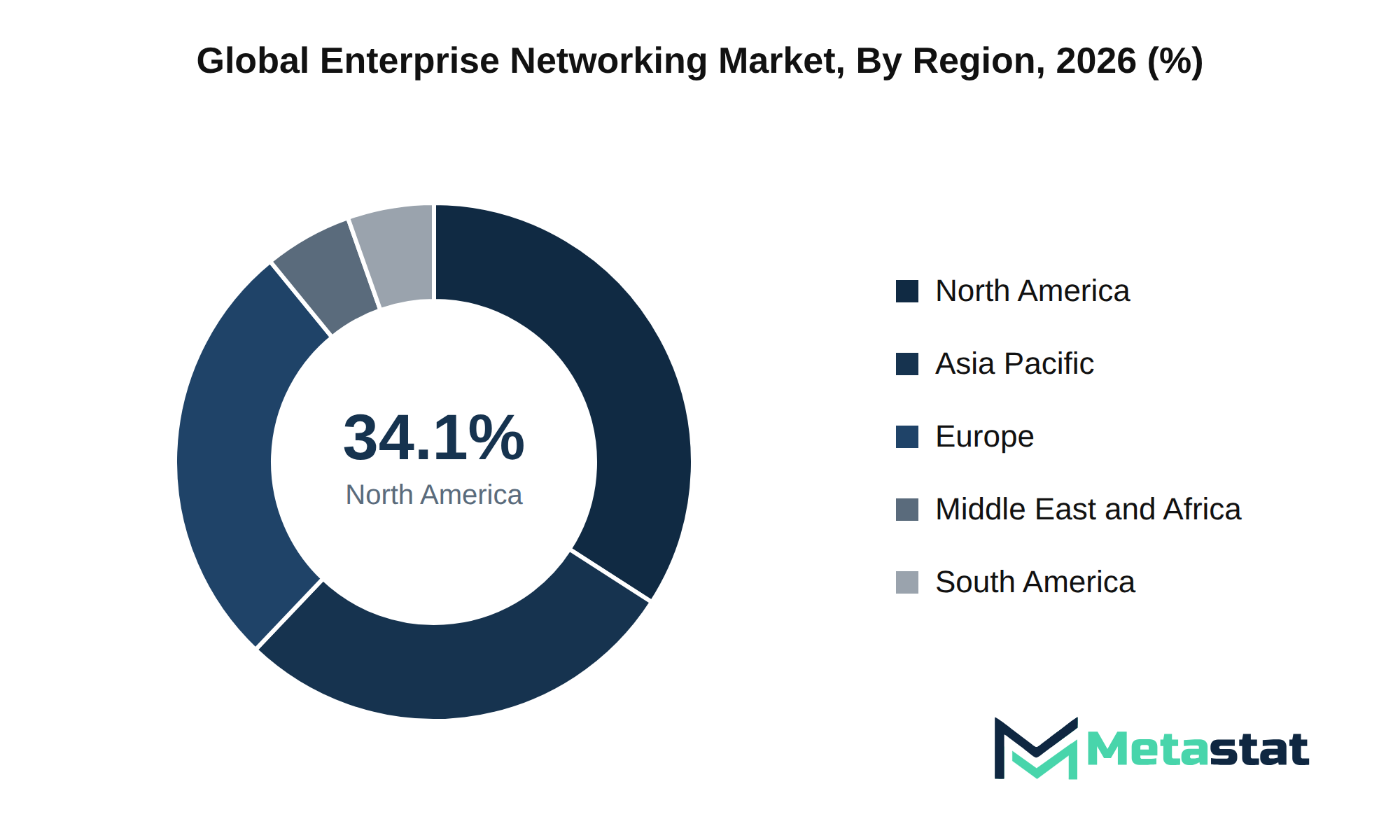
Geographic Lead: North America holds the highest market share at 34.1% in 2025, with the US leading in 2026, supported by advanced IT ecosystems and strong enterprise technology spending.
What's Inside: The report provides detailed segmentation by component, type, organization size, and end-use industry, with in-depth analysis of competitive dynamics, market drivers, and a forecast from 2026 to 2033.
Choose Your License
Global Enterprise Networking Market
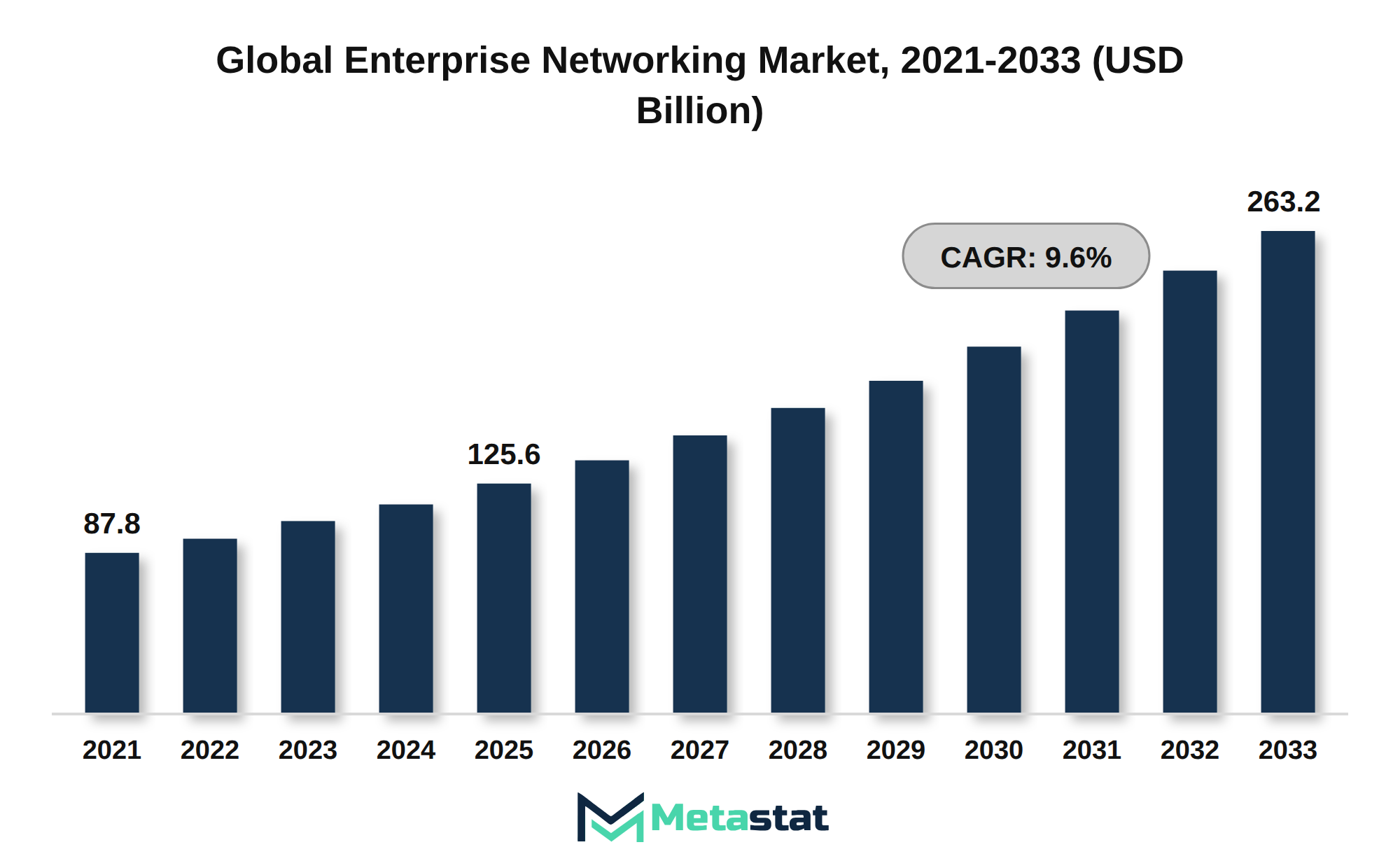
The global Enterprise Networking market was valued at USD 125.6 billion in 2025 and is projected to reach USD 263.2 billion by 2033, growing at a CAGR of 9.6% over the forecast period.
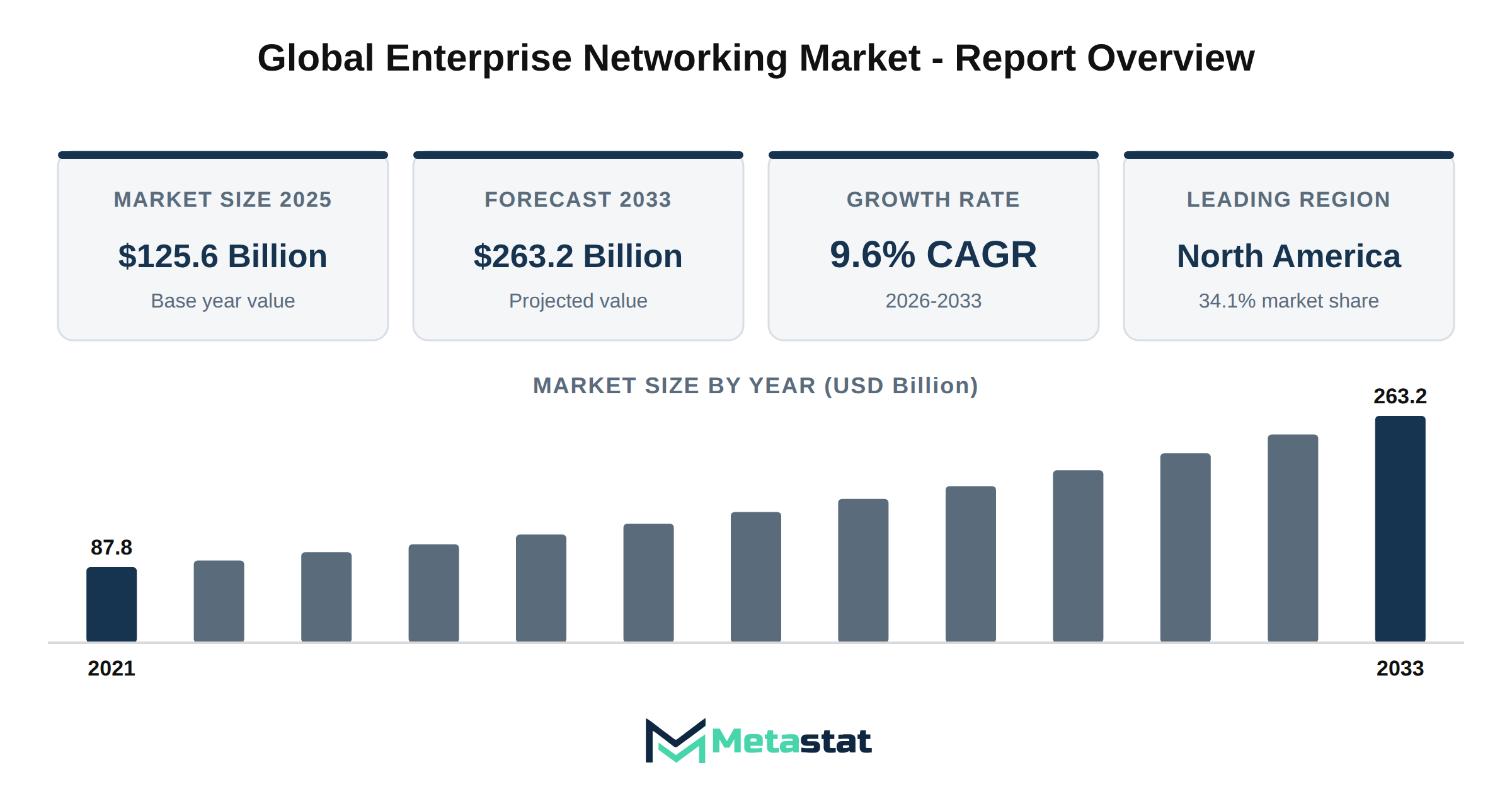
The Enterprise Networking market encompasses hardware, software, and services that enable data, voice, and video communication within and between organizations. Enterprises invest in these solutions to streamline operations, support remote and hybrid workforces, and secure increasingly complex digital environments. Hardware remains the segment with the most value. This reflects sustained demand for robust infrastructure in both established and expanding businesses. These physical installations frequently converge with broader commercial security infrastructure, including IP video surveillance and networked access controls. North America holds 34.1% of the market in 2025. The US leads in 2026.
Growth is driven by the rapid adoption of cloud applications and digital transformation strategies across industries. Organizations prioritize infrastructure upgrades and integrated network management to increase agility and minimize downtime. Demand responds to evolving requirements for speed, scalability, and security, especially for industries managing sensitive data or compliance obligations.
Within the global market, North America maintains the highest share, supported by advanced IT ecosystems and high enterprise technology spending. Continuous investment in next-generation solutions by sectors including BFSI, IT and telecommunications, and healthcare supports expansion. Buyers seek both performance improvements and long-term operational savings. This sustains demand for new deployments and upgrades. In European infrastructure corridors, specialized builds such as those within the Norway data center ecosystem illustrate ongoing enterprise capital deployment into secure regional network nodes.
Organizations allocate increasing budgets to the Enterprise Networking market to streamline connectivity, support hybrid workforces, and ensure secure data access across distributed locations. Buyers focus on upgrading legacy infrastructure to improve network agility and reliability, which supports new digital services and business models. Solutions in this space address requirements for high-performance networking, cloud integration, and centralized management. These capabilities are essential for enterprises aiming to enhance operational efficiency and maintain business continuity.
Among the segments, hardware accounts for the most value, reflecting sustained demand for switches, routers, and wireless LAN infrastructure that underpin network modernization. Enterprises rely on these components to expand capacity and reduce downtime. They enable reliable access for both remote and on-premises users. Software and services complement hardware investments by enabling automation, security, and analytics, but hardware remains the primary revenue contributor in this market.
North America holds 34.1% of the market in 2025, with the US leading in 2026. Large-scale digital transformation initiatives and strong adoption of advanced networking technologies among enterprises support this regional dominance. The key growth driver for the Enterprise Networking market is the rapid shift toward cloud-based applications, SME cloud services, and managed network services. This trend accelerates infrastructure upgrades and increases demand for scalable, secure solutions across industries.
AI-driven network automation is transforming daily operations for enterprises, shifting the market toward greater scalability and operational efficiency. Automated configuration, management, and optimization across virtual networking environments have become essential where manual oversight struggles to match the speed and accuracy demanded by digital business models. Suppliers are integrating artificial intelligence into network management solutions, enabling automated anomaly detection, predictive maintenance, and dynamic bandwidth allocation. This move addresses the increasing volume and variety of networked devices across large enterprises and small and medium enterprises, each group facing distinct operational complexity and resource constraints.
Within the market, software is projected to reach USD 88.2 billion by 2033, supported in part by the adoption of AI-driven network automation tools. Automation reduces operational costs by minimizing human error, shortening response times to network incidents, and enabling proactive rather than reactive network management. For organizations in sectors including IT and Telecommunications, which is forecast to reach USD 47.1 billion by 2033, these capabilities support higher availability and service quality expectations. Enterprises that deploy AI-based automation improve their ability to scale networks quickly in response to organizational growth, while controlling costs and maintaining compliance with evolving security requirements. The commercial consequence is a shift in competitive advantage toward those who rapidly integrate intelligent automation, setting a new benchmark for efficiency and resilience in enterprise operations.
Flexible purchasing and contract models influence adoption of SD-WAN and Secure Access Service Edge (SASE) solutions, particularly for organizations operating distributed branch networks. Enterprises increasingly seek pay-you-grow subscription models and managed service agreements to access advanced SD-WAN and SASE features without large upfront investments. This approach supports rapid scaling and simplifies budgeting. Small and medium enterprises are projected to drive segment growth at a CAGR of 10.8%. Buyers focus on solutions that integrate security and networking through a single platform, reducing complexity and total cost of ownership. Providers respond with bundled offerings that combine hardware, software, and cloud-based management in recurring service contracts. This lowers the barrier to entry for new branches or remote sites.
Managed SD-WAN and SASE services enable organizations to match expenditures with evolving connectivity demands, reducing risk and increasing operational agility. Enterprises benefit from predictable cost structures tied to actual usage. Suppliers secure longer-term revenue streams. The shift from capital-intensive purchases to operating expense models drives increased adoption of secure branch networking solutions and encourages ongoing upgrades while technology advances. Buyers gain greater flexibility while suppliers achieve stronger account retention and recurring revenue stability.
Wi-Fi 7 and high-speed Ethernet are transforming campus network architecture for large enterprises and educational institutions with high-density user environments. The push to support more simultaneous devices, bandwidth-heavy applications, and ultra-low latency requirements is rapidly changing network design strategies. Newer Wi-Fi standards are driving upgrades in both wireless and wired backbones, with buyers seeking equipment engineered for multi-gigabit throughput across expanded coverage areas.
Within the Enterprise Networking market, hardware upgrades driven by these new standards are accelerating. Segment data show that hardware solutions are projected to reach USD 112.4 billion by 2033. This reflects a steady upgrade cycle among organizations that prioritize uninterrupted connectivity, robust security, and centralized management in their campus deployments. For segments including education and healthcare, the transition to Wi-Fi 7 and high-speed Ethernet is not just a speed upgrade but a foundational change, enabling real-time collaboration, advanced learning tools, and connected medical devices. In industrial and critical campus settings, these local architectures often interface with private industrial 5G networks to support low-latency mission-critical connectivity.
Commercially, the shift to Wi-Fi 7 and high-speed Ethernet in the Enterprise Networking market is influencing vendor strategies and buyer requirements. Networking suppliers now integrate advanced radios, AI-driven network management, and enhanced power delivery into access points and switches to meet evolving demands. Organizations investing in these solutions secure a competitive advantage in user experience, operational efficiency, and future scalability.
Cloud-managed networking is shifting enterprise infrastructure buying decisions by transferring network management responsibilities from on-premises teams to cloud-hosted platforms. Buyers in sectors including IT and telecommunications, BFSI, and large enterprises are increasingly attracted to the operational flexibility and central visibility delivered by these solutions. The expanding influence of software-driven approaches is reflected in the Enterprise Networking market’s software segment, which is projected to reach USD 88.2 billion by 2033. This shift enables faster deployment cycles and lowers the upfront capital outlay. Buyers are moving from hardware-centric procurement to software and subscription-based models. Service providers and technology vendors introduce new offerings that streamline upgrades and maintenance. Enterprises now compare total cost of ownership over multi-year periods rather than focusing solely on initial investment. This procurement transition frequently influences where organizations host computing hardware, driving reliance on third-party colocation facilities to house core interconnection backbones.
Cloud-managed networking reduces complexity, so purchasing decisions now emphasize scalability and integration with existing cloud infrastructure. Enterprises deploying cloud-managed solutions or an integrated cloud management platform benefit from centralized policy enforcement and simplified updates. These factors directly influence recurring revenue models and multi-site network consistency. Demand is shifting toward software and services, with the Enterprise Networking market experiencing a marked acceleration in adoption among distributed enterprises and organizations standardizing cloud-first strategies. This dynamic is changing vendor selection criteria, with buyers placing greater weight on security, automation, and ease of management in their infrastructure investments.
Widespread enterprise cloud migration is increasing demand for scalable, high-performance networking infrastructure. Organizations in banking, IT and telecommunications, manufacturing, and healthcare are shifting workloads and applications to public and hybrid cloud environments, which strains legacy on-premises architectures and accelerates network refresh cycles. Buyers prioritize hardware, software, and services optimized for secure cloud access, bandwidth management, and policy-based automation, which supports market growth. Solutions that provide reliable connectivity between branch offices, data centers, and cloud platforms are experiencing accelerated uptake, particularly where distributed workforces and mobile access requirements are highest. Continuous investment in cloud integration supports higher average selling prices for advanced Ethernet switches, SD-WAN, and network security platforms. This dynamic is expected to support sustained revenue expansion through 2033, with cloud-centric architectures becoming foundational for digital business operations.
High upfront investment requirements restrict adoption among small and medium enterprises, even while larger organizations steadily expand their deployments. Hardware and software procurement for new-generation network infrastructure often exceeds the budget flexibility of smaller buyers, leading to delayed or scaled-back upgrades. In this market, this constraint results in slower uptake from the SME segment, despite the rising demand for advanced connectivity and secure access. The segment is projected to reach USD 108.6 billion by 2033, yet growth trails larger enterprises, which have greater capital and operational capacity to implement comprehensive solutions. Persistently high pricing for next-generation networking limits access for cost-sensitive buyers, who reduce order volumes or extend replacement cycles, directly impacting the pace of adoption and the overall growth trajectory for the market.
Rising competition among established vendors and new entrants is intensifying pricing pressure in the Enterprise Networking market. Suppliers frequently lower margins to secure contracts with large enterprises and public sector buyers that demand bulk procurement and multi-year service agreements. This dynamic is pronounced in hardware and software subsegments, where buyers compare offerings across a broad set of global providers. To protect profitability, suppliers invest in value-added services, network management software, and bundled support packages that differentiate their portfolios beyond price. Intensified competition encourages several providers to streamline product lines or automate support, seeking operational savings that offset lower average selling prices. In the Enterprise Networking market, this focus on efficiency and differentiation is expected to influence portfolio strategies and technology integration decisions for suppliers through the forecast period.
Software is projected to deliver the fastest growth opportunity for suppliers in the Enterprise Networking market. The software segment is expected to reach USD 88.2 billion by 2033, advancing at a compound annual growth rate of 11.1 percent, outpacing both hardware and services in terms of expansion. This reflects strong demand for network management, automation, and security platforms that address shifting enterprise requirements for agility, cloud integration, and centralized control. Vendors with software-centric offerings, including SDN, network security, and cloud-based orchestration, are positioned to capture higher-margin revenue streams while organizations prioritize flexible and scalable solutions over legacy infrastructure. Enterprises in sectors with rising digital transformation investments, including IT and telecommunications, increasingly select software-driven architectures to accelerate deployment and streamline ongoing operations.
The Global Enterprise Networking market is segmented based on Component, Type, Organization Size, and End-Use Industry.
Valued at USD 64.1 billion in 2026 and projected to reach USD 112.4 billion by 2033, hardware forms the physical backbone of enterprise connectivity, supporting switches, routers, wireless access points, and specialized devices critical for reliable business operations. Large enterprises and IT service providers drive procurement to support high-density environments, branch expansions, and ongoing replacement cycles. Hardware outpaces services in segment value, though its 8.4% CAGR trails the 11.1% projected for software in the Enterprise Networking market. Demand for advanced hardware is reinforced by the proliferation of connected devices and higher throughput requirements in sectors including BFSI and IT, where infrastructure upgrades are essential to meet data growth. Segment buyers prioritize performance, compatibility, and vendor support, which differentiates hardware from software, where flexibility and integration with cloud-native management set the pace. In the Enterprise Networking market, hardware suppliers face pricing competition driven by new entrants and established vendors responding to rising enterprise expectations for cost-effective, scalable solutions.
Software segment is estimated to reach USD 88.2 billion by 2033, at a CAGR of 11.1% during the forecast period. Buyers invest in this segment to streamline network management, automate policy enforcement, and deliver secure remote access across hybrid and multi-cloud environments. Large enterprises and IT and telecommunications organizations favor software for its scalability and ability to adapt to evolving digital infrastructure demands. Unlike hardware or services, software delivers the fastest growth in the Component group, outpacing the 8.4% CAGR of hardware. This outperformance is driven by rapid adoption of network virtualization, software-defined networking, and centralized orchestration tools that reduce operational complexity. Enterprises prioritize software solutions when seeking to lower total cost of ownership and enable flexible integration with cloud-native workloads. Compared to hardware, software is more frequently adopted by organizations seeking agility and ongoing optimization in their network strategy, reflecting the shift toward programmable and cloud-aligned architectures.
Services in the Enterprise Networking market include consulting, integration, maintenance, and support, addressing both deployment and ongoing management for organizations that lack in-house networking expertise or that choose to outsource critical network operations. Buyers for this segment typically include mid-sized and large enterprises in regulated or complex sectors including BFSI, healthcare, and government, where specialized skills are critical and errors carry high operational risk. The primary force driving growth is the increasing complexity of network environments, which pushes organizations to rely on expert service providers for network optimization and security assurance. Compared to the hardware and software segments, services register slower expansion: hardware is projected to outpace services with a higher absolute market value, while software is expected to grow faster with a higher CAGR. Service providers in this segment differentiate through bundled support offerings, compliance expertise, and tailored managed network solutions that address sector-specific requirements.
Valued at USD 32.1 billion in 2026 and projected to reach USD 56.5 billion by 2033, Ethernet Switches sustain an 8.4% CAGR through the forecast period. These devices serve enterprise IT departments and managed service providers by supporting reliable wired connectivity for core, edge, and access network layers, accommodating growing traffic loads in corporate data centers and campus environments. Organizations upgrade to higher-speed switches to handle bandwidth-intensive applications and IoT device integration, particularly in industries where deterministic performance and low latency are operational requirements. Compared with SD-WAN and WAN Edge Solutions, which post a higher CAGR of 13.4%, Ethernet Switches expand at a steadier rate, reflecting their established role in physical network infrastructure. Pricing for Ethernet Switches tends toward a premium, driven by advanced Layer 2/3 capabilities and security features required by large enterprises. The market sees a clear distinction in buyer priorities: while software and virtualized solutions attract buyers seeking rapid deployment, Ethernet Switches remain essential for organizations prioritizing robust and scalable wired architectures. The market continues to rely on these switches for mission-critical environments where reliability is non-negotiable.
Enterprise Routers and Gateways segment is estimated to reach USD 34 billion by 2033, at a CAGR of 8% during the forecast period. These solutions function as critical network nodes, directing data traffic and integrating disparate enterprise networks. Organizations in banking, finance, government, and telecommunications deploy advanced routers and gateways to ensure secure, high-throughput connectivity between branch offices, data centers, and remote users. Security upgrades and the shift to application-centric workflows drive sustained investment in this segment. In comparison to Ethernet Switches, which are projected to grow at 8.4%, Enterprise Routers and Gateways post a slower CAGR, reflecting their longer replacement cycles and higher unit prices. The market’s demand for advanced routing functions, including SD-WAN integration and multi-protocol support, accelerates adoption among large enterprises with complex network environments. Digital transformation in regulated industries positions routers and gateways as essential for policy enforcement and reliability.
Wireless LAN segment is expected to reach USD 36.4 billion by 2033. Enterprises of all sizes deploy Wireless LAN to deliver reliable connectivity for employees, guests, and IoT devices in office campuses, warehouses, and retail environments. This segment is driven by demand from organizations seeking flexible, scalable wireless access to support mobile workforces and increased device density. Compared with Ethernet Switches, which show a CAGR of 8.4%, Wireless LAN addresses use cases where cable-based solutions are impractical or less cost-effective, and buyers prioritize mobility and ease of expansion. Rapid refresh cycles for wireless equipment result from new standards enabling higher data rates and more reliable coverage, fueling ongoing replacement and upgrade projects. In this segment, buyers often include educational institutions, healthcare facilities, and retailers focused on visitor engagement and operational efficiency. These customers differentiate Wireless LAN from segments like Enterprise Routers and Gateways by assigning greater value to mobility and user experience.
Projected to deliver a 13.4% CAGR through 2033, SD-WAN and WAN Edge Solutions deliver virtualized connectivity and centralized control for enterprises operating across multiple sites. Adoption is concentrated among organizations with distributed workforces and high reliance on cloud applications, particularly those seeking to streamline branch connectivity and security policies without heavy investment in legacy hardware. Demand for these solutions rises while enterprises replace traditional WAN architectures with software-defined approaches that improve flexibility and application performance. Compared to Ethernet Switches and Enterprise Routers and Gateways, both of which sustain CAGRs below 9%, the SD-WAN and WAN Edge Solutions segment outpaces other types in the Enterprise Networking market by capitalizing on demand for scalable, application-aware traffic management. Buyers in this segment often prioritize rapid deployment and policy automation across diverse environments, setting it apart from slower-growing, hardware-centric types that rely on physical infrastructure updates. Vendors competing in this segment differentiate on cloud integration, security enhancements, and simplified management interfaces.
Protection of digital assets and secure access to distributed resources define this segment, with buyers spanning financial services, healthcare, government, and technology providers. Central drivers include the sharp increase in remote work and device proliferation, which has expanded attack surfaces and pushed organizations to prioritize robust authentication, threat detection, and zero trust architectures. These features draw sustained investment from heavily regulated sectors with sensitive data, including banking and healthcare, where regulatory compliance and risk mitigation drive technology adoption. Unlike Ethernet Switches or Enterprise Routers and Gateways, Network Security and Secure Access solutions serve a risk management function rather than focusing on pure connectivity or throughput, resulting in distinct purchase criteria and budget allocation patterns. Demand in this segment is influenced by regulatory changes and emerging cybersecurity threats that continually reshape requirements. Buyers in this sub-segment frequently seek integrated platforms capable of unified policy enforcement and rapid incident response. Providers differentiate through advanced encryption, continuous monitoring, and adaptive access controls.
Network management, monitoring and automation solutions are deployed to enable real-time visibility, remote configuration and performance optimization for complex enterprise infrastructure. IT and telecommunications providers, financial institutions, and large enterprises use these platforms to streamline operations, reduce manual intervention, and quickly diagnose disruptions. The shift toward intent-based networking and integration of analytics-driven automation is supporting higher network uptime and proactive issue resolution, leading to lower operational overhead for buyers. Compared with hardware-intensive segments, network management, monitoring and automation solutions require minimal physical footprint and drive value through software innovation and orchestration capabilities. Rapid increases in network complexity, including hybrid and multi-cloud architectures, are pushing organizations to invest in more advanced management and monitoring suites. This segment attracts buyers aiming for scalable policy enforcement and rapid incident response, while procurement in the hardware segment is driven primarily by capacity expansion. Buyers seeking operational efficiency and adaptability for enterprise IT teams are increasingly prioritizing intelligence and automation in their network management investments.
Network virtualization and software-defined networking (SDN) technologies change how enterprises design, operate, and scale their networks. Buyers primarily include large organizations and cloud-first businesses seeking flexible, programmatic control over network resources, with key adoption drivers rooted in rising complexity, rapid application deployment demands, and the operational savings realized through automation. The market increasingly shifts toward orchestration platforms that decouple network control from hardware, reducing vendor lock-in and supporting multi-vendor strategies. Compared to Ethernet Switches or Enterprise Routers and Gateways, this sub-segment addresses the requirements of enterprises prioritizing agility, rapid reconfiguration, and integration with cloud and hybrid environments. In the market, SDN solutions appeal to IT and telecommunications providers and high-growth technology firms looking to streamline infrastructure management and reduce manual intervention. While not the fastest-growing segment by CAGR, adoption of network virtualization and SDN increases with organizations prioritizing network programmability and adaptability over traditional hardware-centric approaches in this segment.
Application delivery controllers and WAN optimization solutions support enterprises in delivering fast, reliable, and secure access to mission-critical applications across distributed locations. Telecommunications providers, financial institutions, and large-scale retailers deploy these technologies to accelerate application performance, reduce latency, and ensure business continuity, especially for cloud-based and SaaS environments. In the Enterprise Networking market, demand for this sub-segment is shaped by the migration of business applications to hybrid or multi-cloud architectures and the increasing complexity of distributed workforces. Unlike segments driven by core connectivity hardware, this group is influenced by the need for advanced traffic management and optimization to control bandwidth costs and deliver a consistent user experience. Buyers in the Enterprise Networking market seeking these tools often prioritize value-added features over price, differentiating this segment from standardized switching and routing categories where cost competition prevails.
Small and Medium Enterprises segment is valued at USD 52.9 billion in 2026 and is projected to reach USD 108.6 billion by 2033, at a CAGR of 10.8% during the forecast period. This segment includes businesses seeking scalable, secure, and cost-efficient networking solutions to support hybrid workforces, digital operations, and cloud adoption. Buyers in this group often require products that balance affordability with advanced security and reliable connectivity, driving interest in integrated solutions and managed services. Growth among Small and Medium Enterprises outpaces Large Enterprises, reflected by the higher CAGR of 10.8% compared to 8.9%. Faster expansion results from heightened digital transformation initiatives and greater willingness to deploy cloud-managed and software-driven networking, which lower entry barriers for implementation and maintenance. Pricing sensitivity and limited in-house IT resources distinguish this segment from larger organizations, shaping solution design and vendor engagement strategies across the market.
Estimated to reach USD 154.6 billion by 2033, this segment addresses the requirements of organizations with large-scale, distributed operations and complex IT environments. Large enterprises rely on advanced networking infrastructure to support high user density, mission-critical applications, and robust security protocols. The segment’s 8.9% CAGR reflects ongoing investments in scalable, high-capacity networking solutions that handle growing data volumes from digital transformation and hybrid work models. Demand in large enterprises is driven by the integration of cloud computing and edge services, which requires reliable connectivity and secure access across multiple locations. Compared to small and medium enterprises, growth is slightly slower, with small and medium enterprises delivering a 10.8% CAGR, but the absolute revenue is higher due to the scale at which large organizations operate. Buyers in this segment often prioritize resilience, compliance, and integration with legacy systems, which raises complexity and average deployment cost relative to smaller organizations. Strong demand continues from banks, manufacturers, and technology providers seeking to modernize their digital infrastructure.
USD 25.3 billion in segment value in 2026 is projected to reach USD 45.6 billion by 2033, advancing at a CAGR of 8.8%. Financial institutions, insurance providers, and capital market players invest in integrated networking to support digital banking, regulatory compliance, and secure transaction processing. The market in banking and financial services is influenced by rising digitization, with buyers prioritizing secure, high-performance infrastructure for real-time transactions and fraud detection. More stringent regulatory requirements and demand for continuous uptime further accelerate upgrades from legacy networks. This segment’s 8.8% CAGR trails the IT and Telecommunications segment, which posts 10.1%, yet the BFSI sector carries higher average deal values reflecting compliance, security, and reliability demands. Compared to other end-use industries, buyers face distinct integration needs with core banking systems and address critical infrastructure protection, resulting in sustained investment in advanced solutions throughout the forecast period. The market in BFSI continues to evolve in response to regulatory change and the expansion of digital platforms.
Estimated to reach USD 47.1 billion by 2033 with a projected CAGR of 10.1%, this segment serves network operators, telecommunications providers, and IT service companies requiring scalable, low-latency infrastructure for data transmission, cloud connectivity, and digital service delivery. Demand is driven by surging data traffic from 5G rollouts, edge computing, and the rapid expansion of cloud-based services, which intensify requirements for high-throughput and reliable networking solutions. Compared with BFSI, which is projected to reach USD 45.6 billion by 2033 at a CAGR of 8.8%, IT and Telecommunications delivers faster growth. Buyers in this segment invest in advanced enterprise networking hardware and software to support bandwidth-intensive applications and virtualized workloads. The need for integration across multi-cloud environments and real-time analytics further differentiates the IT and Telecommunications segment from other end-use industries in the Enterprise Networking market. Suppliers in the Enterprise Networking market respond to these demands with specialized solutions tailored for carrier-grade performance and rapid scalability.
Expected to reach USD 28.6 billion by 2033, this segment encompasses federal, state, and local agencies investing in secure, scalable communication infrastructure. Public sector organizations rely on network modernization for digitizing citizen services, real-time interdepartmental collaboration, and supporting e-governance initiatives. Regulatory mandates around data sovereignty and cybersecurity drive recurring upgrades, influencing procurement cycles and solution choices. Unlike financial services or IT and telecommunications, government deployments involve unique security requirements and legacy system integration, leading to longer procurement timelines and specialized vendor involvement. In comparison to segments like healthcare, where adoption responds quickly to emerging connectivity needs and regulatory shifts, public sector projects advance at a measured pace, prioritizing resilience and compliance over pure speed of deployment. This segment responds to national digital transformation agendas, with funding cycles and tender processes setting it apart from commercial buyers in the broader market.
Healthcare segment is projected to grow at a CAGR of 10.8% during the forecast period. Hospitals, clinics, and integrated delivery networks drive adoption by expanding digital record systems, telehealth services, and real-time patient monitoring. The demand for secure, always-on connectivity to support stringent data privacy and regulatory compliance standards pushes this segment to deploy robust infrastructure. Compared to BFSI, which is projected at an 8.8% CAGR, healthcare advances more rapidly, reflecting higher urgency around digital transformation and the need for unified communications across complex, multi-site systems. Healthcare buyers prioritize interoperability with medical devices, integration of IoT endpoints, and high availability for mission-critical applications. Stricter data protection requirements and the proliferation of connected diagnostic equipment raise both network complexity and security requirements. Higher investment in scalable, compliant solutions supports the segment’s above-average growth trajectory.
Institutions in the education segment deploy advanced connectivity solutions to support digital learning, smart campus initiatives, and large-scale administrative systems. Demand originates from universities, colleges, K-12 schools, and vocational centers that require secure, scalable, and high-performance networks for online coursework, remote collaboration, and access to cloud-based educational resources. Heightened network traffic from e-learning tools and streaming content has led buyers in this segment to prioritize bandwidth management, wireless access, and security controls. Compared to healthcare or BFSI segments, education buyers tend to operate under tighter budget constraints, with purchasing cycles influenced by public funding and grant availability. Flexible solutions including cloud-managed wireless and network segmentation tailored for multi-campus deployments address these needs. In contrast to the IT and Telecommunications segment, where spending is driven by business continuity and uptime, educational institutions focus spending on affordable infrastructure upgrades and safeguarding student data, shaping unique requirements for vendors.
Omnichannel retail strategies drive significant technology adoption in the Retail and E-Commerce segment. Retailers and online platforms invest in advanced connectivity solutions to support integrated inventory management, in-store digital experiences, and efficient backend operations. Fast, secure, and scalable network infrastructure is essential for unifying point-of-sale systems, customer engagement platforms, and supply chain tracking across physical and digital channels. Buyers in this segment include organized brick-and-mortar chains, pure-play e-commerce providers, and hybrid retailers expanding digital footprints. Two factors shape demand: surging online transaction volumes require resilient, low-latency connectivity, while heightened security pressures from payment data regulations increase the demand for robust network security solutions. Unlike Manufacturing or Energy and Utilities, the Retail and E-Commerce segment faces a unique combination of customer-facing technology integration and frequent traffic spikes around promotions or holidays. This creates distinct requirements for scalability and real-time response, supporting sustained investment among retailers navigating digital transformation. Cloud-managed networking and edge connectivity solutions see strong adoption, with vendors like Cisco Systems, Inc., Aruba (Hewlett Packard Enterprise Development LP), and Ubiquiti Inc. supporting this segment’s growth.
Manufacturing buyers integrate advanced connectivity technologies to support automation, real-time monitoring, and flexible production environments. This segment attracts industrial operations upgrading legacy infrastructure to enable robotics, IoT sensors, and data-driven process control. Rising investments in smart factories and digital supply chains drive the requirement for high-bandwidth, low-latency networks that support device interoperability and production analytics. Compared to segments including BFSI or IT and Telecommunications, manufacturing buyers prioritize reliability and operational continuity over customization or rapid feature upgrades. Adoption barriers reflect the need for network solutions robust enough to operate in harsh industrial settings and compatible with legacy production equipment. While healthcare and IT sectors report faster growth rates, manufacturing’s demand in this market is distinguished by scale and infrastructure complexity, with factories modernizing to compete under Industry 4.0 standards. Security, uptime, and integration with operational technologies influence purchasing decisions in this segment.
Utilities and energy providers deploy networking infrastructure to connect power generation sites, substations, control rooms, and remote assets across geographically dispersed locations. The segment’s buyers include public and private utility companies, energy distribution firms, and renewable energy operators, all requiring always-on connectivity for grid monitoring, real-time SCADA systems, and outage management. Heightened adoption is driven by the shift toward smart grids, where distributed energy resources, advanced metering, and automated control systems demand robust, scalable networks. This segment differs from others in the market in its operational technology integration and its focus on high-availability, ruggedized solutions able to withstand demanding physical environments. Data privacy and cybersecurity requirements in critical infrastructure environments influence supplier selection and procurement cycles, setting this segment apart from those in retail, education, or healthcare. Investment from energy and utilities is shaped by regulatory mandates for grid modernization and infrastructure resilience, driving specialized demand not present in other end-use groups.
Fleet operators and logistics providers use advanced networking solutions to coordinate shipments, manage connected assets, and maintain real-time visibility across distributed transportation hubs. Digitalization of supply chains and the adoption of telematics drive connectivity requirements that differ from those in sectors like BFSI or healthcare, where data sensitivity and compliance shape purchasing. The Enterprise Networking market in transportation and logistics is influenced by high demand for uninterrupted wireless coverage and scalable network capacity at ports, warehouses, and on the move. Buyers in this segment prioritize technologies that streamline route optimization and facilitate IoT integration for vehicle tracking. Unlike education or public sector buyers, transportation and logistics customers often operate in decentralized environments where reliable, secure access beyond fixed facilities is critical. Solutions supporting low-latency communications and broad device compatibility attract sustained investment, with providers seeking to minimize downtime and enhance operational efficiency throughout their networks. This adoption pattern drives unique demand dynamics in this segment.
Hospitality groups, media companies, and professional services firms drive this segment with a focus on guest experience, secure content delivery, and robust digital work environments. Hotels and resorts prioritize high-availability wireless and guest access solutions to differentiate their service offerings and meet rising customer expectations for bandwidth. Media and entertainment organizations depend on low-latency, high-bandwidth infrastructure to enable real-time streaming, content production, and collaborative workflows, supporting distributed teams and global audiences. Professional services buyers emphasize reliability, centralized management, and security integration to ensure client data protection and uninterrupted operations across multiple sites. Compared to segments including BFSI or healthcare, buyers in this category typically face more variable infrastructure spending patterns driven by event cycles, project-based work, and seasonality in guest activity. Technology refresh cycles are influenced by evolving user experience demands and digital content distribution models, leading to a different upgrade cadence than regulated or mission-critical industries. The diverse application landscape in this segment drives specialized requirements that differentiate it, supporting tailored solutions and adaptive infrastructure investments. These needs encourage vendors to develop flexible, scalable platforms targeting the unique operational challenges of hospitality, media, and professional services providers.
Based on geography, the Global Enterprise Networking market is divided into North America, Europe, Asia-Pacific, South America, Middle East, and Africa.
Enterprises in North America commit to large-scale digital transformation initiatives, with a strong emphasis on cloud-first strategies and scalable remote work infrastructure. IT decision-makers in the United States, Canada, and Mexico prioritize network security, high-speed connectivity, and the integration of advanced automation tools. The region’s market growth is driven by enterprise requirements for resilient, low-latency communication and advanced threat management. Investments in AI-powered network management and the rapid adoption of hybrid and multi-cloud architectures differentiate the market in North America, supporting complex operational demands across financial services, high-tech manufacturing, and critical national infrastructure. North America is projected to reach USD 85.5 billion by the end of 2033, reflecting the region’s sustained technology leadership and ongoing investments in next-generation connectivity solutions for highly distributed organizations.
Rising deployment of next-generation connectivity solutions in Germany, France, and the UK supports steady expansion in the Enterprise Networking market across Europe. Demand intensifies among financial services, automotive, and advanced manufacturing sectors investing in secure, high-throughput network infrastructure for digital transformation and automation. This region holds a 27.00% share of global revenue in 2025, reflecting a strong base of established multinational enterprises and public sector organizations prioritizing data sovereignty and compliance with evolving privacy regulations. The presence of well-developed high-speed broadband and data center infrastructure further strengthens the market, attracting technology suppliers focused on software-driven and cloud-managed network solutions. Ongoing investment in private 5G, edge computing, and secure remote access drives continuous upgrades and integration, which distinguishes Europe for scalable and resilient network deployments.
Buyers in Asia Pacific account for 28.0% of global spending in 2025, driven by escalating enterprise digitization and rapid expansion of wireless and cloud-based applications. In China and India, widespread investments in digital infrastructure support large-scale deployments of advanced networking hardware and software. Japanese and South Korean organizations accelerate migration to next-generation connectivity, adopting scalable solutions to address surging data demands and distributed workforces. Increased technology spending by Australian enterprises and public initiatives in Southeast Asia stimulate further adoption. Vendors serving the market in this region adapt to distinct regulatory frameworks and high device density requirements, shaping solution portfolios to fit local operational priorities. Intense competition and a focus on cost efficiency promote swift uptake of network automation and software-defined options, setting Asia Pacific apart in global market development.
Enterprises in Brazil and Argentina accelerate adoption of advanced networking infrastructure to support expanding digital business models and cloud-native operations. Regional demand is shaped by a growing base of technology-driven startups and local service providers investing in flexible, scalable connectivity platforms. The market in this region reflects a preference for solutions that address high network latency and intermittent connectivity challenges. In particular, organizations in Brazil seek equipment and software upgrades to improve reliability across dispersed operations, while Argentinian businesses emphasize cost-effective deployment models to manage limited capital budgets. Regulatory incentives for telecom sector modernization further influence the pace and scope of regional network upgrades, supporting broader participation in the market among small and medium enterprises.
Growth in the Middle East and Africa reflects accelerated investment in secure, reliable connectivity for banking, oil and gas, and government operations. Saudi Arabia and the UAE show rising adoption of dedicated networking hardware and software, supporting digital infrastructure upgrades across both public and private sector organizations. Demand from South Africa centers on replacing legacy network systems to address increased cloud workloads and remote access requirements in regulated industries. Price sensitivity shapes procurement strategies throughout the region, with buyers focusing on scalable solutions that support future digital transformation. Suppliers encounter opportunities linked to infrastructure modernization and changing business needs in major urban and financial hubs. Ongoing attention to cybersecurity and compliance requirements contributes to the steady pace of technology upgrades within this region.
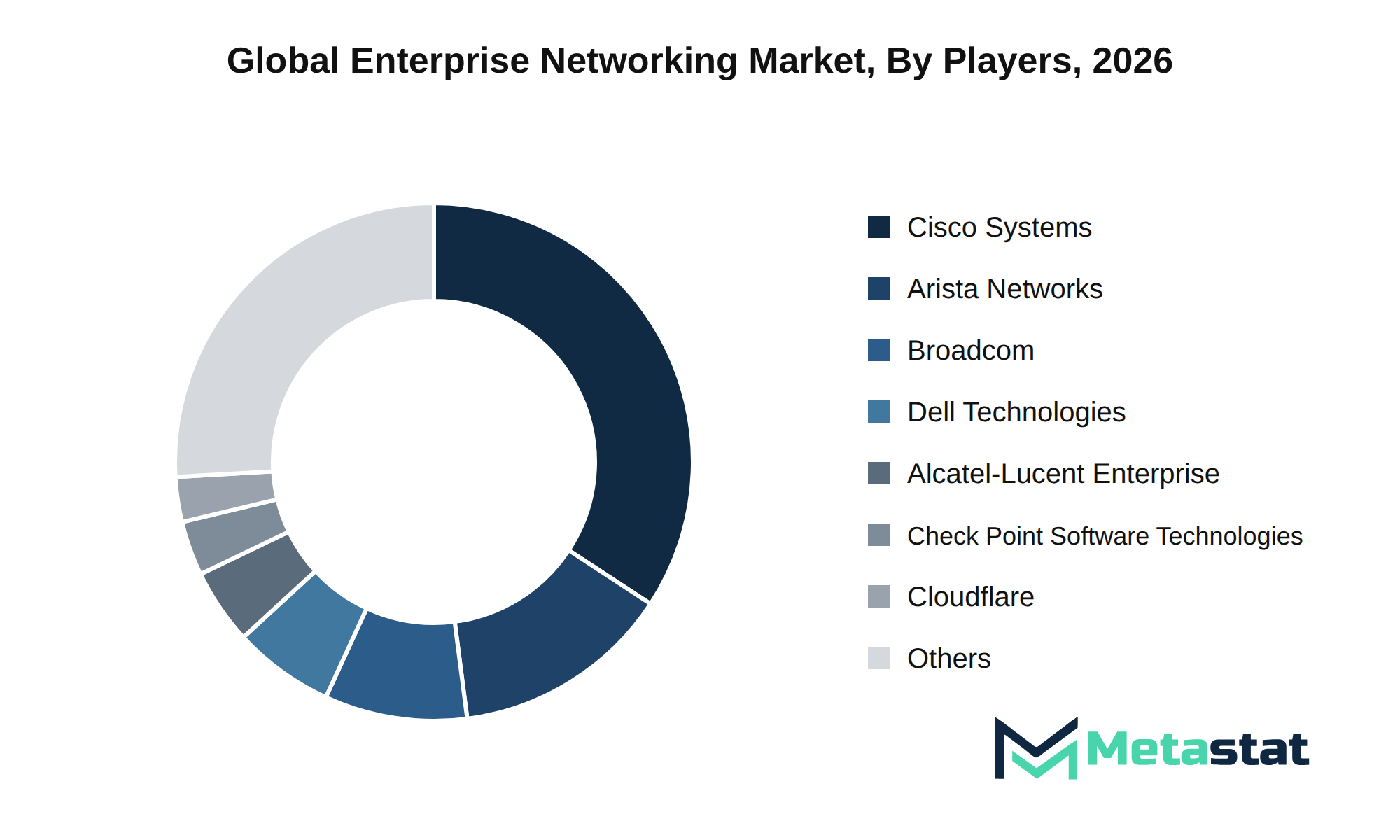
Competition in the Enterprise Networking market centers on continuous product innovation, scalability, and integration capabilities to address evolving enterprise connectivity and security demands. Buyers prioritize comprehensive solutions that deliver performance, reliability, and advanced features, selecting vendors on the basis of service breadth, technology advancement, price competitiveness, and the strength of their ecosystem. Vendors distinguish themselves by offering differentiated portfolios across core segments including hardware, software, and services, and by focusing on vertical-specific solutions.
Cisco Systems, Inc. is recognized for its extensive range of networking infrastructure, serving enterprises seeking scalable and secure connectivity. Fortinet, Inc. prioritizes network security integration, supporting organizations with unified threat management and advanced security features. Juniper Networks, Inc. emphasizes high-performance hardware and software-defined networking, addressing the requirements of data-intensive industries. Companies including Arista Networks, Inc. and Hewlett Packard Enterprise Development LP focus on robust switching solutions and cloud-managed networking, appealing to organizations investing in next-generation architectures. Meanwhile, Cato Networks Ltd. and Versa Networks, Inc. address demand for SD-WAN and cloud-native networking, supporting distributed enterprise environments.
The Enterprise Networking market features established hardware suppliers along with software-centric innovators, with competition shaped by the acceleration of digital transformation and rising demand for integrated, secure, and scalable networking. Buyers increasingly select partners able to deliver end-to-end solutions and support multi-cloud strategies, particularly in sectors including IT and telecommunications and large enterprises.
Achieving this growth depends on advancement in network software and security, increased adoption of software-defined networking, and strong demand from small and medium enterprises. Software is projected to be the fastest growing component, reaching USD 88.2 billion by 2033, supported by rising enterprise investments in cloud-managed networking and security in sectors including IT and telecommunications. The rapid uptake of SD-WAN and WAN edge solutions, projected for the highest compound annual growth rate among type segments, is reshaping enterprise network strategies, particularly in Asia Pacific, where digital infrastructure investment accelerates. Small and medium enterprises are forecast to expand their share, driven by scalable and cost-effective networking options, supporting higher overall volume. The main risk to this outlook is persistent supply chain constraints affecting hardware availability, which restricts hardware segment growth and delays infrastructure upgrades in regions like Europe and South America. If suppliers address these disruptions and enterprises sustain investment in automation and cloud-first networking, the Enterprise Networking market is expected to maintain a strong growth trajectory through 2033.
By Component: Hardware, Software, Services
By Type: Ethernet Switches, Enterprise Routers and Gateways, Wireless LAN, SD-WAN and WAN Edge Solutions, Network Security and Secure Access, Network Management, Monitoring and Automation, Network Virtualization and SDN, Others (Application Delivery Controllers, WAN Optimization)
By Organization Size: Small and Medium Enterprises, Large Enterprises
By End-Use Industry: BFSI, IT and Telecommunications, Government and Public Sector, Healthcare, Education, Retail and E-Commerce, Manufacturing, Energy and Utilities, Transportation and Logistics, Others (Hospitality, Media and Entertainment, Professional Services)
The report strategically identifies and profiles the key market players and analyses their core competencies in each sub-segment of the Enterprise Networking market.
|
Report Attributes |
Details |
|
Study Period |
2021-2033 |
|
Base Year |
2025 |
|
Estimated Year |
2026 |
|
Forecast Period |
2026-2033 |
|
Historical Period |
2021-2025 |
|
Growth Rate |
CAGR 9.6% from 2026 to 2033 |
|
Revenue Unit |
USD billion |
|
Segmentation |
|
|
By Region |
North America (By Component, Type, Organization Size, End-Use Industry, and Country)
|
|
|
|
Asia Pacific (By Component, Type, Organization Size, End-Use Industry, and Country)
|
|
|
|
|
Middle East and Africa (By Component, Type, Organization Size, End-Use Industry, and Country)
|
Find answers to common questions about this report
The Enterprise Networking market size was valued at USD 125.6 billion in 2025.
The projected CAGR is 9.6% for the forecast period from 2026 to 2033.
The North America Enterprise Networking market size is estimated to reach USD 85.5 billion by 2033.
Ethernet Switches lead the type segment with a projected value of USD 56.5 billion in 2033, the highest among all type segments. This figure surpasses Enterprise Routers and Gateways at USD 34 billion and Wireless LAN at USD 36.4 billion in 2033.
Widespread enterprise cloud migration is increasing demand for scalable, high-performance networking infrastructure and driving network refresh cycles. Accelerated adoption of software-driven solutions for network management, automation, and security is supporting faster growth in the software segment.
North America holds the dominant share with 34.1 percent of the total market. This region is projected to reach USD 85.5 billion by 2033, the highest value among all regions.
High upfront investment requirements limit adoption among small and medium enterprises, resulting in slower uptake from this segment. Rising competition among suppliers is intensifying pricing pressure and reducing margins, challenging profitability and influencing portfolio strategies.
Accelerated cloud migration, demand for scalable high-performance infrastructure, and prioritization of software-driven network management and security platforms are driving adoption in this industry. Large enterprises expand deployments to support distributed workforces and digital transformation.
The Enterprise Networking market is estimated to reach a valuation of USD 263.2 billion by 2033.
Companies active in this sector include Cisco Systems, Inc., Hewlett Packard Enterprise Development LP, Juniper Networks, Inc., Arista Networks, Inc., Fortinet, Inc., Dell Technologies Inc., Huawei Technologies Co., Ltd., and Palo Alto Networks, Inc.
The analysts below cover Information & Technology research at Metastat Insights.
LEAD ANALYST
Utkarsh Khirodkar is a Lead Market Research Analyst at MetaStat Insight, specializing in market intelligence, technology sector assessments, and competitive strategy.

PRINCIPAL CONSULTANT - ENTERPRISE AI & EMERGING TECHNOLOGIES
Banking & Finance · Electronics and Semiconductor · Energy and Power · Healthcare IT · Information & Technology · Professional Services
Vijay Gunti is a Principal Consultant at MetaStat Insight, bringing over two decades of experience across enterprise digital transformation, technology strategy, and intelligent systems.

LEAD CONSULTANT - COMMUNICATION, TELECOM, AND IT
Electronics and Semiconductor · Information & Technology · Machinery & Equipment · Professional Services
Ravindra Sathe Consultants for Communication, Telecom, and IT at MetaStat Insight. He leads the firm's industry research initiatives across telecommunications infrastructure, digital connectivity, enterprise networking, and emerging information technology domains.
Assessing 200mm wafer transition schedules and substrate supply bottlenecks requires precise technical intelligence. MetaStat Insight supplied an actionable breakdown comparing planar and trench MOSFET architectures across automotive and industrial drive markets. The regional capacity estimates for Asia-Pacific foundries helped clarify lead-time uncertainties during our strategic planning session. When we needed additional clarification on high-purity raw material sourcing, their analyst team responded with helpful context within twenty-four hours.
Tracking maintenance cycle demand for secondary flight display units and terrain collision avoidance systems across regional jet fleets involves complex aftermarket dynamics. MetaStat Insight provided practical analysis separating airline retrofit programs from OEM forward-fit production schedules in North America and Southeast Asia. The supplier matrix highlighted component obsolescence timelines without resorting to vague generalizations. The dataset served as a dependable reference during our annual program review meetings.
Evaluating secondary resin quality across post-consumer packaging streams requires reliable technical segmentation. MetaStat Insight delivered an objective assessment that distinguished between extrusion-grade flake pricing and optical sorting throughput limitations across Western Europe. The competitive positioning breakdown for licensed depolymerization technology providers answered several questions during our feedstock feasibility audit. Their team clarified regional trade restrictions on mixed plastic scrap quickly when our team submitted follow-up requests.
Explore related market intelligence reports worth reading alongside this one.