
LEAD ANALYST
Utkarsh Khirodkar is a Lead Market Research Analyst at MetaStat Insight, specializing in market intelligence, technology sector assessments, and competitive strategy.

US Telecom Infrastructure Services Market Size, Share, By Type (Telecom Towers, Data Centers, Fiber Networks and Data Center Support Infrastructure), By Application (Design & Engineering Services, Construction & Installation Services, Utility Locating & Permitting Services, Network & System Integration Services, Consulting & Regulatory Advisory Services and Others), Industry Analysis, Growth, Trends, and Forecast, 2026-2033
Report ID
MSI-4535
Published
November, 2026
Pages
309 Pages
Format
Historical
Base year
Forecast
Forecast period
Report Details
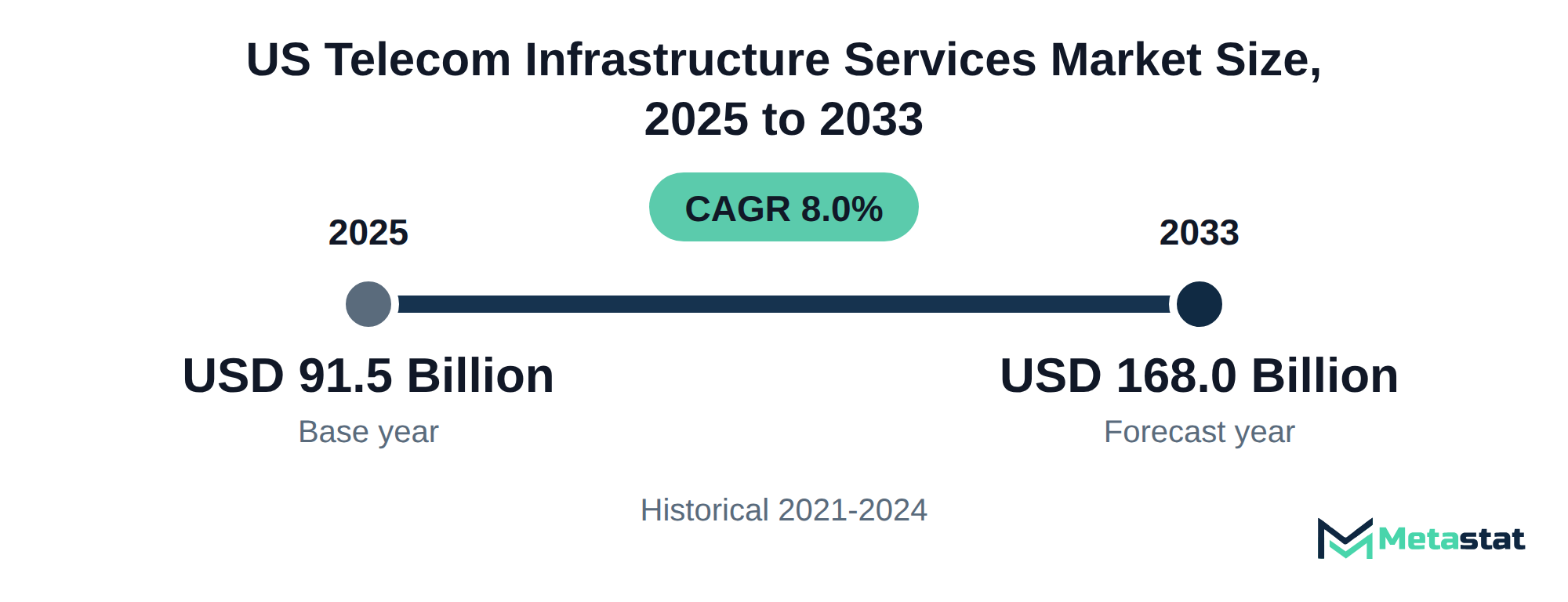
Market Valuation: Valued at $91.5 Billion in 2025, projected to reach $168 Billion by 2033 at a 8.0% CAGR.
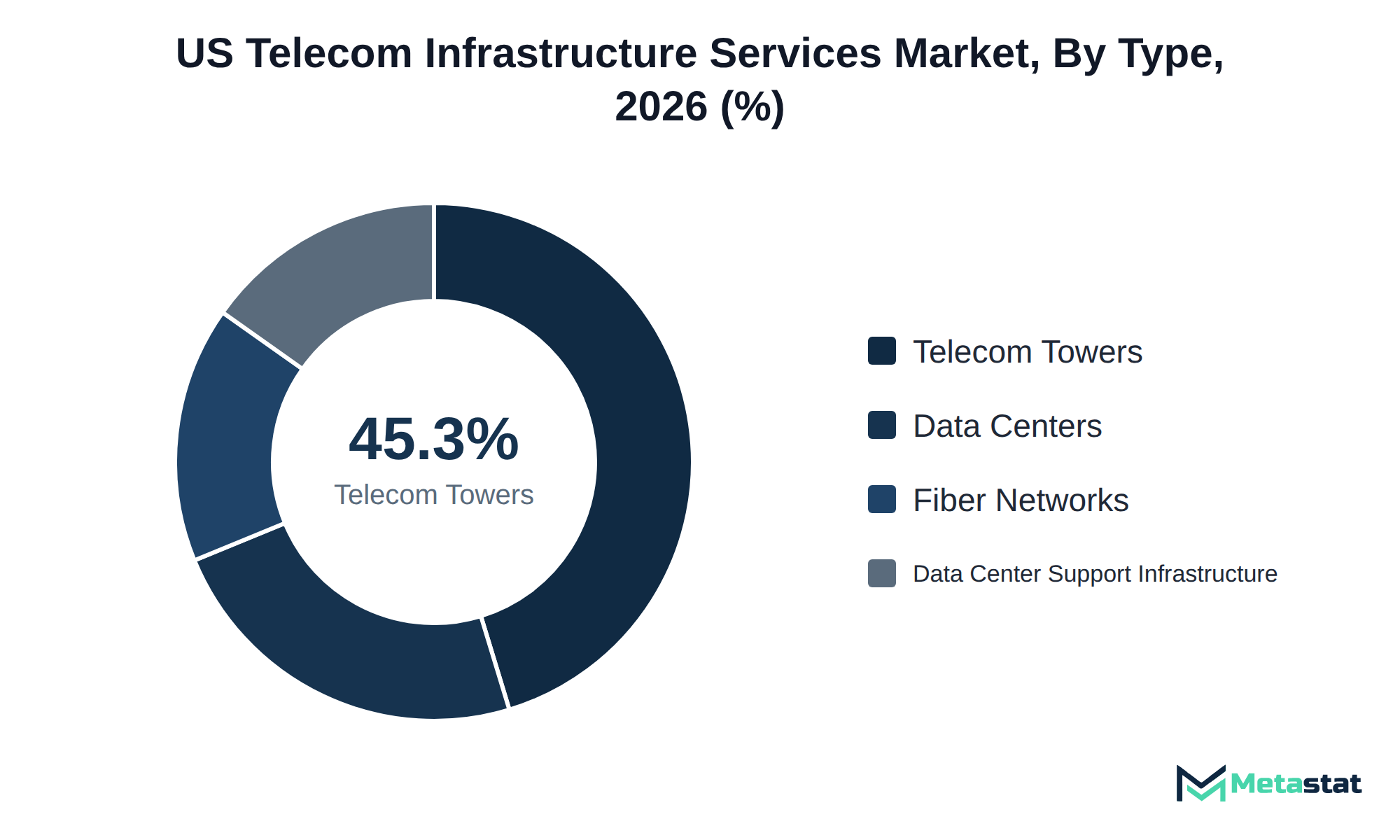
Dominant Segment: Telecom towers lead the market, driven by the ongoing expansion and upgrade of telecommunications infrastructure to accommodate increasing user demands and the rollout of 5G technology.
Geographic Lead: North America dominates the market, fueled by significant investments from telecom operators and service providers aiming to enhance their infrastructure and service offerings.
What's Inside: The report includes comprehensive coverage of market dynamics, competitive analysis, and detailed forecasts across various segments, including telecom towers, data centers, and fiber networks.
Emerging Trends: The report highlights the growing importance of fiber consolidation and dual-use AI strategies, which are reshaping network management and deployment within the telecom infrastructure landscape.
Investment Drivers: Key drivers of investment include the rising demand for high-speed data connectivity and the ongoing digital transformation across various industries.
Choose Your License
US Telecom Infrastructure Services Market
The US Telecom Infrastructure Services market was valued at USD 91.5 billion in 2025 and is projected to reach USD 168 billion by 2033, growing at a CAGR of 8.0% over the forecast period.
The US Telecom Infrastructure Services market encompasses various services that support the telecommunications industry, including telecom towers, data centers, fiber networks, and associated applications including design and engineering services, construction, and integration. Buyers invest in these services to enhance their network capabilities, improve connectivity, and support growing data demands driven by increased mobile usage and digital transformation across industries.
Growth in the market is primarily fueled by the rising demand for reliable and high-speed data connectivity. Among the segments, telecom towers represent the largest value, reflecting the ongoing expansion and upgrade of telecommunications infrastructure to accommodate the increasing number of users and devices. North America holds a substantial share of the market, driven by major investments from telecom operators and service providers to improve their infrastructure and service offerings.
The increasing adoption of cloud-based services and the expansion of 5G networks drive critical growth, pushing companies to enhance their telecom infrastructure. This demand for advanced services leads to substantial investment in data centers and network integration, supporting the overall growth trajectory of the US Telecom Infrastructure Services market.
Investment in the US Telecom Infrastructure Services market revolves around the development and maintenance of critical telecommunications assets essential for connectivity. Buyers include telecommunications providers, government entities, and enterprises, all of which invest in infrastructure to enhance service quality, meet increasing data demands, and ensure reliable network performance. The ongoing digital transformation across industries drives spending, reflecting the need for dependable infrastructure to support advanced applications, including 5G and IoT technologies.
Among the various segments, telecom towers represent the largest value, reflecting the increasing demand for enhanced coverage and capacity expansion. The market experiences significant growth, particularly in North America, which commands the largest share compared to other regions. Rising adoption of cloud services and expansion of mobile broadband services drive primary growth, pushing companies to invest heavily in upgrading and expanding their telecom infrastructure.
Increased collaboration between telecom operators and technology providers further accelerates advancements in the market. This collaboration helps integrate innovative solutions, so service providers can manage modern telecommunications requirements efficiently. Investments in infrastructure and technology enhance operational efficiency and contribute to improved customer satisfaction and loyalty.
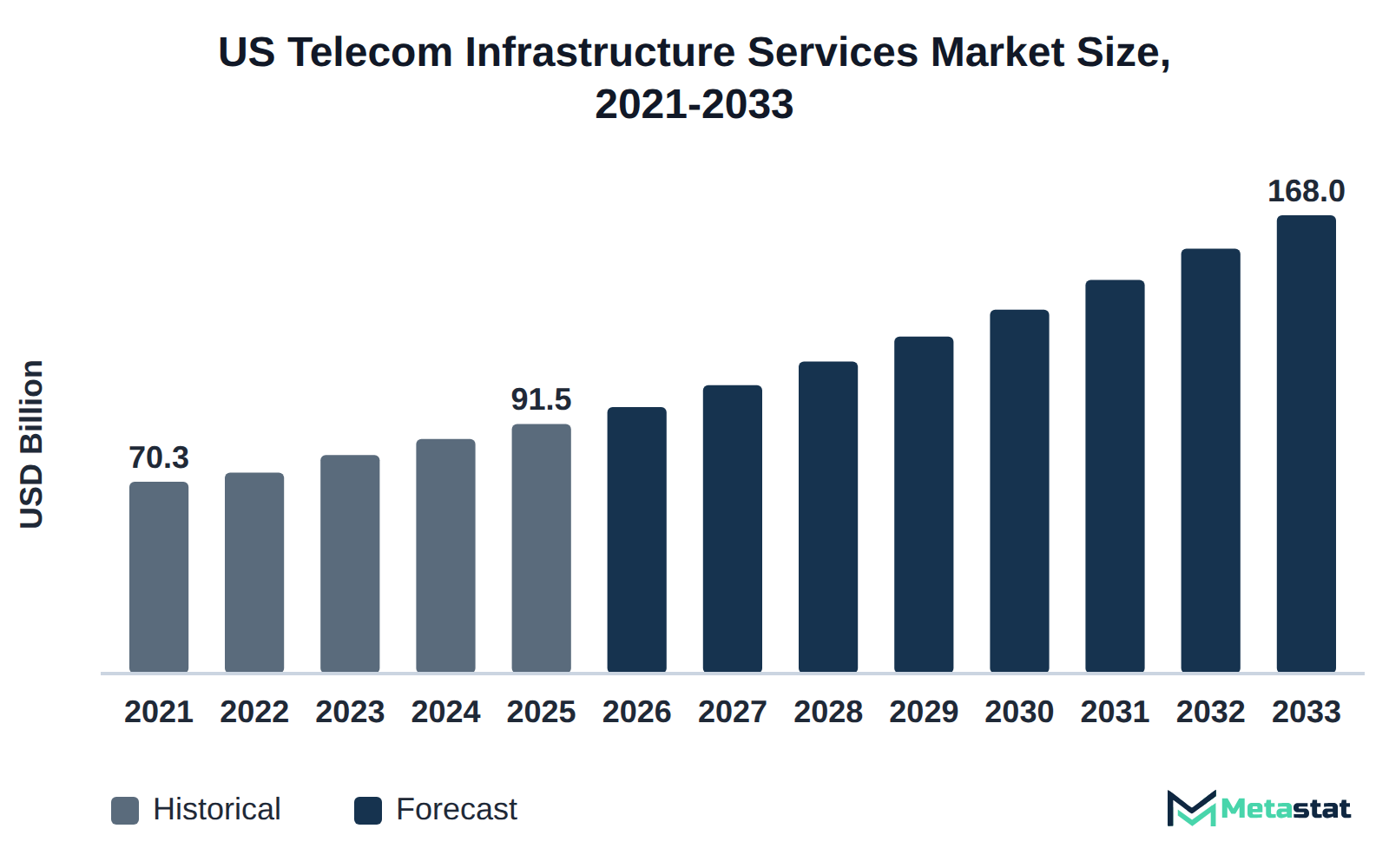
The emergence of fiber consolidation and dual-use AI network deployment strategies represents a significant shift within the US Telecom Infrastructure Services market. Fiber consolidation enables operators to streamline their infrastructure, reducing operational costs while enhancing service delivery. The market reflects a growth trajectory, with fiber networks expected to reach USD 27.1 billion by 2033, highlighting significant investment in this technology.
These strategies use artificial intelligence to optimize network management and deployment. By integrating AI into fiber networks, operators improve performance, apply predictive maintenance, and enhance service reliability. This dual-use approach meets current network demands while positioning companies to adapt efficiently to future requirements.
Commercially, these developments aim to improve overall profitability while reducing downtime. With increased investments in fiber infrastructure and AI capabilities, companies operating in the market expect enhanced competitive advantages and improved customer satisfaction. The ability to deliver reliable, high-speed services drives demand for advanced telecom solutions, ensuring sustained growth for industry players.
The expansion of 5G small cells significantly influences the purchasing dynamics within the US Telecom Infrastructure Services market. Buyers increasingly focus on flexible contract models that align with the rapid deployment needs of 5G networks. A prevalent approach includes multi-year agreements that offer volume discounts and performance-based pricing. Such models encourage long-term commitments from buyers, resulting in favorable pricing structures and enhanced supplier relationships.
In 2026, the share of telecom towers is projected to grow from USD 44.1 billion in 2025 to USD 73.7 billion by 2033, reflecting the urgency of infrastructure expansion. This surge necessitates that buyers negotiate terms that provide competitive pricing and accommodate evolving technology and infrastructure requirements. Suppliers benefit from service agreements that span installation to ongoing maintenance.
Consequently, the shift towards these contract models enhances operational efficiency and cost-effectiveness for buyers, enabling them to adapt swiftly to market demands. The trend toward flexible agreements enhances collaboration between buyers and suppliers and positions stakeholders for sustained growth in the competitive landscape of the market.
High-density urban buildouts often face significant challenges related to zoning restrictions and utility permitting. These obstacles complicate infrastructure deployment significantly, impacting timelines and budgets. The US Telecom Infrastructure Services market sees these challenges particularly pronounced in metropolitan areas, where local regulations frequently dictate the feasibility of new installations. Delays due to zoning approvals extend project timelines by several months, increasing overall costs for service providers.
Design and engineering services, with a projected growth from USD 12 billion in 2026 to USD 22.8 billion in 2033, help companies clear zoning and permitting hurdles. Local municipalities impose specific requirements for site plans, environmental assessments, and community impact evaluations. Companies specializing in design and engineering services streamline the permitting process by ensuring compliance with local regulations, helping companies avoid costly project delays.
The relationship between zoning laws and utility permitting shapes the operational landscape for telecom providers. Effective management of these processes leads to smoother project execution and better financial outcomes. Companies investing in expertise for navigating these regulatory hurdles position themselves favorably within the competitive landscape. A proactive approach to overcoming zoning and permitting challenges is essential for sustaining growth in the US Telecom Infrastructure Services market.
The Broadband Equity, Access, and Deployment (BEAD) Program significantly enhances rural connectivity within the US Telecom Infrastructure Services market. This initiative aims to improve broadband access, particularly in underserved areas. The program focuses on bridging the digital divide, ensuring that rural communities receive the same level of internet service as urban regions. A notable aspect of the BEAD Program is its emphasis on collaboration with various stakeholders, including state and local governments, to tailor solutions that address specific regional challenges.
Investment in rural broadband infrastructure is projected to yield substantial economic benefits. For instance, increasing internet access stimulates local businesses by enhancing their online presence and facilitating e-commerce. Improved connectivity allows for better access to telehealth services and educational resources, enhancing the overall quality of life in these regions. The integration of robust telecom infrastructure, supported by initiatives like the BEAD Program, positions the market for sustained growth, enabling service providers to expand their reach and enhance service offerings.
The surge in remote work and digital services has significantly impacted corporate spending on telecommunications infrastructure. Businesses across various sectors, including finance, healthcare, and education, invest heavily in telecom infrastructure to enhance communication capabilities and expand service offerings. This shift reflects a growing need for reliable connectivity solutions, driven by increased online interactions and the necessity of robust digital systems. Rising demand for advanced telecom services directly correlates with the expansion of data centers, telecom towers, and fiber networks, as companies seek to optimize operational efficiency and enhance customer experience.
Growth in cloud computing and ongoing digital transformation across industries are major drivers of this increased spending. Companies prioritize investments in infrastructure services that support scalability and sustainability, reflecting a broader trend toward digital resilience.
The ongoing evolution of technologies within the telecommunications sector drives significant growth in the US Telecom Infrastructure Services market. Innovations including advanced fiber optics and enhanced data center capabilities improve service quality and efficiency, ensuring that providers meet increasing consumer demands. The adoption of more reliable data centers enables improved computing power and storage solutions that support cloud-based services and applications. This trend attracts investment from various sectors, including finance, healthcare, and education, driven by companies aiming to upgrade their infrastructure to remain competitive.
The push for higher bandwidth and lower latency significantly influences consumer behavior, prompting businesses to invest in advanced telecom solutions. The market sees a rise in projects focusing on the integration of innovative technologies including artificial intelligence and machine learning, which optimize network management and operational efficiency. These advancements create a more responsive infrastructure, ensuring that companies quickly adapt to evolving market demands and consumer preferences. Enhanced technological capabilities within the market facilitate sustained growth and create a more dynamic environment for all stakeholders involved.
High capital expenditures associated with infrastructure investment limit adoption among various buyer groups within the US Telecom Infrastructure Services market. Key segments, including telecom operators and service providers, face substantial financial barriers when upgrading or expanding their network capabilities. This situation results in slower uptake of advanced technology solutions and smaller project scopes, impacting overall market growth. Financial constraints often lead to delayed replacement cycles and a focus on maintaining existing infrastructure rather than pursuing new developments. Increased competition for funding further complicates decisions regarding infrastructure enhancements, resulting in an environment where several players prioritize immediate operational costs over long-term strategic investments. The cumulative effect of these financial limitations hampers overall market progress.
Rising talent costs significantly challenge suppliers within the US Telecom Infrastructure Services market. The ongoing demand for specialized skills in technology and engineering drives competition for qualified personnel. Heightened labor expenses pressure profit margins and operational efficiency. Suppliers respond by investing in training programs and adopting automation to streamline processes, thereby reducing reliance on human resources. These strategies aim to balance the cost of skilled talent while maintaining service quality and project timelines. Firms explore partnerships with educational institutions to expand the talent pool and enhance workforce capabilities. Such initiatives ensure that service providers remain competitive while addressing escalating costs associated with delivering essential telecommunications infrastructure services.
Design and engineering services represent a significant growth segment within the US Telecom Infrastructure Services market, exhibiting a compound annual growth rate (CAGR) of 9.6% through 2033. This segment addresses the increasing complexity of telecommunications infrastructure projects, requiring precise planning and execution to meet modern standards. Rising investments in new technologies, including 5G and fiber networks, drive demand among telecommunications companies seeking specialized expertise in design and engineering. The projected increase from USD 12 billion in 2026 to USD 22.8 billion by 2033 highlights the substantial market opportunity for firms offering these services. Such growth reflects the broader trend toward enhanced connectivity and network capabilities. An increased focus on efficient deployment of infrastructure solutions ensures steady demand for high-quality design and engineering services.
The US Telecom Infrastructure Services market is segmented based on Type, Application.
Telecom towers serve critical infrastructure for wireless communication, facilitating connectivity for mobile operators and service providers. The segment's growth is driven by increasing demand for 5G networks, prompting operators to expand their tower infrastructure to enhance network coverage and capacity. Unlike data centers, which exhibit a higher CAGR of 8.1%, telecom towers show steady growth, emphasizing their role in supporting mobile communication. The expansion of 5G technology results in significant investments in tower construction and upgrades, providing opportunities for construction and installation service providers. These investments form a core part of 5G network and tower deployment. This segment's distinct growth trajectory highlights its importance in responding to evolving telecommunications needs.
Data Centers segment is estimated to reach USD 39.6 billion by 2033, at a CAGR of 8.1% during the forecast period. These facilities provide businesses with the infrastructure required to store, manage, and disseminate data efficiently. Enterprises across various sectors, including technology, finance, and healthcare, rely on data centers for their operations, driven by increasing demand for cloud computing and data storage solutions. Growing emphasis on digital transformation and data analytics supports this segment, differentiating it from others like Telecom Towers, which exhibit a slower growth rate of 7.6%. The evolving nature of data center technology, including increased energy efficiency and enhanced security features, attracts significant investment, positioning this segment for expansion in the market.
This segment focuses on providing high-capacity communication links necessary for data transmission across various networks. Telecommunications providers and internet service companies enhance connectivity and improve data transfer rates for consumers and businesses by deploying fiber networks. The growing demand for bandwidth-intensive applications, including streaming services and cloud computing, drives expansion in this segment. Compared to other segments, Fiber Networks experiences a faster growth trajectory, with a projected compound annual growth rate (CAGR) of 8.1%. This growth reflects the increasing reliance on high-speed internet and data services, differentiating it from segments including Data Centers, which shows strong growth but at a slightly lower rate. Investment in fiber networks supports the goal of enhancing digital infrastructure and connectivity.
Data Center Support Infrastructure segment is projected to grow at a CAGR of 9.1% during the forecast period. This segment encompasses essential services for the design, installation, and maintenance of critical support systems for data centers. Data center operators and cloud service providers heavily rely on these services to enhance efficiency and ensure operational reliability. Increasing demand for cloud computing and data storage drives growth in this segment, with businesses seeking to maintain competitive advantages through robust infrastructure. Telecom Towers and Data Centers have respective CAGRs of 7.6% and 8.1%. By contrast, the rapid growth of Data Center Support Infrastructure reflects a heightened focus on optimizing data center performance and reliability for end-users. Significant investments in digital transformation initiatives across various sectors further highlight the relevance of this segment in the broader US Telecom Infrastructure Services market.
This segment focuses on providing specialized design and engineering solutions for telecommunications infrastructure projects, catering to operators and developers involved in deploying network services. The growth of this segment is driven by increasing demand for sophisticated infrastructure designs and regulatory compliance in network deployments. Compared with other segments, including Construction & Installation Services, which will reach USD 49.2 billion by 2033, the Design & Engineering Services segment shows a faster growth trajectory. This highlights the need for expert input in planning and executing telecom projects. The evolving technological landscape requires innovative approaches, ensuring that this segment continues to meet the challenges posed by advancing communication standards.
Construction & Installation Services segment is estimated to reach USD 49.2 billion by 2033, at a CAGR of 7.8% during the forecast period. This segment encompasses various activities essential for the deployment and establishment of telecommunications infrastructure. Service providers, including telecom operators and infrastructure developers, apply these services for building new facilities and upgrading existing ones. The increasing demand for enhanced connectivity and the rollout of advanced technologies, including 5G, drives this segment's growth. This segment exhibits a higher growth rate compared to others like Utility Locating & Permitting Services, which experiences slower expansion. The focus on rapid deployment of network infrastructure to support growing data traffic underlines the importance of Construction & Installation Services, positioning it as a critical driver in the US Telecom Infrastructure Services market.
Utility Locating & Permitting Services segment is expected to reach USD 10.2 billion by 2033. This segment is essential in identifying underground utilities and securing necessary permits for construction projects, primarily used by contractors and utility companies. Strong demand for efficient project execution and compliance with local regulations drives the growth of this segment. Unique requirements for accurate utility mapping and permitting differentiate it from others, leading to a projected compound annual growth rate (CAGR) of 10.2%. Compared to other segments like Design & Engineering Services, which has a CAGR of 9.6%, this segment demonstrates a distinct growth trajectory due to its specialized focus on utility management and regulatory compliance. Ongoing emphasis on infrastructure development strongly influences this segment, highlighting its significance within the US Telecom Infrastructure Services market.
Network & System Integration Services segment is projected to grow at a CAGR of 8.5% during the forecast period. This service focuses on the integration of various telecommunications systems and networks, ensuring effective communication and data flow among different platforms. Telecommunications companies, enterprises, and service providers apply these services to improve operational efficiency and enhance connectivity. The increasing demand for advanced communication solutions drives this segment forward. The rapid deployment of 5G networks presents significant opportunities, necessitating integration services to support complex architectures. Compared to other sub-segments, this segment has a moderate growth rate, distinguishing it from Design & Engineering Services, which exhibits a higher CAGR of 9.6%. The ongoing evolution of technology influences competitive dynamics, necessitating continuous innovation in service offerings. The market is expected to see growing investment in Network & System Integration Services as businesses prioritize digital transformation and modernization of their infrastructure.
Consulting & Regulatory Advisory Services help telecommunications entities comply with regulatory requirements and optimize operational strategies. Organizations engage these services to navigate complex regulatory landscapes, allowing them to make informed decisions while minimizing risks. This segment attracts telecommunications companies, infrastructure developers, and utilities seeking expert guidance on regulations and standards.
The demand for these services is driven by increasing regulatory scrutiny in the telecommunications sector, compelling firms to seek specialized knowledge. Compared to other segments, this area experiences a slower growth trajectory, influenced by the cyclical nature of regulatory changes and market conditions. Entities engaging in Consulting & Regulatory Advisory Services often face different pricing structures compared to more tangible services including Construction & Installation Services, which possess a clear and immediate monetary value. The market adapts to evolving regulations, creating a competitive environment that prioritizes compliance and strategic advisory capabilities.
Others encompasses various additional services that cater to specialized needs in the telecommunications infrastructure landscape. This sub-segment serves diverse stakeholders including telecommunication firms and utility companies, enhancing operational efficiencies and ensuring compliance with regulatory frameworks. Key forces driving this area include technological advancements necessitating integrated solutions and evolving regulatory environments compelling companies to adopt compliant systems. Compared to other segments, growth in this area experiences variability driven by shifts in market demands and regulatory changes. This sub-segment's unique position allows it to address niche requirements that do not fall under the more traditional categories, presenting distinct opportunities for suppliers in the market.
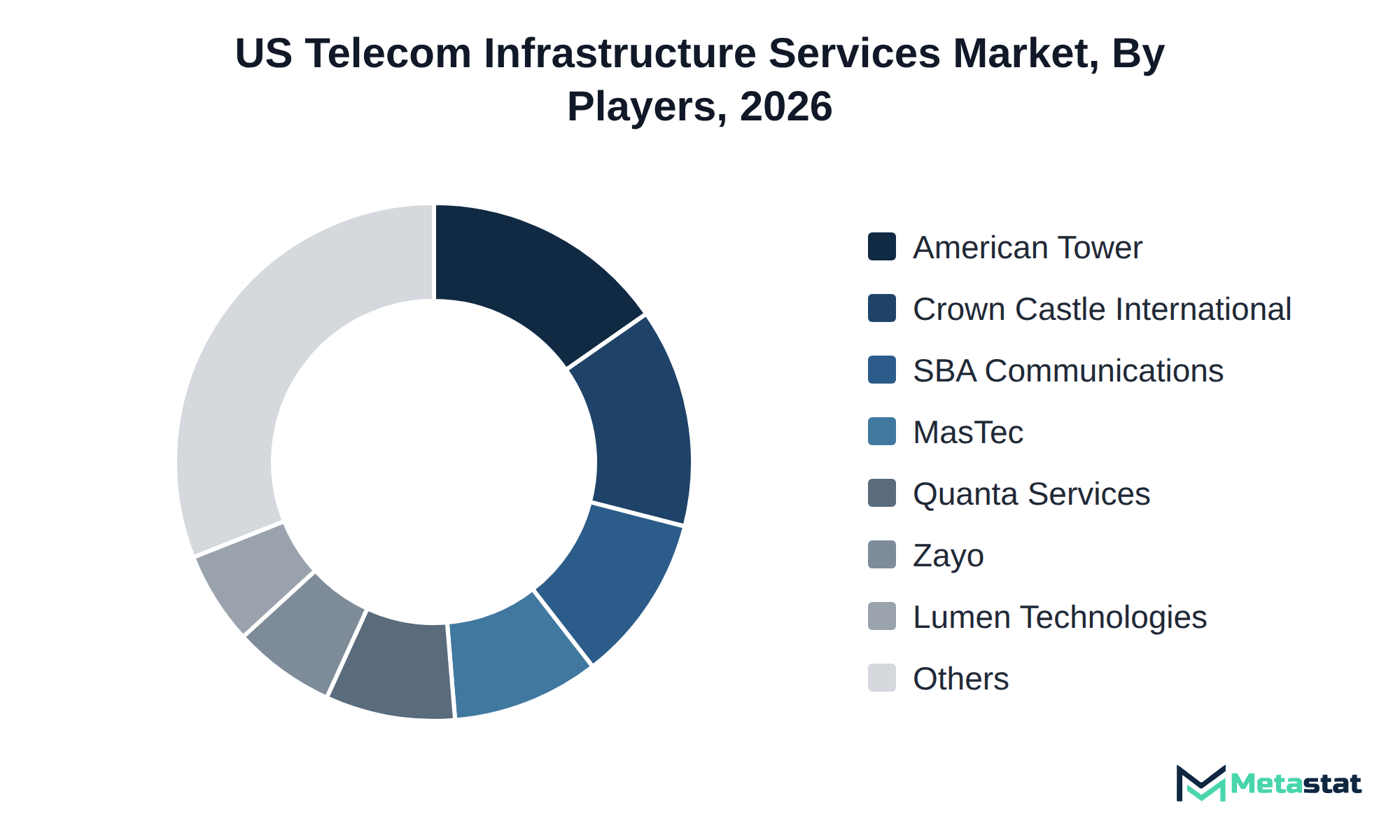
Competition within the US Telecom Infrastructure Services market centers on various service types and strategic behaviors among key players. Companies differentiate themselves based on service offerings that include telecom towers, data centers, and fiber networks, which cater to diverse customer needs. This competitive environment drives innovation and investment in infrastructure, as firms seek to enhance service reliability and expand their market reach.
Buyers prioritize factors including price, service quality, certification, and customization when choosing providers in the market. For instance, American Tower Corporation focuses on expanding its telecom tower portfolio, while Equinix, Inc. specializes in data center solutions. Zayo Group, LLC offers fiber networks with robust integration capabilities, enhancing customer experience and operational efficiency. These selection criteria reflect the increasing demand for tailored solutions that meet specific operational requirements across various industries.
Achieving this significant growth relies on several key developments within the market. First, the continued expansion of telecom towers, projected to grow from USD 44.1 billion in 2026 to USD 73.7 billion by 2033, will support network capacity and coverage, driven by increasing demand for mobile connectivity. Second, advancements in data centers, anticipated to reach USD 39.6 billion by 2033, reflect the shift toward cloud services and data storage solutions, further fueling market growth. The design and engineering services segment is essential, with a forecast increase from USD 12 billion in 2026 to USD 22.8 billion by 2033, highlighting the importance of infrastructure planning in meeting future capacity needs.
However, challenges exist that could hinder this growth trajectory. Potential regulatory hurdles and supply chain disruptions slow down the construction and installation services needed to build and maintain the necessary infrastructure. Addressing these obstacles is essential for the US Telecom Infrastructure Services market to reach its projected value, ensuring investment and demand continue to drive the market forward.
By Type: Telecom Towers, Data Centers, Fiber Networks, Data Center Support Infrastructure
By Application: Design & Engineering Services, Construction & Installation Services, Utility Locating & Permitting Services, Network & System Integration Services, Consulting & Regulatory Advisory Services, Others
The report strategically identifies and profiles the key market players and analyses their core competencies in each sub-segment of the Telecom Infrastructure Services market.
|
Report Attributes |
Details |
|
Study Period |
2021-2033 |
|
Base Year |
2025 |
|
Estimated Year |
2026 |
|
Forecast Period |
2026-2033 |
|
Historical Period |
2021-2025 |
|
Growth Rate |
CAGR 8.0% from 2026 to 2033 |
|
Revenue Unit |
USD billion |
|
Segmentation |
By Type, Application, and Region |
Find answers to common questions about this report
The Telecom Infrastructure Services market size was valued at USD 91.5 billion in 2025.
The market is projected to grow at a CAGR of 8.0% during the forecast period from 2026 to 2033.
Telecom Towers leads the Telecom Infrastructure Services market with a projected value of USD 73.7 billion by 2033. This segment surpasses others in terms of revenue generation within the market.
The growth in cloud computing significantly drives demand for telecom infrastructure services. Ongoing digital transformation across industries further fuels increased spending on advanced connectivity solutions.
High capital expenditures associated with infrastructure investment limit adoption among various buyer groups. Rising talent costs challenge suppliers, driving competition for qualified personnel and increasing labor expenses, which pressure profit margins and operational efficiency.
The ongoing demand for advanced telecom services correlates with the expansion of data centers, telecom towers, and fiber networks. Investments in design and engineering services are increasing due to the complexity of modern telecommunications projects, further supporting adoption within the industry.
The Telecom Infrastructure Services market is estimated to reach a valuation of USD 168 billion by 2033.
Key players operating in the Telecom Infrastructure Services market include American Tower Corporation, Crown Castle International Corp., SBA Communications Corporation, MasTec, Inc., Quanta Services, Inc., Zayo Group, LLC., and Lumen Technologies.
The Design & Engineering Services segment is projected to grow from USD 12 billion in 2026 to USD 22.8 billion by 2033, reflecting a compound annual growth rate (CAGR) of 9.6 percent.
The Data Centers segment is expected to reach a value of USD 39.6 billion by 2033, driven by increasing demand for cloud computing and data storage solutions.
The analysts below cover Information & Technology research at Metastat Insights.
LEAD ANALYST
Utkarsh Khirodkar is a Lead Market Research Analyst at MetaStat Insight, specializing in market intelligence, technology sector assessments, and competitive strategy.

PRINCIPAL CONSULTANT - ENTERPRISE AI & EMERGING TECHNOLOGIES
Banking & Finance · Electronics and Semiconductor · Energy and Power · Healthcare IT · Information & Technology · Professional Services
Vijay Gunti is a Principal Consultant at MetaStat Insight, bringing over two decades of experience across enterprise digital transformation, technology strategy, and intelligent systems.

LEAD CONSULTANT - COMMUNICATION, TELECOM, AND IT
Electronics and Semiconductor · Information & Technology · Machinery & Equipment · Professional Services
Ravindra Sathe Consultants for Communication, Telecom, and IT at MetaStat Insight. He leads the firm's industry research initiatives across telecommunications infrastructure, digital connectivity, enterprise networking, and emerging information technology domains.
Replacing petrochemical surfactants with bio-based alternatives requires realistic timelines on industrial precision fermentation scaling. The market research broke down commercialization timelines, feedstock sugar price sensitivities, and regional cosmetic ingredient regulatory approvals in Europe and East Asia. That supplier readiness mapping gave our formulations team reliable context when comparing renewable chemical sourcing roadmaps.
Tracking ceramic matrix composite adoption in high-bypass aero engines requires strict attention to material qualification cycles and FAA airworthiness testing milestones. The MetaStat Insight team provided a detailed timeline of silicon carbide fiber manufacturing capacity and commercial foundry lead times. Having clear visibility into upstream thermal barrier coating supply helped us stress-test our long-term component procurement strategy.
Transitioning ultra-class mining haul trucks to alternative power requires concrete data on remote hydrogen refueling infrastructure economics. The report evaluated megawatt-scale electrolyzer installation expenses, onsite storage safety mandates, and heavy-duty fuel cell stack degradation under continuous duty cycles. That technical rigor helped our engineers benchmark realistic total operating cost horizons for off-highway fleet decarbonization.
Explore related market intelligence reports worth reading alongside this one.