
LEAD ANALYST
Utkarsh Khirodkar is a Lead Market Research Analyst at MetaStat Insight, specializing in market intelligence, technology sector assessments, and competitive strategy.

Open-Source Database Software Market By Type (Cloud-based and On Premises), By Application (Large Enterprises, Small and Medium-sized Enterprises (SMEs)), Market Analysis, Size, Share, Growth, Trends, and Forecast, 2023-2030
Report ID
MSI-2412
Published
February, 2026
Pages
258 Pages
Format
Report Details
Choose Your License
Open-Source Database Software Market
The global open-source database software market is valued at USD 5,021.8 million in 2023 and is projected to grow at a CAGR of 28.2% in forecast period.
Open-source database software is a special type of software that takes transparency to a whole new level. Unlike traditional software, where the inner workings are hidden, open-source database software proudly showcases its source code to the world. This means that anyone with an interest can not only peek under the hood but also tinker with it, adapt it to their needs, and even share it far and wide without any restrictions. In the world of databases, this software is akin to a digital Swiss Army knife, serving the vital functions of creating, storing, retrieving, and efficiently managing data. Global Open-Source Database Software market is estimated to reach $5,021.8 million in 2023 with a CAGR of 28.2% from 2023 to 2030.
The Global Open-Source Database Software market. Picture MySQL, PostgreSQL, MongoDB, MariaDB, and a host of others, all playing starring roles. These systems are the unsung heroes behind countless business operations, organizational processes, and dazzling web applications. They're the backstage wizards powering everything from your favorite websites to the latest data analytics marvels, and they do it all with grace and precision.
But, like any thriving ecosystem, this market is not just about the software itself. It's a vibrant community teeming with software providers, developers, and a web of services and solutions intricately woven around open-source databases. This ecosystem dances to the rhythm of innovation and support, offering a cornucopia of services. There are experts who craft and maintain database software, ensuring it stays sharp and robust. Others specialize in consultancy, guiding businesses on the best ways to harness the power of these databases. Support services provide a safety net for those in need, and training programs help nurture the next generation of open-source database enthusiasts.
The growth of the open-source database software market has been nothing short of spectacular in recent years. Why? Well, for starters, it's like finding a treasure chest of cost-effectiveness and flexibility. Organizations worldwide are drawn to open-source solutions like bees to honey. They relish the freedom to sculpt the software to match their unique needs, a luxury not always afforded by proprietary database systems. What's more, it's a wallet-friendly choice, as the total cost of ownership tends to be much lighter.
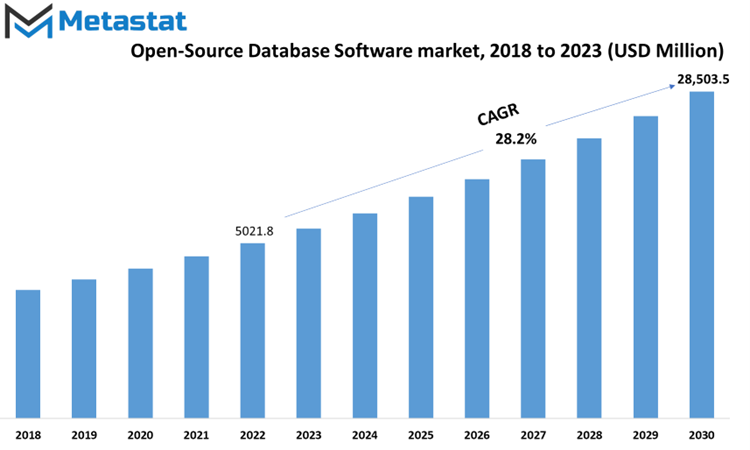
The Open-Source Database Software market is flourishing primarily due to its exceptional cost efficiency. In today's highly competitive business landscape, cost-saving measures are paramount, and open-source database software emerges as a savior by eliminating the need for expensive licensing fees. This advantage holds appeal for small and medium-sized enterprises (SMEs) and startups that often operate on limited budgets. Moreover, the collaborative open-source community plays a pivotal role in reducing maintenance costs. They provide timely updates and support without the exorbitant expenses associated with proprietary software. Open-source databases also offer unparalleled flexibility and scalability, enabling businesses to adapt seamlessly to their evolving needs without incurring excessive costs. In essence, investing in cost efficiency proves to be a strategically sound decision for businesses of all sizes, ensuring financial prudence while maintaining robust functionality.
Dynamic and vibrant, community innovation stands as a driving force propelling the Open-Source Database Software market forward. The open-source ecosystem fosters an environment of continuous improvement and innovation, setting it apart from closed, proprietary systems. A diverse array of contributors collaborates tirelessly to enhance functionality and bolster security in real-time, resulting in the integration of cutting-edge features. The rapid pace of development ensures that users have unfettered access to the latest tools, an invaluable asset in today's fast-paced business environment. The spirit of knowledge sharing and collaborative problem-solving empowers organizations, while end-users actively participate in shaping the software's evolution, thus instilling a deep sense of trust. In summation, community innovation fuels an unending cycle of enhancement, rendering open-source databases an exceedingly compelling choice for organizations keen on harnessing the very latest technological advancements.
For all its merits, the Open-Source Database Software market contends with a notable restraint in the form of limited support. While the open-source model thrives on the contributions of the community, it may occasionally fall short in providing comprehensive support, especially for intricate database needs. Unlike proprietary vendors who offer dedicated customer service, the open-source realm relies on forums and volunteer contributors, potentially resulting in delays during critical situations. This limitation assumes greater significance in industries with stringent compliance and security requirements. The complexity of certain open-source databases can be daunting for users lacking the requisite technical expertise. Addressing this restraint may necessitate the exploration of novel support models or strategic partnerships to ensure users receive the assistance they require, precisely when they need it.
Significant scalability concerns pose another restraint within the Open-Source Database Software market. The process of scaling open-source databases can be intricate, demanding an in-depth understanding and expertise. Achieving optimal performance often requires an intimate knowledge of the database's inner workings. Furthermore, extending support to encompass distributed and multi-node configurations can prove intricate and resource intensive. Data migration, particularly for databases with unique data formats, presents its own set of challenges. Effectively addressing these scalability challenges is of paramount importance for open-source solutions to maintain their competitiveness within the market and cater to the evolving demands of larger enterprises and resource-intensive applications.
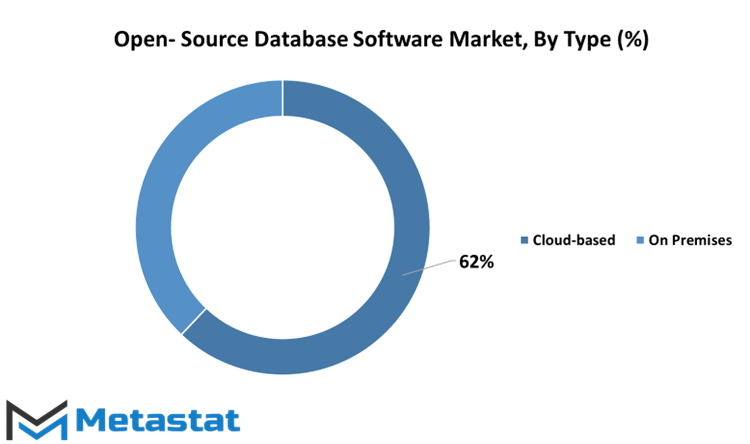
The global Open-Source Database Software market is primarily categorized based on various segments, with one of the key segments being Type. These two primary categories, Cloud-based and On Premises, represent the fundamental choices within the Type segment of the Open-Source Database Software market. Within this segment, the market is further subdivided into two main categories:
Cloud-based segment includes open-source database software solutions that are hosted and accessed via cloud computing services. Cloud-based open-source databases offer advantages such as scalability, flexibility, and accessibility from anywhere with an internet connection. They are well-suited for organizations looking for cost-effective and easily scalable database solutions and it will be 18763.8 USD Million in 2030.
The On Premises segment covers open-source database software that is installed and maintained within an organization's physical infrastructure. It is forecast to grow at a CAGR of 26.3%. This traditional approach provides complete control over data and security but may involve higher initial setup and maintenance costs. On-premises solutions are preferred by organizations with stringent data security and compliance requirements.
The open-source database software market is experiencing remarkable growth, and it can be divided into two primary segments: Large Enterprises and Small and Medium-sized Enterprises (SMEs). In the context of this thriving market, Large Enterprises is poised to reach an impressive valuation of 17,251.5 million USD by the year 2030.
For SMEs, this growth presents a significant opportunity as their contribution to this market is also anticipated to reach 11252 USD million USD by the year 2030. This demonstrates the substantial role that SMEs play in driving the expansion of the open-source database software industry, benefiting from the flexibility and cost-effectiveness that open-source solutions offer.
In 2022, the Asia Pacific region dominated the Open-Source Database Software market, holding a significant 27.2% share of the global market. Meanwhile, back in 2018, the European Open-Source Database Software market was estimated to be worth a substantial 554.5 million US dollars.
Geographically, the global Open-Source Database Software market is segmented into several key regions, each with its own unique characteristics and opportunities. In North America, which includes the United States, Canada, and Mexico, the market is robust and diverse, with a strong presence of technology-driven industries. Europe, on the other hand, comprises major players such as the United Kingdom, Germany, France, Italy, and other countries in the region. It's known for its innovation and well-established IT infrastructure.
Moving to the Asia-Pacific region, we find dynamic markets like India, China, Japan, South Korea, and others. These countries are experiencing rapid technological growth, creating fertile ground for Open-Source Database Software adoption. South America, encompassing nations like Brazil, Argentina, and more, offers a growing market with increasing demands for database solutions to support their expanding industries. Lastly, the Middle East & Africa region, which includes GCC Countries, Egypt, South Africa, and others, is gradually emerging as a potential market for Open-Source Database Software, driven by digital transformation initiatives and increasing IT investments. This geographical breakdown highlights the diverse landscape of the global Open-Source Database Software market, with each region presenting its own set of opportunities and challenges for businesses operating in this space.
Redis Enterprise Software stands as a formidable and enterprise-grade open-source database solution meticulously crafted around the robust capabilities of Redis. This software offers a swift and high-powered data processing experience while prioritizing compliance, reliability, and resilience to cater to the intricate demands of enterprises. What sets Redis Enterprise Software apart is its versatility in deployment options, allowing users to choose from a spectrum of solutions. These encompass hybrid cloud environments, seamless integration with Kubernetes, and robust support for platforms such as Pivotal Tanzu. This diverse range of options ensures that Redis Enterprise Software can seamlessly fit into any enterprise's unique infrastructure and operational needs. Redis Enterprise Software also offers a unique feature, RedisInsight, providing deep data insights and analytics capabilities. This empowers users to gain valuable insights into their data, facilitating data-driven decision-making within their organizations.
In the Open-Source Database Software Market, Redis Enterprise Software is among the key players. Alongside Redis Labs, Inc., other notable players in this Market include MongoDB, Inc., Couchbase, Inc., The Apache Software Foundation, MariaDB Corporation, Neo4j, Inc., Oracle Corporation (MySQL), The PostgreSQL Global Development Group, InfluxData Inc., and Crate.io Inc.
Find answers to common questions about this report
Global Open-Source Database Software market is valued at $5,021.8 million in 2023.
Global Open-Source Database Software market is estimated to grow with a CAGR of 28.2% from 2023 to 2030.
Global Open-Source Database Software market is estimated to reach $28,503.5 million by 2030.
Top players operating in the Open-Source Database Software Market includes Redis Labs, Inc., MongoDB, Inc., Couchbase, Inc., The Apache Software Foundation, and others.
The analysts below cover Information & Technology research at Metastat Insights.
LEAD ANALYST
Utkarsh Khirodkar is a Lead Market Research Analyst at MetaStat Insight, specializing in market intelligence, technology sector assessments, and competitive strategy.

PRINCIPAL CONSULTANT - ENTERPRISE AI & EMERGING TECHNOLOGIES
Banking & Finance · Electronics and Semiconductor · Energy and Power · Healthcare IT · Information & Technology · Professional Services
Vijay Gunti is a Principal Consultant at MetaStat Insight, bringing over two decades of experience across enterprise digital transformation, technology strategy, and intelligent systems.

LEAD CONSULTANT - COMMUNICATION, TELECOM, AND IT
Electronics and Semiconductor · Information & Technology · Machinery & Equipment · Professional Services
Ravindra Sathe Consultants for Communication, Telecom, and IT at MetaStat Insight. He leads the firm's industry research initiatives across telecommunications infrastructure, digital connectivity, enterprise networking, and emerging information technology domains.
Assessing 200mm wafer transition schedules and substrate supply bottlenecks requires precise technical intelligence. MetaStat Insight supplied an actionable breakdown comparing planar and trench MOSFET architectures across automotive and industrial drive markets. The regional capacity estimates for Asia-Pacific foundries helped clarify lead-time uncertainties during our strategic planning session. When we needed additional clarification on high-purity raw material sourcing, their analyst team responded with helpful context within twenty-four hours.
Tracking maintenance cycle demand for secondary flight display units and terrain collision avoidance systems across regional jet fleets involves complex aftermarket dynamics. MetaStat Insight provided practical analysis separating airline retrofit programs from OEM forward-fit production schedules in North America and Southeast Asia. The supplier matrix highlighted component obsolescence timelines without resorting to vague generalizations. The dataset served as a dependable reference during our annual program review meetings.
Evaluating secondary resin quality across post-consumer packaging streams requires reliable technical segmentation. MetaStat Insight delivered an objective assessment that distinguished between extrusion-grade flake pricing and optical sorting throughput limitations across Western Europe. The competitive positioning breakdown for licensed depolymerization technology providers answered several questions during our feedstock feasibility audit. Their team clarified regional trade restrictions on mixed plastic scrap quickly when our team submitted follow-up requests.
Explore related market intelligence reports worth reading alongside this one.