
LEAD ANALYST
Utkarsh Khirodkar is a Lead Market Research Analyst at MetaStat Insight, specializing in market intelligence, technology sector assessments, and competitive strategy.

Rare Disease Genetic Testing Market Size, Share, By Disease Type (Neurological Disorders, Immunological Disorders, Cancer, Hematology Diseases, Cardiovascular Disorders (CVDs), Endocrine & Metabolism Diseases, Musculoskeletal Disorders, Dermatology Disease, and Others,), By Technology (Whole Exome Sequencing (WES), Whole Genome Sequencing (WGS), Array Technology, PCR-based Testing, Sanger Sequencing, FISH, and Karyotyping), By Specialty (Molecular Genetic Tests, Chromosomal Genetic Tests, and Biochemical Genetic Tests), By End User (Research Laboratories & CROs, Diagnostic Laboratories, and Hospitals & Clinics), Industry Analysis, Growth, Trends, and Forecast, 2026-2033
Report ID
MSI-2311
Published
February, 2026
Pages
304 Pages
Format
Report Details
Choose Your License
Rare Disease Genetic Testing Market
Rare disease genetic testing screens all genes known to cause human disease. About 6000 genes are reported to be clinically relevant. The genetic tests are focused on analysis of specific genes, depending on which possible genetic diagnoses are suspected.
Rising incidence of rare diseases is boosting the market growth. For instance, according to the World Health Organization (WHO), over 400 million people are living with one or more of 6,000 identified rare diseases around the world. Rare diseases affect 3.5% to 5.9% of the worldwide population. According to the Genetic and Rare Diseases Information Center, 1 in 10 American, which is 30 million people suffer for some kind of rare disease. 50% of people affected by rare diseases are children. According to the European Commission, approximately 5,000-8,000 distinct rare diseases affect 6% to 8% of the EU population, which is between 27 and 36 million people. In 2019, 70 million people in India are affected by rare diseases. According to the Australians Department of Health, around 8% of Australians, which is 2 million people live with a rare disease. About 80% of rare diseases are genetic in Australia. Further, innovative technologies for rare disease genetic testing is a key driving factor of the market. However, lack of awareness pertaining to rare diseases might hamper the market growth. Moreover, government support for rare disease diagnosis would provide lucrative opportunities for the market in coming years.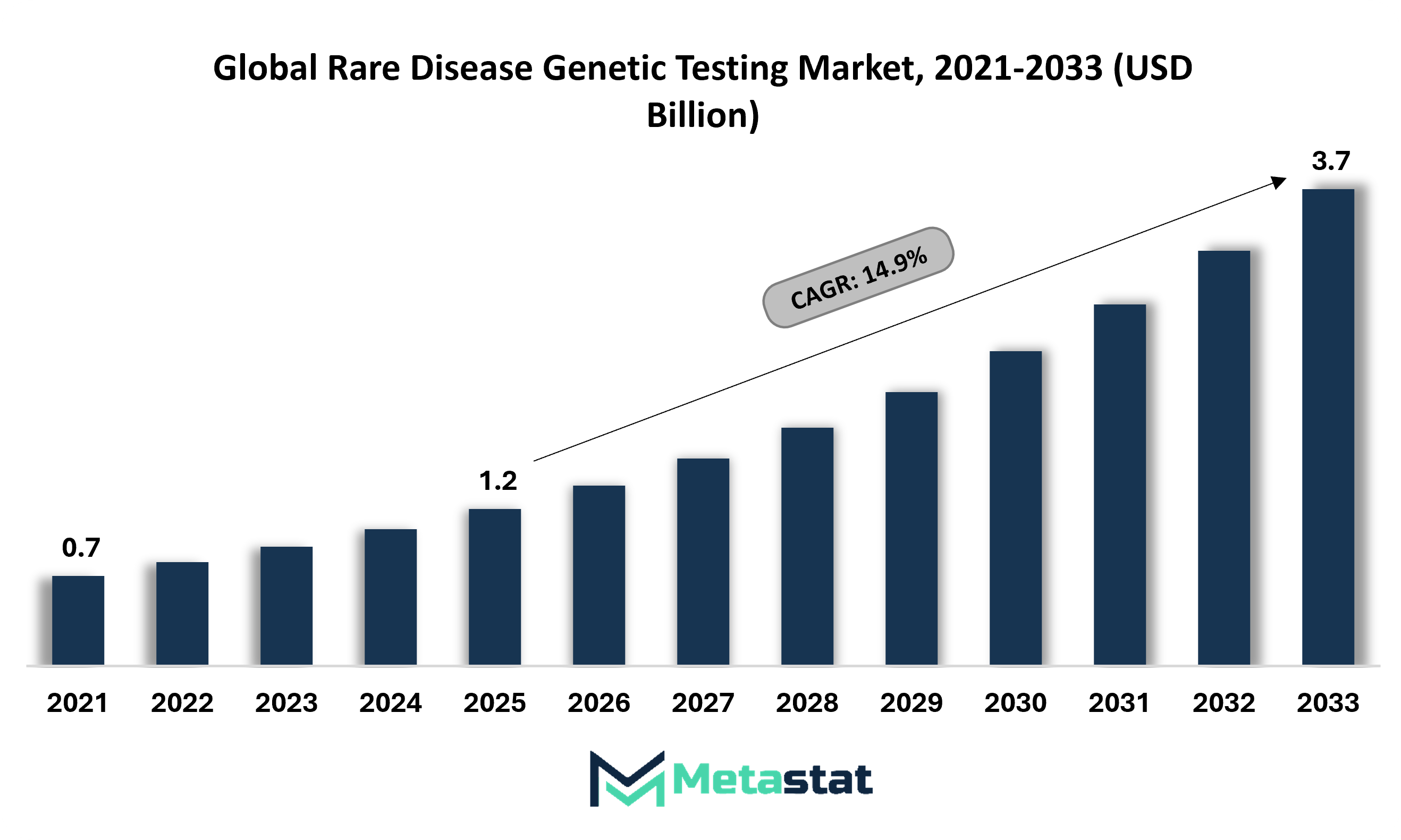
The global rare disease genetic testing market is mainly classified based on technology, disease type, specialty, and end user. Technology is further segmented into Whole Exome Sequencing (WES), Whole Genome Sequencing (WGS), Array Technology, PCR-based Testing, Sanger Sequencing, FISH, and Karyotyping. By disease type the market is divided into Neurological Disorders, Immunological Disorders, Cancer, Hematology Diseases, Cardiovascular Disorders (CVDs), Endocrine & Metabolism Diseases, Musculoskeletal Disorders, Dermatology Disease, and Others. By specialty the market is further divided into Molecular Genetic Tests, Chromosomal Genetic Tests, and Biochemical Genetic Tests. By end user the global Rare Disease Genetic Testing market is divided as Research Laboratories & CROs, Diagnostic Laboratories, and Hospitals & Clinics.
Based in technology, Whole Exome Sequencing (WES) has shown significant growth in 2020, owing to the increasing studies for whole exome sequencing (WES), rising awareness for rare disease genetic testing, and commercialization of service for whole exome sequencing (WES). For instance, Natera, a leader in cell-free DNA testing, has commercialized a research-use-only (RUO) service for whole exome sequencing (WES) of circulating tumor DNA, using plasma samples from patients with cancer. The assay allows researchers to characterize resistance mutations, actionable mutations, neoantigens, and tumor evolution.
Based on geography, the global rare disease genetic testing market is divided into North America, Europe, Asia-Pacific, South America, and Middle East & Africa. North America is further divided in the U.S., Canada, and Mexico, whereas Europe consists of the UK, Germany, France, Italy, and Rest of Europe. Asia-Pacific is segmented into India, China, Japan, South Korea, and Rest of Asia-Pacific. The South America region includes Brazil, Argentina, and the Rest of South America, while the Middle East & Africa is categorized into GCC Countries, Egypt, South Africa, and Rest of Middle East & Africa.
North America was dominating the rare disease genetic testing market, due to the rising incidence of rare disorders, rising awareness regarding the rare disease genetic testing, commercialization of new testing technique for rare disease, and partnership between pharmaceutical companies and other health care institutes to introduce Rare Disease Institute (RDI). For instance, Prognos Health, an AI-driven platform company focused on predicting the trajectory of disease to drive informed decisions earlier in the patient journey, has introduced the Rare Disease Institute (RDI). The RDI is partnering with pharmaceutical companies, reference and genetic testing labs, health systems/academic centers, patient advocacy groups and innovative technology companies to improve testing and therapies for patients, educate patients and physicians on the latest in diagnostics, and empower the pharmaceutical industry with the development of new therapies to treat and cure rare disease.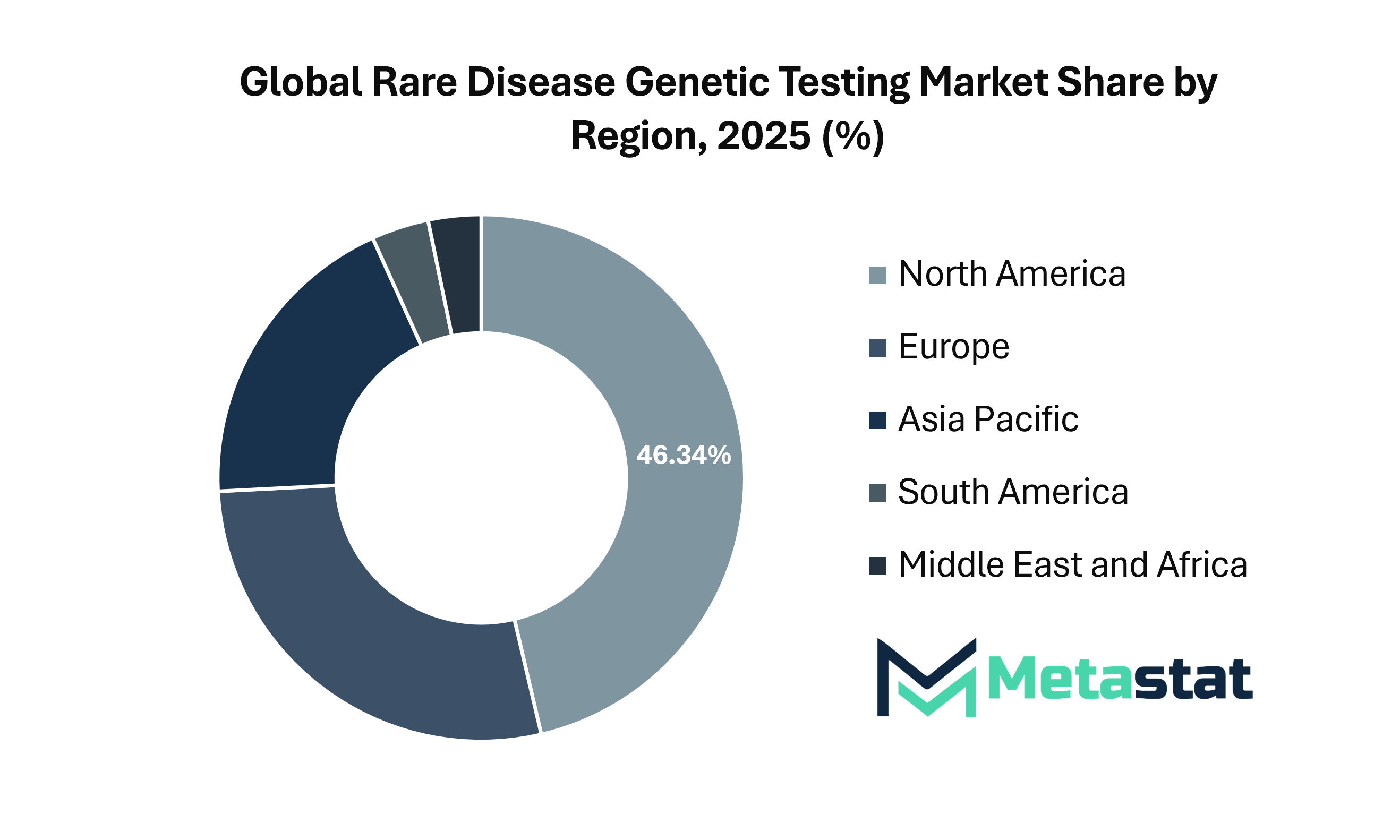
Key players operating in the rare disease genetic testing industry include Quest Diagnostics Inc., Strand Life Sciences, Myriad Genetics, Centogene N.V., Perkin Elmer, 3billion Inc., Invitae Corporation, Baylor Genetics, Ambry Genetics, Macrogen Inc., Preventiongenetics, Opko Health Inc., Progenity Inc., and Fulgent Genetics Inc.
The strategic mergers & acquisitions between companies to expand their offerings and strengthen their presence in this market, increasing clinical studies on rare disease genetic testing technique, commercialization of rare disease genetic testing technique, and extending partnership between companies to continue the diagnose of rare genetic disorders patients are some of the strategies adopted by the major companies. For instance, on April 14, 2021, Centogene N.V., a commercial-stage company focused on rare diseases has extended its partnership with Takeda Pharmaceutical Company Limited to diagnose patients with rare genetic disorders. The partnership has extended until March 2022, under which CENTOGENE will continue to provide rare genetic testing to patients around the world.
Find answers to common questions about this report
Top players operating in the Rare Disease Genetic Testing industry includes Quest Diagnostics Inc., Strand Life Sciences, Myriad Genetics, Centogene N.V., Perkin Elmer, 3billion Inc., Invitae Corporation, Baylor Genetics, Ambry Genetics, Macrogen Inc., Preventiongenetics, Opko Health Inc., Progenity Inc., and Fulgent Genetics Inc.
According to Metastat Insights analysis, the North America Rare Disease Genetic Testing market size is estimated to reach USD 1.6 billion by 2033.
The Metastat Insights study reveals that the Rare Disease Genetic Testing market size was valued at USD 1.2 billion in 2025.
The Rare Disease Genetic Testing market is projected to grow at a CAGR of 14.9% during the forecast period from 2026 to 2033.
The analysts below cover Healthcare research at Metastat Insights.
LEAD ANALYST
Utkarsh Khirodkar is a Lead Market Research Analyst at MetaStat Insight, specializing in market intelligence, technology sector assessments, and competitive strategy.

LEAD PRINCIPAL ANALYST, PHARMA AND HEALTHCARE
Food and Beverages · Healthcare · Healthcare IT · Medical Devices
Ajay Devgire is the Lead Healthcare Analyst at MetaStat Insight, leading strategic research and market intelligence initiatives across the global healthcare domain.
Floating offshore wind feasibility relies heavily on specialized installation vessel availability and port crane limits, which most broad renewable energy forecasts ignore. The report delivered a thorough analysis of dry dock capacity, mooring chain supply constraints, and raw material pricing trends for deepwater anchor installations. It served as a solid independent sanity check for our offshore project capital expenditure assumptions.
Assessing commercial microgrid software adoption requires looking past top-level installation numbers and examining utility interconnection queues. The research provided verifiable data on average permitting timelines, tariff structures, and battery storage integration costs across regional utility territories. That grounded perspective was valuable for our team when building five-year demand projections for industrial microgrid controllers.
Ambulatory surgical centers have very different purchasing cycles for robotic-assisted surgery platforms than major hospital networks. The MetaStat Insight study focused squarely on capital expenditure depreciation, procedural reimbursement pathways, and surgeon training overhead. That operational clarity made it much simpler to validate multi-year procedure growth forecasts against actual ambulatory center adoption patterns.
Explore related market intelligence reports worth reading alongside this one.