
LEAD ANALYST
Utkarsh Khirodkar is a Lead Market Research Analyst at MetaStat Insight, specializing in market intelligence, technology sector assessments, and competitive strategy.

Hemoglobinopathies Market Size, Share, By Type (Thalassemia, Sickle Cell Disease, Others), By End-User (Hospitals, Diagnostics Laboratories, and Others), By Test Type (Genetic Testing, Routine Red Blood Cell (RBC) Count, Hemoglobin Isoelectric Focusing (Hb IEF), Hemoglobin electrophoresis (Hb ELP), and Others), Industry Analysis, Growth, Trends, and Forecast, 2026-2033
Report ID
MSI-2346
Published
February, 2026
Pages
293 Pages
Format
Report Details
Choose Your License
Hemoglobinopathies Market
Global Hemoglobinopathies market size is valued at USD 7.2 billion in 2025 and projected to grow at a CAGR of 18.2% during the forecast period, reaching USD 27.4 billion by 2033
Hemoglobinopathies are a group of disorders inherited in which there is abnormal production or structure of the hemoglobin molecule. Sickle cell disease (SCD) and thalassemia are blood disorders caused by abnormal hemoglobin that damages and deforms red blood cells.
The rising prevalence of hemoglobinopathies is boosting the market growth. For instance, approximately 7% of the worldwide population have hemoglobinopathies and are the most common monogenic diseases. Sickle Cell Disease (SCD) is the most common inherited blood disorder in the United States. According to the Centers for Disease Control and Prevention (CDC), Sickle Cell Disease (SCD) affects approximately 100,000 Americans in 2020. Sickle Cell Disease occurs among 1 out of every 16,300 Hispanic-American births. The prevalence of beta-thalassemia globally is around 288,000, with an incidence of 60,000 births per year. Beta-thalassemia is prevalent in developing countries of Africa, South Asia, Southeast Asia, the Mediterranean region and the Middle East. The total prevalence of beta-thalassemia in the European Union and the United States is estimated to be approximately 19,000 patients. Every year approximately 100,000 children are born with Thalassemia Major around the world, of which 10,000 are born in India. Further, favorable government programs related to hemoglobinopathy are a key driving factor of the market. However, product recall might hamper the market growth. Moreover, an increasing clinical trial for hemoglobinopathies therapy would provide lucrative opportunities for the market in coming years.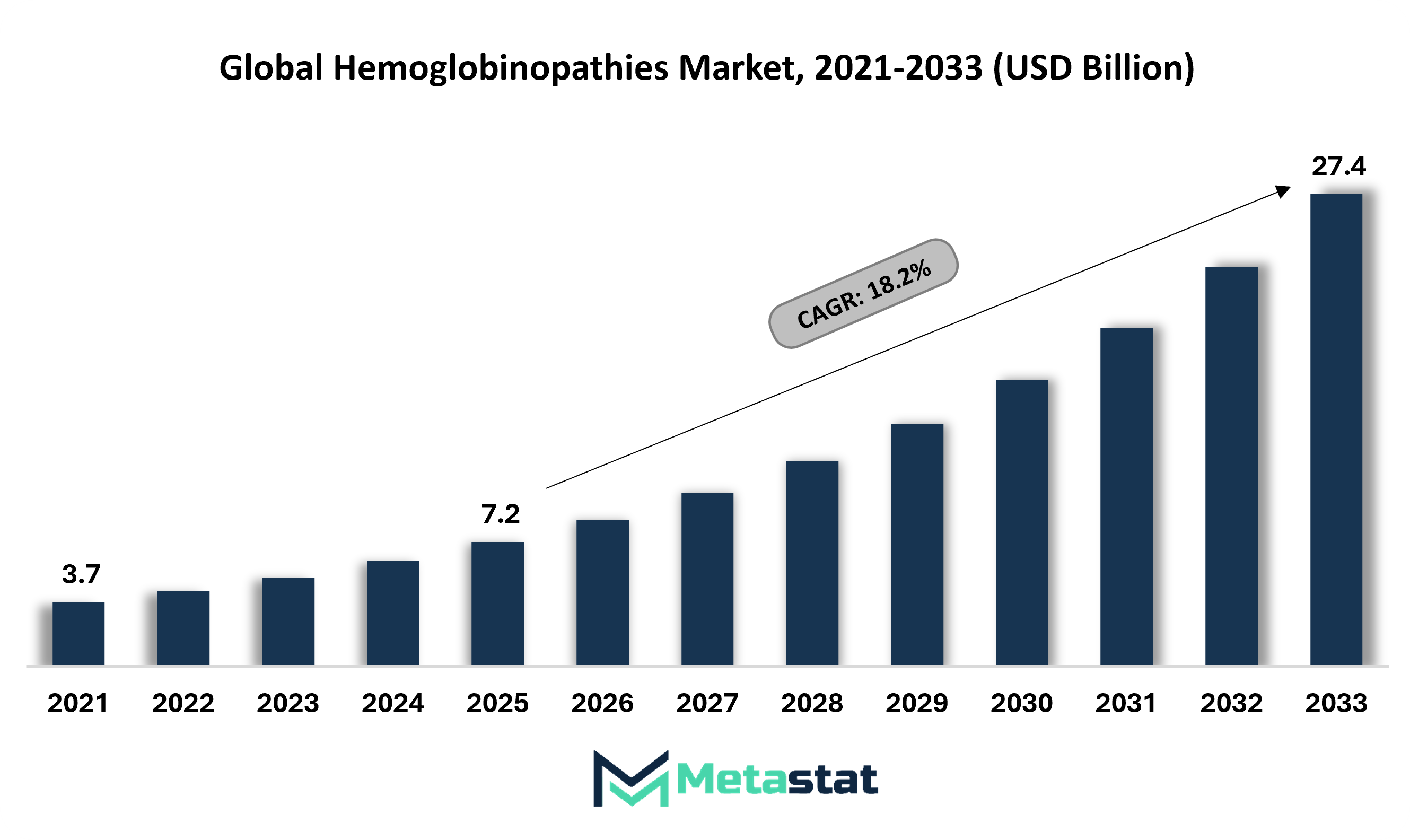
The global hemoglobinopathies market is mainly classified based on type, end-user, and test type. Type is further segmented into Thalassemia, Sickle Cell Disease, and Others. By end-user, the market is divided into Hospitals, Diagnostics Laboratories, and Others. By test type, the market is further divided into Genetic Testing, Routine Red Blood Cell (RBC) Count, Hemoglobin Isoelectric Focusing (Hb IEF), Hemoglobin electrophoresis (Hb ELP), and Others.
Based on Type, Thalassemia segment is valued at USD 4 billion in 2026 and is projected to reach USD 11.9 billion by 2033, at a CAGR of 16.8% during the forecast period.
Based on end-user, Hospitals segment is projected to reach USD 13.8 billion by 2033, at a CAGR of 17% during the forecast period.
Based on test type, Genetic Testing segment is projected to reach USD 12.3 billion by 2033.
Based on geography, the global hemoglobinopathies market is divided into North America, Europe, Asia-Pacific, South America, and Middle East & Africa. North America is further divided into the U.S., Canada, and Mexico, whereas Europe consists of the UK, Germany, France, Italy, and Rest of Europe. Asia-Pacific is segmented into India, China, Japan, South Korea, and Rest of Asia-Pacific. The South America region includes Brazil, Argentina, and the Rest of South America, while the Middle East & Africa is categorized into GCC Countries, Egypt, South Africa, and Rest of Middle East & Africa.
North America is expected to dominate the hemoglobinopathies market in 2021 due to the rising incident and prevalence of hemoglobinopathies, commercialization of regulatory approval of hemoglobinopathies therapy, and increasing clinical studies on hemoglobinopathies therapy. For instance, Imara Inc., a clinical-stage biopharmaceutical company that develops and commercializes therapeutics to treat patients suffering from inherited genetic disorders of hemoglobin, has introduced the company’s Forte Phase 2b clinical trials of IMR-687 for patients with beta-thalassemia. IMR-687 is designed to have a multimodal mechanism action on red blood cells, white blood cells, adhesion mediators and other cell types.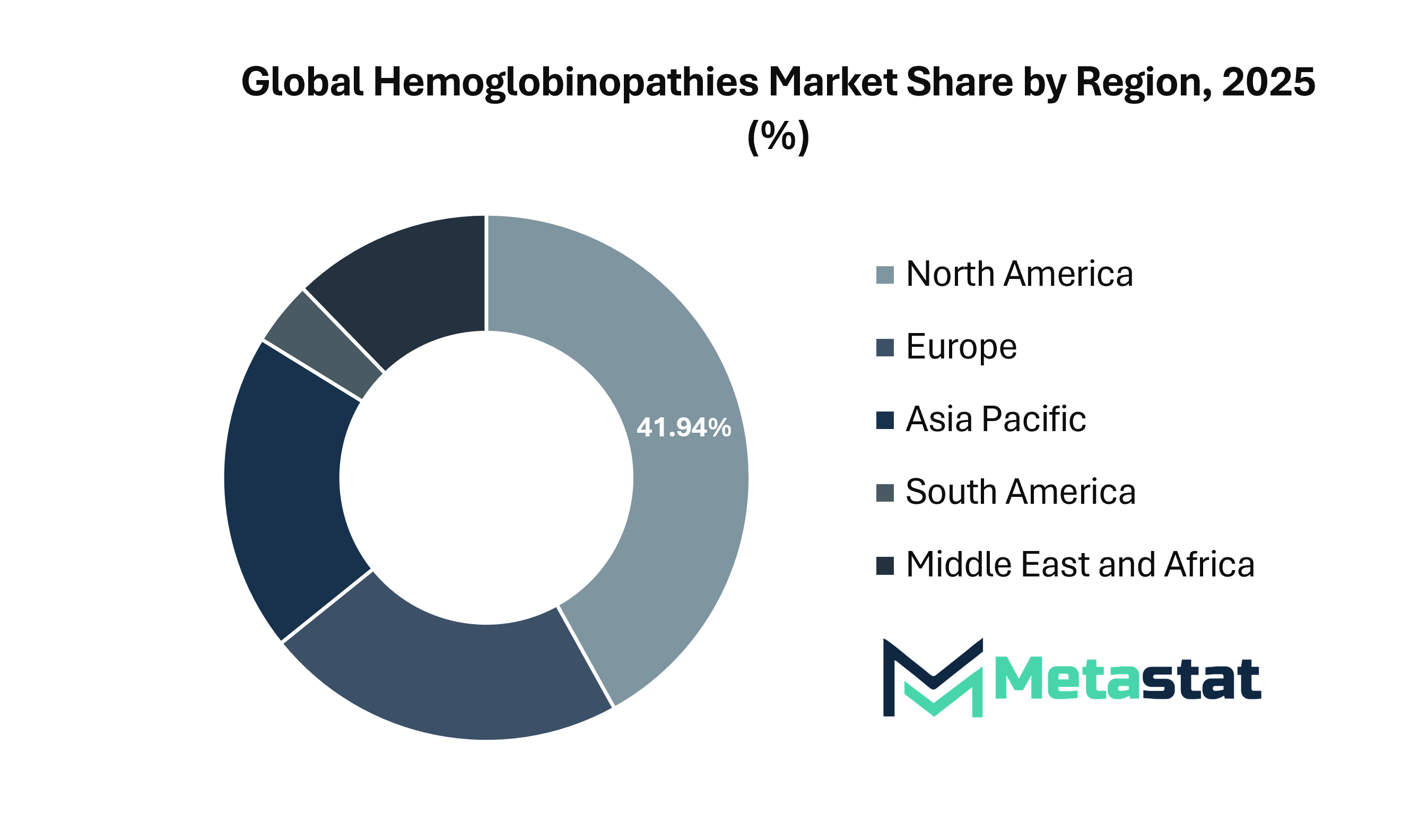
Key players operating in the hemoglobinopathies industry include Bio-Rad Laboratories, Inc., Shenzhen Mindray Bio-Medical Electronics Co., Ltd, PerkinElmer Inc., Sysmex Corporation, Novartis AG, Emmaus Medical, Bristol-Myers Squibb Company, ApoPharma Inc, Gamida Cell, and Acceleron Pharma, Inc.
Raising funds for the development of hemoglobinopathies products, commercialization of regulatory approved hemoglobinopathies therapy, increasing clinical trials for the hemoglobinopathies therapy, and the collaboration between companies and private foundation for the development of hemoglobinopathies therapy products are some of the strategies adopted by the major companies. For instance, on February 17, 2021, Novartis has entered into a grant agreement with the Bill & Melinda Gates Foundation. Based on the agreement, the foundation will provide funding support for the development of a single-administration, in vivo gene therapy for the treatment of sickle cell disease (SCD). The objectives of the project is to expand access to healthcare in low-resource settings in an effort to address sickle cell disease (SCD) life-threatening genetic disease.
|
Report Attributes |
Details |
|
Study Period |
2021-2033 |
|
Base Year |
2025 |
|
Estimated Year |
2026 |
|
Forecast Period |
2026-2033 |
|
Historical Period |
2021-2025 |
|
Growth Rate |
CAGR 18.2% from 2026 to 2033 |
|
Revenue Unit |
USD billion |
|
Sales Volume Unit |
Thousand Units |
|
Segmentation |
By Type, End-User, Test Type and Region |
|
By Region |
North America (By Type, End-User, Test Type and Country)
|
|
|
Europe (By Type, End-User, Test Type and Country)
|
|
|
Asia Pacific (By Type, End-User, Test Type and Country)
|
|
|
South America (By Type, End-User, Test Type and Country)
|
|
|
Middle East and Africa (By Type, End-User, Test Type and Country)
|
Find answers to common questions about this report
The Metastat Insights study reveals that the Hemoglobinopathies market size was valued at USD 7.2 billion in 2025.
The Hemoglobinopathies market is estimated to reach a valuation of USD 27.4 billion by 2033.
According to Metastat Insights analysis, the North America Hemoglobinopathies market size is estimated to reach USD 10.4 billion by 2033.
The Hemoglobinopathies market is projected to grow at a CAGR of 18.2% during the forecast period from 2026 to 2033.
Top players operating in the Hemoglobinopathies industry includes Bio-Rad Laboratories, Inc., Shenzhen Mindray Bio-Medical Electronics Co., Ltd, PerkinElmer Inc., Sysmex Corporation, Novartis AG, Emmaus Medical, Bristol-Myers Squibb Company, ApoPharma Inc, Gamida Cell, Acceleron Pharma, Inc.
The analysts below cover Healthcare research at Metastat Insights.
LEAD ANALYST
Utkarsh Khirodkar is a Lead Market Research Analyst at MetaStat Insight, specializing in market intelligence, technology sector assessments, and competitive strategy.

LEAD PRINCIPAL ANALYST, PHARMA AND HEALTHCARE
Food and Beverages · Healthcare · Healthcare IT · Medical Devices
Ajay Devgire is the Lead Healthcare Analyst at MetaStat Insight, leading strategic research and market intelligence initiatives across the global healthcare domain.
Assessing 200mm wafer transition schedules and substrate supply bottlenecks requires precise technical intelligence. MetaStat Insight supplied an actionable breakdown comparing planar and trench MOSFET architectures across automotive and industrial drive markets. The regional capacity estimates for Asia-Pacific foundries helped clarify lead-time uncertainties during our strategic planning session. When we needed additional clarification on high-purity raw material sourcing, their analyst team responded with helpful context within twenty-four hours.
Tracking maintenance cycle demand for secondary flight display units and terrain collision avoidance systems across regional jet fleets involves complex aftermarket dynamics. MetaStat Insight provided practical analysis separating airline retrofit programs from OEM forward-fit production schedules in North America and Southeast Asia. The supplier matrix highlighted component obsolescence timelines without resorting to vague generalizations. The dataset served as a dependable reference during our annual program review meetings.
Evaluating secondary resin quality across post-consumer packaging streams requires reliable technical segmentation. MetaStat Insight delivered an objective assessment that distinguished between extrusion-grade flake pricing and optical sorting throughput limitations across Western Europe. The competitive positioning breakdown for licensed depolymerization technology providers answered several questions during our feedstock feasibility audit. Their team clarified regional trade restrictions on mixed plastic scrap quickly when our team submitted follow-up requests.
Explore related market intelligence reports worth reading alongside this one.
Starting from
$2950