
LEAD ANALYST
Utkarsh Khirodkar is a Lead Market Research Analyst at MetaStat Insight, specializing in market intelligence, technology sector assessments, and competitive strategy.

Global SIC Discrete Device Market Size, Share, By Type (SiC MOSFET, SiC Diode, and SIC Module), By Application (Telecommunications, Energy, Power, Automotive, Renewable Power Generation, and Others), Industry Analysis, Growth, Trends, and Forecast, 2026-2033
Report ID
MSI-4643
Published
April, 2026
Pages
313 Pages
Format
Report Details
Choose Your License
SIC Discrete Device Market
Global SIC Discrete Device market size is valued at USD 4.1 billion in 2025 and projected to grow at a CAGR of 14.6% during the forecast period, reaching USD 12.2 billion by 2033.
North America holds 25.1% of the global market in 2025, with the U.S. leading the regional market.
SiC MOSFET segment accounts for a market share of 46.8% in 2025.
Key trends driving growth: Increasing adoption of electric vehicles and fast-charging infrastructure driving demand for high-efficiency power devices, Superior thermal conductivity and switching performance of SiC enabling energy savings in industrial and renewable applications.
Opportunities include growing deployment in renewable energy systems and grid infrastructure creating long-term demand for high-performance power semiconductors.
Key insight: Rising electrification across automotive, renewable energy, and industrial sectors is accelerating adoption of high-efficiency SiC discrete devices for advanced power electronics systems.
Global SiC Discrete Device market growth is closely tied to the rapid electrification of transportation systems and the increasing deployment of advanced energy conversion technologies across industrial and power sectors. Silicon carbide devices are gaining traction owing to their ability to operate at higher voltages, temperatures, and switching frequencies compared with conventional silicon-based components.
The Global SiC Discrete Device market continues to benefit from advancements in wide-bandgap semiconductor materials, enabling improved energy efficiency and reduced system losses. Adoption remains strong across electric vehicles, charging infrastructure, and renewable energy systems, where performance reliability under demanding operating conditions remains critical. Manufacturers are actively investing in wafer capacity expansion and fabrication process improvements to meet rising demand across multiple end-use applications.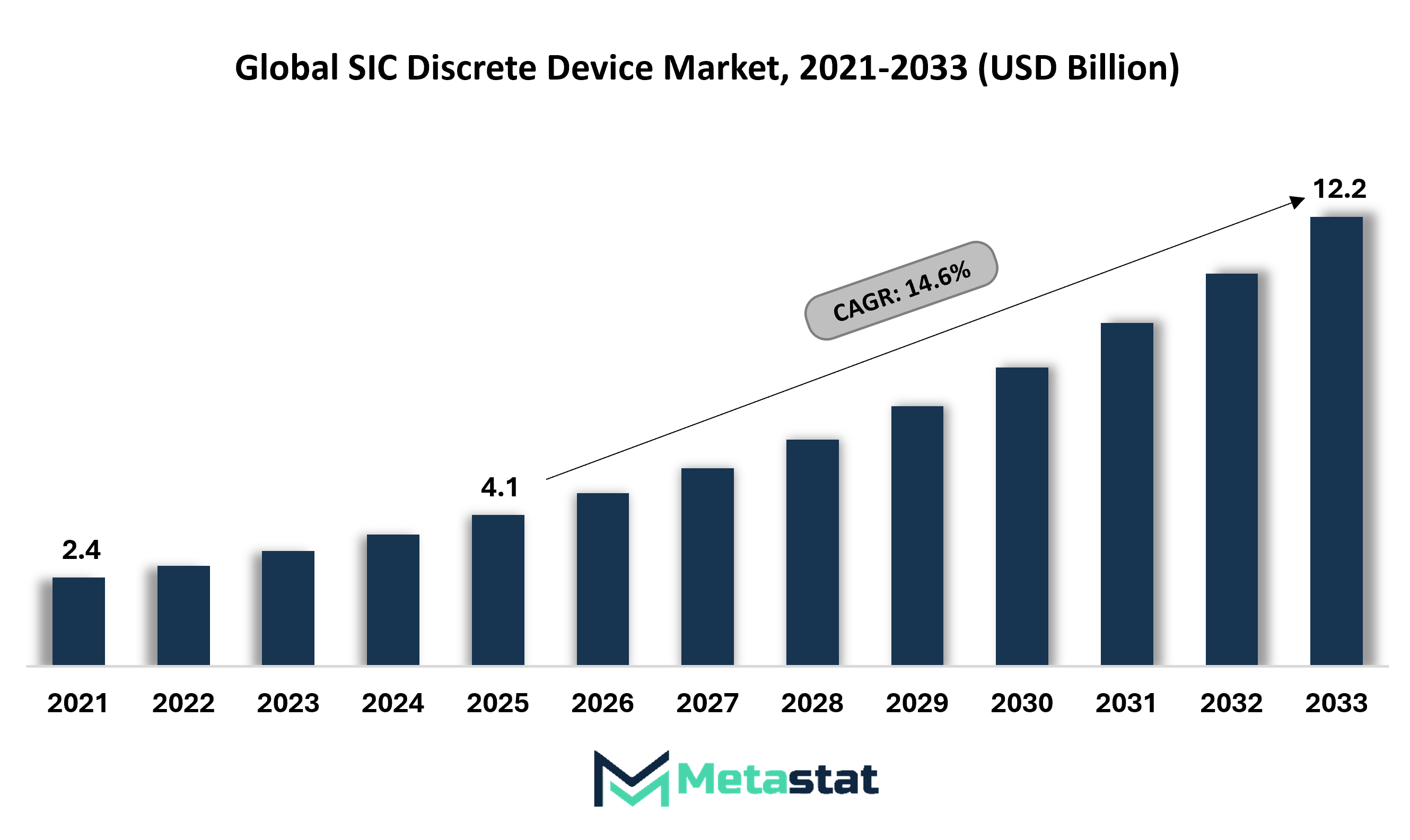
Increasing adoption of electric vehicles and fast-charging infrastructure driving demand for high-efficiency power devices.
Rapid expansion of electric mobility, public charging networks, fleet electrification, and battery innovation is strengthening demand for efficient power devices. SiC discrete components support lower heat generation, faster charging cycles, compact converter design, and improved high-voltage handling. Long-term growth in transportation electrification will sustain procurement across automotive manufacturing value chains.
Superior thermal conductivity and switching performance of SiC enabling energy savings in industrial and renewable applications
High thermal conductivity, low switching losses, and stable operation under elevated temperatures make SiC devices valuable for factories, solar inverters, wind converters, and industrial automation systems. Energy savings support improved operating efficiency and system performance. Ongoing industrial modernization and clean energy expansion will broaden adoption across heavy-duty electrical equipment.
High manufacturing costs and complex fabrication processes limiting widespread adoption
Production of SiC devices involves advanced crystal growth, precision polishing, defect control, and specialized fabrication lines, resulting in elevated manufacturing costs. Premium pricing will slow purchasing decisions among cost-sensitive end users. Future adoption will depend on yield improvement, process efficiency gains, and larger production volumes that support better unit economics.
Supply chain constraints for SiC wafers impacting production scalability
Limited wafer availability, long qualification cycles, concentrated supplier networks, and material defect challenges can restrict manufacturing scale. Delivery delays will affect automotive, energy, and industrial order fulfillment. Future market stability will depend on regional capacity additions, diversified sourcing strategies, and stronger raw material processing ecosystems.
Growing deployment in renewable energy systems and grid infrastructure creating long-term demand for high-performance power semiconductors
Solar farms, wind parks, battery energy storage systems, smart substations, and grid modernization programs require durable high-performance semiconductors. SiC discrete devices improve conversion efficiency and support higher power density. Rising investment in resilient power networks will create long-term revenue opportunities across utility and infrastructure applications.
The Global SIC Discrete Device market is classified based on Type and Application.
SiC MOSFET segment is valued at USD 2.2 billion in 2026 and is projected to reach USD 6.5 billion by 2033, at a CAGR of 16.7% during the forecast period.
Strong demand will support SiC MOSFET adoption within the Global SiC Discrete Device market, driven by efficiency requirements across high-frequency switching environments. Advanced thermal stability will enhance performance under elevated operating conditions, enabling compact system design. Industry participants are focusing on cost optimization, improved reliability, and deeper integration across next-generation electronic architectures.
SiC Diode segment is valued at USD 1.5 billion in 2026 and is projected to reach USD 3.3 billion by 2033, at a CAGR of 11.6% during the forecast period.
SiC diode adoption will expand steadily across the Global SiC Discrete Device market owing to low reverse recovery losses and high voltage tolerance. Power conversion systems will benefit from improved energy efficiency and reduced heat dissipation. Manufacturing advancements will lower production costs, encouraging broader deployment across industrial equipment and high-performance electronic systems.
SIC Module segment is valued at USD 0.9 billion in 2026 and is projected to reach USD 2.4 billion by 2033, at a CAGR of 14% during the forecast period.
SiC module adoption will accelerate across the broader power electronics industry with the growing need for integrated power solutions. Enhanced packaging technologies will improve power density and system durability. Industrial applications will increasingly prefer modular configurations for scalability, while future innovations will strengthen performance consistency across demanding operating environments with reduced system complexity.
Telecommunications segment is projected to reach USD 1.6 billion by 2033, at a CAGR of 15.4% during the forecast period.
Telecommunications infrastructure will support growth through rising demand for high-frequency, low-loss components. Network expansion, including 5G deployment, will require efficient power-handling capabilities. SiC-based devices will support stable signal transmission, lower energy consumption, and long-term operational reliability across evolving communication networks.
Energy & Power segment is projected to reach USD 2.6 billion by 2033, at a CAGR of 13.3% during the forecast period.
Energy and power systems will witness increasing reliance on advanced components within the Global SiC Discrete Device market. Grid modernization efforts will require efficient power conversion technologies with minimal losses. SiC devices will improve transmission efficiency, support smart grid operations, and enable stable performance under fluctuating load conditions across large-scale infrastructure.
Automotive segment is projected to reach USD 5.3 billion by 2033, at a CAGR of 16.9% during the forecast period.
Automotive electrification will remain a major growth driver for the Global SiC Discrete Device market. Electric vehicle systems rely on high-performance power electronics for battery management and drivetrain efficiency. SiC components enable faster charging, extended driving range, and improved thermal management, supporting next-generation mobility solutions with higher energy efficiency.
Renewable Power Generation segment is projected to reach USD 2.1 billion by 2033, at a CAGR of 13.8% during the forecast period.
Renewable power generation will create strong opportunities through the expansion of solar and wind installations. Efficient power conversion will remain essential for maximizing output. SiC devices will support higher switching frequencies and lower losses, improve system performance while enabling efficient renewable energy integration across modern power networks.
Others segment is projected to reach USD 0.6 billion by 2033, at a CAGR of 6.1% during the forecast period.
Other application areas will contribute to the steady expansion of the Global SiC Discrete Device market across diverse industrial and specialized electronics uses. Aerospace, defense, and medical equipment will continue to require high-performance components with strong durability and reliability. SiC technology will support operation under extreme conditions, enabling innovation across systems with precise performance requirements.
Based on geography, the Global SIC Discrete Device market is divided into North America, Europe, Asia-Pacific, South America, Middle East, and Africa.
In North America, a strong electric vehicle ecosystem and expanding renewable energy capacity are driving high demand for SiC power devices across advanced powertrain and grid applications.
In Europe, renewable energy projects, EV adoption, and industrial electrification are supporting steady demand for SiC discrete devices across automotive, industrial, and grid-related applications.
In Asia Pacific, expanding semiconductor production capacity and a dominant EV manufacturing base are creating large-scale opportunities for SiC device deployment across power electronics applications.
In South America, rising investments in renewable energy, power distribution upgrades, and industrial automation are supporting demand for SiC discrete devices across energy conversion applications.
Growth opportunities across the Middle East & Africa are supported by expansion of solar energy capacity, smart grid initiatives, telecom infrastructure development, and increasing deployment of high-efficiency industrial systems.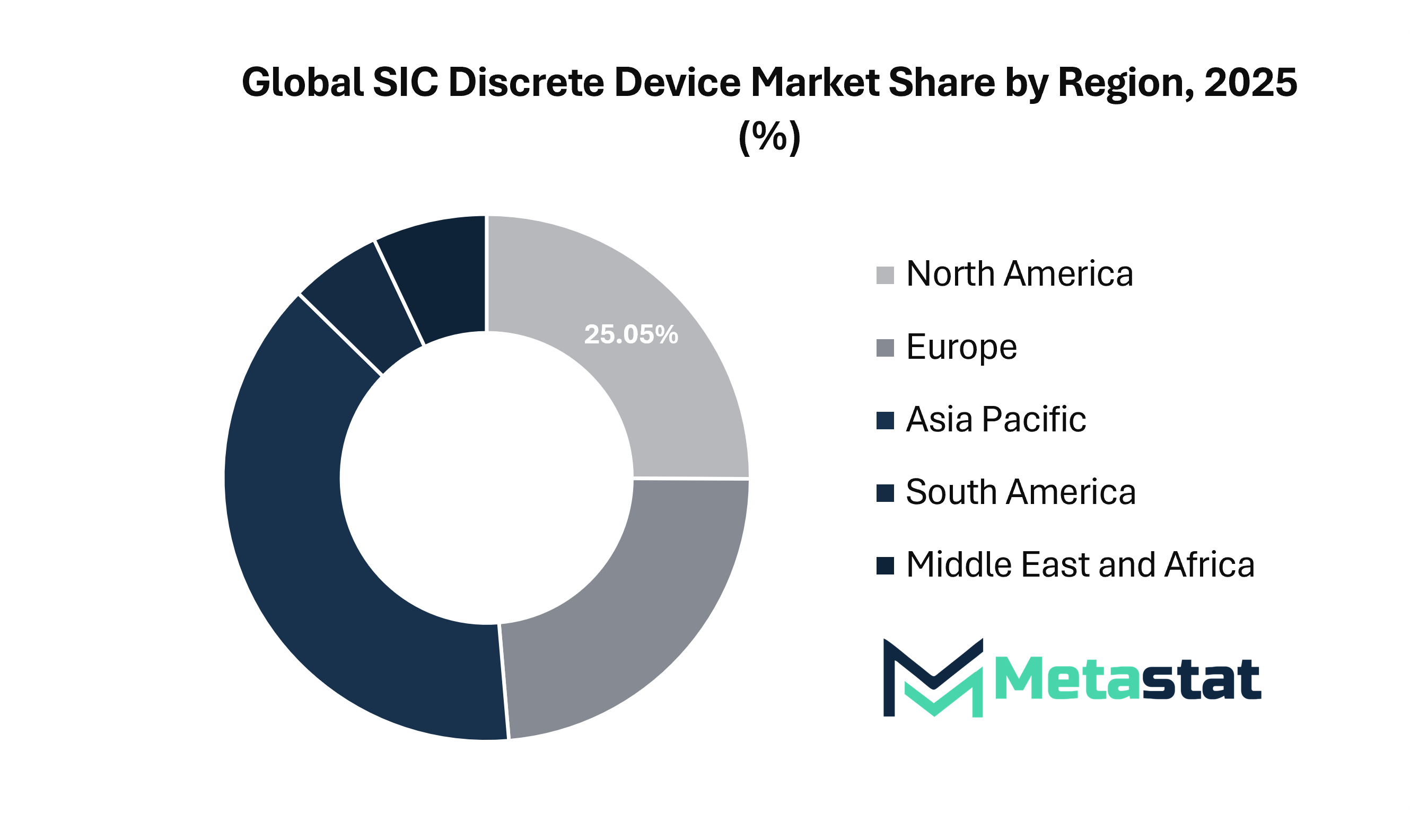
The Global SiC Discrete Device Market is gaining strategic importance as industries move toward energy-efficient solutions and higher performance requirements. Silicon carbide devices are valued for their ability to handle high temperatures and voltages, making them well suited for electric vehicles, renewable energy systems, and advanced industrial equipment. Adoption will continue to rise as manufacturers seek materials that support faster switching and lower energy loss. With increasing focus on sustainability and cost efficiency, these devices will play an important role in shaping next-generation electronics.
The market is witnessing a clear shift toward innovation, with companies investing in research to improve device reliability and reduce manufacturing costs. As technology advances, adoption will expand across sectors that have traditionally relied on conventional silicon-based components. Market development remains steady, supported by practical performance requirements. Manufacturers are improving product efficiency while also scaling production to meet growing demand without compromising quality.
A broad range of companies contributes to the competitive landscape, each bringing distinct strengths in design, manufacturing, and application expertise. Key Global SiC Discrete Device industry players include Wolfspeed, Inc., Infineon Technologies AG, onsemi, STMicroelectronics N.V., ROHM Co., Ltd., Microchip Technology Incorporated, Nexperia B.V., Qorvo, Inc., Navitas Semiconductor Corporation, Littelfuse, Inc., Vishay Intertechnology, Inc., Robert Bosch GmbH, Toshiba Electronic Devices & Storage Corporation, Diodes Incorporated, Fuji Electric Co., Ltd., Shindengen Electric Manufacturing Co., Ltd., SanRex Corporation, WeEn Semiconductors Co., Ltd., Taiwan Semiconductor Manufacturing Company Limited, Alpha and Omega Semiconductor Limited, KEC Corporation, PANJIT International Inc., Bourns, Inc., SemiQ Inc., CISSOID S.A., BASiC Semiconductor Co., Ltd., InventChip Technology Co., Ltd., Hunan Sanan Semiconductor Co., Ltd., China Resources Microelectronics Limited, and Hangzhou Silan Microelectronics Co., Ltd.
These competitors will shape market development through product launches, partnerships, and capacity expansion strategies. Their focus will remain on meeting the needs of industries that require reliable and energy-efficient components. Over time, competition will support technology advancement, product improvement, and stronger value delivery for end users.
Market size is forecast to rise from USD 4.1 billion in 2025 to over USD 12.2 billion by 2033.
The Global SiC Discrete Device market is expected to witness strong growth, driven by continuous advancements in wide-bandgap semiconductor technologies and increasing demand for energy-efficient systems. Expansion of electric mobility, smart grids, and renewable energy infrastructure will play a critical role in shaping long-term market dynamics.
This research report categorizes the SIC Discrete Device market based on key segments and regions, forecasts revenue growth, and analyses trends in each submarket. The report analyses the key growth drivers, opportunities, and challenges influencing the SIC Discrete Device market. Recent market developments and competitive strategies such as expansion, product launch, partnership, merger, and acquisition have been included to draw the competitive landscape in the market.
The report strategically identifies and profiles the key market players and analyses their core competencies in each sub-segment of the SIC Discrete Device market.
|
Report Attributes |
Details |
|
Study Period |
2021-2033 |
|
Base Year |
2025 |
|
Estimated Year |
2026 |
|
Forecast Period |
2026-2033 |
|
Historical Period |
2021-2025 |
|
Growth Rate |
CAGR 14.6% from 2026 to 2033 |
|
Revenue Unit |
USD billion |
|
Segmentation |
By Type, Application, and Region |
|
By Region |
North America (By Type, Application, and Country)
|
|
Europe (By Type, Application, and Country)
|
|
|
Asia Pacific (By Type, Application, and Country)
|
|
|
South America (By Type, Application, and Country)
|
|
|
Middle East and Africa (By Type, Application, and Country)
|
Find answers to common questions about this report
Global SIC Discrete Device market is estimated to reach USD 12.2 billion by 2033.
The SiC MOSFET is the leading type segment in the Global market.
High manufacturing costs and complex fabrication processes limiting widespread adoption will hamper the market growth within the forecast period.
Increasing adoption of electric vehicles and fast-charging infrastructure driving demand for high-efficiency power devices and Superior thermal conductivity and switching performance of SiC enabling energy savings in industrial and renewable applications are key driving factors, boosting the market.
Top players operating in the SIC Discrete Device industry include Wolfspeed, Inc., Infineon Technologies AG, ON Semiconductor Corporation, STMicroelectronics N.V., ROHM Co., Ltd., Microchip Technology Incorporated, and Nexperia B.V.
Asia Pacific region dominates the market.
The Global SIC Discrete Device market is expected to grow at a CAGR of 14.6% over the forecast period (2026-2033).
The Metastat Insights analysis shows that the North America SIC Discrete Device market size is estimated to be USD 3.1 billion by 2033.
The Metastat Insights study shows that the Global SIC Discrete Device market size was USD 4.1 billion in 2025.
The analysts below cover Electronics and Semiconductor research at Metastat Insights.
LEAD ANALYST
Utkarsh Khirodkar is a Lead Market Research Analyst at MetaStat Insight, specializing in market intelligence, technology sector assessments, and competitive strategy.

PRINCIPAL CONSULTANT - ENTERPRISE AI & EMERGING TECHNOLOGIES
Banking & Finance · Electronics and Semiconductor · Energy and Power · Healthcare IT · Information & Technology · Professional Services
Vijay Gunti is a Principal Consultant at MetaStat Insight, bringing over two decades of experience across enterprise digital transformation, technology strategy, and intelligent systems.

PRINCIPAL CONSULTANT - QUALITY SYSTEMS & COMPLIANCE
Electronics and Semiconductor · Machinery & Equipment · Professional Services
Omkar Phadtare is an Industry Consultant at MetaStat Insight, specializing in quality systems, regulatory compliance, and standards benchmarking to drive data-driven market intelligence and strategic industry research.

ENERGY & INFRASTRUCTURE INDUSTRY CONSULTANT
Automotive and Transportation · Electronics and Semiconductor · Energy and Power · Machinery & Equipment
Saurabh Vasant Ganvir consults for Energy & Infrastructure Industry at MetaStat Insight, specializing in renewable energy, solar EPC, and electric vehicle (EV) infrastructure markets.

LEAD CONSULTANT - COMMUNICATION, TELECOM, AND IT
Electronics and Semiconductor · Information & Technology · Machinery & Equipment · Professional Services
Ravindra Sathe Consultants for Communication, Telecom, and IT at MetaStat Insight. He leads the firm's industry research initiatives across telecommunications infrastructure, digital connectivity, enterprise networking, and emerging information technology domains.
In the biological seed treatment space, registration timelines vary drastically between the European Union, Brazil, and North America. The MetaStat Insight research handled these cross-border regulatory barriers with genuine nuance, mapping commercialization pathways alongside historical field adoption rates. The segmentation between microbial strains and biochemical active ingredients was particularly well structured.
Our team was tracking whether regional recycling infrastructure could realistically absorb the growing volume of lithium iron phosphate batteries over the next decade. The report did a solid job separating announced hydrometallurgical plant capacity from active, permitted operational throughput. That distinction made the feedstock availability projections and regional recovery rate models far more credible than standard commercial overviews.
Tracking capacity expansion in single-use bioprocessing requires dependable data on raw material availability and cleanroom-grade polymer supply chains. The competitive landscape chapter gave a grounded evaluation of secondary component suppliers across North America and Asia-Pacific rather than simply reprinting press releases. Having that level of supplier benchmarking helped clarify dual-sourcing considerations for our clinical pipeline planning.
Explore related market intelligence reports worth reading alongside this one.