
LEAD ANALYST
Utkarsh Khirodkar is a Lead Market Research Analyst at MetaStat Insight, specializing in market intelligence, technology sector assessments, and competitive strategy.

Global Smart Logistics Market Size, Share, By Component (Hardware, Software, Services), By Solution Type (Warehouse Management and Execution Systems, Transportation Management Systems, Fleet Management and Telematics, Supply Chain Visibility and Control Towers, Asset Tracking and Traceability Solutions, Order and Inventory Management Solutions, Yard and Dock Management Systems, Last-Mile Delivery Management, Warehouse Robotics and Automated Material Handling), By Deployment Model (Cloud-Based, On-Premises, Hybrid), By End-Use Industry (Retail and E-commerce, Transportation and Logistics, Industrial Manufacturing, Textile and Apparel, Automotive, Food and Beverage, Healthcare and Pharmaceuticals, Aerospace and Defense, Energy and Chemicals), Industry Analysis, Growth, Trends, and Forecast, 2026-2033
Report ID
MSI-5318
Published
September, 2026
Pages
297 Pages
Format
Historical
Base year
Forecast
Forecast period
Report Details
Market Valuation: Valued at $54.9 Million in 2025, projected to reach $254.1 Million by 2033 at a 21.1% CAGR.
Dominant Segment: The Software segment leads the Smart Logistics market, driven by the increasing need for automation and optimization in supply chain operations. This segment is projected to reach USD 103.6 million by 2033, reflecting a CAGR of 22.5%.
Geographic Lead: The Asia-Pacific region is expected to grow fastest, fueled by rapid urbanization and industrialization, which create a strong demand for advanced logistics solutions.
What's Inside: The report provides a comprehensive analysis of the Smart Logistics market, including competitive coverage, market dynamics, and detailed forecasts from 2026 to 2033.
Emerging Trends: Key trends include the adoption of AI and machine learning technologies, which enhance operational efficiency and decision-making across logistics networks.
Investment Drivers: Increased investment in industrial automation and cloud-based logistics platforms is driving significant market growth, as organizations seek scalable and efficient solutions.
Choose Your License
Global Smart Logistics Market
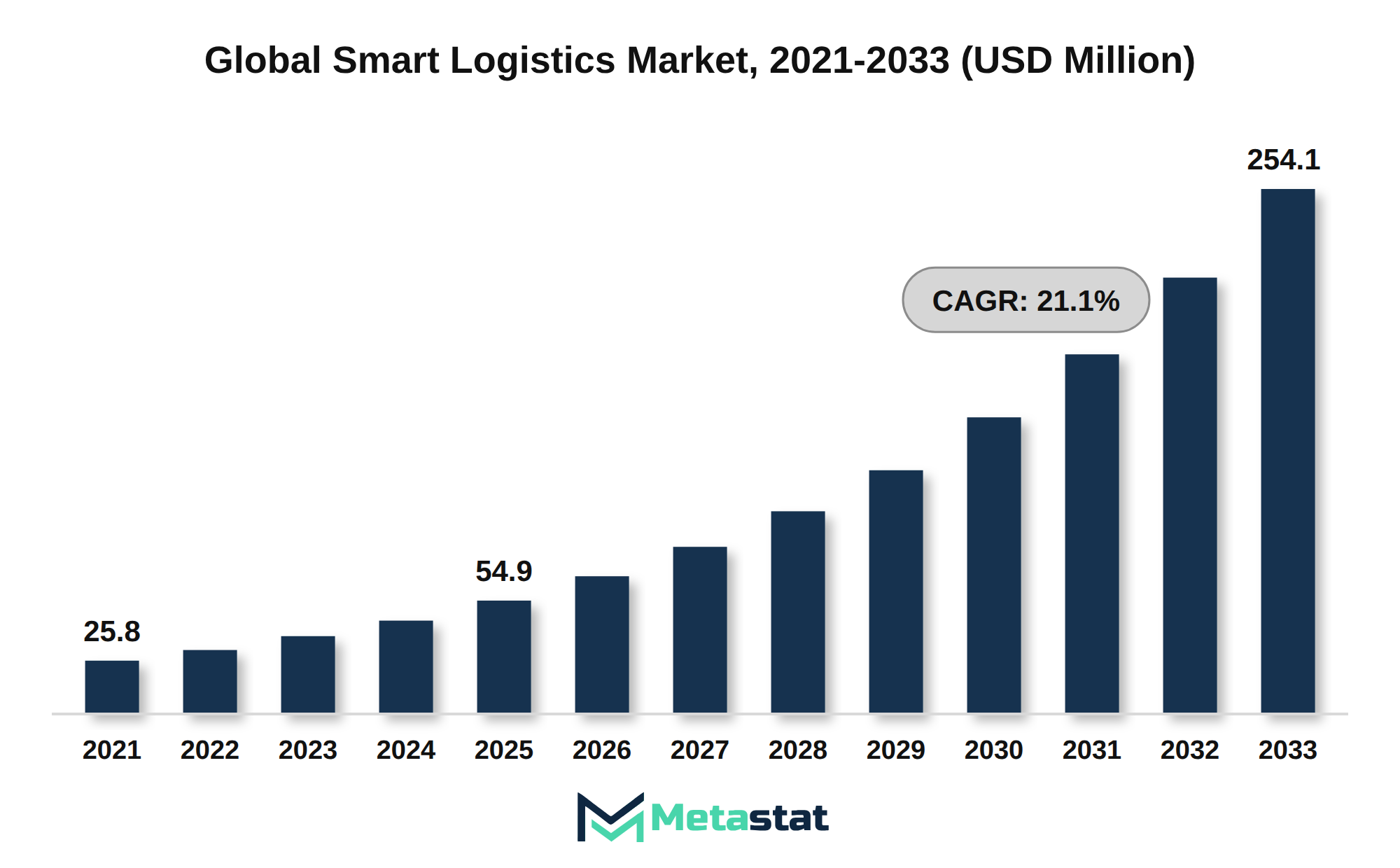
The global Smart Logistics market was valued at USD 54.9 million in 2025 and is projected to reach USD 254.1 million by 2033, growing at a CAGR of 21.1% over the forecast period.
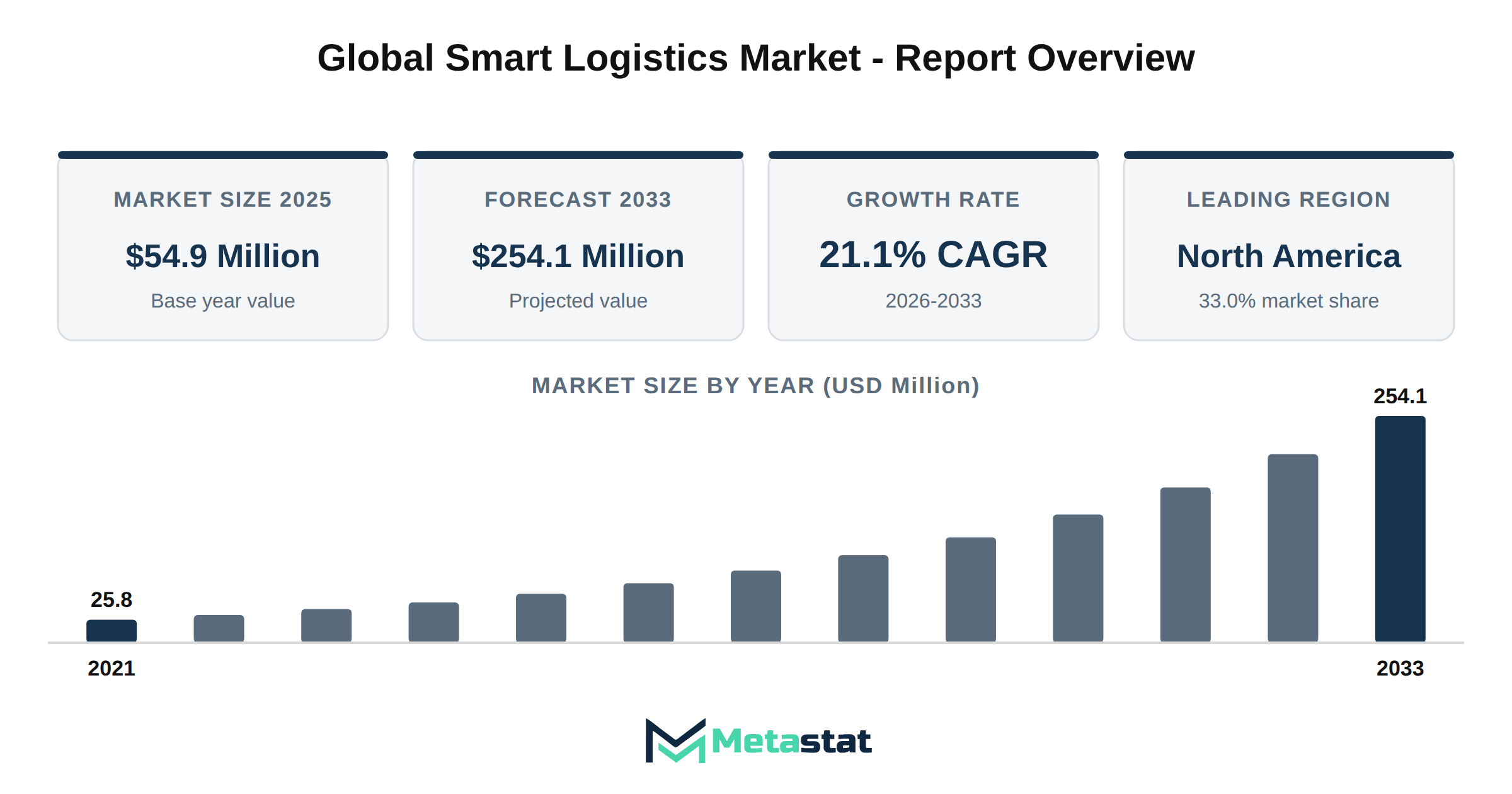
The Smart Logistics market experiences significant growth driven by various factors including digital transformation trends and technological advancements. The market value reached USD 54.9 million in 2025, with projections estimating it will expand to USD 254.1 million by 2033, reflecting a compound annual growth rate (CAGR) of 21.1% during the forecast period.
Digital transformation significantly influences the Smart Logistics market, with organizations adopting innovative technologies to enhance operational efficiency. The integration of artificial intelligence (AI) and machine learning into logistics operations facilitates improved decision-making and automation. This shift generates demand across multiple sectors, particularly in retail and e-commerce, where streamlined processes are essential for competitiveness.
Artificial intelligence and machine learning technologies reshape logistics operations, providing advanced data analytics and predictive capabilities. These innovations enable organizations to optimize supply chain processes, enhance inventory management, and reduce operational costs. The growing reliance on data-driven insights leads to increased investment in AI solutions, thereby propelling market expansion.
Warehouse automation and robotics significantly transform logistics networks, enhancing efficiency and accuracy in material handling. Automated systems reduce human error and expedite order fulfillment, catering to rising consumer demands. This evolution is particularly evident in e-commerce, where rapid delivery expectations necessitate advanced warehouse capabilities.
Cloud-based logistics platforms gain traction owing to organizations seeking scalable solutions for logistics management. Software because a Service (SaaS) models provide flexibility and cost-effectiveness, allowing companies to adapt quickly to changing market conditions. This trend supports the Smart Logistics market by enabling integration of various logistics functions.
Real-time supply chain visibility remains a crucial aspect of the Smart Logistics market, allowing organizations to monitor and respond to supply chain dynamics effectively. The implementation of control towers enhances visibility across logistics networks, enabling proactive decision-making and improved collaboration among stakeholders.
The Internet of Things (IoT) facilitates enhanced asset tracking capabilities, driving growth in connected logistics solutions. IoT devices provide real-time insights into asset location and condition, improving inventory management and reducing losses. This technological advancement significantly benefits sectors like transportation and logistics, where efficiency is critical.
Transportation management systems (TMS) play a vital role in optimizing logistics operations, offering tools for efficient route planning and load optimization. The ability to analyze transportation data helps organizations minimize costs and improve service levels. This trend aligns with the overall growth trajectory of the Smart Logistics market.
Fleet telematics enables organizations to monitor vehicle performance and driver behavior, resulting in enhanced operational efficiency. Intelligent mobility solutions contribute to improved route planning and fuel management, further driving down transportation costs. This focus on efficiency directly impacts the Smart Logistics market, leading to increased adoption of telematics systems.
The Smart Logistics market experiences significant growth driven by digital transformation trends, particularly in AI and machine learning adoption. These technologies enhance operational efficiency and decision-making processes across logistics networks. Industries including retail and e-commerce leverage these advancements to streamline operations and improve customer service.
Warehouse automation and robotics play crucial roles in reshaping logistics networks. The integration of automated systems reduces labor costs and increases productivity, enabling firms to respond swiftly to market demands. This trend is evident in sectors like manufacturing and distribution, where automated solutions optimize inventory management and order fulfillment.
Cloud-based logistics platforms and software-as-a-service (SaaS) adoption facilitate scalable operations. These platforms provide real-time data accessibility and analytics capabilities, allowing businesses to make informed decisions. The market benefits from this shift driven by organizations increasingly seeking flexible and cost-effective solutions to enhance their logistics capabilities.
Real-time supply chain visibility and control tower expansion contribute to improved operational transparency. Companies employ advanced tracking systems to monitor shipments and inventory levels, leading to better coordination among supply chain partners. This trend enhances responsiveness and reduces delays in logistics operations.
IoT-enabled asset tracking and connected logistics growth support enhanced supply chain management. By employing IoT devices, businesses gain insights into asset locations and conditions, allowing for proactive maintenance and management. This capability is particularly relevant in industries including healthcare and pharmaceuticals, where tracking product integrity is vital.
Transportation management systems and route optimization trends further streamline logistics operations. These systems enhance route planning and fleet management, resulting in reduced transportation costs and improved delivery times. Companies benefit from these efficiencies, positioning themselves competitively in the market.
Fleet telematics and intelligent mobility solutions are gaining traction within the logistics sector. These technologies provide data-driven insights into vehicle performance and driver behavior, enabling better fleet utilization and safety measures. The adoption of such solutions enhances operational effectiveness and contributes to overall cost savings.
Last-mile delivery automation and e-commerce fulfillment demand shape the market landscape. With the surge in online shopping, businesses are investing in automated solutions to efficiently handle last-mile logistics. This trend drives investments in technologies that enhance delivery speed and accuracy.
Smart warehouse management and execution system innovation are critical to operational efficiency. These systems enable businesses to automate and optimize warehouse processes, improving order accuracy and reducing operational costs. The market sees increasing investments in such technologies to enhance overall supply chain performance.
Predictive analytics and demand forecasting in smart logistics allow businesses to anticipate market needs. By analyzing historical data, organizations optimize inventory levels and reduce excess stock. This capability is essential for maintaining competitiveness in a rapidly changing market environment.
Digital twins and simulation technologies in logistics planning enhance operational strategies. These tools allow organizations to model and simulate logistics processes, identifying potential inefficiencies and optimizing workflows. The market increasingly recognizes the value of these technologies in improving logistics operations.
Autonomous mobile robots and automated material handling adoption support efficiency in warehouses. These innovations reduce manual labor requirements and enhance throughput, enabling businesses to scale operations effectively. The trend is gaining momentum across various sectors, including retail and manufacturing.
Supply chain resilience and risk management through smart logistics become critical. The integration of advanced technologies enables organizations to identify potential risks and mitigate disruptions in the supply chain. This proactive approach enhances overall stability and reliability, crucial for maintaining customer satisfaction.
Sustainable logistics and carbon reduction technology adoption reflect the industry's commitment to environmental responsibility. Companies increasingly invest in green logistics solutions to minimize their carbon footprints, aligning with regulatory standards and consumer expectations. This trend positively influences market growth and investment opportunities.
Cybersecurity and data privacy challenges in connected logistics require ongoing attention. With increased reliance on digital technologies, firms face heightened risks of data breaches and cyber-attacks. Addressing these challenges is vital for maintaining trust and ensuring the security of supply chain operations.
Investment, funding, and M&A activity within the smart logistics market remain robust driven by firms seeking to expand their capabilities. The competitive landscape encourages innovation among technology providers, leading to enhanced offerings and improved market positioning. This dynamic supports continued growth and development in the sector.
Retail and e-commerce demand accelerates smart logistics adoption, prompting businesses to invest in advanced logistics solutions. The shifting landscape in consumer behavior demands adaptability and efficiency, driving firms toward innovative logistics strategies. The market evolves rapidly, influenced by these changing dynamics.
Manufacturing and automotive industries drive a transformation in smart logistics, integrating advanced technologies to optimize operations. This trend enhances productivity and reduces lead times, positioning companies for success in a competitive marketplace. The market adapts to these changes, reflecting the ongoing evolution of logistics practices.
Healthcare and pharmaceutical logistics digitization trends highlight the importance of technology in maintaining product integrity and compliance. Organizations prioritize advanced logistics solutions to ensure timely deliveries and adherence to regulatory requirements, shaping the future of logistics in this sector.
Asia Pacific presents substantial growth and automation opportunities within the smart logistics market. The region's expanding e-commerce sector and increasing investment in technology create a conducive environment for logistics innovation. Companies are positioned to capitalize on these developments, driving market expansion.
North America exhibits trends in smart logistics technology adoption, with businesses focusing on enhancing operational efficiencies. The region's robust infrastructure and technological advancements support the integration of innovative solutions, influencing market dynamics positively.
Europe experiences developments in smart logistics regulation and automation, creating a competitive environment for logistics providers. While companies adapt to new regulations and invest in automation technologies, the market continues to evolve, reflecting the region's commitment to improving logistics operations.
Emerging market opportunities in smart logistics solutions present avenues for growth. Companies look to capitalize on increasing demand for efficient logistics services in developing regions, driving investments in technology and infrastructure. This trend contributes to the overall expansion of the market.
The future outlook for AI-driven and autonomous logistics networks indicates continued growth and innovation. Companies increasingly adopt AI technologies to enhance decision-making and operational efficiency, shaping the logistics landscape for years to come. The market stands poised for significant advancements driven by these trends.
The Smart Logistics market experiences growth driven by digital transformation initiatives across various industries. Organizations increasingly prioritize the integration of automated solutions, artificial intelligence, and software advancements, enhancing operational efficiency and process accuracy. This transition allows companies to digitize legacy systems, streamlining workflows and improving decision-making capabilities.
Investment in technology supports the adoption of advanced logistics solutions, enabling firms to optimize supply chains and create responsive systems. The focus on cost-efficiency, driven by competitive pressures, necessitates a shift towards innovative logistics strategies. Consequently, businesses experience enhanced productivity and reduced overhead costs, which positively impacts overall revenue.
While organizations embrace these transformations, an increase in demand for smart logistics solutions emerges. The Smart Logistics market is set to benefit significantly from these developments, because firms seek to capitalize on the efficiency gains and competitive advantages provided by digital integration.
The Smart Logistics market benefits from increased investment in industrial automation, a critical mechanism driving efficiency and productivity across various sectors. Organizations recognize the importance of integrating advanced technologies including artificial intelligence and automation to streamline operations, reduce labor costs, and minimize errors. This trend emerges in response to growing operational demands and competitive pressures, compelling firms to enhance their logistics capabilities.
Industrial automation allows companies to optimize supply chain processes, enhancing the speed and accuracy of inventory management and order fulfillment. The shift towards automated solutions, including robotics and digitized platforms, significantly impacts industries including retail and manufacturing, which seek innovative ways to meet consumer expectations. The market's growth aligns with this technological evolution, leading to substantial investments aimed at adopting automated logistics solutions.
Investment in automation technologies is expected to enable deeper integration of digital systems within logistics operations. Companies leveraging these advancements experience improved data analytics, enabling more informed decision-making and better resource allocation. While organizations strive for operational excellence, the Smart Logistics market is projected to expand, driven by a collective focus on adopting advanced automation technologies.
High capital investment requirements pose a significant barrier to the Smart Logistics market. Companies face substantial upfront costs related to technology acquisition, software deployment, and infrastructure improvements. These expenditures deter smaller firms from entering the market, restricting competition and innovation. Consequently, market growth stagnates in sectors where companies struggle to secure necessary funding to upgrade their logistics capabilities.
Escalating operating costs challenge profitability for existing players. With rising expenses for labor, materials, and technology maintenance, firms experience pressure on margins that compels them to reassess their operational strategies. This financial strain impacts investments in new technologies and services, thereby slowing the overall growth trajectory of the Smart Logistics market.
Infrastructure gaps and connectivity deficits create additional obstacles. Many regions lack adequate logistical infrastructure, affecting the efficiency and effectiveness of smart logistics solutions. Deployment bottlenecks arise when companies attempt to implement advanced technologies without the necessary supporting frameworks, leading to delays and increased costs. These challenges hinder market expansion and limit the adoption of innovative logistics solutions.
Industry fragmentation presents a further complication. A multitude of providers with varying levels of technology and service offerings creates a competitive environment that confuses customers. This fragmentation slows decision-making processes, resulting from potential clients facing difficulty in evaluating the best solutions for their needs. Such conditions contribute to a cautious approach towards adopting smart logistics technologies, affecting the market's growth potential.
Geopolitical fragmentation significantly impacts the Smart Logistics market by introducing uncertainties related to international trade and regulatory compliance. Countries increasingly impose tariffs and trade barriers, creating friction that complicates cross-border logistics operations. This situation hampers the efficiency of supply chains, leading to increased operational costs and delays in delivery timelines, which suppliers and customers experience acutely.
Tariff-related pressures generate pricing compression, squeezing margins for logistics providers. The evolving landscape of international relations necessitates that businesses adapt their strategies to navigate these complexities, often resulting in higher compliance overhead. These challenges deter investment and slow growth in the market, driven by companies grappling with the need for agile responses to shifting geopolitical dynamics.
Technological disruptions, including rapid advancements in automation and digitalization, further complicate the landscape. While these innovations promise efficiency, they require substantial investment in research and development, which adds complexity to integration processes. Companies face interoperability friction, hindering effective communication between diverse technological systems and components, which are essential for smart logistics optimization.
The volatility of feedstock and component availability disrupts production schedules, impacting the entire supply chain. Tightening global regulatory standards relating to environmental sustainability and cybersecurity necessitate that companies enhance their operational frameworks. These developments demand considerable resources, both financial and human, thereby increasing existing workforce skill gaps and heightening talent retention pressures within the market.
The Smart Logistics market encounters significant challenges from geopolitical fragmentation, trade deficits, and technological disruptions. Companies operating within the market navigate these complexities while addressing evolving demands for sustainability and compliance. This multifaceted environment dictates strategic adaptations essential for maintaining competitive positioning and ensuring long-term growth.
The Smart Logistics market expands due to emerging regional demands, particularly in developing economies. Rapid urbanization and industrialization in these regions create a strong need for advanced logistics solutions to support growing populations and economic activities. Infrastructure modernization has led to increased investments in logistics capabilities, enhancing operational efficiency and reducing delivery times.
Geographical expansion into untapped markets contributes significantly to the market's growth potential. Companies recognize opportunities to establish operational hubs in regions with rising demand for logistics services. This strategic positioning enables firms to capitalize on local market requirements while providing tailored solutions that meet specific customer needs.
Technological disruptions significantly influence the Smart Logistics market through the integration of next-generation innovations. Advancements in artificial intelligence, IoT, and big data analytics enhance supply chain visibility, improve decision-making processes, and drive automation. These technologies streamline operations, reduce inefficiencies, and enable companies to adapt to evolving market conditions quickly.
Sustainability imperatives exert upward pressure on the market, with organizations increasingly aligning their goals with environmental, social, and governance criteria. Companies pursue green transformations by adopting eco-friendly logistics practices, minimizing carbon footprints while responding to consumer demand for sustainable solutions. This shift toward sustainability opens new revenue streams and strengthens brand loyalty.
Downstream market diversification creates additional opportunities within the Smart Logistics market. Companies explore niche applications that address specific industry challenges, including healthcare logistics, e-commerce fulfillment, and cold chain management. By focusing on specialized segments, firms enhance competitive positions and respond effectively to market needs.
Strategic consolidation within the industry drives growth. Companies pursue mergers and acquisitions to expand service offerings and geographic reach. This trend allows organizations to leverage synergies, optimize value chains, and enhance market positions. Overall, these dynamics contribute to a favorable outlook for the Smart Logistics market, characterized by strong growth and evolving business models.
The Global Smart Logistics market is segmented based on Component, Solution Type, Deployment Model, and End-Use Industry.
Valued at USD 25.6 million in 2026, the Hardware segment is projected to reach USD 88.7 million by 2033, achieving a CAGR of 19.5% during the forecast period. Demand for hardware components within the Smart Logistics market stems from the increasing need for efficient logistics operations across various industries. The rise of e-commerce and the growing emphasis on supply chain optimization drive significant investment in hardware solutions, enhancing tracking, automation, and inventory management capabilities.
Technological maturation in hardware solutions, including advanced sensors and automated storage systems, significantly contributes to segment growth. Companies prioritize the integration of next-generation upgrades to improve operational efficiency and reduce downtime. The evolution of products toward smart and connected devices further stimulates market growth, enabling real-time data analytics and improved decision-making processes.
Industrial sectors, including retail and transportation, actively adopt these hardware solutions to enhance logistics performance. Increased focus on supply chain resilience amid global challenges necessitates robust hardware for effective inventory management and tracking. Organizations strive to address logistics vulnerabilities, making investment in hardware a strategic imperative that supports broader objectives of efficiency and cost-effectiveness across supply chains.
Price volatility in raw materials influences overall cost structures, prompting companies to seek innovative hardware solutions that offer better value. Suppliers in the Smart Logistics market face margin pressures, necessitating a focus on efficient production processes and strategic pricing models. Overall, the Hardware segment represents a dynamic and evolving component of the smart logistics market, characterized by ongoing technological advancements and evolving end-use demands.
Growth in the Smart Logistics market is propelled by the increasing need for automation and optimization in supply chain operations. Enhanced efficiency and accuracy in data management contribute to heightened demand for software solutions. Retail and e-commerce sectors lead this demand, leveraging software to improve inventory management, order processing, and customer engagement. Technological advancements drive the development of next-generation software tools, which enhance operational capabilities and support real-time decision-making.
Software segment is estimated to reach USD 103.6 million by 2033, at a CAGR of 22.5% during the forecast period. Adoption of cloud-based deployment models facilitates scalability and flexibility, allowing organizations to adapt to changing market conditions swiftly. Regulatory compliance standards play a crucial role in shaping software solutions, requiring features that meet specific industry requirements. Vendors that offer robust compliance functionalities are positioned favorably in this competitive landscape.
Investment in software development continues to rise, with companies focusing on innovative features that address evolving market needs. This trend creates a dynamic environment where organizations prioritize software that enhances their operational resilience. Increased capital allocation towards advanced analytics and machine learning capabilities prepares the market for a more integrated supply chain approach. The Smart Logistics market thus stands to gain from continuous advancements, positioning software because a critical component in the overall growth strategy.
Market dynamics indicate a strong upward trajectory for the Services segment within the Smart Logistics market, projected to reach USD 61.8 million by 2033. This growth stems from increasing demand for tailored service solutions that enhance operational effectiveness across various industry sectors.
Key drivers include the rising need for operational efficiency and cost reduction, compelling organizations to seek advanced service offerings. A growing emphasis on technology integration promotes the adoption of next-generation services, enabling companies to streamline logistics operations and enhance supply chain visibility. The ongoing digital transformation across industries acts because a catalyst for this segment's expansion, enhancing user experience and service delivery.
Regulatory compliance standards further influence market dynamics, because companies invest in services that facilitate adherence to evolving regulations. These factors create a favorable environment for innovation and competitive differentiation in the market. The strategic opportunity window surrounding service-oriented offerings highlights the importance of adaptability in response to changing consumer preferences and technological advancements.
Valued at USD 11 million in 2026, the Warehouse Management & Execution Systems segment is projected to reach USD 38.7 million by 2033, exhibiting a CAGR of 19.6% during the forecast period. Primary demand drivers include heightened automation and digitalization within warehouse operations, necessitating advanced systems that improve operational efficiency and accuracy. The proliferation of e-commerce further fuels demand, driven by businesses seeking effective solutions to manage complex inventory and fulfillment processes efficiently. Integration of next-generation technologies, including artificial intelligence and machine learning, facilitates enhanced decision-making capabilities and real-time data analytics, driving segment expansion.
Regulatory compliance standards impose stringent requirements on warehouse operations, pushing businesses to adopt advanced systems to achieve necessary certifications. Cost structures associated with legacy systems, which often require substantial maintenance investments, present challenges, compelling companies to transition to more efficient solutions. The market anticipates significant shifts in consumption patterns, with increased emphasis on sustainability and transparency within supply chains. This evolution presents strategic opportunity windows for firms investing in innovative Warehouse Management & Execution Systems that address emerging consumer preferences and regulatory demands.
Technological maturation within the market leads to improved system capabilities, enabling integration across various supply chain components. The rise of omnichannel retailing necessitates advanced solutions for managing inventory across multiple channels, further stimulating adoption. Supply chain resilience becomes a critical focus, with businesses aiming to mitigate vulnerabilities exposed by recent global disruptions. The segment's growth potential positions it favorably within the broader Smart Logistics market, attracting substantial capital investments geared towards enhancing operational capabilities and encouraging innovation.
Growth in the Transportation Management Systems segment results from increasing demand for streamlined logistics and enhanced supply chain visibility. The evolution of technology and software solutions supports the integration of advanced analytics and real-time data, allowing businesses to optimize transportation processes efficiently. The ongoing shift towards e-commerce and retail drives demand for innovative solutions that enhance delivery speed and cost efficiency, contributing to heightened adoption rates.
The segment is estimated to reach USD 34.5 million by 2033, at a CAGR of 20% during the forecast period. Transportation Management Systems play a crucial role in managing logistics operations across various industries, including retail, manufacturing, and e-commerce. These systems effectively address regulatory compliance standards and enhance supply chain resilience through improved route planning and tracking capabilities.
Increasing investment in technology fuels competition in the market, driving firms to develop next-generation solutions that cater to evolving consumer needs. The transition towards cloud-based deployment models enables businesses to leverage scalable solutions that adapt to changing market conditions. While the market continues to expand, the emphasis on cost control and operational efficiency remains essential for both providers and end users.
Fleet Management & Telematics contributes significantly to the Smart Logistics market, leveraging advanced technologies to optimize vehicle and fleet operations. The integration of IoT, AI, and big data analytics enhances real-time tracking and monitoring capabilities, driving efficiency and reducing operational costs. Key demand drivers include the growing need for improved supply chain visibility and regulatory compliance that mandates detailed tracking of transportation activities.
Technological maturation supports segment expansion, with next-generation upgrades focusing on automation and data-driven decision-making. This shift emphasizes the importance of real-time data analytics in fleet management systems, facilitating proactive maintenance and enhancing overall operational efficiency. End-use industries, particularly in transportation and logistics, leverage these technologies to streamline processes and respond dynamically to consumer demands.
Valued at USD 25.2 million by 2033, the Fleet Management & Telematics segment demonstrates strong growth potential, driven by increasing investments in digital solutions. The ongoing evolution of products within this segment highlights significant opportunities for market participants to innovate and capture additional market share. Strategic investments in cloud-based solutions and advanced telematics applications are expected to enhance operational capabilities further, positioning players for sustained success in the competitive environment.
Rapid advancements in technology significantly drive the demand for Supply Chain Visibility & Control Towers within the Smart Logistics market. Organizations increasingly seek solutions that enhance operational transparency and facilitate real-time decision-making. The growing complexity of supply chains, combined with rising consumer expectations for faster delivery and better tracking, fuels adoption across various sectors. This segment is projected to grow at a CAGR of 23.2% during the forecast period.
Technological maturation, particularly in cloud computing and data analytics, increases the effectiveness of control tower solutions. Companies implementing these systems benefit from improved collaboration and information sharing, leading to optimized inventory management and reduced operational costs. End-use industries, particularly retail and e-commerce, leverage these capabilities to enhance customer service and maintain competitive advantages.
Investment in next-generation upgrades, including artificial intelligence and machine learning, enhances predictive capabilities, allowing businesses to proactively address disruptions and optimize logistics networks. This strategic focus on technology strengthens supply chain resilience and addresses challenges related to sourcing and logistics vulnerabilities. Regulatory compliance standards prompt industries to adopt enhanced visibility solutions, further propelling growth in this market segment.
Demand for Asset Tracking & Traceability Solutions within the Smart Logistics market stems from the increasing need for operational transparency and visibility across supply chains. Businesses across various industries prioritize efficient tracking of assets to enhance security, reduce losses, and ensure compliance with regulatory standards. Adoption accelerates owing to organizations recognizing the importance of advanced technologies, including the Internet of Things (IoT) and artificial intelligence (AI), to improve real-time data collection and analysis.
Segment expansion is further supported by advancements in technology, leading to the integration of next-generation upgrades. Innovations drive product evolution, allowing for enhanced capabilities in tracking and traceability solutions. Companies increasingly invest in these technologies to respond to customer demands for more accountable and sustainable supply chain practices.
End-use dynamics indicate a growing preference for solutions that streamline operations and enhance supply chain resilience. Retail and e-commerce sectors exhibit a robust demand for asset tracking to manage inventory effectively and improve customer satisfaction. Consumption shifts toward automated and digitized solutions reflect a broader trend of digital transformation within the market.
Regulatory compliance standards influence the landscape because businesses seek to comply with stringent guidelines regarding asset management and traceability. Organizations face pressures from fluctuating pricing and margin constraints specific to this sub-segment, necessitating strategic planning and investment in technology to maintain competitive advantage. Companies exploring alternative solutions assess the impact on operational efficiency and overall cost structures.
Technological obsolescence presents challenges, prompting businesses to continually upgrade their systems to stay competitive. Strategic opportunity windows arise for innovative providers offering advanced Asset Tracking & Traceability Solutions, enabling organizations to enhance their logistics capabilities and mitigate vulnerabilities. Capital investment outlook remains strong, driven by the need for improved tracking solutions that align with evolving market demands.
Market trends indicate a rising demand for Order & Inventory Management Solutions, driven by the increasing complexity of supply chains and the need for real-time visibility. Organizations across various industries emphasize the importance of optimizing inventory levels to minimize costs and enhance service levels. Adoption of these solutions is crucial for businesses seeking to streamline operations and reduce stockouts or overstock situations, which directly impacts customer satisfaction and operational efficiency.
The shift towards digitization of logistics processes acts because a catalyst for segment expansion. Businesses increasingly invest in advanced technologies, including artificial intelligence and machine learning, to enhance forecasting accuracy and improve inventory tracking. This technological maturation leads to the development of next-generation upgrades that offer predictive analytics, enabling companies to make informed decisions regarding inventory management and order fulfillment.
End-use dynamics reflect a growing focus on e-commerce and omnichannel retailing, which significantly influences demand for these solutions. Retailers and manufacturers prioritize efficient order processing and inventory management to meet customer expectations for fast delivery and availability. Regulatory compliance standards surrounding inventory management and reporting further drive the market, because organizations seek to avoid penalties and maintain operational integrity.
Cost structures associated with Order & Inventory Management Solutions vary, influenced by the choice between cloud-based and on-premises deployment models. Pricing volatility arises from fluctuations in software upgrades and service-level agreements, impacting organizations' overall budgets. Ensuring supply chain resilience remains critical, particularly because logistics vulnerabilities continue to challenge operational effectiveness. Companies that invest in these solutions recognize the strategic opportunity windows they create, allowing them to adapt swiftly to market changes and customer demands.
Disruptive alternatives, including manual inventory processes, pose risks to organizations that resist upgrading. Companies face the threat of technological obsolescence if they fail to adopt modern solutions that enhance inventory control. Capital investment outlook remains positive, because businesses recognize the necessity of integrating Order & Inventory Management Solutions into their operations to secure a competitive advantage in the evolving Smart Logistics market.
Current trends highlight the importance of Yard & Dock Management Systems in enhancing operational efficiency within the Smart Logistics market. An increasing focus on minimizing turnaround times for loading and unloading processes drives demand for advanced solutions in this segment. Adoption of these systems supports coordination and real-time visibility across supply chains.
The segment benefits from technological maturation, with innovations including automation and data analytics enhancing functionality. Companies prioritize investments in next-generation upgrades, recognizing the value of integrating these systems with existing infrastructure. This evolution creates a more responsive and agile supply chain environment.
End-use dynamics reflect a growing emphasis on compliance with regulatory standards. Companies in industries including retail, e-commerce, and industrial manufacturing adopt Yard & Dock Management Systems to meet stringent requirements. The focus on regulatory compliance drives market growth, driven by businesses seeking solutions that ensure adherence while optimizing operations.
Consumption shifts towards online retail and just-in-time deliveries influence demand for these systems. Companies experience the need for efficient yard and dock operations to manage increased volumes. This shift encourages strategic investment in technologies that enhance throughput and reduce operational bottlenecks.
Supply chain resilience becomes critical in the wake of disruptions, with businesses seeking to enhance their logistics capabilities. The integration of Yard & Dock Management Systems contributes significantly to improving overall supply chain robustness. This focus on resilience positions the segment favorably for growth within the broader Smart Logistics market.
While specific pricing dynamics and cost structures remain variable, ongoing advancements in technology continuously alter the competitive landscape. Companies face pressures to balance investment costs against the operational benefits derived from efficient yard and dock management. Strategic opportunity windows arise because businesses recognize the potential for enhanced efficiencies through tailored solutions in this segment.
In the Smart Logistics market, the Last-Mile Delivery Management segment responds to the increasing demand for efficient and timely delivery solutions. This growing need stems from the rise of e-commerce and customer expectations for rapid fulfillment. Adoption of innovative technologies, including robotics and automation, enhances last-mile delivery capabilities, allowing businesses to streamline operations and reduce costs.
Segment expansion receives support from advancements in artificial intelligence and machine learning, which facilitate real-time tracking and predictive analytics. Integration of these technologies enables companies to optimize routes, thereby improving delivery efficiency and customer satisfaction. The continuous change of delivery models, including crowdsourced delivery and autonomous vehicles, reflects the dynamic nature of this segment.
Downstream applications focus on industries like retail, logistics, and food services, where quick and reliable delivery significantly impacts consumer behavior. Shift in consumption patterns towards online shopping further drives the demand for effective last-mile delivery solutions. Regulatory compliance standards regarding emissions and vehicle safety influence operational strategies, compelling companies to invest in greener alternatives and advanced logistics technologies.
Cost structures comprise expenses related to technology adoption, labor, and fuel, which affect pricing strategies across the segment. Pricing volatility arises from fluctuating fuel costs and varying demand patterns. The segment faces margin pressures due to heightened competition and the necessity for service differentiation. Strategic opportunity windows exist in urban areas where congestion and delivery speed are critical challenges.
Supply chain resilience emerges because a key focus, with companies seeking to mitigate vulnerabilities through diversified delivery options and enhanced logistics networks. Raw material sourcing for packaging and delivery infrastructure aligns with sustainability goals to meet consumer expectations. Disruptive alternatives, including drone delivery and parcel lockers, introduce potential substitution risks, prompting traditional delivery services to innovate continuously.
Technological obsolescence remains a concern in this evolving market, emphasizing the need for ongoing investment in next-generation upgrades. Companies pursuing capital investment in last-mile delivery technologies position themselves advantageously in the Smart Logistics market, ensuring they remain competitive in a landscape defined by customer demands and technological advancements.
Recent advancements in automation technology significantly influence the adoption of Warehouse Robotics & Automated Material Handling within the Smart Logistics market. Industries increasingly recognize the potential of these systems to enhance operational efficiency and reduce labor costs. The shift towards e-commerce and the growing demand for rapid order fulfillment drive investments in automated solutions. Increased competition among retailers and logistics providers emphasizes the need for high-speed, accurate processing of goods, further propelling interest in automation.
Technological maturation in robotics and artificial intelligence streamlines system integration, allowing for effective utilization of existing infrastructure. The flexibility and scalability of these solutions enable firms to adapt to varying operational demands. Regulatory compliance regarding workplace safety and labor standards compels organizations to invest in automated systems that maintain compliance while improving productivity.
Innovation in product design continues to evolve, introducing next-generation robotics that feature enhanced capabilities, including autonomous navigation and sophisticated data analytics. This evolution facilitates better decision-making and resource management across supply chains. Key end-use industries, including retail, transportation, and industrial manufacturing, actively seek to leverage these advancements, driving market growth.
Market shifts in consumption patterns arise from changes in consumer behavior, prompting firms to adopt innovative solutions that meet customer expectations for speed and efficiency. Supply chain resilience becomes vital; organizations that invest in automation position themselves to better withstand disruptions. Strategic opportunity windows emerge because firms align their operations with technological advancements, capitalizing on the benefits of automation within the logistics framework.
Significant demand for the "Others (Reverse Logistics, Freight Audit & Payment)" sub-segment stems from the increasing need for efficiency and transparency in supply chain processes. This demand arises from various industries seeking to optimize operations and reduce costs associated with returns and freight management. The growing complexity of logistics networks necessitates advanced solutions that handle reverse logistics and improve freight audit processes.
Adoption of technology solutions drives expansion in this sub-segment. Companies invest in automation and data analytics to enhance visibility and control over logistics operations. Organizations seek to improve supply chain resilience, making integration of advanced technologies vital in managing returns and optimizing payment processes.
End-use dynamics influence this segment, especially within retail and e-commerce sectors, where products frequently return. The need for efficient reverse logistics processes leads to increased investments in related technologies. Regulatory compliance standards impact the segment, driven by companies navigating evolving requirements concerning returns, tracking, and payment audits.
Strategic opportunity windows arise from the need for effective integration of reverse logistics within broader supply chain operations. Companies that leverage technology solutions mitigate logistics vulnerabilities and address substitution risks effectively. While the market continues to evolve, investment in innovative solutions plays an essential role in shaping the future of the Smart Logistics market.
Valued at USD 32.1 million in 2026, the Cloud-Based segment is projected to reach USD 135.7 million by 2033, reflecting a CAGR of 22.9% during the forecast period. This expansion results from the increasing demand for scalable and efficient logistics solutions, particularly in sectors including retail and e-commerce. Enhanced integration capabilities provided by cloud-based technologies play a vital role in facilitating real-time data sharing and improved visibility across supply chains.
Technological maturation within the market influences the shift toward cloud-based solutions. Enhanced security measures and compliance with regulatory requirements strengthen enterprise confidence in adopting these technologies. The trend toward digital transformation across various industries drives significant investment in cloud infrastructure, allowing businesses to streamline operations while reducing overhead costs. This trend positions cloud-based solutions because critical enablers in the Smart Logistics market.
While enterprises pursue greater supply chain resilience, the adoption of cloud-based logistics solutions becomes increasingly favorable. These technologies provide flexibility to adapt to market fluctuations and respond to evolving consumer demands effectively. Strong support from software developers enhances product evolution, leading to innovative features that address specific industry needs. Consequently, cloud-based solutions play a crucial role in enhancing operational efficiencies across logistics networks.
The trajectory of the Cloud-Based segment highlights the growing importance of agile and adaptive logistics solutions within the Smart Logistics market. The combination of technological advancements and increasing consumer expectations drives this segment, positioning it for continued growth in the coming years.
Valued at USD 62.9 million by 2033, the On-Premises segment experiences strong growth at a CAGR of 17.8% during the forecast period. Increasing demand for data security and control drives the adoption of on-premises solutions, particularly among industries with stringent regulatory compliance standards. Organizations in sectors including healthcare and finance prioritize the control and security that on-premises deployment offers, ensuring sensitive data remains within their own infrastructure.
Technological maturation contributes to the expansion of the On-Premises segment. Organizations increasingly invest in upgrading existing systems to enhance performance and integrate with advanced technologies. The evolution of product offerings, including enhanced analytics and operational efficiency tools, increases market appeal, leading to greater investment in on-premises systems.
End-use dynamics significantly influence the trajectory of this segment within the Smart Logistics market. The retail and e-commerce industries show a growing preference for on-premises solutions, particularly for inventory management and fulfillment operations. This shift results from the necessity for real-time data access and operational oversight, which on-premises systems effectively provide.
Pricing volatility in the market contributes to a consistent demand for on-premises solutions. Larger enterprises favor the long-term cost predictability of on-premises deployments over cloud-based alternatives, despite the initial capital expenses associated with implementation. This preference enhances the segment's resilience in a fluctuating market environment.
Strategic opportunity windows emerge because organizations recognize the potential of on-premises systems to streamline operations and reduce dependency on third-party services. The focus on supply chain resilience during global disruptions further emphasizes the necessity for robust, self-managed solutions, reinforcing the On-Premises segment's position in the Smart Logistics market.
Increasing demand for flexible logistics solutions drives the growth of the Hybrid segment within the Smart Logistics market. Companies seek to integrate both cloud-based and on-premises systems to enhance operational efficiency and responsiveness to market changes. This approach enables organizations to utilize the advantages of both deployment models, balancing immediate accessibility with full control over their data and operations.
Market dynamics indicate that the Hybrid segment is expected to reach USD 55.5 million by 2033. This growth reflects the rising need for adaptable solutions that cater to varying operational requirements across industries. Ongoing technological maturation and evolving customer expectations contribute to this trend, leading to greater investments in hybrid solutions that facilitate data flow and real-time decision-making.
End-use industries, particularly retail and e-commerce, emphasize the importance of agility and efficiency in their supply chains. This focus on robust logistics capabilities drives demand for hybrid solutions, which provide the necessary tools for tracking, managing, and optimizing logistics processes. While businesses strive for resilience in their supply chains, adoption of hybrid models is anticipated to significantly increase over the forecast period.
Valued at USD 14.1 million in 2026, the Retail & E-commerce segment is projected to reach USD 58 million by 2033, at a CAGR of 22.3% during the forecast period. This rapid growth results from increased consumer preference for online shopping, which drives demand for efficient logistics solutions. Key factors influencing segment expansion include the necessity for real-time inventory management and order fulfillment capabilities to meet rising customer expectations for faster delivery times.
The transition to digital platforms continues to reshape the retail landscape, compelling businesses to adopt advanced logistics technologies. Investments in smart logistics solutions enhance supply chain visibility, enabling firms to optimize operations and respond to fluctuations in demand. This shift toward automation and data-driven decision-making contributes to the segment's growth trajectory.
Heightened competition among retailers intensifies the focus on customer experience, fueling the adoption of smart logistics technologies. Companies implementing robust logistics frameworks gain a competitive advantage, leading to improved operational efficiency and cost reduction. The Retail & E-commerce segment benefits from the ongoing evolution of technology, which supports innovations in warehousing, transportation management, and last-mile delivery solutions.
Regulatory compliance and sustainability standards increasingly influence logistics strategies, prompting businesses to seek solutions that align with environmental goals. Firms investing in green logistics practices enhance their market position and address growing consumer demand for sustainable practices. Overall, the Retail & E-commerce segment in the Smart Logistics market presents substantial opportunities for growth driven by technological advancements and changing consumer preferences.
Significant growth in the Transportation & Logistics sector reflects ongoing shifts in consumer behavior and demand for efficient supply chain solutions. Increasing reliance on e-commerce platforms drives the need for enhanced logistics capabilities, resulting in a surge of investments in smart logistics technologies. The segment is estimated to reach USD 44.3 million by 2033, at a CAGR of 20.2% during the forecast period. Integration of advanced technologies including artificial intelligence and machine learning in logistics operations enhances efficiency and reduces operational costs, which appeals to a wide range of end-users.
Adoption of cloud-based solutions emerges because a critical factor influencing the market. These technologies facilitate real-time tracking, data analytics, and improved inventory management, enabling organizations to respond swiftly to market demands. The growing importance of sustainability and regulatory compliance standards in the industry drives investments in environmentally friendly logistics solutions. Heightened awareness of supply chain vulnerabilities highlights the necessity for robust transport management systems that withstand disruptions and ensure continuity.
Investment in innovative logistics software and automation technologies continues to reshape the competitive landscape. Companies prioritize enhancing operational resilience through next-gen upgrades and product evolution, which aligns with the increasing complexity of logistics operations. For instance, advancements in autonomous delivery systems and warehouse robotics provide significant value to the marketplace, optimizing supply chain processes and driving operational efficiency. Overall, these dynamics position the Transportation & Logistics segment because a key driver of growth within the broader smart logistics market.
Continuous evolution within the Industrial Manufacturing sector drives significant adoption of Smart Logistics solutions. Integration of advanced technologies enhances operational efficiency and responsiveness, enabling manufacturers to optimize supply chains and meet growing market demands. Automation and data analytics play important roles in improving production processes, thus influencing investment in logistics solutions. The shift towards more efficient supply chain practices necessitates real-time inventory management and tracking, reinforcing the need for sophisticated logistics systems.
The Industrial Manufacturing segment is expected to reach USD 35.6 million by 2033. Heightened focus on compliance with regulatory standards fuels investment in logistics solutions that ensure safety and quality throughout the manufacturing process. The increasing complexity of supply chains requires manufacturers to adopt more resilient logistics strategies, addressing vulnerabilities and enhancing overall supply chain robustness. These factors collectively support the expansion of the Smart Logistics market, reinforcing its role in the Industrial Manufacturing industry.
Growing consumer preferences for sustainable and ethically produced fashion drive demand within the Textile & Apparel segment of the Smart Logistics market. Companies increasingly adopt advanced logistics technologies to streamline operations, enhance supply chain transparency, and improve responsiveness to fluctuating market trends.
Textile and apparel businesses face increased pressure to optimize inventory management and distribution processes. This trend results in a heightened focus on Warehouse Management & Execution Systems and Transportation Management Systems, improving efficiency and reducing operational costs. Segment expansion is projected to occur owing to companies investing in innovative logistics solutions that support their sustainability goals.
Significant advancements in technology, including automation and data analytics, facilitate the evolution of logistics operations within the textile and apparel industry. These technologies enhance product tracking and inventory visibility, leading to improved order fulfillment and customer satisfaction.
The Textile & Apparel segment is projected to grow at a CAGR of 21.8% during the forecast period. The transition to cloud-based logistics solutions enables companies to scale operations effectively while maintaining flexibility in resource allocation. By leveraging these technologies, businesses address the complexities of global supply chains and navigate challenges related to logistics vulnerabilities.
With a growing emphasis on compliance with regulatory standards and certifications, companies in the textile and apparel sector increasingly prioritize sustainable practices. This focus on sustainability, combined with strategic capital investments, establishes a robust foundation for growth within the market, positioning firms to capitalize on emerging opportunities.
Shift towards electric vehicles and autonomous driving technology fuels demand for smart logistics solutions in the Automotive sector. Manufacturers prioritize supply chain efficiency, resulting in increased investment in logistics technologies that enhance visibility and control. The emphasis on reducing operational costs drives companies to adopt advanced fleet management systems and telematics solutions.
Regulatory compliance regarding emissions and sustainability mandates further accelerates the integration of innovative logistics solutions in automotive operations. Investment in cloud-based platforms allows for real-time tracking and data analytics, enhancing decision-making processes. The market experiences heightened competition driven by manufacturers striving to differentiate through technological advancements and improved customer service.
Strategic partnerships between logistics providers and automotive companies emerge to strengthen supply chain resilience amid global disruptions. The focus on next-gen upgrades, including automation in warehousing and distribution, positions players to respond effectively to evolving consumer expectations. Overall, the Automotive segment within the Smart Logistics market reflects a dynamic relationship of technological evolution and market demand, shaping its growth trajectory.
Growth within the Food & Beverage sector aligns with rising consumer demand for fresh and high-quality products. This demand drives the adoption of Smart Logistics solutions that enhance supply chain efficiency and visibility. Increased complexity in food distribution necessitates advanced technologies to maintain product integrity throughout the supply chain. Implementing temperature-controlled logistics ensures compliance with safety regulations and improves product quality upon delivery.
Regulatory compliance standards in the Food & Beverage industry play a crucial role in shaping logistics strategies. Companies prioritize adherence to these standards to avoid penalties and enhance their market reputation. Evolving consumer preferences toward sustainable sourcing and environmentally friendly logistics solutions influence operational decisions. Businesses focus on leveraging innovative technologies to improve traceability and transparency in the supply chain.
Cost structures within this sector reflect the impact of raw material sourcing and pricing volatility. Fluctuations in ingredient costs affect profit margins and logistics budgets, prompting firms to adopt more resilient supply chain strategies. Investments in next-gen upgrades for logistics systems enable companies to respond effectively to market changes and consumer demands. Maintaining flexibility in logistics operations becomes essential for mitigating risks associated with supply chain vulnerabilities. This flexibility enhances the ability to adapt to changing market conditions.
Strategic opportunity windows arise from the necessity for efficiency and responsiveness in food distribution. The Smart Logistics market provides a framework for enhancing operational agility through automation, real-time data analytics, and streamlined processes. By leveraging these technologies, companies within the Food & Beverage sector improve their overall competitiveness and respond to market dynamics swiftly. This proactive approach positions businesses advantageously for future growth and sustainability.
Growing interest in advanced supply chain solutions drives demand within the Healthcare & Pharmaceuticals segment of the Smart Logistics market. Regulatory compliance standards and the increasing need for real-time tracking of medical supplies and pharmaceuticals contribute significantly to this demand. Enhanced efficiency and accuracy in inventory management and distribution processes support the need for technology-driven logistics solutions, resulting in improved operational performance.
Investment in automation and data analytics facilitates the adoption of next-generation upgrades, positioning firms to respond swiftly to fluctuating consumer demands and market dynamics. Shifts toward digital transformation in the healthcare sector enhance logistics practices, enabling improved patient care and product availability, which strengthens overall market growth.
Global challenges, including the recent pandemic, highlight the vulnerabilities within logistics networks, prompting an emphasis on supply chain resilience. Companies within this segment focus on optimizing raw material sourcing and reducing logistics vulnerabilities, ensuring reliable access to essential healthcare products, which is critical for maintaining service continuity.
The Smart Logistics market benefits from strategic opportunity windows that encourage innovation and investment in technologically advanced logistics solutions. This trend emphasizes the importance of operational effectiveness, enhancing profit margins while addressing the complexities of healthcare logistics, thereby driving long-term demand.
Demand for advanced logistics solutions within the Aerospace & Defense sector significantly correlates with the industry's need for heightened efficiency and security. The increasing complexity of supply chains necessitates robust logistics frameworks capable of supporting stringent regulatory requirements while ensuring timely and accurate deliveries. Adoption of Smart Logistics technologies enhances visibility throughout the supply chain, allowing companies to track shipments and manage inventory effectively, resulting in improved operational efficiency.
Technological maturation drives investments in automation and data analytics, optimizing operations and reducing lead times. This segment experiences pressure to continually innovate, with next-generation upgrades focusing on integrating artificial intelligence and machine learning to enhance operational decision-making. Regulatory compliance standards specific to this sector require firms to invest in advanced tracking and monitoring systems, ensuring adherence to national and international regulations, which influences overall operational costs.
Cost structures in Aerospace & Defense logistics reflect the need for specialized solutions tailored to unique operational requirements. Pricing volatility presents challenges, particularly during periods of increased demand or geopolitical instability. In response, firms prioritize supply chain resilience, seeking to mitigate risks associated with raw material sourcing and logistics vulnerabilities. The dynamic nature of this sector presents strategic opportunity windows for firms that leverage disruptive alternatives and invest in technological advancements, enhancing their competitive position.
Shifts in consumption patterns, driven by global defense priorities, influence logistics strategies. Firms within the Aerospace & Defense sector respond swiftly to changing demands, ensuring that logistics capabilities align with evolving operational goals. By capitalizing on white-space analysis, companies identify unmet needs and innovate solutions tailored to the market, driving growth and maintaining competitive advantage, which is essential for long-term success.
In the Energy & Chemicals segment, ongoing advancements in logistics technology influence operational efficiency and supply chain management. Increasing regulatory compliance standards related to environmental impact and safety stimulate demand for innovative logistics solutions. Enhanced focus on sustainability drives companies to adopt smarter logistics practices, aligning with global environmental goals. Adoption of next-generation upgrades, including automation and data analytics, strengthens the industry's operational capabilities and enhances visibility across supply chains.
Cost structures within the segment reflect variations in raw material sourcing and pricing volatility. Fluctuations in commodity prices impact margin pressures for key players. Strategic opportunity windows emerge because companies invest in logistics resilience to mitigate vulnerabilities. The implementation of advanced technologies addresses disruptive alternatives, ensuring robust supply chain dynamics. White-space analysis highlights areas for growth and expansion, particularly in regions with significant oil and gas activities.
Logistics vulnerabilities within the Energy & Chemicals segment lead to operational delays, necessitating a proactive approach to risk management. Companies seek to optimize their logistics frameworks by investing in smart logistics solutions, enhancing their competitive edge. The shift towards integrated logistics solutions aligns with the larger trends in the Smart Logistics market, supporting growth across various sectors.
In various industries, the "Others" category encompasses a range of applications that extend beyond traditional logistics uses. Factors driving interest in this segment include the need for enhanced supply chain visibility and the integration of advanced technological solutions. Regulatory compliance standards and industry-specific certifications shape operational requirements, influencing stakeholders to invest in innovative logistics solutions.
Growing consumer expectations for real-time tracking and transparency drive companies to adopt integrated systems that facilitate these demands. Many organizations face challenges related to cost structures, with pricing volatility affecting the procurement of advanced logistics technologies. The segment remains dynamic, with increasing pressure to optimize margins while addressing logistical vulnerabilities and ensuring raw material sourcing aligns with operational needs.
Strategic opportunities arise from businesses adapting to shifting consumer behaviors, emphasizing the importance of efficient logistics systems. Investments in next-generation upgrades and product evolution enhance resilience within the supply chain. The Smart Logistics market continues to evolve, with players exploring disruptive alternatives to traditional methods, aiming to stay competitive in a rapidly changing environment.
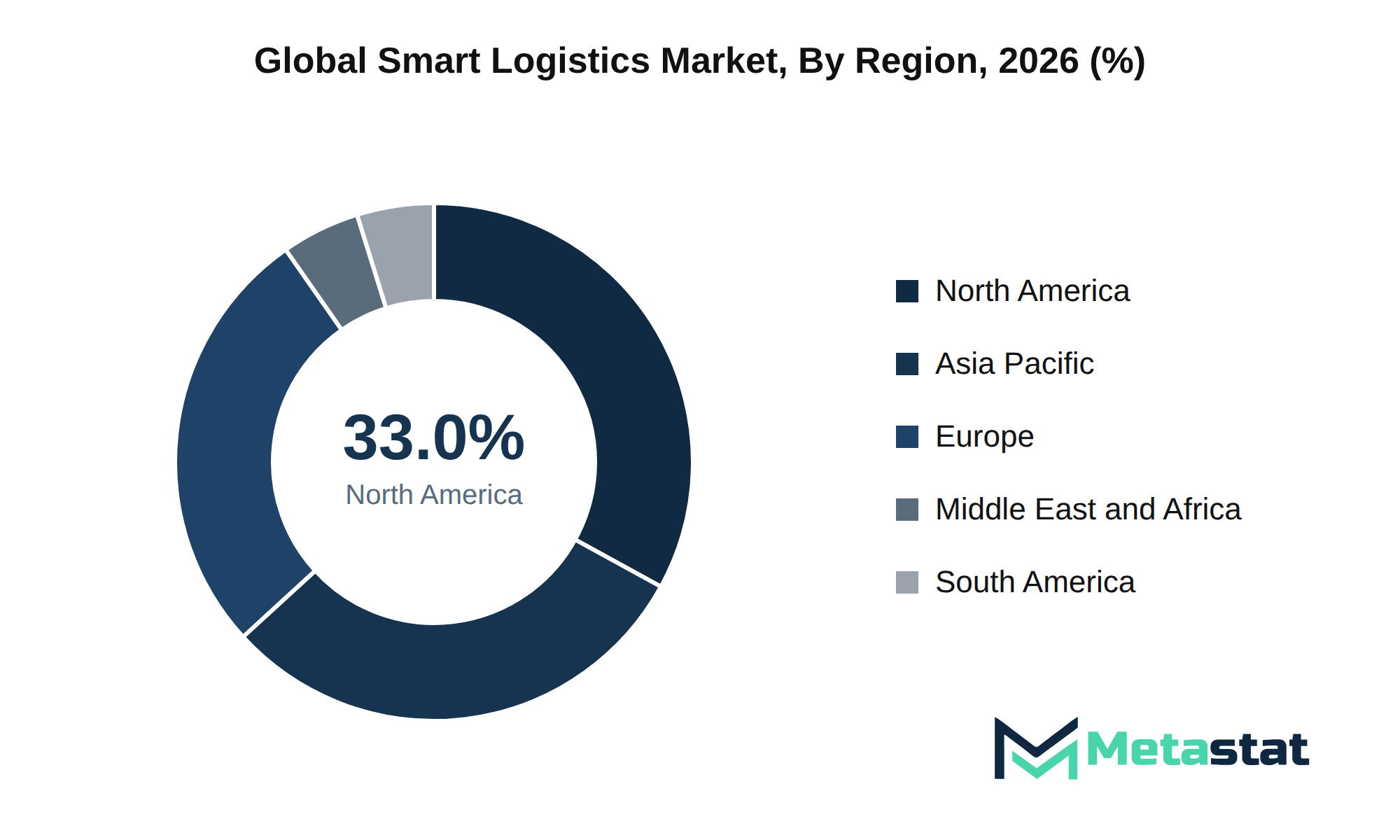
Based on geography, the Global Smart Logistics market is divided into North America, Europe, Asia-Pacific, South America, Middle East, and Africa.
North America will experience substantial growth in the Smart Logistics market, with a projected CAGR of 21.1% during the forecast period, reaching a market size of USD 78.3 million by the end of 2033. This growth results from increasing demand for efficient logistics solutions driven by infrastructure modernization and emerging technologies. The United States, Canada, and Mexico lead the regional market, accounting for 33.00% of the global market in 2025.
Investment in localized manufacturing and supply chain regionalization enhances logistics capabilities in North America. Nearshoring initiatives have gained traction, enabling companies to reduce lead times and improve overall supply chain efficiency. The expansion of advanced logistics solutions within various end-use industries is a direct result of these trends.
While businesses focus on enhancing their logistics operations, the demand for cloud-based deployment models continues to increase. The growing integration of technology, including artificial intelligence and automation, facilitates more streamlined processes across the logistics landscape. Local compliance mandates and regulatory frameworks further influence the operational dynamics, shaping the competitive environment in this region.
Europe represents a substantial share of the global Smart Logistics market, accounting for 27.1% in 2025. Robust demand for innovative logistics solutions emerges from key markets including Germany, France, the UK, Italy, and Spain, where operational efficiency and cost reduction remain critical. The region's complex regulatory environment and diverse consumer preferences influence localized supply chain strategies, prompting companies to adapt their offerings to meet specific market needs.
Technological advancements, particularly in software and automation, drive the expansion of the software segment within the market. Companies increasingly prioritize cloud-based solutions, enhancing operational agility and facilitating real-time data insights. The growth of e-commerce in Europe further fuels the demand for effective warehousing and transportation management systems, driven by businesses seeking to streamline operations and improve customer service.
Geopolitical factors and trade dynamics shape market conditions across Europe, with companies adjusting to evolving supply chain regionalization trends and the impact of local compliance mandates. Increased investment in infrastructure modernization supports the transition towards more efficient logistics operations, positioning Europe because a front-runner in the Smart Logistics market. With a strong emphasis on innovation and sustainability, the region continues to explore new growth opportunities while navigating competitive challenges.
The Smart Logistics market in the Asia-Pacific region demonstrates considerable potential, driven by robust economic growth, evolving consumer expectations, and technological advancements. Countries including China and India, with their rapidly expanding e-commerce sectors, significantly contribute to market dynamics. Increased urbanization in these nations necessitates efficient logistics solutions, enhancing demand for innovative technologies.
Infrastructure modernization plays a critical role in the region's logistics landscape. Investments in transportation networks, including rail and road systems, along with advancements in warehousing capabilities, set the foundation for market growth. Countries like Japan and South Korea increasingly adopt automation and digital solutions, streamlining operations and improving service delivery.
The Smart Logistics market benefits from emerging market front-runners, with Australia and Southeast Asia rising due to competitive players. The influx of foreign direct investment (FDI) supports local businesses, driving innovation and improving operational efficiencies. This influx enhances the market's overall attractiveness and drives technological advancements.
Cross-border trade corridors significantly impact logistics strategies in the region. Enhanced trade agreements and partnerships contribute to increased trade volumes, stimulating demand for logistics services. Geopolitical factors and local compliance mandates shape the competitive landscape, requiring vendors to adapt to varied regulatory frameworks while addressing cultural nuances and regional buying behaviors.
Local market leaders leverage procurement dynamics and strategic entry barriers to strengthen their positions. Companies focus on localized manufacturing densities and nearshoring initiatives, optimizing supply chains to meet regional demands effectively. This strategic alignment with market requirements positions the Asia-Pacific region because a key player in the global Smart Logistics market.
The Smart Logistics market in South America is characterized by a growing focus on infrastructure modernization and localized manufacturing. Brazil and Argentina lead the market, driven by increasing demand for efficient supply chain solutions. The region's share of the global market stands at 4.8% in 2025, reflecting its emerging potential and strategic importance.
Investment in technology and digitalization within logistics operations supports market growth. Local companies are adapting to the evolving landscape, with an emphasis on cross-border trade corridors and regional procurement dynamics. This shift enhances competitive positioning, promoting domestic market leaders and encouraging vendor consolidation trends. The Smart Logistics market shows promise in the face of geopolitical fragmentation and diverse regulatory frameworks, which dictate compliance and operational strategies.
Strategic entry barriers along with foreign direct investment (FDI) flows present opportunities for international players. These dynamics contribute to an environment ripe for incremental growth vectors, positioning South America because a key player in the global logistics framework. While the market expands, local procurement practices and cultural nuances will influence the trajectory of technology adoption and operational efficiencies.
The Smart Logistics market in the Middle East and Africa is characterized by a growing emphasis on modernization and technological advancement. Infrastructure development and increasing investments in logistics capabilities significantly influence the market landscape in this region. Countries like Saudi Arabia and the UAE demonstrate robust initiatives aimed at enhancing their logistics sectors, with strategic efforts focused on localized manufacturing and supply chain optimization. South Africa shows similar trends, benefiting from improved cross-border trade corridors and initiatives aimed at regional integration.
This region experiences a competitive landscape with emerging players and established companies keen on capturing market share. Investment in digital solutions and automation technologies fuels growth within the market, aligning with broader trends toward efficiency and sustainability. An increasing number of domestic and international vendors pursue partnerships to leverage local resources and enhance service offerings.
Regional compliance mandates and regulatory frameworks play a critical role in shaping market dynamics. Companies in the region navigate these complexities while striving to meet local compliance requirements and adapt to cultural nuances in B2B buying behaviors. The Smart Logistics market in this region holds significant potential for growth, driven by distinct factors and emerging market trends.
Competitive dynamics within the Smart Logistics market reflect a landscape shaped by strategic consolidation and product differentiation. Leading players including Amazon, DHL, and FedEx leverage extensive logistics networks to enhance service capabilities, while companies like Blue Yonder Group, Inc. and Cognizant focus on innovative software solutions to optimize supply chain processes. The integration of technology, particularly through proprietary platforms, creates significant barriers to entry, deterring new entrants in the market.
Several firms pursue strategic alliances and cross-industry partnerships to enhance market presence. Partnerships among software providers and logistics companies strengthen value chain integration, facilitating smoother operations for end-users. Companies like Dematic and AutoStore exemplify this trend, focusing on automation and efficiency to capture greater market share. This collaborative approach enables firms to navigate challenges and improve competitive positioning in the logistics sector.
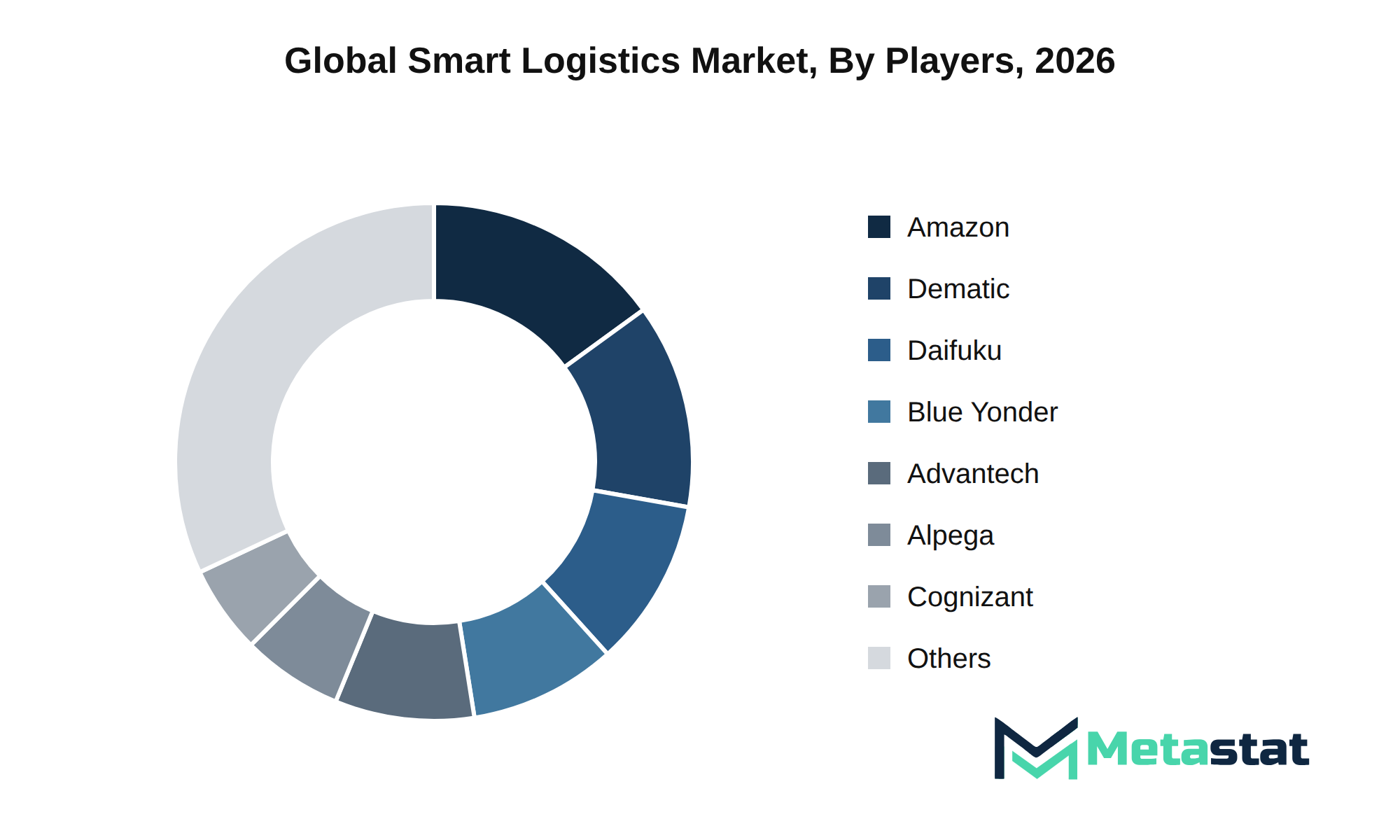
Market size is projected to rise from USD 54.9 million in 2025 to over USD 254.1 million by 2033. This growth reflects strong demand across various sectors, driven by advancements in technology and integration of next-generation solutions. Macroeconomic conditions play an important role in shaping this environment, with evolving trade corridors and geopolitical realignments influencing global supply chains.
While economic cycles fluctuate, downstream demand patterns shift, impacting core industries associated with the Smart Logistics market. Increased emphasis on regulatory compliance and imminent policy enforcement horizons further highlights the necessity for businesses to adapt to changing market dynamics. Organizations prioritizing strategic capital allocation directives and infrastructure commitments position themselves favorably for future growth opportunities.
The market is expected to experience significant maturation, driven by R&D commercialization timelines that bring innovative solutions to fruition. Identifying emerging white-space opportunities and addressing unmet enterprise needs will present high-growth pockets within this evolving environment. Companies developing defensibility roadmaps and executive-level strategic imperatives enhance their competitive advantage, ensuring sustained growth in the Smart Logistics market.
The report strategically identifies and profiles the key market players and analyses their core competencies in each sub-segment of the Smart Logistics market.
Report Attributes | Details |
Study Period | 2021-2033 |
Base Year | 2025 |
Estimated Year | 2026 |
Forecast Period | 2026-2033 |
Historical Period | 2021-2025 |
Growth Rate | CAGR 21.1% from 2026 to 2033 |
Revenue Unit | USD million |
Segmentation | By Component, Solution Type, Deployment Model, End-Use Industry, and Region |
By Region | North America (By Component, Solution Type, Deployment Model, End-Use Industry, and Country)
|
Europe (By Component, Solution Type, Deployment Model, End-Use Industry, and Country)
| |
Asia Pacific (By Component, Solution Type, Deployment Model, End-Use Industry, and Country)
| |
South America (By Component, Solution Type, Deployment Model, End-Use Industry, and Country)
| |
Middle East and Africa (By Component, Solution Type, Deployment Model, End-Use Industry, and Country)
|
Find answers to common questions about this report
The Smart Logistics market size was valued at USD 54.9 million in 2025, according to the Metastat Insights study.
The Smart Logistics market is projected to grow at a CAGR of 21.1% during the forecast period from 2026 to 2033.
The North America Smart Logistics market size is estimated to reach USD 78.3 million by 2033.
The Software segment leads the Smart Logistics market, projected to reach USD 103.6 million by 2033, based on its higher growth rate compared to other segments.
Key drivers for the Smart Logistics market include the push for digital transformation across industries, which enhances operational efficiency through automation and artificial intelligence. Increased investment in industrial automation supports the optimization of supply chains, while the need for cost efficiency compels firms to adopt innovative logistics strategies, driving market growth.
North America holds the dominant share of the Smart Logistics market, with a projected value of USD 78.3 million in 2033, representing 33 percent of the total market.
High capital investment requirements hinder market growth by deterring smaller firms from entering the Smart Logistics market. infrastructure gaps and connectivity deficits create obstacles to implementing advanced technologies, leading to deployment bottlenecks and increased costs. These factors contribute to a cautious approach towards adopting smart logistics technologies, limiting overall market expansion.
The Smart Logistics market experiences increased product adoption due to digital transformation initiatives across industries, prioritizing automated solutions and artificial intelligence. This integration enhances operational efficiency, streamlines workflows, and improves decision-making, leading to higher productivity and reduced costs. Consequently, firms seek to capitalize on efficiency gains and competitive advantages provided by these advancements.
The Smart Logistics market is estimated to reach a valuation of USD 254.1 million by 2033.
Key players in the Smart Logistics market include Amazon, DHL, FedEx, Honeywell International Inc., Blue Yonder Group, Inc., and Cognizant.
The analysts below cover Automotive and Transportation research at Metastat Insights.
LEAD ANALYST
Utkarsh Khirodkar is a Lead Market Research Analyst at MetaStat Insight, specializing in market intelligence, technology sector assessments, and competitive strategy.

ENERGY & INFRASTRUCTURE INDUSTRY CONSULTANT
Automotive and Transportation · Electronics and Semiconductor · Energy and Power · Machinery & Equipment
Saurabh Vasant Ganvir consults for Energy & Infrastructure Industry at MetaStat Insight, specializing in renewable energy, solar EPC, and electric vehicle (EV) infrastructure markets.
Tracking ceramic matrix composite adoption in high-bypass aero engines requires strict attention to material qualification cycles and FAA airworthiness testing milestones. The MetaStat Insight team provided a detailed timeline of silicon carbide fiber manufacturing capacity and commercial foundry lead times. Having clear visibility into upstream thermal barrier coating supply helped us stress-test our long-term component procurement strategy.
Transitioning ultra-class mining haul trucks to alternative power requires concrete data on remote hydrogen refueling infrastructure economics. The report evaluated megawatt-scale electrolyzer installation expenses, onsite storage safety mandates, and heavy-duty fuel cell stack degradation under continuous duty cycles. That technical rigor helped our engineers benchmark realistic total operating cost horizons for off-highway fleet decarbonization.
Enterprise zero-trust network rollouts are often slowed down by multi-cloud transit latency and proprietary hardware retirement schedules. This study provided realistic total cost of ownership models comparing cloud-delivered security edge solutions against traditional hardware refreshes. The analysis of contract renewal lengths and software maintenance fees gave us clear visibility into enterprise replacement cycles over the next three to five years.
Explore related market intelligence reports worth reading alongside this one.