
LEAD ANALYST
Utkarsh Khirodkar is a Lead Market Research Analyst at MetaStat Insight, specializing in market intelligence, technology sector assessments, and competitive strategy.

South Africa Freight and Logistics Market Size, Share, By Service Type (Freight Transportation, Freight Forwarding, Warehousing & Storage, Courier, Express & Parcel Services, Contract Logistics and 3PL Services, Customs Brokerage & Trade Facilitation, Others (Project Logistics, Reverse Logistics and Specialized Logistics)), By Mode of Transport (Road Freight, Rail Freight, Sea Freight and Air Freight), By Shipment Coverage (Domestic, Southern African Cross-Border and Intercontinental), By End-Use Industry (Retail & E-Commerce, Automotive, Mining & Minerals, Industrial Manufacturing, Food, Beverage & FMCG, Agriculture, Healthcare & Pharmaceuticals, Chemicals & Petrochemicals and Others (Technology, Textiles, Paper & Packaging)), Industry Analysis, Growth, Trends, and Forecast, 2026-2033
MSI-5449
October, 2026
293 Pages
Historical
Base year
Forecast
Forecast period
Report Details
Comprehensive Market Analysis And Insights
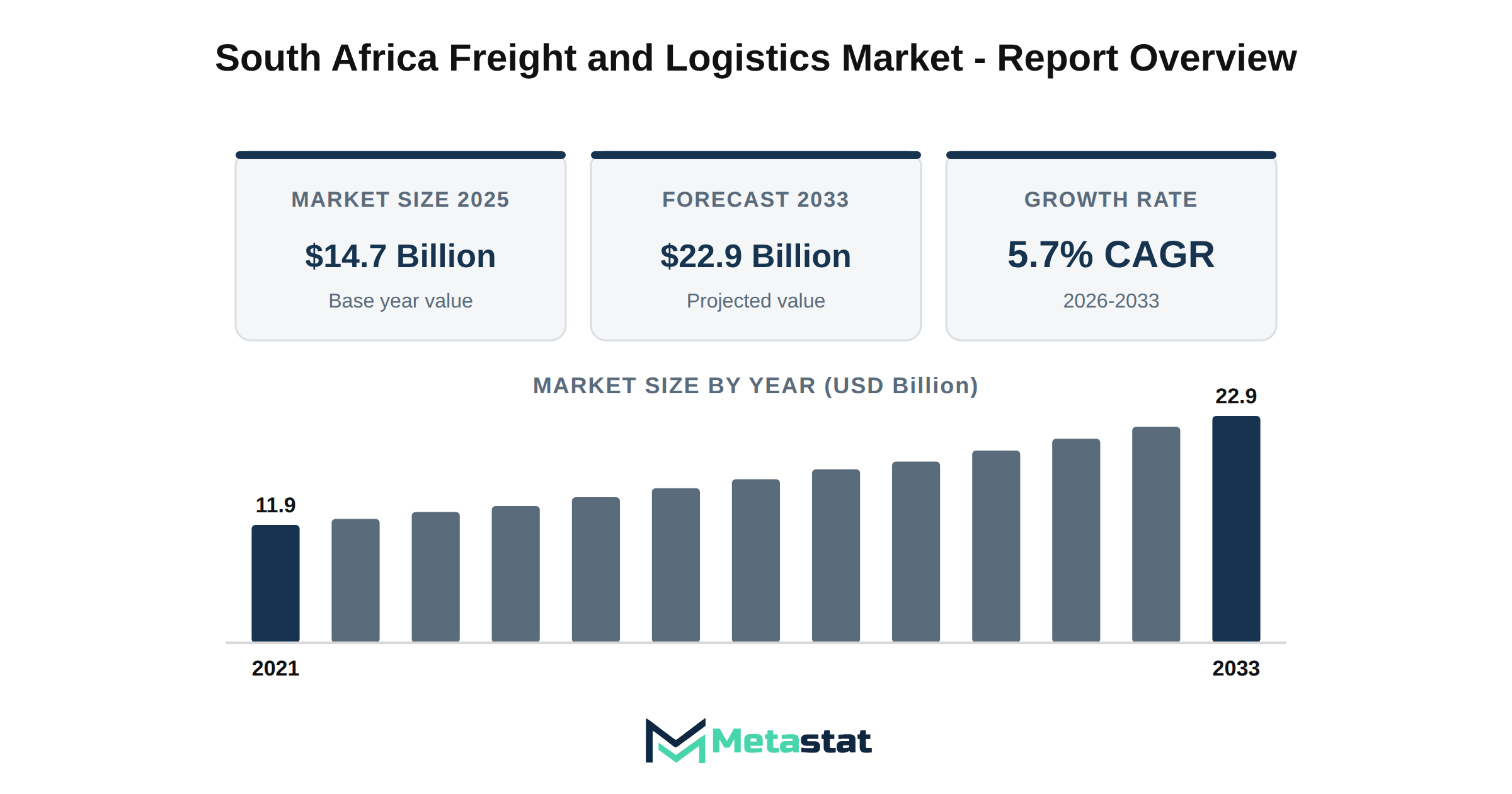
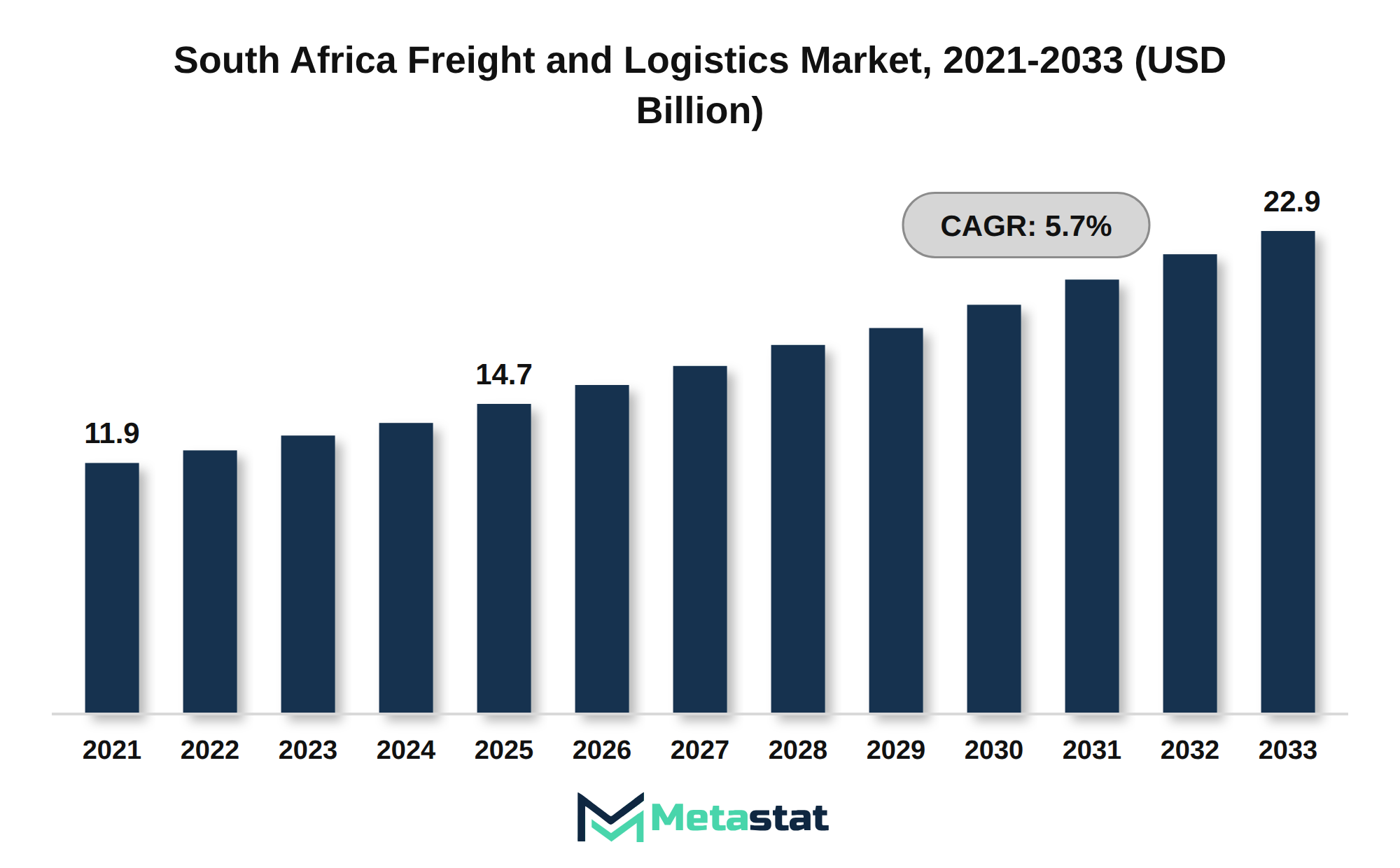
Market Valuation: Valued at $14.7 Billion in 2025, projected to reach $22.9 Billion by 2033 at a 5.7% CAGR.
Dominant Segment: Freight transportation leads the market, accounting for 38.9 percent of total value, driven by its essential role in supporting both bulk commodities and finished goods movement across South Africa and neighboring regions.
Fastest-Growing Segment: Courier, Express & Parcel Services is the fastest-growing service type, projected at a 7.9% CAGR, fueled by rising demand for expedited deliveries from e-commerce and cross-border trade.
Geographic Lead: Domestic shipment coverage remains the largest by value, supported by entrenched consumer networks and established supply chains, while Southern African cross-border shipments are projected to grow faster at a 7.2% CAGR due to expanding regional trade.
What's Inside: The report provides detailed segmentation by service type, mode of transport, shipment coverage, and end-use industry, along with market share analysis, growth drivers, and profiles of leading industry players for the 2026–2033 forecast period.
The South Africa Freight and Logistics market was valued at USD 14.7 billion in 2025 and is projected to reach USD 22.9 billion by 2033, growing at a CAGR of 5.7% over the forecast period.
The South Africa Freight and Logistics market covers a broad range of services including freight transportation, freight forwarding, warehousing and storage, courier and parcel delivery, contract logistics, and customs brokerage. Buyers across retail, automotive, mining, and manufacturing sectors invest in these services to streamline supply chains, access cross-border trade routes, and ensure timely delivery of goods. The diversity of end-user industries reflects distinct requirements for domestic distribution, regional trade, and international shipments, making the market integral to industrial and consumer activity throughout the country.
Freight transportation stands out with the most value, accounting for 38.9 percent of the market share. This segment supports both bulk commodities and finished goods, enabling manufacturers, retailers, and exporters to reach customers and partners across South Africa and neighboring regions. Compared to warehousing, contract logistics, and courier services, freight transportation drives the largest share of spending due to its scale and essential function in both domestic and cross-border movement of goods.
Growth in the market is driven by the expansion of retail and e-commerce, which intensifies demand for reliable and scalable distribution networks. Online retail acceleration leads logistics providers to handle rising shipment volumes and increasingly complex delivery requirements. This shift in buyer behavior pushes investment in transportation and fulfillment capacity, supporting both established operators and new entrants aiming to capture the expanding flow of goods across urban and rural areas.
Buyers in the South Africa Freight and Logistics market invest in services that enable efficient movement of goods, support supply chain continuity, and optimize costs across a range of industries. Retail and e-commerce, automotive, and mining sectors drive demand, with each group seeking reliable and scalable options for domestic and cross-border distribution. The market covers core logistics functions from warehousing solutions to last-mile delivery, responding to rising expectations for speed, visibility, and flexibility in how goods reach customers and production sites.
Freight transportation delivers the highest value among the service segments, accounting for a 38.9 percent share. This segment supports the bulk of physical goods movement for manufacturers, distributors, and retailers, who require dependable options to manage inventory turnover and adapt to fluctuating demand patterns. The strong position of freight transportation reflects the country’s reliance on road, rail, and sea networks, with each network focused on distinct freight corridors and industry clusters.
Within the South Africa Freight and Logistics market, growth is primarily driven by expanding retail and e-commerce activity. Escalating consumer demand for rapid delivery and diverse product availability fuels higher shipment volumes, particularly in domestic and regional lanes. Retailers and digital platforms scaling their operations prompt logistics providers to respond with tailored solutions and expanded capacity, reinforcing the importance of reliable connectivity and integrated services for sustaining business performance.
Private sector engagement is reshaping South Africa’s national freight corridors through innovative rail concessions and infrastructure partnerships. Historically, state-run enterprises dominated rail operations, but recent policy shifts have encouraged competitive participation in track access, rolling stock investment, and intermodal integration. This transition is already influencing the allocation of capital and operational models along high-density cargo routes, resulting in greater efficiency for containerized and bulk shipments. Mining and manufacturing exporters, in particular, are responding to improved reliability and service flexibility, reducing turnarounds and logistics bottlenecks that previously constrained throughput.
Within the South Africa Freight and Logistics market, rail freight is projected to reach USD 2.9 billion by 2033, reflecting a compound annual growth rate of 7.8%. This projected growth outpaces road freight, which carries a lower compound annual rate, and signals a decisive shift in modal preference for corridors where private concessions facilitate system upgrades and consistent maintenance. Such performance gains encourage shippers to reallocate volumes from congested and higher-cost road networks to revitalized rail lines.
For suppliers and buyers in the South Africa Freight and Logistics market, this reconfiguration of corridor management translates to expanded investment opportunities in material handling technologies, digital scheduling platforms, and cross-border transshipment nodes. Service providers that integrate rail with warehousing and contract logistics become more competitive, especially for large-scale exporters and regional distributors that prioritize punctuality and cost control in long-haul transport. These developments set a new benchmark for infrastructure utilization and service design across national supply chains.
Buyers in the South Africa Freight and Logistics market are adapting contract and payment models to reflect the evolving operational landscape at Durban Port and the impact of cross-border transit strategies under the African Continental Free Trade Area (AfCFTA). Modernization projects at Durban Port, a primary gateway for Southern African trade, have influenced procurement behavior. Shippers and third-party logistics providers now pursue longer-term contracts that tie pricing structures to service-level benchmarks and turnaround times, rather than relying on fixed annual rates. This approach protects buyers from unplanned cost escalation linked to port congestion or customs delays, particularly for high-frequency users in retail and e-commerce segments. The segment’s anticipated expansion is reflected in a projected increase for Retail & E-Commerce, set to reach USD 5.1 billion by 2033.
Cross-border transit under AfCFTA has driven buyers to adopt flexible volume commitments and milestone-based payment schedules. These arrangements accommodate variable lead times and regulatory checks at border posts, while strengthening relationships through performance-linked incentives. For automotive and industrial manufacturing clients operating complex regional supply chains, these contract models reduce working capital tied up in transit and improve responsiveness to shifts in regional demand. Buyers are restructuring payment frameworks in response to port and policy changes, resulting in a shift toward collaborative, risk-sharing procurement that aligns service payments with operational outcomes.
Cold chain requirements and decarbonization directives are reshaping logistics decisions for agricultural producers and distributors in South Africa. Exporters of perishable products, including citrus, avocados, and table grapes, face commercial pressure to demonstrate both supply chain integrity and environmental stewardship to retain access to premium markets in Europe and Asia. The market sees heightened investment in temperature-controlled warehousing and transport assets, and new compliance layers for greenhouse gas tracking on primary and secondary distribution fleets.
Within the broader market, the Warehousing & Storage segment is projected to reach USD 3.4 billion by 2033, reflecting growing demand for advanced storage solutions that support both food safety and emissions reduction. Domestic logistics providers are integrating real-time monitoring and energy-efficient refrigeration to serve agricultural shippers whose buyers set strict cold chain verification standards. Meanwhile, cross-border shipment coverage is anticipated to expand, with Southern African cross-border freight forecast to reach USD 3.7 billion by 2033, driven in part by agricultural exports seeking value-added handling and lower carbon footprints.
Fleet operators responding to these dual demands face capital outlays for retrofitting vehicles with lower-emission engines and adopting digital route optimization to minimize spoilage and fuel use. These requirements raise cost hurdles for smaller transporters, increasing opportunities for larger, integrated providers with scale in both fleet modernization and end-to-end cold chain logistics. Compliance with cold chain and decarbonization requirements is strengthening the market position of asset-rich logistics partners, shaping procurement strategies and contract durations among agricultural exporters and their suppliers.
Intermodal shifts and rising freight surcharges are reconfiguring the cost base for logistics providers and buyers in South Africa. The transition toward rail and sea freight draws attention, but road freight remains responsible for ongoing transport cost volatility. Road freight is projected to grow from USD 10.5 billion in 2026 to USD 14.9 billion by 2033, reflecting the sector’s resilience despite mounting surcharges and fluctuating fuel prices. These increases pass through to end-users, particularly in industries including retail and e-commerce, where delivery reliability and frequency are critical.
The influence of surcharges is particularly acute along Southern African cross-border corridors, where regulatory fees and insurance premiums escalate total freight costs. Rail freight is projected to reach USD 2.9 billion by 2033, supported by infrastructure investments and the search for more cost-efficient alternatives. The slower pace of rail modernization and capacity bottlenecks limit its ability to absorb the overflow from road networks, keeping pressure on overall logistics expenses.
For companies operating in the South Africa Freight and Logistics market, these dynamics demand rigorous cost management and adaptive sourcing strategies. The market’s performance, reflected in the projected expansion to USD 22.9 billion by 2033, will depend on how successfully logistics providers optimize intermodal flows, negotiate surcharges, and align with clients’ evolving transport priorities. Shippers recalibrate contracts and shift volumes among modes in response to cost fluctuations, creating a more competitive environment for freight service providers and increasing the focus on transparent pricing models.
Rising e-commerce activity is transforming logistics procurement and service delivery throughout South Africa. Online retail and digital marketplaces generate sustained demand for reliable fulfillment, last-mile distribution, and inventory management services. Retail and e-commerce companies increasingly contract integrated logistics providers to secure rapid delivery, returns management, and scalable warehousing. The Retail & E-Commerce segment is projected to grow from USD 3.1 billion in 2026 to USD 5.1 billion by 2033, supported by multi-channel buying patterns and rising consumer expectations for fast, traceable shipments. This shift is raising volumes in express parcel, warehousing, and cross-border logistics, creating new opportunities for providers with advanced tracking, automation, and flexible capacity. Price competition and service innovation are supporting a compound annual growth rate of 5.7% through 2033. E-commerce fulfillment requirements are now a primary force shaping volume growth and service differentiation for logistics providers in South Africa.
Congestion at major freight hubs restricts timely movement for retail and e-commerce shipments, limiting the capacity of the market to support growth in high-volume consumer sectors. Delays at ports cause retailers and online sellers to adjust inventory strategies, often resulting in smaller and less frequent orders to manage uncertainty in delivery schedules. This shift constrains throughput for service providers and reduces the efficiency gains expected from streamlined supply chains. With retail and e-commerce accounting for a rising share of end-use demand, service providers experience longer contract cycles and hold back on capacity expansion while uncertainty persists. Higher holding costs and erratic delivery windows reduce appetite for premium logistics services, weighing on uptake and revenue potential in the market.
Wage inflation and regulatory adjustments are driving up labor costs across contract logistics, warehousing, and freight handling operations. Suppliers operating in the market face persistent pressure while transport and logistics wages account for an increasing share of operating expenses. This challenge is particularly acute for service providers running labor-intensive segments including warehousing and storage, which represent 13.6% of the market by value. In response, logistics operators are streamlining workflows and adopting process automation in facilities where investment supports sufficient volume to justify the capital outlay. Several players are pursuing workforce optimization initiatives, including flexible scheduling and targeted upskilling, to maximize labor productivity and dampen the impact of rising personnel costs. These measures shape pricing strategies and contract terms, constraining suppliers’ ability to fully protect margins in a competitive environment.
Rail freight is positioned the fastest-growing mode in the South Africa Freight and Logistics market, supported by a projected compound annual growth rate of 7.8% through 2033. Large mining and minerals exporters increasingly favor rail for bulk and long-distance shipments, with new capacity and infrastructure upgrades making more efficient routes to port available. The expansion of rail freight addresses demand from industries requiring high-volume, lower-cost transit, particularly those moving commodities to export terminals. This shift reduces overall logistics expenses for bulk shippers and enables higher operational throughput, supporting export competitiveness. The market is expected to capture greater value from sectors that depend on reliable rail corridors, with total rail freight volume forecast to reach USD 2.9 billion by 2033. Investments targeting rail network resilience and specialized rolling stock further support this opportunity by increasing service reliability and network reach.
The South Africa Freight and Logistics market is segmented based on Service Type, Mode of Transport, Shipment Coverage, and End-Use Industry.
Valued at USD 6 billion in 2026 and projected to reach USD 8.3 billion by 2033, freight transportation is set to expand at a CAGR of 4.7% during the forecast period. This segment delivers essential long-haul and regional movement of bulk goods, industrial inputs, and finished products for industries including mining, automotive, and agriculture. Purchases are driven by manufacturers and commodity exporters seeking scalable capacity and predictable transit times. In the market, freight transportation relies on road and rail providers to reach inland production zones and ports. Its 4.7% CAGR is slower than courier, express, and parcel services, which are projected at 7.9%, reflecting the latter’s faster adaptation to e-commerce and small parcel demand. In contrast, freight transportation addresses high-volume, lower-margin loads, exposing it more to fuel price fluctuations and asset utilization risks. Buyers in this segment prioritize reliability and integration with warehousing over speed or last-mile delivery, setting it apart in the market.
Freight Forwarding segment is estimated to reach USD 2.3 billion by 2033, at a CAGR of 4.9% during the forecast period. Across the market, this segment supports importers and exporters requiring end-to-end coordination of international and regional shipments. Buyers in heavy industry and retail leverage freight forwarding to reduce complexity, consolidate shipments, and secure cost-efficient routing across road, rail, sea, and air. Demand is strengthened by cross-border trade with neighboring Southern African countries and the evolving requirements of supply chains seeking integrated logistics solutions. Freight forwarding in South Africa is projected to grow at a 4.9% CAGR, tracking just above warehousing and storage but below courier, express and parcel services, which are forecasted for 7.9% growth. Differentiated by its focus on multimodal management and regulatory compliance, this segment draws clients seeking expertise in customs clearance, risk mitigation, and multi-country distribution - distinct from domestic-only logistics or asset-heavy transportation providers in the market.
This segment underpins inventory management, distribution, and fulfillment for large-scale retail, e-commerce platforms, and industrial producers. Key buyers include domestic retailers and multinational firms requiring scalable inventory solutions to manage fluctuating demand and seasonal surges. In the market, Warehousing & Storage shows a slower projected pace than Courier, Express & Parcel Services, which records a 7.9% CAGR, reflecting the segment’s established role rather than rapid expansion. Warehousing & Storage supports critical supply chain functions for sectors including retail, automotive, and mining, providing secure storage and value-added handling for both high-velocity consumer goods and bulk industrial materials. Cost containment for buyers depends on warehouse automation and efficient inventory turnover, while persistent energy and facility maintenance costs influence overall segment profitability. Within the market, this segment distinguishes itself by catering to both traditional manufacturers and digital-first commerce entrants, supporting a diverse mix of inventory types and service requirements.
Courier, Express & Parcel Services segment is projected to grow at a CAGR of 7.9% during the forecast period, making it the fastest-growing service type in the South Africa Freight and Logistics market. This segment provides expedited, time-sensitive delivery solutions for documents, parcels, and lightweight goods, serving retailers, e-commerce platforms, healthcare distributors, and high-value B2B clients. The segment’s rapid expansion is driven by ongoing demand for next-day and same-day deliveries, particularly from online retail and cross-border trade. Compared to Freight Transportation and Freight Forwarding, which grow at CAGRs of 4.7% and 4.9% respectively, Courier, Express & Parcel Services exhibits a distinct buyer profile. Small businesses and direct-to-consumer brands prioritize speed and flexibility over bulk shipment pricing. Operators invest in digital tracking and last-mile optimization, meeting customer expectations in urban and peri-urban areas. Increased competition from both global couriers and local specialists is driving innovation to capture growth in parcel volumes and value-added express services.
Outsourced supply chain management through contract logistics and third-party logistics (3PL) services delivers strategic value for manufacturers, retailers, and FMCG companies seeking to streamline warehousing, distribution, and inventory functions. Buyers in this segment respond to the rising need for integrated solutions that reduce fixed logistics costs and improve scalability. The segment draws demand from businesses that prioritize end-to-end visibility and flexibility, especially those exposed to demand volatility or requiring complex distribution networks. Compared to warehousing and freight forwarding, contract logistics and 3PL services focus on tailored, long-term partnerships where the provider assumes operational responsibility and risk, often integrating digital tracking and customized service agreements. This sets the segment apart from others in the market, where transactional, shipment-based services dominate. Growth is influenced by ongoing supply chain optimization in sectors like retail, automotive, and consumer goods, and by pressure to adapt to changing regulatory and compliance requirements. Technology adoption, including advanced inventory management and real-time tracking, drives service differentiation and buyer retention across the segment. Heightened competition from established global providers and local specialists expanding their offerings in contract logistics and 3PL services is shaping commercial strategy and service innovation in this segment.
Customs brokerage and trade facilitation services focus on ensuring the compliant and efficient movement of goods across borders, providing importers and exporters with the regulatory expertise needed to clear shipments and navigate complex documentation. Leading buyers include multinational manufacturers, automotive assemblers, and commodity exporters, who require precise coordination to avoid delays and financial penalties. In the market, this segment stands out for its centrality in cross-border trade, particularly at major land borders with Southern African neighbors. Regulatory updates and shifts in customs protocols drive demand for specialized knowledge and digital integration, prompting providers to invest in automated clearance, e-documentation, and tighter alignment with revenue authorities. Compared with other service types, customs brokerage and trade facilitation typically serve buyers who face higher compliance exposure rather than those prioritizing bulk movement or last-mile distribution. This segment often commands higher service fees per transaction, reflecting the added regulatory risk and the expertise demanded by customs authorities and cross-border commercial flows in the market.
Project logistics, reverse logistics, and specialized logistics are essential for sectors that require tailored solutions for oversized, high-value, or non-standard shipments, and product returns and end-of-life equipment management. Oil and gas, mining, construction, and technology buyers engage these services when standard freight and warehousing solutions do not address their requirements for custom handling, complex routing, or regulatory compliance. In the South Africa Freight and Logistics market, this segment addresses out-of-gauge cargo, plant relocations, hazardous materials, and reverse flows for warranty or recycling. Demand is enabled by capital project cycles and increasing circularity standards, especially among industries pressured to manage waste or demonstrate responsible disposal. Compared to larger and faster-expanding service types including courier, express, and parcel services, this segment advances through highly specialized expertise rather than volume growth. Pricing is typically higher, reflecting the bespoke nature of each project and the value placed on risk management and regulatory assurance. Specialized providers in the market build technical capabilities and compliance infrastructure to differentiate their offerings.
This segment serves manufacturers, retailers, agriculture suppliers, and mining operators seeking reliable and flexible point-to-point distribution within South Africa. Road freight accommodates time-sensitive shipments and destinations not efficiently reached by rail, sea, or air, supporting a high frequency of short-haul routes and just-in-time inventory strategies. Growth is driven by sustained retail, FMCG, and manufacturing output, and expanding cross-border trade with neighboring countries. Compared to rail freight, which is projected to grow at a faster CAGR of 7.8%, road freight maintains a broader customer base and handles higher absolute volumes, reflecting its role in last-mile and regional delivery networks. Buyers in sectors where delivery speed and geographic accessibility are priorities benefit from the versatility and dense inland distribution coverage of road freight, which provides an operational advantage. Road freight pricing remains sensitive to fuel costs and regulatory compliance, with fluctuations influencing contract terms throughout the market.
Bulk commodity shippers in mining and minerals, steel producers, and industrial manufacturing firms are the principal users of this segment, securing cost advantages and predictable transit times for heavy and long-distance cargo. Investments in network electrification and wagon fleet upgrades enable higher throughput and reliability, attracting industries seeking to reduce exposure to fuel price volatility and road congestion. Compared to Road Freight’s CAGR of 5.1%, Rail Freight’s 7.8% growth rate positions it as the fastest-expanding segment among transport modes. Large-scale shippers remain the core buyers, in contrast to Road Freight’s broader customer mix, which includes FMCG and e-commerce. Policy efforts to shift high-volume loads from road to rail contribute to this acceleration, supporting the strategic push for modal balance and lower logistics costs over the forecast period.
Sea Freight segment is expected to reach USD 3.9 billion by 2033. This mode serves importers and exporters moving high-volume, bulk, or oversized cargo, particularly in sectors including mining, automotive, and agriculture. Buyers leverage sea freight for its cost efficiency over long distances compared to air or road options. The segment draws sustained demand from mineral exports and finished goods imports, which are less time-sensitive but require high-capacity shipping. Compared to road freight, which is projected at USD 14.9 billion by 2033, sea freight appeals to a narrower buyer group but offers substantial savings for large consignments. Price sensitivity and exposure to port infrastructure challenges influence adoption rates. International integration, driven by resource-based industries and expanding trade corridors, is a core demand driver for this segment.
Air Freight segment is projected to grow at a CAGR of 7.2% during the forecast period. This segment addresses the demand for high-value, time-sensitive shipments across pharmaceuticals, electronics, and select retail categories, where speed offsets higher transportation costs. Multinational manufacturers and e-commerce platforms tend to prioritize air freight for rapid inventory replenishment or urgent cross-border orders. Compared to road freight, which is projected at a CAGR of 5.1%, air freight stands out for its faster growth rate, reflecting rising import-export volumes and service demand from sectors with low inventory tolerance. For buyers, cost per ton shipped is higher for air freight than for rail or road, but the premium is justified in scenarios where delayed delivery impacts revenue or customer satisfaction. Technology upgrades in tracking, load consolidation, and customs clearance support the segment’s adoption, with logistics providers investing in digital service platforms to secure contracts with high-frequency shippers. International connectivity and network reliability differentiate this segment, supporting value-added solutions for time-critical cargo.
Domestic shipment coverage is valued at USD 10.2 billion in 2026 and is projected to reach USD 14.5 billion by 2033, at a CAGR of 5.1% during the forecast period. This segment primarily handles the transportation of goods within national borders, serving retailers, manufacturers, and FMCG distributors who require consistent, timely delivery for inventory replenishment and store distribution. Growth in the Domestic segment is influenced by urbanization and expansion of organized retail, both of which raise demand for frequent, short-haul shipments. Compared with Southern African cross-border coverage, which is forecast to grow at a higher CAGR of 7.2%, Domestic volume is both larger and more stable, reflecting entrenched consumer networks and established supply chains. Price sensitivity remains a defining characteristic of this segment, with buyers focusing on cost efficiency for regular shipments. The Domestic segment benefits from a high frequency of orders and established road infrastructure, distinguishing it from intercontinental and cross-border segments where regulatory and customs complexities drive higher operating costs.
Estimated to reach USD 3.7 billion by 2033, Southern African Cross-Border freight is projected to expand at a CAGR of 7.2% during the forecast period. This segment addresses the movement of goods between South Africa and neighboring countries, serving regional manufacturers, mining exporters, and retailers supplying fast-moving consumer goods to cross-border markets. Buyers are primarily regional producers and distributors who require reliable access to both upstream inputs and downstream consumer markets in the Southern African region. Rising intra-African trade agreements and investments in trade corridors drive demand, reducing friction for cross-border shipments. Growth in this segment outpaces the domestic coverage category, which records a 5.1% CAGR, reflecting stronger policy and infrastructure support for regional economic integration. The Southern African Cross-Border segment provides an entry point for logistics providers aiming to capitalize on expanding trade links, positioning South Africa as a regional hub for goods movement within the continent. Improved infrastructure and harmonized regulations further support adoption, attracting investment into the sector.
Intercontinental segment is expected to reach USD 4.7 billion by 2033. This segment addresses the transport of goods between South Africa and global markets, serving exporters, importers, and multinational manufacturers who engage in longer-haul trade that requires complex coordination and compliance with international standards. Heightened demand from automotive, mining, and retail industries drives this segment, reflecting their growing need for supply chain resilience and access to distant suppliers and customers. Unlike the Domestic or Southern African Cross-Border segments, Intercontinental shipments involve higher average transaction values and longer lead times, demanding more sophisticated logistics solutions and risk management. This coverage is influenced by shifts in global trade flows and evolving requirements for digital documentation and end-to-end visibility. Rising international e-commerce volumes further differentiate this segment, with global retailers and local exporters investing in reliable intercontinental shipping channels to capture market share beyond the regional market. Persistent volatility in global freight rates and regulatory variability influence pricing, positioning this segment with distinct commercial dynamics compared to local and regional shipments.
Omnichannel retailers and digital-first platforms depend on freight and logistics services tailored for fluctuating order volumes, high-density urban deliveries, and accelerated returns management. Retail & e-commerce shipment requirements increasingly reflect a rise in direct-to-consumer models and last-mile delivery pressures. This segment draws buyers from fashion, electronics, household goods, and specialty retail, who prioritize flexible capacity, digital tracking, and rapid fulfillment solutions that differ from the bulk, recurrent shipments seen in mining or industrial manufacturing. E-commerce adoption remains particularly sensitive to consumer expectations for delivery speed and real-time order visibility, which pushes logistics partners to invest in automated warehousing and integrated digital booking. Compared with segments like automotive or mining, retail & e-commerce buyers often require higher service frequency and shorter lead times, which influences pricing models and operational investments. While other segments emphasize large-scale, scheduled freight, retail & e-commerce customers focus on agility, transparent pricing, and service customization to match evolving consumer purchasing patterns.
Automakers, component suppliers, and tiered manufacturers depend on tailored freight and logistics solutions for the movement of vehicles, parts, and finished assemblies in South Africa. This segment is driven by automotive industry investment cycles, model launches, and consistent demand from aftermarket service networks. Buyers prioritize reliability, just-in-time capabilities, and integrated warehousing to maintain production continuity and meet dealer network requirements. Shifts in consumer preference toward newer vehicle models and stricter regulatory requirements for safety and emissions create additional complexity and increase the adoption of specialized logistics services. In contrast to retail and e-commerce, where shipment frequency and delivery responsiveness dominate procurement, automotive sector buyers focus on cost control, shipment traceability, and secure handling of high-value components. Slower growth compared with e-commerce segments results from longer product life cycles and dependence on industrial investment. Suppliers serving this segment differentiate through sector experience, the ability to integrate with customer production schedules, and compliance with international automotive standards, setting them apart from general freight providers.
Extraction, processing, and export of mineral resources drive significant demand for freight and logistics services in this segment. Mining companies and raw materials traders require transport solutions tailored for heavy bulk loads, hazardous materials, and export-grade commodities. Infrastructure constraints and policy shifts influence procurement strategies; regulatory compliance around environmental safety and customs documentation adds complexity for buyers in this sector. Compared to faster-growing sectors like retail and e-commerce, mining and minerals logistics experiences steadier but less volatile demand cycles, with shipment sizes often larger and more predictable. Buyers in this segment prioritize providers with a strong track record in bulk handling, secure storage, and effective coordination between road, rail, and port operations. Higher exposure to export markets sets mining and minerals apart from domestic-focused sectors, shaping the need for multimodal transport links and cross-border regulatory expertise.
Precision equipment manufacturers and component assemblers rely on specialized freight and logistics solutions to support multi-stage production processes and complex supply chains. This segment is characterized by demand for scheduled bulk movement of machinery, input components, and semi-finished goods between plants, suppliers, and distribution partners. Industrial manufacturing buyers focus on solutions that ensure reliable transit times, traceable shipment status, and accommodation for oversized or high-value inputs. The requirement for coordinated just-in-time deliveries and the integration of advanced tracking systems distinguish this segment from sectors driven by consumer-facing or time-sensitive goods, including retail and e-commerce, which operates at a higher CAGR of 7.2%. In contrast, industrial manufacturing is expected to expand at a moderate pace, supported by capital investment cycles and the adoption of automation in production facilities. Complexities in inventory management and the synchronize inbound logistics with production schedules create an additional barrier to adoption, particularly for smaller firms facing budget constraints or limited scale. Service providers that offer tailored tracking and consolidation capabilities gain preference among industrial buyers seeking to minimize downtime and optimize working capital.
Distribution of perishable goods, beverages, and fast-moving consumer packaged items relies on freight and logistics providers equipped to address strict delivery windows and temperature-sensitive requirements. Core buyers in this segment include supermarket chains, wholesalers, beverage distributors, and large-scale FMCG manufacturers who demand high-frequency shipments, robust traceability, and compliance with food safety standards. Movement is strongest in urban and peri-urban corridors, where buyers prioritize freshness and product turnover. This segment stands apart from categories including mining and industrial manufacturing in its sensitivity to time and contamination risk, driving a different service mix and distinct cost structures. Seasonal sales peaks and promotional cycles intensify shipment volumes, while regulatory checks on cold-chain integrity present adoption challenges unique to food and beverage logistics. In contrast with retail and e-commerce, where order fragmentation and direct-to-consumer models dominate, food, beverage, and FMCG buyers contract for bulk movement with a need for integrated warehousing and short lead times.
Crop growers, livestock cooperatives, and agri-businesses select freight and logistics solutions built for moving large, seasonal volumes to domestic processors and export terminals. This segment covers agricultural commodities requiring dedicated equipment and flexible scheduling to match crop cycles and perishability. Demand in agriculture is influenced by export orientation and intra-regional trade flows, with producers facing variable infrastructure quality compared to other end-use industries including retail and automotive. While cost sensitivity drives contract negotiations, buyers in agriculture prioritize reliability and access to rural collection zones over high-frequency, time-critical delivery. Unlike sectors supported by urban or industrial infrastructure, agricultural movements require adaptable routing and resilience to fluctuating road and storage conditions. This distinct usage profile sets agriculture apart within end-use segmentation, attracting transporters and logistics providers proficient in bulk handling and adaptive scheduling. Expanded agricultural output and trade agreements are expected to shift freight volumes, while exposure to regulatory or climatic disruptions limits predictability for providers specializing in this segment.
Cold chain solutions support the movement of vaccines, medicines, and critical medical devices to public and private healthcare networks nationwide. Service providers in this segment address strict temperature control, security, and compliance with evolving pharmaceutical regulations. Hospitals, clinics, and wholesale distributors account for the primary buyer group, prioritizing vendors with demonstrated reliability in safeguarding product integrity and traceability. Demand in this segment is shaped by ongoing investment in public health infrastructure, shifting disease burdens, and rising healthcare expenditure, resulting in more complex distribution requirements than sectors including mining or agriculture. Stringent regulatory expectations, including the need for end-to-end audit trails and validated handling, set this segment apart from retail or automotive, where speed and flexibility take precedence. Buyers evaluate providers on proven capabilities in risk management and regulatory adherence, leading to higher qualification costs than many other end-use industries.
Bulk producers and downstream processors in the chemicals and petrochemicals sector require freight and logistics solutions that support the movement of hazardous, temperature-sensitive, and regulated materials. Key players in this segment serve manufacturers of base chemicals and intermediates used in plastics, fertilizers, coatings, and industrial solvents. Demand is strongly influenced by ongoing investment in petrochemical processing capacity and the expansion of export-oriented production facilities, which generate a steady flow of outbound shipments. This segment faces stricter compliance requirements compared to end-use categories including agriculture or retail, reflecting the need for specialized handling, certified warehousing, and documentation to meet safety and environmental regulations. Buyers in this sector evaluate providers on their ability to manage risk, deliver traceability, and maintain uninterrupted supply chains for both domestic consumption and cross-border export. Technology upgrades focused on real-time tracking and automated safety checks differentiate service offerings, while high switching costs and regulatory complexity reinforce long-term supplier relationships.
Electronics assemblers, IT infrastructure suppliers, and commercial printers contract for logistics services tailored to frequent product launches, high seasonality, and precise delivery schedules. Demand in this segment responds most directly to rapid innovation cycles, with technology and textile buyers prioritizing partners that accommodate changing shipment profiles and manage delicate or irregularly sized goods. Compared to industries focused on bulk or hazardous cargo, buyers in technology, textiles, and paper and packaging segments typically favor service providers able to flex capacity and digital tracking, even at a premium. High variability in order volume and the importance of timely rollouts distinguish this group from others in the end-use category. While regulatory compliance matters, clients in these sectors place heightened emphasis on shipment visibility and last-mile reliability to maintain competitiveness and respond to market trends. In contrast to segments with well-established, routine shipment flows, companies in this cluster seek agile logistics partners who support frequent product refreshes and supply chain adjustments.
Expanding e-commerce adoption and the ongoing shift to contract logistics and third-party logistics providers are expected to play a central role in segment expansion. Retail and E-Commerce, projected at a CAGR of 7.2% through 2033, accounts for much of the new demand, with consumer expectations for fast delivery and reliable fulfilment supporting technology investment and service upgrades. Another critical factor is the scaling of cross-border and intercontinental shipment coverage, which underpins higher-value logistics contracts and attracts foreign investment into infrastructure. The main risk to this outlook is the constraint posed by rail and port infrastructure, where backlogs or underperformance delay shipments and raise operational costs for logistics providers, especially in international trade corridors. Domestic service providers adapt with increased use of road freight, but at a higher price point. Achieving the projected USD 22.9 billion depends on coordinated infrastructure improvement and digital integration across major corridors and industrial hubs, ensuring that growth in service demand is met with reliable and scalable solutions.
Competitive activity is shaped by a diverse field of full-service logistics providers and specialist operators, focusing on a mix of service integration, geographic footprint, and sector-specific capabilities. Buyers assess providers on reliability, service range, digital platform integration, and the ability to manage cross-border and complex logistics contracts. DSV A/S focuses on offering integrated supply chain management and end-to-end logistics solutions, which attracts enterprises seeking operational consolidation. DHL Group leverages international networks and advanced digital systems to serve multinationals with high-volume and cross-border needs. Bidvest International Logistics and Transnet SOC Ltd. each emphasize local and regional freight infrastructure, appealing to manufacturers and commodity exporters requiring robust domestic and regional distribution. Kuehne+Nagel and A.P. Moller - Maersk support intercontinental and multimodal shipments with established global routing and visibility solutions, while South African Post Office SOC Ltd. and Laser Logistics (Pty) Ltd address last-mile and e-commerce fulfilment. This fragmentation by service specialization and sector focus differentiates the segment from others in the end-use group, where demand often centers on standardized or commodity freight needs.
Growth in this segment reflects increasing demand for integrated freight and logistics solutions supporting supply chains across the country. Companies in retail, automotive, and industrial production drive higher volume requirements, particularly with the scaling up of e-commerce and manufacturing distribution networks. The pace of expansion in this segment outpaces that of warehousing and storage or contract logistics, supported by a projected CAGR of 5.7% from 2025 to 2033. Rising adoption of digital platforms for shipment tracking and operational efficiency strengthens the appeal of modern freight services, while persistent infrastructure constraints in rail and port operations pose a potential barrier to projected momentum. Compared with segments including customs brokerage and trade facilitation, which show lower revenue and a smaller share of market expansion, this segment stands out for its reliance on multi-industry participation and technology-enabled service integration. For the market to meet the USD 22.9 billion projection, sustained investment in network capacity and technology adoption by both service providers and large buyers is required, along with progress in public infrastructure reliability.
Competition in this segment is shaped by the breadth of services and operational scale offered by companies including DSV A/S, DHL Group, and Bidvest International Logistics. Buyers evaluate service providers on the basis of end-to-end integration, digital capabilities, and responsiveness to industry-specific requirements. DSV A/S focuses on comprehensive multimodal logistics tailored for manufacturing, mining, and consumer goods distributors. DHL Group emphasizes express delivery and supply chain management for retail and e-commerce, with a focus on technology-driven efficiency. Bidvest International Logistics targets flexible freight forwarding and customs solutions for diversified business clients. City Logistics and Laser Logistics (Pty) Ltd address distribution and contract logistics for consumer and healthcare segments. Selection criteria for buyers include service customization, pricing transparency, and strength of national transport networks, with companies differentiating themselves through operational reach and sector expertise.
Report Coverage
This report delivers a comprehensive evaluation of the South Africa Freight and Logistics market, covering:
WHAT REPORT PROVIDES
Frequently Asked Questions
Which type segment leads the South Africa Freight and Logistics market?
Freight transportation holds the largest segment share by revenue, with a projected value of USD 8.3 billion by 2033.
What is the growth rate of the South Africa Freight and Logistics market?
The market is projected to expand at a CAGR of 5.7% from 2025 to 2033.
What are the key drivers for the South Africa Freight and Logistics market?
Rising e-commerce volumes increase demand for distribution and express logistics. Expansion of industrial manufacturing and retail networks drives higher shipment volumes and service integration.
What factors are restraining market growth?
Infrastructure limitations in transport networks restrict efficient freight movement. Volatile fuel prices present a challenge to stable pricing and cost management.
What factors are favoring adoption in this industry?
Adoption of digital tracking and integrated supply chain platforms increases operational efficiency and visibility. Growth in cross-border trade within Southern Africa expands the addressable market for service providers.
Who are the key players in the South Africa Freight and Logistics market?
Key players include DSV A/S, DHL Group, Bidvest International Logistics, Transnet SOC Ltd., Kuehne+Nagel, A.P. Moller - Maersk, DP World, and Laser Logistics (Pty) Ltd.
Report Coverage
WHAT REPORT PROVIDES
Frequently Asked Questions
Logistics operations in South Africa serve a wide spectrum of industries, each relying on a tailored mix of freight transportation, forwarding, warehousing, contract logistics, customs brokerage, and specialized project logistics. Buyers include retailers, automotive assemblers, mining exporters, manufacturers, and major FMCG producers, each sourcing logistics solutions to match their product type, transit time, and compliance requirements. Services including courier and express shipping address high-frequency, low-weight shipments, while contract logistics and project logistics support large-scale, asset-intensive industrial movements. Compared to other end-use segments, this category covers a broader set of logistics needs and involves frequent multimodal integration. Pricing and service selection differ by industry, with e-commerce and retail buyers prioritizing speed and last-mile delivery, while mining and manufacturing buyers emphasize reliability and bulk capacity. Adoption is driven by increasing complexity in supply chains and the shift toward integrated service contracts across South African and regional operations. Companies differentiate through service range, sector specialization, and responsiveness to regulatory changes impacting customs and cross-border movement.
Competition in the field divides by service breadth and industry focus, with companies positioning on reliability, sector coverage, and value-added offerings. DSV A/S and DHL Group emphasize integrated freight forwarding and contract logistics, attracting larger manufacturers and retailers seeking consolidated services. Bidvest International Logistics and Transnet SOC Ltd. focus on large-scale freight transportation and infrastructure-based solutions, supporting mining, manufacturing, and bulk commodity sectors. Kuehne+Nagel and United Parcel Service, Inc. specialize in express and time-definite delivery for higher-value, time-sensitive shipments. Providers including Laser Logistics (Pty) Ltd address niche and specialized logistics, catering to sectors with distinct requirements. Buyers select partners based on their ability to deliver consistent service, industry-specific expertise, and scalable logistics platforms.
Growth in this segment is supported by continued expansion in e-commerce, which accelerates demand for integrated warehousing and last-mile logistics, particularly in urban and peri-urban areas. Regional trade agreements and increasing intra-African exports are expected to drive Southern African cross-border and intercontinental shipments, supporting higher volumes for cross-border logistics providers. The key risk slowing progress involves infrastructure bottlenecks in national transportation networks, particularly rail and port congestion, which limit throughput and increase costs for bulk movement segments. Overcoming these constraints depends on investment in supply-side capacity and technology for real-time cargo visibility.
This report covers comprehensive segmentation by service type, mode of transport, shipment coverage, and end-use industry for the South Africa Freight and Logistics market. Analysis includes key company market share, revenue and ranking, profiles of major providers, full in-depth analysis of the parent industry, market share analysis, industry statistics, important changes in market dynamics, segmentation details, historical, ongoing, and projected market analysis, assessment of niche developments, key strategies of major players, unique selling propositions, emerging segments and regional growth potential, company benchmarking, and key strategic recommendations.
Frequently Asked Questions
How big is the South Africa Freight and Logistics market?
Market size is USD 14.7 billion in 2025.
Which segment leads by service type?
Freight Transportation leads by service type.
What are the key drivers for growth?
Rising e-commerce penetration increases demand for integrated logistics. Regional trade agreements support the expansion of cross-border freight services.
What factors restrain growth in the market?
Infrastructure bottlenecks limit throughput, and logistics costs increase due to network inefficiencies.
Which opportunities support greater adoption?
Adoption of integrated digital tracking and supply chain visibility solutions supports more efficient logistics management. Sector-focused service innovation improves reach in underserved and emerging industries.
Who are the key players?
DSV A/S and DHL Group focus on integrated freight forwarding and contract logistics, Bidvest International Logistics and Transnet SOC Ltd. support large-scale freight transportation and infrastructure-based solutions, Kuehne+Nagel and United Parcel Service, Inc. specialize in express and time-definite delivery, and Laser Logistics (Pty) Ltd addresses niche and specialized logistics requirements.
Service Type covers the full spectrum of logistics functions, from freight transportation and forwarding to warehousing, storage, and contract logistics. Industrial manufacturers, retailers, and exporters rely on these specialized service types to align their supply chains with distribution needs and regulatory requirements. One of the strongest influences shaping this segment comes from technology adoption in contract logistics and 3PL services, which enable real-time tracking and integrated value-added solutions for larger retailers and automotive customers. Buyers select service providers based on industry fit, compliance, and the ability to support high-volume or temperature-sensitive shipments, differentiating their requirements from those in courier or project logistics. This segment stands out in its diversity of offerings, with contract logistics attracting clients seeking end-to-end efficiency, while freight forwarding appeals to those managing complex documentation and cross-border flows. Providers in this field compete by offering sector-specific compliance or digital platforms, and by tailoring their service bundles to evolving customer expectations.
Freight transportation moves essential goods for end-use industries that include mining, automotive, manufacturing, and retail sectors. Industrial buyers require regular bulk movement of raw materials and finished products across domestic and cross-border supply chains, which shapes the demand profile distinct from warehousing or contract logistics. In this segment, industrial and resource-based sectors focus on secure, scheduled, and cost-effective movement, often contracting providers on multi-year agreements. Demand growth in freight transportation is driven by increased output from mining and mineral extraction and a rising volume of manufactured goods moving from industrial zones to distribution points. Compared to warehousing or forwarding, freight transportation is more sensitive to fluctuations in fuel and labor costs and faces challenges from periodic infrastructure disruptions. Buyers in this segment emphasize reliability in on-time delivery and secure handling of cargo. Unlike the warehousing segment, which serves inventory management needs, freight transportation supports the flow of goods through distributed supply networks, directly impacting production cycles and customer fulfillment timelines.
Freight forwarding is structured to coordinate the movement of goods across multiple transport modes, supporting clients in sectors that prioritize cost efficiency and route optimization. This segment is used predominantly by manufacturers, mining operations, and retail exporters seeking streamlined cross-border trade and customs clearance. Demand in freight forwarding is influenced by the complexity of regulatory requirements for imports and exports, with buyers selecting providers based on their ability to offer integrated documentation, customs brokerage, and risk management. Compared to warehousing and storage, which addresses inventory needs at a fixed location, freight forwarding is differentiated by its focus on transactional, route-specific optimization and international network access. Buyers in this segment are often driven by the need for consolidated shipments, end-to-end visibility, and the ability to quickly switch between road, rail, air, and sea transport depending on pricing and urgency. Complexity in documentation and compliance drives clients to providers equipped with specialized regulatory knowledge rather than those focused on asset-heavy logistics or last-mile delivery. This results in different pricing structures and buyer priorities than in segments serving domestic-only or asset-intensive supply chains.
Warehousing & storage involves the provision of dedicated facilities for inventory management, order fulfillment, and value-added services. Retailers, e-commerce operators, and manufacturers use these services to buffer supply chains, manage seasonal peaks, and enable quick response to fluctuating demand. Demand in this segment rises when retail and e-commerce buyers require modern, secure storage close to consumption centers. In locations where last-mile delivery speed shapes buyer choice, this requirement becomes more pronounced. Unlike freight forwarding and contract logistics, warehousing & storage focuses on fixed-location services rather than movement or end-to-end integration. Compared with courier, express, and parcel services, warehousing & storage appeals to buyers that prioritize inventory control and scalable storage capacity over rapid, small-parcel handling. Technology adoption in this segment centers on automation and real-time inventory tracking. These tools support visibility and operational efficiency for both high-volume retailers and SMEs. Cost sensitivity varies. Larger clients often demand customized storage and distribution solutions. Smaller players seek flexible, shared facilities to manage expenses. Adoption barriers include high upfront investment in advanced facilities and uneven infrastructure quality, which slow expansion in less urbanized regions.
Parcel delivery and express courier services are integral to the rapid fulfillment of small shipments for business-to-business and business-to-consumer transactions. E-commerce retailers, medical suppliers, and technology distributors rely on these services for time-sensitive distribution and last-mile delivery. Two main factors set this segment apart: accelerated growth driven by digital commerce adoption and a higher degree of technology integration across service offerings. User groups in this segment require speed, traceability, and flexible delivery windows, which are less critical in freight transportation, warehousing, or project logistics. Compared to other end-use industry segments, courier, express, and parcel services attract higher-frequency, lower-volume shipments and command a premium for reliability and service customization. While freight transportation and warehousing focus on bulk movement and storage, this segment is shaped by the need for door-to-door efficiency and customer-oriented tracking solutions. The demand surge from digital commerce and urban retail reshapes buying cycles, making agility and platform integration decisive for providers that serve the most competitive buyers in the market.
Contract logistics and third-party logistics (3PL) services facilitate integrated supply chain management, providing businesses with end-to-end solutions that combine warehousing, transportation, order fulfillment, and value-added services. Consumer electronics, apparel, and fast-moving consumer goods importers engage 3PL providers to outsource non-core logistics operations, focusing on efficiency and cost reduction. The principal force shaping this segment is the rising demand for scalable logistics solutions among retailers adapting to higher volumes and fluctuating demand cycles, particularly in sectors with complex distribution requirements. Buyers in contract logistics weigh providers on service reliability, the ability to customize, and responsiveness to rapid business changes, unlike segments including warehousing, which center on storage capacity and inventory turnover. Compared to freight forwarding, which is driven by route optimization and cross-border shipments, contract logistics supports long-term partnerships and process integration. The segment faces evolving requirements in digital inventory visibility and multimodal transport coordination, setting it apart from standalone transport or storage solutions that do not address the entire supply chain continuum.
Customs brokerage and trade facilitation covers the regulatory and administrative processes that enable goods to cross borders efficiently and in compliance with local requirements. Specialist providers in this segment handle documentation, tariff classification, valuation, and liaison with customs authorities for importers and exporters. Demand is driven by companies in industries with high cross-border activity, including those moving goods via road, rail, sea, or air transport. This segment’s client base prioritizes risk reduction and regulatory compliance over cost minimization, in contrast to warehousing or transportation segments where price and capacity are primary. Regulatory changes or increased complexity in customs procedures influence adoption, with buyers seeking experienced partners to avoid shipment delays or fines. Distinct from service types that focus on physical movement or storage, customs brokerage is selected for its ability to streamline clearance and facilitate legal market access, especially for firms trading internationally or across Southern African borders. New digital customs management tools are emerging, but regulatory expertise remains the key differentiator in provider selection.
Project logistics, reverse logistics, and specialized logistics cover services tailored to unique, non-standard, or highly complex supply chain requirements beyond routine freight movement. Engineering firms, large-scale infrastructure developers, and companies handling valuable or regulated goods engage these services to manage oversized cargo, return flows, or assets with strict handling protocols. Demand in this sub-segment is driven by investment in major capital projects, including energy infrastructure buildouts or mining expansions, where moving unusually heavy or sensitive equipment requires bespoke planning and execution. Unlike other end-use sectors, buyers select providers based on technical expertise, risk management capabilities, and the ability to orchestrate multi-modal, project-specific solutions. Regulatory compliance and insurance requirements are stricter in this area, influencing both provider qualification and pricing. Compared to retail or standard industrial clients, cost structures run higher and contract cycles are longer, reflecting operational complexity and a lower frequency of repeat movements. Adoption barriers include the limited pool of providers with proven experience and specialized equipment, which narrows buyer choice and pushes up premiums for custom or urgent project needs.
Modes of transport comprise road, rail, sea, and air freight, each with distinct user bases and operational priorities. Road freight dominates high-frequency distribution for retailers, manufacturers, and agricultural exporters, responding to infrastructure constraints and flexible scheduling demands. Rail freight supports mining and heavy industry customers for large-volume, long-distance hauling, benefiting from dedicated corridors but limited by infrastructure investment cycles. Sea freight aligns with bulk exports and imports, serving mining and manufacturing sectors where shipment size and international reach outweigh speed. Air freight serves time-sensitive or high-value shipments, including electronics and pharmaceuticals, where premium pricing reflects urgency and cargo sensitivity. Demand for road and rail diverges sharply. Road freight adoption is influenced by fragmented distribution and the scale of local consumer markets. Rail’s uptake is shaped by the volume requirements of mineral exporters and heavy industry. Air freight operates at a higher price per unit than other modes, meeting distinct needs around speed and security. Buyers select mode based on reliability, transit time, and cost-to-value ratio. Shifts in retail and e-commerce patterns accelerate the preference for flexible, last-mile solutions connected to road and air networks.
Trucking routes support frequent short- and medium-haul flows between production sites, distribution centers, and retail stores, driven by consumer goods, perishables, and automotive supplies. Road freight is selected by businesses requiring flexibility and speed, particularly in regions lacking direct rail or air coverage. Demand from retail and e-commerce is especially strong, reflecting the segment’s capacity to provide frequent, small-batch shipments to urban and semi-urban destinations without reliance on fixed infrastructure. Buyers include wholesalers, fast-moving consumer goods manufacturers, and agricultural suppliers requiring just-in-time delivery and responsive replenishment. Compared to rail freight, road services are favored for their geographic reach and schedule flexibility, but typically carry a higher per-ton cost and are exposed to congestion and rising fuel prices more directly. Road freight’s competitive position is influenced by cost sensitivity among smaller shippers and retailers, while high-value and time-critical shipments select it over sea or rail to minimize transit risk and delays. Regulatory compliance around vehicle safety and emissions is an ongoing consideration that shapes the service offerings and investment decisions of logistics providers.
Bulk commodities, mining products, and heavy industrial inputs move primarily by rail freight, which serves sectors where volume and cost efficiencies outweigh the speed of delivery. Mining operators and mineral processors rely on rail to move large tonnage over long distances, reducing per-unit transport costs compared to road or air. Sustained export demand for minerals and ores drives this segment, favoring rail over other modes for bulk movement to ports. Rail freight stands out in end-use industry segmentation by catering to high-volume, price-sensitive buyers with less frequent delivery cycles. Compared to road freight, which supports more diverse and frequent shipment needs, rail is less suited to time-critical or small-batch deliveries. Adoption in this segment reflects infrastructure availability and network capacity, with state-owned and private operators investing in specialized wagons and terminal upgrades to support continued demand from mining, heavy manufacturing, and cross-border trade. Regulatory and operational challenges, including network reliability and service punctuality, influence buyer preference between rail and alternative transport modes.
Bulk shipments of mining materials, metals, and industrial goods depend on sea freight to move between South African ports and global markets. This segment serves mining exporters, large-scale manufacturers, and importers of heavy equipment who prioritize scale and international reach over short delivery cycles. The primary demand driver centers on South Africa’s integration into international trade lanes, with port infrastructure and vessel scheduling influencing both reliability and cost structure for end users. Compared to road and air transport, sea freight offers lower per-unit costs on high-volume or oversized cargo, but with longer lead times and exposure to port congestion and customs processes. In contrast to the faster growth observed in air freight, sea transport’s pace remains steady, shaped by the regularity of bulk exports and imports rather than surges in small-parcel or high-value shipments. Shippers seeking flexibility or rapid turnaround typically shift to road or air, while those moving bulk commodities and non-urgent goods rely on sea logistics for their primary solution. Sector-specific regulations, including port tariffs and shipping standards, further differentiate this segment’s adoption curve and operational hurdles from its modal and end-use peers.
Time-sensitive shipments with high value or perishability drive the use of air freight in South Africa, especially among sectors requiring rapid delivery and reliable handling. Industries including pharmaceuticals, electronics, and fresh produce rely on air transport when delivery speed and cargo integrity outweigh price sensitivity. Retail and e-commerce expansion strengthens demand for these services, with buyers attracted by minimized transit times and the ability to serve geographically dispersed customers. Compared to road, rail, or sea, air freight appeals to buyers prioritizing lead time and shipment security over lower transport costs, though it typically carries a premium price. Within the group of transport modes, air freight adoption is propelled by rising expectations for next-day or express delivery - particularly in healthcare and high-value consumer goods - where missed deadlines incur significant commercial risk. While adoption remains limited by cost, the willingness to pay for speed and reliability differentiates this segment from others. Ongoing improvements in tracking technology and cold chain integration further support uptake among exporters handling perishable or temperature-sensitive goods, setting it apart from slower and less specialized modes.
Shipment coverage divides logistics activity into domestic, Southern African cross-border, and intercontinental movements, each serving distinct buyer requirements and operational complexities. Domestic shipment coverage enables rapid distribution for retailers, FMCG distributors, and industrial producers within South Africa. Demand in this segment is shaped by urbanization and regional consumption shifts. Southern African cross-border shipments connect South African exporters and importers to neighboring countries, appealing to automotive, mining, and agriculture sectors that rely on efficient regional trade. Intercontinental shipment coverage addresses longer-haul, higher-value, and compliance-intensive flows linked to international supply chains, technology imports, and export-driven manufacturing. Cross-border and intercontinental shipments face greater regulatory and customs procedures than domestic movement, driving providers to differentiate services on reliability and compliance. Domestic buyers often prioritize speed and cost, while cross-border and intercontinental clients emphasize regulatory expertise and end-to-end visibility. Road freight dominates domestic and near-regional transport. Sea and air modes feature strongly for intercontinental flows, each with different pricing and service priorities. These shipment coverage segments differ in growth rates, buyer profiles, and operational focus. Regional integration and global trade shifts influence demand patterns across all three.
Commercial shipments that originate and terminate within South Africa serve a broad spectrum of end-use industries, including food, beverage, FMCG, agriculture, and chemicals. Purchases are driven by manufacturers, distributors, and large retail chains seeking to move goods efficiently between regional production facilities, distribution centers, and urban markets. In this segment, demand responds to population growth in metropolitan areas, expansion of organized retail, and infrastructure improvements supporting last-mile delivery. Compared to Southern African cross-border shipments, domestic flows exhibit lower regulatory risk and greater route flexibility, which makes them appealing for high-frequency and high-volume goods movement. Buyers in this segment typically emphasize cost control, route reliability, and service availability over the customs expertise or international compliance required in cross-border operations. Adoption of digital shipment tracking and route optimization technology is increasing within domestic freight, enabling shippers to shorten delivery cycles and contain costs. The segment’s buyer profile skews toward established South African corporations and national retail groups, differentiating it from the cross-border and intercontinental segments, which attract more multinational or export-oriented customers.
Cross-border freight flows between South Africa and its southern African neighbors focus on supporting regional trade in manufactured goods, agricultural produce, and construction materials. Multinational manufacturers, regional wholesalers, and agribusiness export consortia form the primary user groups, selecting providers based on the ability to manage border compliance, documentation, and multi-modal handoffs. Demand in this segment is driven by supply chain integration initiatives and regulatory changes that streamline customs clearance, enabling faster transit and reducing dwell times at major corridors. Unlike domestic shipment coverage, southern African cross-border logistics faces distinct challenges from variable infrastructure quality across borders and complex regulatory environments, often requiring providers to demonstrate specialized expertise in transit management. Pricing in this segment reflects higher operational risk and additional compliance requirements, setting it apart from intercontinental flows, where international maritime and air freight dominate and demand different certifications. Adoption barriers relate to inconsistent border processes and infrastructure bottlenecks, which create variability in cost and service reliability for shippers seeking predictable lead times.
Expansive cross-continental supply chains drive utilization of intercontinental freight and logistics services. Multinational manufacturers, resource exporters, and importers of high-value consumer goods rely on these services to connect South Africa to global production hubs, procurement centers, and key consumer markets. Intercontinental segment users often prioritize the integration of air and sea freight with customs brokerage and specialized handling to support the transit of both finished goods and critical inputs. Compared to domestic and Southern African cross-border segments, intercontinental logistics users face distinct requirements for regulatory compliance, longer lead times, and higher cost sensitivity tied to currency movement and fuel surcharges. This segment serves buyers with complex supply chain needs who demand transparent tracking, risk management, and established relationships with international carriers and third-party logistics providers. While the opportunity for higher-margin services exists, adoption rates are shaped by trade policy shifts and fluctuating global demand, differentiating this segment from those driven primarily by regional economic cycles or local e-commerce growth.
Consumer-facing and industrial sectors - including retail, e-commerce, automotive, mining, manufacturing, food and beverage, agriculture, healthcare, and chemicals - drive this segment, each with distinct logistics needs shaped by shipment frequency, cargo sensitivity, and compliance requirements. Retail and e-commerce buyers trigger high demand for flexible, rapid-response logistics services, while mining and industrial manufacturing require tailored solutions for bulk and oversized cargo with routine scheduling and specialized handling. The fastest expansion within this segment comes from retail and e-commerce, which is projected to outpace automotive and manufacturing due to digital retail adoption and rising online transaction volumes. Automotive and chemicals segments tend to emphasize regulatory compliance and product integrity, influencing provider selection based on capability rather than price alone. In contrast, food and beverage and healthcare logistics place greater focus on temperature control and traceability. This segment’s distinctiveness lies in the diversity of technical and compliance requirements across end-use industries, setting it apart from coverage or mode-based divisions where buyer needs align more closely to shipment distance or transport type.
Key freight and logistics industry players deliver specialized services spanning road, rail, sea, air transport, warehousing, and express solutions for a diverse industrial and retail client base. Buyers prioritize criteria including service reliability, broad coverage, customized solutions, and proven operational expertise when selecting among providers. DSV A/S concentrates on multimodal transport and integrated logistics, supporting complex distribution requirements. DHL Group covers express, freight, and contract logistics, aligning with clients that demand high-frequency, time-sensitive delivery and value chain integration. Bidvest International Logistics supports clients through end-to-end supply chain solutions, leveraging local knowledge for compliance and efficiency. Kuehne+Nagel and A.P. Moller - Maersk extend their focus to sea freight and integrated shipping, serving clients with substantial import-export requirements. The segment stands apart from others by emphasizing end-to-end service orchestration, breadth of modal coverage, and tailored logistics for high-volume and high-value shipments, while warehousing or brokerage-centric sub-segments serve narrower, transaction-driven niches. Competition intensifies on the ability to manage scale, adapt technology, and deliver measurable client outcomes. Providers including DP World and Laser Logistics (Pty) Ltd adapt to evolving buyer preferences by streamlining processes and expanding digital capabilities, reinforcing the strategic value of full-service logistics partnerships.
DSV A/S operates in South Africa providing tailored transport, logistics, and supply chain solutions. Its client base spans industrial, commercial, and retail sectors that require integrated freight movement, warehousing, and distribution services to manage diverse supply chains. Demand for DSV A/S offerings is shaped by requirements for streamlined inventory management and scalable distribution, particularly from large enterprises and multinational companies seeking to optimize logistics costs and ensure service reliability. Unlike segments focused on specialized logistics or last-mile delivery, DSV A/S serves buyers prioritizing end-to-end visibility, advanced technology integration, and flexible contract logistics. This approach differs from other companies in the group that concentrate on niche markets or specific service verticals. DSV A/S leverages a broad service portfolio and international operating footprint to address complex logistics requirements, positioning itself where buyers value multimodal capability and high-volume handling. Procurement decisions in this segment are influenced by the ability to customize solutions, sustain competitive pricing, and deliver consistently across multiple regions and industries.
DHL Group delivers integrated freight and logistics solutions to manufacturers, retailers, and exporters requiring end-to-end visibility and cross-border connectivity. Its segment activity in South Africa centers on contract logistics, express parcel, and freight forwarding, supporting buyers with complex, multi-modal flows and high service-level requirements. Demand for DHL Group’s offering is driven by buyers in industries where time-definite transit, international compliance, and traceability are critical, particularly in fast-moving consumer goods, automotive supply chains, and sectors trading across Southern African borders. This differs from segments dominated by providers focused on bulk domestic shipments or warehousing alone. DHL Group’s value proposition relies on global network integration, technology-driven tracking, and customs facilitation. Buyers select DHL Group when they prioritize reliable multi-country movement, fully digital shipment management, and access to international trade lanes. The adoption barrier for this segment tends to be higher service costs relative to local-only providers, which positions DHL Group primarily with customers for whom reliability and international reach outweigh price sensitivity. The segment’s depth in contract logistics and express distribution distinguishes it from peers that concentrate on traditional road freight or storage.
Bidvest International Logistics delivers integrated freight and logistics services to large-scale industrial, mining, and retail clients, with a focus on end-to-end supply chain management. This provider’s solutions address import, export, and domestic distribution challenges for companies managing bulk commodities, manufactured goods, or high-volume merchandise. Demand for Bidvest International Logistics stems from buyers seeking operational reliability, compliance with complex cross-border regulations, and cost predictability in both routine and project-based movements. Unlike technology- or e-commerce-focused segments, adoption is strongest among established corporations with substantial and recurring logistics requirements. Differentiation in this segment centers on the ability to develop tailored offerings that accommodate sector-specific constraints, including regulatory changes and infrastructure variability. Bidvest International Logistics stands apart from other providers in the group through its experience with large-scale contracts, risk management in volatile sectors, and deep familiarity with South African port and transport networks. Buyers in this segment evaluate providers on track record, sector expertise, and integration with customs processes rather than on speed or pricing alone.
Kuehne+Nagel supplies integrated freight and logistics services to manufacturers, importers, and exporters with requirements for multimodal solutions and specialized handling. Buyers in this segment typically operate across industrial manufacturing, automotive, and cross-border trade, choosing providers that offer a combination of global supply chain connectivity, customized warehousing, and reliable freight forwarding. Uptake of Kuehne+Nagel’s services reflects demand for process automation, digital shipment tracking, and scalable contract logistics, especially in industries with complex inventory flows or value-added handling needs. Compared to providers that focus on domestic or courier-based fulfillment, Kuehne+Nagel differentiates its offering with end-to-end management of international consignments and compliance-intensive shipments. Adoption barriers for this segment include regulatory complexity in cross-border transactions and the cost of technology upgrades required to maintain service reliability at scale. Unlike pure freight transportation players, Kuehne+Nagel targets buyers that prioritize process efficiency and integration over lowest-cost transit, positioning itself for contracts where service assurance and network breadth outweigh price sensitivity.
Ship owners, cargo consolidators, and manufacturers turn to A.P. Moller - Maersk for solutions that connect South African exporters and importers with international supply chains. Customers in this segment demand integrated sea freight and container logistics, particularly those with complex intercontinental routes and high-volume cargo. Demand trends in this sub-segment reflect global trade flows and the importance of efficient port-to-port and door-to-door connectivity. Compared with groups focused on domestic or cross-border trucking, buyers for this segment prioritize vessel capacity, schedule reliability, and digital tracking. Customers include commodity exporters and automotive manufacturers seeking regular shipping lanes, customs-clearance efficiency, and scalable capacity on major ocean routes. Sector dynamics in this sub-segment differ from warehousing and road freight by placing greater focus on international regulatory compliance and multi-port coordination, while service pricing reflects global fuel costs and container cycle times. A.P. Moller - Maersk differentiates its offering through streamlined ocean freight, digital documentation, and value-added inland logistics, appealing to clients with end-to-end shipping requirements and time-sensitive operations.
Port and terminal operations, container handling, and value-added logistics distinguish DP World’s role in this environment. Multinational importers, exporters, and supply chain integrators turn to DP World for its access to streamlined maritime infrastructure and its capacity to support high-volume, cross-border shipments. Demand in this segment is influenced by the expansion of sea freight capacity and increasing throughput at South African ports, which attract global supply chain participants seeking reliable and scalable solutions. DP World stands apart from other end-use segments by focusing on port-centric logistics and integrated terminal services, rather than overland or last-mile distribution. Buyers in this segment prioritize minimized dwell times, advanced cargo visibility, and integration with customs facilitation. These requirements differ from those of segments reliant on air, road, or contract logistics, where speed, flexibility, or specialization in inland transport drive purchase decisions. DP World’s approach supports sectors trading in containerized goods and bulk commodities, reflecting the strategic importance of maritime gateways for South Africa’s international trade flows.
CEVA Logistics delivers contract logistics, freight management, and supply chain services tailored to industrial manufacturing clients and companies navigating complex import and export requirements. Industrial manufacturers and automotive assemblers select CEVA Logistics when they require advanced inventory management, time-sensitive cross-border freight, and integrated warehousing. Demand for CEVA’s services is influenced by the rising complexity of regional supply chains and the push by manufacturers to reduce lead times while maintaining visibility across multiple modes of transport. This segment stands out for its focus on operational integration and end-to-end execution, which distinguishes it from segments catering primarily to retail, e-commerce, or agriculture. Unlike warehousing and storage providers that emphasize site capacity or courier services prioritizing last-mile delivery, CEVA Logistics specializes in scalable, multi-country solutions and process automation to support high-volume industrial flows. Adoption depends on each client’s demand for tailored project logistics and the ability to manage regulatory barriers in cross-border operations, particularly in Southern African export corridors. Buyers weigh CEVA’s offering based on its ability to consolidate transport modes, optimize customs clearance, and provide value-added services that increase supply chain reliability.
FedEx delivers express delivery, time-definite courier, and cross-border shipping services to business users and individual consumers in South Africa, supporting both B2B and B2C segments. The company is positioned for organizations seeking predictable lead times and reliable tracking for parcel and document shipments, particularly in sectors where on-time delivery and international reach are decisive. This segment is shaped by demand from e-commerce retailers and exporters who rely on the efficiency and technology integration FedEx brings, driven by the growth in online shopping and higher expectations for last-mile performance. FedEx differs from other operators in its group through its focus on express parcel and international courier networks rather than bulk or contract logistics services. Buyers in this segment compare providers based on technology-enabled tracking, delivery speed, customs capabilities, and the geographic scope of coverage, rather than lowest price or bulk capacity, which sets it apart from warehousing or freight forwarding segments.
Courier and express logistics providers in this segment support retailers, distributors, and cross-border traders with time-critical, trackable parcel delivery, including express shipments and e-commerce fulfillment. Aramex specializes in fast-moving, flexible express services for business and individual clients that require shipment visibility and short delivery windows, particularly in urban and peri-urban corridors. Flexibility in last-mile delivery, real-time digital tracking, and competitive rates drive interest from both small and midsize merchants seeking to differentiate their customer experience. Unlike freight forwarding and warehousing providers, Aramex aligns its core offering with rapid response and shipment transparency rather than scale or bulk handling. Compared to segments including contract logistics, where long-term volume contracts and integrated supply chain solutions dominate, Aramex emphasizes agility and parcel-level service. This model appeals to buyers prioritizing speed, shipment condition, and traceability over long-term storage or high-volume freight aggregation. Service differentiation centers on digital capability and last-mile reach rather than industrial contract depth or project cargo expertise.
Rhenus Logistics South Africa operates a logistics and freight service business supporting industrial, mining, and automotive supply chains with a focus on tailored contract logistics and multimodal transport. Its offerings target companies that require coordination across warehousing, customs, and transportation nodes to manage both import-export and domestic flows. Clients in sectors including mining and industrial manufacturing rely on Rhenus Logistics South Africa to streamline high-volume, asset-intensive shipments requiring time-sensitive movements and regulatory compliance. This company stands out in its group for its emphasis on contract logistics and integrated solutions for specialized industries, in contrast to segments that concentrate on parcel delivery or standard freight forwarding. Demand in this area is driven by the expansion of mining and industrial output, with buyers prioritizing reliability and service customization over lowest cost. While price remains an important criterion for selection, the ability to support complex, large-scale supply networks gives providers like Rhenus Logistics South Africa greater relevance to asset-heavy sectors than to retail or e-commerce-driven logistics segments.
Hellmann Worldwide Logistics South Africa delivers contract logistics and tailored supply chain solutions for industrial manufacturing, automotive, and technology-driven sectors requiring customized transport, warehousing, and distribution. Its service portfolio addresses clients with complex logistics, regulatory compliance needs, and value-added service requirements. Demand is supported by manufacturers and multinational importers seeking scalable distribution capabilities and digital inventory control, while technology adoption in tracking and visibility remains a key differentiator for buyers in this segment. Compared to segments including warehousing and storage, Hellmann Worldwide Logistics South Africa focuses more on integrating transport and contract logistics, supporting clients that require end-to-end supply chain visibility rather than standalone storage. Pricing structures in this segment reflect the premium placed on reliability, data-driven insights, and the ability to manage complex, multi-modal flows for high-value products. Regulatory alignment and advanced IT infrastructure separate this segment from providers that focus solely on domestic or point-to-point transport services.
Unitrans operates a comprehensive logistics provider serving industrial, retail, and agricultural supply chains with integrated solutions spanning warehousing, dedicated road freight, and value-added logistics management. Clients in this segment rely on Unitrans to facilitate bulk and specialized transport for sectors including mining, consumer goods, and food distribution. Ongoing demand from industries requiring end-to-end logistics support tailored to South Africa’s diverse geography and regulatory environment drives growth in this sub-segment. Unlike segments focused exclusively on courier, express, or time-definite parcel delivery, Unitrans’ offering emphasizes high-volume freight, route optimization, and sector-specific compliance. This positioning enables the business to address longer-term contracts and mission-critical cargo flows. High-frequency, low-weight shipments receive less emphasis. Technology investment centers on fleet management and real-time tracking, supporting operational efficiency and delivery visibility. This sets the provider apart from smaller niche players targeting last-mile delivery or customs brokerage. Buyer choices in this segment reflect the importance of reliability, sector alignment, and transparent cost structures. Price competition is less central. Unitrans’ focus on long-haul and dedicated logistics solutions enables it to meet requirements that differ from the needs of fast-moving e-commerce or express logistics providers.
Super Group delivers supply chain solutions tailored to the requirements of automotive, industrial, and consumer goods manufacturers. Its services address transport management, storage, and distribution for established industry clients, with a focus on contract logistics and third-party logistics integration. Demand for Super Group’s offerings is driven by the growth in outsourced logistics among manufacturers seeking reliable, scalable capacity for both domestic and regional shipments. Unlike segments geared toward courier, express, and parcel services, Super Group’s customer base places priority on end-to-end control, cost optimization, and visibility across long-term projects and complex supply chains. Adoption is influenced by clients’ emphasis on reducing operating expenses and managing inventory risk through dedicated logistics partners. This segment differs from warehousing and storage providers by integrating technology platforms for fleet coordination and real-time tracking, which addresses the operational complexity faced by industrial suppliers. Buyers evaluate Super Group and its competitors on service customization, cost efficiency, and the reliability of delivery commitments rather than on speed alone.
Grindrod Limited delivers port, terminal, and logistics infrastructure with a focus on the movement of bulk commodities, containerized goods, and project cargo. Mining and minerals exporters, industrial manufacturers, and large-scale importers rely on Grindrod Limited for access to strategic transport corridors and value-added supply chain services. Demand in this segment is shaped by infrastructure investment and the requirement among resource producers for multimodal connectivity that links mines, ports, and inland manufacturing hubs. While segments driven by retail or e-commerce are influenced by last-mile delivery and parcel volume, Grindrod Limited is differentiated by its emphasis on bulk and heavy-lift solutions and its integration with port operations. Compared to segments with stronger exposure to time-sensitive courier or express services, this segment aligns with clients prioritizing the efficient handling of high-volume or specialized cargo and access to strategically located assets along Southern Africa’s primary trade routes. Regulatory certainty and investment in port modernization set this segment apart from others that depend primarily on road or air freight networks.
DACHSER delivers logistics services for industrial and commercial clients requiring efficient freight forwarding and contract logistics. Primary users include companies in sectors with complex distribution networks, high routing requirements, and a preference for integrated cargo management. Adoption in this segment is influenced by demand for scalable warehousing and the ability to handle high shipment volumes, supporting clients that prioritize reliability and end-to-end visibility. Compared to segments focused strictly on warehousing or basic transportation, DACHSER emphasizes system integration and value-added logistics. This approach appeals to buyers seeking streamlined supply chain operations rather than lowest-cost providers. Within its peer group, DACHSER stands out where customization and process automation are critical, serving clients who select providers based on the quality of supply chain integration and flexibility to adapt services over time. The segment’s growth is influenced by the broader adoption of digital logistics solutions among industrial and distribution-intensive sectors, differentiating it from service types more exposed to commodity pricing or point-to-point contract competition.
Value logistics covers end-to-end movement and management of goods for clients who require cost-efficient, reliable transport and storage across the supply chain. This segment is used by mid-sized wholesalers, regional distributors, and manufacturers looking for integrated solutions that combine basic warehousing, scheduled freight, and inventory management without the high-touch customization premium segments demand. Demand in value logistics is shaped by the price sensitivity of buyers who prioritize efficiency and predictability over bespoke handling or advanced technology. For many clients, the appeal lies in standardized service packages that keep total landed costs competitive. Compared with contract logistics and courier services, value logistics draws clients with less frequent, larger shipments and moderate inventory turnover. While high-growth segments in this sector reflect strong e-commerce and cross-border activity, value logistics maintains steady traction by serving established retail and industrial channels where margin control is critical. The segment differentiates itself by offering a balance between cost containment and service reliability, rather than speed or deep supply chain integration.
Last-mile and intra-city delivery logistics cater to retailers, e-commerce platforms, and service providers that require high-frequency, time-sensitive distribution in urban areas. Retailers and e-commerce companies rely on these services for fast delivery windows, flexible scheduling, and precise tracking, differentiating this segment from bulk, less time-sensitive operations serving industrial or intercity users. Rapid urbanization and the shift in consumer expectations toward same-day or next-day delivery have spurred demand. In contrast to segments focused on bulk transport or warehousing, buyers in city logistics prioritize agile networks, real-time visibility, and cost-efficient routing within congested metropolitan environments. The competitive field is shaped by companies that specialize in dense urban coverage, innovative route optimization, or integration with digital order platforms. Operational barriers include congestion and high service density, which drive the adoption of advanced technologies and consolidation strategies. City logistics stands apart from other end-use segments by targeting high-frequency, low-volume shipments with urban-specific service requirements and competitive pressures centered on delivery speed and reliability.
Engineering project logistics and supply chain management define The Bertling Group’s operations. The company specializes in managing out-of-gauge and heavy-lift cargo, serving industrial sectors including energy, mining, and engineering contractors that require specialized project transport solutions. Clients select The Bertling Group for expertise in risk management, compliance with international freight regulations, and the delivery of tailored logistics planning for capital equipment and complex cargoes. This focus differs from other end-use providers in the group, where standard freight forwarding or contract logistics drive volume. Demand is influenced by infrastructure investment cycles and large-scale industrial projects, which trigger higher-value and technically demanding shipments. Compared to segments supporting high-frequency e-commerce or retail shipments, The Bertling Group’s buyers place a premium on reliability, project experience, and specialized equipment rather than lowest price or speed. Adoption barriers include regulatory complexity and the requirement for advanced engineering capabilities, which sets this segment apart from general transport or warehousing providers in the market.
Food producers, cold chain distributors, and major retailers source temperature-controlled warehousing and distribution services from Vector Logistics. Demand for this segment is driven by growth in the food, beverage, and fast-moving consumer goods sectors, where reliable cold storage and traceable delivery directly affect product quality and shelf life. Buyers in this segment prioritize compliance with safety standards, digital visibility, and the ability to manage high-throughput, multi-site distribution. Vector Logistics differentiates itself from segments focused on general freight by specializing in end-to-end cold chain management, including real-time monitoring and rapid response capabilities. This specialization addresses stricter regulatory requirements and higher operating costs associated with perishable goods compared to segments serving automotive or mining supply chains. Clients in pharmaceuticals and food distribution select Vector Logistics for its capacity to minimize spoilage risk and adapt to seasonal volume peaks, distinguishing it from providers whose core strength lies in bulk or dry cargo management.
Pargo delivers smart logistics solutions for retail and e-commerce businesses prioritizing convenient, flexible delivery and collection options for consumers. Its network of pick-up points and technology-driven parcel tracking appeals to online retailers aiming to improve last-mile reach and customer satisfaction in both urban and peri-urban regions. Demand growth aligns with rising online sales volumes and changing buyer behavior, where shoppers seek more control over collection times and locations. Retailers integrating with Pargo's platform differentiate by enabling customers to bypass traditional home delivery constraints, supporting higher order completion rates. Compared to freight, warehousing, or standard courier services in the group, Pargo stands apart by targeting e-commerce retailers and direct-to-consumer brands that value speed, transparency, and the ability to offer alternative access points. Adoption is often driven by the requirement to address failed deliveries and reach underserved areas, rather than by price competition or large-scale bulk transport efficiencies. This approach sets Pargo’s service model apart from segments that focus on bulk movement or generic parcel flows, reinforcing its appeal to digital-first retailers looking to streamline their fulfilment experience.
Freight forwarding, customs clearing, and specialized project logistics drive Megafreight’s service focus, supporting importers and exporters across a wide range of industries. Clients that depend on time-sensitive cargo movement and risk mitigation - including technology distributors, mining suppliers, and manufacturers - turn to Megafreight when they require tailored solutions for complex shipments or non-standard delivery requirements. Unlike segments that compete on high-volume, standardized transportation, Megafreight aligns its offerings to buyers prioritizing expertise in regulatory compliance and flexibility in multi-modal coordination. Investment in digital tracking tools and a consultative service model responds to increased demand from clients with evolving supply chain risks, particularly those exposed to cross-border documentation requirements. Where large-scale warehousing or distribution is handled by general logistics providers, Megafreight differentiates through project-based engagements and value-added advisory, attracting customers whose primary concern is end-to-end oversight and minimization of customs delays. This results in a buyer profile that values solution customization and technical support over lowest per-unit price or sheer transactional throughput.
Specializing in integrated logistics, Laser Logistics (Pty) Ltd delivers tailored supply chain solutions for clients in sectors with high demands for secure, traceable inventory management. Its operations focus on providing end-to-end services that combine advanced warehouse management systems and dedicated fleet management for retail, e-commerce, and technology customers who require time-definite delivery and flexible response to fluctuating order volumes. Buyers in this segment select providers not only on price but on the ability to guarantee full visibility and accuracy in fulfillment, making system integration and responsive customer service primary differentiators. Compared to warehousing or standard contract logistics peers, Laser Logistics (Pty) Ltd competes on its emphasis on technology adoption and real-time monitoring, targeting industries where product traceability and rapid fulfilment influence supplier selection more than scale or legacy infrastructure. The segment’s growth trajectory reflects rising e-commerce penetration and the trend among retailers and distributors toward outsourcing complex logistics requirements to providers able to offer both operational transparency and scalability in service delivery.
Logwin AG delivers contract logistics and freight management for industries requiring precision coordination, regulated handling, and scalable infrastructure. Clients include technology firms, automotive suppliers, and manufacturing companies whose operations depend on reliable supply chain execution and compliance with international standards. In this segment, buyers choose providers based on service integration, customization for sector-specific requirements, and the ability to manage complex, multi-modal shipments. Distinct from segments focused on last-mile distribution or bulk commodity transport, Logwin AG targets projects that demand traceable documentation, value-added warehousing, and streamlined customs processes. Compared to segments with a stronger emphasis on price or urban delivery speed, this segment differentiates itself through technical capabilities and a consultative approach. Adoption is influenced by the rising complexity of cross-border trade and the pressure on manufacturers to optimize inventory levels and lead times. Product innovation in digital track-and-trace and compliance-driven logistics strengthens supplier appeal and supports client retention for projects with high regulatory or security sensitivities.
Savino Del Bene SpA operates a logistics provider focused on international freight forwarding and tailored supply chain management, serving importers, exporters, and manufacturers dealing with complex, multi-modal movements. Demand stems from clients in specialized industries that rely on integrated, cross-border transport and value-added services, including documentation and regulatory compliance. This segment stands apart from domestic or regional road freight and warehousing service providers by emphasizing global connectivity, custom solutions for long-haul logistics, and expertise in managing consolidated shipments across air, sea, and land. Technology adoption, including advanced tracking and digital documentation, drives operational efficiency and visibility, which are attributes valued by multinational corporations and clients shipping high-value or time-sensitive goods. Buyers select providers like Savino Del Bene SpA for their ability to coordinate end-to-end shipments beyond national borders, and for specialized knowledge in handling international regulatory complexities. Compared with segments focused on single-mode or intra-country transport, this segment attracts clients prioritizing reliability, risk management, and efficient international trade execution over pure price competition.
Achieving growth in end-use industry segments depends on three primary developments: the acceleration of retail and e-commerce logistics, technology-driven efficiencies in warehousing, and enhanced cross-border trade flows with neighboring Southern African countries. Retail and e-commerce drive demand for integrated logistics solutions, benefiting segments including courier, express and parcel services, which are projected to expand at a CAGR of 7.9%. Technology adoption in warehousing and storage improves throughput and transparency, supporting growth in high-turnover sectors. Cross-border shipment coverage, particularly Southern African trade corridors, is projected to grow at a 7.2% CAGR, outpacing domestic logistics. A principal risk to this outlook is supply chain disruption from infrastructure constraints or regulatory delays, which would slow the movement of goods in key segments and dampen market expansion. Market competitors differentiate through service scope, digital integration, and sector specialization, with firms including DSV A/S, DHL Group, Bidvest International Logistics, Transnet SOC Ltd., Kuehne+Nagel, and A.P. Moller - Maersk focusing on tailored solutions for diverse client needs.
Frequently Asked Questions
What are the key drivers for the South Africa Freight and Logistics market?
Retail and e-commerce expansion is increasing demand for fast, integrated logistics. Technology upgrades in warehousing and transport enhance competitiveness and scalability.
What factors are restraining the South Africa Freight and Logistics market growth?
Infrastructure limitations restrict throughput in major corridors. Delays from regulatory procedures challenge efficient movement of goods.
What factors favor adoption in this industry?
Emerging demand for end-to-end digital solutions provides new growth avenues. Rising cross-border trade with Southern African countries expands the addressable market.
Growth in retail and e-commerce logistics, investment in road and rail infrastructure, and expansion of cross-border freight activity are shaping the outlook for end-use industries. Rising e-commerce activity is driving demand for integrated logistics, particularly in warehousing and last-mile services. Road freight is expected to reach USD 14.9 billion by 2033, reflecting the sector’s central role in domestic and regional movement. Rail freight, forecast at a CAGR of 7.8 percent, is projected to address heavy bulk segments and alleviate capacity constraints on roads. Southern African cross-border shipments, set to reach USD 3.7 billion by 2033, present a growth avenue for operators addressing regional trade integration. The main risk to these projections is supply chain disruption, particularly power and port infrastructure challenges, which restrict throughput and reliability across all modes.
Analysis in this section highlights how end-use industries are responding to evolving logistics requirements. Retailers and manufacturers are prioritizing flexible warehousing and distribution models to manage inventory and meet consumer expectations for rapid delivery. Mining and quarrying industries are focusing on bulk freight solutions and multimodal transport to optimize costs and improve reliability. Wholesale and retail trade is expanding its use of digital tracking and route optimization to enhance visibility and reduce delivery times. These shifts are influencing service demand, pricing strategies, and investment priorities across logistics providers.
Moller - Maersk, and Laser Logistics (Pty) Ltd. operate in the market, each focusing on different service offerings and end-use sectors. Their strategies include expanding warehousing capacity, investing in digital fleet management, and strengthening cross-border capabilities to capture growth in targeted industries. Segment coverage includes service type, mode of transport, shipment coverage, and end-use industry, supporting tailored solutions for diverse customer requirements.
Frequently Asked Questions
What is the growth rate for the South Africa Freight and Logistics market?
The CAGR is 5.7 percent from 2025 to 2033.
Which segment has the largest share?
Freight Transportation holds the largest share at 38.9 percent.
What are the key drivers for growth?
Expansion of e-commerce logistics is increasing demand for warehousing and express services. Infrastructure upgrades in road and rail systems are supporting capacity and network resilience.
What challenges or restraints affect the market?
Supply chain disruptions and infrastructure bottlenecks create delays and cost volatility. High operating costs impact margins for logistics providers.
Where do future opportunities lie?
Emerging cross-border trade, especially in Southern Africa, is expected to drive demand for integrated logistics solutions. The adoption of digital technologies is anticipated to improve operational efficiency and customer service.
This segment addresses the most common inquiries from industry stakeholders, including buyers seeking market entry clarity, investors evaluating segment strength, and suppliers tracking competitive positioning. Questions often focus on which service type holds the largest share, which end-use industry is expanding fastest, the primary drivers of volume growth, and the leading players shaping outcomes. Demand growth is influenced by expansion in retail and e-commerce, while cost pressures remain a recognized constraint. Unlike segments tied directly to physical goods movement or warehousing, the value of this segment lies in enabling transparent benchmarking, providing detailed segmentation, and supporting strategic decision-making for both new entrants and established operators. Buyers in this segment differentiate suppliers based on their depth of industry insight and the timeliness of their intelligence, rather than on price or service customization that dominates operational sub-segments.
Frequently Asked Questions
Which service type holds the largest share?
Freight transportation holds the largest share among service types.
What are the key drivers for growth?
Retail and e-commerce expansion increases demand for integrated logistics; investment in multimodal transport strengthens capacity across segments.
What is the main restraint and challenge?
Cost inflation driven by fuel and infrastructure constraints restricts growth. Congestion and inefficiencies in domestic and cross-border corridors present ongoing operational challenges.
Where are the new opportunities?
Digitalization of freight operations increases transparency and efficiency for shippers and forwarders. Specialized logistics services for high-value and temperature-sensitive goods bring new commercial potential.
Moller - Maersk, and DP World.
Report Coverage
This section provides detailed segmentation, competitive benchmarking, and analysis of emerging end-use industries. The coverage supports strategic decision-making for both established participants and new entrants by highlighting niche opportunities and regional growth potential.
Demand in this segment is driven by requirements from major industries seeking integrated movement of goods, including manufacturers, retailers, and resource exporters. Buyers in this segment typically require reliable, end-to-end delivery solutions that manage scale, diverse cargo types, and time-sensitive operations. This segment is distinct from others in its group by meeting broad-based, high-volume needs rather than specialized or niche logistics requirements. Freight & Logistics solutions in this context support national supply chains and export-import flows, with purchasing decisions influenced by service scope, coverage, and value-added offerings. While Warehousing & Storage addresses stationary inventory management, and Courier, Express & Parcel Services target smaller, fast-turnaround shipments, the overall Freight & Logistics segment delivers comprehensive coverage across multiple transport modes and service types. Adoption accelerates with infrastructure improvements and increasing trade activity, leading to larger contract values and sustained volume growth compared to other segments with narrower service footprints.
Three developments drive the outlook for this segment. Investment in road and rail infrastructure supports volume expansion for domestic and cross-border freight, particularly in the Road Freight and Domestic segments, which together account for a substantial share of activity. The growth of retail and e-commerce leads to rising demand for integrated logistics, stimulating uptake in Retail & E-Commerce and fueling higher service spending per transaction. Warehousing and storage services gain traction when manufacturers and distributors increase inventory to buffer volatility and meet stricter service-level agreements. The main risk to this outlook emerges from constraints on capital investment in transport infrastructure, which slow shipment velocity and reduce operational capacity. Sustained expansion depends on capacity improvements and sector-specific demand remaining resilient across the forecast period.
Within this segment, several market participants focus on expanding multimodal capabilities and digital integration to meet evolving customer requirements. Companies operating in this space are adapting their service portfolios to address the growing complexity of supply chains and the need for scalable, technology-driven solutions. This approach supports competitive positioning and enables providers to capture opportunities in emerging end-use industries and regional trade corridors.
Frequently Asked Questions
Which type segment leads the Freight & Logistics market?
Freight Transportation holds the leading share among service types.
What is the forecasted size of the Freight & Logistics market by 2033?
The market is expected to reach USD 22.9 billion by 2033.
What are the key drivers for the Freight & Logistics market?
Expansion in e-commerce and retail supply chains lifts demand for logistics and distribution services. Infrastructure upgrades and investments support more efficient movement of goods across the region.
What factors are restraining the Freight & Logistics market growth?
Limited capital investment in road and rail infrastructure restricts operational capacity. Regulatory complexities challenge cross-border shipment efficiency.
What factors are favoring adoption in this industry?
Strong regional trade flows and the shift to digital logistics platforms increase adoption across a wider range of buyers and suppliers. Service providers with scalable, technology-enabled networks gain traction by meeting evolving client needs.
Moller - Maersk, and DP World.
The Freight & Logistics market is projected to grow at a CAGR of 5.7% during the forecast period from 2026 to 2033. Growth reflects robust expansion across core logistics services, driven by increased activity from retail, e-commerce, and industrial sectors. Corporate buyers in fast-moving goods, retail, and manufacturing expand contract volumes with logistics providers to streamline supply chains and reduce operational risk. The segment’s CAGR of 5.7% tracks above the historical average for the region. Digitalization and rising demand for integrated logistics solutions support this trend. Compared with segments including automotive or warehousing, growth is steadier and more broad-based. Volatility is less pronounced than in export-dependent verticals. Investment in technology by key logistics firms enables greater efficiency and end-to-end shipment visibility. This supports adoption among established enterprises and emerging e-commerce players. Slower growth in traditional segments including customs brokerage, with lower CAGRs, signals a shift in buyer emphasis toward comprehensive, higher-value logistics contracts and digital service offerings that address evolving requirements in South Africa’s business environment.
Freight transportation leads all service type segments in the South Africa Freight and Logistics market by revenue share. Companies in mining, manufacturing, retail, and agriculture use this segment for domestic and cross-border movement of bulk goods and containerized cargo. Steady industrial output and strong retail distribution requirements drive demand for freight transportation. Buyers in this segment prioritize reliability and route coverage over price alone. Compared to warehousing and storage or courier, express, and parcel services, freight transportation serves industries with larger shipment volumes and longer distance needs. Investments in road and rail infrastructure influence adoption, supporting high-volume flows between production sites, ports, and consumption centers. Contract logistics and 3PL services address end-to-end supply chain outsourcing, while freight transportation providers specialize in asset-based hauling and direct linehaul services. This creates a distinct operating model and buyer base from forwarding or storage-focused firms. Growth in freight transportation outpaces warehousing, but expansion in courier, express, and parcel services is faster, reflecting a shift toward smaller, higher-frequency shipments in several verticals.
Attaining projected growth in this sector requires sustained expansion across e-commerce, retail, and industrial shipments, underpinned by strategic investment in digital and physical infrastructure. The market depends on two core developments for this expansion. First, retail and e-commerce drive structural transformation, with demand for high-frequency, time-sensitive deliveries expanding coverage and shipment volumes. The segment’s growth at a 7.2% CAGR through 2033 indicates a faster pace than automotive or manufacturing, intensifying requirements for integrated warehousing and advanced inventory tracking. Second, enhanced cross-border trade within the Southern African Development Community (SADC) stimulates demand for cross-border freight services, evidenced by an expected 7.2% CAGR in southern African cross-border shipments. This dynamic expands opportunities for specialized and value-added logistics solutions. The primary risk to these projections is persistent infrastructure bottlenecks in road and rail networks, which restrict throughput and raise operating costs, especially in rural or high-traffic corridors. The sector’s trajectory relies on how effectively providers address these constraints and scale technology-enabled services tailored to new demand profiles.
Rising input costs and persistent infrastructure challenges limit the pace at which logistics and freight providers expand service coverage for end-use industries. Retail and e-commerce companies, which show higher shipment growth, experience delays when poor road conditions and rail bottlenecks disrupt scheduled deliveries. Unlike warehousing and contract logistics providers, which adjust their pricing for storage based on real estate and utilities, freight transportation segments absorb fluctuating fuel costs directly, diminishing margins and creating budget uncertainty for fleet operators. Regulation intended to increase safety and compliance in cross-border operations creates additional documentation and customs processing requirements, raising both the time and cost of moving goods across borders for automotive and industrial manufacturers. In contrast to segments including courier and express delivery, which adapt more swiftly to urban and high-frequency needs, companies serving mining, minerals, and heavy industry face obstacles when large-scale shipments depend on under-invested rail and port assets. This combination of operational risks and regulatory burden suppresses investment appetite and slows service innovation among established and new entrants alike.
End-use industries favor adoption of advanced freight and logistics solutions when these offerings reduce operational complexity and support reliable on-time delivery for high-demand sectors. Retail and e-commerce buyers, for example, increasingly select providers with digital tracking and multi-channel distribution, seeking to manage rising order volumes and consumer expectations for rapid fulfillment. Adoption is further supported by logistics providers introducing scalable warehousing and distribution models that address peaks in retail cycles and minimize storage costs for fast-moving consumer goods. In contrast, sectors including mining and minerals require robust project logistics for heavy or bulk consignments, prioritizing providers with specialized handling capabilities over those offering routine express services. This segment differs from others by attracting buyers who place a premium on technology-enabled visibility and flexibility, while segment peers including automotive focus on cost efficiency and established cross-border compliance. Adoption in this segment is driven both by digital innovation tailored to high-volume retail and by service customization for industries with complex logistics requirements.
Achieving the projected USD 22.9 billion market size by 2033 depends on sustained expansion in retail and e-commerce distribution, which supports higher logistics volumes and drives demand for warehousing and last-mile delivery. Retail and e-commerce end users are projected to increase their share, with this segment forecast to reach USD 5.1 billion by 2033, reflecting a CAGR of 7.2 percent, one of the highest across end-use industries. Technology adoption in warehousing and transport management, including digital tracking and route optimization, is expected to streamline operations and lower handling costs, particularly when providers address more complex supply chains. The primary risk to reaching the USD 22.9 billion mark is ongoing infrastructure bottlenecks, particularly in road and port capacity, which affect both cost competitiveness and reliability for shippers. Compared to sectors including mining and automotive, retail and e-commerce buyers push for faster delivery and integrated service models, increasing pressure on logistics providers to innovate around efficiency and scale.
Leading players in this segment offer a broad mix of integrated logistics, freight forwarding, contract logistics, and parcel services tailored to the requirements of manufacturers, retailers, and exporters. Buyers evaluate providers on service range, reliability, technology integration, and specialization. DSV A/S and DHL Group supply end-to-end freight management and supply chain solutions to firms with complex, multi-modal needs. Bidvest International Logistics supports industrial and retail buyers with domestic and regional logistics, drawing demand from sectors prioritizing local market access and national distribution. Transnet SOC Ltd. delivers critical rail freight and intermodal connectivity, serving mining and resource-driven buyers with high-volume, bulk movement requirements. Kuehne+Nagel and A.P. Moller - Maersk focus on international forwarding and maritime logistics for cross-border and intercontinental shipments. DP World and CEVA Logistics address client demand for scalable warehousing, contract logistics, and value-added services. United Parcel Service, Inc. and FedEx compete on time-definite express delivery and parcel networks, targeting importers, e-commerce, and healthcare distributors. Competitive positioning depends on the ability to provide sector-specific solutions, digital platforms, and efficient service coverage across domestic and regional corridors.
Table of Content in the End-Use Industry segmentation refers to the structured outline and organization of report sections, providing clarity on which industry verticals, service types, and transport modes are covered in the South Africa Freight and Logistics market report. This component is used by industry stakeholders, including logistics managers, supply chain analysts, and sector-specific buyers, who rely on it to assess which segments have been evaluated and to identify where their interests align with the report’s analysis. In contrast to demand-driven sub-segments like Retail & E-Commerce or Automotive, Table of Content serves as a reference and navigational function, supporting more effective use of the report rather than reflecting market performance or a forecasted growth rate. Where other sub-segments focus on quantified market participation or growth - including Retail & E-Commerce, which is driven by increasing consumer demand for faster delivery - Table of Content supports users by providing report structure and segment detail. This navigational role distinguishes it from operational segments, focusing instead on accessibility and usability for decision-makers and market entrants.
Market Introduction within end-use industry segmentation defines the application scope, buyer profile, and commercial context for freight and logistics services. This segment sets the functional boundaries that distinguish transport, forwarding, warehousing, and specialized logistics providers by clarifying their roles in industrial, retail, and cross-border supply chains. In South Africa, importers, exporters, manufacturers, and retailers use this segment to assess solution fit, reliability, and scalability for their operational requirements. Shifts in procurement patterns among large manufacturers and high-volume retailers drive adaptation in service offerings, with contract logistics and third-party integration gaining traction among those seeking to control cost and efficiency. Compared to segments focusing on shipment coverage or mode of transport, Market Introduction is less influenced by transport cost fluctuations and more by structural industry demand and regulatory clarity. Buyers in this segment prioritize integrated logistics solutions that streamline end-to-end supply chain management instead of isolated transport or storage products. Regulatory adaptation and industry digitalization remain central, influencing both the scope of services delivered and the competitive edge of specialized providers.
Growth in the executive summary segment is shaped by competitive dynamics and operational specialization, with buyers evaluating providers based on service integration, reliability, and the ability to manage complex supply chains. Companies including DSV A/S, DHL Group, and Transnet SOC Ltd. target shippers in key sectors, with DSV A/S and DHL Group focusing on comprehensive logistics and multimodal transport, while Transnet SOC Ltd. centers its offering on large-volume rail freight. Buyers compare providers by their expertise in integrated service bundles, supported by robust infrastructure or technology platforms. Pricing and value-added capabilities weigh heavily in decision-making for automotive and manufacturing customers, who seek end-to-end control and responsiveness. In contrast, FedEx and United Parcel Service, Inc. are selected for time-critical parcel and express needs, especially by retail and e-commerce segments seeking rapid, traceable delivery. South African Post Office SOC Ltd. and Aramex serve high-volume, last-mile and cross-border shipments, setting themselves apart through network reach and price competitiveness. This field rewards specialization: providers that align closely with sector-specific logistics requirements attract recurring demand, especially when they demonstrate scalability and reliability under varied economic conditions. Integrators that cover warehousing, transport, and trade facilitation capture a broader customer base than niche-focused players.
Market Definition in the end-use industry segmentation clarifies how freight and logistics services are commercially structured for retail, automotive, mining, industrial manufacturing, and other sectors. This segment establishes the criteria that distinguish freight services by industry, supporting tailored transport, warehousing, and distribution models. Buyers in this segment are typically procurement leaders or supply chain managers in large retailers, automotive manufacturers, and mining companies, selecting services according to delivery schedules, safety requirements, and volume capacity. Shifts in procurement policy and supply chain integration drive change in this segment, with retailers and e-commerce brands prioritizing speed and flexibility, while mining and manufacturing emphasize reliability and compliance. Compared with specific end-use segments including Retail & E-Commerce, which targets rapid growth at a 7.2% CAGR, the Market Definition segment provides a broad structure rather than focusing on a single industry’s requirements. Distinct from segments defined by strict regulatory compliance or unique handling needs, it addresses the foundational logic that underpins service structuring and buyer selection criteria across South Africa’s key industrial sectors.
Market Scope within the end-use industry segmentation defines the extent and boundaries of freight and logistics service applications, addressing which industries, shipment types, and operational requirements fall under the scope assessed in the South Africa Freight and Logistics market. Applications span from industrial manufacturing and mining to retail, e-commerce, and automotive, with each buyer group driving unique service specifications and contract terms. Scope is shaped both by regulatory frameworks and buyer-specific demands for reliability, shipment traceability, and service integration. Large-scale manufacturers and commodity exporters select providers based on the range of capabilities and sector-specific compliance. Distinct from detailed end-use industry breakdowns, Market Scope serves as a reference point for determining the inclusion of new and evolving service offerings and niche segments. Demand in this area responds to changing industry regulations, ongoing digitalization, and the entry of multi-industry service models, while adoption barriers stem from complex industry entry requirements and the variability of sectoral standards. These factors set Market Scope apart from segments including Warehousing & Storage or Courier, Express & Parcel Services, which focus on operational specialization rather than the breadth and criteria of inclusion in the South Africa Freight and Logistics market.
Research methodology defines the principles and processes used by industry participants to evaluate, compare, and select freight and logistics providers for end-use sectors. This segment is relied upon by procurement teams within automotive, mining, retail, and manufacturing organizations that require rigorous vendor assessment and performance benchmarking. Procurement specialists and industry analysts implement structured methodologies to assess vendors on service quality, compliance, technology adoption, and cost-effectiveness. The primary driver for this segment lies in the growing complexity of supply chain operations and the heightened importance of provider reliability for sectors managing high volumes or time-sensitive goods. Compared to segments including warehousing or transportation, research methodology is not a revenue-generating activity but an enabling function that directly influences which providers secure contracts, especially in regulated or high-value sectors. Increasing regulatory scrutiny and demand for transparency in procurement practices encourage the adoption of more structured evaluation frameworks. This segment stands apart from operational service lines by focusing on process rigor and standardization, rather than direct logistics execution or asset deployment.
Primary research within end-use industries involves direct engagement with companies and sector stakeholders to gather first-hand commercial and operational data. Consultancies, logistics providers, and industry analysts use this segment to identify service requirements, plan capacity, and benchmark performance against competitors. Buyers in this segment include organizations seeking granular insight into cargo volumes, route preferences, and sector-specific logistics needs for strategic decisions. Demand for primary research rises with the increasing complexity of supply chains and the push for data-driven optimization. Unlike other end-use industry segments, which rely on transactional or operational data, this segment depends on direct stakeholder input. Primary research activity focuses less on the physical movement of goods and more on supporting strategic procurement, network design, and risk assessment decisions. Adoption depends on the sophistication of the buyer and the priority given to customized logistics intelligence. Engagements often result in higher costs. Primary research supports informed contracting and service alignment in a shifting business environment, where off-the-shelf insights do not meet the specificity required by leading market participants.
Secondary research in the end-use industry segmentation involves the analysis of published data, trade statistics, and sector-specific reports to inform corporate strategy and operational decision-making. Stakeholders include logistics planners, market analysts, and procurement teams seeking to benchmark service offerings or evaluate supply chain alternatives. Increased adoption in this segment is driven by the rising volume of accessible logistics performance data, which has allowed buyers to make more informed decisions on provider selection and risk management. Unlike segments where direct service delivery or physical assets drive value, secondary research enables comparative analysis and procurement efficiency. Demand for this segment differs from operational service areas since buyers in secondary research prioritize completeness and reliability of information over delivery speed or physical infrastructure. This contrasts with retail, automotive, or mining end-use segments, which focus on shipment handling and turnaround. Adoption is further supported by the expansion of digital data repositories and regular industry reporting cycles, reducing information asymmetry across buyer groups and improving transparency for corporate logistics strategy.
Assumptions and exclusions clarify the boundaries for segmenting end-use industries, setting parameters that determine which freight, logistics, and supply chain activities are included in market statistics. This segment guides buyers and providers by delineating which service categories, shipment types, and industry verticals are measured, while explicitly ruling out atypical, niche, or one-time operations not aligned with the standardized market scope. Its users are primarily industry researchers, consulting firms, and corporate strategists who require clarity on how market size, growth rates, and segment shares are calculated. Assumptions and exclusions serve a different purpose from segments including retail, automotive, or mining, which profile commercial demand and supply. Where other segments focus on operational drivers and buyer requirements, this segment addresses methodology transparency and statistical consistency. The main force shaping this segment is the requirement for comparability and repeatability in market sizing, so buyers and investors assess trends with confidence. Unlike the growth-oriented segments, assumptions and exclusions introduce rigor, ensuring differences in coverage or definition do not distort results or lead to misaligned investment decisions.
Secondary data sources aggregate economic, trade, and industry information from published databases, market reports, and regulatory filings to support supply chain decision-making. Logistics companies, manufacturers, and large retailers are primary users, tapping this segment to benchmark market trends, validate operational assumptions, and support investment planning. In South Africa, demand is supported by the complexity of cross-border trade and the volume of sector-specific compliance requirements, which drive organizations to seek broad and credible datasets beyond their in-house systems. Compared to other end-use industry data segments, secondary sources serve buyers who prioritize breadth and external validation over proprietary insight or direct survey data. Uptake is influenced by the growth in digital infrastructure and data interoperability, which has lowered barriers to integrating multiple information streams. Companies rely on secondary data to evaluate supplier risk and track shifting demand patterns, especially where direct measurement is impractical or resource-intensive. This segment stands apart in its focus on completeness and regulatory relevance rather than on real-time operational depth or customization.
Shifts in demand and supply fundamentals shape how freight and logistics providers serve end-use industries, with sector requirements and service differentiation driving competition. Retail and e-commerce companies, automotive manufacturers, mining operators, and industrial manufacturers rely on tailored transport, warehousing, and value-added services to support complex supply chains. Providers respond by developing industry-specific offerings and leveraging their networks to deliver rapid turnaround, flexibility, and cost-efficient solutions. This segment diverges from others in its group through the diversity of buyers and the breadth of services required, with retail and e-commerce customers prioritizing speed and coverage, while mining and automotive sectors focus on reliability and specialized handling. Pricing pressure remains acute, with buyers comparing providers on cost, service reliability, and ability to manage high-volume or high-value shipments. Technology adoption, including tracking and logistics management platforms, influences buyer decisions, particularly where transparency and performance reporting are central to supplier selection. The ability to adjust to fast-changing retail demand or shifting production schedules sets this segment apart from more stable, predictable logistics categories.
Report Segmentation and Scope details how the South Africa Freight and Logistics market is divided into service type, mode of transport, shipment coverage, and end-use industry, providing a structured framework for examining supply and demand trends. This segmentation is critical for buyers including retail chains, automotive manufacturers, mineral exporters, and industrial producers, who require tailored solutions for their operational and geographic needs. Segmentation enables providers to match service offerings to sector-specific requirements, including rapid fulfillment for e-commerce or bulk handling for mining. Compared to standard sector coverage, this approach delivers higher relevance and granularity, helping stakeholders benchmark performance and identify emerging sub-segments. The focus on dynamic end-use industries supports faster adoption in segments like retail and e-commerce, reflecting evolving purchasing behaviors. By outlining these divisions, segmentation supports competitive differentiation and improved strategy in response to varied client expectations and regulatory contexts.
Growth in this segment depends on sustained digitalization of logistics operations, especially for warehousing and parcel services, where automation and real-time tracking improve efficiency for high-volume retail and e-commerce buyers. Expansion of road and rail freight capabilities, particularly in domestic and cross-border corridors, is another essential development, supporting industrial manufacturing and automotive shipments. The main risk to this outlook is persistent infrastructure limitations, which delay capacity upgrades and slow service quality improvements. Without addressing these constraints, providers face higher costs and reduced competitiveness, especially in regions where demand from mining and agriculture is rising.
Scope in this section extends to the analysis of how segmentation by end-use industry enables logistics providers to tailor offerings for specific operational demands. For example, retail and e-commerce require rapid fulfillment and high delivery reliability, while mining and manufacturing depend on bulk transport and specialized handling. This segmentation framework supports more precise benchmarking, helps identify underserved segments, and guides investment in technology and infrastructure aligned with sector needs.
WHAT REPORT PROVIDES
Frequently Asked Questions
What is the Freight & Logistics market growth rate?
The CAGR is 5.7% for the forecast period.
What are the key drivers for the Freight & Logistics market?
Growth in e-commerce and retail distribution strengthens demand for integrated logistics. Investments in transport infrastructure and digital supply chain management further accelerate adoption.
What factors are restraining the Freight & Logistics market growth?
Rising operational and fuel costs reduce profit margins for logistics providers. Delays in infrastructure upgrades impede service expansion and efficiency improvements.
What factors are favoring adoption in this industry?
Adoption accelerates when advanced logistics solutions reduce operational complexity. Reliable on-time delivery for high-demand sectors including retail and automotive influences provider selection.
Moller - Maersk, DP World, CEVA Logistics, United Parcel Service, Inc., FedEx, South African Post Office SOC Ltd., Aramex, Rhenus Logistics South Africa, Unitran, Super Group, Grindrod Limited, DACHSER, Value Logistics, City Logistics, Cargo Carriers (Pty) Ltd., The Bertling Group, RTT Group (Pty) Ltd., Heneways Freight Services (Pty) Ltd., RAM Transport (Pty) Ltd., Vector Logistics, Pargo, Megafreight, FPT Group (Pty) Ltd., Laser Logistics (Pty) Ltd., LOGWIN AG, and Savino Del Bene SpA.
Key market trends in end-use industries reflect shifting demand from traditional manufacturing and mining to high-growth sectors including retail and e-commerce. Retail and e-commerce buyers have driven a step-change in logistics requirements, seeking faster, more flexible fulfillment and last-mile solutions. E-commerce shipment volumes have expanded. Logistics providers respond by developing specialized warehousing and inventory management tailored to online retailers. This segment stands out with a 7.2% CAGR for retail and e-commerce, faster than automotive and industrial manufacturing, each at 5%. Digital sales channels are relied on more heavily, and higher expectations for delivery speed encourage adoption of value-added services and technology-driven logistics. In contrast, traditional end-users including mining and industrial manufacturing focus on bulk movement and efficiency. They favor cost optimization over speed or customization. Those buyers are less likely to require advanced tracking or rapid parcel-level delivery, setting them apart from e-commerce-driven demand. Innovation and service diversification for retail and e-commerce outpace other end-use categories, reflecting a younger buyer base and a greater willingness to pay for flexibility and visibility.
Growth in demand from retail, automotive, and industrial manufacturing sectors has shaped this segment’s expansion, with each industry seeking timely and reliable freight and logistics solutions. Retail and e-commerce buyers drive adoption by requiring flexible delivery schedules and last-mile fulfillment, while automotive and industrial firms prioritize bulk shipments and specialized handling. Buyers in this segment choose providers based on reliability, network coverage, and cost efficiency, with requirements shifting toward value-added and integrated services. Compared to segments including mining or agriculture, retail and e-commerce exhibit faster demand growth, supported by a CAGR of 7.2% for the retail and e-commerce end-use industry. Industrial manufacturing and automotive, although stable contributors, show a lower CAGR of 5%. Digitalization in service offerings and increased customization for specific industry requirements have accelerated adoption rates and expanded provider differentiation in this segment, supporting volume and contract value growth. Distinct from commodity-driven industries, this segment’s buyers evaluate providers on technology integration, speed, and adaptability to consumer-facing supply chains.
Barriers in this segment typically reflect ongoing supply chain inefficiencies and infrastructure gaps that directly impact end-use industries relying on reliable freight movement. Sectors including retail, automotive, and mining depend on continuous cargo flow, yet face operational delays resulting from congestion at major ports and inconsistent rail service. These issues increase transportation lead times, causing higher inventory holding costs and eroding profit margins for industrial and retail buyers. Compared to faster-growing segments like Retail & E-Commerce, which posts a 7.2% CAGR, industries including mining and industrial manufacturing often experience slower uptake of value-added logistics services, limited digital integration, and underinvestment in handling technology. Regulatory compliance requirements further challenge adoption, with documentation processes and customs procedures in cross-border shipments demanding significant administrative resources from buyers. End-users in these sectors are more exposed to cost fluctuations and service interruptions than buyers in higher-growth, consumer-driven segments, resulting in more conservative logistics outsourcing and slower technology adoption.
Opportunity in end-use industries centers on the expansion of logistics services for sectors experiencing digital and distribution transformation. E-commerce retailers, technology suppliers, and specialized manufacturers drive demand for new fulfillment capabilities, with requirements shifting beyond traditional warehousing and transportation toward value-added services, last-mile solutions, and real-time tracking. This differs from segments like Mining & Minerals or Automotive, where logistics models remain focused on bulk movement and predictable routes. Opportunity in this context includes rapid scaling for high-volume, high-frequency shipments, which favors providers able to offer customization and flexible service integration. The proliferation of digital platforms and rising urban delivery density prompt logistics firms to invest in automation, analytics, and customer experience enhancements to meet evolving buyer needs. While price sensitivity remains high for commodity flows, the willingness to pay for reliability, speed, and digital visibility sets this opportunity apart from slower-growth, asset-heavy industrial segments. Regulatory adaptation and investment in scalable technology support the sector’s ability to capture new verticals and optimize utilization rates.
Porter’s five forces analysis examines competitive intensity, buyer and supplier influence, barriers, the threat from substitutes, and the impact of new entrants on this service sector. Buyers in the South Africa Freight and Logistics market compare companies primarily on pricing, reliability, range of integrated solutions, and value-added services. Providers including DSV A/S, DHL Group, and Bidvest International Logistics focus on full-spectrum solutions that attract large retailers and manufacturers seeking scale and efficiency. By contrast, companies including Laser Logistics (Pty) Ltd and City Logistics target specialized or regional segments, responding to the requirements of e-commerce, retail, and project-based industries that prioritize customization and delivery speed over network breadth.
Switching costs are moderate, with buyers shifting suppliers for superior technology integration or more adaptable service portfolios. Price competition remains strong in road and last-mile segments, where numerous firms operate, while contract logistics and 3PL services see differentiation through bundled offerings and service innovation. Supplier power is limited by the presence of global and regional players, and the market’s segmentation by service type - ranging from freight transportation to courier and 3PL - means that competitive pressure shifts according to customer industry, shipment coverage, and value chain position. High service quality and operational transparency drive sustained supplier selection, especially in industries where logistics cost and reliability impact downstream profitability.
Market share in this sector is shaped by a distinct mix of established international logistics providers and regional specialists, each tailoring their service portfolios to match the needs of South African industries. DSV A/S and DHL Group address complex international and domestic requirements by offering integrated freight, warehousing, and contract logistics solutions. Transnet SOC Ltd. and Grindrod Limited prioritize rail, port, and infrastructure-linked services, supporting mining and industrial manufacturing clients focused on bulk transport and efficiency. Bidvest International Logistics and Value Logistics emphasize local market penetration with customizable contract logistics and warehousing, appealing to retail and automotive buyers seeking flexibility and scale. Service differentiation is critical, with buyers comparing companies on tailored delivery models, technology-driven visibility, and adaptability to sector-specific regulations. For example, Kuehne+Nagel and CEVA Logistics focus on scalable supply chain management for high-value goods and time-sensitive shipments, while Laser Logistics (Pty) Ltd targets specialized distribution for retail and e-commerce. Competitive positioning hinges on balancing pricing, operational reach, and the ability to adapt to evolving end-user demands across retail, automotive, and industrial sectors.
Service type segmentation covers a diverse set of offerings that serve distinct buyer priorities. Freight transportation is used for high-volume, long-distance cargo needs across industrial, mining, and retail supply chains, with users typically basing selection on reliability and route coverage. Warehousing and storage services address inventory management for manufacturers and e-commerce retailers who require secure, scalable space aligned with distribution cycles. Courier, express, and parcel services cater predominantly to time-sensitive retail and e-commerce shipments, where rapid delivery and real-time tracking differentiate providers. Contract logistics and 3PL providers integrate multiple functions, often appealing to global manufacturers seeking process efficiency through bundled solutions. Customs brokerage and trade facilitation services are essential for importers and exporters dealing with complex regulatory procedures in cross-border flows. Project logistics and specialized services support unique requirements for oversized or high-value cargo, frequently selected by sectors including mining and energy. This segmentation stands apart from others through varied growth rates and adoption barriers; for example, courier, express, and parcel services are expected to grow faster than freight transportation, reflecting demand for speed, while customs brokerage growth is shaped more by regulatory complexity than by volume or price.
End-use industry segmentation covers sectors ranging from traditional manufacturing to emerging technology-driven fields. Each industry in this segment procures freight and logistics solutions to address challenges unique to its production scale, regulatory environment, and distribution strategy. Sectors including food, beverage, and FMCG show high-frequency shipment cycles and demanding service requirements, while technology and pharmaceutical clients prioritize reliable, compliant handling for sensitive goods. Distinct from other segmentation axes, end-use industry segmentation reflects variation in operational complexity, shipment volume patterns, and the degree of specialization required from providers. The forces moving this segment center on shifts in consumer buying habits and the expansion of online retail, which pressure logistics providers to innovate service models. Compared to mode of transport or service type segmentation, end-use industry segmentation captures the direct influence of sector-specific drivers on logistics demand, often translating into differentiated pricing and service expectations across industries. Adoption in this segment depends on the ability to align logistics solutions with sectoral needs instead of purely transaction or route-based considerations.
Retail and e-commerce platforms contract freight and logistics providers to manage the distribution of high-volume, time-sensitive consumer shipments to urban and peri-urban buyers. Demand growth in this segment is sustained by the shift in South Africa’s retail environment toward online purchasing and omnichannel distribution, which requires logistics partners capable of order fulfillment, last-mile delivery, and returns processing. This segment’s expansion is influenced by the accelerated adoption of digital marketplaces and mobile commerce among urban households, driving service providers to invest in scalable, flexible warehousing and digital tracking solutions. Compared to automotive or mining shipments, retail and e-commerce freight services experience more frequent, lower-weight consignments and a higher proportion of express deliveries, requiring route optimization and advanced inventory management. Pricing structures differ from bulk freight, reflecting the need for rapid response and high delivery density. Adoption is concentrated among retail chains, independent sellers, and online marketplaces seeking to address consumer expectations for reliable and transparent shipping. Service providers in this area invest in technology integration and customer service enhancements to differentiate from competitors focused on industrial or commodity freight.
Cost sensitivity varies.
Transport mode selection defines how goods move across South Africa’s supply chains, with buyers choosing between road, rail, sea, and air based on shipment type, urgency, and cost sensitivity. Retailers and manufacturers often prioritize road freight for domestic coverage, given its flexibility and established network, while mining and minerals sectors frequently rely on rail and sea for bulk, long-haul shipments. Cost competitiveness and service availability drive purchasing, with road transport generally offering lower upfront logistics costs for last-mile and regional delivery, while air and sea transport address time-critical or import/export-specific needs. Road and rail show distinct adoption patterns: road handles diverse shipment sizes and supports e-commerce and FMCG demand spikes, while rail appeals to buyers moving large volumes over fixed corridors. Air freight is typically reserved for high-value, urgent cargo and is shaped by capacity constraints and price premiums compared to other modes. Sea freight primarily serves industries exposed to global trade flows. Each mode’s adoption is influenced by regulatory developments, including road safety and environmental standards, shaping operational models and supplier investment.
Shipment coverage segmentation distinguishes between domestic, Southern African cross-border, and intercontinental freight flows, each tailored to different shipper requirements and risk profiles. Domestic shipment coverage serves manufacturers, wholesalers, and retailers moving goods within South Africa’s borders, with demand driven by the scale of retail distribution networks and just-in-time inventory practices. Southern African cross-border flows are selected by exporters and regional distributors who serve neighboring markets, with buyers prioritizing regulatory familiarity and experience in handling customs requirements. Intercontinental coverage addresses the needs of importers and exporters engaging in trade with non-African partners, where service differentiation rests on access to global networks and multi-modal integration. Compared to domestic coverage, cross-border and intercontinental segments face more frequent regulatory changes and greater exposure to currency and transit risk. Buyers in the cross-border and intercontinental segments exhibit a higher willingness to pay for reliability and compliance assurance than those focused solely on domestic transportation. Each segment’s adoption rate, pricing, and service complexity reflect the specific requirements of its most active buyer groups and the operational risks unique to the geographic scope of coverage.
Consumer-facing industries, including retail, e-commerce, and automotive, procure freight and logistics solutions that align with rapid inventory turnover and direct-to-customer delivery models. This segment is characterized by its reliance on multi-modal transport options, especially road and air, to handle high-frequency, time-sensitive shipments. Retail and e-commerce buyers drive requirements for advanced inventory visibility and flexible warehousing, while automotive assemblers and distributors place priority on precision-timed deliveries and optimized inbound parts supply. Price sensitivity in this segment differs from sectors including mining and minerals, where contract durations are longer and infrastructure demands are less variable. Adoption is shaped by the surge in online retail activity and the increasing complexity of product flows, which require integration between warehousing, last-mile delivery, and returns management. Compared to industries including chemicals or healthcare, retail and e-commerce buyers weigh technology integration and fulfillment speed more heavily than regulatory certifications or cold-chain capabilities.
Company profiles offer detailed insight into the strategies, portfolios, and operational priorities of logistics and freight providers active in this market. Buyers ranging from large industrial manufacturers to e-commerce retailers evaluate these companies on service breadth, pricing flexibility, and capacity to support specialized and high-volume shipments. The competitive field covers both international operators and established domestic firms, with DSV A/S delivering an integrated network approach across freight, warehousing, and supply chain management. Bidvest International Logistics focuses on end-to-end logistics tailored to South African industries, while Grindrod Limited combines freight forwarding with port terminal operations to address multi-modal needs. Laser Logistics (Pty) Ltd emphasizes time-critical and customized delivery solutions for retail and technology clients. Selection criteria often center on reliability, technology adoption, and adaptability, distinguishing these providers from segments focused strictly on warehousing or traditional freight forwarding. A dynamic supplier ecosystem and buyer preference for integrated service models shape the evolution of this segment, with demand for cross-border and value-added services rising.
Providers in this segment outline their organizational structure, operational reach, service territory, and principal rivals. Buyers evaluate these aspects to select partners that match their requirements for network coverage, service diversity, and reliability. DSV A/S maintains a broad service portfolio in contract logistics and freight forwarding, supporting clients across multiple industry verticals. Bidvest International Logistics and Unitrans distinguish their offerings through integrated road freight and warehousing solutions, appealing to clients with extensive domestic distribution needs. DHL Group and FedEx focus on time-definite courier, express, and parcel services, supporting high delivery frequency and last-mile execution. Grindrod Limited and Value Logistics invest in multi-modal transport and project logistics for industrial and mining clients. Laser Logistics (Pty) Ltd specializes in customized logistics for retail, technology, and consumer goods brands. Buyers weigh service scope, pricing, customization, and the ability to scale capacity during peak demand or project rollouts. This segment covers a broader range of services and operating footprints than shipment, coverage, or end-use segments. Providers demonstrate both reach and adaptability to sustain competitiveness.
Customs brokers, multinational manufacturers, and automotive assemblers rely on DSV A/S for integrated transport and logistics platforms that combine warehousing, freight forwarding, and contract logistics. Multi-industry buyers select DSV A/S for solutions optimized across road, rail, and air freight, with applications ranging from just-in-time deliveries to regional cross-border shipments. Demand in this sub-segment is driven by the manage complex supply chains and synchronize inbound and outbound flows for sectors including automotive and industrial manufacturing, where reliability and compliance are crucial. DSV A/S differs from other providers in its group through an emphasis on scalability and end-to-end digital visibility, supporting buyers seeking continuous tracking and rapid exception management. While warehousing and storage segments tend to serve static inventory management, DSV A/S platforms are engineered for dynamic, high-velocity movements, often prioritized by importers and exporters dealing with time-sensitive or regulated goods. Regulatory compliance requirements and the push for more flexible, technology-enabled logistics solutions accelerate adoption among enterprises aiming for greater control and risk mitigation in their supply chain operations.
Financial performance for DSV A/S relates to the company’s ability to deliver cost-effective, reliable logistics and freight services tailored to clients across mining, automotive, and industrial manufacturing sectors. Buyers value the scale and integration of multimodal transport, contract logistics, and warehouse management capabilities, especially when handling large, consistent shipment volumes or highly coordinated supply chains. This segment is influenced most by procurement contracts from major manufacturers and exporters seeking standardized pricing, service-level commitments, and operational transparency. DSV A/S differentiates itself from other providers through its focus on supply chain optimization and continuous improvement in process efficiency. Price competition is evident, yet the segment is shaped more by buyers’ demand for end-to-end solutions that reduce lead times and improve inventory turnover. Compared to freight forwarding or courier services, this segment appeals to buyers with longer-term partnership objectives and higher transaction volumes, resulting in greater revenue stability but requiring consistent investment in technology and infrastructure to maintain service standards.
Retail and e-commerce activity is expanding rapidly, pushing demand for specialized logistics and last-mile delivery services. This trend increases volume in express and contract logistics segments. Investment in multimodal transport infrastructure supports efficiency and reliability for domestic and Southern African cross-border shipments. Road, rail, and sea freight benefit, with road freight expected to contribute the largest absolute value. Providers across all segments address sector-specific requirements. Retailers prioritize speed. Manufacturers demand reliability. Resource producers require bulk handling. Persistent infrastructure bottlenecks, including congestion at ports and underinvestment in rail networks, restrict throughput and delay goods movement across key corridors. If these issues persist, shipment times lengthen and logistics costs rise for several end-use industries.
Business overviews in this sector detail the commercial focus, service range, and strategic positioning of logistics providers. Companies differentiate themselves on criteria valued by buyers, including cost efficiency, service customization, reliability, and breadth of coverage. DHL Group and FedEx address international and express delivery needs, prioritizing time-sensitive shipments and global connectivity. Bidvest International Logistics centers on large-scale freight movement and warehousing, serving major manufacturers and commodity exporters. Value Logistics builds a profile around integrated road freight and contract logistics, supporting supply chain needs for domestic distributors. Buyers select providers based on their ability to deliver consistent transit times, manage cross-border compliance, and offer scalable solutions for fluctuating volumes. Competitive intensity centers on price, technology adoption, and the ability to meet evolving demands in retail, manufacturing, and resource sectors.
Ship owners, cargo consolidators, and manufacturers turn to A.P. A.P.
Price competition is less central.
The South Africa Freight and Logistics market includes a mix of international logistics providers and regional specialists, with competition shaped by the breadth of service portfolios and the ability to address multi-modal, cross-border, and sector-specific needs. Global operators including DSV A/S, DHL Group, Kuehne+Nagel, A.P. Moller - Maersk, CEVA Logistics, FedEx, DP World, United Parcel Service, Inc., and Aramex operate alongside established domestic providers including Bidvest International Logistics, Transnet SOC Ltd., South African Post Office SOC Ltd., Unitrans, Super Group, Grindrod Limited, and City Logistics. These companies compete on service integration, reliability, and tailored solutions for industries including retail, automotive, mining, and manufacturing.
Service differentiation influences competitive positioning, with several players focusing on contract logistics, warehousing, and last-mile delivery to support the rising e-commerce and retail sectors. Providers including Laser Logistics (Pty) Ltd, Pargo, and Vector Logistics develop last-mile and express parcel capabilities, addressing time-sensitive delivery requirements and supporting rapid order fulfillment for retailers and e-commerce platforms. International freight forwarding and cross-border transport receive attention from operators including Heneways Freight Services (Pty) Ltd., Megafreight, The Bertling Group, and LOGWIN AG, who support clients managing complex supply chains and regional trade flows.
Several companies in the South Africa Freight and Logistics market expand through acquisitions, network partnerships, and investment in digital infrastructure to improve tracking, route optimization, and customer interfaces. Multinational firms leverage established international networks, while domestic operators strengthen their footprint by entering new regions or growing contract volumes in key verticals. The competitive field includes diverse business models, from asset-heavy integrated transport providers to asset-light logistics coordinators, allowing customers to match service level, cost, and coverage to their requirements. This diversity continues to stimulate pricing competition and service innovation across the market.
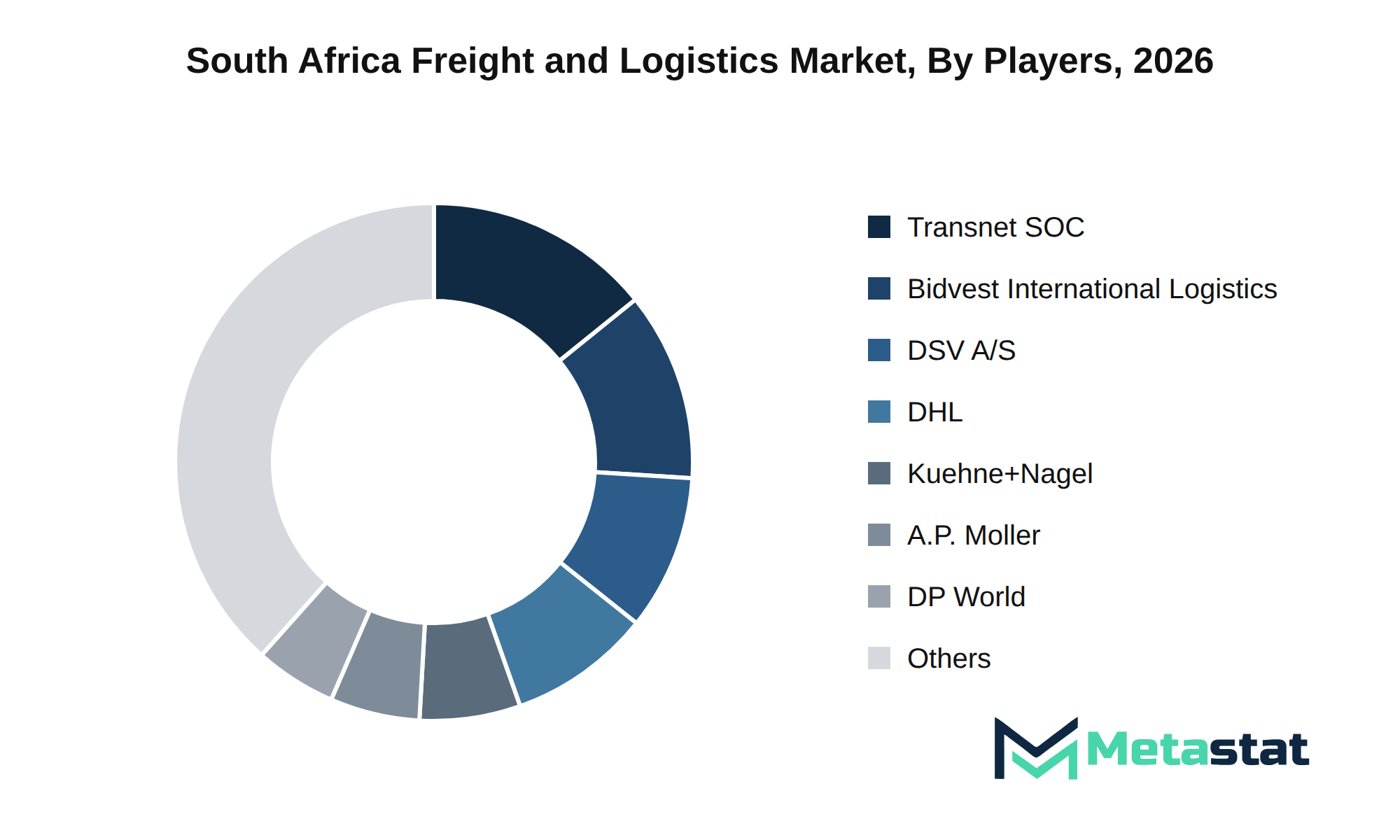
This outlook depends on rising demand from retail and e-commerce, which is projected to expand at a 7.2% CAGR within the end-use industry segment, supported by greater digital adoption and urban consumer spending. Strong momentum in courier, express, and parcel services, with a 7.9% CAGR under service type, reflects a shift toward faster deliveries and last-mile logistics, directly benefiting from e-commerce expansion. Growth in cross-border trade, particularly in the Southern African region, is projected to drive Southern African cross-border shipment coverage to USD 3.7 billion by 2033. This development relies on stable trade agreements and ongoing regional integration initiatives.
However, the market faces risks from constraints in transport infrastructure capacity and reliability, especially in road and rail freight. Network disruptions or underinvestment slow volume growth and raise costs for providers, challenging the ability to consistently meet demand. The forecast is reached only if improvements in infrastructure and service quality keep pace with volume increases, particularly in segments experiencing the fastest growth.
By Service Type: Freight Transportation, Freight Forwarding, Warehousing & Storage, Courier, Express & Parcel Services, Contract Logistics and 3PL Services, Customs Brokerage & Trade Facilitation, Others (Project Logistics, Reverse Logistics and Specialized Logistics)
By End-Use Industry: Retail & E-Commerce, Automotive, Mining & Minerals, Industrial Manufacturing, Food, Beverage & FMCG, Agriculture, Healthcare & Pharmaceuticals, Chemicals & Petrochemicals, Others (Technology, Textiles, Paper & Packaging)
The report strategically identifies and profiles the key market players and analyses their core competencies in each sub-segment of the Freight & Logistics market.
Report Attributes | Details |
Study Period | 2021-2033 |
Base Year | 2025 |
Estimated Year | 2026 |
Forecast Period | 2026-2033 |
Historical Period | 2021-2025 |
Growth Rate | CAGR 5.7% from 2026 to 2033 |
Revenue Unit | USD billion |
Segmentation |
Find answers to common questions about this report
The Freight & Logistics market size was valued at USD 14.7 billion in 2025.
The projected CAGR is 5.7% for the forecast period from 2026 to 2033.
Freight Transportation leads by share, accounting for 38.9 percent of the total market. This segment holds the highest proportion compared to all other service types.
Rising e-commerce activity is generating sustained demand for fulfillment, last-mile distribution, and inventory management services, supporting higher volumes and service innovation. Expansion in rail freight, driven by infrastructure upgrades and bulk export demand, is enabling cost-efficient, high-volume shipments and supporting export competitiveness.
Congestion at major freight hubs restricts timely movement for retail and e-commerce shipments, limiting capacity to support growth in high-volume consumer sectors. Wage inflation and regulatory adjustments are driving up labor costs, raising operating expenses for logistics providers and constraining their ability to protect margins.
Adoption in this industry is favored by rising e-commerce demand for rapid fulfillment and scalable warehousing, along with investment in rail freight infrastructure that supports efficient bulk and long-distance shipments. These factors support service innovation and expand provider opportunities.
The Freight & Logistics market is estimated to reach a valuation of USD 22.9 billion by 2033.
Key players in the freight and logistics industry include DSV A/S, DHL Group, Bidvest International Logistics, Transnet SOC Ltd., Kuehne+Nagel, A.P. Moller - Maersk, DP World, and CEVA Logistics.
Rail freight is projected to be the fastest-growing mode, with a compound annual growth rate of 7.8 percent through 2033 and a forecasted value of USD 2.9 billion by 2033.
The Retail & E-Commerce segment is projected to reach USD 5.1 billion by 2033, up from USD 3.1 billion in 2026.
Choose Your License
South Africa Freight and Logistics Market
The analysts below cover Automotive and Transportation research at Metastat Insights.
LEAD ANALYST
Utkarsh Khirodkar is a Lead Market Research Analyst at MetaStat Insight, specializing in market intelligence, technology sector assessments, and competitive strategy.

ENERGY & INFRASTRUCTURE INDUSTRY CONSULTANT
Automotive and Transportation · Electronics and Semiconductor · Energy and Power · Machinery & Equipment
Saurabh Vasant Ganvir consults for Energy & Infrastructure Industry at MetaStat Insight, specializing in renewable energy, solar EPC, and electric vehicle (EV) infrastructure markets.
Integrating zero-trust access controls across legacy electronic health record systems involves complex compliance overhead. Team produced an analysis that clearly separated identity governance and administration tools from privileged access management platforms. Their evaluation of HIPAA and GDPR compliance features across cloud native solutions gave our architecture group clear baseline criteria. The custom data request regarding biometric authentication adoption in hospital networks was returned promptly with clear documentation.
Evaluating calorific value requirements and air permit compliance across municipal waste facilities requires localized data. Metastat Insight structured their analysis around operational throughput capacity and feedstock composition variations in Latin America and Eastern Europe. Their competitive mapping of sorting equipment vendors helped clarify technology differences between optical separators and heavy media systems. The study provided an objective baseline during our capital expenditure reviews.
Decarbonizing industrial thermal processes hinges on refrigerant regulations and compressor efficiency limits. Metastat Insights delivered a thorough market analysis that evaluated natural refrigerants like CO2 and hydrocarbons against synthetic low-GWP alternatives. The breakdown of utility incentives and grid capacity constraints across key European manufacturing hubs offered valuable perspective. The follow-up conversation with their sector analysts addressed our specific questions on mechanical vapor recompression systems efficiently.
Explore related market intelligence reports worth reading alongside this one.
Starting from
$2950