
LEAD ANALYST
Utkarsh Khirodkar is a Lead Market Research Analyst at MetaStat Insight, specializing in market intelligence, technology sector assessments, and competitive strategy.

Global Stand-Up Pouch Packaging Machine Market Size, Share, By Type (Horizontal Form-Fill-Seal (HFFS) Machines, Vertical Form-Fill-Seal (VFFS) Machines, Premade Pouch Fill-and-Seal Machines and Spouted Pouch Fill-and-Cap Machines), By Product Form (Solid & Granular Products, Powder Products, Liquid Products and Viscous & Semi-Liquid Products), By Pouch Format (Standard Stand-Up Pouches, Zipper Stand-Up Pouches, Spouted Stand-Up Pouches, Shaped & Contour Stand-Up Pouches and Retort Stand-Up Pouches), By End-Use Industry (Food & Beverage, Pet Food, Home Care & Household Chemicals, Personal Care & Cosmetics, Pharmaceuticals & Nutraceuticals, Industrial & Specialty Chemicals and Others (Agriculture Products, Hardware & Technical Products)), Industry Analysis, Growth, Trends, and Forecast, 2026-2033
Report ID
MSI-5426
Published
October, 2026
Pages
257 Pages
Format
Historical
Base year
Forecast
Forecast period
Report Details
Market Valuation: Valued at $2,226.7 Million in 2025, projected to reach $3,884.8 Million by 2033 at a 7.2% CAGR.
Dominant Segment: Vertical Form-Fill-Seal (VFFS) Machines account for the highest value segment, driven by their widespread adoption among high-throughput operations that require speed and versatility for packaging solids, powders, and liquids.
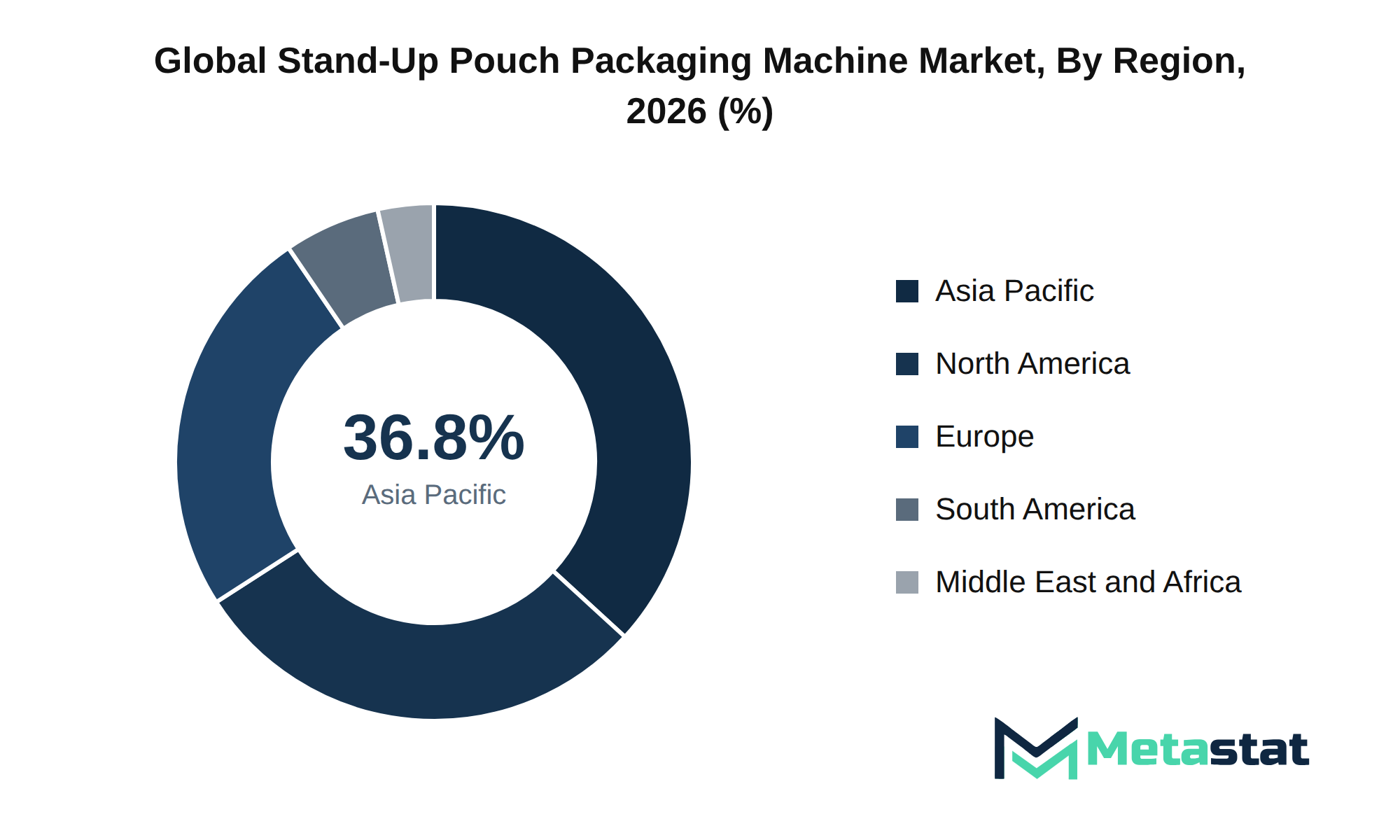
Geographic Lead: Asia Pacific holds the largest regional share at 36.8%, supported by strong manufacturing bases and expanding packaged goods consumption across China, India, and Southeast Asia.
Fastest-Growing Segment: Spouted pouch fill-and-cap machines are the fastest-expanding equipment type, with a CAGR of 9.4% through 2033, as brands in beverages and personal care seek resealability and controlled dispensing.
What's Inside: The report provides segment-wise market size and growth analysis by machine type, product form, pouch format, and end-use industry, with detailed regional breakdowns, competitive landscape, and forecasts through 2033.
Choose Your License
Global Stand-Up Pouch Packaging Machine Market
The global Stand-Up Pouch Packaging Machine market was valued at USD 2,226.7 million in 2025 and is projected to reach USD 3,884.8 million by 2033, growing at a CAGR of 7.2% over the forecast period.
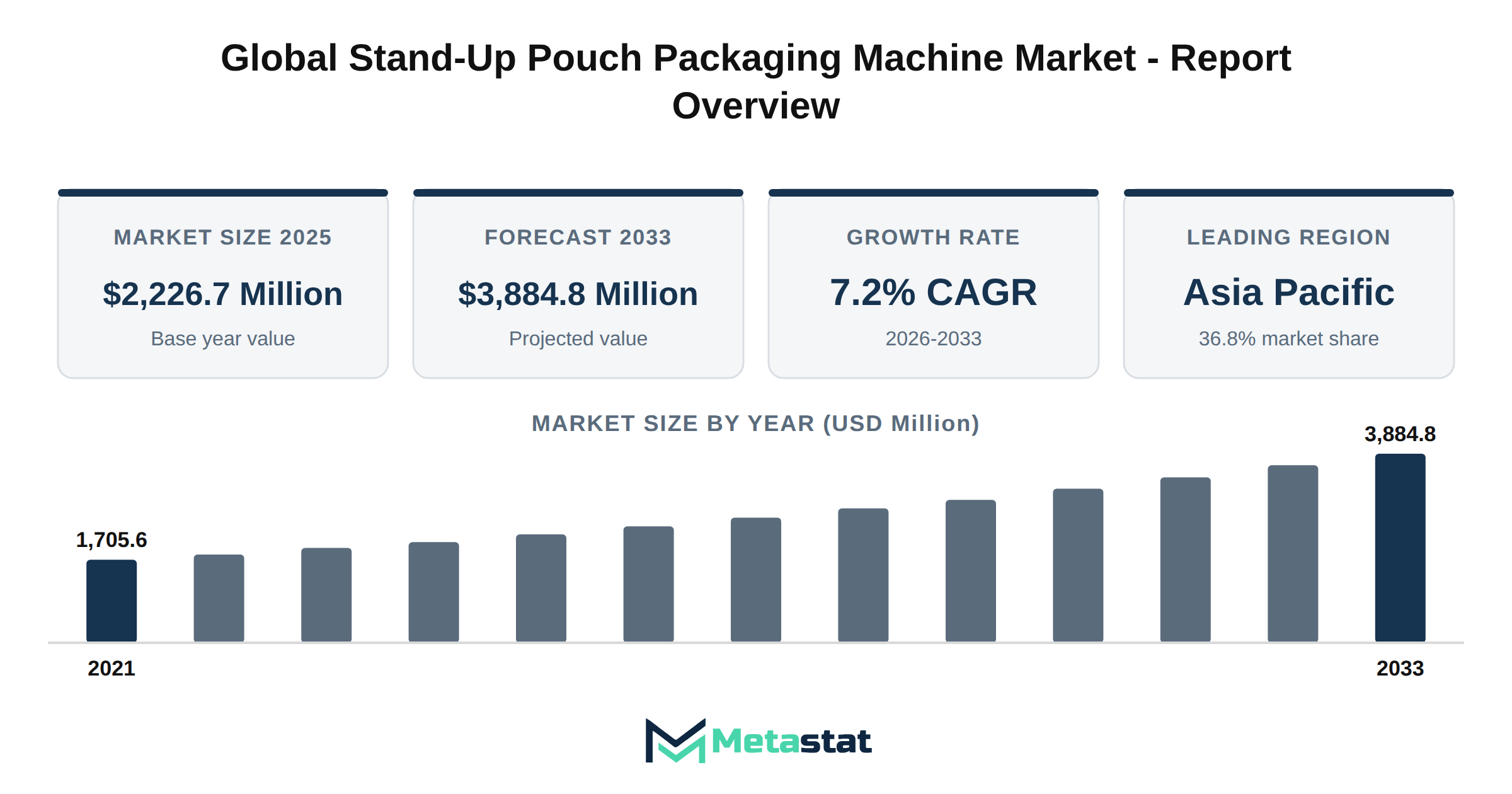
The Stand-Up Pouch Packaging Machine market covers automated systems designed to form, fill, seal, and cap stand-up pouches for industries seeking efficient, flexible packaging solutions. Buyers invest in these machines to address shifting consumer preferences toward lightweight, resealable, and visually appealing packaging, which supports both convenience and shelf differentiation. This deployment directly parallels broader capital investments across the automated filling equipment sector, where manufacturers upgrade volumetric and rotary lines to handle diverse product viscosities. Food and beverage companies, pet food manufacturers, and producers of home care products drive demand for these machines, seeking to streamline production while meeting evolving packaging standards.
Within the market, Vertical Form-Fill-Seal (VFFS) Machines account for the highest value segment, reflecting widespread adoption among high-throughput operations that prioritize speed and versatility. These machines serve industries handling a diverse range of products, including solids, powders, and liquids, enabling rapid format changes and efficient packaging of varying product types. In pouch formats, zipper stand-up pouches and spouted options gain traction, but standard stand-up pouches remain widely used for their compatibility with established machinery and broad end-use versatility.
Asia Pacific holds the largest regional share at 36.8%, supported by strong manufacturing bases and expanding packaged goods consumption across China, India, and Southeast Asia. North America holds 29.1% of the market in 2025, with the US leading in 2026. Acceleration in demand from food and beverage producers, who seek higher throughput and packaging flexibility to support new product launches and rapidly changing consumer tastes, drives the main growth in this market.
Packaging automation addresses the demands of industries that require flexible, efficient, and cost-effective solutions for high-volume consumer goods. The Stand-Up Pouch Packaging Machine market serves manufacturers in food and beverage, pet food, personal care, and household chemicals, with buyers prioritizing quick changeover, product safety, and packaging versatility. Investments in new equipment are driven by the differentiate products on retail shelves and improve operational efficiency, which supports higher throughput and reduced downtime for large-scale producers.
Asia Pacific accounts for the largest regional share, reflecting strong demand from expanding food processing, beverage, and personal care industries across China, India, and Southeast Asia. Manufacturers in these regions emphasize speed and adaptability to meet the needs of multinational brands and private label producers, which has accelerated adoption of advanced pouch packaging machinery.
The food and beverage segment accounts for the highest value among end-use industries, reflecting its continuous rollout of new products and packaging formats that require precision and hygiene. Growth in the Stand-Up Pouch Packaging Machine market is primarily driven by rising consumer preference for lightweight, resealable, and visually appealing packaging, which encourages brand owners to adopt flexible pouch solutions over traditional rigid containers.
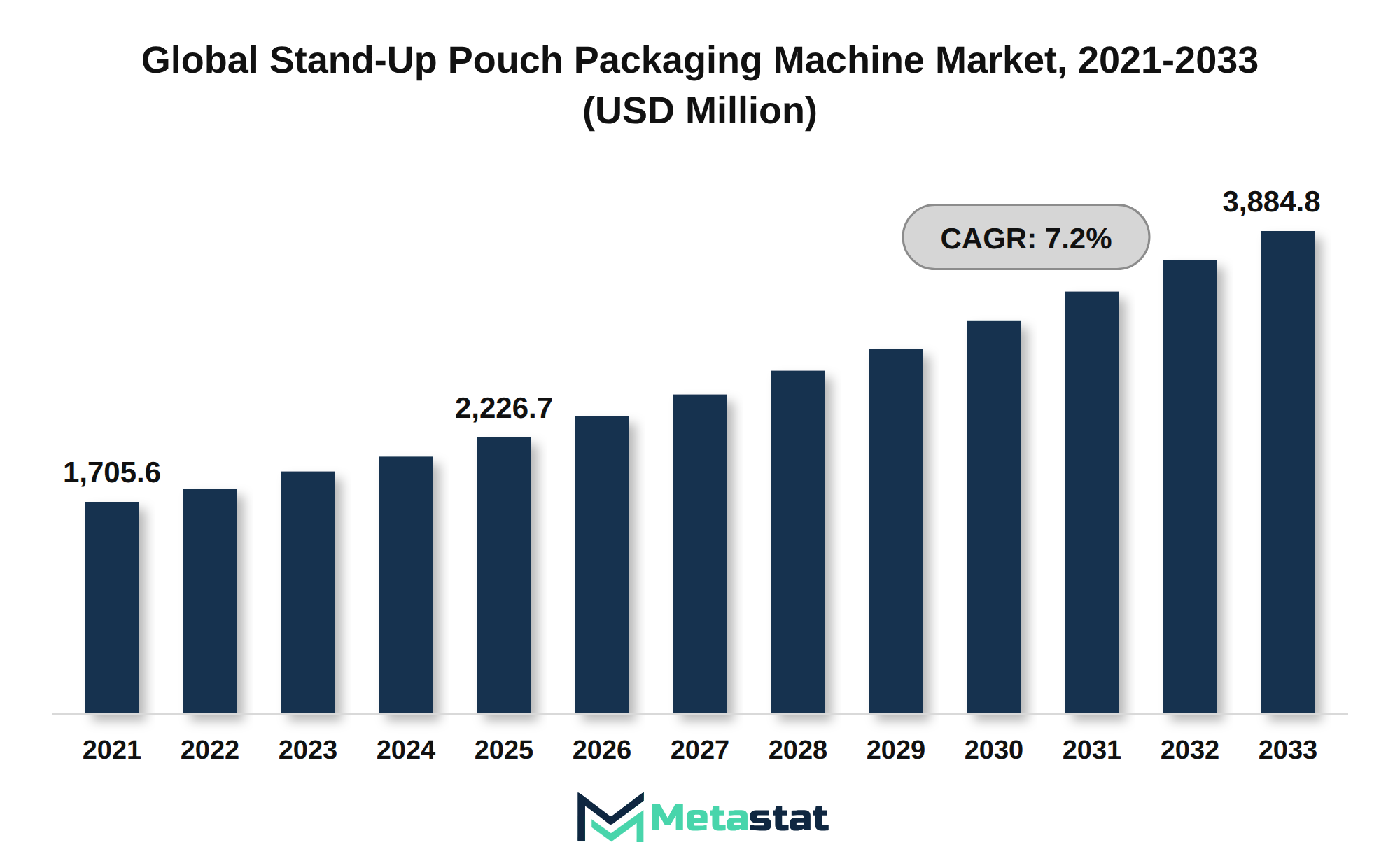
Servo-driven premade pouch fill-and-seal lines are accelerating a structural change in capital allocation within the Stand-Up Pouch Packaging Machine market. Traditionally, buyers prioritized horizontal or vertical form-fill-seal machines to increase speed, but recent investment patterns indicate a shift toward premade pouch fill-and-seal technology. This transition is driven by the demand for flexibility among food, beverage, and personal care producers, who increasingly seek to minimize downtime during format changes and support shorter production runs. The segment’s visibility is underlined by its forecast value of USD 1,185.6 million in 2033, outpacing earlier expectations for traditional machinery in settings that require rapid SKU changes or accommodate smaller batch sizes.
Servo-driven systems deliver precise motion control, enabling consistent pouch sealing and reducing product waste. Reduced mechanical complexity lowers maintenance requirements and enables quicker format adjustments, which appeals to manufacturers managing diverse packaging portfolios. In the Stand-Up Pouch Packaging Machine market, this has shifted competitive dynamics, with suppliers upgrading product lines to integrate advanced servo controls and user-friendly interfaces. Customers are responding to the operational and commercial benefits by reallocating capital from legacy equipment toward these flexible lines, supporting stronger returns on automation investments and expanding the addressable end-user base for this technology.
Recyclable mono-material films are transforming specification and contract priorities for buyers in the Stand-Up Pouch Packaging Machine market. Regulatory and consumer pressure around sustainability is intensifying. Food and beverage brands increasingly prefer mono-material pouches that support recycling streams. This shift directly influences machinery requirements. Mono-materials, while easier to recycle, require higher-precision sealing parameters and tighter thermal management compared to legacy multi-layer laminates produced through conventional extrusion coating processes. Purchasers from sectors including food and beverage are projected to drive segment value from USD 1,054 million in 2026 to USD 1,620.7 million by 2033. These buyers now prioritize equipment with precise seal control and streamlined changeover capabilities.
Contract terms and payment models reflect this heightened technical demand. Buyers often request extended trial periods or performance-based payment schedules that tie machine acceptance to successful sealing across a wide range of recyclable films. Suppliers in the Stand-Up Pouch Packaging Machine market adapt by integrating advanced sealing modules and modular tooling, which reduces downtime during film or product changeovers. These adaptations support brand agility and shorten the path to commercial launch for new recyclable pouch formats. Similar sealing adjustments are increasingly required as brand owners explore recyclable barrier paper structures to replace synthetic barrier polymers in dry food packaging. Buyers who secure equipment capable of rapid, repeatable changeovers gain cost predictability and reduce the risk of supply chain delays as upstream converters re-engineer multi-layer webs using recyclable adhesive films and solvent-free lamination systems. This trend reinforces supplier differentiation through technical capability, influencing both pricing structures and long-term service contracts across the market.
Packaging requirements from pet food, nutraceuticals, and personal care manufacturers are shifting the application scope for stand-up pouch filling equipment. These buyers increasingly demand pouch formats that serve functions beyond food and beverage packaging, including enhanced product containment, resealability, and extended shelf appeal. Pet food suppliers are adopting advanced pouch filling systems to accommodate the growth of premium and single-serve packaging, which supports a projected segment value of USD 499.6 million by 2033 for pet food-related machine demand. Nutraceutical and personal care brands select stand-up pouch packaging to differentiate products on crowded shelves and protect sensitive formulations, pushing machine suppliers to engineer equipment supporting precise fill controls and high material flexibility.
Product diversity and regulatory standards in these sectors create distinct operational pressures. Nutraceuticals require machines capable of handling powders and solids with strict hygiene controls, while personal care products often introduce viscous or semi-liquid contents that benefit from specialized filling and sealing systems. Packaging machinery vendors in the market respond with modular designs that enable rapid changeovers between pouch formats and product types. This continuous upgrade cycle increases average selling prices for equipment and drives recurring revenue streams from aftersales support and customization. While more non-food sectors integrate stand-up pouch packaging, suppliers in the market capture a broader customer base and reinforce resilience against fluctuations in traditional food and beverage demand.
The cost of a stand-up pouch packaging machine varies significantly depending on the type of machine and its application, with price differences primarily driven by automation level, flexibility, and supported pouch formats. Horizontal Form-Fill-Seal (HFFS) machines and Vertical Form-Fill-Seal (VFFS) machines represent the main categories, but HFFS machines are projected to grow from USD 577.7 million in 2026 to USD 861.6 million by 2033, reflecting the continued demand for robust and high-throughput equipment. Machines engineered for complex pouch styles including spouted or shaped stand-up pouches require higher investment compared to standard models, driven by their specialized filling, sealing, and capping requirements.
Product form influences machine selection and cost, with viscous and semi-liquid product machines showing a higher CAGR of 9 percent, indicating increased demand for advanced dosing, cleaning, and maintenance systems tailored to these applications. Buyers in food and beverage packaging, pet food, and personal care are willing to pay more for machines that ensure speed, hygiene, and flexibility in changeover between pouch formats. Tailored solutions for powder, solid, liquid, and specialized pouches exert a direct influence on capital expenditure and expected returns. This price range shapes the purchasing decision for both start-ups and established manufacturers looking to balance performance against upfront investment while expanding capacity or entering new product categories.
Food and beverage producers are adopting new stand-up pouch formats to meet changing consumer preferences for single-serve, resealable, and convenience-focused packaging. This shift has expanded demand for machines that accommodate a wider range of pouch shapes, closures, and material specifications. The market is experiencing increased investment from buyers upgrading legacy equipment to handle high-speed, multi-format production lines. Rising demand for zipper and spouted stand-up pouches is accelerating procurement decisions among contract packagers and major consumer brands. Equipment suppliers respond with systems that offer faster changeovers and improved compatibility with diverse laminate films, enabling buyers to launch more SKUs without sacrificing throughput. Product differentiation and packaging innovation are driving competitiveness among consumer packaged goods companies, strengthening long-term demand for advanced pouch machinery.
Upfront capital requirements restrict adoption in segments with lower production volumes and tight operating budgets. Small and midsize enterprises, particularly in personal care and household chemicals, encounter extended decision cycles when evaluating new equipment due to the high acquisition costs of fully automated stand-up pouch packaging machines. For these firms, the investment threshold often results in smaller order sizes, more gradual replacement of legacy filling lines, and delayed entry into flexible pouch packaging. The market reflects these dynamics in slower uptake among value-conscious buyers, especially where shorter product runs or frequent format changes limit the payback period for advanced machinery. Market expansion is more concentrated within established, high-throughput food and beverage processors with the financial flexibility to support larger-scale investments. Cost pressures in price-sensitive industries are expected to moderate overall equipment demand through the forecast period.
Manufacturers in the Stand-Up Pouch Packaging Machine market face persistent pressure from rising prices of critical components, including advanced servo motors, high-speed sensors, and precision tooling. Increased complexity in machine design, driven by the shift toward more versatile pouch formats and multi-product lines, intensifies the demand for technologically sophisticated parts. Suppliers experience margin compression when they absorb higher input costs to remain competitive or retain customers with established machinery budgets. In response, manufacturers streamline supplier networks and renegotiate contracts to secure bulk discounts on essential materials. Design teams are reworking assemblies to enable standardized components that reduce per-unit costs and simplify maintenance, especially for high-throughput lines. This environment requires careful balancing of product innovation with cost control, directly influencing the profitability and investment appetite in the Stand-Up Pouch Packaging Machine market.
Spouted pouch fill-and-cap machines are positioned as the fastest-expanding segment in the Stand-Up Pouch Packaging Machine market, with a compound annual growth rate of 9.4 percent through 2033. This segment addresses the requirements of brands in beverages, viscous food products, and personal care, where resealability and controlled dispensing drive format preference. The underlying opportunity stems from brands seeking to differentiate products through convenience and enhanced shelf appeal, especially in categories where traditional rigid packaging once dominated. Suppliers delivering scalable, high-speed spouted pouch machinery reach a group of buyers with expanding product portfolios and a willingness to invest in process upgrades. Manufacturers are expected to increase capital spending to upgrade or diversify production lines toward spouted pouch formats.
The Global Stand-Up Pouch Packaging Machine market is segmented based on Type, Product Form, Pouch Format, and End-Use Industry.
These systems are predominantly used by large-scale food and beverage manufacturers seeking consistent pouch quality and high output efficiency for solid, granular, and snack products. In the market, HFFS machines stand out for supporting integrated, continuous production lines where throughput and consistency outweigh the flexibility found in vertical or pre-made pouch systems. Demand is strengthened by requirements for cost-effective, high-volume packaging, particularly among multinational food producers and contract packagers. Compared to vertical form-fill-seal machines, which post a 6.6% CAGR, HFFS machines expand at a slightly slower rate, reflecting their specialization for established, high-capacity applications. This segment attracts buyers prioritizing capital investment in automation for long production runs, while smaller or more diverse operations tend to select alternate machine types in this market.
Estimated to reach USD 1,429.2 million by 2033 with a CAGR of 6.6%, vertical form-fill-seal (VFFS) machines address high-speed packaging needs for granular, powdered, and liquid products in industries with demanding throughput requirements. These machines serve food, beverage, and home care producers seeking continuous operation and automated changeovers, supporting large-volume SKUs and private label runs. Higher adoption in fast-moving consumer goods correlates with efficiency gains and the ability to switch between various pouch sizes without extended downtime. Compared to horizontal form-fill-seal (HFFS) machines, which are projected at a lower CAGR of 5.9%, VFFS machines outpace them in growth, driven by retailers and contract packers who prioritize flexibility and rapid setup. In this segment, the speed of automation and demand for multi-product lines distinguish VFFS machines from other machine types, as the rise of smaller pack formats and increased SKU proliferation influence both equipment specification and capital investment decisions.
Premade Pouch Fill-and-Seal Machines segment is expected to reach USD 1,185.6 million by 2033. This segment addresses contract packers and brand owners requiring flexibility to switch between short-run products, seasonal promotions, or multiple SKUs without the expense and complexity of rollstock forming. Food processors and personal care companies depend on premade pouch fill-and-seal lines to achieve high presentation quality and fast changeovers, especially for premium or limited-edition items. Unlike vertical or horizontal form-fill-seal machines, buyers of this equipment prioritize packaging aesthetics and ease of maintenance over maximum throughput. Adoption accelerates where skilled labor is scarce, since these machines support simplified operation and quick format changeover. Compared with other segments in the market, premade pouch fill-and-seal lines are selected where product differentiation or branding drives shelf impact, rather than where cost per unit is minimized through high-speed, high-volume runs. This distinction shapes investment patterns among mid-tier and premium brands seeking packaging flexibility and quality.
Spouted Pouch Fill-and-Cap Machines segment is projected to grow at a CAGR of 9.4% during the forecast period. This equipment type is selected by manufacturers packaging liquid and semi-liquid products, including beverages, baby foods, sauces, and household chemicals, where spill-proof dispensing and resealability drive end-user preference. Buyers in this segment often operate in high-value product categories or target markets where packaging integrity and convenience directly influence brand positioning. Growth in this sub-segment significantly outpaces horizontal (5.9% CAGR) and vertical (6.6% CAGR) form-fill-seal machines, reflecting a surge in demand for premium, functional packaging formats. The shift toward single-serve and on-the-go consumption fuels adoption, and regulatory requirements for tamper evidence and child safety features push technology upgrades. Unlike standard or zipper pouch systems, spouted pouch lines require precision filling and advanced capping modules, leading to higher average selling prices and a buyer profile weighted toward established brands and contract packagers with larger capital budgets. Manufacturers investing in this machinery often seek to differentiate through product innovation, supporting revenue premiumization in this segment.
Valued at USD 976.2 million in 2026 and projected to reach USD 1,494.1 million by 2033, this segment advances at a CAGR of 6.3% during the forecast period. Demand for packaging machinery tailored to solid and granular goods is driven by the requirements of food, agriculture, and chemical manufacturers seeking fast, contamination-averse filling for products including snacks, cereals, seeds, and fertilizers. Buyers in this segment prioritize high throughput and dust control to protect product integrity and streamline compliance, differing from liquid and powder applications that require different dosing or sealing controls. Growth is influenced by the expanding range of packaged dry goods and a shift toward smaller pack sizes that facilitate retail distribution. The CAGR of 6.3% for solid and granular products stands slightly below that of viscous and semi-liquid applications, reflecting a mature but stable replacement and expansion cycle. Consistent investment from high-volume processors focused on operational efficiency and safety standards supports this segment.
Estimated to reach USD 869 million by 2033, this segment grows at a compound annual rate of 6.5%. Powder products packaging machines serve manufacturers of powdered food, nutraceuticals, instant beverages, and chemical powders that require precise dosing and product integrity. Demand strengthens with producers of health supplements, instant mixes, and dry dairy products transitioning from rigid containers to flexible pouches for cost savings, shelf appeal, and shipping efficiency. Adoption is supported by stand-up pouch technology’s ability to minimize product waste and improve portion control, which is critical for high-value or single-use powders. Compared to solid and granular products packaging, which advances at 6.3% CAGR, powder products grow slightly faster in the Stand-Up Pouch Packaging Machine market, reflecting higher innovation in product launches and line upgrades. The need for dust control and contamination prevention further distinguishes this segment from those dedicated to liquid or viscous product packaging, requiring specialized sealing, filling, and air management features in the equipment.
Liquid Products segment is expected to reach USD 904.4 million by 2033. This segment supplies filling solutions for products ranging from juices and dairy beverages to cleaning liquids and personal care formulations, supporting both food and non-food industries. Brand owners in these categories prioritize leak-proof, contamination-resistant sealing and demand reliable dosing for a wide viscosity range, pushing equipment specifications beyond what dry or powder product lines require. Movement in this segment reflects increased demand for on-the-go beverage packaging, nutraceutical drinks, and household cleaners that benefit from spouted or easy-pour pouch formats. Compared with solid and granular product applications, the liquid products segment serves buyers with a greater focus on hygiene and shelf life. Growth in this segment is supported by expanding single-serve and resealable packaging demand, which drives adoption of more advanced filling and sealing automation. Manufacturers targeting liquid products invest in differentiated line configurations to handle foaming, splashing, and sterile fill requirements unique to the segment, influencing capital spending patterns.
Projected to grow at a CAGR of 9%, viscous and semi-liquid products occupy a distinct position in the Stand-Up Pouch Packaging Machine market. Applications focus on packaging items including sauces, gels, dairy concentrates, and other high-viscosity food or household products, where precise filling and seal integrity are essential. Demand is shaped by the shift among food and personal care manufacturers toward flexible formats that preserve product freshness and reduce spillage, supporting higher adoption of advanced pouch filling technologies. This segment outpaces both solid and granular products (6.3% CAGR) and powder products (6.5% CAGR), reflecting accelerated demand for customizable pouch filling solutions that handle challenging product consistencies. Equipment suppliers in the Stand-Up Pouch Packaging Machine market respond to these requirements by enhancing machine capabilities for high-viscosity handling, which involves advanced dosing systems and specialized nozzles. Buyers in this segment include food, cosmetics, and home care brands prioritizing shelf-ready presentation and extended shelf life, distinguishing their investment rationale from those focused on dry or powdered products.
Standard Stand-Up Pouches segment is valued at USD 850.3 million in 2026 and is projected to reach USD 1,237.3 million by 2033, at a CAGR of 5.5% during the forecast period. This pouch format serves high-volume applications in food, beverage, and household products where stability, versatility, and cost efficiency are purchasing priorities. Buyers in this segment opt for standard pouches to achieve lower per-unit packaging costs and broader compatibility with both solid and liquid products, supporting flexible production lines. Relative to zipper or spouted pouch segments, standard pouches expand at a slower pace, reflecting a mature adoption curve and entrenched demand in established categories. The 5.5% growth rate is below the 6.9% CAGR for zipper formats, reflecting the shift toward features like resealability in new product launches. Adoption in this segment is driven by large-scale manufacturers seeking to maintain throughput and minimize changeover times, which influences purchasing decisions for line integration and automation.
Estimated to reach USD 1,063.6 million by 2033, zipper stand-up pouches show a projected compound annual growth rate of 6.9% for the period. This pouch format is widely adopted by food, pet food, and personal care brands seeking resealability and portion control for premium products. Retailers and manufacturers favor zipper pouches for dry snacks, confectionery, and household goods, where consumer demand for reusable and convenient packaging supports volume growth. Advances in zipper application technology improve seal reliability and production speed, encouraging adoption among high-throughput producers. Compared to standard stand-up pouches, zipper formats achieve faster growth, with a CAGR of 6.9% versus 5.5%. Premium pricing for zipper-equipped pouches reflects both added material and consumer willingness to pay for resealable features, lifting average unit values in the market. Expansion of retail and e-commerce channels increases demand for packaging with enhanced functionality, strengthening the position of zipper stand-up pouches among pouch formats.
Spouted Stand-Up Pouches segment is expected to reach USD 805.3 million by 2033. This pouch format serves applications that require controlled dispensing and secure resealability, which has made it the preferred choice for products including beverages, baby foods, sauces, personal care liquids, and household chemicals. In the market, buyers in food, beverage, and home care industries increasingly favor spouted pouches for their convenience and portion control, especially where spill prevention matters. A principal force in this segment is the rising replacement of rigid bottles and jars with lightweight flexible packaging, driven by brand owners aiming to reduce transportation costs and improve sustainability credentials. Compared to standard and zipper stand-up pouches, spouted formats typically target higher-margin products and buyers with advanced filling needs, resulting in higher equipment prices and a stronger focus on customization. The market sees spouted pouch equipment purchased by manufacturers who prioritize fast changeover, consistent seal integrity, and the ability to handle various product viscosities efficiently.
Shaped and contour stand-up pouches are projected to grow at a CAGR of 9.6% during the forecast period, outpacing all other pouch format segments in the Stand-Up Pouch Packaging Machine market. These pouches are distinguished by their custom forms and unique visual appeal, targeting premium brands in personal care, cosmetics, and specialty food sectors looking to differentiate products on crowded shelves. Demand in this segment is driven by marketing departments seeking shelf impact and brand distinction, resulting in greater willingness to invest in higher-specification packaging machinery. Compared with standard or zipper stand-up pouches, shaped and contour pouches involve more complex forming and sealing equipment, leading to higher average equipment costs and attracting buyers with larger marketing budgets and premium product portfolios. Adoption is further influenced by technology advancements that enable greater flexibility in design and quick changeovers, allowing brand owners to respond swiftly to evolving consumer preferences and short product cycles. This technical edge sets the segment apart by catering to shorter runs and niche launches, making it the fastest-growing format in the market.
Retort stand-up pouches provide a high-barrier, heat-resistant packaging solution designed for ready-to-eat meals, wet pet food, soups, and prepared sauces. Food and beverage manufacturers, along with pet food producers, rely on these pouches to extend product shelf life while preserving nutrition and flavor without refrigeration. Adoption in this segment is driven by demand for shelf-stable, convenience-focused products in Asia Pacific, where urbanization and shifting eating habits prompt packaged meal growth. Compared to standard or zipper stand-up pouches, retort options require more advanced packaging machinery, reflecting higher capital investment and stricter process control to withstand thermal sterilization. These requirements position retort pouch systems at a higher price point and restrict adoption to manufacturers with significant volumes or regulatory compliance needs. Retort pouches are differentiated by technical complexity and a focus on food safety, rather than the mass-market orientation of basic pouch types.
This segment serves packaged food manufacturers, beverage brands, and processors seeking high output and shelf-ready packaging. In the Stand-Up Pouch Packaging Machine market, this segment draws momentum from shifting consumer preferences toward convenient, resealable, and portion-controlled packaging. Brands invest in advanced machinery to support frequent product launches and diversification. Compared to Pet Food, which grows at a faster 8.7% CAGR, the Food & Beverage segment advances steadily on higher absolute revenue and broader buyer diversity. Food safety standards, traceability requirements, and the demand for flexible, lightweight packaging drive upgrades and equipment replacements, supporting continued investment in new machinery. The Stand-Up Pouch Packaging Machine market sees this segment distinguished by its focus on compliance and operational efficiency, addressing both global and regional regulatory pressures.
Pet Food segment is estimated to reach USD 499.6 million by 2033, at a CAGR of 8.7% during the forecast period. Primary buyers include pet food manufacturers seeking flexible packaging automation for dry kibble, treats, and soft products, with demand driven by premiumization and a rising focus on convenience packaging. Compared to the Food & Beverage segment, which records a CAGR of 6.3%, pet food applications advance at a faster pace, reflecting the willingness of pet brand owners to invest in innovative pouch formats and rapid line changeovers. In this segment, packaging machinery adoption is further supported by the push for single-serve and resealable formats, aligning with evolving consumer expectations for freshness and portion control. Unlike home care or personal care verticals, pet food companies frequently prioritize operational throughput and packaging versatility to compete in retail channels. The market benefits from repeat capital upgrades and a relatively high frequency of replacement purchasing among pet food manufacturers.
Expected to reach USD 364 million by 2033, this segment serves manufacturers of detergents, fabric softeners, hard surface cleaners, and related household chemicals. The primary buyers include home care brands seeking flexible, lightweight packaging that streamlines transportation and storage while maintaining chemical compatibility and safety. Increasing preference for convenient single-use formats and the shift toward resealable, spill-proof packaging drive equipment demand in this category. Compared to Food & Beverage and Pet Food end-use segments, Home Care & Household Chemicals attracts different investment priorities, where packaging machinery selection often focuses on handling caustic or reactive liquids and powders and maintaining hygienic filling environments. Adoption in this segment is influenced by the growing number of SKUs and the trend toward concentrated refills, requiring machines with precise dosing and flexible format changeover. While high-volume food and beverage production shapes the broader market, this segment grows through product innovation and changing regulatory guidelines regarding chemical labeling and packaging safety, differentiating its demand profile within the market.
Projected to expand at a CAGR of 7.8% during the forecast period, personal care and cosmetics applications drive substantial interest among brand owners and contract manufacturers seeking to differentiate products on the retail shelf. Flexible pouch packaging in this segment is adopted for items including skincare creams, lotions, hair treatments, and cosmetic refills, targeting both mass-market and premium buyers. The main demand driver is the industry’s emphasis on visual appeal and convenience, where resealable and precisely contoured pouches enhance user experience and shelf impact. Compared to food and beverage packaging, buyers in personal care and cosmetics focus more on aesthetics, tactile quality, and compatibility with viscous or sensitive formulations, often paying higher unit prices for smaller production runs tailored to frequent product launches. Regulatory scrutiny and consumer preference for hygienic, tamper-evident, and easily dispensable packaging surpass levels seen in home care or industrial categories, accelerating adoption in this segment. Suppliers adapt machinery for smaller batch sizes and customizable output to meet brand differentiation needs in personal care and cosmetics, supporting above-average pricing and driving technology upgrades throughout the market.
Pharmaceuticals and nutraceuticals manufacturers rely on stand-up pouch packaging solutions to address the strict safety, barrier, and labeling requirements found in regulated healthcare and wellness sectors. This segment serves companies producing over-the-counter supplements, prescription medications, vitamins, and functional food products seeking moisture and tamper resistance for sensitive formulations. Increasing consumer demand for convenient, single-dose and travel-friendly health products has strengthened investment in flexible pouch formats, driving the adoption of automated packaging machinery tailored to pharmaceutical-grade standards. Compared to food, beverage, or pet food buyers, these customers prioritize track-and-trace features, precise dosing systems, and hygienic materials, often resulting in higher equipment specification, compliance costs, and longer procurement cycles. Pharmaceutical contract packers and nutraceutical brands show sustained interest in automated pouch machinery as they respond to stringent serialization and anti-counterfeiting regulations. These regulatory drivers differentiate the segment, raising capital intensity and qualifying requirements compared to less regulated end-use industries in the market.
Manufacturers of agricultural chemicals, industrial lubricants, cleaning agents, and specialty additives employ stand-up pouch packaging machinery to address requirements for chemical resistance, controlled dosing, and secure containment. Buyers in this segment include producers of agrochemicals, construction additives, and specialty process chemicals who seek packaging that offers both safety and convenience. Adoption is shaped by regulatory scrutiny on chemical packaging and the growing number of industrial users seeking scalable, cost-effective alternatives to rigid containers. Compared with food or personal care sectors, industrial and specialty chemical packagers often require customized barrier properties and tamper-evident designs, leading to higher average costs per unit. This segment stands out for its demand for robust automation and integration with filling systems that handle aggressive formulations. Differentiation from other end-use industries is marked by a greater emphasis on compliance and chemical compatibility, which influences both supplier selection and technology modernization cycles.
This segment addresses packaging machinery demand from agricultural product processors, hardware suppliers, and manufacturers of technical items. Buyers in this category include agricultural cooperatives packaging seeds or fertilizers, hardware distributors offering tools or fasteners, and technical component producers focused on protective and transport-efficient packaging. Compared to food and personal care, adoption in this segment is influenced by the requirement for flexible sizing and the ability to handle non-uniform or heavy items, which often present mechanical challenges for standard packaging machines.
For suppliers, technical customization is a primary driver, with machine configurations tailored to accommodate diverse product shapes and weights. This differs from segments focused on uniform, lightweight goods. Price sensitivity tends to be higher than in pharmaceuticals or cosmetics, with procurement often linked to operational budgets rather than branding priorities. Regulatory influence is limited in contrast to highly regulated end-use sectors, but durability and efficiency are prioritized. Innovations in modular equipment and adaptable filling lines support growth for this segment, meeting seasonal variability and the specialized demands distinct from those of food or chemical buyers. Higher customization requirements and batch variability distinguish this segment’s needs from those driving volume in core consumer goods applications. Machine builders find opportunities to deliver value-driven, flexible solutions to these specialized buyers.
Based on geography, the Global Stand-Up Pouch Packaging Machine market is divided into North America, Europe, Asia-Pacific, South America, Middle East, and Africa.
Growth in North America reflects a heightened focus on automation and quality assurance in packaging operations across the United States, Canada, and Mexico. Food safety and traceability requirements have prompted manufacturers to invest in advanced pouch packaging machinery equipped with inspection and data capture capabilities. In 2025, North America accounts for 29.1% of the global Stand-Up Pouch Packaging Machine market, driven by prominent adoption in branded consumer goods and contract packaging services. Demand from pet food and premium snack producers supports ongoing capital upgrades, with flexible equipment configurations favored for shorter production runs and SKU proliferation. Regulatory compliance and a competitive retail environment encourage rapid equipment replacement cycles. The region is projected to reach USD 1,046.6 million by 2033, supported by technology adoption, brand-driven packaging differentiation, and consumer preference for convenient packaging formats.
Europe reflects sustained investment in automated packaging lines across Germany, France, the UK, Italy, Spain, and Russia. Major food processors and consumer goods manufacturers in these countries prioritize stand-up pouch applications to address both regulatory waste reduction targets and consumer preference for resealable, lightweight packaging. High labor costs in Western Europe have accelerated adoption of automation, prompting machinery upgrades among mid-sized and large-scale producers to maintain competitiveness. The market in this region benefits from robust technical standards and a mature installed base, supporting integration into existing high-speed production environments. Demand is further shaped by private-label expansion and frequent packaging redesigns aimed at differentiation in retail settings. Stringent product quality and traceability requirements drive demand for advanced pouch filling and sealing solutions with in-line inspection and tracking features, setting the European market apart from other regions.
Asia Pacific holds a 36.8% share of the global Stand-Up Pouch Packaging Machine market in 2025, reflecting sustained investment from consumer goods manufacturers and contract packagers in China, India, and Southeast Asia. High-volume production environments in these countries accelerate machinery upgrades while brand owners shift toward flexible packaging formats for food staples, personal care, and convenience products. Regional packaging machinery suppliers respond to demand for automated systems compatible with diverse pouch types, supporting frequent product launches and high SKU turnover that characterize much of the local retail and export trade. Regulations on food safety and labeling influence equipment adoption, especially in China and India, where rapid urbanization and rising middle-class consumption drive packaging innovation. The pace of retail growth and changing consumer preferences draws interest from both domestic equipment manufacturers and multinational suppliers.
Brazil and Argentina have become principal drivers for the Stand-Up Pouch Packaging Machine market in South America, propelled by growth in food processing and export-oriented agricultural sectors. Manufacturers targeting these countries prioritize machinery that handles diverse pouch materials and formats for both dry and liquid contents, reflecting the region’s emphasis on flexible, high-volume packaging lines. In 2025, South America holds a 6.00% share of the global market, highlighting its position as a moderate but stable contributor among emerging regions. Local consumer preference for portion-controlled, resealable packaging influences purchasing decisions, leading to sustained investment in advanced filling and sealing technology. The market in this region incorporates solutions tailored to mid-scale producers and exporters seeking greater shelf appeal and efficiency without the capital requirements of fully automated, high-speed European or North American systems.
Packaging machinery suppliers in the Middle East and Africa encounter demand driven by rapid growth in consumer packaged goods and rising investments in food processing facilities, particularly across Saudi Arabia, the UAE, and South Africa. Regional buyers prioritize solutions that support a broad mix of pouch formats in response to evolving consumer product preferences and an expanding middle class. The region benefits from increased retail sector modernization, greater diversity in product offerings, and the adoption of flexible packaging formats. Many brand owners focus on packaging machinery that addresses both shelf appeal and product protection, seeking to differentiate their goods in increasingly competitive retail environments. Demand for stand-up pouch packaging machines reflects ongoing shifts toward automation and greater packaging versatility, as manufacturers respond to the specific requirements of local markets and the need for operational efficiency.
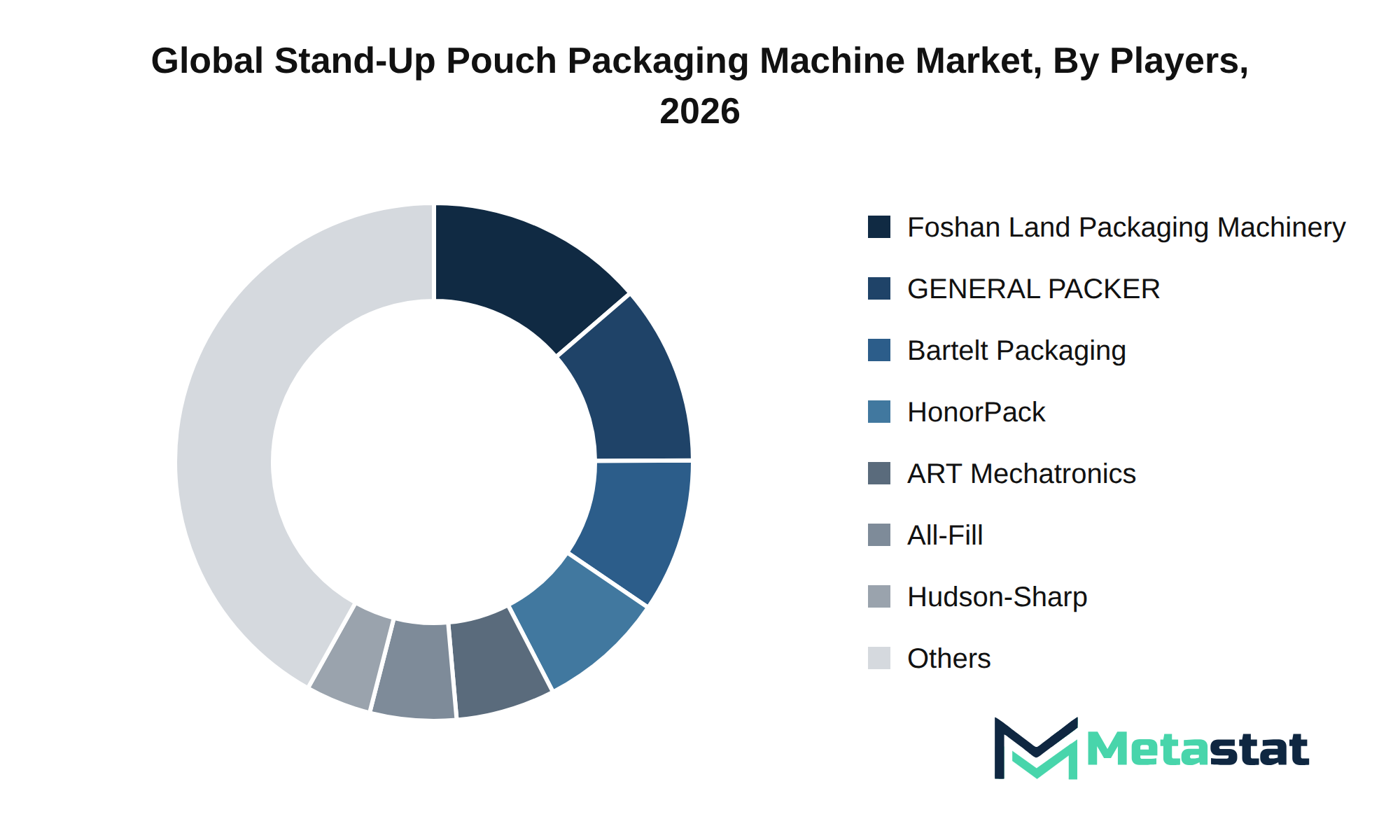
The Stand-Up Pouch Packaging Machine market consists of a broad field of equipment manufacturers and integrated packaging solution providers, each focusing on technology advancement, cost efficiency, and customization. Buyers evaluate offerings on automation capabilities, flexibility to handle diverse pouch formats, after-sales support, and the ability to address specific end-use requirements. Product adaptability to solid, liquid, and viscous content supports demand from sectors including food and beverage, pet food, and home care products.
Several companies prioritize specialized technology. Mespack S.L. centers its portfolio on high-flexibility machines for complex product forms and pouch styles, which supports adoption in food and beverage and personal care. Totani emphasizes engineering precision in high-speed pouch machinery, aligning its strategy with customers seeking scalable, reliable solutions for large-volume production. Foshan Land Packaging Machinery Co., Ltd. focuses on cost-effective and modular solutions, attracting buyers in growth markets with evolving packaging needs. Amcor and ProAmpac integrate machinery with proprietary packaging materials, serving brand owners seeking end-to-end process optimization and packaging innovation. Meanwhile, Smurfit Kappa and Huhtamaki leverage their expertise in sustainable packaging to address the rising preference for eco-friendly formats, particularly in Europe and North America.
In the Stand-Up Pouch Packaging Machine market, customization and technical support matter most to buyers navigating varied product viscosities and regulatory demands. Companies including Mamata Machinery Limited and Viking Masek Packaging Technologies adapt their offerings with modular upgrades and format versatility, targeting producers in rapidly changing consumer segments. Ongoing investment in automation enables market participants to differentiate through innovation, regional expertise, and integrated solutions, supporting long-term competitiveness and responsiveness to shifting industry requirements.
Achieving this growth depends on several developments across key regions and end-use industries. Expanding demand for automation in food and beverage packaging is expected to drive volume, especially with manufacturers adopting vertical and horizontal form-fill-seal machines to meet throughput and hygiene requirements. The food and beverage segment generates the highest revenue, supported by rising packaged food consumption and retail channel modernization. Asia Pacific, holding the largest regional share at 36.8%, is positioned to contribute significantly, with local manufacturers and increasing investments in flexible packaging infrastructure accelerating adoption of new filling and sealing technologies.
The sustained advancement of pouch format varieties, including zipper and spouted stand-up pouches, underpins higher equipment demand among consumer goods producers seeking product differentiation and resealability. Suppliers continue to innovate on machine flexibility and integration with upstream product handling systems to support this expansion. The main risk to this outlook is a potential slowdown in capital spending by food and beverage or consumer product manufacturers, particularly in regions facing economic or supply chain uncertainty, which would delay equipment upgrades and slow volume growth.
By Type: Horizontal Form-Fill-Seal (HFFS) Machines, Vertical Form-Fill-Seal (VFFS) Machines, Premade Pouch Fill-and-Seal Machines, Spouted Pouch Fill-and-Cap Machines
By Product Form: Solid & Granular Products, Powder Products, Liquid Products, Viscous & Semi-Liquid Products
By Pouch Format: Standard Stand-Up Pouches, Zipper Stand-Up Pouches, Spouted Stand-Up Pouches, Shaped & Contour Stand-Up Pouches, Retort Stand-Up Pouches
By End-Use Industry: Food & Beverage, Pet Food, Home Care & Household Chemicals, Personal Care & Cosmetics, Pharmaceuticals & Nutraceuticals, Industrial & Specialty Chemicals, Others (Agriculture Products, Hardware & Technical Products)
The report strategically identifies and profiles the key market players and analyses their core competencies in each sub-segment of the Stand-Up Pouch Packaging Machine market.
|
Report Attributes |
Details |
|
Study Period |
2021-2033 |
|
Base Year |
2025 |
|
Estimated Year |
2026 |
|
Forecast Period |
2026-2033 |
|
Historical Period |
2021-2025 |
|
Growth Rate |
CAGR 7.2% from 2026 to 2033 |
|
Revenue Unit |
USD million |
|
Segmentation |
|
|
By Region |
North America (By Type, Product Form, Pouch Format, End-Use Industry, and Country)
|
|
|
|
Asia Pacific (By Type, Product Form, Pouch Format, End-Use Industry, and Country)
|
|
|
|
|
Middle East and Africa (By Type, Product Form, Pouch Format, End-Use Industry, and Country)
|
Find answers to common questions about this report
The Stand-Up Pouch Packaging Machine market size was valued at USD 2,226.7 million in 2025.
The market is projected to grow at a CAGR of 7.2% during the forecast period from 2026 to 2033.
The North America Stand-Up Pouch Packaging Machine market size is estimated to reach USD 1,046.6 million by 2033.
Vertical Form-Fill-Seal (VFFS) Machines lead by value, reaching USD 1,429.2 million in 2033, the highest among all type segments. This figure surpasses Horizontal Form-Fill-Seal (HFFS) Machines, Premade Pouch Fill-and-Seal Machines, and Spouted Pouch Fill-and-Cap Machines.
Food and beverage producers are shifting to single-serve, resealable, and convenience-focused pouch formats, driving demand for machines that support diverse shapes and closures. Rising adoption of zipper and spouted pouches is accelerating equipment upgrades among contract packagers and major consumer brands.
Asia Pacific holds the dominant share with 36.8 percent of the total market, leading all other regions by share. North America follows with 29.1 percent.
Brands seeking product differentiation and enhanced shelf appeal are favoring adoption, especially for spouted and resealable pouch formats that address convenience and dispensing needs. Equipment suppliers offering scalable, high-speed machinery enable buyers to expand product portfolios and invest in process upgrades.
The Stand-Up Pouch Packaging Machine market is estimated to reach a valuation of USD 3,884.8 million by 2033.
Companies active in the stand-up pouch packaging machine sector include All-Fill Inc., Bartelt Packaging, Foshan Land Packaging Machinery Co., Ltd., GENERAL PACKER CO., LTD., Mamata Machinery Limited, Mespack S.L., Shanghai Acepack Intelligent Technology Co., Ltd., and SN Maschinenbau GmbH. These firms manufacture or supply equipment specifically designed for stand-up pouch packaging applications.
Food and beverage holds the largest share, with a projected value of USD 1,620.7 million by 2033, driven by demand for single-serve and resealable pouch formats.
The analysts below cover Packaging research at Metastat Insights.
LEAD ANALYST
Utkarsh Khirodkar is a Lead Market Research Analyst at MetaStat Insight, specializing in market intelligence, technology sector assessments, and competitive strategy.

SENIOR RESEARCH ANALYST
Biotechnology · Food and Beverages · Medical Devices · Packaging
Snehal Pasalkar is a Research Analyst at MetaStat Insight, operating at the intersection of life sciences research, competitive strategy, and market intelligence.

INDUSTRY CONSULTANT - CHEMICALS & ADVANCED MATERIALS
Chemicals and Materials · Machinery & Equipment · Packaging
Amit Gadhekar Consultant for Chemicals and Materials at MetaStat Insight, directing sector-specific intelligence, research, and strategic consulting across global chemical and processing markets.
When planning edge sensor rollouts across refinery environments, generic IoT reports typically miss the harsh-environment certification bottlenecks. MetaStat Insight gave an objective evaluation of ATEX and Class 1 Division 2 hardware availability, along with realistic five-year maintenance cycle cost projections. The comparison of wireless mesh versus private cellular backhaul helped our team pressure-test network reliability models for remote processing facilities.
In the biological seed treatment space, registration timelines vary drastically between the European Union, Brazil, and North America. The MetaStat Insight research handled these cross-border regulatory barriers with genuine nuance, mapping commercialization pathways alongside historical field adoption rates. The segmentation between microbial strains and biochemical active ingredients was particularly well structured.
Our team was tracking whether regional recycling infrastructure could realistically absorb the growing volume of lithium iron phosphate batteries over the next decade. The report did a solid job separating announced hydrometallurgical plant capacity from active, permitted operational throughput. That distinction made the feedstock availability projections and regional recovery rate models far more credible than standard commercial overviews.
Explore related market intelligence reports worth reading alongside this one.