
LEAD ANALYST
Utkarsh Khirodkar is a Lead Market Research Analyst at MetaStat Insight, specializing in market intelligence, technology sector assessments, and competitive strategy.

Transient (Dissolvable) Electronics Market, By Devices (Transistors, Sensors, Biomedical Implants, Temporary Pacemakers, and Environmental Monitors), By Technologies (Biodegradable Materials, Pattern Formation, Wireless Power Transfer, and Bioresorbable Electronics), By Application (Medical, Healthcare, Environmental Monitoring, and Consumer Electronics), By End User (Healthcare Institutions, Research Institutions, Environmental Agencies, and Consumer Electronics Manufacturers), Industry Analysis, Size, Share, Growth, Trends, and Forecast, 2024-2031
Report ID
MSI-2730
Published
February, 2026
Pages
253 Pages
Format
Report Details
Choose Your License
Transient (Dissolvable) Electronics Market
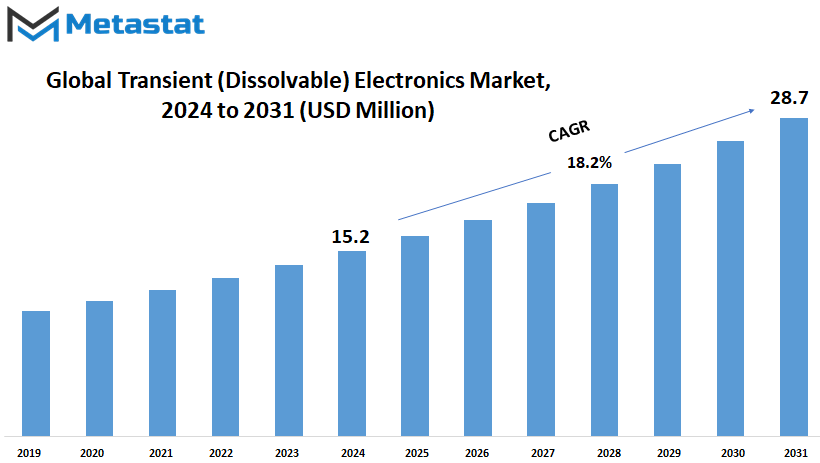
Global Transient (Dissolvable) Electronics market is estimated to reach $28.7 Million by 2031; growing at a CAGR of 18.2% from 2024 to 2031.
The Global Transient (Dissolvable) Electronics market, within the broader spectrum of the electronics industry, is poised to revolutionize the landscape of technology. Unlike traditional electronics that endure indefinitely, transient electronics are designed to dissolve or disintegrate after fulfilling their purpose. This innovative approach promises a plethora of applications across various sectors, ranging from healthcare to environmental monitoring.
In the healthcare, transient electronics offer unprecedented opportunities. Imagine a scenario where implantable medical devices seamlessly dissolve within the body once they have served their function. This advancement could mitigate the risks associated with traditional implants, such as infection or the need for additional surgeries for removal. Furthermore, transient electronics hold the potential to revolutionize drug delivery systems by enabling the controlled release of medications within the body before dissolving harmlessly, eliminating the need for invasive removal procedures.
In environmental monitoring, the utilization of transient electronics presents a paradigm shift in data collection techniques. Imagine deploying sensor networks in sensitive ecosystems or industrial settings that automatically dissolve once their mission is accomplished. This approach not only minimizes the environmental impact of sensor deployment but also allows for the collection of crucial data without the need for retrieval, thus reducing operational costs and resource consumption.
The defense and security sector also stand to benefit significantly from the advent of transient electronics. These electronics could be utilized in surveillance systems, providing temporary monitoring capabilities in strategic locations without leaving a trace behind. Moreover, transient electronics could be integrated into sensitive equipment or communication devices, ensuring data security by self-destructing in the event of compromise or unauthorized access.
The consumer electronics market is another arena where transient electronics hold immense promise. Imagine wearable devices that seamlessly integrate into clothing or accessories, providing personalized health monitoring or augmented reality experiences before dissolving without a trace. Additionally, transient electronics could revolutionize the concept of product lifecycle management by eliminating electronic waste through self-destruction after obsolescence or malfunction.
However, despite the myriad opportunities presented by transient electronics, several challenges must be addressed for widespread adoption. The development of materials that are both functional and biocompatible is paramount to ensuring the safety and efficacy of transient electronic devices. Additionally, advancements in manufacturing techniques and scalability are crucial to making transient electronics cost-effective and commercially viable.
The Global Transient (Dissolvable) Electronics market represents a disruptive force poised to reshape the landscape of technology across various industries. From healthcare to environmental monitoring, defense, and consumer electronics, the potential applications of transient electronics are vast and diverse. As research and development efforts continue to advance, the realization of this transformative technology draws nearer, promising a future where electronics seamlessly integrate into our lives before dissolving into the annals of history.
The burgeoning Global Transient Electronics market promises a revolutionary shift in technology, marked by the advent of dissolvable electronics. These transient electronics hold immense potential in combating the escalating issue of electronic waste, steering towards eco-friendly solutions. As society progresses towards a greener future, the adoption of dissolvable electronics will play a pivotal role in mitigating the environmental impact of conventional electronics.
One of the primary drivers propelling the growth of the Global Transient Electronics market is the pressing need to address electronic waste. With the rapid pace of technological advancement, electronic devices are becoming obsolete at an alarming rate, leading to an accumulation of electronic waste. Dissolvable electronics offer a promising solution by providing temporary devices that can disintegrate harmlessly after use, thereby minimizing environmental pollution and reducing the burden on landfills.
Furthermore, the field of biomedicine stands to benefit significantly from the advent of temporary medical implants enabled by transient electronics. These implants hold the potential to revolutionize healthcare by offering temporary solutions for a wide range of medical applications, including drug delivery, monitoring, and tissue engineering. By leveraging dissolvable electronics, medical practitioners can administer treatments with greater precision and efficiency, leading to improved patient outcomes.
Despite the promising prospects offered by transient electronics, certain restraints pose challenges to their widespread adoption. Material costs and manufacturing complexities remain significant barriers, hindering the mass production of dissolvable devices. Additionally, navigating the durability and performance limitations of transient electronics presents a considerable challenge, requiring further research and development efforts to enhance their reliability and effectiveness.
However, amidst these challenges lie significant opportunities at the intersection of advancements in materials science and electronics. Breakthroughs in materials engineering are paving the way for the development of novel materials with enhanced properties, such as biocompatibility and biodegradability, which are essential for the realization of transient electronics. Moreover, advancements in manufacturing technologies hold the promise of streamlining the production processes, thereby reducing costs and accelerating the commercialization of dissolvable devices.
The Global Transient Electronics market is poised for exponential growth, driven by the urgent need to combat electronic waste and revolutionize biomedicine. While facing certain restraints, the market presents abundant opportunities for innovation and collaboration at the nexus of materials science and electronics. As we journey towards a sustainable future, the adoption of dissolvable electronics will undoubtedly play a pivotal role in shaping the technological landscape of tomorrow.
The global transient (dissolvable) electronics market is poised for significant growth in the coming years, with various devices leading the charge. These devices, which are designed to dissolve or disintegrate after a certain period, offer unique advantages in terms of sustainability and versatility.
Among the different devices in the market, transistors hold a prominent position. By 2032, the transistor segment is projected to reach an estimated value of 5.19 USD million. Transistors serve as crucial components in electronic circuits, facilitating the amplification and switching of electronic signals. Their dissolvable nature opens up possibilities for applications where temporary electronics are required, such as in environmental monitoring or biomedical sensing.
In addition to transistors, sensors represent another key segment in the transient electronics market. With an estimated value of 3.53 USD million by 2032, sensors play a vital role in collecting data from the surrounding environment or monitoring various parameters. Their dissolvable nature allows for temporary monitoring solutions, which can be especially useful in scenarios where long-term deployment is impractical or unnecessary.
Biomedical implants form another significant segment within the global transient electronics market. These implants, valued at approximately 13.5 USD million by 2032, offer temporary solutions for medical interventions or monitoring. Temporary pacemakers, for instance, can provide short-term support for cardiac patients without the need for surgical removal once their function is no longer required. Similarly, transient environmental monitors can be deployed to gather data in remote or temporary locations, contributing to various research and monitoring efforts.
The rise of transient electronics reflects a broader trend towards sustainable and adaptable technology solutions. By offering devices that can dissolve or disintegrate after use, manufacturers can reduce the environmental impact associated with electronic waste. Furthermore, the temporary nature of these devices enables flexible deployment in various applications, from healthcare to environmental monitoring.
Looking ahead, the global transient electronics market will continue to evolve as researchers and manufacturers explore new materials and fabrication techniques. Advances in biodegradable polymers, transient conductive materials, and dissolvable substrates will further enhance the capabilities and applications of transient devices. As a result, transient electronics will play an increasingly important role in addressing societal challenges and driving innovation in the years to come.
In the global landscape of technology, a fascinating emergence is on the horizon: the Global Transient (Dissolvable) Electronics market. This market, characterized by its transient nature, is poised to revolutionize various industries. It is segmented by technologies, notably Biodegradable Materials, Pattern Formation, Wireless Power Transfer, and Bioresorbable Electronics, each holding its own promise and potential.
Biodegradable Materials, encompassing polymers and metals, offer a sustainable solution to electronic waste. As society increasingly prioritizes environmental conservation, these materials will gain traction in the market. Their ability to dissolve over time ensures minimal ecological impact, aligning with the growing demand for eco-friendly technologies. The Biodegradable Materials segment is projected to witness significant growth as awareness of environmental issues continues to rise.
Pattern Formation, facilitated by techniques like Inkjet Printing and Photolithography, plays a crucial role in shaping transient electronics. These methods enable precise and intricate designs, essential for various applications ranging from medical devices to consumer electronics. As technology advances, these processes will become more efficient and accessible, driving the growth of the Pattern Formation segment. The estimated value of 3.89 USD Million in 2032 underscores the increasing demand for pattern formation technologies.
Wireless Power Transfer represents a paradigm shift in how devices are powered. Eliminating the need for conventional batteries, this technology enables seamless integration into various devices. As consumers seek convenience and mobility, the demand for wireless power transfer solutions will surge. The estimated value of 5.16 USD Million in 2032 highlights the rapid expansion of this segment as it transforms the electronics landscape.
Bioresorbable Electronics exemplifies the pinnacle of innovation in transient technology. These electronics are designed to dissolve harmlessly within the body, offering revolutionary possibilities in healthcare and biomedicine. From implantable sensors to drug delivery systems, bioresorbable electronics hold immense potential to enhance patient care and treatment outcomes. As medical technology continues to advance, bioresorbable electronics will play an increasingly significant role in improving healthcare delivery.
The Global Transient (Dissolvable) Electronics market is poised for remarkable growth and innovation. With advancements in biodegradable materials, pattern formation, wireless power transfer, and bioresorbable electronics, this market will shape the future of various industries. As society embraces sustainability and technological progress, transient electronics will pave the way for a more efficient, eco-friendly, and interconnected world.
In the expanding landscape of technology, the concept of transient electronics is gaining momentum, promising a revolution in various sectors. These transient electronics, also known as dissolvable electronics, offer a unique proposition: they are designed to dissolve or disintegrate after a predefined period, leaving no trace behind. This innovative characteristic opens doors to a multitude of applications across different domains.
One of the significant domains poised to benefit from transient electronics is the medical and healthcare sector. These electronics can be integrated into medical devices and implants, providing temporary monitoring or therapeutic solutions without the need for surgical removal. For instance, transient electronic sensors could monitor vital signs or deliver medication within the body, offering personalized healthcare solutions that enhance patient comfort and convenience.
Another promising application of transient electronics lies in environmental monitoring. With increasing concerns about environmental sustainability, there is a growing demand for monitoring systems that can provide real-time data without causing long-term ecological impact. Transient electronic sensors deployed in environmental monitoring devices can fulfill this need by offering accurate data collection capabilities while minimizing environmental footprint. For example, these sensors could be used to monitor air quality, water pollution, or soil conditions, aiding in environmental conservation efforts.
Furthermore, the consumer electronics segment is also expected to witness the integration of transient electronics into various products. In an era where electronic waste is a pressing concern, the development of dissolvable electronics presents a sustainable solution. Manufacturers can incorporate transient components into consumer devices such as smartphones, wearables, or smart appliances. Once these devices reach the end of their lifecycle, the transient electronics will dissolve harmlessly, reducing the environmental burden of electronic waste disposal.
Looking ahead, the global transient electronics market is projected to witness significant growth, driven by the increasing adoption of these technologies across different applications. By 2032, the environmental monitoring segment alone is estimated to reach a valuation of 3.03 USD million, reflecting the growing importance of transient electronics in addressing environmental challenges.
Transient electronics represent a paradigm shift in electronics, offering temporary functionality with minimal environmental impact. With applications ranging from healthcare to environmental monitoring to consumer electronics, these dissolvable technologies are poised to redefine various sectors in the coming years. Embracing the potential of transient electronics will not only drive innovation but also contribute to a more sustainable future for generations to come.
In the rapidly changing landscape of technology, one emerging trend that's capturing attention is the development of transient (dissolvable) electronics. These are a class of devices designed to dissolve or disintegrate after fulfilling their intended purpose. Such technology holds significant promise across various sectors, with implications for healthcare, research, environmental monitoring, and consumer electronics.
Healthcare institutions, including hospitals and clinics, stand to benefit significantly from transient electronics. These institutions often require temporary monitoring devices for patients or implants that can safely dissolve in the body once they are no longer needed. For instance, sensors that monitor vital signs or drug delivery systems could be designed using transient electronics, reducing the need for additional surgical procedures to remove them.
Research institutions, such as universities and research labs, are also poised to leverage transient electronics in their studies. These institutions often require sensors and data collection devices for experiments, many of which are conducted in sensitive environments. Transient electronics offer a solution whereby these devices can be deployed without concerns about environmental impact or the need for retrieval after the experiment concludes.
Environmental agencies tasked with monitoring various ecosystems and pollution levels can utilize transient electronics for data collection purposes. These agencies often deploy sensors in remote or inaccessible locations, where retrieval can be challenging or costly. With transient electronics, these sensors can be left in place, collecting data over time, and then naturally dissolve without leaving a trace, minimizing environmental impact.
Consumer electronics manufacturers are also exploring the potential of transient electronics. In a world where electronic waste is a growing concern, the ability to create devices that dissolve or disintegrate after use could revolutionize product lifecycle management. Imagine a smartphone or wearable device that dissolves harmlessly once it reaches the end of its usefulness, reducing the burden on landfills and recycling facilities.
As the global transient (dissolvable) electronics market continues to evolve, it is expected to witness significant growth across these diverse end-user segments. The demand for environmentally friendly, minimally invasive, and cost-effective solutions will drive innovation in this field. However, challenges such as material development, device reliability, and regulatory considerations will need to be addressed to realize the full potential of transient electronics.
Transient electronics represent a futuristic approach to device design and deployment, with applications spanning healthcare, research, environmental monitoring, and consumer electronics. As technology advances and societal priorities shift, these dissolvable devices will play an increasingly prominent role in shaping the future of various industries.

The global market for Transient (Dissolvable) Electronics is a dynamic landscape, shaped by geographical divisions and regional dynamics. Understanding these divisions is crucial for comprehending the market's trajectory and potential opportunities.
Geographically, the global Transient (Dissolvable) Electronics market is segmented into several regions: North America, Europe, Asia-Pacific, South America, and Middle East & Africa. Each of these regions presents unique characteristics and opportunities for the market.
In North America, which encompasses the United States, Canada, and Mexico, there exists a robust infrastructure for technological innovation and adoption. The region's advanced research facilities and investment in cutting-edge technologies position it as a key player in the Transient (Dissolvable) Electronics market. Moreover, partnerships between industry players and academic institutions drive innovation and foster market growth.
Europe, consisting of countries like the UK, Germany, France, Italy, and others, boasts a rich history of technological advancement and a strong manufacturing base. The region's emphasis on sustainability and environmental consciousness aligns well with the transient nature of dissolvable electronics, creating a favorable environment for market expansion. Additionally, government initiatives and funding support research and development efforts, further propelling market growth.
The Asia-Pacific region, including economic powerhouses like India, China, Japan, and South Korea, presents immense opportunities for the Transient (Dissolvable) Electronics market. Rapid industrialization, coupled with a burgeoning consumer electronics market, drives demand for innovative technologies. Furthermore, the region's vast population and increasing disposable income levels contribute to market expansion and adoption.
South America, encompassing countries such as Brazil and Argentina, showcases a growing interest in technological advancements. The region's focus on healthcare and agriculture creates avenues for the application of dissolvable electronics in various sectors. Moreover, strategic partnerships and collaborations foster innovation and market penetration in South America.
In the Middle East & Africa, including GCC Countries, Egypt, South Africa, and others, initiatives aimed at diversifying economies and fostering technological innovation stimulate market growth. The region's focus on infrastructure development and investment in emerging technologies presents opportunities for the Transient (Dissolvable) Electronics market to thrive.
Understanding the geographical divisions of the global Transient (Dissolvable) Electronics market is essential for navigating its complexities and identifying growth prospects. Each region presents unique opportunities and challenges, shaping the market's trajectory in the coming years. As technological advancements continue to drive innovation, the market will witness further expansion and evolution across different geographical regions.
In the vast landscape of the Transient (Dissolvable) Electronics industry, several significant players stand at the forefront, each contributing uniquely to its growth and advancement. Among these key players, the John Rogers Research Group at the University of Illinois commands attention with its pioneering research and innovation. Led by Professor John A. Rogers, this research group has been instrumental in developing transient electronics technology, pushing the boundaries of what was once deemed impossible. Their contributions are poised to shape the future of healthcare, environmental monitoring, and beyond.
Another noteworthy contender in this dynamic arena is Fiorenzo Omenetto's Research Group at Tufts University. With a focus on bio-integrated electronics and silk-based technologies, Omenetto's team has unlocked novel applications for transient electronics in biomedicine and biotechnology. Their interdisciplinary approach and collaboration with industry partners have positioned them as a driving force in the field.
Adding to the mix is Biotronik, a leading medical technology company specializing in cardiac rhythm management. With a commitment to innovation and patient care, Biotronik has embraced transient electronics to enhance implantable medical devices' performance and safety. Their investment in research and development signals a strategic move to stay ahead in a competitive market.
PARC, a Xerox company, also commands a prominent presence in the Transient Electronics landscape. Leveraging its expertise in materials science and printable electronics, PARC has spearheaded projects aimed at creating transient sensors and devices for diverse applications. Their collaborative approach and industry partnerships ensure a steady stream of breakthroughs and commercialization opportunities.
MC10, founded by Professor John A. Rogers and a team of experts, is another key player making waves in the transient electronics arena. Specializing in flexible electronics and wearable devices, MC10 has developed innovative solutions for healthcare monitoring, sports performance, and consumer electronics. Their emphasis on user-centric design and seamless integration sets them apart in a crowded market.
Rogers Corporation, with its rich history in materials science and engineering, rounds out the roster of competitive players in the transient electronics space. Through continuous research and development, Rogers Corporation remains at the forefront of material innovation, providing essential components and solutions for transient electronics applications across industries.
As the global transient electronics market continues to evolve, these key players will play pivotal roles in shaping its trajectory and driving innovation forward. Their collective efforts will not only fuel technological advancements but also pave the way for new possibilities in healthcare, consumer electronics, and beyond. With competition intensifying and demand soaring, the stage is set for a dynamic and transformative journey in the realm of transient electronics.
Find answers to common questions about this report
Global Transient (Dissolvable) Electronics market is valued at $15.2 million in 2024.
Global Transient (Dissolvable) Electronics market is estimated to grow with a CAGR of 18.2% from 2024 to 2031.
Global Transient (Dissolvable) Electronics market is estimated to reach $28.7 million by 2031.
Top players operating in the Transient (Dissolvable) Electronics industry includes John Rogers Research Group at the University of Illinois, and Others.
The analysts below cover Electronics and Semiconductor research at Metastat Insights.
LEAD ANALYST
Utkarsh Khirodkar is a Lead Market Research Analyst at MetaStat Insight, specializing in market intelligence, technology sector assessments, and competitive strategy.

PRINCIPAL CONSULTANT - ENTERPRISE AI & EMERGING TECHNOLOGIES
Banking & Finance · Electronics and Semiconductor · Energy and Power · Healthcare IT · Information & Technology · Professional Services
Vijay Gunti is a Principal Consultant at MetaStat Insight, bringing over two decades of experience across enterprise digital transformation, technology strategy, and intelligent systems.

PRINCIPAL CONSULTANT - QUALITY SYSTEMS & COMPLIANCE
Electronics and Semiconductor · Machinery & Equipment · Professional Services
Omkar Phadtare is an Industry Consultant at MetaStat Insight, specializing in quality systems, regulatory compliance, and standards benchmarking to drive data-driven market intelligence and strategic industry research.

ENERGY & INFRASTRUCTURE INDUSTRY CONSULTANT
Automotive and Transportation · Electronics and Semiconductor · Energy and Power · Machinery & Equipment
Saurabh Vasant Ganvir consults for Energy & Infrastructure Industry at MetaStat Insight, specializing in renewable energy, solar EPC, and electric vehicle (EV) infrastructure markets.

LEAD CONSULTANT - COMMUNICATION, TELECOM, AND IT
Electronics and Semiconductor · Information & Technology · Machinery & Equipment · Professional Services
Ravindra Sathe Consultants for Communication, Telecom, and IT at MetaStat Insight. He leads the firm's industry research initiatives across telecommunications infrastructure, digital connectivity, enterprise networking, and emerging information technology domains.
Assessing commercial microgrid software adoption requires looking past top-level installation numbers and examining utility interconnection queues. The research provided verifiable data on average permitting timelines, tariff structures, and battery storage integration costs across regional utility territories. That grounded perspective was valuable for our team when building five-year demand projections for industrial microgrid controllers.
Ambulatory surgical centers have very different purchasing cycles for robotic-assisted surgery platforms than major hospital networks. The MetaStat Insight study focused squarely on capital expenditure depreciation, procedural reimbursement pathways, and surgeon training overhead. That operational clarity made it much simpler to validate multi-year procedure growth forecasts against actual ambulatory center adoption patterns.
When planning edge sensor rollouts across refinery environments, generic IoT reports typically miss the harsh-environment certification bottlenecks. MetaStat Insight gave an objective evaluation of ATEX and Class 1 Division 2 hardware availability, along with realistic five-year maintenance cycle cost projections. The comparison of wireless mesh versus private cellular backhaul helped our team pressure-test network reliability models for remote processing facilities.
Explore related market intelligence reports worth reading alongside this one.
Starting from
$2950