
LEAD ANALYST
Utkarsh Khirodkar is a Lead Market Research Analyst at MetaStat Insight, specializing in market intelligence, technology sector assessments, and competitive strategy.

UAE Frozen Potato Products Market Size and Share, By Product Type (French Fries, Tikki, Potato Wedges, Potato Bites, Smileys, Hash Brown, and Others), By Distribution Channel (B2B, Supermarkets, Hypermarkets, Convenience Stores, Departmental Stores, Online Sales, and Others), By End Use (Food Services, Retail, QSR, and Households), Industry Analysis, Growth, Trends, and Forecast, 2026-2033
Report ID
MSI-4564
Published
February, 2026
Pages
311 Pages
Format
Report Details
Choose Your License
UAE Frozen Potato Products Market
The UAE Frozen Potato Products market size was valued at 346.7 kilotons in 2025. The market is projected to grow from USD 203.8 million in 2026 to USD 346.5 million by 2033, exhibiting a CAGR of 7.9% during the forecast period.
The UAE Frozen Potato Products market was valued at USD 186.7 million in 2025 and is projected to reach USD 346.5 million by 2033, registering a CAGR of 7.9% during 2026-2033.
French Fries segment accounts for a market share of 63.6% with a sales volume of 216.7 kilotons in 2025.
Key trends driving growth: Rising consumption of quick-service restaurant meals is strengthening demand for frozen fries and potato-based sides, while busy urban routines and higher disposable income are increasing preference for convenient, ready-to-cook food options.
Key opportunities include premium product innovation focused on healthier variants such as low-oil and air-fryer-friendly formats.
Key insight: Urban lifestyle acceleration and foodservice expansion are reshaping frozen potato demand, while price sensitivity and supply volatility continue to influence purchasing decisions across the UAE.
The UAE frozen potato products market within the processed food industry will enter a phase defined by operational sophistication, contract-driven demand, and food engineering in commercial foodservice channels. The industry will expand beyond traditional retail freezer and fast-service products towards tailored solutions designed for airlines, cloud kitchens, hospitality groups and institutional catering networks operating in the emirate.
The product strategy will increasingly focus on cut precision, coating consistency and fry-life performance to support high-throughput kitchens demanding predictable output under varying preparation conditions. Manufacturers will prioritize format innovation, including low oil absorption variants and oven-ready profiles, to align with controlled kitchen environments, where speed and yield management will guide purchasing decisions. Taste adaptation to regional menus will gain prominence through spice-rich and textured offerings developed for local taste alignment rather than mass standardization.
Quick-service restaurant expansion in urban centers will increase institutional demand for standardized frozen potato formats. Product consistency, stringent staff training requirements, and predictable inventory control will support repeat procurement. Food service operators will prioritize frozen fries and potato sides to satisfy volume performance goals and customer expectations.
Urban employment density and growing shopping strength will increase demand for ready-to-cook frozen potatoes. Time-efficient meal preparation will advantage importance at home. Retail shopping behaviour will want merchandise that require minimum preparation while maintaining familiar flavor, leading to solid category penetration.
Agricultural yield variability and global supply pressures will affect raw potato pricing trends. Cost volatility will challenge margin planning for processors and vendors. Pricing uncertainty will complicate long-term contracts and promotional techniques, probably restricting competitive market expansion plans.
Greater attention to nutritional stability will lessen common consumption of conventional frozen potato merchandise. Label checking and aspect assessment will affect purchasing selections. Market growth will face resistance in health-focused consumer segments looking for fresh or minimally processed options.
Product development emphasizing low oil absorption and modern cooking compatibility will entice the growing choices of consumers. Premium positioning will permit differentiation within retail shelves. Innovation consistent with wellness developments will support value growth at the same time as addressing intake worries.
The UAE Frozen Potato Products market is segmented by Product Type, Distribution Channel, and End Use.
French Fries segment is valued at USD 129.7 Million in 2026 and is projected to reach USD 221 Million by 2033, at a CAGR of 7.9% during the forecast period.
The demand for French fries will continue to grow in the future due to the expansion of food service formats and increasing food preferences in urban centres. Product innovations focusing on textural stability, controlled oil absorption and longer shelf life will shape manufacturing priorities. Institutional buyers will favor sustainability, while premium variants will find a place in hospitality-oriented menus.
Tikki segment is valued at USD 17.0 Million in 2026 and is projected to reach USD 29.2 Million by 2033, at a CAGR of 8% during the forecast period.
Tikki will experience steady traction driven by cultural familiarity mixed with modern preparation convenience. Manufacturers will emphasize uniform seasoning, superior binding quality and adaptable cooking performance. Growing acceptance within café and quick food formats will elevate positioning beyond traditional use, supporting broader menu integration and continued category relevance.
Potato Wedges segment is valued at USD 30.4 Million in 2026 and is projected to reach USD 53.3 Million by 2033, at a CAGR of 8.4% during the forecast period.
Potato wedges will get preference due to their premium status and visual appeal in plated meals. Future production trends will highlight skin-on cuts, balanced spice profiles and improved crisp retention. Foodservice operators will rely on such offerings for menu differentiation, particularly in casual dining environments looking for portion versatility and preparation efficiency.
Potato Bites segment is valued at USD 11.8 Million in 2026 and is projected to reach USD 19.5 Million by 2033, at a CAGR of 7.5% during the forecast period.
Potato bites will benefit from increasing snack-based consumption habits associated with social dining formats. Compact size, predictable cooking results and taste adaptability will drive demand. Institutional catering and entertainment venues will increasingly choose such formats due to reduced waste levels and simplified service logistics during high-volume service periods.
Smileys segment is valued at USD 8.0 Million in 2026 and is projected to reach USD 12.8 Million by 2033, at a CAGR of 6.9% during the forecast period.
Smiley-shaped potato products will maintain demand through family-oriented consumption patterns. Nutritional balance, integrity of shape during cooking and attractive texture will be prioritized in future development. Retail-focused packaging innovation will reinforce shelf visibility, while foodservice adoption will be tied to child-centric dining experiences and themed food offerings.
Others segment is valued at USD 6.9 Million in 2026 and is projected to reach USD 10.7 Million by 2033, at a CAGR of 6.4% during the forecast period.
Other frozen potato formats will allow experimentation with sizes, coatings and seasoning styles. Manufacturers will take advantage of flexible processing systems to address specific culinary concepts. Such diversity will support customization needs across hospitality channels, enabling tailored solutions to evolving menu structures and regional taste expectations.
Business-to-Business segment is projected to reach USD 109.8 Million by 2033, at a CAGR of 8.1% during the forecast period.
Business-to-business distribution will remain fundamental due to the large volume procurement cycle. Future growth will depend on reliability of supply, cold-chain precision, and contract-based pricing stability. Strategic partnerships with institutional buyers will promote long-term planning while encouraging investment in scalable production infrastructure.
Supermarkets and Hypermarkets segment is projected to reach USD 160.1 Million by 2033, at a CAGR of 7.8% during the forecast period.
Supermarkets and hypermarkets will continue to shape consumer reach through wider product visibility. Shelf placement strategies, private-label expansion and value-focused packaging will influence purchasing behaviour. Technology integration within the inventory system will enhance freshness control, supporting consistent availability in high footfall retail environments.
Convenience Stores segment is projected to reach USD 27.2 Million by 2033, at a CAGR of 7.6% during the forecast period.
Convenience stores will expand relevance through compact packaging formats designed for faster turnover. The selection of frozen potatoes will suit immediate consumption needs and limited storage capacity. Improved freezer efficiency and curated assortment will strengthen presence in urban areas, supporting time-sensitive purchasing decisions.
Departmental Stores segment is projected to reach USD 10.8 Million by 2033, at a CAGR of 6.9% during the forecast period.
Departmental stores will cater to specific consumer segments looking for premium frozen food options. Product assortment will reflect the perception of quality rather than fluctuations in quantity. Future emphasis will include curated selections aligned with lifestyle branding, strengthening differentiation from mass retail distribution formats.
Online segment is projected to reach USD 31.6 Million by 2033, at a CAGR of 8.4% during the forecast period.
Online channels will gain influence through fixed delivery models and subscription-based purchasing. Frozen potato products would benefit from better insulated packaging and distribution coordination. Digital platforms will support detailed product descriptions, enabling informed selection tailored to cooking preferences and portion requirements.
Others segment is projected to reach USD 7.1 Million by 2033, at a CAGR of 6.9% during the forecast period.
Others will include specialized outlets and institutional purchasing networks. Flexibility within logistics and order customization will guide the partnership. Such channels will support targeted market entry strategies addressing unique operational needs in non-traditional food distribution environments.
Food Services segment is projected to reach USD 118.1 Million by 2033 with a share of 34.6% in 2025.
Food service applications will increase volume consumption through standardized preparation requirements. Future demand will favor products that ensure cooking consistency across different appliances. Menu engineering strategies will rely on reliable frozen formats that support speed, portion control and waste reduction objectives.
Retail segment is projected to reach USD 110.3 Million by 2033 with a share of 31.6% in 2025.
Retail consumption will increase through home-based food preferences emphasizing convenience. Packaging innovation, clarity of cooking guidance and freezer compatibility will influence the selection. Product differentiation through texture and flavour balance will encourage repeat purchases within competing freezer categories.
Quick Service Restaurants segment is projected to reach USD 73.1 Million by 2033 with a share of 20.5% in 2025.
Quick service restaurants will continue to prioritize offering frozen potatoes while supporting faster service cycles. Operational efficiency, uniform production and predictable supply will remain the decisive factors. Product development will be in line with evolving menu formats focused on speed without compromising the sensory experience.
Households segment is projected to reach USD 44.9 Million by 2033 with a share of 13.3% in 2025.
Households' consumption will reflect a change in lifestyle toward simplified food preparation. Frozen potato products will address a variety of cooking methods including oven and air fryer. Future growth will depend on balanced portion sizes and reliable cooking results that support everyday meal planning within modern residential settings.
The UAE frozen potato products market will continue to grow due to changes in food behaviour, increasing urban lifestyle and strong call for quick-carrier restaurants and present-day retail product. Consumers across the UAE are increasingly preferring meal options that offer comfort without compromising on taste or consistency. Frozen potato products meet those expectations through offering consistent quality, long shelf life, and ease of preparation. Expanding tourism, an engaged working populace and persevered boom in dual-income families will in addition guide demand in houses, cafes and food carrier outlets.
International manufacturers play a strong position in shaping product standards and deliver supply stability within the UAE. Lamb Weston Holdings Inc., McCain Foods Ltd., Avico B.V., Del Monte International GmbH, JBS S.A. through its Cera brand, and AJC International, Inc. These companies bring international processing expertise, advanced freezing technology, and broad product portfolios. Their presence guarantees the continuing availability of fries, wedges, hash browns and specialty potato codecs in supermarkets and commercial kitchens. The strong cold-chain infrastructure in the UAE allows these players to maintain product quality from port to plate.
Regional and local companies also have a solid position by aligning offerings with local taste preferences and cultural expectations. Al Islami Foods, Al Kabir Group ME, Americana Foods, Sunbulah Group and Saudia Dairy & Foodstuff Company (SADAFCO) focus on halal-certified products, trusted branding and wide distribution reach. Agthia Group PJSC (Al Ain) strengthens market depth through food processing experience and retail penetration. These companies will continue to invest in packaging innovation, portion control formats and value-focused pricing to attract families and institutional buyers.
The competition in the frozen potato products market in the UAE is turning tougher, forcing participants to enhance innovation in the procurement of ingredients, increase sustainability efforts, and diversify portfolios. Companies are relying increasingly on collaborations with foodservice establishments and private label food retail stores to establish a stable market for themselves in the years to come. With increasing demands for ready-to-cook products, brands will emphasize reliable supply, taste, and efficiency to solidify market positioning.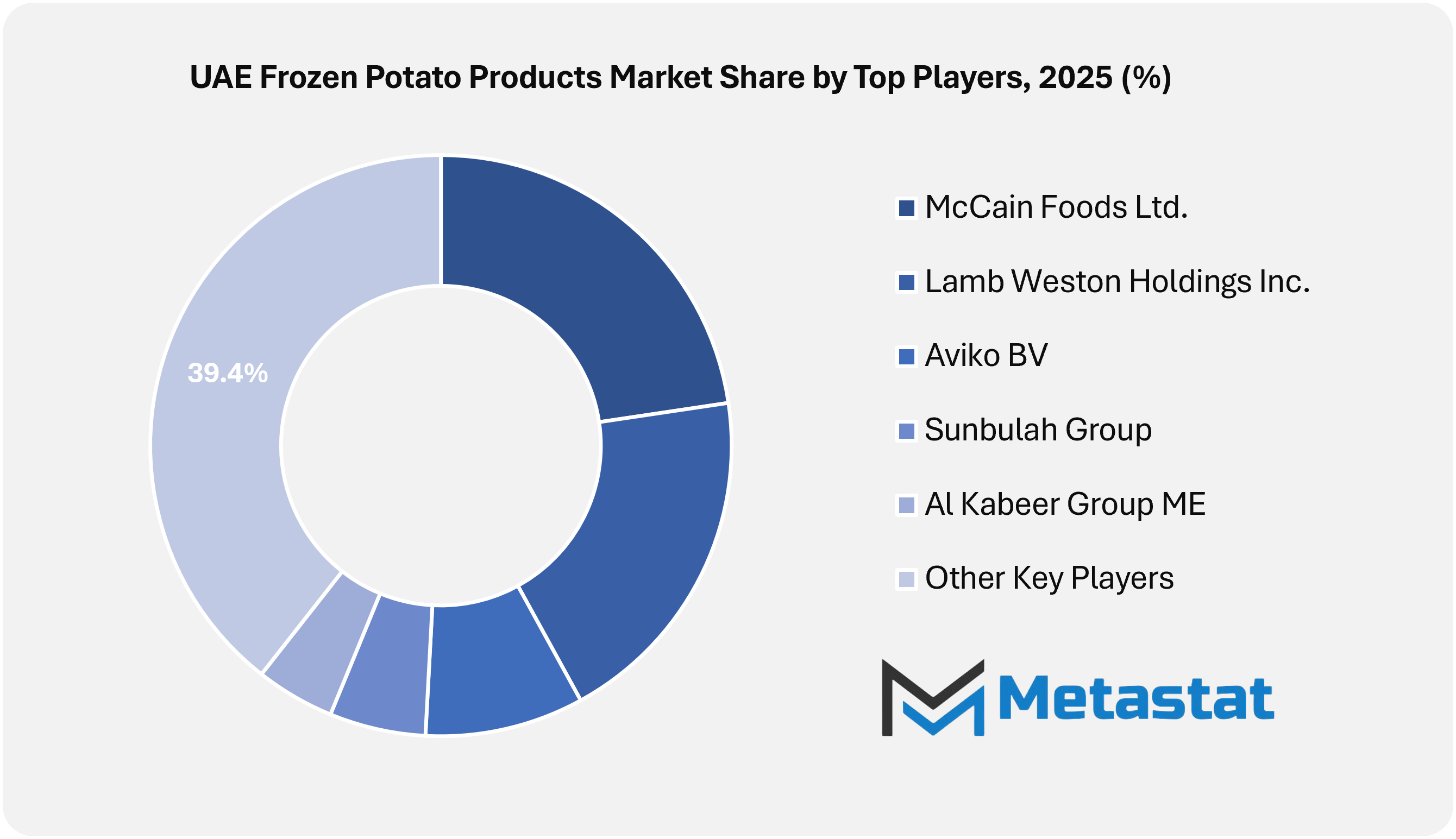
Market size is forecast to rise from USD 186.7 million in 2025 to over USD 346.5 million by 2033.
Sustainability conditions will influence purchasing narratives through water management disclosure, packaging weight optimization and energy-efficient freezing protocols embedded within supplier contracts. Technology integration in logistics, quality monitoring and demand forecasting will shape competitive position more than headline expansion metrics. In the coming years, the UAE frozen potato products market will function less as a commodity category and more as a performance-driven input supporting foodservice reliability, brand consistency and operational planning within highly structured consumption environments.
This research report categorizes the Frozen Potato Products market based on key segments and regions, forecasts revenue growth, and analyses trends in each submarket. The report analyses the key growth drivers, opportunities, and challenges influencing the Frozen Potato Products market. Recent market developments and competitive strategies such as expansion, product launch, development, partnership, merger, and acquisition have been included to draw the competitive landscape in the market.
The report strategically identifies and profiles the key market players and analyses their core competencies in each sub-segment of the Frozen Potato Products market.
|
Report Attributes |
Details |
|
Study Period |
2021-2033 |
|
Base Year |
2025 |
|
Estimated Year |
2026 |
|
Forecast Period |
2026-2033 |
|
Historical Period |
2021-2025 |
|
Growth Rate |
CAGR 7.9% from 2026 to 2033 |
|
Revenue Unit |
USD million |
|
Sales Volume Unit |
Kilotons |
|
Segmentation |
By Product Type, Distribution Channel, and End Use |
|
By Product Type |
|
|
By Distribution Channel |
|
|
By End Use |
|
Find answers to common questions about this report
The Metastat Insights study shows that the UAE Frozen Potato Products market size was USD 186.7 million in 2025.
The UAE Frozen Potato Products market is likely to grow at a CAGR of 7.9% over the forecast period (2026-2033).
The Metastat Insights analysis shows that the UAE Frozen Potato Products market size is estimated to be USD 346.5 million by 2033.
The French Fries is the leading type segment in the UAE market.
Rising consumption of quick-service restaurant meals is strengthening demand for frozen fries and potato-based sides are key driving factors, boosting the market.
Fluctuating raw potato prices are affecting cost stability for manufacturers and distributors and will restrain market growth during the forecast period.
UAE Frozen Potato Products market is estimated to reach USD 346.5 million by 2033.
Top players operating in the Frozen Potato Products industry include Lamb Weston Holdings Inc., McCain Foods Ltd., Al Islami Foods, Aviko BV, and Al Kabeer Group ME.
The analysts below cover Food and Beverages research at Metastat Insights.
LEAD ANALYST
Utkarsh Khirodkar is a Lead Market Research Analyst at MetaStat Insight, specializing in market intelligence, technology sector assessments, and competitive strategy.

LEAD PRINCIPAL ANALYST, PHARMA AND HEALTHCARE
Food and Beverages · Healthcare · Healthcare IT · Medical Devices
Ajay Devgire is the Lead Healthcare Analyst at MetaStat Insight, leading strategic research and market intelligence initiatives across the global healthcare domain.

SENIOR RESEARCH ANALYST
Biotechnology · Food and Beverages · Medical Devices · Packaging
Snehal Pasalkar is a Research Analyst at MetaStat Insight, operating at the intersection of life sciences research, competitive strategy, and market intelligence.
Analyzing the transition from natural gas to green hydrogen in iron ore reduction requires realistic infrastructure timelines. Meta stat insight supplied a detailed regional assessment of DRI plant conversion costs and scrap metal availability in North America and Western Europe. Their report carefully examined pellet quality specs and electrical grid access constraints without making oversimplified market assumptions. The research material served as a practical reference during internal technology roadmap discussions.
Integrating zero-trust access controls across legacy electronic health record systems involves complex compliance overhead. Team produced an analysis that clearly separated identity governance and administration tools from privileged access management platforms. Their evaluation of HIPAA and GDPR compliance features across cloud native solutions gave our architecture group clear baseline criteria. The custom data request regarding biometric authentication adoption in hospital networks was returned promptly with clear documentation.
Evaluating calorific value requirements and air permit compliance across municipal waste facilities requires localized data. Metastat Insight structured their analysis around operational throughput capacity and feedstock composition variations in Latin America and Eastern Europe. Their competitive mapping of sorting equipment vendors helped clarify technology differences between optical separators and heavy media systems. The study provided an objective baseline during our capital expenditure reviews.
Explore related market intelligence reports worth reading alongside this one.