
LEAD ANALYST
Utkarsh Khirodkar is a Lead Market Research Analyst at MetaStat Insight, specializing in market intelligence, technology sector assessments, and competitive strategy.

Foodservice Market Size, Share, By Foodservice Type (Cafes, Bars, Cloud Kitchens, Full-Service Restaurants, QSR, and Others), By Outlet (Chained Outlets and Independent Outlets), By Service Type (Dine-in, Takeaway, and Delivery), Industry Analysis, Growth, Trends, and Forecast, 2026-2033
Report ID
MSI-4545
Published
February, 2026
Pages
310 Pages
Format
Report Details
Choose Your License
Foodservice Market
The global Food Service market size is valued at USD 3,911.4 billion in 2025.and is projected to grow from USD 4,185 billion in 2026 to USD 6,767.11 billion by 2033, exhibiting a CAGR of 7.1%
Global foodservice market was valued at USD 3,911.4 billion in 2025 and is projected to reach USD 6,767.11 billion by 2033, reflecting a CAGR of 7.1% over the forecast period.
North America holds 39.95% of the food service market in 2025, with the US leading the market share in 2026.
Cafes and Bars accounted for a market share of 15.8% in 2025, owing to menu innovation and concept diversification through new product and format experimentation.
Key trends driving growth include increasing demand for convenience and off-premises dining options, and consumer preference for experience-driven and premium dining.
Opportunities include the growth of operational efficiency technology and personalized marketing.
Key insight: Shifting towards tech-driven personalized menus and loyalty programs can significantly enhance customer lifetime value.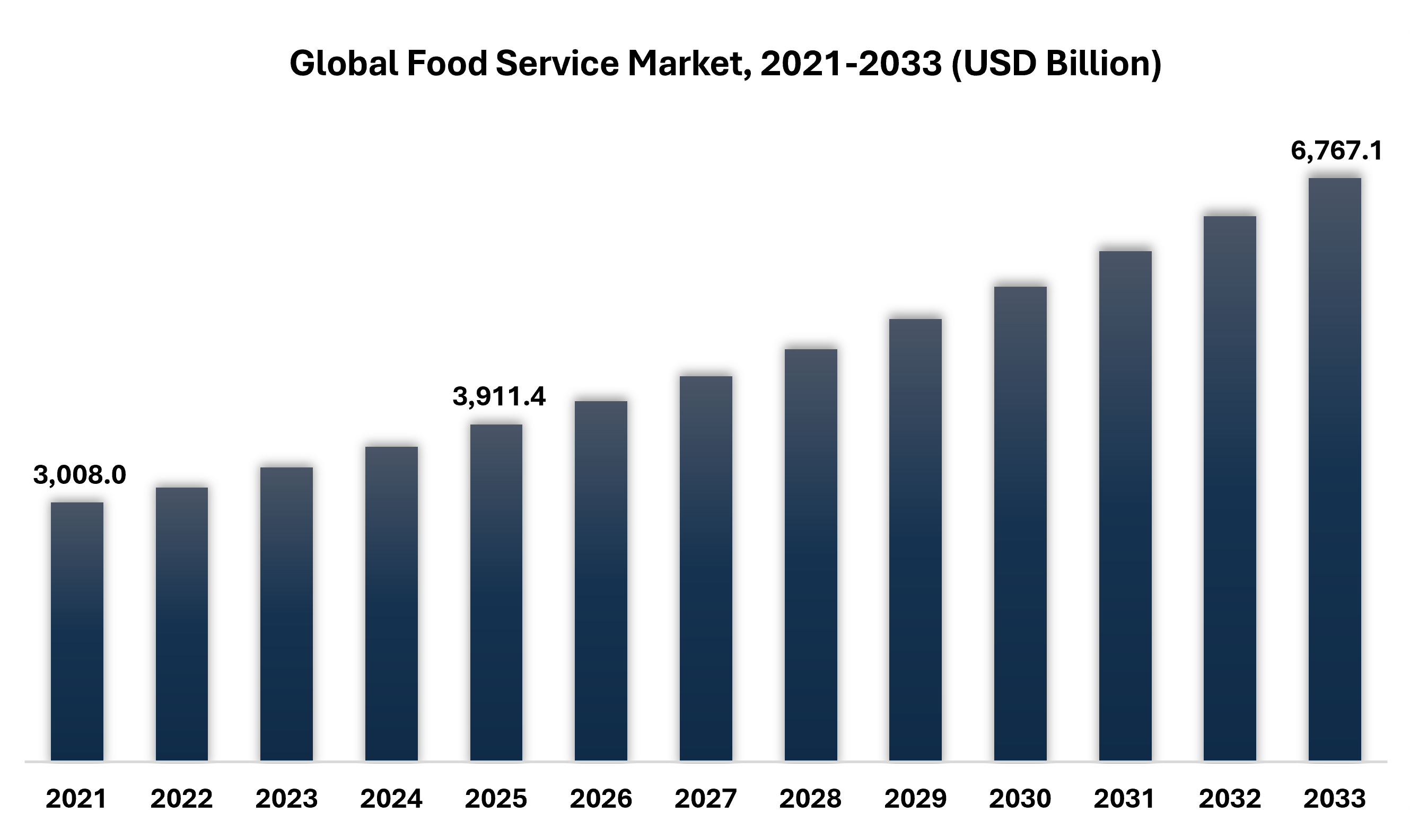
Increasing Demand for Convenience and Off-premises Dining Options
Increased preference for convenience and out-of-home occasions is reshaping operating models, with higher reliance on delivery, takeout, and drive-thru formats accelerating investments in digital ordering, kitchen throughput, and packaging performance.
Consumer Preference for Experience-driven and Premium Dining
Increased preference for experience-led dining is supporting premium formats, with high-touch venues commanding higher checks owing to differentiated culinary narratives, artisanal positioning, and immersive ambience.
Persistent Labor Shortages Compounded by Wage Inflation
Chronic workforce shortages and wage inflation represent material operational constraints, limiting capacity and pressuring margins through higher labor costs, reduced operating hours, and trade-offs between service standards and price positioning.
Volatile Food Input Costs and Supply Chain Disruption
Volatile food costs and supply disruptions increase margin volatility and execution risk, with logistics delays and incremental procurement costs disrupting menu planning, pricing discipline, and product availability.
Growth of Operational Efficiency Technology with Personalized Marketing
Operational efficiency technology and personalized marketing represent a dual opportunity, enabling workflow automation to mitigate labor constraints and supporting data-led targeting to strengthen loyalty and marketing return on investment.
The global foodservice market is classified by foodservice type, outlet, and service type.
Cafés and bars represent a blended format aligned with premium beverages and convenience, integrating daytime café occasions with evening bar traffic to improve margin mix via specialty drinks, curated snacks, and differentiated atmosphere. Cafés and Bars segment is valued at USD 661.3 billion in 2026 and is projected to reach USD 1054.3 billion by 2033, at a CAGR of 6.9% during the forecast period.
Cloud kitchens are digital-first production hubs aligned with off-premises consumption, enabling delivery-only brands to scale without dining rooms or prime real estate costs, while supporting multi-brand, multi-cuisine throughput from a centralized footprint. Cloud Kitchens segment is valued at USD 596 billion in 2026 and is projected to reach USD 1038.7 billion by 2033, at a CAGR of 8.3% during the forecast period.
Full-service restaurants compete on experience and perceived value, using table service, atmosphere, and menu craftsmanship to justify premium checks and capture destination dining occasions. Full-Service Restaurants segment is valued at USD 1050 billion in 2026 and is projected to reach USD 1669.4 billion by 2033, at a CAGR of 6.8% during the forecast period.
Quick-service restaurants maximize throughput in cost-sensitive environments, balancing speed and convenience with value positioning through simplified menus, counter service, drive-thru operations, and digital ordering. Quick-Service Restaurants segment is valued at USD 1642.8 billion in 2026 and is projected to reach USD 2654 billion by 2033, at a CAGR of 7.1% during the forecast period.
Food trucks, pop-ups, and convenience-store foodservice act as agile formats with alternative access points, leveraging lower entry costs and flexible location strategies to test new concepts and capture impulse-led occasions.
Chained outlets represent a scale-driven operating model, enabling cost advantages, consistent brand execution across geographies, faster rollout of new items and formats through standardized systems, and procurement leverage. Chained Outlets segment is projected to reach USD 6076.1 billion by 2033, at a CAGR of 7.2% during the forecast period.
Independent outlets compete through differentiation and local relevance, using concept diversity, community ties, and chef-led innovation to deliver distinctive menus and faster adoption of emerging food trends.
Dine-in represents the premium, experience-led service model where ambience, hospitality, and table service increase dwell time and average check size while strengthening direct loyalty through higher-touch interactions.
Takeaway supports convenience and throughput, serving customers seeking off-premises meal solutions via optimized packaging and streamlined handoff processes that improve peak-hour flow across outlet types.
Delivery has evolved into a large, technology-led growth channel supported by third-party platforms, extending restaurant reach while reshaping unit economics through commissions, packaging requirements, service-time expectations, and digital visibility.
Based on geography, the global Food Service market is divided into North America, Europe, Asia-Pacific, South America, and the Middle East & Africa.
North America foodservice market is projected to expand at a CAGR of 7.1% during 2026-2033, reaching a market size (TAM) of USD 2,692.6 billion by 2033.
The biggest driver of the foodservice market in North America is sustained consumer preference for digital convenience, accelerating structural shifts in ordering, fulfillment, and loyalty execution.
APAC presents high-potential growth opportunities supported by technology-led scaling, hyper-local menu localization, and flexible expansion models aligned with diverse consumer preferences. It involves using data analytics and digital platforms to customize menus to local taste profiles and consumption occasions across key APAC markets.
APAC has a massive potential in the food service market, by improving the dining experience and taking advantage of increasing disposable income and by giving people something new, something that stakes out more territory than mere survival.
Middle East & Africa and South America reflect an uneven foodservice landscape shaped by fragmented supply chains, price-sensitive consumers, and gradual formalization of foodservice infrastructure.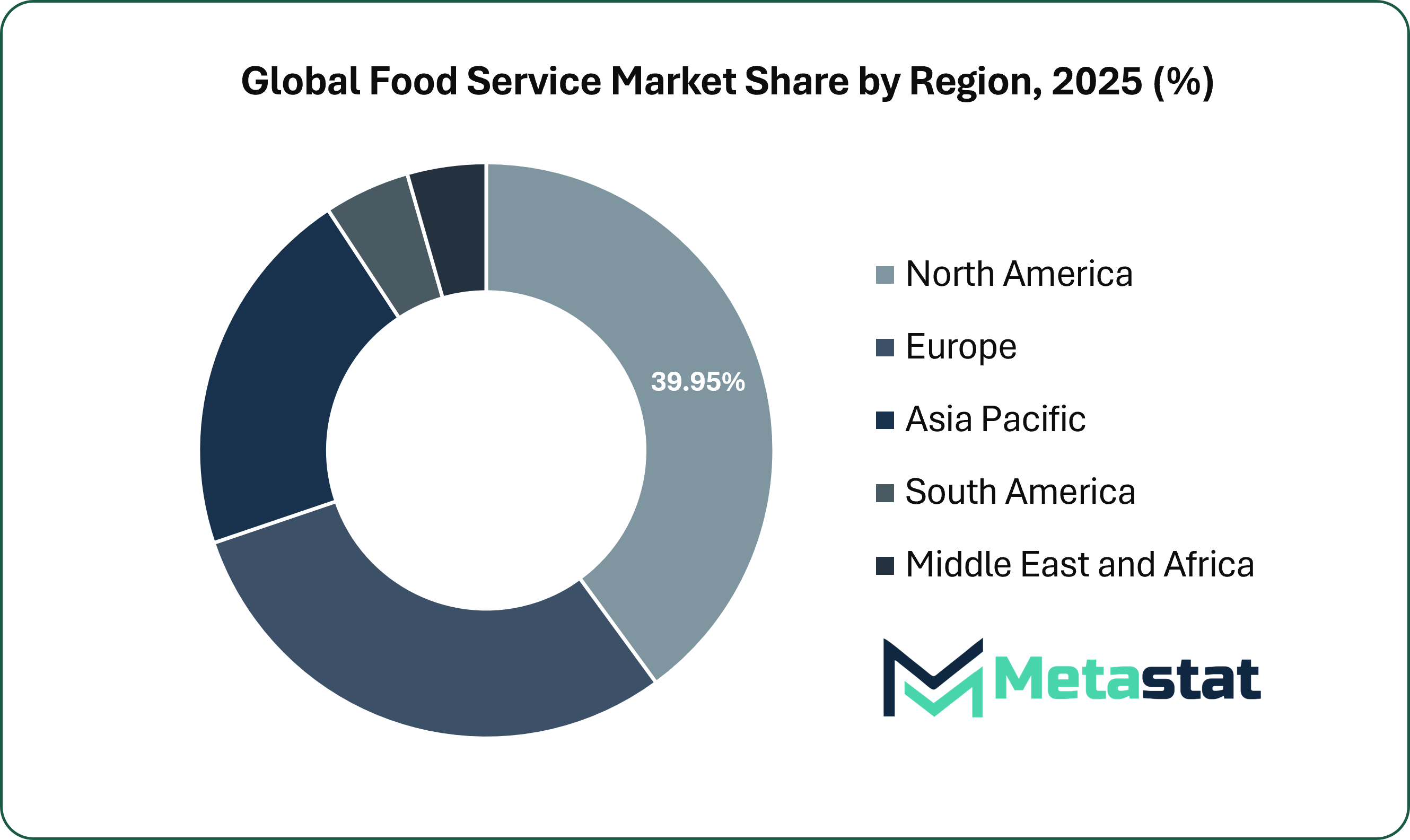
Global foodservice comprises multiple strategic groups that compete across scale, price positioning, experience, and digital execution. Global QSR franchise leaders such as McDonald's, Yum! Brands, Restaurant Brands International, and Domino's hold scale advantages rooted in asset-light, predominantly franchised models that accelerate international expansion. RBI operates a franchise-dominant model, with approximately 95% of system-wide restaurants franchised, and has guided toward at least 40,000 restaurants by 2028, supported by digital ordering, marketing investment, and unit expansion across its brand portfolio.
A second competitive group includes fast-casual and specialty leaders such as Starbucks, Chipotle, Chick-fil-A, and Panera Bread, competing through brand experience, perceived quality, and operational excellence within focused categories. Their approach revolves around driving premium pricing with high consumer loyalty, powered by digital loyalty and menu innovation augmented by LTOs. Full-service and casual dining operators such as Darden Restaurants and Bloomin' Brands compete on experience-led dining occasions, strengthening off-premises execution alongside dine-in differentiation. Their brand DNA is table service and social, which is being developed to enable strong off-premise and delivery participation due to changing consumer behaviours. The competitive landscape is not made any more approachable by the International & Regional Powerhouses such as Jollibee Foods Corporation out of the Philippines and China’s Luckin Coffee and Haidilao, which benefit from strong cultural relevancy in high-growth Asia Pacific as they go on acquisition binges to accumulate multi-brand portfolios into new categories.
Market size is forecast to rise from USD 3,911.4 billion in 2025 to over USD 6,767.11 billion by 2033.
The global foodservice market is projected to expand over the long term, while near-term economic headwinds and shifting consumer priorities are creating execution pressure across formats. One headwind is less of a price gap as inflation from QSRs has made casual dining look like a better value, pressuring QSRs to be more aggressive with menu innovation and LTOs. Key competitive trends in the space include accelerated implementation of artificial intelligence in operations and personalization, the adoption of delivery-only models such as ghost kitchens, and a consumer-led demand for sustainability, experiential dining and global fusion food. M&A activity is likely to rebound in 2026, supported by easing capital costs and expansion priorities toward higher-growth territories such as Southeast Asia.
This research report categorizes the Food Service market based on key segments and regions, forecasts revenue growth, and analyses trends in each submarket. The report analyses the key growth drivers, opportunities, and challenges influencing the Food Service market. Recent market developments and competitive strategies such as expansion, new format and menu launches, partnerships, and mergers and acquisitions have been included to illustrate the competitive landscape.
The report strategically identifies and profiles the key market players and analyses their core competencies in each sub-segment of the Food Service market.
|
Report Attributes |
Details |
|
Study Period |
2021-2033 |
|
Base Year |
2025 |
|
Estimated Year |
2026 |
|
Forecast Period |
2026-2033 |
|
Historical Period |
2021-2025 |
|
Growth Rate |
CAGR 7.1% from 2026 to 2033 |
|
Revenue Unit |
USD billion |
|
Segmentation |
By Foodservice Type, Outlet, Service Type, and Region |
|
By Foodservice Type |
Cafés and Bars |
|
Cloud Kitchens |
|
|
Full-Service Restaurants |
|
|
Quick-Service Restaurants |
|
|
Others |
|
|
By Outlet |
Chained Outlets |
|
Independent Outlets |
|
|
By Service Type |
Dine-in |
|
Takeaway |
|
|
Delivery |
|
|
By Region |
North America (By Foodservice Type, Outlet, Service Type, and Country) |
|
United States |
|
|
Canada |
|
|
Mexico |
|
|
Europe (By Foodservice Type, Outlet, Service Type, and Country) |
|
|
Germany |
|
|
France |
|
|
UK |
|
|
Italy |
|
|
Spain |
|
|
Russia |
|
|
Asia Pacific (By Foodservice Type, Outlet, Service Type, and Country) |
|
|
China |
|
|
Japan |
|
|
India |
|
|
South Korea |
|
|
Australia |
|
|
Southeast Asia |
|
|
Rest of Asia Pacific |
|
|
South America (By Foodservice Type, Outlet, Service Type, and Country) |
|
|
Brazil |
|
|
Argentina |
|
|
Rest of South America |
|
|
Middle East and Africa (By Foodservice Type, Outlet, Service Type, and Country) |
|
|
Saudi Arabia |
|
|
UAE |
|
|
South Africa |
|
|
Rest of Middle East and Africa |
Find answers to common questions about this report
The Metastat Insights study shows that the global Food Service market size was USD 3,911.4 billion in 2025.
The global Food Service market is likely to grow at a CAGR of 7.1% over the forecast period (2026-2033).
The Metastat Insights analysis shows that the North America Food Service market size is estimated to be USD 2,692.6 billion by 2033.
The Quick-Service Restaurants is the leading type of segment in the global market.
Increasing demand for convenience and off-premises dining options and consumer preference for experience-driven and premium dining are key driving factors, boosting the market.
The North America region dominates the market.
Persistent labor shortages, compounded with increasing pressure on wages, will hamper market growth within the forecast period.
Consumer demand for convenience, value, and diverse dining options, combined with significant investment in digital ordering and delivery technology, is expected to favor the Food Service Market.
The Global Food Service market is estimated to reach USD 6767.11 billion by 2033.
Top players operating in the Food Service industry include McDonald’s Corporation, Starbucks Coffee Company, Yum! Brands, Inc., Restaurant Brands International Inc., Domino’s Pizza, Inc., Subway, Inspire Brands, Jollibee Foods Corporation, Chick-fil-A, Inc., Chipotle Mexican Grill, Inc., Darden Restaurants, Inc., Dine Brands Global, Inc., The Wendy’s Company, Papa John’s International, Inc., Little Caesars Enterprises, Panera Bread (Panera Brands), Luckin Coffee Inc., Haidilao International Holding Ltd., Greggs plc, Nando’s Group, Shake Shack Inc., Bloomin’ Brands, Inc., Brinker International, Inc., MTY Food Group Inc., Alsea, S.A.B. de C.V., Compass Group PLC, Sodexo S.A., Aramark, Elior Group, and Delaware North.
The analysts below cover Food and Beverages research at Metastat Insights.
LEAD ANALYST
Utkarsh Khirodkar is a Lead Market Research Analyst at MetaStat Insight, specializing in market intelligence, technology sector assessments, and competitive strategy.

LEAD PRINCIPAL ANALYST, PHARMA AND HEALTHCARE
Food and Beverages · Healthcare · Healthcare IT · Medical Devices
Ajay Devgire is the Lead Healthcare Analyst at MetaStat Insight, leading strategic research and market intelligence initiatives across the global healthcare domain.

SENIOR RESEARCH ANALYST
Biotechnology · Food and Beverages · Medical Devices · Packaging
Snehal Pasalkar is a Research Analyst at MetaStat Insight, operating at the intersection of life sciences research, competitive strategy, and market intelligence.
Decarbonizing industrial thermal processes hinges on refrigerant regulations and compressor efficiency limits. Metastat Insights delivered a thorough market analysis that evaluated natural refrigerants like CO2 and hydrocarbons against synthetic low-GWP alternatives. The breakdown of utility incentives and grid capacity constraints across key European manufacturing hubs offered valuable perspective. The follow-up conversation with their sector analysts addressed our specific questions on mechanical vapor recompression systems efficiently.
Assessing 200mm wafer transition schedules and substrate supply bottlenecks requires precise technical intelligence. MetaStat Insight supplied an actionable breakdown comparing planar and trench MOSFET architectures across automotive and industrial drive markets. The regional capacity estimates for Asia-Pacific foundries helped clarify lead-time uncertainties during our strategic planning session. When we needed additional clarification on high-purity raw material sourcing, their analyst team responded with helpful context within twenty-four hours.
Tracking maintenance cycle demand for secondary flight display units and terrain collision avoidance systems across regional jet fleets involves complex aftermarket dynamics. MetaStat Insight provided practical analysis separating airline retrofit programs from OEM forward-fit production schedules in North America and Southeast Asia. The supplier matrix highlighted component obsolescence timelines without resorting to vague generalizations. The dataset served as a dependable reference during our annual program review meetings.
Explore related market intelligence reports worth reading alongside this one.