
LEAD ANALYST
Utkarsh Khirodkar is a Lead Market Research Analyst at MetaStat Insight, specializing in market intelligence, technology sector assessments, and competitive strategy.

Global Used Cooking Oil Market Size, Share, By Source (Food Service Establishments, Food Processing Facilities, Households and Institutional Kitchens), By Application (Biodiesel, Renewable Diesel, Sustainable Aviation Fuel, Oleochemicals and Animal Feed), By Oil Origin (Vegetable Oil, Animal Fat and Mixed-Origin Oil), By Processing Grade (Crude Used Cooking Oil, Filtered and Dewatered Used Cooking Oil and Pretreated Used Cooking Oil), Industry Analysis, Growth, Trends, and Forecast, 2026-2033
Report ID
MSI-4529
Published
November, 2026
Pages
310 Pages
Format
Historical
Base year
Forecast
Forecast period
Report Details
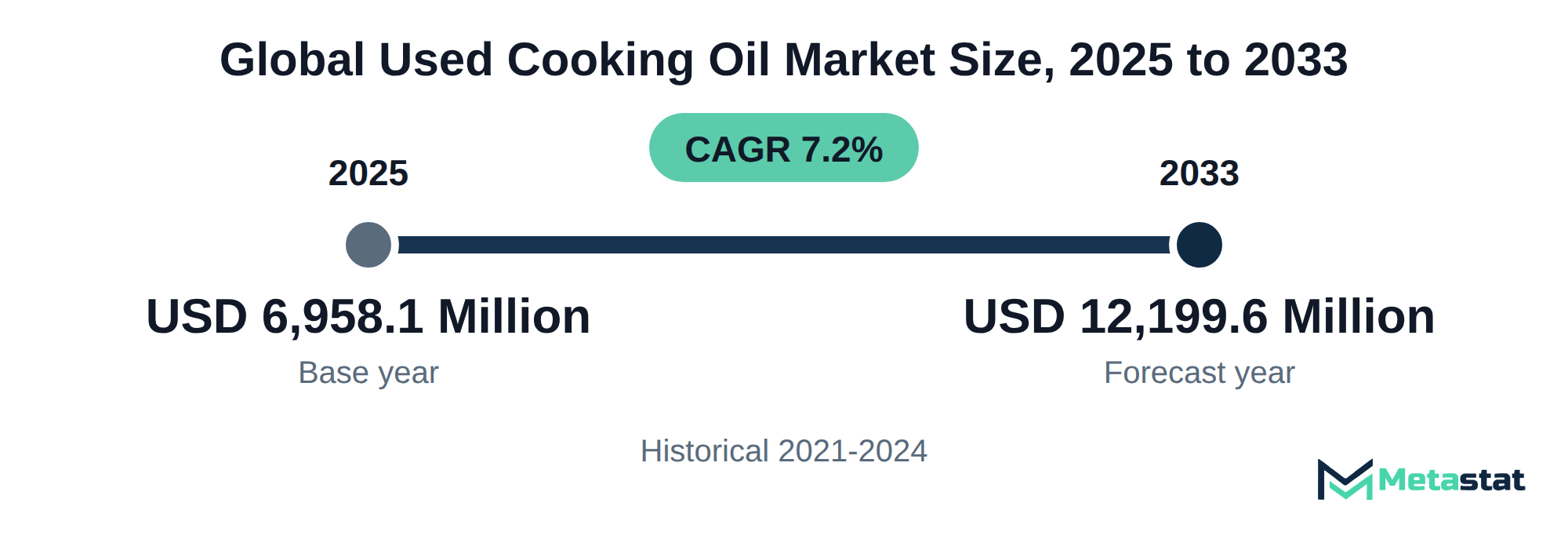
Market Valuation: Valued at $6,958.1 Million in 2025, projected to reach $12,199.6 Million by 2033 at a 7.2% CAGR.
Dominant Segment: The food service establishments segment leads the market, driven by significant consumption patterns and a strong focus on sustainability initiatives. This segment is projected to grow from USD 4,338.1 million in 2026 to USD 6,866 million by 2033, reflecting a CAGR of 6.8%.
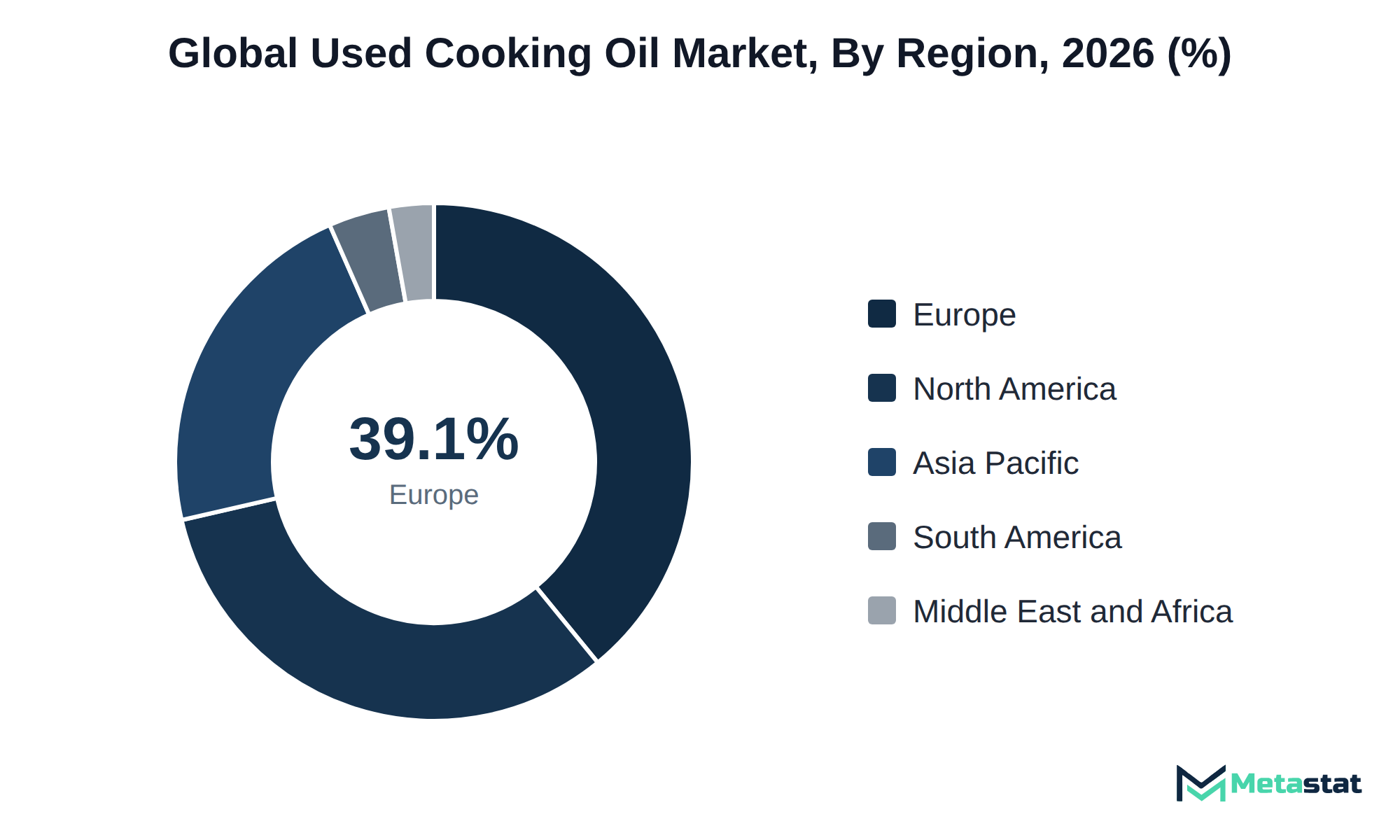
Geographic Lead: Europe commands the largest share of the market, accounting for 39.1% in 2025, supported by stringent environmental regulations and a well-established recycling infrastructure. North America, particularly the US, is also a key player, holding 32.3% of the market in 2025.
What's Inside: The report provides a comprehensive analysis of the global Used Cooking Oil market, including detailed segmentation by source, application, oil origin, and processing grade. It covers competitive landscape insights, market dynamics, and future growth forecasts.
Growth in Food Service Establishments: The food service establishments segment is experiencing notable growth due to increasing awareness of sustainability and waste management practices. This shift is prompting restaurants and food outlets to recycle used cooking oil, enhancing profitability through cost savings.
Choose Your License
Global Used Cooking Oil Market
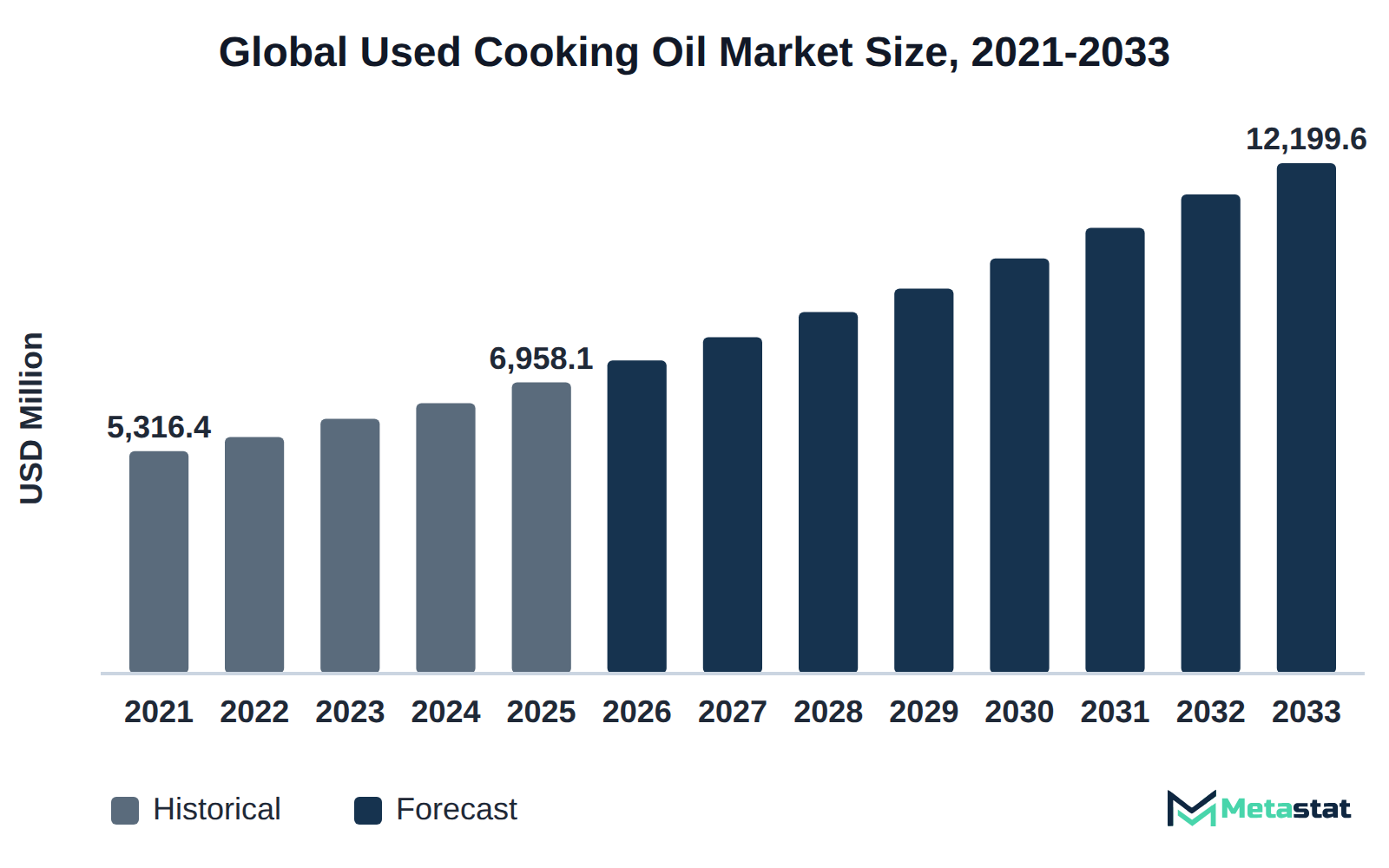
The global Used Cooking Oil market was valued at USD 6,958.1 million in 2025 and is projected to reach USD 12,199.6 million by 2033, growing at a CAGR of 7.2% over the forecast period.
The Used Cooking Oil market covers the collection, processing, and distribution of the oil, a valuable resource for applications including biodiesel production and oleochemicals. Buyers invest in used cooking oil primarily to reduce costs associated with raw materials while contributing to sustainability efforts. This shift toward renewable energy sources drives demand across multiple sectors, including food service establishments and food processing facilities.
Growth in the market is propelled by a heightened focus on environmental sustainability and the increasing regulatory push for renewable energy solutions. The food service establishments segment represents the highest value, reflecting significant consumption patterns and operational needs. North America holds 32.3% of the market in 2025, with the US leading in 2026, which points to a well-developed framework for adopting used cooking oil.
Among the regions, Europe commands the largest share, driven by stringent environmental regulations and a well-established infrastructure for recycling used cooking oil. Regional dynamics indicate a strong commitment to sustainable practices, influencing investments in the market. The increasing demand for biodiesel and renewable diesel fuels results in substantial opportunities for growth within the industry.
The market serves multiple sectors, including biodiesel production, renewable diesel, and oleochemicals, reflecting a diverse application base. Buyers invest in used cooking oil primarily to meet sustainability goals while reducing waste disposal costs. The growing emphasis on environmentally friendly practices drives demand across industries, prompting a shift toward renewable energy sources and sustainable materials.
Food service establishments stand out as the most significant source segment, contributing substantial economic value. Europe follows closely, accounting for 39.1% of the total share, indicating robust interest in recycling and repurposing used cooking oil for various applications.
One main growth driver stems from increasing regulatory support for renewable energy initiatives, enhancing the recovery of used cooking oil for biodiesel production. This regulatory environment boosts investment in technology and infrastructure within the sector. Sustainability becomes a priority across industries, and the market is expected to expand, driving competition and innovation.
Traceability systems in the Used Cooking Oil market are essential for ensuring authenticity and quality. The rise of feedstock fraud raises concerns among buyers, highlighting the necessity for reliable verification methods. Significant investments in traceability technologies allow for the tracking of oil from its source to end-use applications. The rapid growth of food service establishments emphasizes the need for stringent controls to protect against fraudulent practices.
Adoption of technologies including blockchain and IoT (Internet of Things) offers transparent tracking of used cooking oil throughout the supply chain. These technologies facilitate verification of the origin of the oil, ensuring compliance with safety and quality standards. Suppliers strengthen their credibility and consumer trust, which matters in a competitive market. With increasing regulatory scrutiny, companies that implement strong traceability measures face lower risks from feedstock fraud, which supports market growth and stability.
In the Used Cooking Oil market, pretreatment enhances the quality and usability of oils for applications in renewable diesel and aviation fuel. By processing used cooking oil through methods including filtration and dewatering, the resulting product meets stringent specifications required by biodiesel producers and aviation fuel manufacturers. This pretreatment improves fuel efficiency and ensures compliance with environmental regulations.
The pricing structure for pretreatment services varies based on several factors including the source of the oil and the processing techniques employed. For instance, food service establishments, a major source of used cooking oil, often enter into contracts that outline pricing terms based on the volume of oil collected and the frequency of service. Contracts typically include provisions for price adjustments driven by market fluctuations in oil quality and availability, ensuring that suppliers remain competitive while maintaining profitability.
By 2033, the value of used cooking oil sourced from food service establishments is projected to reach USD 6,866 million, reflecting a compounded annual growth rate of 6.8%. This sharp increase highlights the growing demand for treated oils in renewable energy applications, incentivizing suppliers to refine their sourcing and pretreatment processes. Such dynamics in the market encourage investment in advanced pretreatment technologies, ultimately enhancing product quality and driving down costs for end users.
Recovering oil from households and commercial kitchens is central to sustainability initiatives within the Used Cooking Oil market. Households are projected to contribute significantly to the overall market, with an expected recovery value of USD 2,241.1 million by 2033. This substantial figure reflects increasing awareness among consumers regarding waste reduction and environmental impact, driving a shift toward responsible disposal methods.
Commercial kitchens, including restaurants and institutional kitchens, demonstrate distinct needs for managing used cooking oil. These establishments often generate large volumes of waste oil, necessitating efficient recovery and recycling processes. With a projected growth rate of 8.3% for institutional kitchens, the demand for streamlined oil recovery solutions is anticipated to rise. Players in the market benefit from targeted solutions tailored to these sectors, enhancing operational efficiency and reducing disposal costs.
The emphasis on recovery from these sources highlights the market's potential for growth through sustainable practices. Enhanced oil recovery initiatives contribute to the overall circular economy, supporting the development of renewable energy sources including biodiesel and sustainable aviation fuel. Waste management and energy production overlap in this market, which supports future investment and expansion.
The quality of used cooking oil significantly influences feedstock pricing within the market. Higher quality oils often yield better performance in applications, leading to increased demand and higher prices. For instance, biodiesel production sees a notable difference based on the quality of the oil sourced. In 2026, biodiesel application values start at USD 3,412.7 million and are expected to reach USD 4,981.1 million by 2033, indicating strong growth driven by demand for high-quality feedstock.
Feedstock quality affects both pricing and operational efficiency in processing facilities. Facilities processing lower-quality oil encounter higher purification costs and reduced yield in biodiesel production. This deters several suppliers from entering the market. The feedstock quality directly correlates with profitability margins for producers. Sourcing high-quality oil therefore becomes essential for companies seeking competitive pricing and sustainable operations in the used cooking oil market.
A notable trend in the Used Cooking Oil market involves rising demand for biodiesel production as a transportation biofuel. This increase is driven by a shift among various buyers, particularly from food service establishments and food processing facilities, seeking sustainable energy sources. The growth of environmental regulations and consumer preferences for renewable energy fuels has led to increased procurement of used cooking oil for biodiesel. The market's value for biodiesel applications is projected to expand from USD 3,412.7 million in 2026 to USD 4,981.1 million by 2033, reflecting a compound annual growth rate of 5.6%. This transformation highlights a significant opportunity for suppliers, incentivizing them to enhance collection and processing capabilities to meet the evolving needs of this expanding segment.
Increased demand for renewable diesel further contributes to growth in the Used Cooking Oil market. The evolving energy landscape emphasizes the importance of transitioning to sustainable fuel alternatives.
Innovations in processing methods significantly influence the dynamics of the Used Cooking Oil market. Enhanced technologies for oil extraction and purification improve the efficiency and quality of recovered oils, driving higher yields from the feedstock. Advanced filtration and treatment technologies separate impurities effectively, enabling the production of high-quality oils suitable for diverse applications, including biodiesel and renewable diesel. These improvements attract buyers from food processing facilities and institutional kitchens, seeking reliable feedstock that meets stringent quality standards.
Investment in state-of-the-art processing facilities reduces operational costs for suppliers, allowing them to compete effectively in the market. The application of new technologies supports scalability, enabling suppliers to respond to increasing market demand without significant capital expenditure. Enhanced processing capabilities provide suppliers with a competitive advantage, strengthening relationships with buyers who prioritize quality and sustainability. These technological advances support growth and investment in the market.
Fluctuations in the price of used cooking oil significantly impact the purchasing decisions of various buyer groups, particularly food processing facilities. Price instability often leads to smaller orders and delayed replacements, with companies hesitating to commit to higher costs. The biodiesel sector faces constraints when prices rise unexpectedly, prompting producers to seek alternatives or reduce production levels. Households, which contribute to the supply chain, exhibit cautious behavior when prices fluctuate, limiting their willingness to participate in collection programs. Rising prices lead to decreased overall demand for used cooking oil, affecting market growth prospects. This volatility introduces uncertainty, influencing budgeting and planning across sectors reliant on used cooking oil. Consequently, price fluctuations present challenges for maintaining consistent supply and demand dynamics within the market, hindering overall expansion and long-term investments.
Rising raw material costs create challenges for suppliers in the Used Cooking Oil market. Increasing demand for sustainable energy sources intensifies competition for feedstock, driving up acquisition expenses. Suppliers face pressure to maintain profit margins while adapting to fluctuating prices of used cooking oil.
To address these challenges, suppliers implement strategies focused on enhancing efficiency and reducing operational costs. Investments in advanced processing technologies streamline production, allowing for better yield from raw materials. Suppliers explore partnerships within the industry to secure stable sources of used cooking oil, helping to mitigate volatility.
These responses aim to stabilize profit margins and strengthen supply chain resilience. By prioritizing cost management and resource optimization, suppliers position themselves to compete effectively in the evolving market.
Food service establishments present significant growth opportunities within the Used Cooking Oil market. The increasing demand for used cooking oil from this segment is driven by a shift towards sustainability and the circular economy, prompting restaurants and food outlets to recycle their oil. This growth aligns with rising awareness of environmental benefits, encouraging food service operators to manage waste responsibly. Using used cooking oil for applications including biodiesel production or animal feed positions establishments favorably in the market, enhancing profitability through cost savings on waste disposal. This trend indicates a structural shift in operational practices, where waste transformation into a resource contributes positively to both business margins and environmental outcomes.
The Global Used Cooking Oil market is segmented based on Source, Application, Oil Origin, and Processing Grade.
Valued at USD 4,338.1 million in 2026, this segment is projected to reach USD 6,866 million by 2033, at a CAGR of 6.8% during the forecast period. Food service establishments primarily use used cooking oil for biodiesel production and feedstock for renewable diesel applications. The increasing focus on sustainability within the food industry drives demand in this segment, with many establishments seeking to minimize waste and maximize resource recovery. In contrast to other segments including households, which focus less on large-scale applications, food service establishments represent a lucrative market due to their significant oil consumption and processing capabilities. With a CAGR of 6.8%, this segment exhibits growth that surpasses growth rates observed in other segments, highlighting its essential role in the broader dynamics of the Used Cooking Oil market.
Food Processing Facilities segment is estimated to reach USD 2,394.8 million by 2033, at a CAGR of 7.8% during the forecast period. This segment primarily focuses on the collection and processing of used cooking oil from food manufacturing plants and processing facilities. Buyers in this segment include food manufacturers and processors that require used cooking oil for various applications, including biodiesel production. An increasing emphasis on sustainability and waste reduction drives demand in this segment, benefiting from heightened regulatory scrutiny on waste disposal practices. Compared to other segments, including households, the Food Processing Facilities segment demonstrates stronger growth potential, reflecting higher volumes of used oil generated. While the Institutional Kitchens segment experiences a CAGR of 8.3%, the Food Processing Facilities segment remains crucial for the overall growth of the market, contributing significantly to the supply chain for biodiesel and other applications.
The households segment is expected to reach USD 2,241.1 million by 2033. This segment primarily involves used cooking oil generated from residential cooking activities. Households serve various applications, including biodiesel and animal feed production, significantly contributing to sustainability efforts. Adoption of this segment benefits from increasing consumer awareness regarding environmental impacts, driving demand for recycling used cooking oil. Compared to other sources, households generally exhibit slower growth, with less consistent volumes generated in comparison to food service establishments, which are projected to grow significantly, reaching USD 6,866 million by 2033. This unique characteristic highlights the importance of educational campaigns focused on proper disposal and recycling methods, supporting overall market recovery efforts. The growth of the market is further supported by innovations in processing technologies that enhance oil quality, supporting its versatility across multiple applications.
Institutional kitchens serve a critical source for the collection of used cooking oil, projected to grow at a CAGR of 8.3% during the forecast period. These kitchens, which include large-scale operations including schools, hospitals, and catering services, use used cooking oil primarily for biodiesel production and other sustainable applications. Demand for sustainable practices drives this segment's growth, aligning with global initiatives aimed at reducing waste and promoting renewable energy sources. Compared to other segments, institutional kitchens represent a higher growth trajectory, responding to increasing environmental regulations and the push for greener energy solutions. This segment stands out in the oil source category because of its commitment to sustainability. Its operational practices align with environmental goals, which differentiates it from households and food service establishments.
This segment primarily serves the renewable energy sector, where biodiesel production employs used cooking oil as a feedstock. The growing global emphasis on reducing carbon emissions drives demand for biodiesel, attracting interest from energy producers and environmental regulators. Compared to other segments, including renewable diesel with a CAGR of 8.3%, biodiesel experiences slower growth, reflecting varying adoption rates and regulatory support. Factors influencing this segment include advancements in processing technologies and fluctuating oil prices, which affect production economics and market competitiveness. The sector's potential for sustainable energy generation makes it a focus area for investment and development.
Renewable diesel segment is estimated to reach USD 3,375.6 million by 2033, at a CAGR of 8.3% during the forecast period. This segment primarily serves various transportation sectors, where renewable diesel acts as a cleaner alternative to fossil fuels. Key users include fleet operators and transportation companies aiming to meet stringent emissions regulations. Strong demand for renewable energy sources drives interest in this segment, supported by government incentives promoting cleaner fuels. Compared to other applications, renewable diesel exhibits a higher growth rate, driven by advancements in technology that improve production efficiency and yield. This segment's faster growth relative to biodiesel, which has a CAGR of 5.6%, indicates a shifting preference toward renewable diesel solutions in the market.
Sustainable Aviation Fuel segment is expected to reach USD 1,514 million by 2033. This segment supplies fuel for the aviation industry, which increasingly seeks alternatives to fossil fuels to meet environmental regulations and reduce greenhouse gas emissions. The growing commitment to sustainability from airlines increases demand within this segment. Sustainable aviation fuel differentiates itself from other applications, exhibiting a relatively lower growth rate compared to biodiesel, with a projected CAGR of 6.5%, in contrast to biodiesel's 5.6%. The aviation sector's stringent quality requirements for fuel adoption poses a barrier to faster uptake. Overall, the focus on renewable energy sources across various industries, including aviation, drives significant interest in this segment, highlighting its role in the broader context of sustainability initiatives. The sustainable aviation fuel segment benefits from these trends and contributes to emissions reduction in the aviation sector.
Oleochemicals segment is projected to grow at a CAGR of 5.3% during the forecast period. This segment finds applications in the production of surfactants, lubricants, and personal care products, primarily used by manufacturers in these industries. Increasing awareness of sustainability drives demand for oleochemicals derived from renewable sources, including used cooking oil, appealing to environmentally conscious consumers. Vegetable-based oleochemicals draw on the same renewable oil supply, and vegetable oil is the largest oil origin segment in the used cooking oil market. Compared to other segments, oleochemicals exhibit steadier growth patterns, reflecting consistent demand for biodegradable and non-toxic alternatives in various applications. The segment faces pricing pressures due to fluctuating raw material costs, influencing manufacturers' sourcing decisions. While the market evolves, innovations in production technologies enhance yield efficiency and reduce operational costs, positioning oleochemicals as a strong option for companies transitioning to greener formulations.
Animal Feed serves as a valuable ingredient in animal nutrition, contributing to the feed industry. Various livestock producers and feed manufacturers incorporate this oil as a feed ingredient to enhance the energy content of animal diets. Demand for sustainable and cost-effective feed options drives interest in this segment. Increasing concern over feed costs influences the shift toward alternative ingredients, highlighting a growing preference for by-products like used cooking oil. This segment presents slower growth compared to biodiesel and renewable diesel, driven by regulatory support for animal feed applications. Unlike other segments, which focus on fuel applications, Animal Feed emphasizes nutrition, providing a unique avenue for used cooking oil. The market reflects a broader trend toward sustainability and resource efficiency, aligning with global initiatives for responsible animal husbandry.
This sub-segment comprises applications involving direct combustion and biogas feedstock. Energy producers and companies focused on renewable energy utilize this segment to address the growing need for sustainable energy sources. Demand for biogas feedstock enhances adoption across industries seeking environmentally friendly alternatives for energy generation. Regulatory support for renewable energy initiatives drives interest in sustainable solutions, leading to greater investment in technologies that convert used cooking oil into energy. Unlike the biodiesel and renewable diesel segments, which are anticipated to experience strong growth rates, this segment operates with less visibility and slower expansion dynamics. The varied applications of used cooking oil in energy production offer unique opportunities for organizations focused on sustainability and energy transition efforts, differentiating it from other application segments in the market.
Valued at USD 5,751.8 million in 2026, this segment is projected to reach USD 9,548.7 million by 2033, at a CAGR of 7.5% during the forecast period. Vegetable oil primarily serves the biodiesel and renewable diesel sectors, where it is used as a feedstock for fuel production. Demand for this segment is driven by the increasing adoption of biodiesel as an alternative energy source, particularly among environmentally conscious consumers and businesses. Compared to other oil origin segments, vegetable oil demonstrates a higher growth rate, with a CAGR of 7.5%, outpacing animal fat and mixed-origin oil. The sustainable nature of vegetable oil in energy production aligns with global trends toward cleaner energy solutions, enhancing its competitiveness against traditional fossil fuels and other oil origins.
Animal Fat segment is estimated to reach USD 834.5 million by 2033, at a CAGR of 6.5% during the forecast period. This segment primarily finds use in the production of biodiesel and renewable diesel, appealing to manufacturers focused on sustainable fuel alternatives. Demand for Animal Fat has increased due to rising emphasis on eco-friendly energy sources. Compared to segments including Vegetable Oil, which is projected to grow at a CAGR of 7.5%, Animal Fat experiences a slightly slower growth rate. Demand dynamics differ, with buyers of Animal Fat prioritizing cost-effectiveness and regulatory compliance in sourcing used cooking oil. The market benefits from a trend towards the use of animal fats in various biofuel applications, reflecting an ongoing shift towards sustainability in energy production.
Mixed-Origin Oil segment is expected to reach USD 1,816.5 million by 2033. This sub-segment typically consists of a blend of various oils, catering primarily to industries focused on biodiesel production and other applications that employ used cooking oil. Demand for this segment is influenced by the growing interest in sustainable and renewable energy sources, with biodiesel producers seeking to diversify their oil inputs. The unique composition of Mixed-Origin Oil allows it to serve specific applications that are not viable with single-origin oils, positioning it differently within the Used Cooking Oil market. Overall, this segment's versatility and adaptability play significant roles in expanding usage across multiple applications.
Crude Used Cooking Oil segment is valued at USD 2,057.3 million in 2026 and is projected to reach USD 2,880.3 million by 2033, at a CAGR of 4.9% during the forecast period. This segment serves multiple applications, primarily in biodiesel production and renewable diesel, appealing to suppliers in the energy sector. Demand is driven by the increasing emphasis on sustainable fuel alternatives and regulatory support promoting the use of renewable sources. Compared to other processing grades, crude used cooking oil exhibits slower growth, particularly when compared to filtered and dewatered used cooking oil, which grows at a CAGR of 6.9%. Price dynamics and end-user applications differentiate this segment, appealing to both biofuel producers and manufacturers seeking cost-effective feedstock for further processing. The market adapts to evolving environmental regulations that sustain its relevance and growth potential.
Filtered and Dewatered Used Cooking Oil segment is estimated to reach USD 5,711.9 million by 2033, at a CAGR of 6.9% during the forecast period. This segment finds significant application in the production of biodiesel and renewable diesel, serving key industries including transportation and energy. The demand for this type of oil is driven by stringent regulations aimed at reducing carbon emissions, which support the use of alternative fuels. Compared to other segments in the processing grade classification, including Crude Used Cooking Oil, which has a lower projected growth rate of 4.9%, Filtered and Dewatered Used Cooking Oil exhibits a faster growth trajectory. This segment’s higher demand reflects a shift toward environmentally friendly energy solutions, influencing investments and production methodologies among suppliers in the Used Cooking Oil market.
Valued at USD 3,607.4 million by 2033, this sub-segment focuses on the processing of used cooking oil into pretreated form, serving vital applications in biodiesel and renewable fuels. Pretreated Used Cooking Oil is primarily used by biodiesel producers and renewable fuel manufacturers seeking sustainable feedstock. Demand for this sub-segment is driven by increasing regulatory support for renewable energy sources and a shift towards environmentally-friendly fuels. Compared to other processing grades, including Crude Used Cooking Oil, this segment experiences higher growth rates, with a CAGR of 4.9% anticipated during the forecast period. The market benefits from advancements in processing technologies that enhance the quality and yield of pretreated oil, further reinforcing its role in the broader Used Cooking Oil market.
Based on geography, the Global Used Cooking Oil market is divided into North America, Europe, Asia-Pacific, South America, Middle East, and Africa.
Demand for the Used Cooking Oil market in North America stems primarily from food service establishments, which significantly contribute to the collection of used cooking oil. The region's infrastructure facilitates efficient processing and recycling of this resource, driven by strong regulations promoting sustainability and waste reduction. The United States, Canada, and Mexico actively participate in several initiatives aimed at enhancing biofuel production. North America accounted for 32.3% of the global market share in 2025. By 2033, the market is projected to reach USD 3,759.9 million, reflecting ongoing commitment to renewable energy sources and the circular economy. This growth aligns with increasing consumer awareness and corporate responsibility toward environmental sustainability within the region.
Strong demand for the Used Cooking Oil market in Europe stems from various sectors, primarily food service establishments and food processing facilities. The market benefits from an established regulatory framework that emphasizes sustainability and recycling, encouraging the collection of used cooking oil for biodiesel production and other applications. Countries including Germany and the UK display robust infrastructure supporting efficient processing and distribution of used cooking oil, enhancing market accessibility. Spain and Italy contribute significantly to the market, driven by their high levels of food production and consumption. By 2025, Europe is projected to hold a 39.1% share of the global market, highlighting its critical role in the broader used cooking oil market.
Asia-Pacific holds a significant presence in the Used Cooking Oil market, contributing 22.0% of the global share in 2025. Demand arises primarily from food service establishments, where high volumes of cooking oil are used. The region benefits from a growing biodiesel sector, with countries like China and India investing in renewable energy initiatives that promote the use of used cooking oil for biodiesel production. Infrastructure improvements enhance collection and processing capabilities across various countries, enabling efficient supply chains. The market is projected to expand due to rising adoption of sustainable practices. Southeast Asia demonstrates increasing interest in alternative energy sources, driving demand for used cooking oil applications.
In South America, the Used Cooking Oil market shows a unique demand landscape driven by food service establishments and household consumption. Brazil and Argentina represent the primary contributors to market growth, supported by increasing awareness of sustainability and environmental benefits associated with used cooking oil recycling. The region's limited infrastructure for efficient collection and processing of used cooking oil presents challenges that influence operational costs. The market's share of the global market in 2025 stands at 3.8%, reflecting growth potential in the coming years. Increased investment in processing technologies enhances the value derived from used cooking oil, facilitating broader application in biodiesel and renewable diesel production.
The Used Cooking Oil market in the Middle East and Africa focuses primarily on food service establishments and food processing facilities, which drive significant demand. Countries including Saudi Arabia, UAE, and South Africa demonstrate growth potential due to increasing awareness surrounding sustainability and renewable energy. Infrastructure developments and initiatives aimed at promoting biofuels support the adoption of used cooking oil for biodiesel production. With a projected market share of 2.8% in 2025, regional players focus on improving collection systems and processing capabilities to meet growing demand. Efforts to enhance oil quality through filtration and dewatering processes contribute to market expansion. Unique economic conditions in this region create an environment conducive to investments in sustainable solutions, reinforcing the market trajectory during the forecast period.
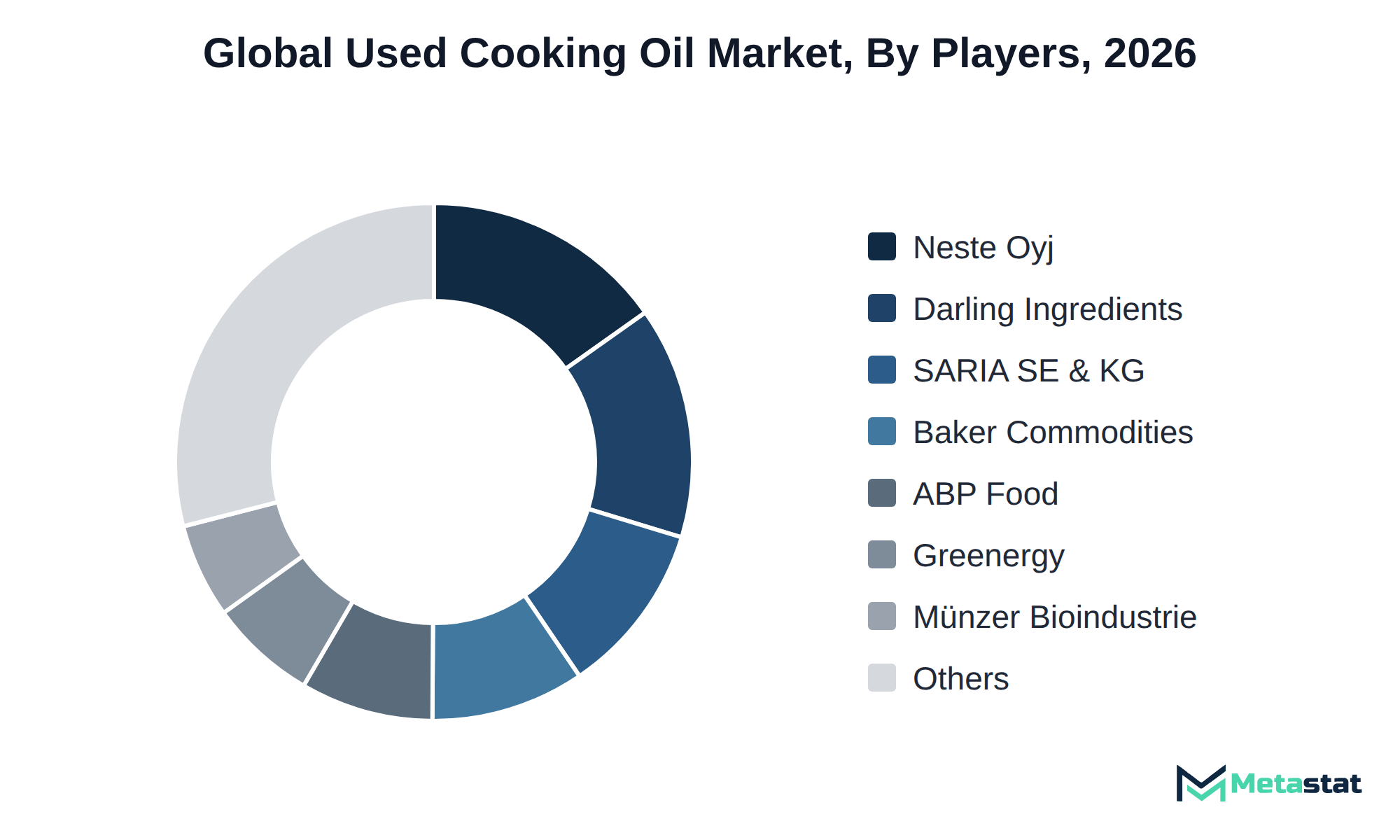
The Used Cooking Oil market features companies positioned across various segments, focusing on different operational strategies and customer needs. Suppliers including Darling Ingredients Inc. and Neste Oyj emphasize sustainability and quality, appealing to buyers prioritizing environmentally friendly options. Price competitiveness remains critical, with processors like Baker Commodities Inc. and ABP Food Group offering attractive pricing strategies to capture market share.
Industry players differentiate themselves through certification processes and customization capabilities. Companies like Greenergy and Veolia Environnement S.A. focus on providing certified products that meet specific regulatory requirements, enhancing their appeal to sectors requiring compliance. In contrast, firms including Quatra and West Coast Reduction Ltd. concentrate on service excellence, ensuring reliable delivery and customer support in a competitive environment. These strategies contribute significantly to buyers' selection processes within the market.
For the market to reach USD 12,199.6 million by 2033, several key developments will drive growth. First, demand from food service establishments is projected to grow from USD 4,338.1 million in 2026 to USD 6,866 million by 2033, making it a main driver of market expansion. Conversely, challenges exist that could hinder growth. Factors including regulatory constraints and competition from alternative feedstocks pose risks. The European region, with its stringent regulations and significant market share, faces particular pressure to adapt, which slows the overall expansion of the Used Cooking Oil market. Addressing these challenges effectively will be essential for realizing the forecasted market size and ensuring sustained growth in the coming years.
By Source: Food Service Establishments, Food Processing Facilities, Households, Institutional Kitchens
By Application: Biodiesel, Renewable Diesel, Sustainable Aviation Fuel, Oleochemicals, Animal Feed, Others (Direct Combustion, Biogas Feedstock)
The report strategically identifies and profiles the key market players and analyses their core competencies in each sub-segment of the Used Cooking Oil market.
|
Report Attributes |
Details |
|
Study Period |
2021-2033 |
|
Base Year |
2025 |
|
Estimated Year |
2026 |
|
Forecast Period |
2026-2033 |
|
Historical Period |
2021-2025 |
|
Growth Rate |
CAGR 7.2% from 2026 to 2033 |
|
Revenue Unit |
USD million |
|
Segmentation |
By Source, Application, Oil Origin, Processing Grade, and Region |
|
By Region |
North America (By Source, Application, Oil Origin, Processing Grade, and Country)
|
|
Europe (By Source, Application, Oil Origin, Processing Grade, and Country)
|
|
|
Asia Pacific (By Source, Application, Oil Origin, Processing Grade, and Country)
|
|
|
South America (By Source, Application, Oil Origin, Processing Grade, and Country)
|
|
|
Middle East and Africa (By Source, Application, Oil Origin, Processing Grade, and Country)
|
Find answers to common questions about this report
The Used Cooking Oil market size was valued at USD 6,958.1 million in 2025.
The market is projected to grow at a CAGR of 7.2% during the forecast period from 2026 to 2033.
The North America Used Cooking Oil market size is estimated to reach USD 3,759.9 million by 2033.
Food Service Establishments lead the Used Cooking Oil market with a projected value of USD 6,866 million by 2033, based on the highest forecast figure among the segments.
Rising demand for biodiesel production drives growth in the Used Cooking Oil market, particularly from food service establishments seeking sustainable energy sources. The increasing focus on sustainability and the circular economy among food service operators enhances the market's appeal, promoting responsible waste management practices.
Europe holds the dominant share of the Used Cooking Oil market, accounting for 39.1 percent in 2025. This figure surpasses that of North America, which holds a share of 32.3 percent.
Fluctuations in the price of used cooking oil significantly impact purchasing decisions, leading to smaller orders and delayed replacements. Rising raw material costs create challenges for suppliers, intensifying competition for feedstock and driving up acquisition expenses.
Rising demand for used cooking oil from food service establishments and food processing facilities drives adoption, reflecting a shift toward sustainability and the circular economy. This trend enhances profitability through cost savings on waste disposal while promoting responsible waste management practices.
The Used Cooking Oil market is estimated to reach a valuation of USD 12,199.6 million by 2033.
Key players operating in the Used Cooking Oil market include Darling Ingredients Inc., Neste Oyj, ABP Food Group, Baker Commodities Inc., SARIA SE & Co. KG, and Veolia Environnement S.A.
The analysts below cover Food and Beverages research at Metastat Insights.
LEAD ANALYST
Utkarsh Khirodkar is a Lead Market Research Analyst at MetaStat Insight, specializing in market intelligence, technology sector assessments, and competitive strategy.

LEAD PRINCIPAL ANALYST, PHARMA AND HEALTHCARE
Food and Beverages · Healthcare · Healthcare IT · Medical Devices
Ajay Devgire is the Lead Healthcare Analyst at MetaStat Insight, leading strategic research and market intelligence initiatives across the global healthcare domain.

SENIOR RESEARCH ANALYST
Biotechnology · Food and Beverages · Medical Devices · Packaging
Snehal Pasalkar is a Research Analyst at MetaStat Insight, operating at the intersection of life sciences research, competitive strategy, and market intelligence.
Integrating zero-trust access controls across legacy electronic health record systems involves complex compliance overhead. Team produced an analysis that clearly separated identity governance and administration tools from privileged access management platforms. Their evaluation of HIPAA and GDPR compliance features across cloud native solutions gave our architecture group clear baseline criteria. The custom data request regarding biometric authentication adoption in hospital networks was returned promptly with clear documentation.
Evaluating calorific value requirements and air permit compliance across municipal waste facilities requires localized data. Metastat Insight structured their analysis around operational throughput capacity and feedstock composition variations in Latin America and Eastern Europe. Their competitive mapping of sorting equipment vendors helped clarify technology differences between optical separators and heavy media systems. The study provided an objective baseline during our capital expenditure reviews.
Decarbonizing industrial thermal processes hinges on refrigerant regulations and compressor efficiency limits. Metastat Insights delivered a thorough market analysis that evaluated natural refrigerants like CO2 and hydrocarbons against synthetic low-GWP alternatives. The breakdown of utility incentives and grid capacity constraints across key European manufacturing hubs offered valuable perspective. The follow-up conversation with their sector analysts addressed our specific questions on mechanical vapor recompression systems efficiently.
Explore related market intelligence reports worth reading alongside this one.
Starting from
$2950