
LEAD ANALYST
Utkarsh Khirodkar is a Lead Market Research Analyst at MetaStat Insight, specializing in market intelligence, technology sector assessments, and competitive strategy.

US Litigation Funding Market Size, Share, By Dispute Type (Commercial Disputes and Consumer / Personal Claims), By Funding Stage (Pre-Litigation Funding, Active Litigation Funding, and Post-Litigation Funding), By Funding Structure (Percentage of Recovery, Fixed Fee, and Hybrid / Combination Structures), By End Use (Individual Plaintiffs, Law Firms, Corporates, and Insolvency Practitioners and Trustees), Industry Analysis, Growth, Trends, and Forecast, 2026-2033
Report ID
MSI-5281
Published
September, 2026
Updated
Pages
303 Pages
Format
Historical
Base year
Forecast
Forecast period
Report Details
Market Valuation: Valued at $3,207.7 Million in 2025, projected to reach $6,162.6 Million by 2033 at a 8.5% CAGR.
Dominant Segment: Commercial disputes lead the US Litigation Funding market, accounting for 78% of total funding activity. This segment's growth is driven by robust adoption among corporates and law firms aiming to manage legal costs effectively.
Geographic Lead: The US is the primary market for litigation funding, with increasing demand driven by rising consumer and corporate litigation activities. The expansion of the digital economy and heightened consumer awareness are key factors propelling growth.
What's Inside: The report provides a comprehensive analysis of the US Litigation Funding market, including detailed segmentation by dispute type, funding stage, funding structure, and end use. It features competitive coverage and insights into market dynamics and future forecasts.
Emerging Market Dynamics: The market is poised for growth due to increasing regional demands and evolving buyer behaviors. Technological advancements and digital transformation initiatives are reshaping the landscape, enhancing competitiveness and expanding service offerings.
Choose Your License
US Litigation Funding Market
The US Litigation Funding market was valued at USD 3,207.7 million in 2025 and is projected to reach USD 6,162.6 million by 2033, growing at a CAGR of 8.5% over the forecast period.
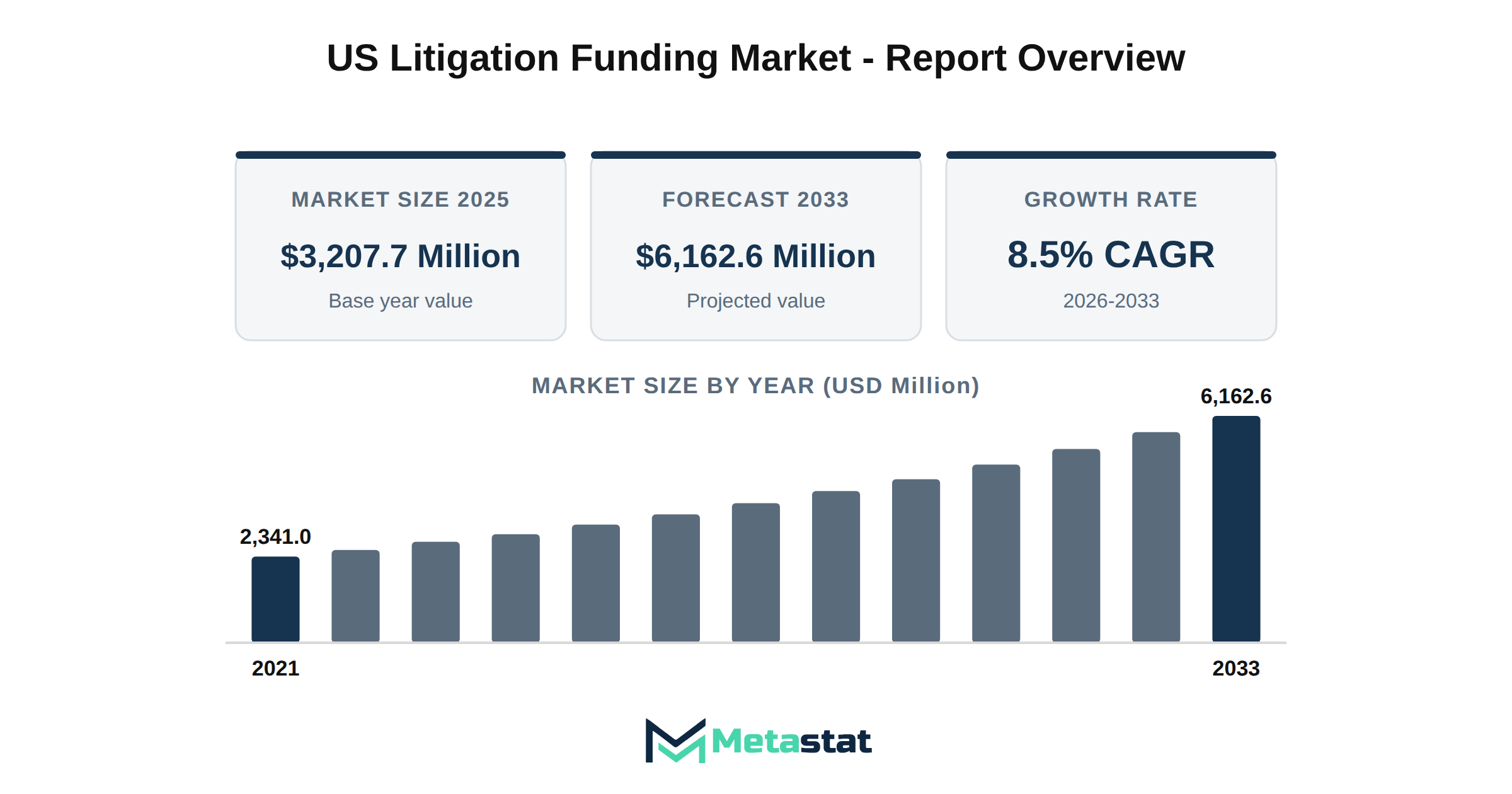
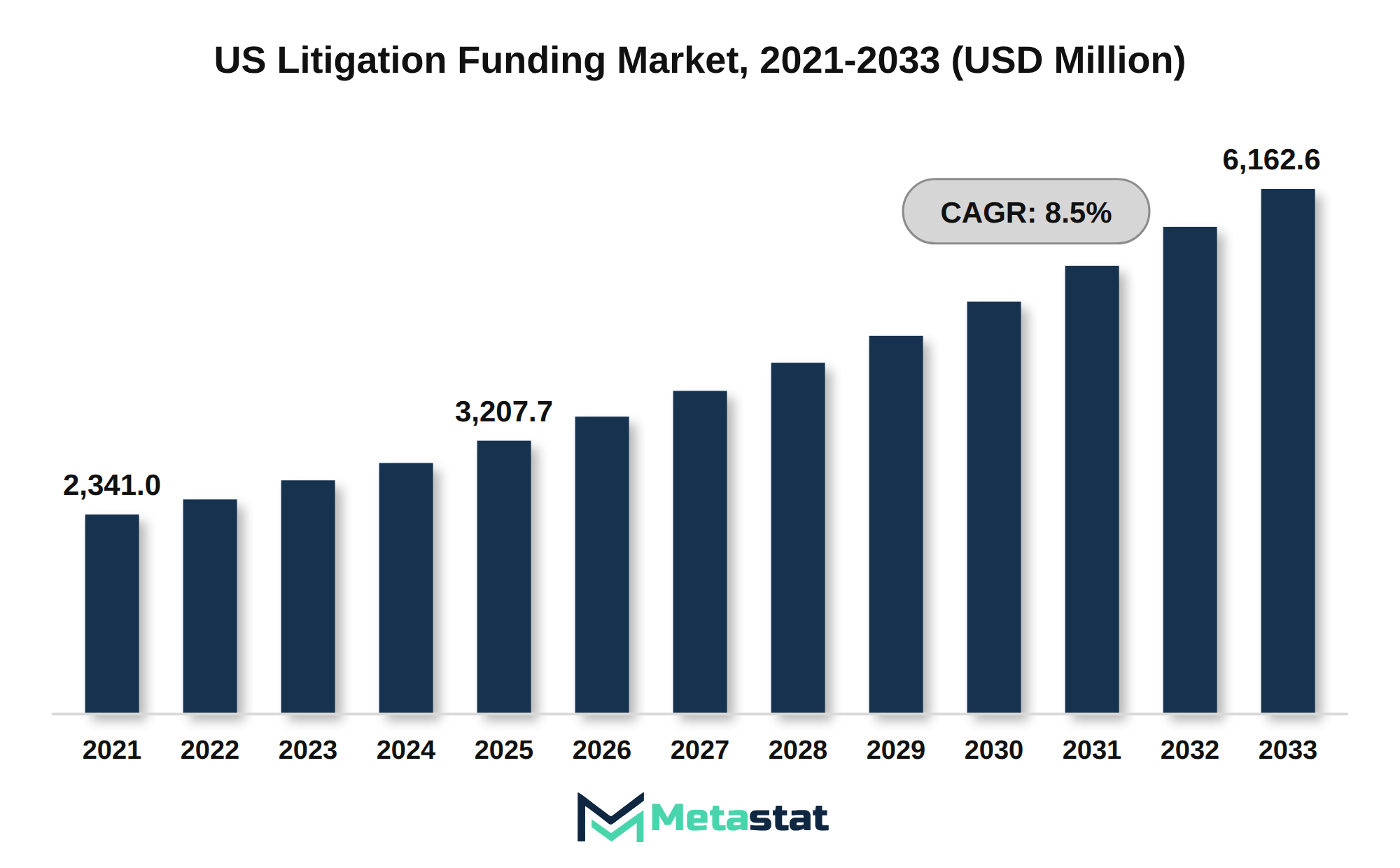
The US Litigation Funding market reached a valuation of USD 3,207.7 million in 2025 and is projected to expand to USD 6,162.6 million by 2033, reflecting a compound annual growth rate (CAGR) of 8.5%. The growth trajectory of the market reflects increasing demand for litigation funding solutions across various sectors, including commercial disputes and consumer claims.
Commercial disputes account for 78% of total funding activity. This segment benefits from robust adoption by corporates and law firms seeking to manage legal costs effectively while pursuing high-value claims. The demand for consumer and personal claims funding experiences growth, with this segment representing 22% of the market share. Heightened awareness of legal funding options among individuals contributes to this upward trend.
Pre-litigation funding exhibits strong demand due to its role in supporting early-stage claim financing. This funding stage is anticipated to grow from USD 2,151.9 million in 2026 to USD 3,593.4 million by 2033, achieving a CAGR of 7.6%. Active litigation funding, particularly for complex commercial disputes, remains a critical component of the market. This segment is projected to reach a value of USD 827 million by 2033, driven by the increasing complexity and financial stakes involved in these cases.
Post-litigation funding and judgment monetization trends reflect evolving strategies by litigants and funders. This segment serves because a crucial option for plaintiffs looking to capitalize on successful outcomes while managing cash flow. The market experiences a shift in litigation funding pricing models and return structure evolution, with a notable rise in percentage-of-recovery and hybrid funding structures. These models offer flexibility to both funders and claimants, aligning interests and enhancing funding accessibility.
Growth in the US Litigation Funding market is driven by increasing demand from corporates and law firms for commercial litigation funding. Corporates recognize litigation funding because a strategic tool to manage financial risk while pursuing high-stakes cases. Law firms leverage this funding to enhance their service offerings, allowing them to take on more complex cases without upfront financial burdens. This trend is projected to sustain growth, with corporates seeking to optimize their legal expenditures and ensure greater access to justice.
Consumer and personal claim funding is witnessing notable demand in the United States. Individuals increasingly seek funding solutions to pursue claims against larger entities, ensuring that financial constraints do not impede their access to legal recourse. This segment is expected to grow robustly, driven by heightened awareness of legal rights and the importance of funding in personal injury and consumer disputes.
The use of portfolio litigation finance among law firms is rising. Law firms are increasingly adopting portfolio financing models to manage multiple cases simultaneously, distributing risk while maximizing potential returns. This approach allows firms to stabilize cash flow and invest in more diverse case portfolios, which contributes to the overall growth in the market.
Single-case litigation funding is trending, particularly for high-value disputes. This model appeals to claimants seeking to maximize their potential recovery from significant lawsuits, allowing them to focus resources on litigation without financial strain. The trend highlights a shift towards bespoke funding solutions tailored to specific case needs.
Demand for pre-litigation funding and early-stage claim financing is gaining momentum. Claimants benefit from having financial support before litigation begins, enabling them to pursue their claims aggressively. This early-stage financing facilitates a smoother transition into the litigation process and enhances the chances of successful outcomes.
Active litigation funding for complex commercial disputes continues to expand. This funding type addresses the needs of businesses involved in intricate legal battles, providing necessary resources to navigate the complexities of litigation. The trend emphasizes the role of litigation funding in supporting businesses facing substantial legal challenges.
Post-litigation funding and judgment monetization are evolving. After a case concludes, many litigants seek to monetize their judgments, converting them into immediate cash. This trend reflects a growing acknowledgment of the importance of liquidity in managing financial resources after litigation.
Pricing models for litigation funding are experiencing significant evolution. The market is seeing a shift towards percentage-of-recovery and hybrid funding structures, allowing claimants to align their financial obligations with case outcomes. This flexibility supports broader market participation and enhances the attractiveness of litigation funding options.
Law firm financing and case portfolio monetization trends are changing the financial landscape within the market. Law firms increasingly rely on innovative financing solutions to manage operational costs and fund their case portfolios effectively. This dynamic enables firms to maintain competitiveness while pursuing larger and more complex cases.
Corporate adoption of third-party litigation finance has reached new heights. Corporates leverage litigation funding to mitigate financial risks associated with legal disputes, ensuring that they pursue necessary actions without jeopardizing operational cash flow. This trend highlights the strategic value of litigation funding for corporates aiming to safeguard their interests.
Opportunities for litigation funding in insolvency and bankruptcy claims are expanding. Financial distress situations often lead to complex legal disputes, and funding solutions help parties navigate these challenges effectively. This segment offers significant growth potential because stakeholders seek to maximize recoveries in difficult financial situations.
Regulatory and disclosure developments are shaping the market. Increased scrutiny around litigation funding practices is prompting providers to enhance transparency and compliance mechanisms. This evolution supports market integrity while promoting greater trust among participants.
State-level regulations regarding litigation funding are becoming more pronounced. Different states are implementing specific compliance requirements, impacting how funding providers operate in various jurisdictions. This regulatory landscape encourages firms to adapt their practices in line with local laws, ensuring sustained market growth.
Institutional capital deployment in US litigation finance is on the rise. Institutional investors recognize the potential returns associated with litigation funding, leading to increased capital inflows. This trend enhances the market's depth and competitiveness, allowing funding providers to offer more diverse financing options.
Competitive dynamics among litigation funding providers are intensifying. A growing number of entrants into the market encourages innovation and differentiation, compelling established players to refine their offerings. This competitive environment benefits claimants by providing a wider range of funding solutions tailored to their specific needs.
Underwriting and case selection trends among litigation funders are evolving. Providers are increasingly using data analytics to assess risks and identify high-potential claims. This analytical approach enhances decision-making processes and allows funders to optimize their investment strategies.
Technology and data analytics play a crucial role in litigation funding underwriting. Enhanced analytical capabilities enable funders to evaluate claims more effectively, leading to better-informed funding decisions. This integration of technology supports a more efficient underwriting process and contributes to the overall growth of the market.
AI-enabled legal claim assessment is emerging because a significant trend in funding decisions. Leveraging artificial intelligence allows funders to analyze vast amounts of data and assess claims with greater accuracy. This advancement ensures that funding decisions are based on comprehensive insights, thereby enhancing the quality of funding available in the market.
Secondary market activity for litigation claims and legal assets is gaining traction. Investors are increasingly exploring opportunities to purchase claims, which adds liquidity to the market. This trend supports broader participation and investment in litigation funding, enhancing its overall appeal.
Litigation funding trends in commercial arbitration and dispute resolution are evolving. While businesses seek alternative dispute resolution methods, funding solutions tailored for arbitration cases are expanding. This shift reflects the increasing recognition of litigation funding because a viable option across various dispute resolution mechanisms.
Funding demand across intellectual property and antitrust litigation is experiencing growth. The complexities involved in these cases often necessitate substantial financial resources, making litigation funding an appealing solution for stakeholders. This trend highlights the market's adaptability in addressing the unique challenges presented by specialized legal disputes.
Personal injury and consumer legal funding growth trends indicate a strong upward trajectory. Individuals pursuing claims in these categories increasingly rely on funding to overcome financial barriers, supporting broader access to justice. This growth supports the overall expansion of the market.
Law firm working capital and litigation expense financing demand is strengthening. Law firms require financial resources to sustain operations and manage litigation costs effectively. This demand illustrates the vital role of litigation funding in supporting legal practices and ensuring continuity in operations.
The US Litigation Funding market experiences growth driven by rising consumer and corporate litigation activities. Factors including increased legal disputes across various sectors drive demand for funding solutions. The expansion of the digital economy, combined with heightened consumer awareness of legal rights, contributes to a surge in personal claims, further influencing market dynamics.
Corporate entities, facing complex regulatory environments and competitive pressures, increasingly seek litigation funding to manage risks associated with legal disputes. This trend leads businesses to view litigation financing because a strategic tool for safeguarding financial interests while pursuing claims. The interdependence of economic conditions and litigation funding reflects a robust link between macroeconomic factors, including GDP growth and consumer spending patterns, and the overall health of the market.
The increasing prevalence of commercial disputes, particularly in sectors including technology and finance, supports the expansion of pre-litigation funding options. This funding mechanism allows entities to pursue claims without incurring upfront legal costs, aligning with the financial strategies of organizations seeking to mitigate risks and optimize their cash flow. Overall, enhanced consumer awareness and corporate engagement in litigation fuel significant growth in the US Litigation Funding market.
The US Litigation Funding market benefits significantly from advancements in technology and digital transformation. The integration of automation, artificial intelligence, and software solutions enhances operational efficiency across funding stages. These technologies streamline case assessment processes, enabling faster evaluation and funding decisions, which attracts more clients seeking financial support for litigation.
Growing reliance on digitizing legacy processes positions firms to better serve individual plaintiffs and law firms by improving turnaround times and reducing costs. Enhanced data analytics capabilities facilitate better risk assessment, allowing funders to optimize portfolios and allocate resources more effectively. This shift improves operational standards in the market and drives revenue potential by expanding access to funding options.
While the market evolves, technological integration creates competitive advantages for firms that adopt these innovations. Embracing new tools and methodologies increases client engagement and satisfaction while positioning firms to capture a larger share of the growing demand for litigation funding. These dynamics contribute to the overall expansion and maturation of the US Litigation Funding market.
The US Litigation Funding market faces significant constraints from regulatory compliance and inflationary pressures. The evolving regulatory environment introduces complexities that increase the operational burden for funding firms. Compliance hurdles require legal assessments and adjustments to funding structures, introducing delays and additional costs. These factors create barriers for new entrants and established players aiming to expand their market presence.
Inflationary pressures compound the challenges faced by market participants. Rising costs of legal services and litigation-related expenses impact the overall funding landscape. Legal mandates, which demand higher transparency and accountability, escalate operational costs. This environment limits the financial flexibility of funding firms, affecting their ability to deploy capital effectively.
Macroeconomic headwinds contribute to a cautious investment climate. Economic uncertainty influences litigation trends, affecting demand for funding services. Funders hesitate to commit capital without assured returns, leading to a slowdown in funding activity. This stagnation impacts the overall growth trajectory of the US Litigation Funding market.
In addition, market fragmentation presents challenges for scalability and integration. Diverse funding structures and varying legal interpretations across jurisdictions create complexities that hinder standardization. This fragmentation slows market adoption and complicates strategic initiatives aimed at enhancing market share. These factors create an environment where operational stability and growth become increasingly difficult to achieve.
The US Litigation Funding market encounters challenges stemming from geopolitical fragmentation and widening trade deficits. Political tensions and trade disagreements lead to increased tariffs, creating friction that affects cross-border financial agreements and investments. This situation results in heightened costs for litigation funders, influencing their pricing strategies and operational margins.
Technological disruptions pose challenges for the market. Rapid advancements in technology necessitate significant investments in infrastructure and integration, which strain resources for litigation funders. Complex research and development integrations complicate the process of aligning new technologies with existing legal frameworks, affecting efficiency.
The market faces pressures from evolving legal liabilities and compliance overhead. Increasing scrutiny on litigation funding practices prompts funders to invest in compliance measures, diverting resources away from potential growth areas. The tightening of regional regulatory standards results in operational hurdles that funders navigate, impacting profitability.
In addition, rising input cost structures and margin pressures limit the ability of funders to offer competitive rates. Balancing operational costs with client expectations creates a challenging environment for sustained growth. Workforce skill gaps exacerbate these challenges, owing to the difficulty in finding talent with expertise in both law and finance.
Overall, the confluence of these factors creates a complex environment for the US Litigation Funding market. Addressing geopolitical tensions, technological demands, and regulatory complexities will be essential for funders aiming to maintain a competitive edge while navigating the evolving legal and financial landscape.
The US Litigation Funding market exhibits significant opportunities driven by increasing regional demands and evolving buyer behaviors. Expansion across geographical boundaries allows firms to tap into new customer bases, resulting in heightened competition and investment. The shift toward strategic consolidation and cross-industry mergers enhances operational efficiency and expands service portfolios, benefiting end users.
Technological disruptions and digital transformation initiatives reshape the market. Operators leveraging innovative funding structures enhance their competitiveness, capturing diverse segments including individual plaintiffs and corporates. The shift toward digital procurement models streamlines processes, optimizing operational yields and improving client engagement.
Sustainability imperatives and ESG-driven alignments play a crucial role in market development. Firms focusing on eco-friendly practices and regulatory compliance enhance their attractiveness to socially conscious investors and clients. This focus increases market penetration and opens avenues for niche applications within the industry.
Forecasts indicate that the market is projected to reach USD 6,162.6 million by 2033, reflecting a compound annual growth rate of 8.5 percent. The anticipated growth highlights the market's resilience and adaptability, affirming its relevance in an evolving legal and financial environment.
The US Litigation Funding market is segmented based on Dispute Type, Funding Stage, Funding Structure, and End Use.
Valued at USD 2,709.7 million in 2026, the Commercial Disputes segment is projected to reach USD 4,617 million by 2033, at a CAGR of 7.9% during the forecast period. Demand for litigation funding in commercial disputes stems from increasing complexities in business transactions and heightened awareness of available funding options among companies. This segment attracts significant interest from corporations facing costly litigation, enabling better financial management and risk mitigation related to legal expenses.
Growth catalysts for this segment include rising business activity and the prevalence of disputes resulting from contractual agreements. Increased adoption of litigation funding by law firms provides a further boost, facilitating access to capital for their corporate clients. The potential for substantial recoveries in commercial disputes enhances the attractiveness of funding arrangements, leading to more corporations seeking external financial support.
End-use dynamics show that corporations increasingly consider litigation funding a strategic tool rather than a last resort. This shift influences consumption patterns, with more businesses opting for pre-litigation funding to enhance their negotiating leverage in disputes. Evolving regulatory compliance standards promote the legitimacy of litigation funding, increasing confidence among users in the US Litigation Funding market.
Pricing volatility in legal services affects the cost structures associated with litigation funding. Fluctuations in legal fees and case durations influence funding terms, prompting funders to adjust their pricing strategies. Understanding these dynamics and maintaining flexible pricing models becomes essential for sustaining profitability within the segment.
Strategic opportunity windows arise from the ongoing expansion of the commercial sector and an increasing volume of disputes. The potential for innovative funding structures, including hybrid models that blend fixed fees with percentage recovery arrangements, equips funders to better meet the diverse needs of corporate clients. The outlook for investment in this segment remains positive, driven by continued capital inflow into the US Litigation Funding market, positioning it for sustained growth through 2033.
Growth in the Consumer / Personal Claims segment stems from increased awareness among individuals regarding their legal rights and options for funding litigation without upfront costs. Rising medical expenses, personal injury claims, and consumer disputes drive demand for litigation funding. Individuals facing financial challenges while pursuing claims find funding solutions attractive, allowing them to maintain their legal pursuits.
This segment is projected to reach USD 1,545.6 million by 2033, at a CAGR of 10.3% during the forecast period. The evolving legal landscape and a heightened focus on consumer rights contribute to this expansion, creating a favorable environment for growth in the market. Innovative funding models and simplified application processes enhance accessibility for individual plaintiffs, further propelling the segment's growth.
Regulatory changes aimed at protecting consumers reinforce the segment's momentum, ensuring transparency and fairness in funding agreements. Increased litigation activity across various sectors, including personal injury and family law, provides additional opportunities for the consumer claims segment. Overall, the strategic focus on consumer advocacy and financial empowerment enhances the prospects for litigation funding in this area.
Pre-Litigation Funding segment is valued at USD 2,151.9 million in 2026 and is projected to reach USD 3,593.4 million by 2033, at a CAGR of 7.6% during the forecast period. Demand for pre-litigation funding arises from the increasing need for individuals and businesses to secure financial resources before entering the courtroom. Law firms and individual plaintiffs increasingly rely on this funding to enhance their negotiation power and ensure access to necessary legal services. The segment expansion reflects a broader trend of financial innovation within the US Litigation Funding market, where traditional financing options lack flexibility.
Technological advancements play a crucial role in driving the growth of the pre-litigation funding segment. Enhanced data analytics and algorithm-driven assessments streamline the evaluation process for funding applications, enabling quicker decision-making. This efficiency attracts more applicants, resulting in increased competition among funding providers. The segment's growth is expected to benefit from the rising acceptance of litigation funding in various sectors, including personal injury and commercial disputes, leading to greater awareness among potential users.
Regulatory compliance remains an essential factor influencing the pre-litigation funding landscape. States implementing clearer guidelines for litigation funding support market stability and build trust among participants. Despite occasional policy headwinds, the overall legal framework encourages the growth of pre-litigation funding, enabling better service offerings to clients. Cost structures within this segment are becoming increasingly competitive, with firms exploring innovative pricing models that cater to diverse client needs, further supporting adoption rates.
The pre-litigation funding segment within the US Litigation Funding market shows a robust trajectory driven by growing demand, technological advancements, and regulatory clarity. This environment creates investment opportunities and strategic partnerships among key players, ultimately enhancing service offerings and supporting market expansion.
Active litigation funding faces strong demand from various entities involved in disputes. This demand primarily stems from individuals and law firms seeking financial support during ongoing legal actions. While the legal landscape evolves, an increasing number of plaintiffs recognize the potential benefits of securing funding to manage litigation costs. This segment is projected to reach USD 827 million by 2033, reflecting a CAGR of 7.2% during the forecast period.
Significant factors contributing to segment expansion include heightened awareness of litigation funding solutions and increased acceptance among legal practitioners and clients. Growing consumer interest in understanding alternative financing options influences adoption rates and encourages law firms to integrate funding solutions into their service offerings. The market experiences a shift towards digital platforms that facilitate funding processes, enhancing efficiency and accessibility for potential clients.
Pricing dynamics play a critical role in shaping the landscape of active litigation funding. Competitive pricing structures enable law firms to offer funding solutions that align with clients' financial capabilities. This flexibility supports wider adoption, particularly among individual plaintiffs who face financial obstacles in pursuing litigation. Advancements in technology streamline processes, reducing costs associated with funding applications and approvals.
End-use dynamics highlight a notable trend towards individual plaintiffs seeking funding, driven by a desire for equitable access to justice. While awareness of funding options increases, more clients engage with litigation funding providers to alleviate financial burdens during legal proceedings. This shift emphasizes the importance of targeted marketing strategies tailored to individual plaintiffs, ensuring effective outreach and communication regarding available funding solutions.
The US Litigation Funding market functions within a regulatory framework that influences operational practices. Compliance with legal standards ensures that funding agreements maintain transparency and fairness for all parties involved. Ongoing assessments of regulatory compliance remain essential in maintaining trust within the market, thereby encouraging further growth and adoption of active litigation funding.
Growth in the Post-Litigation Funding segment reflects a notable increase in demand for financial solutions following legal disputes. This sector, valued at USD 1,742.2 million by 2033, benefits from trends in litigation practices that encourage clients to seek funding after litigation concludes. Increasing awareness of funding options drives adoption among individual plaintiffs and law firms, enabling them to secure financial support to cover costs associated with prolonged legal processes.
Funding structures in this segment, particularly fixed fee arrangements and recovery percentages, enhance attractiveness for clients. The segment displays a compound annual growth rate (CAGR) of 7.2% through 2033, supported by the rising need for accessible financial resources in the aftermath of litigation. Strategic opportunities exist for firms that specialize in post-litigation funding, targeting corporate clients and insolvency practitioners who seek to navigate complex financial landscapes.
Regulatory compliance standards play an essential role in shaping the market, influencing investment decisions and the willingness of stakeholders to engage in post-litigation funding. Firms that adapt to evolving regulations and maintain transparency in their operations position themselves favorably in this competitive environment. Overall, the US Litigation Funding market thrives owing to stakeholders increasingly recognizing the value that post-litigation funding brings to managing the financial aftermath of legal disputes.
Valued at USD 2,151.9 million in 2026, the Percentage of Recovery segment is projected to reach USD 3,593.4 million by 2033, at a CAGR of 7.6% during the forecast period. Primary demand drivers for this segment include increasing awareness of the benefits of litigation funding among plaintiffs and law firms. This awareness stimulates higher adoption rates, particularly within commercial disputes where funding for legal proceedings continues to grow.
Segment expansion catalysts include favorable regulatory environments and an increase in litigation cases across various sectors. These factors contribute to a robust pipeline of funding opportunities, allowing the market to thrive. Technological maturation enhances operational efficiencies and reduces the cost of capital, benefiting both funders and clients.
End-use dynamics play a crucial role, particularly among individual plaintiffs and law firms that seek to mitigate financial risks associated with prolonged legal battles. Consumption shifts towards more flexible funding models are evident, where clients express a preference for arrangements based on a percentage of recovery rather than fixed fees. This flexibility aligns with the evolving needs of customers, creating a competitive market.
Cost structures remain influenced by the performance of underlying cases and the resulting recovery rates. Pricing volatility in legal services directly impacts funding options, creating margin pressures that require careful management. Strategic opportunity windows exist for funders who adapt to changing market conditions and provide tailored solutions to diverse client needs.
Overall, the US Litigation Funding market presents a strong outlook driven by significant growth in the Percentage of Recovery segment, underpinned by increasing demand, evolving client preferences, and a supportive investment landscape.
Growth in the Fixed Fee segment reflects a shift towards predictable pricing structures within the US Litigation Funding market. Clients increasingly prefer fixed fee arrangements owing to the transparency and risk mitigation they offer. This preference aligns with the evolving needs of stakeholders, including law firms and individual plaintiffs, who seek financial stability during litigation processes.
Fixed Fee segment is estimated to reach USD 827 million by 2033, at a CAGR of 7.2% during the forecast period. The segment's growth benefits from rising acceptance among law firms and corporates, who recognize the advantages of fixed fees in budgeting for legal expenses. The segment gains traction because firms streamline operations and enhance service offerings, which strengthens their competitive positions.
Technological advancements and product evolution further support the Fixed Fee segment. Innovative platforms enable more efficient handling of case assessments and funding applications, enhancing the overall customer experience. Increased demand for transparency in pricing creates a favorable environment for fixed fee arrangements, driving further adoption across the market.
Regulatory compliance standards influence the growth of fixed fee funding structures. Legal professionals increasingly focus on compliance with evolving regulations, prompting a shift towards funding solutions that align with best practices. This dynamic contributes to a more robust framework for fixed fee arrangements, positioning them because a trusted option for a variety of stakeholders in the market.
Expectations for the Hybrid / Combination Structures segment reflect its projected growth to USD 1,742.2 million by 2033. This segment experiences increased adoption due to favorable conditions for funding models that blend various approaches, appealing to a broader range of litigants. The flexibility offered by hybrid structures attracts individual plaintiffs and law firms, facilitating access to capital for cases that do not fit traditional funding criteria.
Significant demand arises from the necessity for tailored financing solutions, particularly in complex legal disputes. This segment benefits from ongoing technological maturation, leading to more efficient assessment and management of litigation risks. Consequently, a robust competitive environment emerges, prompting firms to innovate their offerings and respond to changing client needs effectively.
Investments in hybrid models provide strategic opportunities for funders to differentiate themselves within the US Litigation Funding market. The anticipated increase in consumer and personal claims further supports segment growth, driven by heightened public awareness of litigation funding options and their potential benefits. This evolving landscape highlights the importance of hybrid structures in meeting diverse client requirements and enhancing overall market dynamics.
Valued at USD 878.1 million in 2026, the Individual Plaintiffs segment is projected to reach USD 1,715.7 million by 2033, at a CAGR of 10% during the forecast period. This segment experiences growth driven by increasing awareness among individuals regarding their legal rights and the financial support available for litigation. The rise in consumer and personal claims reflects a growing trend of individuals seeking litigation funding to pursue valid claims without the burden of upfront legal costs.
Adoption of litigation funding continues to expand due to a shift in consumer behavior, with individuals more frequently turning to external funding options to finance their legal battles. Legal service providers increasingly recognize the value of litigation funding in enhancing client service offerings, thereby influencing more plaintiffs to seek financial assistance. The market benefits from an increasing number of law firms collaborating with funding providers, creating a more supportive environment for individuals pursuing legal remedies.
The segment's growth is influenced by regulatory changes that encourage fair access to justice, enabling individuals to pursue claims without financial constraints. Evolving economic conditions and rising litigation costs drive individuals to seek funding solutions to alleviate financial pressures, further propelling demand within the US Litigation Funding market. Overall, the Individual Plaintiffs segment represents a critical area within the evolving landscape of litigation funding, highlighting the increasing reliance of individuals on external financial support in legal matters.
Demand for litigation funding within law firms continues to grow, driven by the increasing complexity of legal cases and the need for financial resources to support litigation efforts. Law firms face challenges in securing upfront fees from clients, prompting a shift towards third-party funding solutions that alleviate financial burdens. This trend allows firms to take on more cases, including those with higher risks and potential rewards.
Law firms are projected to reach USD 2,419.5 million by 2033, at a CAGR of 7.8% during the forecast period. This expansion reflects a strategic move towards innovative funding structures that enhance cash flow and manage litigation costs. Firms recognize the value of funding arrangements that align with case outcomes, allowing for more flexible financial planning.
The shift towards proactive case financing aligns with broader consumption trends in the market. Clients are more informed about their options, leading to greater acceptance of funding solutions because a viable means to pursue justice without upfront financial strain. Regulatory compliance in the legal sector supports the legitimacy of litigation funding, creating an environment conducive to its growth.
Technological advancements within law firms contribute to the market's evolution, enabling better case management and data analytics. These tools assist firms in evaluating case viability and potential returns on investment, driving informed decisions regarding litigation funding. The market for law firms continues to evolve alongside these developments, positioning them for sustained growth in the US Litigation Funding market.
Demand for litigation funding among corporates stems from an increasing recognition of the financial benefits associated with litigation strategies. Corporates often face significant legal challenges, driving the need for external funding solutions to manage cash flow and mitigate risks associated with protracted legal disputes. The segment is expected to reach USD 1,365 million by 2033, illustrating a strong upward trajectory.
Corporate clients exhibit a preference for pre-litigation funding, which enhances their ability to navigate complex legal environments while maintaining operational liquidity. This preference highlights a broader trend within the US Litigation Funding market, where organizations increasingly prioritize funding strategies that support their legal initiatives without compromising financial stability.
Technological advancements contribute to a more efficient funding process, allowing corporates to access financing options tailored to their specific needs. Enhanced data analytics and risk assessment tools enable funders to evaluate cases more effectively, promoting a conducive environment for litigation funding adoption within the corporate sphere.
Competitive pressures within industries compel corporates to pursue litigation funding because a strategic tool for legal leverage. Engaging in litigation without external funding strains internal resources, leading to unfavorable outcomes in disputes. By leveraging external funding, corporates position themselves to pursue legal action without jeopardizing their financial health.
Cost structures associated with litigation funding remain a crucial consideration for corporates. While funding solutions often entail fees based on case outcomes, the potential return on investment from successful litigation outcomes justifies these costs. This dynamic reflects a broader willingness among corporates to embrace funding models that align with their legal strategies.
The US Litigation Funding market anticipates significant growth in the corporates segment, driven by evolving legal landscapes and a heightened focus on risk management. With increasing awareness of the financial implications of litigation, corporates are likely to explore diverse funding structures to support their legal initiatives.
Growth in the Insolvency Practitioners and Trustees segment reflects a projected compound annual growth rate (CAGR) of 9.1% during the forecast period. This growth is driven by increasing demand for alternative funding solutions among insolvency practitioners, who require financial resources to manage complex cases. The ongoing evolution of financial products tailored to this segment enhances accessibility and appeals to practitioners seeking to mitigate cash flow constraints while navigating insolvency proceedings.
The US Litigation Funding market benefits from the rising number of insolvency cases, resulting in greater opportunities for funding providers to support practitioners. Continued technological advancements streamline the application and approval processes, facilitating the adoption of litigation funding. Practitioners recognize the advantages of such funding in enhancing case outcomes, and the segment is expected to attract substantial investment, reinforcing its growth trajectory.
Market participants focus on developing funding models that align with the specific needs of insolvency practitioners, enabling tailored financial solutions. This strategic alignment positions the segment favorably within the broader US Litigation Funding market, contributing to an overall expansion of funding opportunities.
Interest in litigation funding from diverse entities continues to shape the Others sub-segment within the US Litigation Funding market. Increasing awareness of the benefits associated with litigation financing drives this segment, capturing a range of unique clients who seek alternative funding solutions. The evolving landscape of legal disputes encourages various stakeholders to explore funding options beyond traditional avenues, contributing to a shift in demand dynamics.
Growth drivers within this segment include changes in regulatory frameworks that support litigation funding and an overall increase in legal claims across industries. The ability to finance litigation without upfront costs allows clients to pursue legal actions without financial strain. This factor encourages wider adoption among smaller firms and individuals who typically lack the resources to engage in lengthy legal battles.
Technological advancements enhance the segment's attractiveness, with platforms facilitating easier access to funding and improved transparency. Increased digitization in legal processes streamlines application procedures and reduces administrative burdens. Clients become more comfortable with technology-driven solutions, leading to a notable expansion in participant engagement within the market.
The Others segment presents strategic opportunity windows for investors and providers within the US Litigation Funding market. By addressing the unique needs of this diverse clientele, stakeholders capitalize on shifts in demand while supporting long-term growth through tailored funding solutions.
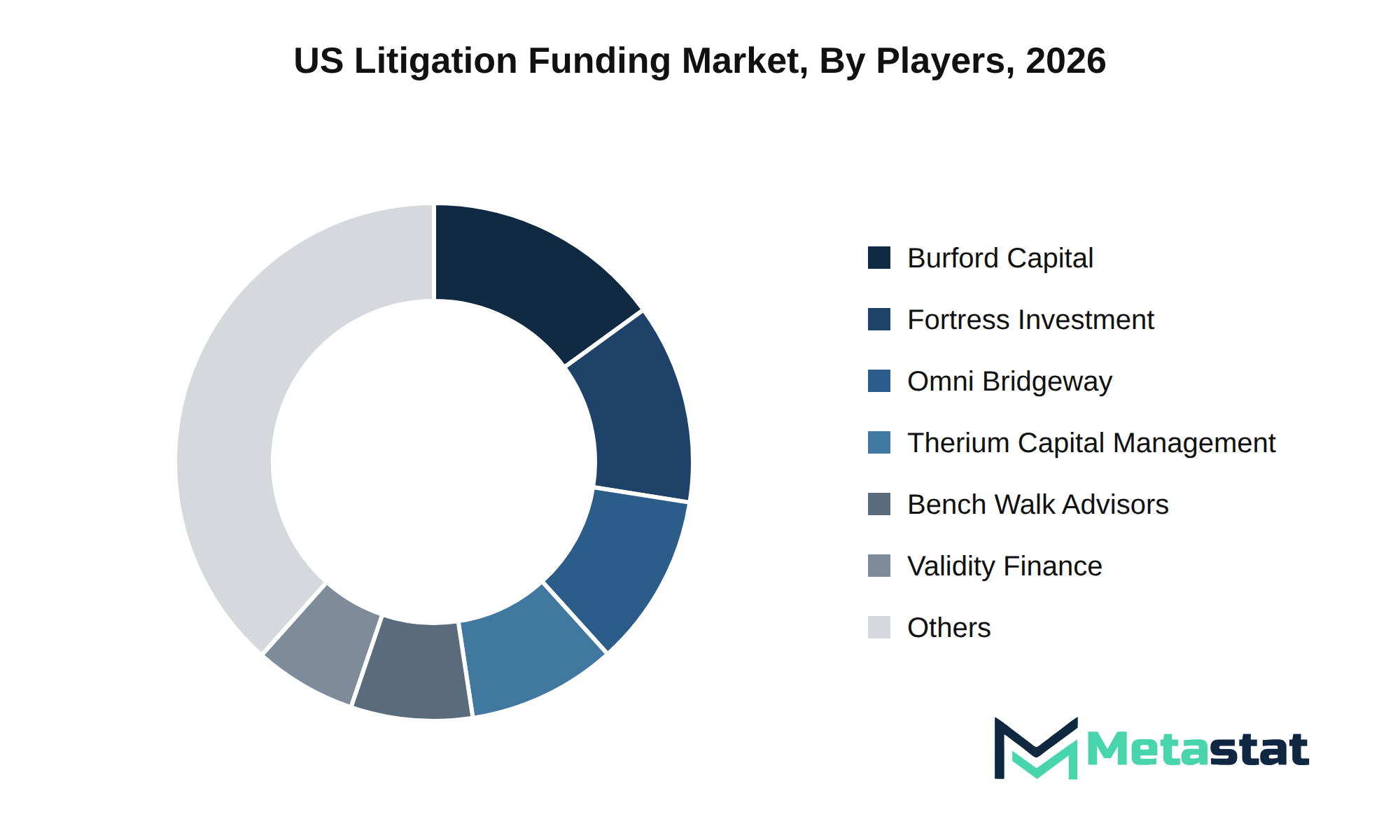
The US Litigation Funding market features several prominent players actively engaged in various strategic behaviors to enhance their market positions. Companies including Burford Capital Limited, Omni Bridgeway Limited, and Fortress Investment Group LLC employ aggressive go-to-market strategies, focusing on expanding their client bases and service offerings. These strategies include forming strategic alliances and leveraging existing customer relationships to drive growth.
Product differentiation remains a key focus within the market, with firms like Therium Capital Management and Parabellum Capital LLC investing in proprietary technology to create competitive advantages. This emphasis on unique offerings enhances customer retention and establishes significant barriers to entry for potential new entrants. Companies including Bench Walk Advisors LLC and Validity Finance, LLC prioritize developing comprehensive intellectual property portfolios, which strengthen their market defensibility and mitigate technological disruption risks.
The competitive outlook indicates a trend toward consolidation, with firms exploring mergers and acquisitions to streamline operations and achieve greater market share. In this evolving landscape, understanding customer preferences and maintaining brand equity become essential for sustaining a competitive edge. While the US Litigation Funding market continues to expand, strategic growth vectors are likely to emerge, further intensifying competition among industry players.
Market size is forecast to rise from USD 3,207.7 million in 2025 to over USD 6,162.6 million by 2033. The base case anticipates a steady growth trajectory at an 8.5% CAGR, indicating robust demand for litigation funding services across various sectors.
The bull case envisions an accelerated growth rate driven by increased adoption of litigation funding among corporate clients and law firms. Expanding awareness of funding options and favorable regulatory environments enhance investment activities within the market. In contrast, the bear case highlights potential challenges, including economic downturns and shifts in regulatory frameworks, which could constrain market growth by impacting available capital for litigation funding.
Factors including macroeconomic conditions, evolving demand trends, and advancements in technology will shape the future outlook of the US Litigation Funding market. Continuous investment in research and development, along with strategic capital allocations, supports the integration of next-generation technologies, enhancing operational efficiency and expanding service offerings. These developments create competitive advantages for key participants in the market.
Overall, the US Litigation Funding market is poised for significant growth, driven by structural shifts in demand and technological advancements, with a clear trajectory towards enhanced service delivery and market penetration through 2033.
The report strategically identifies and profiles the key market players and analyses their core competencies in each sub-segment of the Litigation Funding market.
|
Report Attributes |
Details |
|
Study Period |
2021-2033 |
|
Base Year |
2025 |
|
Estimated Year |
2026 |
|
Forecast Period |
2026-2033 |
|
Historical Period |
2021-2025 |
|
Growth Rate |
CAGR 8.5% from 2026 to 2033 |
|
Revenue Unit |
USD million |
|
Segmentation |
By Dispute Type, Funding Stage, Funding Structure, End Use, and Region |
Find answers to common questions about this report
The Litigation Funding market size in the United States was valued at USD 3,207.7 million in 2025.
The US Litigation Funding market is projected to grow at a CAGR of 8.5% during the forecast period from 2026 to 2033.
The Commercial Disputes segment leads the US Litigation Funding market with a projected value of USD 4,617 million by 2033, compared to the Consumer / Personal Claims segment, which is expected to reach USD 1,545.6 million in the same year.
Key drivers for the US Litigation Funding market include rising consumer and corporate litigation activities, increased legal disputes across various sectors, and the expansion of the digital economy. Enhanced consumer awareness of legal rights and corporate entities seeking funding to manage risks associated with legal disputes further fuel market growth.
The US Litigation Funding market faces constraints from regulatory compliance complexities and inflationary pressures. Rising legal service costs and stringent regulatory mandates increase operational burdens for funding firms, limiting their financial flexibility and affecting capital deployment. market fragmentation complicates standardization, hindering growth and scalability.
Enhanced consumer awareness of legal rights and rising corporate litigation activities favor product adoption in the US Litigation Funding market. The expansion of the digital economy and the increasing complexity of regulatory environments further drive demand for funding solutions, allowing entities to pursue claims without upfront legal costs.
The Litigation Funding market is estimated to reach a valuation of USD 6,162.6 million by 2033.
Key players in the US Litigation Funding market include Burford Capital Limited, Omni Bridgeway Limited, Fortress Investment Group LLC, Therium Capital Management, Parabellum Capital LLC, and Bench Walk Advisors LLC.
North America leads the US Litigation Funding market, driven by a mature legal system and ample institutional capital.
The Commercial Disputes segment is projected to grow from USD 2,709.7 million in 2026 to USD 4,617 million by 2033, reflecting a CAGR of 7.9.
The analysts below cover Banking & Finance research at Metastat Insights.
LEAD ANALYST
Utkarsh Khirodkar is a Lead Market Research Analyst at MetaStat Insight, specializing in market intelligence, technology sector assessments, and competitive strategy.

PRINCIPAL CONSULTANT - ENTERPRISE AI & EMERGING TECHNOLOGIES
Banking & Finance · Electronics and Semiconductor · Energy and Power · Healthcare IT · Information & Technology · Professional Services
Vijay Gunti is a Principal Consultant at MetaStat Insight, bringing over two decades of experience across enterprise digital transformation, technology strategy, and intelligent systems.
Last Updated: October, 2026
Tracking ceramic matrix composite adoption in high-bypass aero engines requires strict attention to material qualification cycles and FAA airworthiness testing milestones. The MetaStat Insight team provided a detailed timeline of silicon carbide fiber manufacturing capacity and commercial foundry lead times. Having clear visibility into upstream thermal barrier coating supply helped us stress-test our long-term component procurement strategy.
Transitioning ultra-class mining haul trucks to alternative power requires concrete data on remote hydrogen refueling infrastructure economics. The report evaluated megawatt-scale electrolyzer installation expenses, onsite storage safety mandates, and heavy-duty fuel cell stack degradation under continuous duty cycles. That technical rigor helped our engineers benchmark realistic total operating cost horizons for off-highway fleet decarbonization.
Enterprise zero-trust network rollouts are often slowed down by multi-cloud transit latency and proprietary hardware retirement schedules. This study provided realistic total cost of ownership models comparing cloud-delivered security edge solutions against traditional hardware refreshes. The analysis of contract renewal lengths and software maintenance fees gave us clear visibility into enterprise replacement cycles over the next three to five years.
Explore related market intelligence reports worth reading alongside this one.
Starting from
$2950