
LEAD ANALYST
Utkarsh Khirodkar is a Lead Market Research Analyst at MetaStat Insight, specializing in market intelligence, technology sector assessments, and competitive strategy.

Law Firm Market Size, Share, By Type (Full-Service Law Firms, Boutique Law Firms, and Specialized Practice Areas), By End-Users (Individuals, Corporations, Government Agencies, Non-profit Organizations, Healthcare Institutions, Real Estate Developers, Financial Institutions, Technology Companies, and Others), By Service Type (Corporate and Commercial Legal Services, Litigation and Dispute Resolution, Banking, Finance and Capital Markets Legal Services, Regulatory, Compliance and Investigations, Real Estate and Property Legal Services, Tax, Private Wealth and Estate Planning, Employment and Labor Legal Services, Immigration and Global Mobility Legal Services, Intellectual Property, Technology and Data Legal Services, and Others), By Client Type (Large Enterprises and Multinational Corporations, Small and Medium-Sized Enterprises), Industry Analysis, Growth, Trends, and Forecast, 2026-2033
Report ID
MSI-3044
Published
February, 2026
Pages
304 Pages
Format
Report Details
Choose Your License
Law Firm Market
The Global Law Firm market represents a very large and highly specialized industry that will continue to address an extensive array of legal services across international boundaries. The firms cater both to local and global clients, adapting their expertise to diverse jurisdictions, regulatory frameworks, and different economic landscapes. As economies grow increasingly interconnected, the need to provide legal services across borders is expected to intensify; law firms are thus being challenged to come up with wholesome solutions that can solve the problems raised in different sectors and regions. The Global Law Firm market is far more than a mere list of firms that do the standard legal work; it consists of complex structures and strategic alliances tailored to fulfill cross-border needs by multinational corporations, government entities, and private clients.
One of its primary characteristics will be its focus on a wide range of practice areas, from corporate law, intellectual property and mergers and acquisitions to litigation, arbitration, tax law, and compliance, where all these services must grapple with extremely complex legal requirements, such as regulatory compliance, risk management, and dispute resolution, which differ significantly from one country to the other. In this market, law firms will be able to provide more specialized expertise across these areas to service those clients who operate internationally, where advice needs to take into account the variations of several legal systems.
Technology and innovation will be the significant agents of change in the Global Law Firm market. Therefore, firms will take artificial intelligence, data analytics, and other digital tools to improve their research capabilities, the efficiency of operations, and deliver faster and more precise solutions to clients. The trend will help firms not only address the need for sophisticated legal services but also increase the competitive standing of a firm within the industry. These technologies will be embraced by firms, which in turn will transform traditional business models to create new opportunities for service delivery and client engagement.
Adaptability towards regulation changes across the globe is one of the most critical characteristics of the Global Law Firm market. Governments and international organizations will always establish new legislation and rules as an adaptation to the changing nature of the world's economy. This will present a chance for law firms to guide their clients in changing with the times. Take, for instance, domains such as data privacy, environmental regulation, or international trade. In these, changes in the direction of policy decisions will force firms to be sharp, notifying their clients on the best ways of managing compliance, risk mitigation, and strategic planning. It will thus mean that the shape of the market will depend on the firms' ability to foresee, understand, and respond to international regulatory trends.
The competitive landscape in the Global Law Firm market is therefore likely to be determined by the presence of the large multinational firms as well as smaller, more specialized firms with deep knowledge in particular areas or regions. The larger firms will obviously provide a full range of services across multiple jurisdictions, so differentiation for the smaller firms will be on niche knowledge and very highly tailored service offerings. Because firms are competing to deliver excellent service and value for their clients, this dynamic will enliven innovation in the market.
The Global Law Firm market will continue to be dynamic and a vital part of the global economy. Its companies will continue to grow and mature for the needs of a hyperconnected world, whose legal needs will become increasingly complex. Whether through technology innovation, regulatory adaptation, or strategic service offerings, firms competing in this market will be essential supporters of global business, government compliance, and individual legal needs. The market, therefore, will be going through the process of continued specialization, efficiency, and global reach that will keep them relevant to the world in the years to come.
The international law firm market is expected to grow significantly in the next few years. This growth is based on a number of key growth factors and opportunities that are apt to flourish in this market. Growing demand for legal services across the globe can be seen as the principal driver for growth within this market. Larger businesses and economies increasingly require legal counsel to navigate the ever more complex regulatory environment, protect intellectual properties, and resolve disputes. This is more particularly prominent in the emerging markets, as fast economic growth compels establishing new ventures and alliances, which create an ever-increasing demand for legal expertise. Moreover, globalization has made trading and doing business across borders with greater frequency, thus mandating law firms to solicit their services across several jurisdictions. Advances in technology, particularly legal technology are considered another significant growth driver in the global law firm market.
Technologies such as artificial intelligence, machine learning, and data analytics are revolutionizing the practice of law. Law firms can now deploy such tools to manage cases more efficiently, simplify administration, and even analyze trends better so as to give proper advice to the clients. This may not only increase the quality of service but also reduce costs. All this will mean that legal services will now reach a greater market of consumers. In this trend, there are several firms that might likely survive and meet greater client expectations, and these are those that are adopting themselves to new changes. Nevertheless, there are several factors that might still hinder the growth of global law firm markets.
One of these is that it is very expensive to run a law firm. Running expenses, among other costs such as rent, payrolls, and technology acquisitions make running such a small to medium firm unbearable for firms, more so these sizes. Another challenge lies in the tough competition with many legal professionals and firms wanting a slice of the financial pie by cutting down charges offered. This financial pressure could limit the ability of some firms to spend on growth initiatives or the adoption of new technology. Another potential drag might be the regulatory environment, which differs so much from country to country and can complicate cross-border legal services considerably. Law firms need constantly to learn of new regulations and compliance requirements, both time-consuming and costly in themselves. Nevertheless, the international law firm market appears bright, with ample opportunities in the future.
More international transactions will lead to increased trade and expansion in different industries; with greater demand for specialized legal services. Additionally, law firms can now access previously underserved markets where professional legal assistance is lacking. In addition, the expanded client base with companies that can integrate appropriate technology for their benefit and change in the expectations of clients is definitely going to be the beneficiaries. The law firms taking up these trends and understanding what the market place really needs in the near future will be in good positions for future opportunities.
Full-Service Law Firms segment is valued at USD 76.9 billion in 2026 and is projected to reach USD 84.9 billion by 2033, at a CAGR of 1.4% during the forecast period.
The law firm market around the world is dynamic and competitive, as it continues to change with the very changing legal, economic, and technological landscape. Growing need for legal services has been felt by businesses that expand across borders and face complex legal challenges. The traditional models of practice are not only shaping the global law firm market, but the needs of clients are changing. This has resulted in a variety of law firms and specialized services that cater to different types of requirements. Full-service firms are one of the major categories found in the market.
These firms provide a full range of legal services often including corporate law, intellectual property, litigation, and real estate. Large and multinational companies will more than likely have full-service firms as their mainstay in the global law firm market. These firms may diversify further and have applications of new technologies like artificial intelligence and automation in their operations to make things easier and friendlier to clients. The other important segment of the global law firm market is boutique law firms.
These small-scale, niche firms specialize in a particular practice area, such as tax law, family law, or employment law. Boutique firms attract high-profile expertise in a specific field, while their size allows them to be more agile and responsive than larger firms. Boutique firms will continue to prosper through further specialization and customized solutions in the near future. With the growing patterns of niche markets, boutique firms will likely be integrated further into the specialized needs of clients. The category of law firms that specialize in practice areas is also expected to expand more.
These firms specialize in one particular legal area, so they specialize and offer deep expertise and tailored services that a general practice firm usually doesn't. Specialization will be an even greater need as these industries such as technology, healthcare and finance evolve further. Their specialized attorney firms will most certainly be called upon when business and personal clients require advice for the specific needs of their industry. Simultaneously, such mature legal services market will come across the mentioned above three kinds of companies: full-service, boutique, and specialized; through which, the entire law firm will be well-oriented with the upcoming challenges that enable them to produce market trends according to new technologies, client demand, and global demand.
Individuals segment is projected to reach USD 40.4 billion by 2033, at a CAGR of 1.6% during the forecast period.
The Global Law Firm market is consistently growing and dynamic sector and serves large diversified number of clients of their different needs and demands. A segment of the market consists of various types of end-users, such as the individual, corporations, government agencies, and non-profit organizations; healthcare, real estate developers; financial institution; technology company; and many others. These groups represent a diverse range of clients serviced by law firms, and their needs will likely change further with shifting global economies.
Increased connectivity and linkage among people all over the world will also increase requirements for legal services on international issues such as cross border transaction or personal data protection. Individuals will sooner than later seek the specialized legal firms that can provide them with personalized and accessible legal advice.
Corporations will still be one of the largest end-users in the Global Law Firm market. In fact, corporations use legal expertise for mergers and acquisitions, intellectual rights, compliance, labor laws, and much more. With corporations expanding into territories around the world, they will need companies that offer expertise in navigating the complexities of international laws and can provide support services across multiple jurisdictions. In the near future, corporations will request more from technologically up-to-date and innovative law firms to be at par with advanced solutions in legal matters litigated by artificial intelligence or blockchain technology.
Government agencies are also part of the law firm market. Most of the time, these organizations need legal service for matters involving public policy, regulatory compliance, and government contracts. Therefore, with more and more complicated challenges being thrown up at the governments around the world from cybersecurity threats to environmental control, this demand for specialist legal services only is bound to increase further. And therefore, there will be a call for law firms to adjust to changing conditions and hiring experts in fields that have just started appearing, such as cybersecurity law, environmental law, and international law.
Healthcare institutions will become a major end-user in the future considering the increasing complexity of healthcare regulations, patient rights, and the number of medical malpractice cases. As the healthcare industry expands and develops, more healthcare institutions will need law firms to guide them through legal challenges like healthcare reform, privacy, and fraud prevention.
Apart from these already established end-users, emerging sectors like tech companies and real estate developers would emerge and new demand for legal services created. In the technology sector, law firms would be crucial in handling issues as technology advances: new technologies such as artificial intelligence, data protection, and intellectual property. Real estate developers would continue to require legal counsel on matters related to property transactions, zoning laws, and environmental concerns.
The market sector is bound to attract financial institutions. With the capital markets of the world becoming increasingly integrated with one another, financial institutions would look for law firms which have capabilities in banking regulations, investment law, and international trade. Integrated comprehensive legal service capabilities across different financial sectors are going to be huge demand items from law firms for the future.
In general, the Global Law Firm market will expand and mature further to meet the specific and changing needs of the various end users. As globalization, technology, and regulatory complexity accelerate, law firms must be one step beyond the curve in delivering expertise specifically matched to the challenges that individuals, corporations, government agencies, healthcare institutions, real estate developers, financial institutions, technology companies, and many others face every day.
The global law firm market is experiencing growth across multiple regions, with each area contributing uniquely to its overall development. As legal services continue to expand in scope and complexity, regional dynamics play a critical role in shaping the industry's trajectory. The market is generally divided into five primary geographical regions: North America, Europe, Asia-Pacific, South America, and the Middle East & Africa. Each of these regions has distinct characteristics and varying demands for legal services, which will continue to evolve as economic, political, and technological landscapes change.
North America, which includes the U.S., Canada, and Mexico, is one of the most prominent markets for legal services. The U.S. alone represents a significant portion of the global law firm market due to its large economy, well-established legal infrastructure, and a diverse array of industries requiring legal expertise. The presence of major multinational corporations, financial institutions, and technological companies further boosts the demand for specialized legal services in the region. Canada and Mexico also contribute to the market but to a lesser extent. As we look to the future, the demand for legal services in North America will likely grow, especially in areas such as corporate law, intellectual property, and litigation.
In Europe, countries like the UK, Germany, France, and Italy are key players in the law firm market. The legal landscape in Europe is shaped by a mix of civil law systems and common law practices, offering a broad range of legal services. The UK's strong financial sector and Germany's manufacturing and engineering industries continue to drive the demand for corporate and commercial legal expertise. The region's regulatory environment, especially post-Brexit, will likely influence the future of law firms operating in the region, with an increasing need for cross-border legal services and compliance expertise.
The Asia-Pacific region, including India, China, Japan, South Korea, and other parts of Asia, is experiencing rapid growth in the law firm market. Economic development, an expanding middle class, and greater foreign investment are fueling the demand for legal services in the region. Countries like China and India, with their large populations and fast-growing economies, are expected to become even more significant players in the global law firm market in the coming years. With the rise of technology, regulatory changes, and international trade, law firms in Asia-Pacific will be increasingly called upon to navigate complex legal challenges.
South America, which includes countries like Brazil and Argentina, is another emerging market for legal services. The region is undergoing significant economic development, which in turn is increasing the need for legal expertise in various sectors, such as energy, natural resources, and infrastructure. As the economies in South America continue to grow and integrate with global markets, law firms will play a critical role in facilitating trade, investment, and regulatory compliance.
The Middle East & Africa is a diverse region with distinct legal markets. Countries like the UAE, Saudi Arabia, Egypt, and South Africa contribute significantly to the law firm market. With a focus on infrastructure, energy, and construction projects, particularly in the GCC countries, there is a high demand for legal services in areas like mergers and acquisitions, project finance, and dispute resolution. South Africa, as the largest economy in Africa, is poised to drive growth in the legal sector, with its legal market likely expanding due to both local and international investment.
As the global law firm market continues to develop, each region will play a unique role in shaping the future of legal services. Increased globalization, technological advancements, and the need for specialized expertise will continue to push firms to expand their geographic reach and adapt to the changing needs of clients worldwide. Each region’s economic growth, regulatory environment, and political stability will play a pivotal role in how the global law firm market evolves.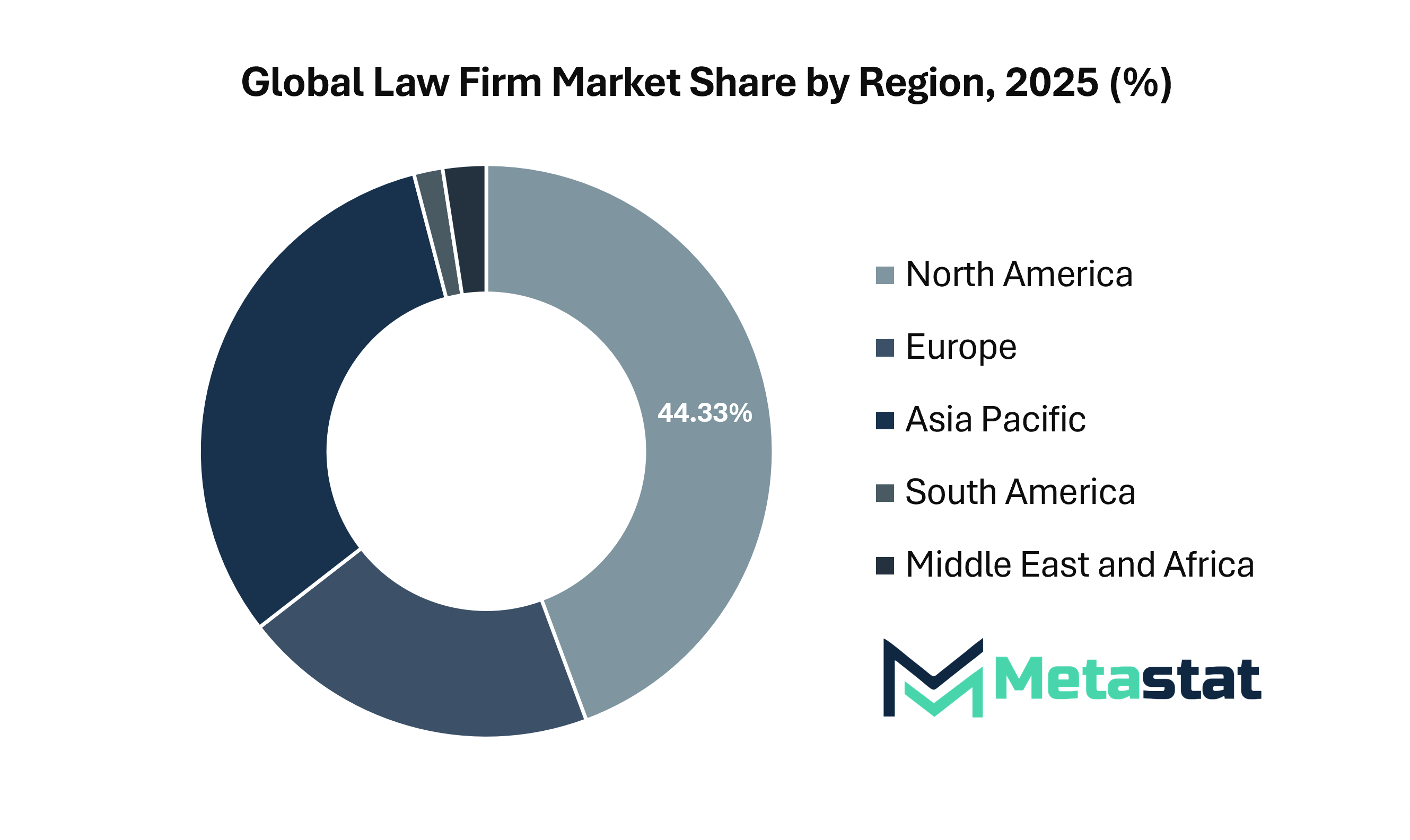
The global law firm market, dynamic and critical, is a network of extensive professional legal services and firms. With businesses operating and expanding across borders, the demand for the finest legal services grows, especially with how highly complex global regulations have become. Included in that number are more key players that control and determine the landscape within this growing market, and each one is fighting to maintain its own position as a competitor within an increasingly competitive environment.
This market, of course, will see all these players fight to retain their leadership positions. Some of the global leaders in providing legal professional services to clients in diversified industries are Baker McKenzie LLP and DLA Piper International LLP. These companies have emerged out of the mere provision of traditional legal services with the need to branch out into new markets and create wide international networks for catering to their multinational clients. Their capacity to navigate some of the toughest challenges of both regulatory changes and cross-border mergers and acquisitions will remain a key to their further success.
Other leading firms, namely Norton Rose Fulbright LLP and Kirkland & Ellis LLP, will also remain very competitive due to the excellent reputation for good legal counseling, in addition to the practice's capability to deal with cross-border matters. Their focus toward technology innovation and legal solutions will make them stand out in a market that has increasingly valued speed and efficiency. As advanced technologies are increasingly utilized by firms to enhance client services and conduct business, the ability to seamlessly infuse new tools into the legal process will be one of the highest-performing differentiators for the firm.
Beyond these prominent ones, new firms such as White & Case LLP and A&O Shearman LLP are likely to rise. Their aggressive approach toward legal practice, especially in the intellectual property and technology law arenas, is well-suited for contemporary demands made by the need to keep pace with rapid improvements in technology. These firms are likely to be in positions to capitalize on areas like fintech, data protection, and environmental law, where sectors of immense growth can continue to position themselves as industry leaders.
While it is expected that powerhouses Clifford Chance LLP, Linklaters LLP, Mayer Brown LLP, Freshfields Bruckhaus Deringer LLP, Jones Day, Sidley Austin LLP, and Hogan Lovells International LLP, among others will also carry on in the lead role, the future direction of the law firm market shall continue to be moulded by their strong global networks, high-stakes transactions capabilities, and deep knowledge of regulatory environments.
The future landscape of Global Law Firms will only become even more competitive. Innovation has to be aligned with tradition: sophisticated solutions have to continue to be served up with reliability and trust that is expected from top-tier legal providers. It will be the firms that navigate those changes and adapt themselves to successfully keeping pace with these changing client needs while placing themselves firmly at the forefront of the market in years to come.
|
Report Attributes |
Details |
|
Study Period |
2021-2033 |
|
Base Year |
2025 |
|
Estimated Year |
2026 |
|
Forecast Period |
2026-2033 |
|
Historical Period |
2021-2025 |
|
Growth Rate |
CAGR 1.8% from 2026 to 2033 |
|
Revenue Unit |
USD billion |
|
Segmentation |
By Type, End-Users, Service Type, Client Type, and Region |
|
By Region |
North America (By Type, End-Users, Service Type, Client Type, and Country)
|
|
|
Europe (By Type, End-Users, Service Type, Client Type, and Country)
|
|
|
Asia Pacific (By Type, End-Users, Service Type, Client Type, and Country)
|
|
|
South America (By Type, End-Users, Service Type, Client Type, and Country)
|
|
|
Middle East and Africa (By Type, End-Users, Service Type, Client Type, and Country)
|
Find answers to common questions about this report
The Metastat Insights study reveals that the Law Firm market size was valued at USD 141.2 billion in 2025.
The Law Firm market is projected to grow at a CAGR of 1.8% during the forecast period from 2026 to 2033.
According to Metastat Insights analysis, the North America Law Firm market size is estimated to reach USD 70.8 billion by 2033.
Top players operating in the Law Firm industry includes Baker McKenzie LLP, DLA Piper International LLP., Norton Rose Fulbright LLP, Kirkland & Ellis, and Others.
The analysts below cover Information & Technology research at Metastat Insights.
LEAD ANALYST
Utkarsh Khirodkar is a Lead Market Research Analyst at MetaStat Insight, specializing in market intelligence, technology sector assessments, and competitive strategy.

PRINCIPAL CONSULTANT - ENTERPRISE AI & EMERGING TECHNOLOGIES
Banking & Finance · Electronics and Semiconductor · Energy and Power · Healthcare IT · Information & Technology · Professional Services
Vijay Gunti is a Principal Consultant at MetaStat Insight, bringing over two decades of experience across enterprise digital transformation, technology strategy, and intelligent systems.

LEAD CONSULTANT - COMMUNICATION, TELECOM, AND IT
Electronics and Semiconductor · Information & Technology · Machinery & Equipment · Professional Services
Ravindra Sathe Consultants for Communication, Telecom, and IT at MetaStat Insight. He leads the firm's industry research initiatives across telecommunications infrastructure, digital connectivity, enterprise networking, and emerging information technology domains.
When evaluating distributed energy resource management systems, standard research summaries tend to gloss over the operational differences between front-of-the-meter utility deployments and behind-the-meter industrial sites. The MetaStat Insight report addressed those distinctions directly, especially regarding software interoperability standards and grid interconnection backlogs. The five-year market sizing across regional transmission organizations provided actionable context for our grid modernization strategy.
Most industry reports on warehouse automation bundle autonomous mobile robots and fixed conveyor installations into the same top-level numbers, which complicates advisory work. This study split the market cleanly by payload tiers, navigation technology, and fleet management software layers. The regional forecast for Western Europe gave our team defensible adoption benchmarks when evaluating capital allocation for logistics clients, saving us days of secondary data scrubbing.
Analyzing the transition from natural gas to green hydrogen in iron ore reduction requires realistic infrastructure timelines. Meta stat insight supplied a detailed regional assessment of DRI plant conversion costs and scrap metal availability in North America and Western Europe. Their report carefully examined pellet quality specs and electrical grid access constraints without making oversimplified market assumptions. The research material served as a practical reference during internal technology roadmap discussions.
Explore related market intelligence reports worth reading alongside this one.