
This post examines the contrasting growth trajectories of the Power and Utilities MLCC market in Asia Pacific and North America, exploring the factors behind their divergence.
The Power and Utilities MLCC market exhibits notable regional divergence, particularly between Asia Pacific and North America. This split highlights distinct growth trajectories and underlying factors influencing market dynamics in these regions.
What drives the growth in the Asia Pacific region?
The Asia Pacific region leads the Power and Utilities MLCC market, driven by rapid industrialization and infrastructural advancements. Countries in this region invest significantly in modernizing their energy sectors to accommodate increasing energy demands. The strong push towards renewable energy sources further enhances this trend, because utilities seek reliable and efficient components to support new systems.
This investment in infrastructure is critical in not only upgrading existing grids but in integrating renewable energy resources. The adoption of multi-layer ceramic capacitors (MLCCs) is particularly pronounced in high-voltage applications across power generation and transmission systems. The regulatory environment in several Asia Pacific countries incentivizes sustainability, compelling utilities to adopt innovative technologies that improve energy efficiency.
How does North America compare?
North America shows promising growth within the Power and Utilities MLCC market but lags behind Asia Pacific. The region focuses primarily on upgrading existing infrastructure rather than extensive new developments. This includes the integration of renewable energy sources into pre-existing grids, which involves retrofitting rather than building from scratch.
Moreover, North America faces regulatory challenges that complicate market expansion. Stricter compliance requirements increase operational costs for manufacturers, influencing their pricing strategies. Macroeconomic uncertainties, including inflation and supply chain disruptions, present additional obstacles, potentially hindering the swift adaptation of new technologies.
What are the key factors causing this divergence?
The disparity in growth between the two regions primarily arises from differences in investment priorities and regulatory environments. In Asia Pacific, government initiatives strongly support infrastructure development and renewable energy integration, facilitating a favorable climate for MLCC adoption. This contrasts with North America, where regulatory complexities and existing infrastructure limitations restrict rapid growth.
Technological advancements contributing to grid modernization are more readily embraced in Asia Pacific, partly due to the region's flexibility in adapting to innovations. This adaptability enhances the competitive edge of manufacturers in Asia Pacific compared to their North American counterparts, who face higher barriers to entry due to strict regulatory compliance.
What role does supply chain stability play?
Supply chain dynamics significantly influence the evolution of the Power and Utilities MLCC market in both regions. Asia Pacific has demonstrated greater resilience in navigating supply chain challenges, often benefiting from a robust manufacturing ecosystem. Conversely, North America faces vulnerabilities stemming from geopolitical tensions and inflationary pressures, leading to disruptions that impede production timelines and inflate costs.
For manufacturers in North America, addressing supply chain vulnerabilities remains critical. The need for strategic sourcing and maintaining material availability is significant in ensuring consistent production capabilities. Innovative firms actively seek to diversify supply chains and enhance resilience against potential disruptions, a strategy that could improve their competitive positioning.
What opportunities lie ahead?
Despite the challenges, opportunities remain in both regions for the Power and Utilities MLCC market. In Asia Pacific, the ongoing shift towards sustainable energy solutions presents significant growth potential. Companies investing in green technologies and innovations aligned with regulatory standards are well-positioned to capture market share.
In North America, focusing on retrofitting existing infrastructure and enhancing energy management systems leads to increased demand for reliable MLCCs. This approach supports operators seeking to optimize their assets while meeting evolving energy efficiency standards. Overall, strategic investments and a commitment to innovation will be essential for market participants in both regions to capitalize on the growth trajectory of the Power and Utilities MLCC market.
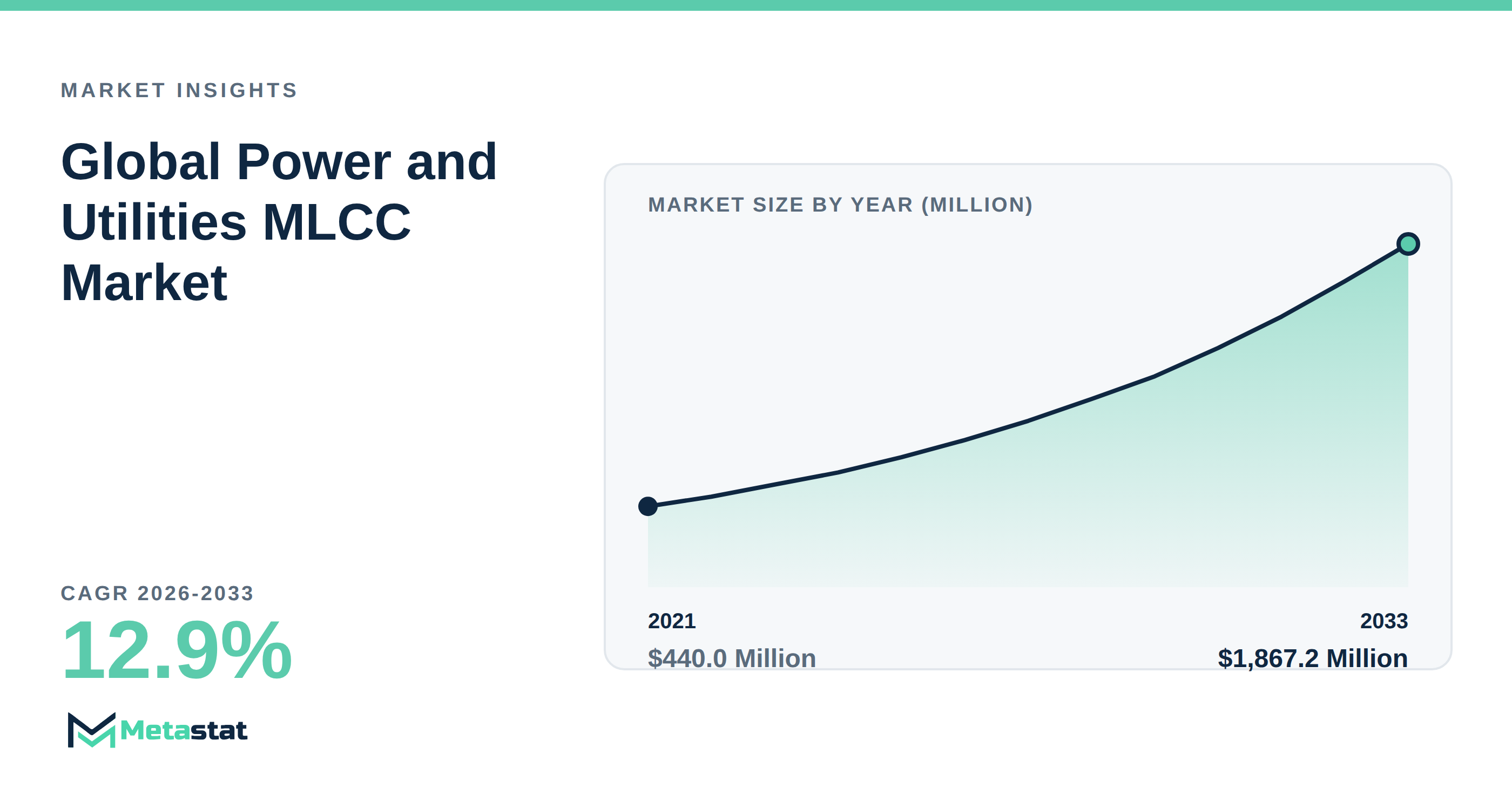
Global Power and Utilities MLCC Market offers in-depth analysis and insights.
Tags
About the Authors

LEAD ANALYST
Utkarsh Khirodkar is a Lead Market Research Analyst at MetaStat Insight, specializing in market intelligence, technology sector assessments, and competitive strategy.

PRINCIPAL CONSULTANT - ENTERPRISE AI & EMERGING TECHNOLOGIES
Banking & Finance · Electronics and Semiconductor · Energy and Power · Healthcare IT · Information & Technology · Professional Services
Vijay Gunti is a Principal Consultant at MetaStat Insight, bringing over two decades of experience across enterprise digital transformation, technology strategy, and intelligent systems.

ENERGY & INFRASTRUCTURE INDUSTRY CONSULTANT
Automotive and Transportation · Electronics and Semiconductor · Energy and Power · Machinery & Equipment
Saurabh Vasant Ganvir consults for Energy & Infrastructure Industry at MetaStat Insight, specializing in renewable energy, solar EPC, and electric vehicle (EV) infrastructure markets.